



Abstract
Much of the environmental communication literature follows the consensus-building perspective and thus explores how to communicate climate change in ways that can diffuse politico-ideological conflict. My paper, on the other hand, builds on the critical debate approach—which asserts that the depoliticization of climate change acts as a barrier to transformative socio-ecological change—and argues that animated parody offers a powerful rhetorical tool to re-politicize climate change. I develop the paper’s argument through a case study of the Rick and Morty episode “A Rickconvenient Truth”—a parodical take on the 1990s children’s TV show Captain Planet and the Planeteers. By applying reflexive thematic analysis to a dataset of >7,600 Reddit user comments, I reveal that the episode prompts fans to question “standard” ways of thinking about climate change and deliberate radical alternatives for combatting the ecological crisis.
Introduction
The title of this paper may seem a bit clickbaity. Why, readers might ask, should TV shows and other pop culture media seek to politicize climate change? Such a response is understandable, given that much of environmental communication scholarship works under the assumption that politicizing climate change is a bad thing. Understood as the alignment of positions on climate change with political ideologies and existing partisan divisions, politicization is blamed for preventing concerted and science-informed action against climate change. Consequently, what we ought to do as scholars of environmental communication is to figure out how to communicate climate change in ways that depoliticize climate change and foster societal consensus on how to tackle the planetary crisis. However, when I invoke the term “politicization” in the title, I am not using the term in the same way as scholars who are guided by the dominant consensus-building perspective on environmental communication. Rather, I follow the critical debate approach to environmental communication, which claims that discursively constructing climate change as a scientific or societal consensus is problematic because it impedes debate about alternative socio-ecological futures beyond the framework of those political and economic institutions that keep contributing to climate change (e.g., Carvalho et al. 2021; Hammond 2021; Maeseele 2015; Pepermans and Maeseele 2016). In other words, when I advocate for a re-politicization of climate change, I emphasize the need to investigate how TV and mass media can help create the discursive conditions necessary for transformative change at the systemic level.
Following a literature review that fleshes out the differences between the two approaches to environmental communication further, I will develop the argument that humor—specifically, animated parody—offers a unique device to disrupt “standard” ways of thinking and talking about climate change, thereby encouraging a public debate that is not exclusively focused on market-based or technical fixes. My argument is built from two parts. First, borrowing from the incongruity theory of humor, I claim that parody creates space for critical reflection when audiences try to make sense of the discrepancies between the original text and the parodied copy. Second, I build my argument on the premise that, because the medium of animation carries “cartoony” and “childish” connotations, animated humor can detach serious issues, such as a climate change, from reality, allowing audiences to consider these issues from a removed position.
Empirically, I illustrate my argument with a case study of the Rick and Morty episode “A Rickconvenient Mort” (s5e3), which can unmistakably be read as a parody of the 1990s cartoon series Captain Planet and the Planeteers. Often described as an adult animated sci-fi sitcom, Rick and Morty has been running for seven seasons, winning the Primetime Emmy Award for Outstanding Comedy Series in 2018 and 2020. In the United States, the show airs on Cartoon Network’s nighttime programing block Adult Swim; in many other countries, Rick and Morty can be streamed on Netflix.
Following the process set out by Braun and Clarke (2022), I conduct a reflexive thematic analysis of 364 Reddit posts and 7,327 associated comments that make reference to the episode “A Rickconvenient Mort.” Reddit is an increasingly popular data source among communication researchers, one reason being that it offers targeted recruitment options for reaching small and hard-to-survey populations (Hintz and Betts 2022)—in the case of my study, fans of Rick and Morty. The thematic analysis reveals that, when using discussion boards under the r/rickandmorty subreddit to collectively make sense of “A Rickconvenient Mort,” Reddit members debate solutions to climate change that go beyond what is “thinkable” or “possible” within the market-driven techno-managerial paradigm. The very existence of such a debate points to the ability of animated parody to re-politicize climate change.
Humor and Climate Change: From Consensus to Critical Debate
Is it ok to laugh about climate change? For a long time, scholars of environmental communication seemed to have a clear answer: no. However, in recent years, attitudes have shifted, giving way to a growing body of academic literature that investigates the role of humor in climate change communication (Kaltenbacher and Drews 2020; Skurka and Lee Cunningham 2023). Two reasons can help explain this change in thinking. First, there is a growing realization that the dominant rhetorical modes of climate change communication—fear, sadness, and anger—have largely failed to catalyze mass action against climate change. Rather, as Moser (2016, 352) summarizes, “researchers are increasingly interested in the role of hope, optimism, and positive emotions in climate communication.” Second, to promote the acceptance of laughter as a valid response to climate change, environmental communication scholars have highlighted that, for centuries, humans have approached difficult subjects with humor and comedy (e.g., Corbett and Brett 2017, para. 27; Zekavat 2019, 370). Relatedly, humor research has explored topics as dark as the Holocaust (Zandberg 2006), the history of slavery (Hellmann 2023a), and terrorism (Achter 2008).
However, irrespective of these shifts in thinking, the emerging literature on the use of humor in climate change communication continues to follow what Pepermans and Maeseele (2016) have labeled the consensus-building perspective. Relying largely on experimental research designs, studies focus on the same question as the field of environmental communication as a whole: How can we communicate climate change in a way that fosters consensus on the causes of and the solutions to climate change?
To begin with, a number of studies investigate whether packaging environmental messages in humor can help convince people of the scientific consensus on climate change. For example, Brewer and McKnight (2015, 2017) as well as Clarke et al. (2022) employ randomized experiments to explore if exposure to satirical TV news programs – specifically, segments in which the host affirms the scientific evidence for climate change and rebuts climate change skeptics—increases viewers’ certainty that climate change is happening. In a similar direction, scholars have conducted content analyses to determine the extent to which TV comedy frames climate change as a scientific consensus (e.g., Brewer 2013; Carter 2023; Feldman 2013).
Research also examines the effects of humorous media on pro-environmental behavior. More to the point, does exposure to climate change comedy increase the likelihood of people adopting more sustainable lifestyles in accordance with the moral consensus that individuals have a personal responsibility to mitigate climate change? For the purpose of detecting correlations between humor and research participants’ behavioral intentions toward climate change, studies employ general survey items, such as “People should take additional steps to protect the environment from global warming” or “I should take additional steps to protect the environment from global warming” (McKasy et al. 2024), and more specific measures, such as “Use energy efficient light bulbs” or “Recycle newspapers, plastics, cans, and glass” (Skurka et al. 2018).
In short, the main question that has been driving the “humor turn” in the field of environmental communication is whether humor increases the effectiveness of communication, with “effectiveness” defined as the degree to which communicative practices can diffuse politico-ideological conflict and increase agreement with the (scientific and moral) consensus around climate change. Yet, the problem with this research agenda is that it fails to recognize that climate change is—at its fundamental core—a political issue. As Carvalho et al. (2017, 124–125) convincingly argue, “climate change is political at its inception as politically instituted social systems and practices, epitomized by market-driven, neoliberal globalization, lie squarely at its origin.” Therefore, “transforming the politics of climate change involves questioning [these institutional] arrangements and challenging the power and value systems that underpin them.” Certainly, several humor-centered studies of environmental communication focus on individuals’ political engagement as the dependent variable—measured, for example, by asking participants whether they intend to “vote for politicians who want to protect us against climate change” (Clarke et al. 2022) or “join a climate change campaign group on a social networking site” (Zhang and Pinto 2021). What is remarkable about these forms of political participation, however, is that they can be carried out within pre-existing institutional frameworks and thus do not disrupt the power structures behind climate change.
Overall, then, the literature on humor in environmental communication not only seeks to understand whether humor can help overcome politico-ideological conflict, but—by employing empirical measurements that frame climate change as a scientific or moral consensus—this body of scholarship does itself contribute to the depoliticization of climate change. Seen through the lens of what Pepermans and Maeseele (2016) have termed the critical debate approach to environmental communication, such discursive constructions of climate change as a post-political issue are problematic as they obstruct radical transformations of human-nature relations: the de-politicizing nature of the politics of consensus precludes debate on the meaning(s) of the environment and resultantly on the articulation of alternative (environmental, technological, etc.) futures, by concealing the competing imaginations mobilized by social actors. This naturalizes the existing socio-political status quo and neoliberal foundations of the Western economic development paradigm in specific, and reduces the politics of the environment to a negotiation about potential technomanagerial fixes within this framework. (Maeseele 2015, 393)
Hence, because depoliticization is understood as a barrier to transformative socio-ecological change, scholars who follow the critical debate approach to environmental communication call for a re-politicization of climate change, with the aim to revive debate over the social, political, and economic structures that underlie climate change (e.g., Carvalho et al. 2017, 2021; Hammond 2021; Pepermans and Maeseele 2016). What this means is that, rather than conceptualizing environmental communication as a linear sender-receiver process and studying the role of humor in increasing message effectiveness, we should focus on the question of whether humor can unsettle processes of discursive naturalization in relation to climate change.
So far, only a small number of studies have sought to answer the question of whether humor can open up space for critical debate on climate change. One of the very few examples is Seymour’s discussion of “bad environmentalism” (Seymour, 2018), which highlights that “bad” forms of environmental communication—labeled “bad” because they are laden with ironies and absurdities, and demonstrate none of the classic hallmarks of environmentalism—can provoke critical reflection on how the mainstream environmental movement seeks to tackle climate change. Following similar lines of thought, other scholars have shown how the Don’t Look Up movie relies on satire “to humorously expose the interconnected failings of late-capitalist systems in both dealing with, and exacerbating, an extinction level threat” (Doyle 2022, 4); how cartoons may serve “not as visual evidence of climate change but as vehicles for education, awareness and debate” (Manzo 2012, 493); and how climate justice activists use humor to bring public attention to “socially vulnerable communities (migrants and people of color in particular) who are least culpable for, and most impacted by, climate change” (Sze 2021, 175).
While these analyses have certainly made important contributions to the critical debate perspective on environmental communication, the humor aspect remains somewhat underdeveloped. Existing studies do not explicitly discuss what makes environmental communication funny nor do they offer any explanations for how the elicitation of laughter creates room for the re-politicization of climate change. It is these limitations that I will address in the remainder of the paper—thereby also advancing critical environmental communication scholarship more broadly, which has so far mainly documented cases of mass media de-politicizing climate change (e.g., Hellmann 2023b; Pepermans and Maeseele 2018).
Encouraging Critical Debate Through Incongruous Humor
Humor is, by its very nature, disruptive. As Gray et al. (2009, 9) elaborate, “humor always, at least potentially, offers the possibility of defamiliarization, allowing us to see the social and scientific order anew.” Parody and satire are considered particularly disruptive forms of humor. For example, writing about satire, Hill (2013, 329) argues that, “by offering a new way of looking at ‘normal reality’, the satirists’ strategy calls into question the taken-for-granted assumptions . . . underpinning social life.”
Incongruity theory—which, along relief and superiority, is one of the three traditional theories of humor—provides a persuasive mechanism to explain how parody and satire disrupt patterns of thinking and ways of knowing. According to incongruity theory, “humor results from a mental reaction to something unexpected, unusual, or odd in a nonthreatening way when an accepted norm or pattern is violated” (Meyer 2015, 17). Specifically, humor is experienced when the audience “resolves” or “makes sense of” the incongruity between two scripts that intersect with each other: a first (conventional) script, which sets up expectations as to how things will (or should) unfold, and a second script, which does not conform to the predictions evoked by the first script (Martin and Ford 2018, 55–58; Young 2017, 875–876).
While parody and satire are sometimes discussed synonymously, there are important differences between the two concepts. Hence, even though my paper’s focus is on parody, it seems important to clarify the conceptual boundaries. In particular, parody and satire can be contrasted not only in terms of the nature of the rules that are being broken by the second script, but also in terms of the target of attack. Satire typically takes the following structure: the first script creates expectations based on socio-cultural norms, the second script then violates these expectations in a highly absurd manner. Satirists thus draw attention to the incongruity between the normative societal ideal and lived experience, aiming ridicule at those who they deem responsible for the discrepancy between ideal and reality, which may include political actors, cultural organizations, and audiences themselves (Hill 2013, 331; Park-Ozee 2019, 588). Parody, in contrast, “attacks a particular text or genre, making fun of how that text or genre operates” (Gray et al. 2009, 17). In the case of parody, therefore, the first script draws not on socio-cultural norms, but on rules “located in the field of art” (Vandaele 2002, 234). Humor results from incongruity between the original work (the first script) and its imitation (the second script). Importantly, the second script does not only set up a believable imitation of the target work, but it also delivers an absurd alteration that transgresses the conventions on which the first script relies. What this means is that understanding parody is made easier if audiences have prior knowledge of the particular texts or genres that are being mocked (Gray 2006, 45).
Following these theoretical ideas, I will next—through the example of the Rick and Morty episode “A Rickconvenient Mort”—develop the argument that humorous incongruity is a powerful rhetorical device that can disrupt consensual ways of thinking and talking about climate change, and thus open up space for the re-politicization of climate change. By conveying a parodic take on the 1990s cartoon series Captain Planet and the Planeteers, the absurd story of fourteen-year-old Morty falling in love with the much older eco-superhero Planetina not only highlights the limitations of environmentalist children’s TV shows in bringing the planet back from the brink of ecological collapse, but it also encourages audiences to critically consider a range of alternative solutions, including the use of violent action.
For some readers, the focus on animated parody may seem somewhat strange. First, why make parody the subject of analysis? If the aim of parody is to ridicule a specific text or genre, how can it possibly have re-politicizing effects beyond its target of attack? Second, given that animation is used most commonly in entertainment targeted at children, does animated parody not distract from the seriousness of climate change?
The simple answer to the first question is that parody does much more than just mock a particular text or genre. Most fundamentally, based on the mere fact that the target work can be imitated for comic effect, parody allows audiences to understand that the target work was produced “according to some kind of system” (Diepeveen 2020, para. 20). Moreover, by subverting the original, parody enables audiences to see not only the mechanisms according to which the system operates, but also the ideological content that resides within the system. As Gray (2006, 55) explains, “any act of revealing and externalizing a genre’s grammar and inner workings stands to reveal and externalize the ideological partner.” Yet, this is not all that parody does. Through the incongruous second script, the parodist can introduce alternative ideological standpoints—which, as I will elaborate later, is precisely how parody can re-politicize climate change.
My response to the second question follows other scholars who argue that animation can encourage serious engagement with climate change and other environmental issues (e.g., Heise 2014; Starosielski 2011). Specifically, I believe that animation—because the medium carries with it certain audience expectations—boosts the disruptive potential of parody in at least two ways. For one, expectations regarding the artificiality of the animated medium provide ample space to play with plausibility. Even though absurdity is a key property of parody generally, animated parody—due to the fact that the audience’s disbelief is already suspended—can crank up the absurdity dial much more than live-action parody (Gray 2006, 67). What is more, the ingrained expectation that animation is “cartoony”—and therefore “childish”—can be used to strip back reality and place serious issues, such as a climate change and the threat of ecological collapse, in a context where audiences can consider them from a removed position. By softening the impact of what an audience is seeing on the screen, animation can guide viewers toward engaging with abstract ideas for solving such issues, away from the consideration of actual human experiences (Higgs 2019, 99–100).
Mocking Captain Planet: “There’s Only One Solution for Earth’s Pollution . . . You!”
The Rick and Morty episode “A Rickconvenient Mort,” which was first released in July 2021, is an easily recognizable parody of Captain Planet and the Planeteers—an animated children’s TV series that originally aired in the 1990s. The main storyline of the series revolves around a group of five culturally diverse teenagers from around the world, each of whom possesses a special elemental ring—given to them by Gaia, the spirit of the Earth—that grants them the powers of earth, fire, wind, water, and heart. When faced with eco-villains or environmental crises, the five Planeteers combine their powers to summon Captain Planet, a superhero with the ability to control the elements. Designed to empower children to become more environmentally conscious, the series coined the memorable catchphrase “The power is yours!” and often ended with a direct call to action, encouraging viewers to think about how they can make a difference in their own lives.
While there is much ground for criticism of the Captain Planet show, two problematic aspects stand out. First, and related to the earlier discussion, Captain Planet can be condemned for individualizing the responsibility for climate change. For example, as King (1994, 16) argues, the series offers “simplistic, individualistic solutions to complex, systemic problems that demand serious social, political and economic consideration and concern.” Second, Captain Planet has been attacked for its farcical depiction of eco-villains as “nasty male queens, dark spirits, mustachioed men with accents, brittle and demented white female scientists, or mutant human/animal paranoids with delusions of grandeur” (Sturgeon 2004, 272). The show’s villains always operate outside the law, which distracts from the fact that most of the activity that produces climate change occurs within legal frameworks and institutions. It is precisely these two weak spots that the Rick and Morty writers mock in their parodic riff on Captain Planet.
The opening scenes of “A Rickconvenient Mort” create an almost identical copy of a typical Captain Planet episode. When Rick and Morty are out shopping, the city comes under attack from eco-villain Diesel Weasel and his acid rain. After the two seek shelter, it does not take long for superhero Planetina to arrive on the scene (Figure 1, top). Using her elemental powers, Planetina defeats Diesel Weasel and turns to viewers with her catchphrase: “There’s only one solution for Earth’s pollution . . . you!” Morty develops an immediate crush on Planetina and awkwardly asks her out on a date.
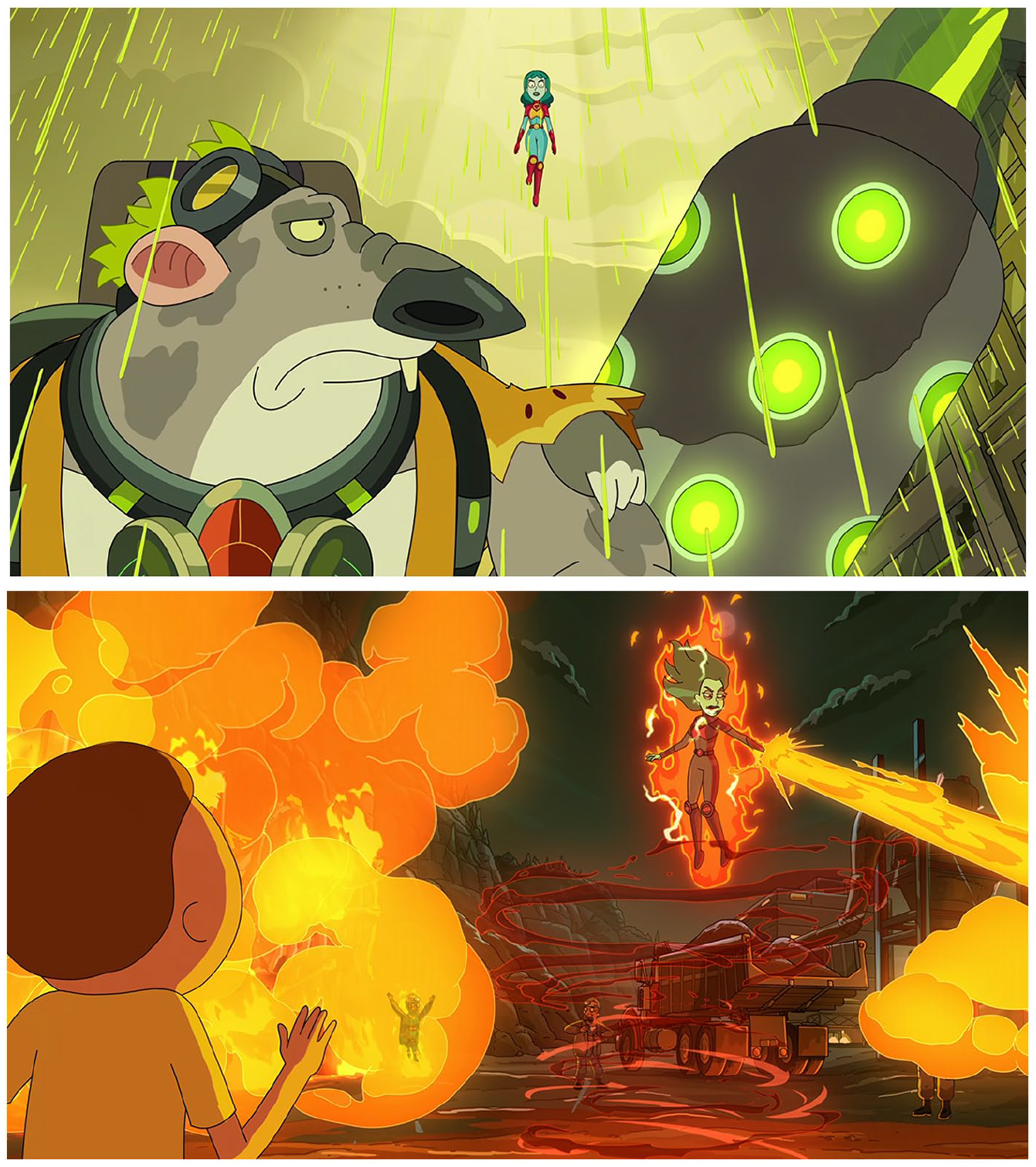
The transformation of Planetina.
From here onward, the original and the copy begin to diverge more and more. Much to his mother’s dismay, who is concerned about the large age gap, Morty decides to travel to a forest fire 200 miles away in the hope of running into Planetina again. Morty gets there just as Planetina extinguishes the fire and—after the two admit that they like each other—asks her out on a second date.
[stammering] You want to go out again?
I do! But, uh, Morty? I have kids.
[stammering] Oh, I’ll get along with them. I’m a kid.
No, I mean the four kids that bring me into existence by combining the power of their elemental rings so I can save Earth from ecological disasters.
It is in this moment that a Planetina-branded tour bus with the four Tina-teers pulls up. Far from being “kids,” the Tina-teers appear to be in their forties, which suggests that the Planetina show has been running for three decades.
As the episode progresses, the relationship between Morty and Planetina blossoms into love. At the same time, Morty slowly realizes that the Tina-teers control and exploit Planetina. For example, and of relevance for the story later on, we learn that the Tina-teers do not allow Planetina to watch the news as “it’s too upsetting.” Eventually, Morty comes across a secret plot to sell Planetina to a rich Arab and, to disrupt the plan, kills the Tina-teers with their own rings.
After this violent scene, Morty tells his family that he invited Planetina to live with them. However, his mother—still upset about the age gap—throws Planetina out of the house. Morty is enraged and the two leave together, making it their joint mission to stop natural disasters and environmental destruction.
The problem is, though, that—freed from the control by the Tina-teers—Planetina begins to understand the full extent of the planet’s ecological crisis. As a result, her actions become increasingly violent. Initially, she scares off big-game hunters in Africa and slashes the tires of cars stuck in rush-hour traffic, but then fire-bombs the mansion of a congressman and uses her powers to destroy a coal mine, killing 300 miners (Figure 1, bottom). Morty is horrified and decides to end the relationship with Planetina.
Those miners were innocent.
Those innocent miners voted men into power to protect their precious jobs, so they can buy more plastic garbage and eat the corpses of tortured animals. The system is broken, Morty! This is the only way I can save Earth.
To sum up, incongruity between the Captain Planet original and the Rick and Morty imitation is primarily created through Planetina’s behavior: in the beginning, much like Captain Planet, she fights grotesque and unlawful eco-villains; toward the end, she employs violence against law-abiding individuals and corporations. Viewers can reconcile the incongruity by following Planetina’s own justification: the system is broken. Evidently, given that Planetina has been on air since the 1990s, educating individuals on how to reduce their personal impact on the environment has done very little to address the planet’s ecological crisis; if anything, climate change has accelerated over the last three decades. Rather, released from supervision by the Tina-teers, Planetina comes to realize two things: the worst forms of environmental degradation are attributable to corporate eco-villains, not individuals, and these eco-villains operate inside the legal and political system, not outside it.
Hence, at least in theory, resolving the incongruity between the first and the second script prompts audiences to reflect on what actions are needed to successfully tackle climate change. Environmental movements around the world already engage in a range of confrontational strategies, including sabotage and other forms of violence (e.g., Sovacool and Dunlap 2022). The parodic discrepancy allows viewers to critically consider whether these strategies are “too radical”—as those defending the techno-managerial consensus to climate change would claim—or whether these are precisely the strategies that we need to protect our ecosystems and climate.
However, I am, of course, merely engaging in theoretical speculation. As scholars of humor emphasize, parody and satire require a high degree of mental participation from audiences (e.g., Diepeveen 2020, para. 19; Gray et al. 2009, 15), which means that there is no guarantee that viewers of Rick and Morty will make sense of Planetina’s dramatic change in behavior—and Morty’s decision to break up with Planetina—by reflecting on what is possible and desirable in the fight against climate change. Thus, to address the issue of audience reception, I next conduct a reflexive thematic analysis of the online fan subreddit r/rickandmorty, which allows me to understand the nature of the discussions that emerged around the episode “A Rickconvenient Mort.”
Discussions Among Rick and Morty Fans: A Thematic Analysis of Reddit
The social media platform Reddit is widely used by fans of TV shows to organize themselves in online communities—called subreddits—and collectively make sense of newly released episodes. Not surprisingly, then, scholars of communication and popular media are increasingly drawn to Reddit as a data source (Hintz and Betts 2022). My own study of the r/rickandmorty subreddit—which, at the time of writing, had 2.7 million members—applies reflexive thematic analysis, which is an interpretative approach to qualitative data inquiry that facilitates the identification of themes in a given dataset. Reflexive thematic analysis sets itself apart from other variants of thematic analysis in that it values “a subjective, situated, aware and questioning researcher” (Braun and Clarke 2022, 5). Themes are not deductively predefined and then supported by “finding” codes in the data that evidence these themes. Rather, the data is coded in a flexible and organic fashion, and themes are subsequently produced by compiling clusters of codes that seem to share a core idea or concept. Applying this process to the r/rickandmorty subreddit reveals five climate change-related themes in fans’ discussions of “A Rickconvenient Mort.” 1
Individualizing Climate Change “Is a Corporation’s Dream”
One way in which Rick and Morty fans make sense of Morty breaking up with Planetina is by arguing that Morty fell in love with a different version of Planetina. This not only leads fans to identify early-episode Planetina as a parody of Captain Planet (“it is obviously a play on captain planet,” as one Reddit user comments), but it also prompts them to reflect on the individualization of climate change that is propagated by the Captain Planet and the Planeteers TV series and the corporate world. For example: it wasnt “Morty gets heartbroken again” it was more Morty falling in love with the personification of 90s idealism, that if we all just recycle we will save the world. asking individuals to be responsible for the massive pollution problem is a corporation’s dream That’s why Gen X are so big on “Reduce, Reuse, Recycle” because the propaganda during the 70s/80s by the fossil fuels industry shifted the responsibility to the individual.
Through these discussions, subreddit fans put on display the ideological positions that underpin Captain Planet and the Planeteers and the moral consensus on climate change more broadly, highlighting that individualizing the responsibility for climate change serves to protect the predominant neoliberal-capitalist order from critical questioning.
Ecological Modernization
Subreddit fans not only discuss why Morty broke up with Planetina, but they also exchange views on whether the break-up could have been avoided. One alternative storyline that surfaces again and again sees Planetina using her powers to facilitate a technology-driven shift to a low-carbon economy. Examples include: She wouldn’t need to sacrifice herself, just help build the infrastructure for us to transition to a more sustainable society I think our best option is to go for Geothermal energy, she could create lava pools with enough heat to feed all the mayor cities in the world Ask her to build large artificial islands, these could be filled with solar panels to power all the coastal cities
When writing these alternative endings to the episode, Rick and Morty fans echo the views of those actors within the environmental movement who follow the ecological modernization approach and are committed to the idea that climate change can be mitigated through technological innovation within the context of existing institutions (see Mol 2000).
Ecosocialism
Collective sensemaking in the r/rickandmorty subreddit also involves trying to understand why Planetina went through a dramatic shift in behavior. Many fans are able to comprehend her violent actions toward the end of the episode by arriving at the same justification that Planetina put forward: “The system is broken.” To quote a few examples: Consumerism needs be reigned in. Capitalism more so. the machine is too strong to convince it to stop consuming. Thats the train you have to stop first. Smashing the capitalist pollution machines? I’m on board.
What these quotes show is that, when providing a rationale for Planetina’s violent actions, subreddit fans end up making arguments that are in line with the ecosocialist diagnosis of climate change. According to ecosocialists, the capitalist logic of profit accumulation is the prime driver of climate change. Hence, ecosocialists argue that, to address the planet’s ecological crisis, partial reforms are inadequate; instead, our mode of production needs to be fundamentally reoriented—away from profits toward social needs and environmental concerns (see Löwy 2005).
Nevertheless, while subreddit fans whose discussion contributions can be labeled ecosocialist express an understanding for Planetina’s actions, they do not necessarily condone her killing the 300 miners—as can be illustrated through these two quotes: the common people aren’t the problem when it comes to climate change. Yes right wing idiots vote for politicians funded by oil and fracking money but fixing a global system can’t be fixed by attacking the bottom, it needs to be completely overhauled. Don’t blame the workers. The system is rigged against them.
Such responses are again consistent with ecosocialism, which—at least in its orthodox form—promotes the belief that environmental degradation and social injustice are interconnected, and hence seeks to liberate both workers and nature from capitalist domination.
Deep Ecology
Rather, those subreddit fans who do defend Planetina’s use of violence against humans join the discussion with arguments that conform to deep ecology—an environmental philosophy that sees humans as an integral part of the natural world, not separate or above it, and advocates for the concept of biocentric equality, according to which all living organisms possess the same amount of intrinsic value. In parts of the environmental movement, differences over how to interpret deep ecology have fueled periodic debates about the ethics and utility of violence against humans. Radical interpretations claim that, because of their inherent and unchangeable “evil nature,” humans should be excluded from the protection of the biocentric equality principle (Posłuszna 2015, 53–55). More specifically, while mainstream environmentalists overwhelmingly reject violence, radical followers of deep ecology have sought to legitimize violent tactics by making the argument that humanity is a “virus” or “cancer” and hence must be excised from the planet (Torres 2018, 133)—an argument that also appears in the r/rickandmorty subreddit. For example: she acts onto us the same way we act onto parasites we’re like cancer to her humanity is a virus so it’s whatever The world is grossly overpopulated. If your intention is to minimise the loss of biodiversity and habitat loss to the planet, pressuring people in power or threatening them with violence isn’t going to accomplish as much as culling billions of humans would. the fastest and most direct way to save the planet is by getting rid of humans we sort of deserve to die out with how much death and destruction we’ve caused on a global level. We’re the species responsible for hundreds of thousands of other species going extinct and the destruction of many ecosystems all so we can obtain worthless shiny rocks and poisonous liquids/gases that we can use to further cause harm.
Another, albeit very similar, argument that has been used to justify violence from the perspective of deep ecology revolves around the idea that humans are at war with nature, which serves to support the claim that environmental activists have the right to act in self-defense on behalf of nature (Mortimer 2017, 441). Again, this argument surfaces in the subreddit: it’s ok to kill in self-defense. What makes you think Planetina is not acting in self-defense given she is inherently linked to the planet? If we go with she is the earth then it’s basically self defense. Planetina did it in defence of the planet.
Principled Nonviolence
Arguments for the use of violence do not go unchallenged in the subreddit. One objection that is frequently raised against Planetina’s militant environmentalism in the later part of the episode concerns the morality of means and ends. While those fans who support the use of violence rely on consequentialist logic (i.e., as long as we achieve our ends, the means are justified), others maintain that our actions should be guided by the principle of the unity of means and ends. For example: what Planetina was doing was basically “the end justify the means” thats a very dangerous thing to validate, she may think that killing to protect the planet is justified murdering people—even bad people doing bad things—is pretty much not okay. The ends don’t justify the means when you’re ending lives. There might be reasons to do so, they might be good reasons. But, murder is, fundamentally, wrong. Ends don’t justify means when you’re killing innocent people.
The discussion in the subreddit thus mirrors the divide between militant activists and principled nonviolent activists in the environmental movement, with the latter arguing that activism should embody the values imagined in the end. Cruelty is, as proponents of nonviolent environmentalism assert, “at the core of militarism and ecological degradation. The solution should not replicate the pernicious values that cause the problem” (Fiala 2015, 15).
Conclusion
This paper started with the observation that the bulk of research on humorous environmental communication follows the consensus-building perspective, seeking to understand whether humor can diffuse politico-ideological conflict and foster social consensus around climate change science. Moreover, by employing empirical measurements that frame climate change as a scientific or moral consensus, this body of scholarship does itself contribute to the depoliticization of climate change. Such an apolitical framing, however, can be criticized because it precludes debate about the political and economic institutions that perpetuate climate change.
Following this critique, my own paper, instead of investigating the effectiveness of humorous environmental communication in fostering consensus-building, explores the potential of humor to disrupt naturalized thinking about the planet’s ecological crisis and open up space for the re-politicization of climate change. The paper does so through a case study of the Rick and Morty episode “A Rickconvenient Mort”—a parody of Captain Planet that mocks the 1990s TV show for individualizing climate change and caricaturing polluters as ludicrous villains. At least in theory, resolving the parodic incongruity between the original and the absurd Planetina imitation encourages audiences to critically reflect on radical alternatives to market-driven and technical climate change solutions. The use of animation plays an important role in facilitating reflection—in particular, because it distances characters from the real world, thereby abstracting their actions to thinkable possibilities. For audiences, animation softens the impact of what they see on the screen—for example, the mass killing of 300 miners—and allows them to consider potential options for climate change action from a removed position.
A reflexive thematic analysis of the r/rickandmorty subreddit lends support to these theoretical arguments about animated parody: when collectively making sense of the episode, Rick and Morty fans not only lay bare the ideological workings that underlie the moral consensus on climate change and voice opposition against the individualization of ecological responsibility, but they also propose fundamentally different solutions to the climate emergency—solutions that echo with ecosocialist and deep ecological positions in the environmental movement. While many fans object to Planetina’s use of violence against humans, this finding should not be interpreted to mean that the Rick and Morty episode failed to re-politicize climate change. As mentioned earlier, the environmental movement generally eschews terrorist tactics; militant action against humans is considered an option only at the extremist fringes of the movement. Rather, re-politization is evidenced by the mere fact that Rick and Morty fans use the subreddit to discuss a wide range of options for protecting our ecosystems and climate—both within and outside existing institutional frameworks.
By presenting these findings from the thematic analysis I am not making any claims that Rick and Morty can, on its own, spark an ecological revolution. Rather, the strength of “A Rickconvenient Mort”—as an example of animated parody—lies in prompting audiences to deliberate the full inventory of climate change actions, including possibilities for action that are not normally articulated in the mainstream public sphere. As such, the episode exposes the predominant socio-political order to critical questioning and contributes to the incremental re-politicization of climate change. Future research by TV and popular culture scholars can help this re-politicizing shift along by documenting other ways in which entertainment media—humorous and non-humorous—can promote citizen engagement with the political fabric of climate change.
Footnotes
Acknowledgements
I would like to thank the two anonymous reviewers for their constructive feedback as well as Justin Phillips for his help with the data scraping.
Declaration of Conflicting Interests
The author declared no potential conflicts of interest with respect to the research, authorship, and/or publication of this article.
Funding
The author received no financial support for the research, authorship, and/or publication of this article.
