



Abstract
Netflix’s arrival in Australia in 2015, almost a decade after its start as a streaming media platform, helped to close the cultural and technological gap in televisual content legitimately available to the national audience. Australians, eager for international content unavailable locally, had turned to Internet piracy, dramatically changing traditional national televisual consumption practices. Although commonly described as “disruptive,” Netflix’s arrival in Australia, according to its users, was mostly stabilizing and not as transformative to their viewing practices as it may seem. By drawing on in-depth interviews with Australian Netflix users, we provide an account of its early integration into the Australian media landscape. The methodology provides a new model for examining the experience of users engaging with technologies labeled as “disruptive.” The Disruption-Experience (D-E) model is a means for exploring participants’ experiences and accounting for ways that new technologies can reinforce, undermine and dramatically shift user thoughts, feelings and practices. In applying this model to the experiences of Australian Netflix users, we discovered that Netflix concretized—but did not necessarily create—a new set of expectations about agency, accessibility, and temporality that has not previously been accounted for. This is an important discovery at a time of rapid proliferation and adoption of streaming video-on-demand (SVOD) services in Australia, as the competing costs and demands of multiple services could mean a return to the once-prodigious levels of illegal and unauthorized access to television content.
Introduction
Before the American streaming video-on-demand service (SVOD) Netflix rolled out around the world, Australians expressed their frustration with the limited free-to-air (FTA) entertainment environment offered by national broadcasters and cable subscription services (Bennett et al. 2020). Australians managed this artificial limitation by extensively adopting internet piracy and other content-sharing practices. Initially a DVD-by-mail service in the late 1990s, the Netflix SVOD service commenced in 2007, expanding to Canada in 2010, Latin and Central America in 2011, Britain in 2012, and across Europe in 2013. Australia was only behind China in seeing a national Netflix launch in 2015. Despite Netflix offering an alternative to internet piracy and other illegal content-sharing activities, its arrival in Australia was perceived as the “most dramatic disruption” for the local industry (Bennett et al. 2020; Turner 2019a).
The wait for Netflix is part of a long history of anticipation and appetite for overseas televisual content, particularly American content, in what is referred to as “The Great Australian TV Delay” (Lobato 2019; Spencer 2014, 2015). After decades of commercial arrangements, more than 30 percent of overseas productions went without specific air dates in Australia or never aired locally at all. Although national DVD sales of television shows were high, Australians relied heavily on internet piracy to access shows available in international markets (Starr 2016). In 2014, international TV shows took on average fifty-four days after their initial airing to appear on Australian television—often only on cable television services—resulting in 29 percent of Australians relying on alternative and illegal modes of access (Quinn 2017; Spencer 2014). Following the introduction of two SVOD services in 2015, Netflix and Stan, the delay of international shows to Australian television dropped to thirty-seven days, and national piracy rates dipped to 24 percent (Quinn 2017; Spencer 2015).
There was a rapid acceleration of data usage in Australia after the arrival of affordable SVOD services, which increased the consumption of long-form content such as television series with many seasons. Indeed, Turner (2019a) observes “the patterns of consumption in Australia after 2015 have been dramatically disrupted” (p. 225). Australia’s decade-long national broadband (NBN) infrastructure rollout was severely challenged by the increased technological and social autonomy. It became clear that the NBN, designed to be “future-proof” could not support the popularity of streaming, and will therefore struggle to enable future growth (Chang 2019; Ross 2017; Thompson 2019). It is important to highlight however, as Wayne and Castro (2021, 917) note, that Internet distributed television, both pirated and legitimately accessed SVOD, did not entirely replace the traditional distribution models that existed nationally.
This article draws on fourteen in-depth interviews with Australian Netflix users to better understand their experience with a new technology that had been widely described as “disruptive” (Cunningham and Scarlata 2020). The analysis concentrates on individual reflections around Netflix’s arrival and integration into their lives between 2015 and 2018. This research is significant amidst the trend toward data analytics and algorithm-based understanding of the user experience. It is easy to lose touch with the everyday circumstances that create dynamic situations and provide the nuance required for understanding audiences’ relationship to content, technology, and infrastructure. Investigating individual experiences is crucial for sharing knowledge of the varied attitudes, beliefs and practices that have become more difficult to capture due to the rate of technological change and adaptive user behaviors. This research works to ground the intense speculation based on broader activity patterns suffering from “too little documentation” with sustained qualitative research (Gray 2017, 81; Turner 2021).
There are multiple frameworks for understanding disruption and disruptive technologies in business (see Chapman 2016; Christensen 1997; Clarke 2017; Ingle 2015; Rutz 2010; Sarto 2015; Sood and Tellis 2011). However, there is no comprehensive model that adequately accounts for the user experience of disruptive technologies. There are many innovations in media and communication-related fields, including television and audience studies, that bring anthropological approaches to understanding user experiences (Bruns 2006; Evans 2020; Hall 1980; Hill et al. 2017; Jenkins 2006; McLuhan 1964; Pertierra and Turner 2013; Turnbull 2006, 2014; Turner 2019a). However, Lotz et al. (2018) and Turner (2019a) have argued that we need more robust methodologies for analyzing media consumption to better understand individuals’ participation and contribution to technological change. Indeed, the tools for accounting user experiences need to be continually refreshed and updated. To address these challenges, this article introduces the Disruption-Experience Model (D-E Model), an analytical framework that was developed to support analytic insight into the user experience of technologies that have been perceived as disruptive.
In this article, we use an ethnographically-inspired approach that incorporates the sociohistorical context of Netflix, which includes a review of internet piracy and television in Australia and an understanding of why Netflix has been labeled as a “disruptive interloper” (McDonald and Smith-Rowsey 2016, 24). Part of this contextual inquiry is the analysis of individual accounts to reveal how new technologies labeled as being disruptive are being experienced and integrated into daily life. The aim is to provide a nuanced account of the way a small section of the Australian televisual audience perceives their viewing practices, providing new insights into the experience of the disruptive introduction of SVOD technologies. This will help others interested in researching new media technologies that are viewed as disruptive as well as how changes in the entertainment landscape might take shape in the future.
Is/Was Netflix Disruptive in the Australia Context?
Netflix has accrued many labels from advertisers, journalists, technologists, and scholars working across and studying entertainment industries. Often called “The Netflix Effect” and “the Netflix paradigm,” the service has been described as disruptive because it transformed the ways the entertainment industry produces and distributes content, reshaping of user behaviors on a global scale by exerting new dimensions of control and influence in international markets (Bailey 2014; Barker and Wiatrowski 2017; Bloomfield 2016; Buonanno 2019; Campbell 2018; Chandler and Munday 2020; Christensen 1997, 2001; Daley 2015; Doyle 2016; Hallinan and Striphas 2016; Horn 2016; Idato 2017; Jenner 2018; Lobato 2019; Plothe and Buck 2019; PwC UK 2018; Siegel 2017; Smith 2019; Solis 2014; Stingemore 2017; Turner 2019a). Netflix’s label as a disruptor is often discussed in reference to the previously powerful entertainment giant Blockbuster, which failed to modify its well-established business model by adapting to the affordances of high-speed internet access (Cocheo 2017; DeBord 2017; Hopp et al. 2018; Stingemore 2017). Indeed. Netflix has had a profound effect on the televisual and cinematic content industries and their consumers, changing the nature of what “television” is considered to be (McDonald and Smith-Rowsey 2016, 24; Barker and Wiatrowski 2017; Burroughs 2019; Lobato 2019). Netflix continues to innovate and disrupt viewing conventions, genres (Khoo 2022, 9) and business strategies (Gómez et al. 2023) at a time when the company faces intense competition from a range of established and emerging SVOD services.
Televisual technologies and content have always arrived late and priced at a premium in Australia. Television consumption was historically based on family viewing around a single TV, which began to change in the 1980s with the widespread adoption of VHS. As prices dropped even further in the 1990s, DVDs became more available, and Australians demonstrated a prodigious aptitude for imported content, primarily from the US and UK. Digital video recording (DVR) technology offered viewers more agency over their viewing practices, but it did not arrive in Australia until 2008, almost ten years after its introduction in the United States, with a high price point (Meese et al. 2015). By 2010, Australians were widespread adopters of broadband internet and had multiple screens and mobile devices for viewing in the home and elsewhere (Bennett et al. 2018: 142). The delay of international shows reaching Australian TV, and the cultural exclusion it leads to, contributed to Australia’s piracy rates that outpacing any other country (Starr 2016). The desire for imported content by the Australian audience, which Netflix conveniently serves, has challenged interest in locally produced content, fueling the perception of Netflix as a “disruptive force” (Cunningham and Scarlata 2020, 155).
The Australian Cultural Fields (ACF) project provided key insights into Australians using Netflix and watching television (Turner 2019a, 2021). The project’s initial questionnaire had 1,400 participants in 2014, followed by forty-five interviews (2016–2017). The interview methodology was vital for building on information gathered in the questionnaire, and it revealed a dynamic cultural change in television consumption. The ACF result contributed to the understanding of Netflix as a disruptor (Bennett et al. 2020; Turner 2019a, 2021), but Turner (2019a) insists that more qualitative research is needed to better understand the nuances of Australian viewing experience. Knowledge of the Australian experience of disruptive media technologies is crucial for the local industry, but we have always been a test market for the US and other major content producers, suggesting international implications for the findings.
In 2015, the same year Netflix arrived, the Australian government passed the Telecommunications (Interception and Access) Amendment (Data Retention) Act to curb the prevalence of national piracy, but the rate would not drop significantly until the widespread subscription to Netflix (Morgan 2016; Quinn 2017; Screen Australia 2017; Whigham 2018). The data retention act allowed the government to access metadata from Internet Service Providers (ISP) users, increasing the likelihood of financial penalties and incarceration for online pirates (Reilly 2015). Australian internet users have an international reputation as voracious participants in online piracy as a way to overcome geographical and market isolation and mitigate the Great Australian TV Delay (Quinn 2017; Spencer 2014, 2015; Whigham 2018). For example, the first episode in season six of Game of Thrones was downloaded more than 200 thousand times, with Australians making up 12.5 percent of total BitTorrent downloads (Starr 2016). The Australian government introduced site-blocking orders, disabling access to sites like The Pirate Bay, a futile and superficial response to an issue that points to a lack of service rather than an overwhelming cultural desire to avoid paying for content. These government interventions overlapped with, or perhaps encouraged the rapid adoption of Netflix by Australians in its first year, and piracy in Australia has since seen a significant decline (Morgan 2016; Quinn 2017; Screen Australia 2017; Whigham 2018).
Methodology
This paper examines the user experiences of a technology that others have labeled disruptive by highlighting the participants’—Australian Netflix users—points of view within the broader cultural content of Australian television audiences between 2015 and 2018 (Geertz 1973; Hine 2000; Pertierra 2017a, 2017b; Spitulnik 1993; Trueba 1981). The intent is to provide a snapshot of Netflix’s arrival in Australia when the inability to access overseas content was part of audiences’ frustrations, by asking participants to reflect on their initial reactions to adopting the SVOD service. Semi-structured interviews were conducted with 14 Netflix users from the Illawarra region of New South Wales, the central-eastern state of Australia. This sample is not representative of the broader population, but it is still an appropriate size and reveals a unique and valuable set of experiences, of which the insights could drive future research. Participants were selected based on the following criteria: (1) over eighteen years of age, (2) current Netflix user, and (3) ability and willingness to meet for a face-to-face interview. The recruitment process involved creating and sharing a post to field interest on Twitter and in Facebook groups, which were followed up through private messages and email. The interviews were conducted with individuals over the age of eighteen, between July and September 2018. The participant group included those aged between nineteen and fifty-four years, with men and women equally represented. The Human Research Ethics Committee (HREC) which approved this research considered the inclusion of participants engaging in internet piracy, therefore each participant is represented by a pseudonym to protect their identity.
The interview technique involved the participant using a personal device, either laptop, tablet, or phone, to log into their personal Netflix account. The participant then engaged in a virtual “walk-through” of their experience with Netflix. The technique was based on the approach used by Robards and Lincoln (2016) to study the experience of Facebook timelines in which users scrolled through their feeds to “narrate and reflect on what they were seeing” (p. 4). To better understand the participants’ quotidian experience of Netflix, participants were asked to comment on their practices, habits, and thoughts about service. The walk-through was central to discussing functionality and Netflix’s recommendation algorithm. The participants’ insights into the otherwise “black boxed” operation of the algorithm are crucial to providing insight into the experience of Netflix as a viewing technology that would be similarly obscured by a data analytic approach to user behavior. Interview prompts included questions about personal viewing habits and discussions of how Netflix changed prior behavior patterns. The questions were not concerned with participants’ views on specific feelings about content, focusing instead on thoughts and feelings about how the service fits into their daily lives. Each interview took approximately one hour, with eighty questions and prompts on average, guiding the conversation from initial reactions of the Netflix platform to its current place in the participants viewing habits.
The Disruption-Experience (D-E) Model
The Disruption-Experience (D-E) Model is used to better understand the user experience of a technology labeled as disruptive. The model emerged because of the different ways disruption and technological change is understood (Vettoretto 2021). The D-Model has three core concepts: stabilization, destabilization, and transformation. Destabilization and transformation represent the duality apparent in the discourse on disruption; as something both disturbing and damaging yet innovative and ground-breaking. Stabilization, in contrast, captures the mundane, unlocking the granular, everyday insights of the user experience. While these concepts may interconnect, they are not linear stages or phases—as would be the case with paradigmatic changes—but rather vehicles to draw out and demarcate different aspects of the user experience.
The investigative cues and principles shown in Table 1 were developed from the literature on disruption and refined based on patterns in the empirical evidence. Throughout the analysis, there were experiences that met or exceeded users’ expectations, were consistent with their beliefs about how the technology or their experience with it should be, and established or desired habits and behaviors were upheld. These experiences were identified as sustaining, because users’ thoughts, feelings and practices were being reinforced. The term stabilization is used to highlight experiences of this nature. In addition, there were experiences in which users’ expectations were unmet, inconsistent with their beliefs and challenged established or desired habits and behaviors. These experiences were identified as dysfunctional, because users’ thoughts, feelings and practices were being undermined in some way. The term destabilization is used to highlight experiences of this nature. Finally, there were experiences whereby users were establishing new expectations, new beliefs and new habits and behaviors. These experiences are identified as novel, because users’ thoughts, feelings and practices were dramatically shifting. The term transformation is used to highlight experiences of this nature (Vettoretto 2021).
The Concepts, Cues and Principles of the Disruption—Experience (D-E) Model.
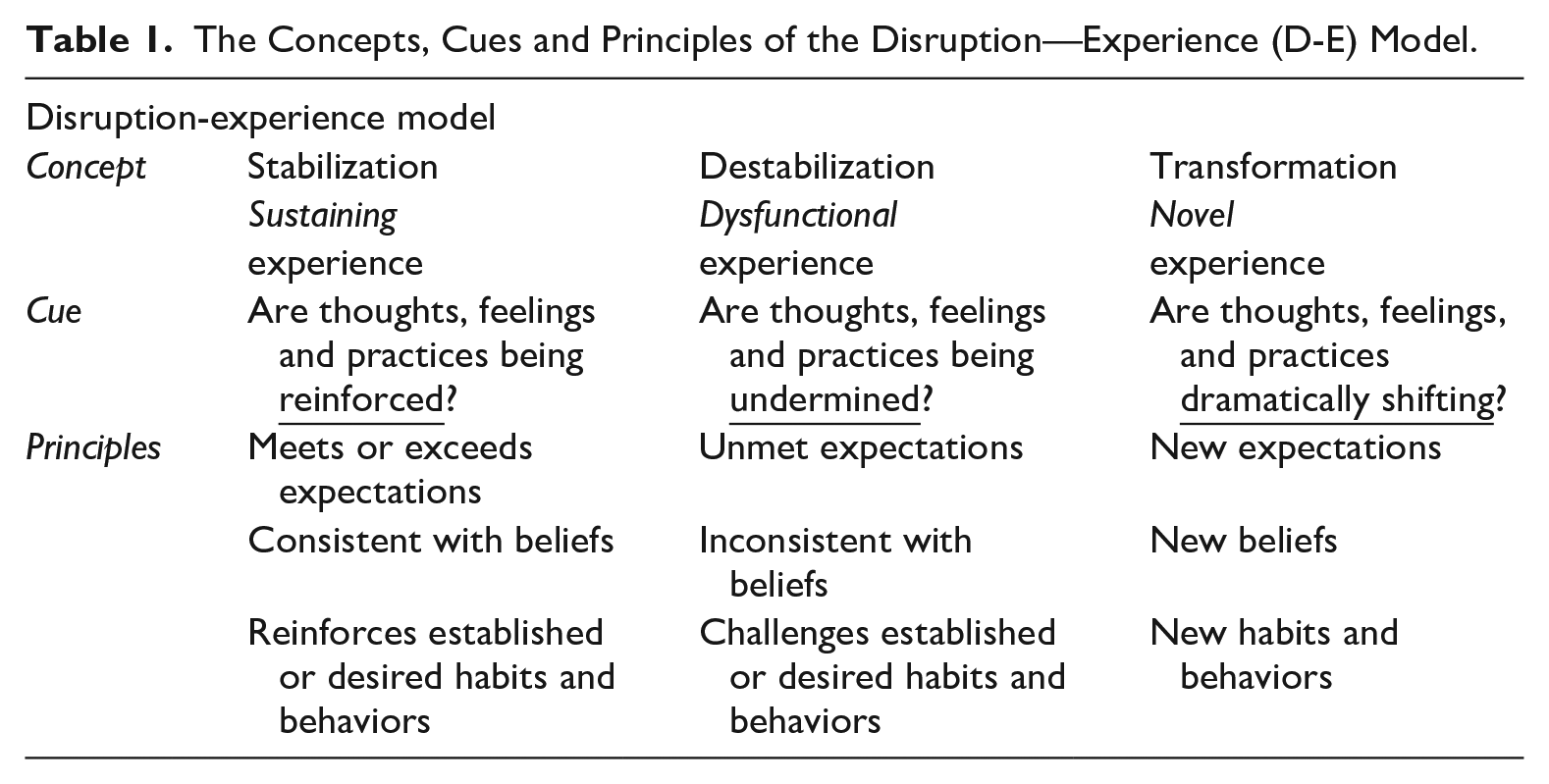
The principles in the D-E Model are not criteria to be fulfilled; their purpose is to draw out aspects of the user experience and talk about them in this framework of disruption. The D-E model is a useful instrument for interpreting and describing user experiences and helps to pinpoint further questions and research trajectories into disruptive technologies.
Experiencing Netflix
That’s probably the shift. Like it went definitely from television, to [pirating], to Netflix. (Gus, age 25)
Participants in the millennial generation identified internet piracy as the middleman between television and Netflix. Indigo, age thirty, reported that using BitTorrent “was really how I consumed most TV shows” prior to Netflix. Participants reported engaging in various forms of alternative access to international content not available via FTA or cable services in Australia, transforming their viewing experiences by completely replacing or greatly supplementing their television viewing and creating new expectations around accessing and viewing entertainment. Given that Netflix is often credited for transforming consumption habits, these findings are critical for producing an accurate picture of what the arrival of Netflix meant in Australia from the users’ point of view.
Transformation: Internet Piracy
Participants’ experiences indicate that internet piracy was a transformative practice, radically changing their thoughts, feelings, and practices around television viewing. File-sharing was the most common mode of access to content; however, some “vernacular” methods of access, such as the loaning of USB devices or portable hard drives loaded with content, were also popular. Other studies have demonstrated that in 2014 approximately 20 percent of Australians were actively using Virtual Private Networks (VPNs) to obscure their file-sharing habits and circumvent geo-blocking to access Netflix’s America services to access the range of titles in the Netflix catalog not available to them locally (Lobato and Ewing 2014; Pinantoan 2014, see also Iordache 2022; Lobato 2018). Internet piracy was an important and liberating alternative to channel switching and a move away from traditional TV screens. Participants explained using laptops and PCs, installing torrenting software and searching websites to locate content. However, the process wasn’t as straightforward as traditional viewing and required often tedious work to obtain the desired content from reliable sources. Jess, age twenty-four, suggested that “When you download stuff. . .you need to see if it’s actually available to do that, and then there’s no guarantee. Then you download it, and it’s in another language. . .” Although online piracy required a new set of digital literacies and effort to acquire and manage content effectively, participants felt validated by the increased agency and individual choices afforded by illegal downloading.
Primary drivers for pursuing alternative access to content among participants were access, cost, and autonomy. Before the availability of high-speed internet, Australia featured a robust rental culture, while cable remained prohibitively expensive for most of the population and FTA content lacked diversity (Australian Home Entertainment Distributors Association. 2015; Pertierra and Turner 2013, 7–8). Gus, age twenty-five, explains his frustration of this scenario, “The conversation was ‘people shouldn’t be downloading illegally’, and that was fine, but then there was no service there to access movies. . . it wasn’t affordable; they wanted you to buy movies individually.” In addition, Gus explains that autonomous scheduling (the ability to watch anything at any time) is radically different (and better) than cable television viewing: In terms of Austar [local cable service] in comparison to Netflix is the flexibility and the time that I can watch it, obviously because it’s fixated on Foxtel which is annoying. Who knows if we’re going to be available at 3.30 to watch Jurassic Park. . .with downloading, I can watch whenever. . .That was a motivator [for downloading content].
A significant part of the experience of Netflix’s arrival in Australia is the reduction of ‘The Great Australian TV Delay’ because Australians overwhelmingly elect to watch American TV shows over local content (Lobato 2019; Spencer 2014, 2015). Jess, age twenty-four explained her reason for pirating was “[watching] what I wanted when I wanted compared to just having to wait for things or not liking anything on TV.” Jess points to a critical issue with Australian television; “having to wait for things.” Indeed, many Australians had embraced alternative access methods to mitigate the delay and attain a sense of cultural inclusion (Starr 2016).
The more participants engaged in internet piracy, the more ad-breaks seemed to be destabilizing. Chiara, age twenty-eight, reflects on her aversion to ad-breaks, “using downloads regularly to entertain myself. . .I just couldn’t go back to [ads].” Gus recounted an experience in which he had not watched FTA in over a year: I lived somewhere with no TV and I just watched things that I downloaded. . .I remember after a long time having not watched Free-to-Air or television. . .the first ad break I was like oh, what? Like it kind of really shocked me.
By accessing TV shows and movies through alternative methods, participants’ viewing experiences were transformed because they were no longer experiencing intermittent breaks out of their control. This created new expectations around how content should be delivered.
Destabilization: Local Content
All participants expressed various degrees of distaste for local content, which echoes Lobato’s (2019) argument and the ACF finding that Australians opted to watch high-budget dramas produced overseas (Turner 2019a, p. 224). Bianca, a forty-year-old female, born in South Africa, and Fox, a forty-year-old male born in Norway, had a particularly strong aversion to Australian content—although particular genres and types of content were not identified. Fox, who immigrated when he was twenty-five, described FTA in Australia as “absolutely woeful.” Bianca, who immigrated when she was twenty-two, reported distrusting Netflix’s algorithmic-based recommendations system to prompt binge-watching practices. However, she still noted that SVOD service had expanded individual choice and agency for viewers: “Who would be watching normal television if you’ve got Netflix? Even I don’t.” Netflix disrupted the local television industry as networks scrambled to create their own services to compete, yet its arrival was stabilizing for participants who engaged in internet piracy, clarifying that affordable, legitimate access to content is—and has always been—a viable option.
Stabilization: Netflix
Participants reported that their viewing experiences did not change much when subscribing to Netflix but rather stabilized their beliefs and practices that had already been transformed by piracy. In contrast to Netflix’s dramatic interference of the Australian television industry and impact on distributional infrastructure (the NBN), the arrival of the SVOD service was not described as a significant event among participants, especially those who engaged in internet piracy. Most participants could not remember when Netflix became available in Australia. Chiara, age twenty-eight, responded: “I really am actually struggling to pinpoint when I got Netflix.” The adoption of Netflix was not memorable as participants were already accessing Netflix via VPN or consuming content in a similar way via illegal downloading and internet streaming. Netflix was merely a continuation of the agency that internet piracy had afforded them. For Matt, age twenty-five, it was an immediate transition: “I would’ve been downloading illegally on UTorrent religiously and I’m talking the whole family. . .I stopped doing it as soon as Netflix came out.” Others, such as Dean, age twenty-four, suggest a slower and more progressive adoption: I pretty much used to download exclusively, then I got Netflix and it was sort of like 50/50, if Netflix didn’t have it I’d download it. And then now with Netflix, Foxtel, Stan, even if they don’t have something, I probably won’t bother to download it because I will find something eventually. . .its exposed me to new content that I probably would never have been able to access before. . .I think what made it stick was just accessibility. . .instead of having to wait every week for a new episode of a show you liked, it’s all there. . .easy to access. . .It can be put on multiple devices.
Internet piracy created new expectations, beliefs and habits regarding autonomy and access to a library of content. Netflix made content access more convenient, reinforcing these transformational elements of internet piracy, but it did not necessarily create them. Rather, participants explain that Netflix elevated their viewing experiences in three primary ways; that it was legal, that it offered additional features making viewing more enjoyable because of the ease, and it reduced the work and time needed to access and manage content obtained via piracy. Jess (24) explains: I didn’t have to do the labour of downloading, as well as always having subtitles accessible, because I watch things with subtitles, the accessibility of being able to be where you’re up to and not have to physically find that. . .Also, I guess, not having to face the consequences of being caught if you were downloading.
Jess felt the convenience of access and extra control functions were important and its legality was a bonus, and Indigo (30) expressed that accessing content “The pure legal way” made them feel good. Netflix certainly made a difference in Australia, helping to alleviate the TV delay and eliminating the hassles and risks associated with online piracy. Yet participants still believe Netflix is expendable. Lee, age fifty, insists that without Netflix, “I’d seek another source” and Fox (40) affirms “I don’t feel loyalty to any kind of platform as such.” By 2017, two years after Netflix’s arrival, around half of all SVOD users reported that they do not illegally download or stream content as often as they used to (Screen Australia 2017, 2018). The declining piracy rates suggest that pirates are willing to access content legally if it is at an affordable price point and they can maintain a similar degree of autonomy around their viewing.
The absence of loyalty to Netflix from Australian users points to the stabilizing effect of streaming services highlighted by all the participants interviewed. Netflix did not represent radical change or departure from the established beliefs, habits and viewing practices enabled by online piracy. It did, however, change the discourse for those practices, for the most part legitimizing their mode of access, so much so that Netflix quickly became a colloquial epithet for streaming televisual content. Emily, age forty-two, observes: “People don’t say. . .what have you been watching on iView, or SBS On Demand. They always say; what have you been watching on Netflix [which means] what are you currently watching, is there anything good?. . .People don’t say; what have you been watching on Stan.”
The participants did report that Netflix as a brand, a company, and its interface, was not as important as the gap it filled. Participants acknowledged that the concept and term “Netflix” had fully infiltrated the cultural imagination, and no one wanted to return to the pre-streaming viewing life and audience limitations of pre-SVOD services. Like internet piracy, Netflix helps mitigate the “Australian TV Delay” (Spencer 2015). Hannah (25) explains: We can now get shows that are new in the US at the same time, and they’ll quite often make that a point of advertisement on Netflix. They’ll be like same time as the US like when it’s a new show, which I think is so important since Australia has had such a history of being behind culturally with pop culture and things like that. I think it’s really great that we can be up to speed with things like Netflix. I think it’s made a huge difference in that area, which is really good.
Indeed, one of the biggest concerns for these viewers was encountering spoilers on social media and being excluded from discussions of popular content with international audiences and local viewers relying on pirated content (Spencer 2014). For Hannah and other Australians, understanding where Australia fits in the world regarding having access to popular culture is an important part of cultural identity and personal beliefs. Hannah’s account, and other participants, highlight that it was more important for Australians to feel like they are present in the contemporary moment of popular culture with equal access to new content rather than have access to Australian-produced content.
For participants who did not engage in internet piracy, Netflix did not transform their viewing experience, it was complementary. Indeed, Bennett et al. (2020) observe, “broadcast television is turning out to be more resilient than some expected” (p. 85). Responses from older participants I interviewed explained that they check what is on television before using Netflix. Bianca (40) observes, “I always go TV first. . .Because I’m old fashioned. Netflix, you can access anytime. Television, it’ll go away if you don’t see it. Fear of missing out, I think.” This practice could be habitual, however, by highlighting the “fear of missing out,” Bianca suggests that she prefers the sense of watching something at the same time other people are. In addition, participants who checked FTA first were allured by the possibilities and surrendered to what was chosen for them by the television. 1 Participants never consulted a TV guide before surfing FTA channels but rather hope to serendipitously be drawn into a captivating program. Interestingly, some participants will commit to programs on television over Netflix, Kath (54) reflects “If I see a movie on free-to-air, I will watch it on that, even though I know [it’s on Netflix].” This suggests that titles on streaming services do not have that same hook; when it’s on TV, as Bianca notes, “it’ll go away if you don’t see it.” These findings are significant; Netflix was considered disruptive and adopted in large numbers in Australia, yet statistics show that FTA has not gone away, and my research sheds some light on why this may be the case; habit and the “fear of missing out” (Screen Australia 2018).
Netflix was stabilizing among millennial participants because they were already consuming content in a similar way via internet piracy. This contributes to the discourse from Jenner (2018) and Barker and Wiatrowski (2017) who acknowledge that Netflix has not been the singular driving force in the reconception of television. The evolution of the televisual landscape continues to be influenced by various social and technological developments. Records have shown Australians to be the worst offenders of internet piracy across the globe (Quinn 2017; Whigham 2018). Internet piracy transformed participants’ viewing experiences because they were more in control of how they consumed televisual content compared to television. The extensive discussion of internet piracy among millennial participants suggests that it played a meaningful role in the evolution of their viewing habits. Piracy rates have declined since the arrival of SVOD services, yet if their introduction did not coincide with the Australian government’s crackdown on internet piracy, perhaps many more would still be engaging in the practice.
The contrast between the industry and user experience of Netflix in Australia is pronounced. Netflix threatened the television industry as it was an immediately popular and legitimate opponent, which led to a reconfiguration of the national media system. For users, however, the transition was seamless (and barely memorable) due to the convenience, timeliness and affordability already established by piracy as key demands of Australian audiences. However, it is important to note that Australian television, especially at the time of Netflix’s introduction was a very different type of content service to the streaming platforms. There are other factors involved that this study did not consider such as the way television users might turn to other non-television platforms and services to access content that television was particularly known for servicing such as news and weather information as well as more localized reality TV genres and “live” events.
Conclusion
In this research project, we have deployed a new model for examining the experience of users engaging with technologies labeled as disruptive. The D-E model is structured by a set of three concepts for understanding participants’ encounters with the technology, which include stabilization, destabilization, and transformation. Each of these concepts has a set of cues that are used to examine the participants’ responses closely and has a range of principles that help to analyze, explain, and contextualize the responses. In this article we have looked specifically at the experiences of Australian Netflix subscribers who for the most part adopted the service to stabilize their expectations previously transformed by online piracy to bridge the delay in overseas content being available in Australia on free-to-air and cable television services. Vettoretto (2021) provides a significantly more detailed account of the perception of Netflix as a disruptive agent in Australia, destabilizing user experiences like the paradox of choice and how the SVOD service stabilized other viewing habits such as the desire for binge-watching.
It was made clear that while Netflix had been labeled as disruptive, the Australian television experience had already been destabilized by the failure of FTA and cable services to meet local demand. Netflix was highly stabilizing for Australian audiences who had engaged in internet piracy, legitimizing the beliefs and practices they had established around autonomous viewing and agency of access to large libraries of content. In its ability to corporatize streaming, profiting both itself and legacy media corporations, Netflix was able to promote viewing habits that enhanced its profitability. Even new copyright infringing practices like using VPNs to access Netflix libraries in other countries enhanced the company’s bottom line and were highly profitable for the company, while it could demonstrate it was respecting local intellectual property laws and trade agreements. These are important findings in the current period of SVOD proliferation, as access to high profile content becomes increasingly difficult to access without multiple subscriptions to platforms available in Australia including Disney+, Stan, Binge, Amazon Prime Video, Apple TV Plus, Paramount Plus and Foxtel Now. It may be that Australian, and international audiences, return to online piracy to stabilize their experiences with access to televisual content. The D-E model will be particularly useful to scholars engaging with current subscription practices and users returning to piracy to enjoy the content they feel has been too costly or too complicated to access legitimately.
Footnotes
Declaration of Conflicting Interests
The author(s) declared no potential conflicts of interest with respect to the research, authorship, and/or publication of this article.
Funding
The author(s) disclosed receipt of the following financial support for the research, authorship, and/or publication of this article: Ren Vettoretto received the University Postgraduate Award (UPO) scholarship from the University of Wollongong during her PhD candidature which supported the original research included in this article.
