



Abstract
In this paper the focus is on the representations of “middle-aged” or “aging” women streamers in western media. I analyze discussions in Western online media around a case of Chinese DouYu live-streamer. “Qiaobiluo Dianxia,” as her streamer name goes, became a topic in Western media after a glitch in her live stream revealed her to be a middle-aged woman, rather than young woman she was assumed to be. The discussions are analyzed with critical discourse analysis. It is argued that the aging bodies of women, both their presence and absence, should be read and understood through toxic gaming culture and geek masculinity and the hegemonic discourse they constitute.
In this article, I look at the way that ideas about “middle-aged” or “aging” women streamers are constructed in Western discourses about video game live streaming. To do this, I analyze discussions in Western online media around the case of “Qiaobiluo Dianxia,” a live streamer on the Chinese streaming platform DouYu. “Qiaobiluo Dianxia” (her streamer name) became a topic in Western media after a glitch in her live stream revealed her to be a middle-aged woman, rather than young woman she was assumed to be. In the Western news outlets, the event was sensationalized, and the streamer was portrayed ambiguously as both deceptive and cunning: as someone who was aware of the attention economy surrounding streaming and was not afraid to use that for her own advantage, but who also betrayed her viewers through her actions. Most of the news outlets covering the story did not, however, question the way this attention economy functions or examine the very narrow space women who stream video games are often allocated. This space excludes many facets of womanhood and femininity, such as the aging body.
I analyze the media discussions around the case by utilizing critical discourse analysis (Wodak and Meyer 2001). Throughout my inquiry, I focus on how the media framed the event and what assumptions the media took for granted, which pervaded discourse about gaming, streaming, age, gender, and modes of inclusion and exclusion. I contextualize and problematize these findings and show how they are connected to the normative assumptions about what women (game) streamers ought to be and what kind of bodies are welcome in the space of live streaming of video games which is largely governed by toxic masculinity.
Background, Data, and Methods
The first thing one notices about the aging body of women in gaming is its absence. Female video game characters and avatars are usually young, fit, able-bodied, and overly sexualized (Cote 2018; Downs and Smith 2010; Ivory 2006; Kennedy 2002). This type of character design is intertwined with the historical perception of video games as a masculine domain: in the early 1990s, videogames became constructed in the public discourse as a masculine activity and the makers of video games (particularly the big studios) started to think of (young) men as their target audience and to design their games accordingly (Kirkpatrick 2016). It comes as no surprise then that women, together with other minorities, are marginalized in video game culture and in video game live streaming (Cotes 2018; Ruberg et al. 2019).
While both women and men play video games and stream them, previous research shows that woman in streaming face more harassment than men (Ruberg et al. 2019). They are more often complimented based on their appearances (rather than their gameplay) than men (Nakandala et al. 2017; Ruvalcaba et al. 2018) and face constant pressure of how to present themselves and their bodies (Ruberg et al. 2019). The appropriate ways to perform femininity while playing and live streaming games are constantly governed and regulated by other (often male) players. Often this includes expecting women to play traditionally feminine roles in games, such as support or healer (Butt 2016; Ruotsalainen and Friman 2018), and negotiate their right to belong through men, for instance, through boyfriends or brothers (Butt 2016). Moreover, whilst live streaming, women’s bodies are under constant scrutiny (Ruberg et al. 2019). This is coupled with a general toxic gaming culture (Consalvo 2012) and hegemonic geek masculinity, which blends traditional athletic masculinity prevalent in Western cultures together with the importance of technological mastery (e.g., Taylor 2012; Taylor and Witkowski 2010). Thus, the space women are suggested to occupy in both gaming and video game live streaming is extremely narrow. Multiple works addressing this have highlighted that white, heterosexual men still maintain positions of power in the majority of game communities (e.g., Consalvo 2012; Paul 2018; Ruotsalainen and Friman 2018; Taylor 2015).
The data for the research consists of twenty-one articles from online magazines, written in English and published between July 17 and August 5, 2019 on international online media platforms. These platforms include news outlets such as BBC news and Global News, publications focused on games such as Kotaku, Gamebyte, and Gurugamer, as well as an assortment of publications focusing on technology, entertainment, and lifestyle. All these articles discuss the case of the Chinese DouYu streamer known as “Qiaobiluo Dianxia.” This data was initially collected using a Google search for the name of the streamer and by snowball method, since occasionally the publications referred to other publications about the same topic.
As for my method of analysis, I have applied critical discourse analysis. Critical discourse analysis is particularly interested in language as a social phenomenon through which power is exercised (Wodak and Meyer 2001). Within this frame I have focused on how gender and age are constructed performatively through repetitions in the analyzed data (cf. Palonen and Saresma 2017) The analysis has been informed by intersectionality (Crenshaw 1991). I have furthermore traced the meaningful absences (von Münchow 2018) that appear in this data. As an analytical lens, the idea of meaningful absences helpfully draws focus to elements that are not immediately present in the text, but which may be important to the wider discourses which the text is part of. Through my analysis, I seek to understand how the hegemonic discourse about women video game life streaming is constructed and how this affects the way different bodies are or are not invited to be present in video game life streaming.
Throughout my analysis, my focus is on Western news outlets. I am thus not analyzing the original Chinese context, but how the event is reproduced in the West and to what discourses are utilized to frame it. As my interest is in the way the event is presented rather than in the event itself, I do not make claims about the truth or falsehood of the information the media coverage spreads. 1 Rather I am interested in how the event is presented in news articles: what kind of terms are used in the articles, and what is said and importantly what is not said, thus taken for granted. In this way, I seek to unveil the prominent norms, often present in mainstream publications and discussions, governing gaming and streaming cultures in the West.
The Case of “Qiaobiluo Dianxia”
In 2019, multiple Western news outlets covered the story of popular Chinese DouYu streamer “Qiaobiluo Dianxia” by her streamer name. In the twenty-one articles I analyzed, the event was covered mostly in similar a fashion. Most outlets repeated the same basic information, while some notable smaller differences did emerge. What appears to be consensus in these articles is that a live streamer with streamer name “Qiaobiluo Dianxia,” a nickname meaning “Your Highness Qiaobiluo,” was a popular Chinese DouYu streamer with approximately 160,000 followers before the event took place. Her real name is never revealed in the Western articles. “Qiaobiluo Dianxia” was known for never streaming with her face visible on camera. Instead, she opted to have the camera pointed at the level of her chest or use the camera with filter that would cover her face. She would, however, post pictures of herself and in these pictures, which also showed her face, she appeared to be a young woman. As requests to see her face in the stream became more common, “Qiaobiluo Dianxia” promised to do a “face reveal” in a live stream if she received gifts worth of 100,000 yuan (approximately 15,345 U.S. dollars). However, during one live streaming session, the filter covering her face glitched, revealing her face before she was able to initiate the reveal herself. The accidental reveal made many of her viewers and followers leave her stream and unfollow her, as well as retract donations given to her. The event gained attention in Chinese social media and was widely discussed.
Some of the analyzed stories end with this, whilst some of them describe what happened afterwards, claiming that though the fifty-eight-years old “Qiaobiluo Dianxia” initially lost followers after her real face and age were revealed, she actually ended up gaining more followers than she had before. Following the event, she totaled almost half a million viewers and received the affectionate nickname “Granny.” However, few of these stories continued to explain that she would end up getting banned from the streaming service, as her acts were perceived as deceitful.
Most of these articles use sensationalized headlines. Some examples include: “Cute goddess is actually an aunty” (Hui 2019); “Glitch Reveals Popular Young Streamer Is A Middle-Aged Woman” (Ashcraft 2019), “Popular young livestreamer is actually old woman catfishing” (Jackson 2019), and “Famous young gamer is a fifty-eight-year-old Chinese woman; streaming bug reveals” (Deccan Chronicle 2019). A consistent trope within all these headlines is the importance of age and gender. Another consistency in the stories is the use of what is claimed to be streamer’s pictures, most commonly “before” and “after” pictures of the streamer. In these, it is claimed, the “before” picture shows the streamer with a filter and the “after” picture shows her without the filter (Figure 1). In addition, some of the stories also included other filtered pictures that the streamer had uploaded.
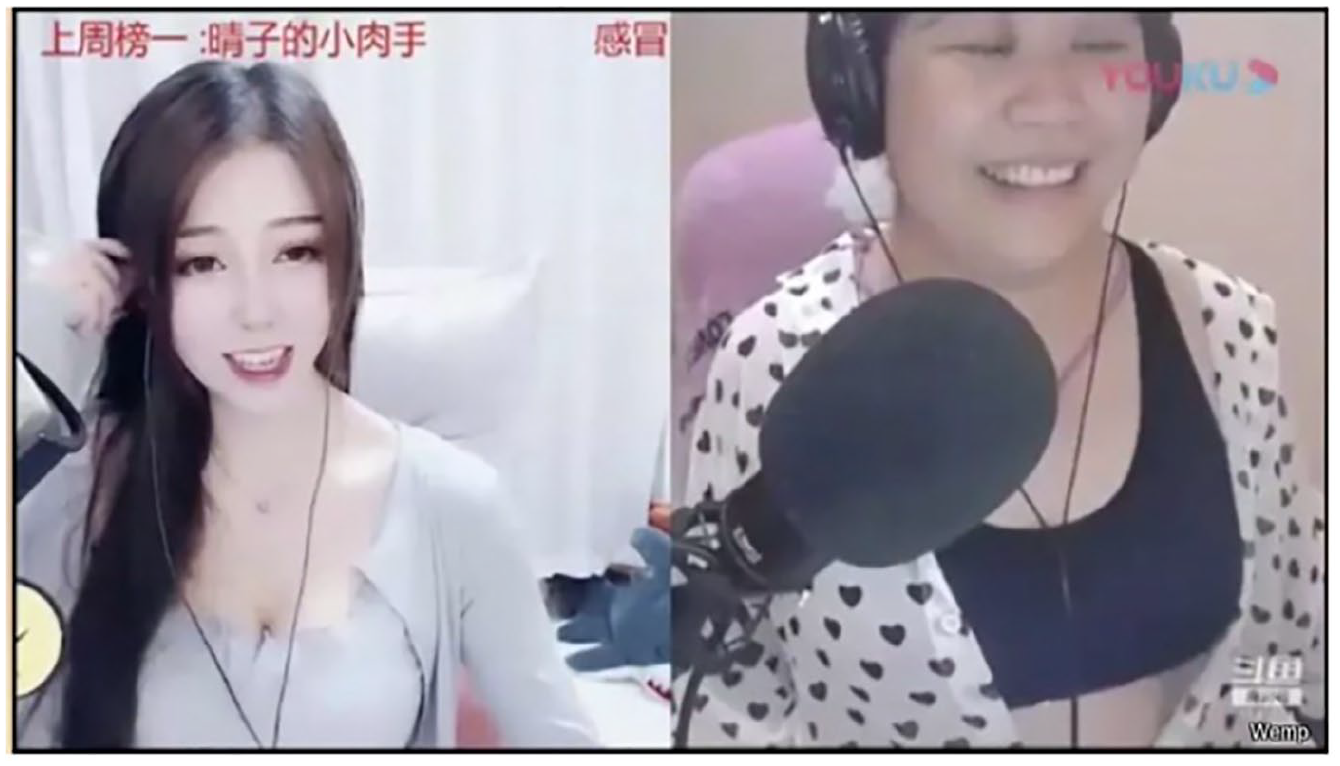
A set of what is claimed to be a “before” and a “after” photo of “Qiaobiluo Dianxia.”
The presumed relationship between age, beauty, and gender plays a significant role in how the contents of these pictures were described. However, these presumptions are also present in news stories that did not include pictures, though it is a topic that is rarely expanded upon. Rather, the stories seem to suggest and take for granted that the streamer’s beauty is tied to her age and that her success is due to her desirability (even though she, allegedly, gained more followers after the event itself). The streamer in the “before” pictures is described using adjectives relating to beauty. By contrast, in the “after” pictures she is always described through her age, with terms such as “Aunty,” “Granny,” “middle-aged woman,” and “old woman.” The interplay between age, gender, and beauty is central to the grand framing of all the stories, along with the theme of deceit, which I will discuss in the next section.
One of the most notable differences between different articles in how they discuss the case of “Qiaobiluo Dianxia” is how they refer to her. Some of the news outlets opt to call her a vlogger (Goulopoulos 2019; Shah and Allen 2019), while others called her a “gamer” (Deccan Chronicle 2019; Smith 2019), “video game streamer” (Newby 2019), or “streamer” (Farner 2019; Loh 2019). Most outlets suggested that her broadcast content was about video games, and one outlet named a game that she played, stating: “After the incident, it came to light that the streamer is actually a fifty-eight-year-old lady who just really enjoys playing Apex Legends” (Judita 2019). However, none of the other articles described the contents of her live stream in more detail. Though most publications suggested that her content centered around video games, one publication specifically singled her out as a beauty blogger and discussed the case within this framing. However, as most stories framed “Qiaobiluo Dianxia” as game streamer, I will focus on how she discussed within this framing.
Deceit, Age, and Monstrosity
Most of the news stories about “Qiaobiluo Dianxia” appeared to take for granted that the streamer’s actions constituted a form of deceit. The rhetoric used to describe her actions (using the filter to change her appearance) was similar to the rhetoric that would be used for someone who has cheated in a video game. Clearly gendered terms were also used, such as “catfish” (Glaze 2019). However, one of the articles did question the gendered way this “deceit” was framed, arguing that altering and enhancing the way that one looks while streaming is not only common, but seen also as acceptable for some streamers. The writer of this article used a popular Western male streamer, “Dr. Disrespect,” as an example of a streamer who alters their appearance in order to play a particular character, such as by using fake facial hair and sunglasses. The writer notes that: “Of course, what Qiaobiluo did isn’t a crime or even necessarily uncommon. Followers, primarily men, gave her attention and money and gifts without verifying her identity. They parted with their time and money unprompted, primarily because they’re just thirsty dudes trying to get a woman’s attention. But once they found out the woman wasn’t attractive in the way they thought she was, they lipped out. Many streamers change their appearance one way or another. In some cases, like with Qiaobiluo, it’s done with filters. Other times, it’s something a little more analog, like makeup. Regardless the means, people regularly change their appearance in both subtle and extreme ways. There is no morality clause for streamers requiring them to present themselves unfiltered” (Dellinger 2019).
However, beyond this one exception, most of the stories did adopt the approach that the streamer had been de facto cheating and doing something morally questionable. Most of the articles did not meaningfully address the fact the streamer was actually planning to reveal her face in the stream. Rather, these articles described the streamers actions as deceitful, and most stories were framed in a manner that suggested that her motives were financial. Two of the stories described the event as follows: “You thought that while manga and anime are just fun since it’s impossible for these things to happen in real life. Well, that’s true, but then the Internet came about. Lies and falsehood were made easier. Many females took advantage of this, using filters and other software to make themselves look more attractive on-screen. It’s not just limited to photos too. Several female streamers on streaming platforms use filters to achieve a higher beauty, but this next one takes it to a whole new level” (Loh 2019). “With Instagram and Snapchat face filters dappling every selfie on your feed, and the horrifying ethical implications of deepfakes, you’d think that people would know better than to believe everything they see, but apparently not” (Yalcinkaya 2019).
These descriptions, considered together with the articles’ sensationalist headlines and choice of pictures, create a feeling of an impending threat that women streamers pose: the risk that they might not be who they say they are (or how they appear on screen) but something else, that they are “catfishing” the viewer. The (male) viewer is thus presented as being at risk of possibly being deceived by women streamers. These articles implied that a streamer could be anyone and anyone—especially any woman—could deceive viewers at any time.
The imagined risk here is twofold. Firstly, as the streamer is described with terms such as “cute goddess” (Hui 2019) before the filter glitches, she is also positioned as a male erotic fantasy of “gamer girl” (Apperley 2019). This fantasy is strengthened by the fetishation and orientalization of Asian women in the West (Brooks and Hébert 2006). The revealing of the streamer’s real face and age shatters this fantasy and exposes the risk (or the reality) that the male audience is fantasizing about a phantom in the first place. And, indeed, the figure of the “gamer girl” is a phantom and a fantasy. According to Apperley (2019), the trope of the gamer girl is common in video game porn, where it functions to strengthen the toxic masculinity of the video game cultures by creating a woman subject that is always subjugated (and longs to be subjugated) by men. Secondly, toxic masculinity also offers a very limited space that women are allowed to inhabit in gaming communities and game cultures at large (cf. Ruotsalainen & Friman 2018). Thus, when “Qiaobiluo Dianxia” is revealed to be not a young woman, she is breaking out of this limited position and threating the normativity of the gaming culture. Her age comes to represent her monstrous otherness, which threatens the exclusionary boundaries that are typically placed around popular women game streamers. In this way, she symbolizes the omnipresent threat experienced and perceived by those who are privileged within gaming communities—namely white, straight men (Consalvo 2012; Paul 2018; Taylor 2015). Admittedly, it is worth noting that young women are not safe from such boundary drawing or policing in live streaming either. To the contrary, their bodies are placed under constant scrutiny and belittlement and are often highly sexualized. They are also frequently condemned for their bodies and viewed as “cam girls” or “titty streamers” (Ruberg et al. 2019). However, in the case of “Qiaobiluo Dianxia,” the particular monstrosity and otherness represented by her age is also visible through the way her age is discussed. Many of the news outlets call “Qiaobiluo Dianxia” middle-aged, whilst some call her “old.” Others give more specific names as “Granny” or “Auntie.” These terms function to suggest non-belonging and intrusion into the game culture, suggesting that game culture now must be vigilant in protecting its borders.
Interestingly, these same factors, namely the streamers age and her supposed act of deception, also function as potential sites of resistance against the gendered norms found in these discourses. Whilst most articles briefly mention that “Qiaobiluo Dianxia” gained considerably more followers after the event, few also bring up reactions from the Chinese community, which included expressions of encouragement toward the streamer. The power of this phenomenon, however, was impacted by two factors. Firstly, as some of the articles mention, “Qiaobiluo Dianxia” was has later been banned from the streaming service. Secondly, her success was framed as being the result of a stunt and the attention it garnered. Though this is possibly true, and not necessarily negative in itself, it does highlight the “otherness” of the middle-aged woman streamer.
Absences and the Silent Acceptances
von Münchow (2018) reminds us that, when doing discourse analysis, it is not only what is present that is important. Absences can be just as meaningful. Recognizing them can reveal important facets of hegemonic discourses. In the news articles discussing the case of “Qiaobiluo Dianxia,” two absences stand out strongly. Firstly, almost none of the articles discuss the content of the streamer’s broadcast itself, as mentioned above, which diminishes the importance of her creative work. Most of the articles do not address in detail (beyond the choice of the vlogger/streamer/gamer terminology and few offhand mentions of online games and chatting) what kind of content she actually produces. This leave readers wondering what the focus of Qiaobiluo Dianxia’s streams was, but it also suggests that this content does not matter-that what is important, and only important, is the streamer herself and the way she appears to the public. This echoes the way women who stream games are often treated: they receive far more comments from their audience about their appearances than men do, and far fewer comments about their gameplay (Nakandala et al. 2017). It could be argued that focusing only the streamer rather than on her content is understandable if the content of her streams focused on the streamer herself (i.e., vlogging about herself). However, some of the news outlets specifically frame the streamer as a gamer or video game streamer, whilst failing to name any of the games she plays or how her gameplay might have affected her fame. However, though this might have been conscious choice, it is also possible that the writers of these articles simply did not know what kind of content Qiaobiluo Dianxia produced and perhaps struggled to find that out due to language barriers.
The second visible absence is that most of the articles do not discuss why the situation is newsworthy and how this itself could be problematic. The only times when the economy of attention and the demands it places on women is questioned in these articles is in the Chinese cultural context. Specifically, a few articles noted that the event had raised discussion in China about the unattainable beauty standards women face. These discussions, however, were not extended to the Western context. The Western reception of the event was thus effectively not problematized and expectations for performing femininity within economics of attention are not sufficiently addressed. The consequences of economics of attention extend beyond the sphere of video-game live streaming, regulating the way that people present their bodies in the larger sphere of social media. However, I would argue that is particularly visible in live streaming, where the aging female body is marginalized (together with other bodies that are perceived deviant, such as queer bodies) and almost fully absent.
Conclusion
Earlier research has shown that women’s bodies are oversexualized in video games and game communities (Downs and Smith 2010; Ivory 2006; Kennedy 2002; Ruberg et al. 2019). Furthermore, while live streaming video games, women receive disproportionately high amounts of attention focused on their looks, rather than their gameplay (Nakandala et al. 2017; Ruberg et al. 2019). This is part of toxic game culture, of which the central building block is hegemonic geek masculinity. Hegemonic geek masculinity functions to posit and maintain the expectation that the power to regulate the boundaries of inclusion and exclusion for gaming culture belongs to white heterosexual men. The aging bodies of women, both in their presence and absence, should be read and understood against this backdrop and the hegemonic discourse that reflects it.
Through an analysis of Western media coverage of a streamer who turned out to be older than she was first assumed to be, I have sought to show how the aging body of women streamers is framed as posing a challenge and threat to hegemonic game culture, which narrowly dictates how women are allowed to perform gender within gaming and live streaming spaces. The streamer, once her real age was revealed, became both monstrous and ridiculed, as well as strongly othered, effectively pushing her to the margins. By breaking the illusion of the “cute goddess,” the normatively attractive gamer girl who is welcome to stream only within set parameters, she poses a threat which is negotiated away by distancing the events to a Chinese context.
The research has limitations. Some of the details of the case of “Qiaobiluo Dianxia” remain unclear and sometimes it is hard to say how much of the content of the stories that I analyze here have been influenced by this lack of information. This research also only focuses on one case and the discussions around it. Future research could expand on this topic could by looking directly at older women who stream and how they negotiate their identities and perform femininity, and what kind of role age plays in their experiences.
Footnotes
Declaration of Conflicting Interests
The author declared no potential conflicts of interest with respect to the research, authorship, and/or publication of this article.
Funding
The author disclosed receipt of the following financial support for the research, authorship, and/or publication of this article: This research was supported by the Academy of Finland project Centre of Excellence in Game Culture Studies (CoE-GameCult, 312397).