



Abstract
With live streaming rising in popularity, many people stream the creation of 3D avatars However, many of these avatars end up following a similar output: a hyper-feminized anime girl. Why is this? What are the social and technological processes constructing these avatars? To answer these questions, I propose that human (streamer and audience) and non-human (streaming platform and 3D modeling software) participants interact to produce the cultural experience of the live stream, re-producing common heteronormative, cisgendered, and racialized tropes about bodies and desirable avatars. And so, I take as my object of study the interaction that happens when all of these participants merge, forming what I call a white heteronormative assemblage. I argue that this assemblage is collective, relational, and self-reinforcing. Analyzing the relations between human and non-humans participants helps us turn our analytical lens away from media content or streamer motive, and instead toward the restrictive outcomes of such interactions.
Hyper-customized avatars rendered using 3D modeling software are increasingly a norm in live streaming and video sharing. In their live streams, designers create avatars for several reasons, might that be: for digital worlds, for commissions, for their own games, or even just for streaming their art. To design and sculpt these avatars, digital artists use 3D modeling software like Blender or Maya which provide digital tools for designing 3D models. When the model is complete, many of these artists often upload their unique avatar creations for other users to wear in digital worlds like VRChat or Second Life, or they post them online for other users to use as their VTuber persona. 1 This practice has become quite commonplace over the last few years, spawning its own niche area of digital art production, commerce, and community. For avatar designer that live stream their avatar design process for audience members on live stream platforms like Twitch, viewers engage with the design process while observing the intricacies of the 3D modeling process through discussing the avatar model on screen.
However, despite the fact that 3D modeling softwares allow for avatar designers to create or import an enormous range of body types, and despite the fact that many popular avatar designers are highly skilled in using these softwares, the results of avatar creation processes are almost always hyper-feminized anime girls. These anime girls often have large breasts, small waists, big butts, and large eyes, among other hyper-feminized features. And so, this paper asks: why does this design process regularly produce such similar results? Are there specific factors found within the software itself and within the human actors that limit or discourage more creative avatar design, while encouraging the constant re-production of the hyper-feminized anime girl? I argue that the answer is simultaneously social and material, where both cultural and technical factors intertwine in the continued production of avatar tropes. More specifically, I argue that the constant re-production of feminine anime avatars observed in avatar design streams is the result of the interactions between the designer, their audiences, and the platforms through which they stream. The participants studied in this paper operate within social contexts that perpetuate dominant white heteronormative attitudes and habitual practices of hetero- and racialized objectification in the creation of art and media.
Design sessions become moments at which a community forms around the building of an avatar. Here, audience members often provide feedback on the avatar model mid-design, which becomes an important interaction for producing and/or contributing to the trope of the hyper-sexualized anime girl. Using the live chat feature, audience members often ask the streamer to re-shape particular body parts. At times, this results in a conversation between the audience, the streamer, and the 3D modeling software, during which avatar bodies are prodded and stretched. These alterations are based on what the community members think will be approved of not only by the streamer, but by other viewers. Slowly, the avatars on screen become bigger breasted and thinner waisted (Brett 2019). In this exchange, the streamer and audience members are important actors in maintaining and infusing the stream as a white heteronormative space by discussing their heteronormative fantasies and racialized exotification about femme-coded bodies. Blender and Twitch are also crucial actors in this conversation; while Blender affords such hyper customization, Twitch allows audience members, streamer, and Blender (as a non-human actor) to work together in the production of these avatars. Notably, I draw attention to the work done by these platforms in helping produce anime girl avatars because technologies are critically involved in contributing to what is possible in terms of the cultivation of community norms as well as digital body parts.
In other words, in order to better understand why near-limitless technology produces limited ends, we must analyze the collective fashioning of images between all of these actors, which defaults toward the white heteronormative beauty standards of feminine bodies as the ideal avatar. Each of these actors brings in something unique to avatar design (McArthur 2018) during live streaming moments. In this way, I take as my object of study the interaction that happens when all of these actors merge, forming what I refer to as a white heteronormative assemblage. I argue that this assemblage is one that is collective, relational, and therefore self-reinforcing. In order to analyze this phenomenon in these avatar design live streams, I use and adapt the concept of microethnography (Giddings 2009) because of its ability to highlight the moment at which human and non-human actors come together to produce cultural experience. In the end, I conclude that white heteronormative assemblages created during live streams not only restrict avatar bodies produced on-stream but also reproduce white heteronorms that circulate within live streaming platforms.
Co-Creating Heteronormative Bodies in Live Stream
During one moment in a live stream that I observed, the streamer began working on the rear of the avatar on-screen. A viewer quickly chimed in and said “y’all click on here for the butt.” Once the avatar’s butt took a large portion of the workspace, the chat went wild. About twenty to thirty audience members began to fill the live chat with various comments about the fact that the stream would now be filled with butts, and talking about their excitement of seeing butts being touched and stretched. The streamer continued to mold and pull the avatar’s butt in order to change its shape to closely match a picture of an anime girl which the designer was looking at as the basis for the design. The streamer expressed frustration during the design process as the butt’s shape felt off.
In response, several viewers pitched in their feedback to help adjust the butt. One viewer typed “toning the curves down and making her more rectangle would make her [butt] less thick.” Many audience members disagreed with this suggestion, and explained their desire for feminine bodies with big butts. Although the design off-screen already had a large butt, the audience members did not want to reduce the feminine sexual appeal by reducing the size of the butt. Another audience member said that the way the butt looked moments ago in the streamed looked best. Other viewers agreed with this commenter’s remarks. The designer, this commenter, and other audience members discussed back and forth the micro-adjustments the model needed, while the designer carefully applied the feedback provided through their pinching and pulling. “THAT—That yes!,” a commenter interrupted in the chat function, in approval of the current state of the avatar’s butt. By this point, the audience members were happy with the evolution of the avatar model’s butt. The streamer stopped to take a look at the figure and shouted with eagerness “look at this butt!” Audience members flooded the live stream chat with comments talking about the thick and flawless hyper-feminine butt that the live stream collectively produced. This included comments like: “hot!,” “perfect [butt],” “uff too much heat here,” “I need alone time with her,” and “I want my head between those thighs.”
Finding Connections in Avatar Design and Live Streams
In the live stream moments like the one described above, the final fruit of their collective labor is the “perfect” feminine body part of the avatar model. But, how do we begin to analyze how heteronormative processes get entangled in what might otherwise seen like an interaction of art making? How do we account for the work of each actor in these conversations? And, how do these cultural, technological, and human aspects stick together to carefully craft hyper-feminized avatars?
A microethnographic approach suggests a methodological strategy not only for “small-scale ethnography,” but for identifying and conceptualizing the ties and micro-interactions between technology, cultures, and humans (Giddings 2009). This type of methodology is concerned with tracing the transmission of agency between human and non-human entities (Barad 2003; Haraway 2006). In taking up this type of view, the analysis focuses on the interactions, connections, or the assemblage (Latour 1992) created “between” humans and non-humans.
In describing microethnography of games, Giddings notes that a game needs a player as much as the player needs the game in order to engage in gameplay (Giddings 2009). The game system waits for the player to send their input actions to solve the challenges that the game presents. The game’s interface translates the player’s action for the game to interpret, calculate, react, and reply to the player so that the game system may create new challenges. The player then responds to these new challenges. The player acts, the game reacts, the player responds, and so forth in what resembles a near-conversational, cyclical loop which Giddings points out is the foundations of gameplay (Brett 2021; Giddings 2009). In this mode of analysis, we conceptualize gameplay as an interactive moment between the player and the game, which allows us to understand how the game and player work collaboratively to produce the cultural experience of gameplay. This is to say that we don’t just play games, we play with games (Giddings 2009). Likewise, I argue that a similar reciprocal process occurs when designers and 3D modeling software make avatars. The designer and the 3D modeling software both need each other in order to create and produce any piece of digital art. Put differently, the extent to which 3D modeling software produces art exists through the interactions it has with the designer. And vice versa.
Blender presents the designer with its workspace (see Figure 1), which includes a multitude of digital brushes, tools, materials, etc. to source a design. Some of the tools allow the designer to build designs from scratch, while some allow for the designer to alter the shape of a model using a brush which pulls parts of the model depending on its properties. Additionally, Blender allows for the user to import old models to update, this quickly allows a “copy-and-paste” process to recycle and clone bodies and body parts. In turn, making it easier to recreate the same types of bodies. Another important tool in avatar creation includes “weight painting,” where designers and Blender define how body parts move when the avatar moves. A powerful tool commonly used for simulating physics for avatar models. For example, when the avatar’s arm moves to wave, weight painting defines how the skin of the arm may flap and jiggle during this animation. This tool makes it possible for many of the constructed feminine bodies to have physics for their breasts, butts, and hair, so that these body parts jiggle and move according to heteronormative standards. Even so, 3D modeling software has the ability to give some body parts what are called as “colliders.” When users wear the avatars in platforms like VRChat, colliders allows parts of the models to interact with each other when they collide. This is a popular feature as it allows users to reach out and squeeze the breasts of avatars in digital worlds by placing colliders on the hands and breasts of avatars (Brett 2019).
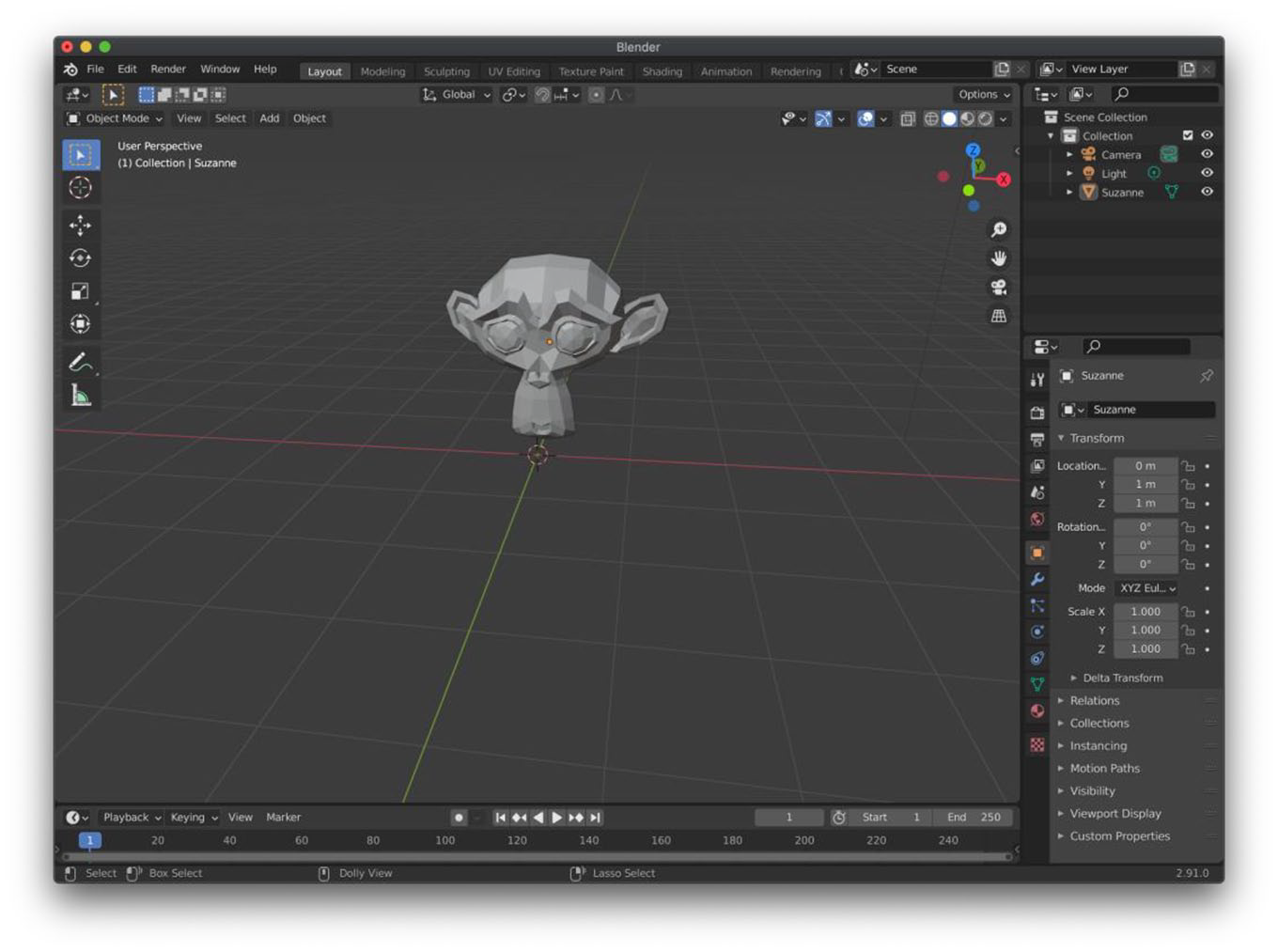
Blender’s work space with Blender’s monkey as a design.
Blender “waits” for the designer to apply their skill set by picking up a digital brush or tool. The designer paints, and Blender reacts to the inputs of the designer by digitally constructing the design onto the workspace. The designer then responds to the shapes and figures that appear on the workspace by taking further actions that will edit, mold, or build upon the figure laid out on the workspace. These constant, ongoing, and barely noticeable interactions form a reciprocal process that shapes and constructs digital designs. In this way, the creation of 3D models can be thought of as a coming together of human (the designer) and non-human (the 3D modeling software) features that together make up the digital design process.
When it comes to live streaming avatar design, the live streaming platform tosses in other ingredients into this design process: audience members and the live chat feature. As the designer and 3D modeling software create together, the audience members watch and become invested in the final product of the stream through the live chat feature. Unlike YouTube, where viewers’ comments on the design video are out of sync with the designing process, live streaming platforms’ live chat feature allows for constant and instant interaction. Often, users of avatar design streams express that the chat feature is what attracts them to a stream as opposed to watching a static video of avatar creation; the live chat feature allows them to interact with the host and thereby enter the design process as it emerges during the stream. Importantly, this feature gives audience members the ability to provide feedback and criticism on the design if they believe the avatar should look differently.
In the streams studied in this paper, like the one described earlier, when the body parts of an avatar models feel “not right” , the viewers involve themselves by asserting how and where the designer should manipulate the design to perfect the model. In these moments, the designer will often act on the collective feedback of the audience member by applying their design suggestions. At other times, the designer will ask for the opinion of the audience when they feel the body is not right, waiting for a collective agreement between audience members and the designer. The designer and software create, the audience members supply feedback or approval, the designer and software respond, and so on. These interactions achieve more than just a completed avatar. We see a formation that occurs between all humans and non human actors that collectively discusses, creates, and shapes images, 3D models, and bodies. But, how does the discussion turn towards white heteronormative expectations that repeatedly re-create the trope of the hyper-sexualized anime girl?
White Heteronormative Live Streaming Spaces
Nakamura (1995, 2014) discusses that users who come from privileged positions (i.e., white, heterosexual, and male) have historically dominated online spheres. Conflicts arise as users insist that other users not “bring identity into online spaces.” In this case, the historical conditions afford whiteness and heterosexuality as the “default,” where each user should work to maintain the white heteronormative status quo. This is also true for live streams, where women or femme-coded people experience harassment during their live streams, often being reduced to body parts (Ruberg et al. 2019; Taylor 2018). This also shows up in streaming platform policy and how it fosters a heteronormative, straight male dominated environment by including guidelines that regulate the bodies of female streamers (Cullen and Ruberg 2019). For the avatar design streams that I studied for this paper, white heteronormativity as a default space is established in three ways: by the design of the stream view itself, how people talk and collectively agree about the gendered aspects of avatars, and the histories of racialized exotification.
The stream’s window frames the 3D modeling software’s workspace to show the different body parts of the avatar for the audience to discuss and dissect. When it gets to a sexualized body part, the audience members and the streamer bring in heteronormative expectations by speaking about the avatar bodies in a heteronormative gendered way. For example, talking about increasing the sizes of the avatar’s breasts or bottoms, and about what constitutes the perfect breast jiggle to increase the sexual appeal.
In these streaming moments, the designer and the audience members work to find ways to use Blender to implement “perfect bottoms” (or other body parts) for the perceived gender of the avatar. Here, a “perfect bottom” for feminine genders is encoded as large and perfectly round. Importantly, when a viewer suggests a fix that would minimize the size or make the appearance of the avatar’s butt block-like (like in the live streaming moment described above), the designer and the rest of the viewers reject the suggestion because such a suggestion would “obviously” decrease the presence of features which code as hyper-feminine. In other words, suggestions that alter avatar bodies away from hyper-idealized femininity are collectively vetoed by the existence and active involvement of the collective audience. In this sense, suggestions that might draw the avatar away from expected femininity and toward other creative capacities potentially left un-tapped in designers and modeling platforms are not realized due to the collective agreement of binary gender representations.
Hyper-sexualization is also increasingly common in anime, as over the years anime female designs have received breast augmentation and wear more revealing clothing. This is a growing trend in various anime studios in attempts to attract heterosexual male viewers to their anime TV shows (Animerose 2020). Although since the introduction to anime to the West, anime designs are drawn with less “Asian features” (Grigsby 1998), I argue that there are other features of avatar design streams that re-contextualize anime girls towards racialized exotification. Many of the audience members and streamers use Japanese words to describe the avatars (such as describing anime girls as kawaii 2 ) or even give the avatar models Japanese names. 3 The streamer and the audience collectively listen to Japanese music to go along with the design process. And, some of the anime girl avatars are adorned with Japanese inspired clothing or animations that allow the avatar to say phrases in Japanese. This is particularly problematic given that the designers and many of the audience member did not identify as Japenese themselves. Moreover, the avatar is quiet, demure, and submissive to being exotified and sexualized, as the avatar does not have her own agency to object. This particularly resonates with the way white men have historically exotified and sexualized Asian women, furthering the stereotyped idea that Asian women are not to be heard and just for white male pleasure (Hai and Dong 2019; Mukkamala and Suyemoto 2018; Nakamura 1995).
In this way, all human and non-human actors contribute to the white heteronormative assemblage that happens between their discussion and production of the anime girl avatar. The process of participating in (white) heteronormative assemblages is a performative way of doing and rebuilding (white) heteronormativity (Butler 1988, 1993). Judith Butler’s concept of performativity showcases how the concept of gender that seems static and located within the individual is collectively constructed through interactive actions. That is, by contributing to interactive processes that creates heteronormative bodies informed by whiteness, the constituent actors of the assemblage collectively abide by white hetero-cultural expectations of gendered and racialized bodies. And so, we can begin to extend the observations made in this paper to include how audience members and designers work to re-define and concretize their gender identity and white heteronormative values in relation to the collective with which they participate (Devries 2021). In other words, by participating in these interactive mixes, people might leave reinforcing their ideas of whiteness, heteronormative genders, and the affordances that hetero-coded bodies carry. In turn, the human actors take these values with them which informs the interactions within online communities, concretizing these spaces as white hetero-male.
By drawing attention to these connections, we can analyze outputs like anime girl avatars as the result of processes and interactions built by hybrid, heterogeneous assemblages, rather than making assumptions about the intent of either human or technological actors (Brett 2021; Giddings 2009). More specifically, rather than concerning ourselves with whether individuals (human or technological) mean to perpetuate white heteronormative standards of bodies, we focus instead on what each actor contributes during the interactive moments which reproduce those white heteronormative worldviews. Shifting our focus this way becomes particularly important when we consider how collective practices carry the affordances for perpetuating white heteronormative standards from their interaction. Evidently, we can neither blame the audience, the streamer, or the platforms alone for the output of hyper-feminine avatars.
Conclusion
In this paper, I followed and built upon the theories that inform a “microethnographic” methodology (Giddings 2009) to outline how we can view avatar design streams as a connection between human and non-human actors that interact and affect each other during live streams. Each actor involved in the stream puts in different work that contributes to the design process. The design process requires both the designer and software to act on and with each other to create new avatar models. The streaming platform ties together the audience members to the design process, where audience members can experience the design process as it happens and provide feedback to be implemented onto the avatar mid-design. In turn, this generates a white heteronormative space where all of these actors collectively construct femme-coded anime avatars through their interactions.
Heteronormative representations are the most common product of this assembled collective entity of streamer, platform, audience, and heteronormativity. This is because when assembled, streamers, spectators, 3D modeling software, and streaming platform restrain femme-coded gendered bodies by following a collective agreement on what hetero gender visuals looks like. In fore-fronting a theoretical and methodological approach that focuses on these connections between actors in avatar design live streams, we concern ourselves with how normative female genders are re-formed and re-coded as “the best ones” through these collective practices. More specifically, in the case of anime girls avatars, we also see that Asian identity is something that can exist online within these assemblages only when it is performed, appropriated, and re-created by white men by using “Orientalism” as a sexual lure (Nakamura 1995).
However, certain live streams in Twitch and other streaming platforms host avatar design streams that produce non-normative and non-heteronormative bodies. I did not explore or discuss these streams in this paper, however I believe that we can still apply this relational lens to explore how queer assemblages form in these streaming moments. By focusing on connections, we can ask questions such as: How are queer assemblages generated? What ingredients do each of these actors bring in to circulate queerness within the assemblage? And, what happens when heteronormative and queer assemblages collide?
In this same vein, I propose that we can extend the insights about interactive mixes and assemblages to gaming live streams. We saw that in the case of avatar design streams, each actor contributes to the design process of avatar models. Furthering the analogy of gameplay from microethnography, that is an interactive connection between player and game, to include the affordances of live stream platforms, live stream gaming is no longer just an interactive moment between player and game, but between audience members, player/streamer, and game/platform. As the streamer plays the game, audience members interject by validating and rejecting certain moments of gameplay. This becomes even more obvious for the streams which include technologies that allow the audience members to directly play with the game. 4
Generally, when studying and working with live streams, I propose that it is important to consider how the variety of human and non-human actors interact to produce the cultural experience of live stream, and in the streams studied for this paper, its visual product in the hyper-feminine anime girl avatar. When looking for connections during moments of live streams, we can begin to ask questions along the lines of “what outcomes arise from the interactive mix created from the connections between streamer, audience, and the digital platforms?” Following an analysis of formative interactions provides a new avenue for game and streaming studies, where our analytical lens turns away from analyzing media content or streamer motive, and instead shines light on the restrictive outcomes of such interactions.
Footnotes
Declaration of Conflicting Interests
The author declared no potential conflicts of interest with respect to the research, authorship, and/or publication of this article.
Funding
The author received no financial support for the research, authorship, and/or publication of this article.