



Abstract
In this paper, we reveal the understudied transnational dimensions of politically manipulative activity on social media. Specifically, we identify and investigate a bot-like Twitter network associated with the controversial organization of Iranian political exiles, the Mojaheddin-e Khalgh (MEK). Tracing and contextualizing the Twitter debate around women’s rights within the 2016 Iranian Parliamentary election, our analysis contributes to the scholarship on diaspora and digital media by drawing attention to the often-neglected potentials for non-state actors such as diaspora groups to make use of social media to promote political propaganda that advances militarist violence. We demonstrate how the MEK network’s “online performance of civic participation” is typical of a bot-net of weak influence inside Iran, but that the aims and extent of its influence can only be fully understood by situating it within a historical and transnational analysis of Iranian diasporic media and politics, one that takes complex US-Iran diplomacy dynamics into consideration.
Introduction
A social bot has been defined as “a computer algorithm that automatically produces content and interacts with humans on social media, trying to emulate and possibly alter their behavior” (Ferrara et al. 2016). Social bots are thought to operate manipulatively in a variety of ways, and the profiling, detection, and understanding of their technical features has produced multiple typologies and sophisticated categorizations (see Latah 2020 for a recent overview). While definitions and taxonomies of bots vary in the scholarship on platforms and political manipulation, there is basic consensus that bots are automated software built to mimic human-run social media user accounts. Hence, a defining feature of social bots is thought to be their automation, which manipulates by mechanically exaggerating the popularity of a person or idea, thus potentially generating greater actual popularity. Indeed, “no real users’ accounts (such as human spammers, trolls, managed accounts) are defined as social bots” (ibid.). However, given the prevalence and relative acceptance of commercial bots that operate in this way, the manipulative quality of bots is not reducible to their technical feature of automation. A further problem with identifying bot manipulation by its automation is presented by the fact that human troll farms are known to be active alongside bots as a common compound tactic (Woolley and Howard, 2019). Troll farms operate by the same mechanism of inluence (exaggeration of populairty) as automated bots, and their observable traces have many of the same deviations as bots’ do from other human use patterns (e.g. tweet frequency, newtork density/isolation, etc.).
Certain leading scholars have defined a sub-category of bots (“political bots”) as being used for the specific objective of political manipulation (Woolley and Howard, 2019), and this sub-category has been designated as “malicious” (Beskow and Carley, 2019), by virtue of the political content being spread. However, this approach also basically understands the manipulative quality of such bots as residing in their automation, and therefore runs back into the problem that the mechanism of influence and observable differences from other human use patterns have close similarities to human-user troll farm initiatives. Their automation, alone, cannot effectively explain what is manipulative about bots.
In the quest to empirically examine the political impacts of bots, a significant area of bot scholarship has focused on cases of domestic politics, with national elections/referenda being the main area of interest. Examples include research on manipulation within the UK Brexit discussion (Bastos and Mercea 2019; Howard et al. 2018) and interference with the 2017 German Bundestag election discussion (Brachten et al. 2017). Research has also traced international links in manipulation to Russian foreign influence on national elections (Badawy et al. 2018; Bessi and Ferrara 2016). Such research also starts from the premise that the manipulative influence of bots is defined by their automation, and is distinguished by metrics such as user networks that appear and disappear in crucial moments (e.g., before a referendum date), produce user activity that is particularly prolific (e.g., producing hundreds of tweets per day), and support a single message (e.g., an election candidate). In light of the challenges of defining what is politically manipulative about bots per se, this paper proposes a deeper understanding of the politics of computational manipulation. We propose drawing on more than content and technical features and rather suggest an analytical approach to manipulation that highlights the inextricable links between bot-technicity and the political context in which this appears.
Exercises of politically contextualizing bot-like networks are not always straightforward, and the case we focus on in this paper exposes the complexities of appropriately contextualizing bot-like activity. This is particularly true when this activity takes place within a transnational political context and has long historical trail of political significance. The case we analyze is that of the Mojahedin-e Khalq or MEK, an Iranian diasporic organization with political ambitions related to the Iranian national context, and whose known strategy involves active political lobby work in the US and Europe. Although the MEK’s official Twitter account claims the organization to be “the main Iranian opposition group seeking to establish a free and democratic state respecting freedoms and gender equality,” the group is a controversial political force whose leadership has been in exile since the 1980s. Its membership of between 5,000 and 10,000 is also reported to be mostly located outside Iran, and it has little involvement in Iranian politics as it instead seeks the military overthrow of the Iranian regime through a strategy of influencing US and EU foreign policy.
To that end, the organization’s most notable advocates have included the former Trump administration’s security advisor, John Bolton, and member of the former US President’s legal team and personal attorney, Rudy Guiliani, both of whom have received fees to speak at MEK events (Dehghan 2018). For such audiences, the MEK has fashioned itself as a major grassroots opposition group with mass support inside Iran. It has furthermore geared its efforts toward gender and women’s rights in Iran, as the above-mentioned Twitter bio also suggests. Cumulatively, we see the contemporary MEK’s political profile as discursively situating the organization within the history of the global “war on terror,” and more specifically, within a gendered, postcolonial historical context in which discourses about the international human rights of Middle Eastern women have been mobilized selectively toward Western militarist agendas (Stabile and Kumar 2005), in which Iranian internet users have been framed as potential allies in the US imperialist project (Shakhsari 2011), and where diasporic actors have been recruited toward similar geopolitical ends (Dabashai 2011).
By challenging the assumption that mechanisms of political manipulation operate within nation-state contexts, the approach to understanding political manipulation we advance in this paper seeks to avoid the “methodological nationalism” of naturalizing the nation state as the unit of analysis (Wimmer and Glick Schiller 2002, 2003). It also avoids the short-term focus that tends to follow from life cycles of bot-nets oriented toward national elections. The main questions the paper addresses are, therefore: how does the transnational and historical contextualization of the social media traces of a diasporic political organization’s activities help to reveal the manipulative qualities of their online political activity? And what can this tell us about how to better define what is manipulative about certain forms of organized participation and campaigning on social media?
To investigate, the paper takes tweet activity as an entry point for understanding the influence of the MEK in the online political discussion within Iran, particularly with relation to the issue of women’s rights. We therefore discuss tweet data collected in the Persian language Twittersphere in the period of the 2016 parliamentary election in Iran with a focus on a specific issue: women in Iran. Twitter was chosen because it is both accessible for research and conducive to political discussions, including in the Iranian context. We look closely at the activity traces of an international online network promoting the MEK, which we identify as bot-like. The analysis we develop demonstrates how the network associated with this exile group is situated within a political strategy that reaches far beyond both the period of the election and the domestic consequences of its political outcome. We argue that the potential political manipulation taking place can be characterized as a tactical performance of civic participation. With this term we refer to concerted social media account activity that aims to mimic aggregate human dynamics in public participation. To the extent that influential social media platforms like Twitter are treated by Western media as a stand-in sphere for Iranian civil society—as we argue they have tended to be—the stakes are raised for the kind of bot-like political manipulation tactics we analyze.
In what follows, we frame our discussion by bringing digital diaspora studies perspectives about transnational political participation to bear on literature concerned with social bot manipulation and related matters of political propaganda specific to the contemporary digital media landscape. The understanding of manipulation we develop by looking at diaspora politics through a gendered, postcolonial, transnational lens rests on an analysis of the inseparable interplay between the technical features of online manipulation and the political context in which it appears. After framing our paper’s contribution to these conceptual discussions, we then present a brief political background to the MEK organization, following which we outline our data collection methodology and how it led us to identify the pro-MEK network. Subsequently, we discuss how the connectivity patterns within the cluster of users that make up this network, and the idiosyncratic usage of hashtags and hyper-intensive tweet frequency, together reflect characteristics of bot-nets described in the literature (Bastos and Mercea 2019). Finally, we analyze the political implications of these findings, showing that the feigned popularity of the MEK supports the organization’s wider regime change agenda. On this basis, we argue that bot manipulation need not increase the MEK’s popularity inside Iran to be effective in inflating the organization’s legitimacy for international audiences. This case, therefore, helps us demonstrate the need for an analytical lens that not only considers the domestic Iranian political context, but also includes the realm of US foreign policy, Iranian diaspora politics, and international mass media narratives about the role of social media in Iranian civil society.
Diaspora Politics and Online Political Manipulation
Seminal research in the burgeoning field of computational propaganda points out that “we can only hope to understand and respond appropriately to a problem like computational propaganda’s impact on our political systems by undertaking computational research alongside qualitative investigation—by addressing the computational as well as the political” (Woolley and Howard 2019, 5). Furthermore, cutting edge social bot studies research reminds us that while the field is advancing technically, “little is known about the actors controlling. . . bots” and how decisions about them are made (Bastos and Mercea 2019, 4). These overlapping bodies of work have highlighted the importance of doing more than technically identifying automated bots, and working toward understanding the complex motives of the agents behind their activities (Ferrara et al. 2016). In-depth, qualitative research on local actors behind manipulative online tactics has compellingly demonstrated how trolls and the human actors behind bots have motivations that stem from interests that must be taken seriously if we are to understand and properly address their usage (Ong and Cabañes 2019). In addition, diaspora politics constitutes an area of digitally-mediated political engagement that especially calls for a transnational approach, as migrant groups often maintain border-crossing political investments in both “host” country and “homeland” politics. And the role of media in these transnational commitments has long been theorized as significant (Karim 2003; Karim and Al-Rawi 2018; Ogunyemi 2015).
In the study of diaspora politics and internet practices, influential works have tended to emphasize the diverse, progressive, and conflict-resolution potentials of political diasporic digital media practices (see Alonso and Oiarzabal 2010; Brinkerhoff 2009; Diminescu and Loveluck 2014). This includes recent work on the powerful role diaspora played in political movements and social changes in their homeland through employing the Internet and social media in the so-called Arab Spring (Moss 2020). But especially in the decade following 9/11, a wider scholarly research agenda on Middle Eastern diasporas in the West developed to present a corrective to policies emphasizing diaspora links to harboring extremists, sponsoring terrorism long-distance, or imposing the spread of illiberal values. Such concerns in Western European and North American countries were expressed through public panics about dual national loyalties, border and immigration policies, and cultural values. Despite its important contributions, the agenda of countering stereotypes of violence may have created a relative blind spot in diaspora and digital media scholarship when it comes to examining diaspora political groupings using social media to advocate for militarist violence.
Nevertheless, there have been exceptions to the tendency for diaspora research to focus on progressive migrant politics and/or apolitical diasporic homeland connections. For instance, Mohan (2015) has valuably pointed out how Hindu nationalists among the Indian diaspora engage in right wing politics online. And Gursel has discussed how diasporic remembering on social media has shaped the memory of the figure of the Turkish guest worker in line with Turkish nationalist tendencies (2020). Alongside the study of conservative nationalisms, critical discussions of inclusion/exclusion processes of migrant groups (or parts thereof) in/from digital publics, spheres, or communicative spaces, has featured in the latest scholarship on digital diaspora and transnational digital politics (Ponzanesi 2019; Udupa et al. 2020). While important, this work stops short of examining specific meanings and mechanisms of political manipulation, disinformation, and malevolent diasporic political participation through means specific to social media platforms. Hence, our focus on the MEK’s activity in the Persian language Twittersphere also helps address the relative under-theorization of social and political processes of platform-based manipulation by diasporic political actors. Examining the peculiar case of the Iranian MEK’s social media activity enables us to fruitfully bring together discussions concerning political manipulation and diasporic digital politics with a twofold aim. Namely, we primarily hope to expand research into online manipulation to more thoroughly incorporate transnational and longitudinal political processes of manipulation. Secondly, we believe the field of digital media and diaspora research is further enriched by investigating the manipulative social media activity of militarist non-state actors within diasporas.
The implications of the social media manipulations we discuss in this particular case are exacerbated by the tendency among Western media audiences to see social media platforms as stand-ins for civil society in Iran and the Middle East. This view has its roots in the notion of Twitter as a replacement for the Iranian blogs that received significant international attention in the early 2000s (see Marchant et al. 2016). This notion of social media as civic stand-in solidified with the 2009 protests contesting the presidential election, a movement in which the use of Twitter gained central international visibility prior to the “Arab Spring.” Many commentators overstated the role of social media in these protests in the rush to explain its impact in comparison with other communication forms (cf. Honari 2015). 1 Some scholars, therefore, counter-emphasized that it was not the sentiments expressed on Twitter that mattered, but the popular contestations of the election results and the street protests (Harvey 2012 as cited in Khiabany 2015).
Yet, the emphasis on Twitter in the 2009 uprising saw an increase in attention for how social media were used in a pro-democratic movement (Honari 2013; Wojcieszak and Smith 2014). In the absence of Western press, who were banned from the country during the 2009 election period, social media platforms like Twitter, YouTube, Facebook, alongside mobile devices, were the main conduits through which the movement of 2009 became “real” for international audiences through the forceful, mediated appearance of “the people” of Iran (Alinejad, 2017). While this bred grassroots international solidarity, it also raised attention for how Western organizations might use platform data to trace trends in Iranian civil society. Conservative think tanks like the Rand Corporation expressed interest in doing Twitter research in countries like Iran (Elson et al. 2012) where authoritarian regimes are unsympathetic to US interests. These developments raise the stakes for the kind of social media manipulation we address in this paper, taking a segment of the MEK’s Twitter participation as a case-study.
Background and Methods: Women’s Rights as Key Political Controversy
After the revolution that overthrew the Shah in 1979, political power in Iran was increasingly consolidated in the hands of the clerical elite. For the MEK, this meant that despite the organization having been the primary armed faction responsible for the overthrow of the Iranian monarchy, it was increasingly excluded from the political process inside Iran, turning it into a clandestine group relegated to isolated pockets of armed struggle responsible for the killings of hundreds of members of political figures associated with the new government (Ismael et al. 2015). MEK leaders and members were targeted (along with other political opposition group members) with severe repression in the late 1980s (Cohen 2018). This severely truncated the influence of the organization’s armed revolutionary forces, which had enjoyed popular support in the immediate aftermath of the revolution (Abrahamian 1989).
Exiled from Iran, the organization’s leadership fled to Paris, establishing themselves there in 1981. But in 1983, at the height of the Iran-Iraq war (1980–1988), the MEK, set up a guerrilla camp on the Iran-Iraq border called camp Ashraf with the aim of overthrowing the new government, and took part in military operations from that base. This signaled the beginning of an alliance between Saddam Hussein and the MEK. “Its forces were used by Hussein to gather military intelligence against Iran and to crush the Iraqi Kurdish and Shi’ite rebellions” (Ismael et al. 2015, 182). This led to the organization’s significant decline in credibility inside Iran. During this period, the MEK was, furthermore, responsible for the use of terror tactics. But since the end of the Iran-Iraq war, the organization’s strategies in attempting to re-build credibility from outside the country meant distancing themselves from their past of armed insurrection and alliance with tyrant, Saddam Hussein, as well as from their foundational ideology that mixed political Islam with Marxist historical thought.
Due to the MEK’s exclusion from the Iranian political sphere, it was reduced to an exile group oriented toward accruing international attention for human rights abuses by the theocratic regime, especially from the US and UK governments they extensively lobbied (ibid.). However, this was also a period in which evidence surfaced of the MEK’s own human rights abuses against its members in the camps (Human Rights Watch 2005). The MEK turned toward the use of “propaganda as their main and most effective tool” in their fight against the Iranian government (Cohen 2018, 1000). 2 The organization’s shift toward media tactics is evident in their recent social media presence. In a report on social media use in the 2016 election period we also discuss in this paper, pro-MEK users were found to be “prolific” on Twitter (Marchant et al. 2016).
Since the US-led invasion of Iraq in 2003, the MEK has further warmed to US interests, aligning with anti-Iran Middle East agendas (Merat 2018). In 2012, under the Obama administration, the MEK was removed from the US State Department’s list of designated terrorist organizations (Richardson 2019; Shane 2012), and in 2012 they opened operations in Albania with Western support. In the course of these developments, the organization’s use of a human rights discourse was instrumental in it reframing itself as a civil society actor. Amidst growing diplomatic tensions between the US and Iran, and with the withdrawal of the US from the Iran Nuclear Deal (Joint Comprehensive Plan of Action or JCPOA) in 2018, the MEK’s positioning as an Iranian human rights defender becomes increasingly valuable to those in Washington who advocate regime change in Iran toward the end of expanding US regional hegemony. With Donald Trump’s ascent to the Whitehouse, the MEK’s relationship with key figures in and close to the administration (Dehghan 2018) boosted the organization’s influence on the then US President (New York Times 2018). The direct influence may vary from president to president, but rather than a break with the past, the MEK’s campaigning reflects continuity with its previously articulated goal of regime change, pursued instead via means of international soft power, and alignment of its own military forces.
With this background in mind, in the initial stage of this investigation, we collected publicly available tweets related to the 2016 parliamentary elections in Iran using the Twitter search API. Specifically, this included all tweets mentioning at least one of the preselected keywords (in Persian) related to the elections and the issue of women. We focused on the issue of women in Iran because it was one of the major sources of dissatisfaction with the Islamic government in the 2009 election (Khiabany 2015), after which this dissatisfaction has only continued, if not intensified. Since that time, widespread and highly contested women’s rights campaigns have gained national and international attention, including in the run-up to the parliamentary elections in question (Barlow and Nejati 2017). Furthermore, the issue of women’s rights in Iran is one of the main human rights issues the MEK is vocal about.
Hence, we refined our investigation through the following keyword selection in order to access the discussion of women’s rights with relation to the parliamentary elections: “elections [انتخابات]”, “parliament [مجلس]”, “vote [رای]”, “candidate [نامزد]”, and “women [زنان]”. This yielded a total of 63,896 tweets made by 9,891 different Twitter accounts. These Tweets were gathered for the duration of four weeks from 12 January 2016 to 9 February 2016 (the elections took place on 26 February) and compiled into a single overall dataset. From those accounts Tweeting in the discussion, we extracted two sub-sets of data; one of users’ “relational data” and another of their “attribute data,” 3 and we excluded the most inactive users whose participation in the discussion fell below three tweets during the data-collection timespan in an attempt to focus on the most significant user engagement. This left us with a dataset of 1,912 active user accounts that posted a total of 37,937 tweets with regard to issues concerning women or the election. This is the data we analyze, adopting the mixed method approach. Researchers investigating the Twitter sphere have been encouraged to combine qualitative and quantitative methods in order to provide greater insights of social media analytics (Bruns 2020). In a similar way to such work (Bruns et al. 2017; Shaw et al. 2013), we initially employed digital quantitative methods to understand the structure of Persian Twitter sphere discussing women issues in the electoral period, after which we used qualitative analysis not only to identify cluster’s characteristics, but also contextualize our findings. However, rather than conduct content analysis of tweets, our approach to contextualization expands the geographical and temporal bounds to how this qualitative step has typically been practiced.
Visualizing Bot Networks by Analyzing User Connections
We distinguish between relations through which users connect to each other (relation network) and channels by which active users spread information and show affirmation (retweet network) (Bingham-Hall and Law 2015). The latter is investigated through tweets and retweets made by users. However, to investigate the connectedness of users, we mapped the network of users on the basis of the “relational data” (the uni-directional relationship of who follows whom). We chose to start by mapping a relational network because we wanted to understand how pro-MEK users were situated with relation to other active users in the discussion. Using the modularity algorithm in Gephi network analysis software, we identified five main clusters based on the connectedness of users, as shown in Figure 1. We identify these according to the common characteristics of their user accounts according to account’s Twitter information, observable attributes, and known key players (see Table 1). The first large cluster (shown in purple in Figure 1) is oriented around international news media agencies’ and journalists’ accounts such as the highly followed BBC Persian account. It has the highest average number of followers (6,335) and the highest percentage of verified accounts (6.01%). Its users have a relatively high average number of tweets discussing elections, which is consistent with journalistic election coverage. We refer to this first cluster as Cluster 1. Journalism and Media.
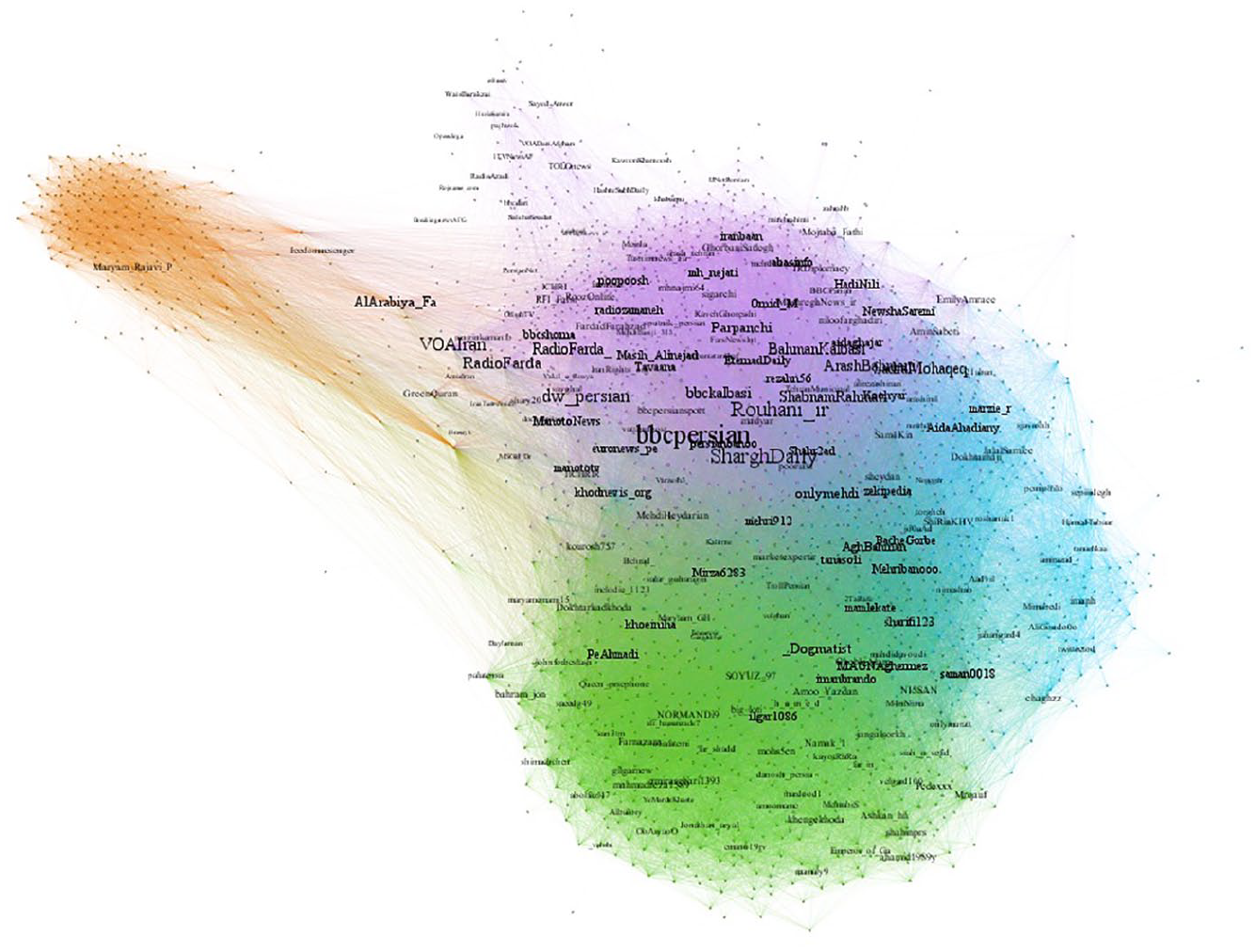
User clusters.
Cluster descriptives.
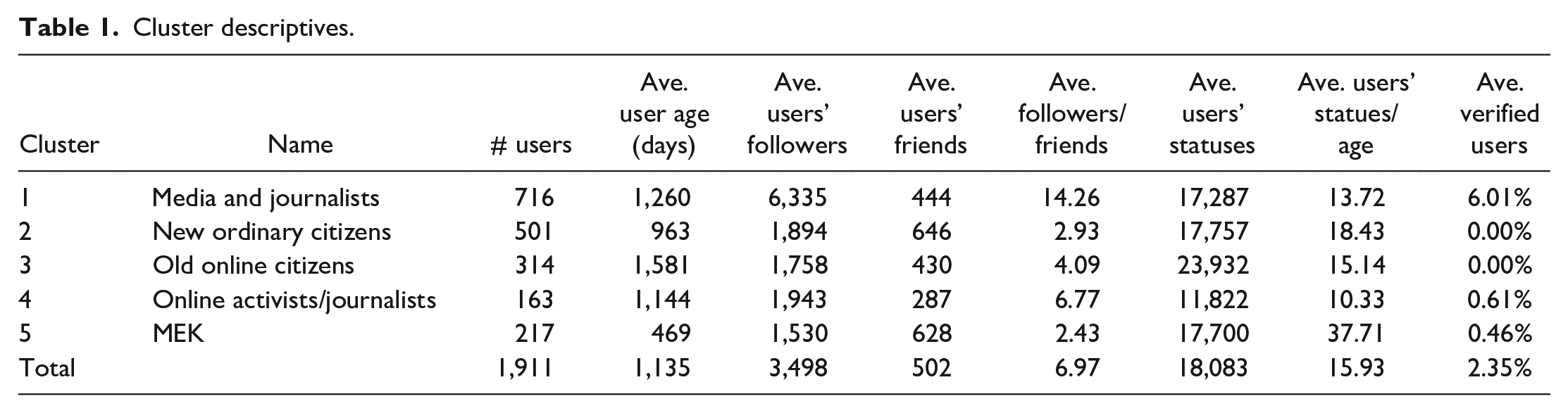
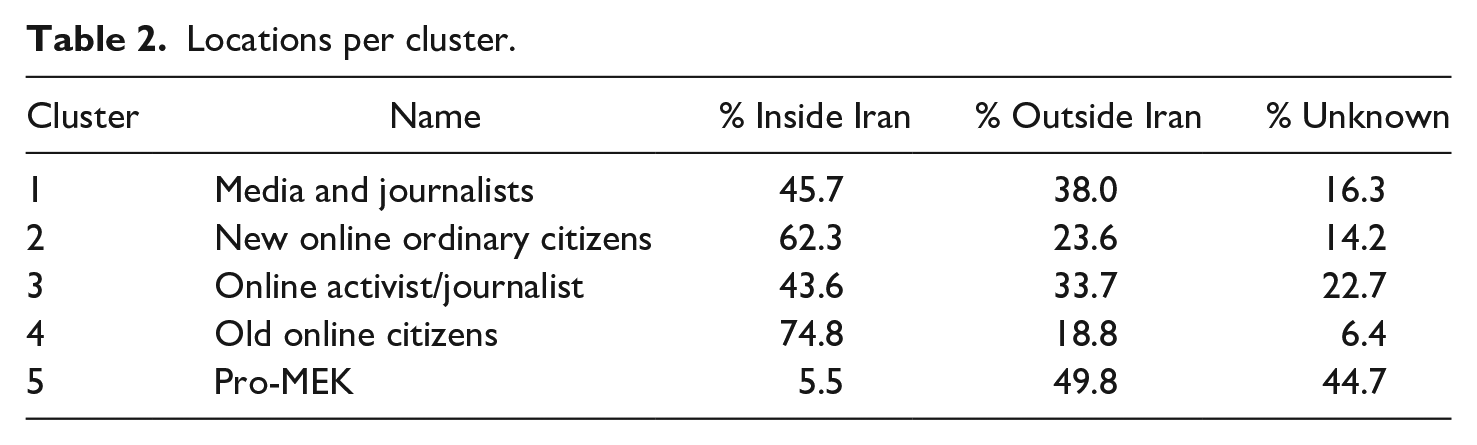
Closely connected to the first cluster is the second largest cluster (green in Figure 1). This one is comprised of a variety of users who are mostly located inside Iran (62.3% inside Iran—see Table 3). The geographical location of users was determined on the basis of each user’s time zone and profile information. 4 This cluster is characterized by users who are neither public figures nor associated with media outlets, and their defining characteristic is that the accounts are relatively new (the average age is about three years), less known and influential and less politically active compared to other ordinary users. We refer to this cluster as Cluster 2. New ordinary citizen users. The third cluster we identified (light blue in Figure 1) was the third largest. It was made up of users who had been active for the longest on Twitter, and it had the highest proportion of users located inside Iran (74.8%). We refer to this cluster as Cluster 3. Old ordinary citizen users (the label of “ordinary citizen” was simply chosen as a way of distinguishing these two lay-user clusters from the journalistic, mass media, and opinion-making/political activist account clusters). The fourth cluster identified was made up of users who were public commentators, bloggers, individual journalists, and online activists. We refer to this cluster as Cluster 4. Online activists/journalists (grey in Figure 1). There are a great many connections between this cluster and the larger ones, as it is embedded between the three aforementioned user clusters. The fifth and final cluster we identified is by far the most loosely connected to the others, and is characterized by accounts associated with the MEK. Its connections revolve around the user, Maryam_Rajavi, the account of the leader of the MEK. We refer to this cluster as Cluster 5. Pro-MEK.
In stark contrast with the other clusters, only 5.5% of the pro-MEK cluster’s users are located inside Iran (see Table 2), and in comparison with other clusters, the pro-MEK cluster, on average, has by far the youngest accounts (469 vs. 1,144, 1,581, 1,260, and 963 days), even more so than the New Ordinary user cluster. The pro-MEK accounts also produce significantly higher numbers of Tweets than others, while having a far lower importance index. 5 This cluster’s users are densely intra-connected, with little connection to the other four inter-connected clusters. In fact, the pro-MEK cluster is only connected to the others via two main bridge nodes. The first is the news agency, Al Arabiya Persian (connecting to Cluster 1. Journalism and Media), and the second is an MEK activist user with 4,498 follows and 831 followers (connecting to Cluster 2. New Ordinary Citizens). On average, users in the pro-MEK cluster have the lowest number of followers.
Locations per cluster.
The dense internal connectivity we find is similar to the findings of work conducted on the “spamming” practices of pro-MEK, bot-like Twitter accounts during discussions of the 2015 Nuclear Deal (or JCPOA) (Najafabadi and Domanski 2018). Given the alignment between Riyadh and elements in the Whitehouse on US foreign policy in the Middle East, the Al Arabiya connection is consistent with this media agency being a Saudi-funded outlet. Overall, we see the pro-MEK cluster as isolated from the other main clusters (for a similar observation see Khazraee 2019; Marchant et al. 2016), both in terms of geographic characteristics and user connectedness. The pro-MEK accounts follow many other accounts, but receive less follows back in comparison with others. These accounts are also are very new, which is consistent with the short lifespan of bots. 6 The isolation we find indicates a superficial penetration and therefore relative lack of pro-MEK accounts’ significant presence in the discussion. In what follows, we discuss the issue participation and forms of engagement among the pro-MEK cluster to further understand the MEK accounts’ involvement in the discussion content.
Tracing Activity: Pro-MEK User and Issue Engagement
Looking more closely at the pro-MEK cluster’s participation, we used the other user clusters as points of comparison. Over four weeks around the 2016 elections, the pro-MEK users intensively participated in the segment of the election discussion focused on the issue of women by tweeting and retweeting significantly more than the other clusters’ users (see Table 3).
Participation in discussion per cluster.
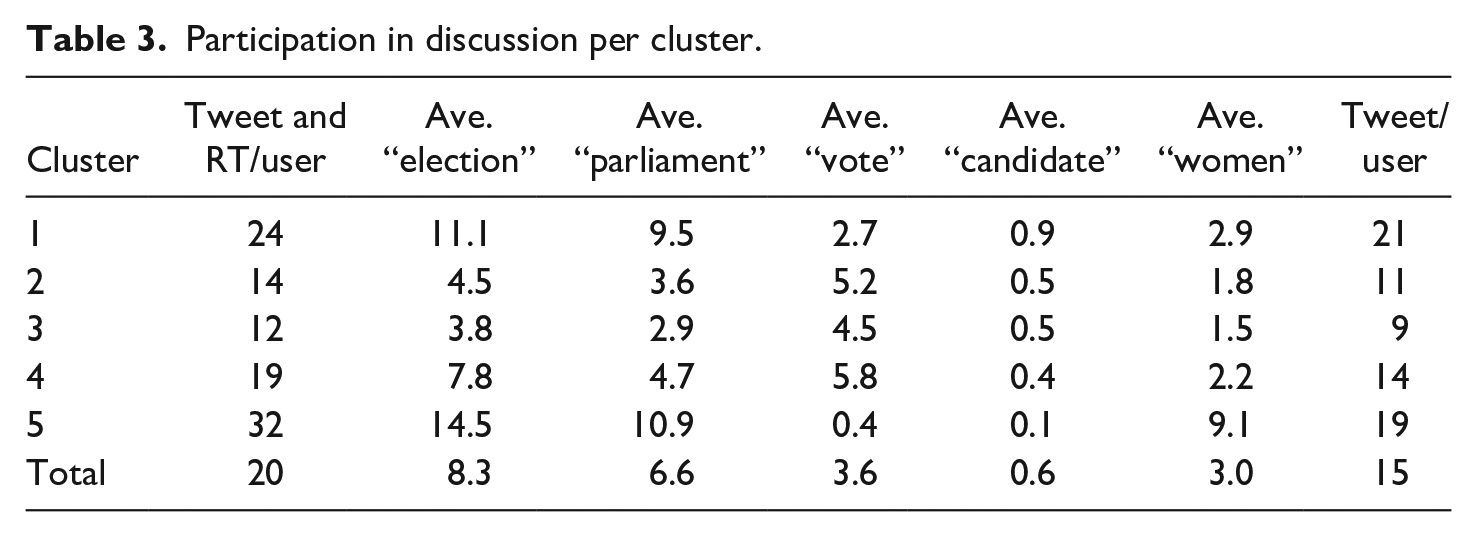
On average, they produced three to nine times the number of tweets of any of the other cluster using the word “women,” and three times more than the Media and Journalism cluster. On average, they also tweeted more than all other clusters using the words “parliament” and “election,” and they produced the highest average number of retweets. Table 4 investigates this striking retweeting behavior.
Retweets per cluster.
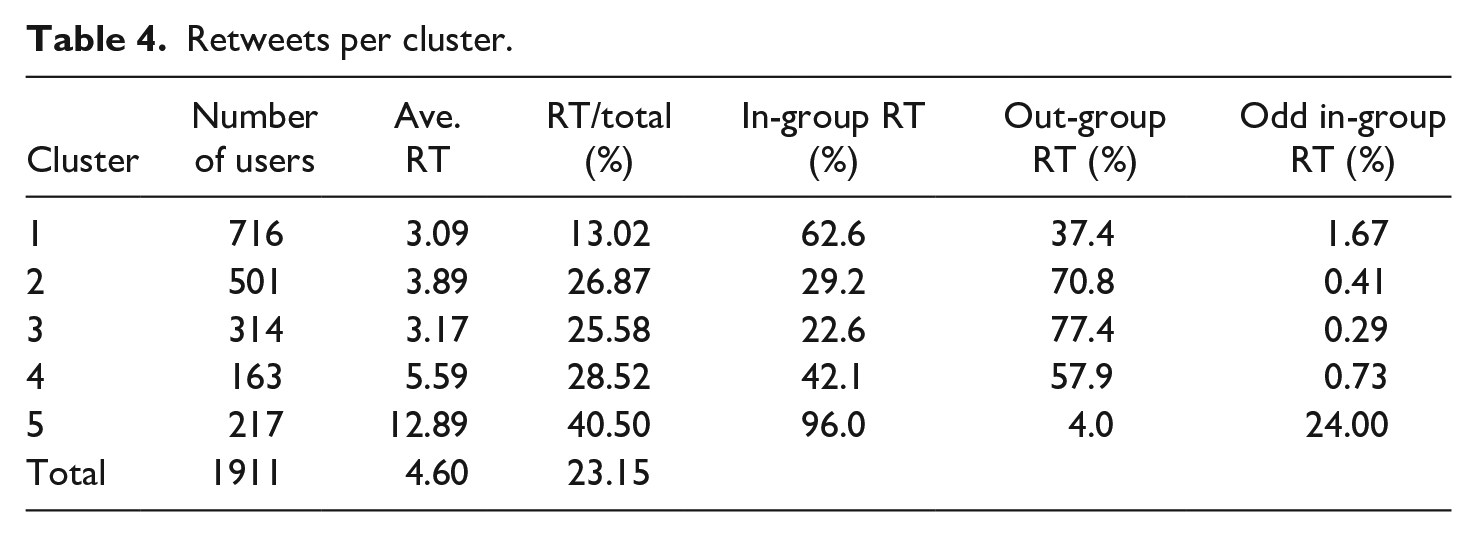
Notably, the percentage of retweets by the pro-MEK cluster (as a portion of total tweets) is markedly higher than all other clusters (40.5%). Furthermore, the tweets that were retweeted almost all originate from within this same cluster (96%), whereas this cluster’s tweets are hardly retweeted in other clusters (4%). While other clusters retweeted each other very frequently, they very rarely retweeted MEK tweets. Of the 6,067 total retweets by other users, only 36 tweets originated from pro-MEK users, such that the cluster’s activity confirms its connective isolation from other participants. We characterize this as a hyperactive level of internal retweeting cohesion, and low level of interactivity with outside users relative to other clusters.
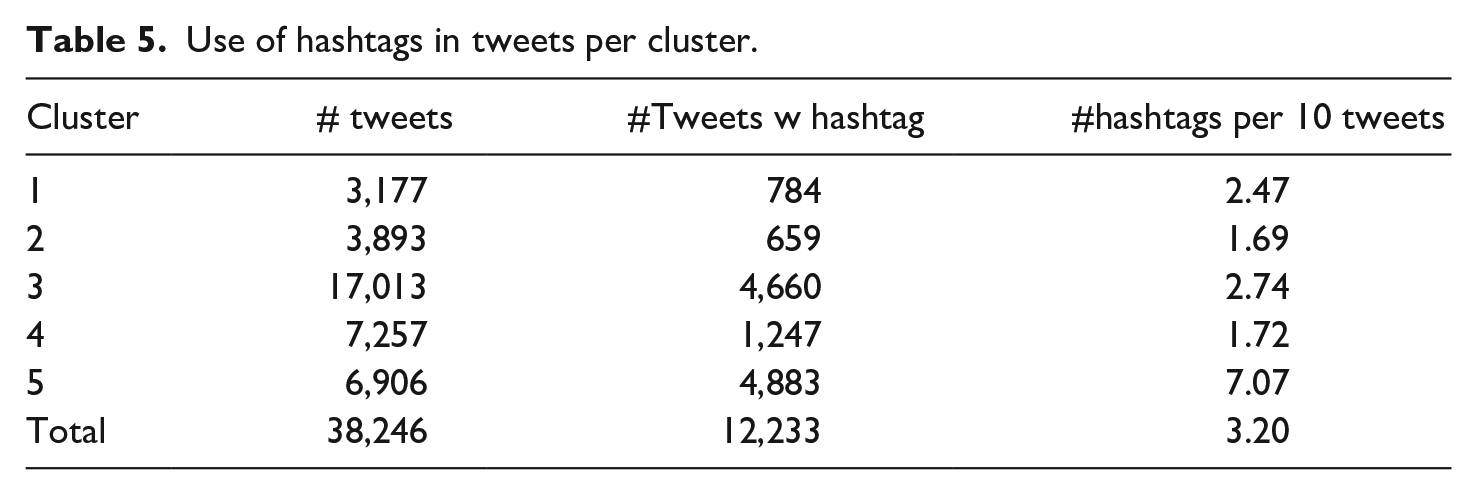
In further analyzing issue participation, we looked comparatively at hashtags the pro-MEK cluster used. From tweet content, we noticed that tweets by pro-MEK users were typified by the relatively intensive usage of hashtags, which inflated the share of the collected data accounted for by this group. Table 5 presents numbers of tweets using hashtags as well as number of hashtags used in 10 tweets per cluster. It shows that pro-MEK users used hashtags in their tweets extremely frequently compared to any other cluster (7.07 hashtags per 10 tweets).
Use of hashtags in tweets per cluster.
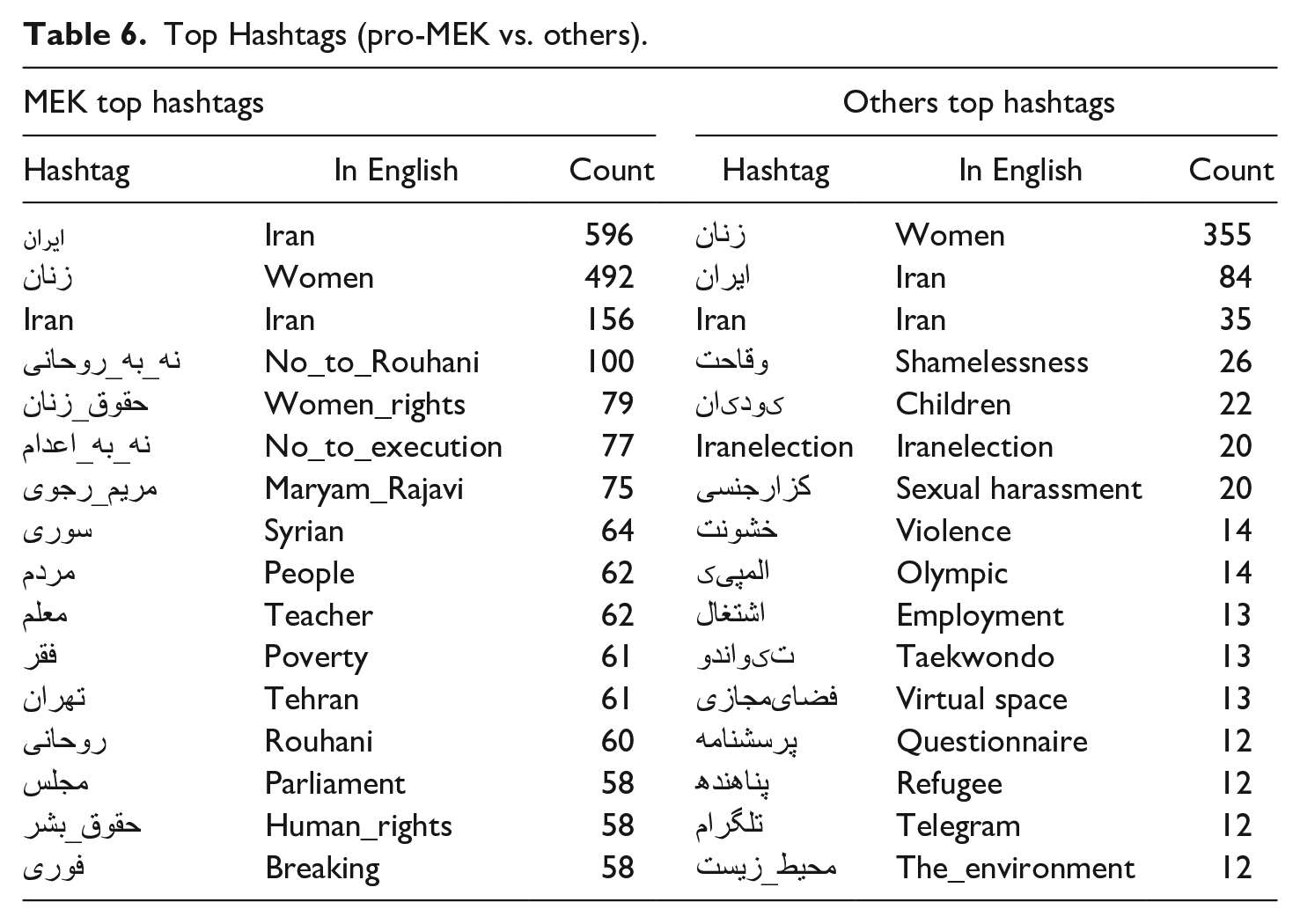
Investigating this further, Table 6 shows top hashtags in the pro-MEK and other clusters. Aside from the exceptionally intensive use of hashtags overall, the content of the hashtags used reflect a difference from those used mostly in the overall discussion. The overall discussion was characterized by the use of hashtags relating to a variety of issues affecting women and Iranian citizens more broadly (e.g., sexual harassment, sports, employment, the environment, children, and the elections), and without reference to specific political figures. The pro-MEK users, however, had a clear focus on women’s rights in terms of human rights (violations), rejecting the Iranian President, and mentioning MEK leader, Maryam Rajavi.
Top Hashtags (pro-MEK vs. others).
Illustrating typical hashtag use that includes #women, Figure 2 shows a tweet with content we translated as “Hope for the future of Iran: #Iran—in #expectation #death [link to blog] #Iran #execution #no_to_execution #human_rights #maryam_rajavi #No2Rouhani #women.” While it was posted by a user whose account information shows no explicit connection to the MEK, the collectively authored blog it links to only reproduces articles published on the MEK organization’s official website (https://www.mojahedin.org/).
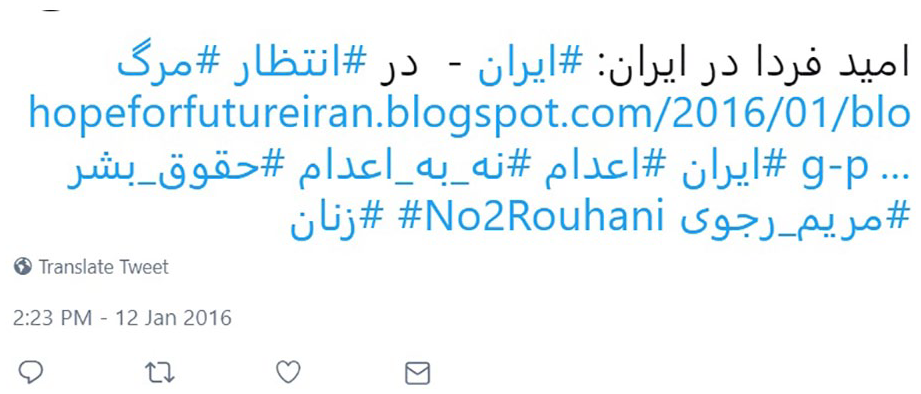
Illustrative tweet from pro-MEK user.
We see this tweet as indicative of a common mode of disengagement with the content of issues affecting women in Iran according to the election debate on Twitter. While it foregrounds human rights—a key theme in the MEK’s contemporary messaging strategy—the tweet makes use of a loose set of hashtags within an otherwise generic tweet about an Iranian “future” rather than with relation to the various relevant societal topics that emerge from wider issue participation on the issue of women in Iran. Using generic hashtags, as a tactic to “broadcast” the message beyond own followers, has been found in the same way associated with bots and conspiracy theories (Moats and Borra 2018). Patterns of connection (densely internally connected and otherwise disconnected cluster), activity (in-cluster retweeting), and issue engagement (narrow focus on women’s rights as international human rights rather than themes from domestic discussions of gender in Iran) together reinforce the cluster’s isolation from the rest of the discussion. This adds a layer to the discussion of the previous section about the cluster’s isolation. Namely, rather than reflecting an infiltration of issues that feature in the national political discussion, MEK activity indicates a hyperactive involvement (in both temporal intensity and overall quantity) that follows a narrow content focus and takes on atypical tweet forms compared to other clusters. While these important features indicate similarities with other bot-like activity, these features do not help us properly comprehend the full extent and nature of the political manipulation in this case. Hence, in the following section, we discuss the implications of the findings thus far presented, arguing that they suggest the MEK network is engaged in what we call “a tactical online performance of civic participation.” We can only develop such an analysis by transnationally contextualizing the social media data we have analyzed.
Tactical Online Performance of Civic Participation
Our analysis of pro-MEK tweeting patterns shows connectivity, activity, and content engagement that is hyper-present in, yet largely dissociated from, the wider 2016 election discussion regarding women in Iran. This engagement is produced through the introduction of new accounts for the apparent purpose of hyper-frequently producing tweets that disproportionately contain hashtags, and which also feature intense retweeting from within the same MEK cluster. These tactics are likely aimed at flooding the discussion’s important hashtags with generic slogans and links to pro-MEK content in a practice of “spamming” that manipulates Twitter trend algorithms, leading to overrepresentation of pro-MEK accounts in the election discussion about themes of women in Iran. However, because of the relative lack of integration with the rest of the election discussion, the influence on the discussion appears limited.
While these tactics might seem weak, we suggest that their efficacy can only be properly understood when seen within the context of a wider MEK communication strategy on Twitter and beyond. In 2019, Twitter attracted some public criticism from Iranian officials and foreign journalists for exercising its anti-bot policy (Twitter 2017) by closing down bot accounts associated with the Iranian regime while leaving certain accounts recognizable as MEK bots untouched (Goldberg 2019). In the same year, Twitter suspended the account of what turned out to be a group of three pro-MEK activists. The account claimed that the MEK was the main opposition to the Iranian regime (Rezaian 2019). The account had engaged in Twitter trolling public figures with anti-war, anti-sanctions, and pro-Iran nuclear deal views. The suspension took place after it became known that Heshmat Alavi—the identity the three MEK supporters had used on Twitter and in credible outlets to publish writing under his name—was not an actual person. This helps to understand the “spamming” tactics we have identified as part of a wider online effort that specifically includes anonymous trolling of users opposing US war with Iran and producing the illusion that credible diasporic authors/opinion-makers support MEK positions.
This approach aligns with the MEK’s strategic lobby efforts, as we outlined above, of supporting foreign-backed regime change in Iran by posing as an Iranian civil society actor and mobilizing human rights media discourses against the Islamic Republic on an international stage. Recent journalistic investigation has also suggested that the MEK is not interested in swaying public opinion within Iran (Hussain 2019), but instead appears invested in the international appearance of legitimacy as an opposition group inside the country. Social media platforms allow MEK actors to perform social media issue engagement that, on the surface, appears as highly active civic participation. The MEK is notorious for its “troll farms” (or “troll armies”), as journalistic investigations suggest that the organization runs concerted social media campaigns out of a heavily fortified base housing 2,300 MEK members in the northwest of Albania (Al Jazeera 2018).
In the relative absence of independent polling and social research inside Iran, and with the web affordances of ubiquitous auto-translate technologies, the mere presence of MEK actors and opinions in the Persian-language Twittersphere potentially shapes the picture that international journalists, policymakers, media pundits, and researchers have of the situation. Following Twitter hashtags and conducting content analysis will reveal a strong presence of MEK perspectives on key issues to international users. However, our analysis reveals multiple observable similarities with bot-nets within this active presence, as well as parallels with techniques used in other MEK bot-like campaigns, and consistency with research characterizing MEK media strategies as focused heavily on international propaganda. We therefore suggest that the MEK’s activity reflects a form of online manipulation that constitutes a misleading performance of civic participation by means of social media; a performance intended to convince international publics of the organization’s popular legitimacy as an opposition group within Iran. We call this a tactical performance of online civic participation.
It is important to note that the potential effects of this strategy are exacerbated by the tendency among international audiences to view the Twittersphere as a surrogate for an otherwise absent Iranian civil society. Due to repressive circumstances, influential social media platforms like Twitter have arguably come to be treated by foreign media and political actors as a stand-in for Iranian civil society. To the extent that this is the case, the stakes of political manipulation through social media bot tactics increase. This expectation that Twitter is a surrogate civil society also places questionable hopes in commercial platforms, and ignores the campaign-based coalition building among women’s advocates/Iranian feminists that has been found to deploy a sophisticated combination of both extensive online work and activity in offline public space “when strategically necessary” (Abbasgholizadeh 2014). It is important, therefore, to remain wary of the lasting effects of mass media narratives and international imaginaries about the democratic role of social media in Iran.
Conclusion
In this paper, we have sought to broaden the analytical scope of research on political manipulation. We therefore challenge the prevalent assumption that the political effects of computational manipulation can be sufficiently understood through the lens of nation-state politics and within relatively short timeframes, and we question whether the automation of bots sufficiently explains what it politically manipulative about them. We investigated a relevant case on Twitter to help show how tracing diasporic political networks might help us better understand the transnational dimensions of manipulative social media activity. More generally, we have sought to show how political and historical contextualization of online data can be done to reveal manipulative processes that would otherwise have remained unnoted. Because the MEK is not an overtly foreign organization, it may register to international audiences/users as nothing but legitimate civil society participants within Iran. Yet, in the Twitter data we analyzed from the Iranian 2016 parliamentary election period, the tactics of the exiled political organization emerged as producing a bot-like network that we argue sought to present a tactical performance of online civic participation. While we saw similarities in the network analysis with bot activity identified in previous research, the political effects of this misleading performance are only fully discernible when understood through a lens that encompasses the history of the organization, its transnational role within its diasporic “host” countries, and the wider geopolitical field of conflict and diplomacy in which it operates.
By situating this discovery within a discussion of political strategy from a gendered postcolonial perspective on diaspora digital politics, we took up the call from bot researchers to develop perspectives that identify “patterns in campaigns and attacks rather than in behavior of single actors,” as this is what can help develop approaches that “are able to deal with human-driven, fully automated as well as hybrid campaigns and attacks in cyberspace” (Grimme et al. 2018, 460).
Rather than being designed to increase MEK popularity in Iran, this network’s performance of civic participation on social media appears to be designed for an international public in order to help the MEK gain legitimacy through the creation of the appearance of involvement in online political discussions, particularly those affecting Iranian women. Looking beyond the temporal and national scope of the election, we demonstrate how the MEK network and its focus on women’s rights is engaged in a complex form of manipulation. It is not the secular, universalist rights discourse that the organization mobilizes on this issue that constitutes the manipulative interference in domestic affairs, as this frame is typically shared by a broader range of Iranian (exile) feminists already for decades (Paidar 1995). Rather, it is the organization’s specific media strategy of fabricating an image of popularity among Iranians that underpins our argument about this new manipulative tactic. Since this tactical performance is tailored to Twitter in platform-specific ways, it presents both new technical and political challenges for detection and analysis.
While we agree with the value of more research on Persian language Twitter (Khazraee 2019), such research must account for bot accounts, trolls, and other forms of manipulation as their existence challenges the validity of social media studies (Keller and Klinger 2019, 185). And while Iran’s recent state sponsored tactics have been analyzed (Kargar and Rauchfleisch 2019), we show that non-state actors’ tactics are significant and worthy of further investigation, as well. Most importantly, our intervention draws attention to the understudied dark sides of diaspora communications in the age of digital disinformation. By bringing the area of internet research-within which digital diaspora studies is situated-into closer relation to studies of political manipulation, we expose how propaganda can be hidden in media-specific and transnational ways, thus heeding recent suggestions of scholars urging greater engagement between internet research and propaganda studies (Farkas and Neumayer 2020). As research on computational disinformation develops, we underscore the significance of transnational social forces and international policy dynamics for understanding the impacts of tech platforms on political communication. As we have highlighted in our analysis, this includes expanding narrowly focused bot studies scholarship to further account for how platform-specific facets of current manipulation forms are inextricably linked with deeply layered political histories. Through the case we have discussed, we demonstrate the importance of addressing regional histories (of war and revolution), globally hegemonic policy discourses (of liberating Middle Eastern women through invasion), and narratives about new media (of internet as democratic) as a way of helping to elucidate the strategically manipulative qualities of otherwise fragmented instances of bot-like activity on social media. 7
Footnotes
Declaration of Conflicting Interests
The author(s) declared no potential conflicts of interest with respect to the research, authorship, and/or publication of this article.
Funding
The author(s) received no financial support for the research, authorship, and/or publication of this article.
