



Abstract
States are struggling to assure an adequate number of registered nurses are active in the clinical workforce to serve patients and communities. Nurse compact legislation—enacted in 39 states—facilitates interstate recognition of nurse licensure. We used a cross-sectional email survey of registered nurses in Michigan to measure their opinions on compact licensure legislation and examined differences in compact licensure opinions by nurses’ personal characteristics. Primary analyses reported herein are from 7,098 Michigan nurses with complete data. Most respondents felt that the compact would make it easier to redeploy nurses in an emergency (76.6%), improve access to nursing care (66.6%), and boost their personal career options (55.1%). Most nurses disagreed that compact legislation would weaken patient protections (60.7%). The majority expressed neutral feelings on whether compact licensure would make disciplinary actions more difficult to enforce (50.9%) and a plurality that current licensure policies were satisfactory (44.0%). The majority were supportive of Michigan joining the compact (72.3%). In multivariable analysis, stronger support for joining the compact was associated with advanced degrees, male sex, and younger age. Less support was associated with membership in a collective bargaining unit. Policymakers who wish to ease acute nurse vacancies should consider enacting nurse licensure compact legislation. Careful attention to patient protections and disciplinary review would address potential safety concerns.
Introduction
Across the United States, policymakers are seeking solutions to ease the painful impacts of nurse vacancies. Easing regulatory burden of nurse licensure in each state is one identified strategy, as there is ample evidence that nurses are unevenly distributed across the United States with respect to population needs (Auerbach et al., 2020). The nurse licensure compact, currently enacted in 39 states, facilitates interstate recognition of nurse licensure. Purported benefits of the legislation include broader recognition of licensure across compact-participating states, potentially accelerating registered nurse employments in acute shortage areas. Compact states also share and report disciplinary data, which could facilitate faster response to potential safety concerns.
Despite these potential benefits, there is sparse empirical literature on nurse compact legislation and regulation (French et al., 2022; Scheidt, 2022). The extant literature takes the form of informational news articles, opinion pieces, and case studies. Prior concerns on compact legislation have largely centered on assuring the integrity of state-level nurse registration, as well as concerns that state boards of nursing may abdicate important credentialing responsibilities, which could pose risks to patient safety (Scheidt, 2022). Proponents assert that compact legislation accelerates nurses’ (re)location to areas of potential shortages, streamlines and simplifies initial licensure and subsequent renewals, and offers greater opportunities to share safety and credentialing information across multiple states simultaneously (Puente, 2017).
Few investigators have solicited the views of registered nurses about compact licensure legislation in states that have yet to join. As part of a broader query on nurses’ opinions of various health workforce policy proposals, French et al. (2022) asked nurses in two states, “how do you view allowing RNs to practice across state lines without obtaining additional licenses?”; 74% of respondents supported the proposal (French et al., 2022). To date, no published paper has asked nurses specifically about the potential pros and cons of compact legislation. This critical gap in understanding makes it difficult to inform policymakers and assure that health policy changes align with community views (Lomas, 2000). Michigan is a unique setting to conduct this work, as the state faces notable workforce deficits and borders four states, three of which are compact states.
As part of a larger investigation on an array of workforce concerns, our team launched the Michigan Nurses Survey on February 22, 2022, to provide actionable data for policymakers and health care leaders. Within this larger survey, we intentionally assessed nurses’ views on compact legislation. For this specific subproject, our research questions were as follows:
What are registered nurses’ views of nursing compact licensure legislation? What personal factors are associated with more and less favorable views of joining the nursing licensure compact in a state that has yet to enact legislation?
Data and Methods
Our team has published the survey methodology previously (Medvec et al., 2023). Registered nurses who held an unrestricted license in the State of Michigan as of February 2022 and had valid email addresses on file (99% of the population) were eligible to participate. The state licensing agency provides email addresses on file for individuals who hold registered nurse licenses.
Using Qualtrics™ (Provo, UT), the research team sent up to three email messages to the sampling frame, eight days apart (Dillman et al., 2014). The anonymous feature was used to protect identities and separate identifiers from participants’ survey data. No incentives were provided, other than the option to receive study results at the conclusion of the project, regardless of participation. The survey included several other components, in addition to the compact legislation questions (the entire survey is available upon written request to the corresponding author). In field-testing with three registered nurses and two social scientists (not on the study team), the full survey took an average of fifteen minutes to complete. More complete details on survey administration are available in the Supplementary Material.
Of 165,185 email addresses associated with a registered nurse license in the state of Michigan, 17,936 recipients (11%) opened the survey invitation and of these, 13,687 (76%) completed the survey. Using the American Association of Public Opinion Response Rate calculator, the calculated response rate—2 is 8.3%. From those who completed the survey, 7,098 (51.86% of all respondents) reported their personal characteristics and answered all seven compact licensure questions for this specific analysis.
Nurses reported their primary nursing position and received guidance to answer survey questions that were pertinent to their role and skip any questions that were not. All participants completed informed consent during survey completion. The study protocol was reviewed by the Institutional Review Board and was determined to be exempt from review. The analyses reported herein are from nurses who completed all survey items that pertained to perceptions of nursing compact legislation.
Perceptions of Compact Legislation
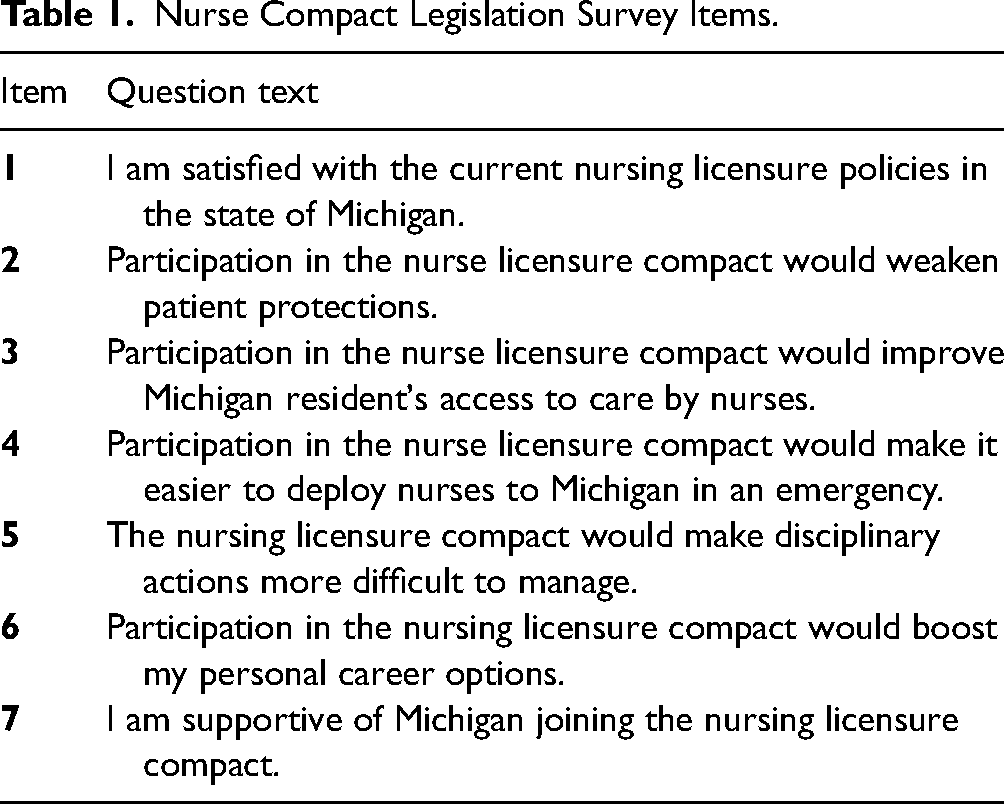
Other than one study that used a single item question as described above (French et al., 2022), the study team was unable to find previously-published surveys in the peer-reviewed literature that assessed nurses’ views on compact legislation. Therefore, our team drafted candidate statements that were framed as favorable, neutral, or unfavorable to the policy. By consensus, the team included seven items in the survey, and asked participants to rate their agreement with each item, using a five-point Likert scale (1 = strongly disagree, 5 = strongly agree). Items are listed in Table 1.
Nurse Compact Legislation Survey Items.
Personal Factors
Our prior work has shown notable differences in nurses’ workplace assessments by individual nurse characteristics (Medvec et al., 2023). Personal factors were included in these analyses to help inform policymakers appraise differences in compact licensure opinions across the state's registered nurse population. Age was treated as a categorical variable, congruent with the state's nurse licensure reporting system. Nurses identified their primary practice setting (inpatient/acute care, long-term care, community or public health, school nursing, nursing education, or other). We asked nurses to report their gender identity, whether they held an advanced practice nurse role, and whether they were a member of a collective bargaining unit in their primary nursing position.
Analyses
IBM SPSS Statistics was used for all analyses (IBM SPSS Statistics 29). After descriptive statistics were computed for outcomes and independent variables, a linear regression model was used to estimate the relationship between personal factors and overall support for Michigan to enact compact legislation.
Study Results
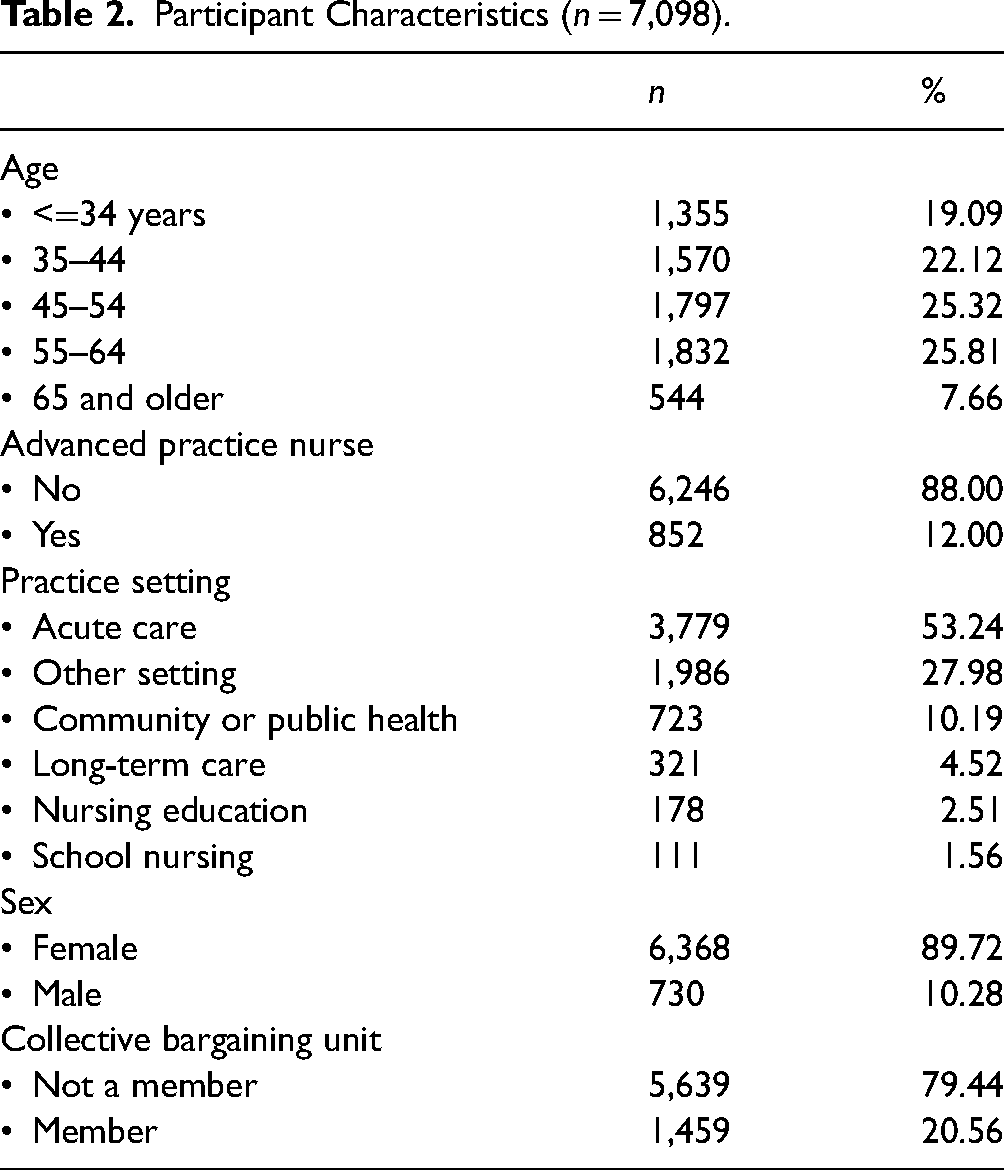
Table 2 shows characteristics of participants included in these analyses. In Supplemental Material, we compared distributions of nurses by age and advanced practice nurse status across the analytic sample for this analysis, all survey respondents, and the entire population of Michigan nurses. The analytic sample is slightly younger and includes more nurse practitioners than the overall Michigan nurse population.
Participant Characteristics (n = 7,098).
Nurses’ Opinions on Compact Legislation
Overall, nurses held positive views on many aspects of compact legislation (Figure 1). As a baseline, a plurality of surveyed nurses assessed the overall nurse licensure policies in Michigan as satisfactory (44.0%). Most respondents agreed or strongly agreed that the compact would boost their personal career options (55.1%), make it easier to redeploy nurses in an emergency (76.6%), and improve access to nursing care (66.6%). The next two items were reverse coded, as they represent less positive views of compact legislation. The majority expressed neutral feelings on whether compact licensure would make disciplinary actions more difficult to enforce (50.9%). Most nurses disagreed or strongly disagreed that compact legislation would weaken patient protections (60.7%), while 5.1% agreed or strongly agreed and 34.2% were neutral. On the final global item of support, the majority agreed or strongly agreed that they were supportive of Michigan joining the Compact (72.3%), 3.9% disagreed or strongly disagreed, and 23.8% were neutral.
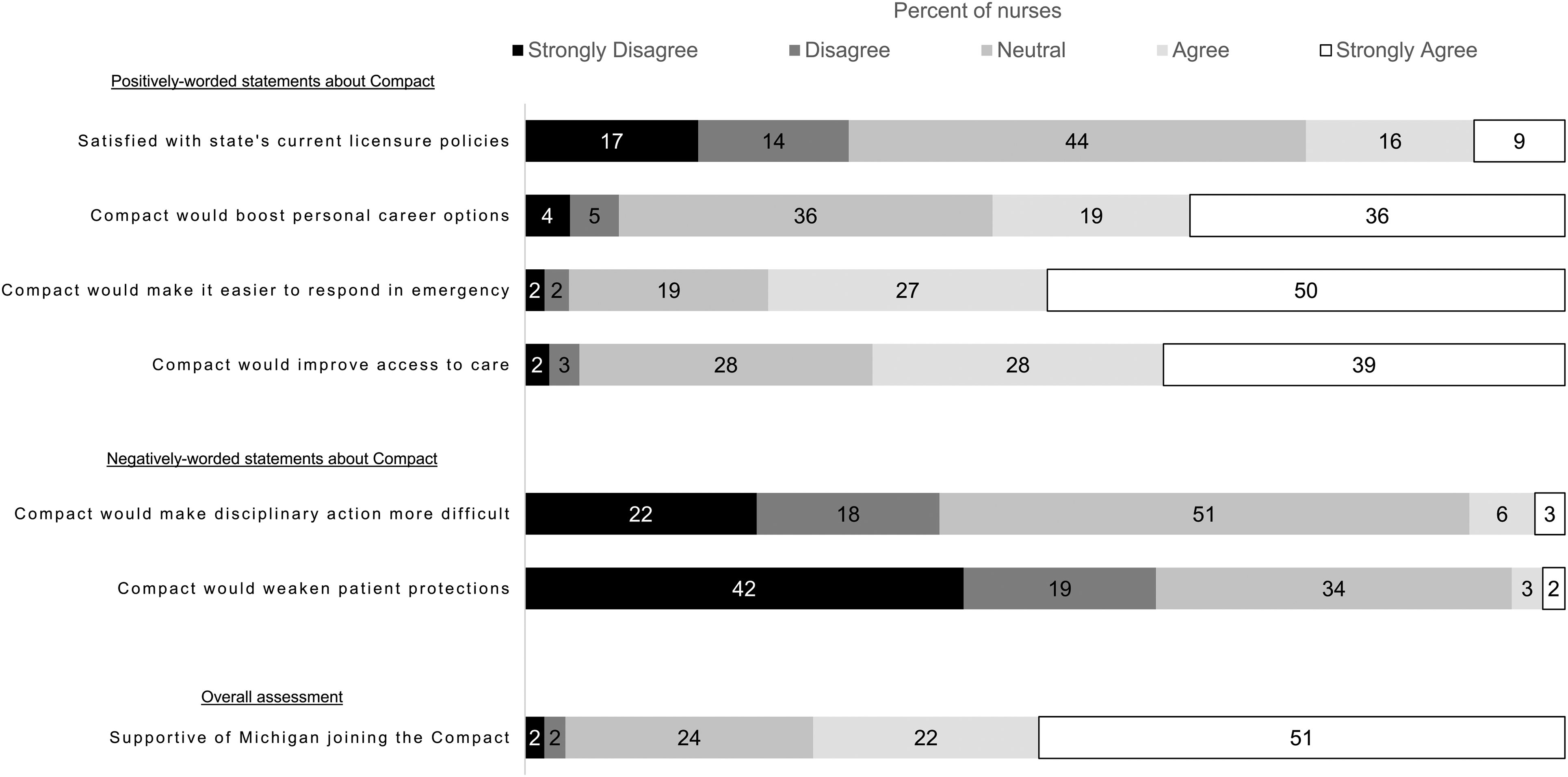
Participant Views of Nurse Compact Licensure Legislation (n = 7,098).
Favorable Views of Compact Legislation
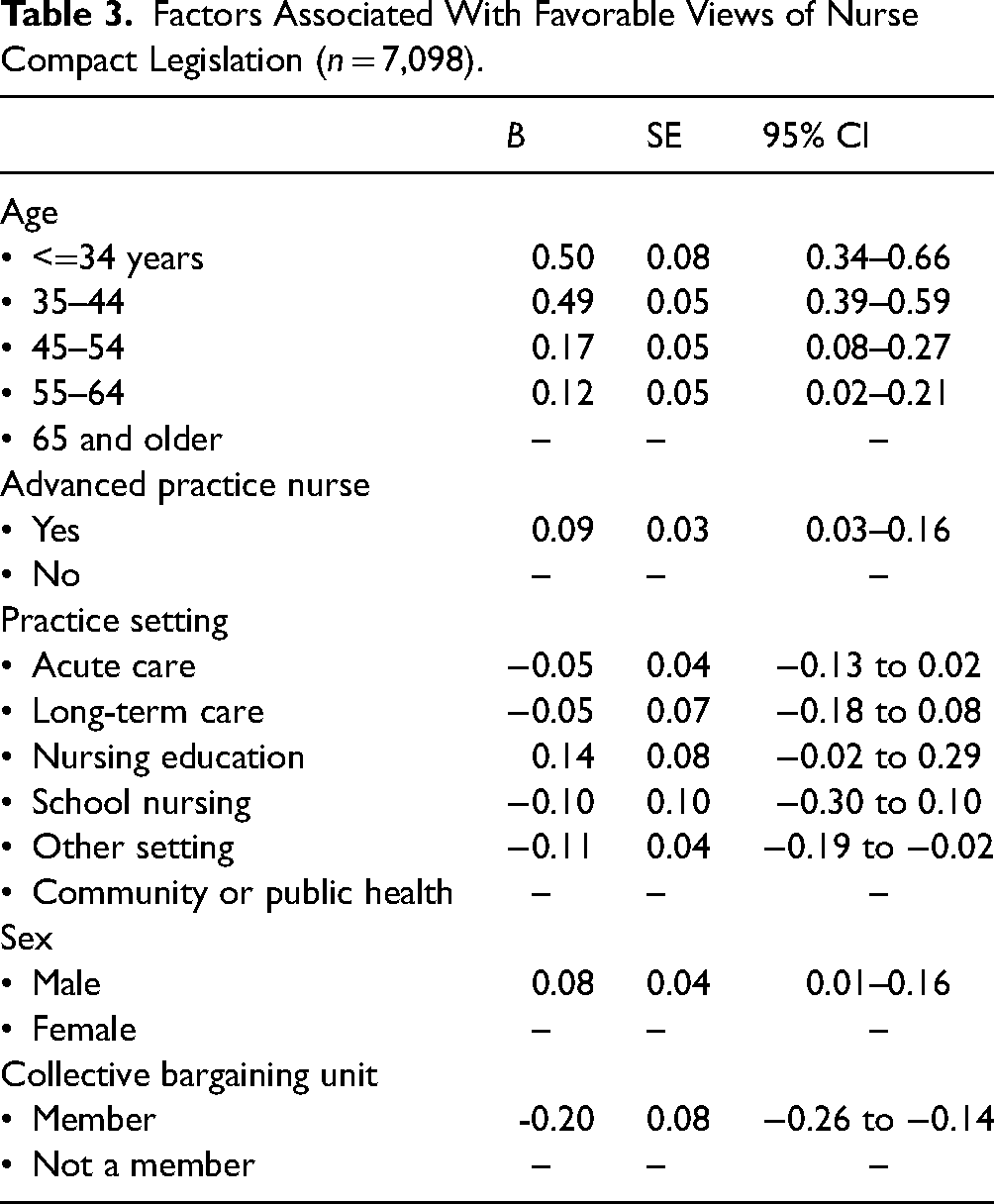
Factors significantly associated with more favorable views of the compact included advanced practice nursing degree (β = 0.09, 95% confidence interval [CI] 0.03–0.16) and male gender (β = 0.08, 95% CI 0.01–0.16), and younger ages, compared with nurses 65 years of age and older (see Table 3). Factors associated with less favorable views of compact legislation included membership in a collective bargaining unit (β = −0.20, 95% CI −0.26 to −0.14) and practice settings outside of schools of nursing, although most of these differences are not statistically significant (see Table 3). The only significant difference in setting observed was that nurses employed in “other” settings, compared with nurses in community or public health, held more negative views of compact legislation (β = -0.20, 95% CI −0.26 to −0.14).
Factors Associated With Favorable Views of Nurse Compact Legislation (n = 7,098).
Discussion
In this 2022 statewide sample of registered nurses, our team found generally favorable views toward compact legislation. The majority or plurality of nurses agreed on most of the potential benefits and were neutral on potential downsides to the legislation. As states continue to grapple with negative impacts of acute vacancies and increased demand for nurses, these findings have immediate policy implications (Buerhaus et al., 2022).
Placed into context, the study findings provide policymakers with nurses’ current views on compact legislation. The overall positive assessment of compact legislation in our sample aligns with a similarly high rate (74%) reported in a survey of New York and Illinois nurses, where compact legislation is also pending (French et al., 2022). The data reported herein provide additional nuance to that overall sentiment. Specifically, nurses surveyed in our sample agreed that joining the compact would assist in emergency response, improve access, and boost their own career options. They held more mixed views on whether the compact would weaken protections or whether the compact would make disciplinary enforcement more difficult. Small differences were noted across personal factors; nurses of younger age, notably those below 44 years of age, viewed the legislation more favorably when compared to nurses who were 65 and older. Compact participation may offer longer-term career flexibility for nurses who expect to work longer, compared with those who are closer to retirement. Advanced practice nurses held more positive views, which may reflect their employment settings. Compact legislation may reduce administrative burdens for nurses whose employers have cross-state practice sites. Differences across practice settings were small; slightly more negative views by nurses employed in “other” settings may reflect the diffuse nature of this category of survey respondents. Slightly less favorable views among collective bargaining unit members aligns with critiques of the legislation that have been published previously by National Nurses United, which includes several statewide collective bargaining units (Hwang, 2018).
During the acute phase of the COVID-19 pandemic, Michigan's governor issued emergency orders that permitted registered nurses licensed in other states to practice in Michigan. Those powers ended as public health emergency orders expired. Despite state house and senate passage of compact licensure legislation in 2020, the Governor vetoed the bill, citing constitutional sovereignty concerns (Sanchez, 2020). Specifically, the governor cited that if enacted, the compact legislation would forfeit the state's prerogative to set standards of care required of nurses. Conversely, Michigan's physicians have participated in multistate compact licensure since 2019, enacted under a different administration and legislative composition.
The authors recognize the disparate views and policy approaches to compact legislation, which also aligns with the present study's findings. Opponents to compact legislation have identified challenges given recent threats to secure and valid nursing licensure procedures. Surveyed nurses’ equivocal views on patient protections and disciplinary actions warrant further scrutiny, given the January 2023 indictments of individuals for providing false nursing school transcripts (Fake nursing diploma scheme in Florida; 25 arrested, 2023). These findings suggest there is an important opportunity to revisit and potentially strengthen the regulatory guardrails that support registered nurse licensure. One can support these actions, regardless of one's views of compact legislation.
As examples, the National Council of State Boards of Nursing, respective State Boards of Nursing, and nursing school leaders need to strengthen the quality and rigor of student documentation and strengthen reporting processes to assure nurses and the public that all state regulatory bodies employ rigorous credentialing and oversight functions. If compact legislation proceeds in states that have yet to enact the provisions, ongoing assessment of safety and disciplinary concerns would strengthen the evaluative rigor of the program and identify actions for future quality improvement.
Study Limitations
Study limitations included a relatively low response rate; however this response rate is comparable to others that use large sampling frames and approach participants via email (Lasater et al., 2021). Moreover, we did not identify systematic bias in the survey sample relative to published data on the population of nurses in the State (Medvec et al., 2023). Our sample differs slightly with more nurses of younger age and advanced practice credentials than the state of Michigan census. Data were not available on nurses’ employers or their specific geographic location, which may have uncovered additional differences in nurses’ views on compact legislation. For example, nurses who resided close to bordering states that participate in the compact may hold more favorable views of the legislation, as might nurses employed in health systems with locations in multiple states. These limitations are presented alongside a large statewide sample, and direct solicitation of nurses’ views on a timely and actionable policy issue.
Conclusions
In a large statewide sample, registered nurses were generally supportive of nursing compact licensure. The purported benefits—improved access to care, faster emergency response, and advancing career options—are weighed against mixed views on patient protections and disciplinary concerns. The findings provide regulators and health policymakers with the data necessary to consider nursing licensure reforms. As federal and state policymakers face increased pressure to address registered nurse vacancies, broader enactment of compact legislation has the potential to ease nurses’ burdens in securing licensure, provided that close attention be paid to assuring robust monitoring and oversight (Costa & Friese, 2022).
Supplemental Material
sj-docx-1-ppn-10.1177_15271544231210518 - Supplemental material for Nurses’ Perceptions of Licensure Compact Legislation to Facilitate Interstate Practice: Results From the 2022 Michigan Nurses’ Study
Supplemental material, sj-docx-1-ppn-10.1177_15271544231210518 for Nurses’ Perceptions of Licensure Compact Legislation to Facilitate Interstate Practice: Results From the 2022 Michigan Nurses’ Study by Barbara R. Medvec, Marita G. Titler and Christopher R. Friese in Policy, Politics, & Nursing Practice
Footnotes
Declaration of Conflicting Interests
The authors declared no potential conflicts of interest with respect to the research, authorship, and/or publication of this article.
Funding
The authors disclosed receipt of the following financial support for the research, authorship, and/or publication of this article: This work was supported by the National Institute of Nursing Research, University of Michigan, National Cancer Institute (grant numbers T32-NR016914, Elizabeth Tone Hosmer Professorship Funds, P30-CA-046592, T32-CA-236621). The work and views expressed are solely those of the authors and do not necessarily represent the views of the funders or the authors' employers or affiliated institutions.

Supplemental Material
Supplemental material for this article is available online.
References
Supplementary Material
Please find the following supplemental material available below.
For Open Access articles published under a Creative Commons License, all supplemental material carries the same license as the article it is associated with.
For non-Open Access articles published, all supplemental material carries a non-exclusive license, and permission requests for re-use of supplemental material or any part of supplemental material shall be sent directly to the copyright owner as specified in the copyright notice associated with the article.
