



Abstract
This paper examines the socioeconomic drivers behind the structural transformation of leisure in developing economies, emphasizing the modernization of sports consumption. Using a two-way fixed-effects panel-data model on 19 upper-middle-income countries (2008–2023), we analyze disaggregated imports of two bundles: a ‘Modern’ wellness bundle (individual fitness equipment and lifestyle apparel) and a ‘Traditional’ sports bundle (team and outdoor equipment). The findings reveal that rising per capita income is the primary factor driving this shift, with the income elasticity of demand for the Modern bundle (1.2) exceeding that of the Traditional bundle (0.84). Urbanization shows a consistent, yet counterintuitive, negative relationship with sports goods consumption. As income grows, consumer preferences shift from collective, outdoor sports to individualized, wellness-oriented activities. This transformation presents significant implications for public health policy, particularly in mitigating emerging lifestyle inequalities through targeted interventions, and for global firms aiming to engage a new generation of consumers in developing economies.
Keywords
Introduction
The concept of structural transformation traditionally explains the reallocation of an economy's productive factors from agriculture and industry to services. However, contemporary perspectives broaden this framework to encompass fundamental societal changes such as the transitions from rural to urban living and from home production to market-based consumption (Alisjahbana et al., 2022; Sen, 2023; Zhibiao and Yonghui, 2022). Central to this process is the non-homothetic nature of household demand, where rising incomes systematically shift spending from basic necessities toward discretionary services and lifestyle goods (He et al., 2024). Framed in the context of sports economics, our paper argues that investigations into the evolution of leisure can offer new opportunities through which deeper structural transformation can be analyzed.
One highly relevant domain where these economic shifts can be observed is in the consumption of leisure and lifestyle goods, particularly in emerging markets. While it is well-established that economic development spurs aggregate consumer demand (Araujo and Teixeira, 2021; Jangam et al., 2024; Ramadan and Morshed, 2024), the following question regarding the mechanism of this transformation remains largely unanswered: Does rising per capita income drive a fundamental shift in consumption patterns toward modern, individualized, and aspirational goods, or does it scale up existing demand for traditional ones? Answering this question is crucial for understanding deeper transformations that accompany economic modernization. The distinction matters not only for theory but also for policy, as each pathway implies different welfare dynamics, infrastructure needs, and market signals for firms responding to evolving consumer hierarchies (Sharma, 2024). The current paper addresses the problem by investigating whether the structural transformation of leisure is characterized by a simple expansion of demand or a significant compositional change in consumed goods.
The resulting primary aim is to address the research question empirically in the context of sports consumption across a panel of 19 upper-middle-income economies from 2008 to 2023. Due to the need to distinguish between a scaling-up of demand and a true compositional shift, the core methodological choice is to disaggregate demand into two theoretically distinct categories. Specifically, a ‘Modern’ consumption bundle is the first classifier that comprises individual fitness equipment and lifestyle-oriented sports apparel to reflect the advent of a privatized, wellness-centric culture. In contrast, a ‘Traditional’ bundle accounts for team and outdoor sports equipment that is associated with community-based recreational activities. To our knowledge, this is the first multi-country empirical study systematically testing for heterogeneous demand drivers across these two groups, a choice that allows us to explore the specific nature of consumption modernization. This empirical separation also enables clearer detection of emerging consumption hierarchies that would remain obscured in aggregate-level analyses.
The paper's contribution is the empirical identification and quantification of the compositional nature of leisure transformations. Instead of only confirming that economic growth amplifies aggregate demand, we demonstrate that rising per capita income systematically drives a shift in consumer preferences toward modern, individualized forms of leisure. In this light, our analysis uncovers complex structural dynamics that challenge conventional development assumptions, particularly regarding the role of urbanization. The results indicate that urbanization, often treated as a proxy for modernization, may not reliably signal increased demand for tradable lifestyle goods. Consequently, the study provides a novel framework for understanding the evolution of consumer markets, while offering key insights for development theory, public policy, and global business strategy.
The following structural organization effectively presents the conducted research: Section 2 highlights the reviewed literature on structural transformation, consumption hierarchies, and the determinants of sports demand; Section 3 describes the data and econometric methodology; Section 4 presents the core empirical results; Section 5 discusses the findings and their implications; and Section 6 serves as a conclusion.
Literature Review
The literature review situates the study of sports consumption within broader economic debates on the modernization of consumption as a dimension of structural transformation, the determinants of sports demand, and the relationship between urbanization and consumption in developing economies. Subsequently, it establishes the theoretical foundations for our hypotheses and identifies a knowledge gap that motivates the core research design.
The Consumption Hierarchy and Structural Transformation
Forming the theoretical foundation of this study, the contemporary view of structural transformation extends beyond production to encompass fundamental changes in consumption, lifestyle, and leisure (Elorza et al., 2025; Sen, 2023). Within this expanded framework, economic development is marked by non-homothetic household demand, where rising incomes systematically shift spending from basic necessities toward discretionary goods and services (Gollin & Kaboski, 2023). The phenomenon closely mirrors Engel's Law, which states that the proportion of household income spent on food declines as income rises. Micro-founded models further explain the dynamic by showing that as wages increase, the opportunity cost of time rises, prompting households to substitute toward time-saving market services and goods such as modern fitness technologies (Chakrabarti et al., 2025; Degner, 2025; Lagakos and Shu, 2023). Such reallocations free up disposable income for higher-order needs, making the evolution of consumption baskets a powerful indicator of economic progress and shifting societal aspirations.
As demand dynamics undergo structural shifts, their intrinsic connection to international trade patterns in emerging markets stands as an outlier. Whereas advanced industrial nations typically produce high-end consumer goods domestically, developing economies rely on imports to satisfy the rising interest in distinct lifestyle products (Delechat et al., 2024). In this context, the consumption of modern aspirational goods is frequently mediated through international trade, with domestic manufacturing often remaining concentrated on traditional or lower-value products (Chaudhry et al., 2025; Sestino et al., 2022). Consequently, the acquisition of advanced fitness equipment and branded athletic apparel occurs primarily through global supply chains rather than local production. While acknowledging that the reliance on trade data may underestimate the volume of traditional sports goods sourced from local markets, import data emerges as a viable proxy for the penetration of globalized leisure standards that define the modern middle-class lifestyle. Finally, as modern leisure becomes increasingly capital-intensive, import flows isolate the specific demand for cutting edge global goods that developing economies typically lack the comparative advantage to produce domestically.
Multiple empirical studies confirm that leisure and recreation are primary beneficiaries of budget reallocation in developing economies (Cossu et al., 2023; Dai et al., 2023). An analysis of the 2017 International Comparison Program data covering 140 countries found that ‘recreation and culture’ is a highly income-elastic category (World Bank, 2025). In low-income countries, the estimated elasticity was 1.67, reinforcing its classification as a luxury good. More recent estimates from the 2024 USDA update confirm this pattern, reporting even higher elasticities for categories like restaurants and hotels at 2.53, underscoring the discretionary nature of modern lifestyle consumption (Zereyesus et al., 2025). In contrast, the elasticity for necessities like food was found to be declining with development. Nevertheless, the observed hierarchy is not static, as a continued income rise leads to elasticities for some goods exhibiting an inverse U-shape form (Leeds et al., 2022; Zhibiao and Yonghui, 2022). While this pattern may theoretically apply to traditional sports, it is only sporadically noted for modern wellness goods in developing economies (Wan et al., 2025). The reported evidence points to a clear consumption hierarchy that emerges once subsistence needs are satisfied (Grover et al., 2023). Households then tend to allocate additional income toward services and non-essential goods that exhibit markedly higher income responsiveness.
The primary demographic associated with the shift is the expanding middle class in emerging markets. Characterized not only by rising disposable income but also by aspirational consumption patterns, this group prioritizes education, health, and branded lifestyle goods to signal social mobility and modern identity (Najib et al., 2022). Research on middle-income consumers in Turkey and Latin American countries reveals a consistent pattern of increased budget shares being allocated to gym memberships, electronics, and private transport (Cavusgil, 2021; Kaplinsky and Kraemer-Mbula, 2022). Members of a first-generation middle class typically prioritize visible and aspirational goods over other forms of investment. A strong preference for status symbols reflects a broader effort to solidify and express newfound economic status (DeFraites, 2024; Hansen and Wethal, 2023). Given that this consumer base is projected to double over the next decade, its influence on global demand for discretionary and aspirational goods is likely to be profound (Oxford Economics, 2024).
Modern Drivers of Sports Consumption
Income is a foundational driver of sports demand, but the literature also identifies other important influences, including urbanization and digitalization. While the former expands access to facilities, the latter can increase consumer exposure through media and e-commerce (Ziming and Kharchenko, 2023; Wu, 2021). A major limitation reported in prior research is the treatment of sports goods as a single, aggregated category (Andersen et al., 2022; McKinsey & Company, 2021). Such aggregation conceals important internal differences across leisure types, in addition to individual sports and different purposes served by sports products. Previous studies have highlighted the need for greater granularity in analyzing leisure consumption by identifying differences between categories of goods based on their functional and symbolic significance (Cossu et al., 2023; Craik, 2020). Segmenting demand within previously uniform product categories offers a more nuanced understanding of economic modernization. It reveals not only how much people consume, but also what kinds of activities they prioritize and why (Naim, 2023). With the evidence showing that the wellness sector grows faster than global GDP, it reveals a persistent shift in consumer priorities toward health-oriented lifestyles (McKinsey & Company. 2025).
From this standpoint, athleisure represents a fundamental component of the so-called modern group of sports products. Encompassing athletic apparel worn for casual and everyday activities, this category transformed into a global market exceeding $350 billion, with projections of strong, continued growth (Fuller, 2021). Notably, the functional utility for exercise is not the primary driver of the demand for athleisure for many consumers. Several authors concluded that it is essentially a lifestyle signifier that enables individuals to express an affiliation with health, fitness, and modernity (Lee, 2024; Noh and Ahn, 2025). In their research, Manley et al. (2023) determined that the perceived social and emotional value of athleisure drives purchase intentions through the mediating desire for conspicuous consumption. Building on Veblen's theory and Bourdieu's concept of distinction, the new findings extend beyond the conspicuous consumption of goods to include conspicuous leisure and the accumulation of physical capital (Bourdieu, 2023; Ishida, 2021). In this context, visible dedication to a demanding fitness lifestyle and the adoption of global wellness trends signal not just wealth, but a specific modern identity distinct from traditional community norms (Dai et al., 2023; İbrahim, 2022; Webb, 2022). The theoretical basis laid out here further supports hypotheses regarding high income elasticity and lifestyle sports apparel. The latter derives much of its value from symbolic capital, as it communicates identity and status to others. Complementing the emergent status-seeking behavior, the diffusion of fitness culture is further accelerated by the behavioral mechanism of social proof (Todorova and Leisinger, 2021). In this context, digital platforms amplify the visibility of wellness practices, which facilitates a mimetic adoption process where consumers in developing economies align their choices with global standards.
The Urbanization-Consumption Puzzle
A key body of literature pertinent to the discussed subject examines the complex and often counter-intuitive relationship between urbanization and consumption in developing countries (Jedwab et al., 2022). The concept of ‘consumption cities’, emerging in a hypothesis developed by Gollin et al. (2016), presents a plausible theoretical framework. According to the theory, economies dependent on natural resource exports or affected by premature deindustrialization may experience urbanization processes without a corresponding expansion in the tradable goods sector. In such cases, urban labor markets become dominated by non-tradable services such as commerce, personal care, and hospitality (Jedwab et al., 2025). Additional empirical work suggests that such sectoral concentration can insulate these cities from the productivity gains typically associated with industrial diversification, thereby constraining disposable income growth and limiting shifts in consumption toward tradable leisure goods (Tahsin and Börü, 2022; Theurillat and Graezer Bideau, 2022). Household spending that moves toward local services can reduce demand for traded manufactured goods like sports equipment even when incomes increase.
Additional microeconomic mechanisms within urban centers intensify the pattern. High costs for housing, urban congestion, and transport absorb a large share of income, and limited discretionary spending on non-essential goods curtails demand (Lukas and Howard, 2023). Survey data from several developing countries provide empirical support for the described effect (Ali and Dahana, 2023; McCullough, 2025). In highly urbanized settings, per-capita ownership of tradable durables can stagnate or decline after controlling for income, as more spending is channeled toward non-tradables (Wan et al., 2022). Consumers in dense urban environments may also prefer access-based solutions, such as gym memberships, over ownership of bulky expensive equipment. This trend is reinforced by urban spatial constraints and time scarcity, which collectively reshape the economics of ownership, making service access a rational substitute even for affluent consumers (Henderson and Turner, 2020; Zhang et al., 2023). In addition to other financial factors, these forces produce a situation where urbanization does not consistently lead to greater consumption of all goods (Huang et al., 2023), a phenomenon that we term ‘urbanization-consumption puzzle’.
The reviewed literature reveals a research gap in sports economics. Although income is accepted to be an important driver of discretionary spending, few studies have systematically compared its influence with other structural forces such as urbanization or digitalization in the modernization of sports consumption (Yan et al., 2023). Moreover, prior academic work has approached sports goods as a single category, without accounting for fundamental differences in consumption patterns (Andersen et al., 2022). To our knowledge, no multi-country empirical study has directly tested whether demand for modern, individualized goods responds differently to structural drivers than demand for traditional, team-oriented ones. This absence of empirical differentiation represents a critical blind spot, especially as industry reports and consumer analytics increasingly document divergent growth trajectories between these segments in emerging markets. Whereas disaggregating consumption into these two categories allows for a more precise investigation of compositional shifts in leisure, measuring the difference in income elasticity provides a direct test of competing theories of modernization. The present study is designed to meet that need.
Based on the outlined theoretical framework and the identified gaps in the literature, our study is designed to test three primary hypotheses. First (H1), consistent with foundational consumption theory, we expect that rising per capita income has a positive and significant effect on the demand for all categories of sports goods. Second (H2), we hypothesize that the income elasticity of demand is significantly higher for the ‘Modern’ consumption category, which comprises individual fitness equipment and lifestyle apparel, than for the ‘Traditional’ category, which includes team sports equipment. This difference is expected to reflect a broader modernization of leisure consumption. Third (H3), we hypothesize that after controlling for income, the direct effects of other structural drivers, specifically urbanization and digitalization, are secondary in explaining this compositional shift.
Methodology and Data
Data and Variables
To conduct the analysis, we constructed a balanced panel dataset covering 19 upper-middle-income countries over the period 2008–2023. The countries included in the sample are Argentina, Bulgaria, Brazil, Chile, China, Colombia, Costa Rica, Ecuador, Indonesia, Kazakhstan, Malaysia, Mexico, Peru, Poland, Romania, Serbia, South Africa, Thailand, and Turkey. The inclusion of post-socialist transition economies alongside Latin American and Asian markets introduces a degree of institutional heterogeneity, yet diagnostic checks confirmed that zero-trade observations do not exhibit geographic clustering. The sample and timeframe were chosen to capture significant structural economic and lifestyle shifts in a diverse set of economies that, while classified as upper-middle-income, remain pertinent to the discourse on developing markets in the aftermath of the global financial crisis.
The dependent variables measured per capita imports of distinct sports goods categories, sourced from the UN Comtrade database. Specifically, import values were converted to constant 2015 U.S. dollars and log-transformed as ln(1 + x) to accommodate observations with zero trade flow. To test the central hypothesis, we disaggregated total demand into variables representing two theoretically distinct consumption groups. First, the ‘Modern’ bundle captured the trend towards privatized, lifestyle-oriented wellness as it comprised two individual components, imports of individual fitness equipment (HS 950691) and sports apparel (HS 6112), which reflect the fashion dimension of the wellness trend. Second, the ‘Traditional’ bundle was represented by imports of team and outdoor sports equipment (HS 950662, HS 950640, HS 950651), which serve as a proxy for conventional community-based recreational activities.
In turn, the primary independent variables were sourced from the World Bank's WDI and the World Health Organization. These included the natural log of GDP per capita, PPP; the urban population as a percentage of the total; obesity rates; and the percentage of individuals using the internet. For robustness checks, we included controls for income inequality and human capital.
Econometric Strategy
The primary analytical tool for this study was a two-way fixed effects (TWFE) panel regression model. This method is the standard for macro-panel analysis as it effectively controls for two major sources of omitted variable bias (Imai and Kim, 2021). While including country-specific fixed effects to account for all time-invariant unobserved heterogeneity, such as geographic location or historical institutional context, it also incorporates year-specific fixed effects to absorb the influence of global shocks and trends that affect all countries simultaneously. Accordingly, the baseline model was specified as follows:

The central empirical strategy of this paper expanded beyond interpreting the significance of individual coefficients. Instead, we first estimated the model separately for our ‘Modern’ and ‘Traditional’ dependent variables. To test the main hypotheses, we further conducted a formal post-estimation F-test for the equality of the income elasticity coefficients across these regressions (Arkhangelsky et al., 2024). This step facilitated testing of whether the effect of income growth on demand is significantly different for modern versus traditional sports goods. The validity of the core findings was subsequently confirmed by re-estimating the models with additional control variables.
The Arellano-Bond estimator and other dynamic panel models were initially considered to account for consumption persistence and potential endogeneity. Due to the panel's dimensions, instrument proliferation and the difficulty of identifying valid external instruments for GDP emerged as significant concerns. Furthermore, the risk of reverse causality is theoretically minimal given that sports imports constitute a negligible fraction of aggregate GDP, limiting the necessity for complex instrumental variable strategies. For this reason, the more efficient and stable TWFE estimator was prioritized for the main results. Regarding the ln(1 + x) transformation used to accommodate zero-import values, an analysis of our data revealed that zero-trade observations are exceptionally rare. For two of our three dependent variables (Individual Fitness and Team/Outdoor Equipment), there were no zero-value observations whatsoever. Furthermore, an examination of the zero-import values for Apparel revealed no systematic temporal or geographic patterning. As the potential for selection bias is empirically negligible in our specific dataset, the more complex two-part or count models are unwarranted and theoretically incompatible with the continuous nature of monetary import values, making the transparent ln(1 + x) transformation the most appropriate and efficient solution. All analyses were conducted using the Python programming language, with the linearmodels and statsmodels libraries.
Results
Descriptive Statistics
Table 1 provides summary statistics for the key variables in the panel dataset, which covers 19 countries from 2008 to 2023. The data show considerable variation across all variables, which is important for the selected fixed-effects methodology. Notably, the average logged per capita import value for Individual Fitness Equipment is 0.99, more than double that of Traditional Team/Outdoor Equipment at 0.46, with Apparel falling in between at 0.57. The values offer initial evidence of a compositional difference in sports consumption and support the empirical relevance of the disaggregated approach. Moreover, the substantial within-sample variation in GDP per capita, urbanization rates and internet penetration reinforce the suitability of the dataset for fixed effects estimation.
Descriptive Statistics of Key Variables.
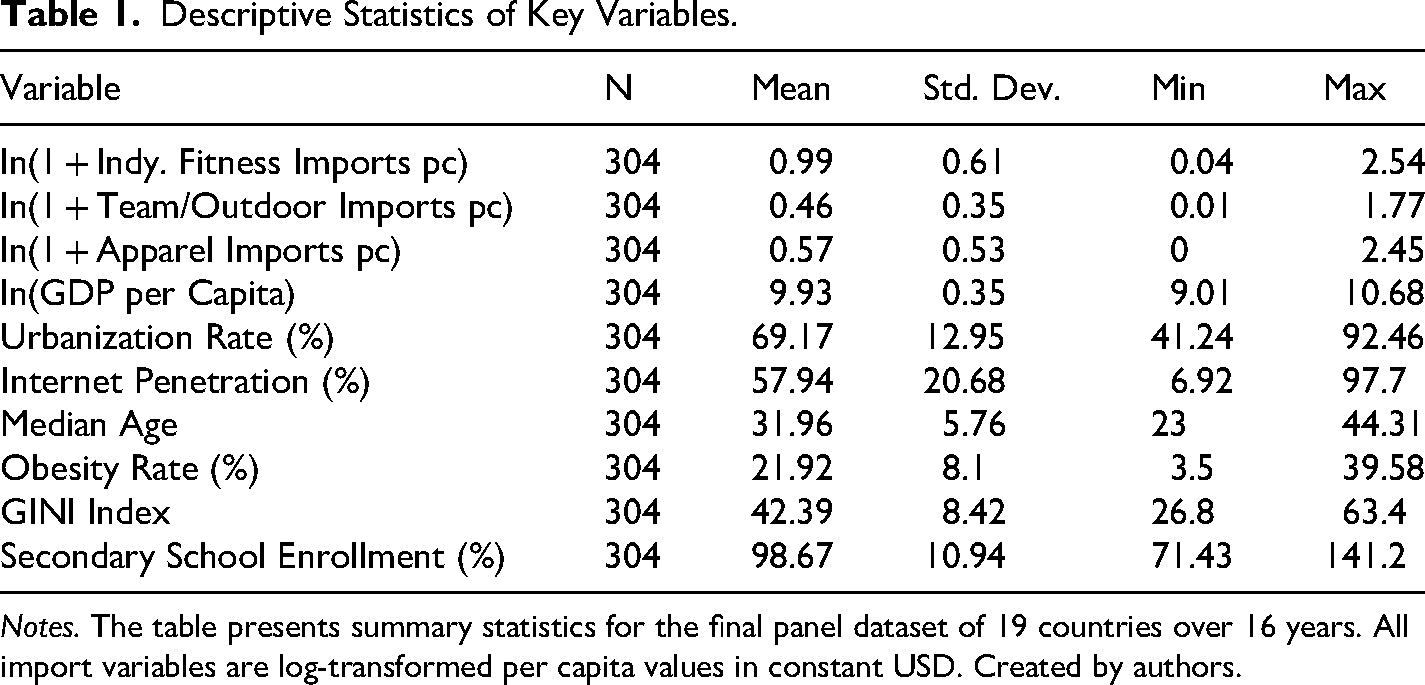
Notes. The table presents summary statistics for the final panel dataset of 19 countries over 16 years. All import variables are log-transformed per capita values in constant USD. Created by authors.
Main Regression Results
The results of the baseline two-way fixed effects models presented in Table 2 allow for direct testing of the three hypotheses.
TWFE Regression Results for Determinants of Sports Goods Demand.
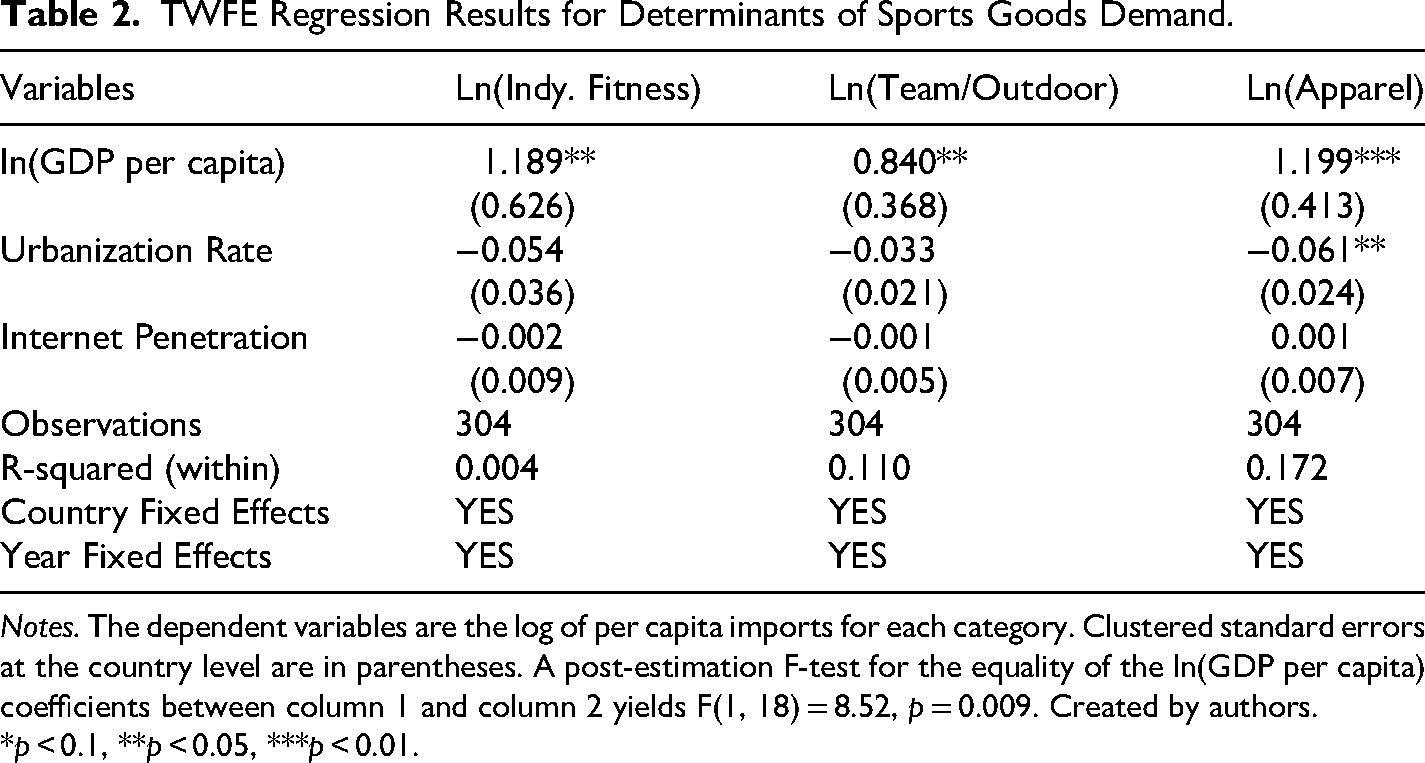
Notes. The dependent variables are the log of per capita imports for each category. Clustered standard errors at the country level are in parentheses. A post-estimation F-test for the equality of the ln(GDP per capita) coefficients between column 1 and column 2 yields F(1, 18) = 8.52, p = 0.009. Created by authors.
*p < 0.1, **p < 0.05, ***p < 0.01.
In line with the first hypothesis (H1), per capita income emerges as a positive and statistically significant driver of demand across all three categories. The coefficient is significant at the p < 0.05 level for Individual Fitness and at the p < 0.01 level for both Team/Outdoor equipment and Apparel. Thus, the results confirm that rising purchasing power universally increases consumption of sports goods.
The results additionally provide strong initial support for the second hypothesis (H2), positing that the income elasticity of demand is significantly higher for the ‘Modern’ consumption category. The estimated income elasticity for Individual Fitness equipment is 1.19, whereas that for Apparel is 1.20. Both are substantially larger than the elasticity for Traditional Team/Outdoor equipment, which stands at 0.84. Although all sports goods consumption grows with income, the data suggest that modern wellness categories exhibit the characteristics consistent with the economic definition of luxury goods with elasticity greater than one, whereas the traditional category behaves as a normal good with elasticity less than one.
Finally, the findings support the third hypothesis (H3), stating that income is the primary driver relative to other structural factors. After controlling for income, the coefficient on Internet Penetration is statistically insignificant in all models. Furthermore, the coefficient on Urbanization Rate is consistently negative and statistically significant for Apparel at the p < 0.05 level, a counterintuitive finding that contradicts the presumption that urbanization directly boosts demand for all modern goods.
Figure 1 provides a visualization of the core finding, displaying the point estimates and 95% confidence intervals for the income elasticity across the three categories. The figure visually confirms that the elasticities for the modern bundle components are nearly identical and their magnitudes are substantially larger and statistically distinct from that of the traditional group.
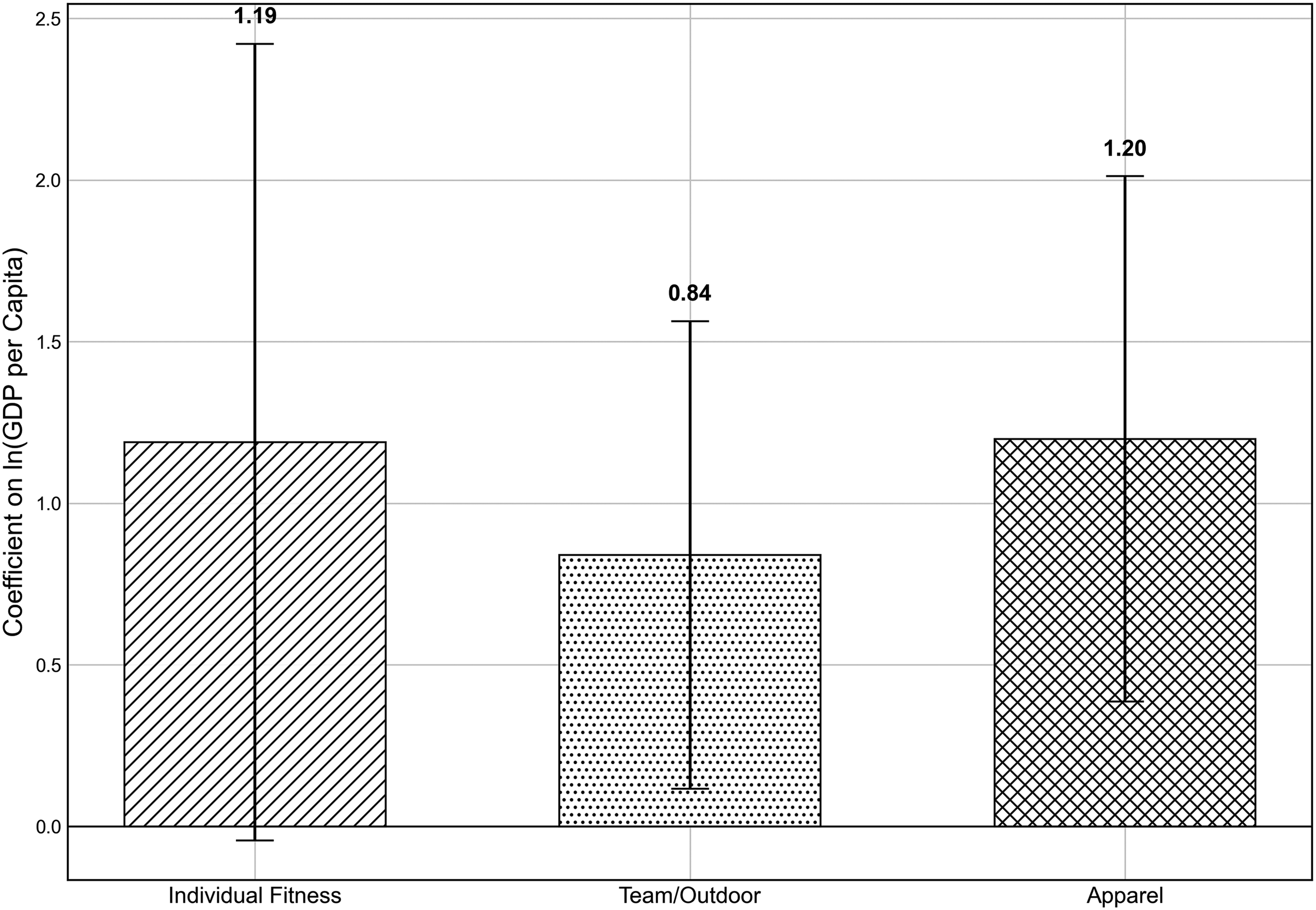
Estimated Income Elasticity of Demand by Sports Goods Category. Created by Authors.
Formal Test of the Modernization Hypothesis
To definitively test our central hypothesis (H2), we conducted a formal post-estimation F-test for the equality of the income elasticity coefficients between the modern and traditional categories. As the test yielded a p-value of 0.009, we reject the null hypothesis of equal coefficients at the 1% significance level. This provides rigorous statistical evidence that as incomes rise, demand shifts disproportionately towards modern, individualized wellness goods over traditional sports equipment.
Robustness of the Main Finding
To eliminate the possibility of omitted variable bias, we re-estimated the main models with additional controls for income inequality and human capital. The results of the robustness checks presented in Table 3 show that the inclusion of these controls does not substantively alter the core findings. Specifically, the estimated income elasticities remain highly stable in both magnitude and statistical significance. While we acknowledge that fixed effects cannot fully rule out time-varying endogeneity, the stability of coefficients across specifications suggests that the income effect is not driven solely by omitted institutional factors. Since the statistically significant difference between the income elasticity of the modern and traditional categories persists, the test confirms the robustness of the central finding. While our models did not find a robust, direct statistical relationship between national obesity rates and imports of sports goods, the causal pathway is likely complex due to endogeneity. Consequently, a promising opportunity for future research is to use household and health survey data to investigate how individual and community-level indicators influence the decision to invest in wellness goods and activities.
Robustness Checks with Additional Control Variables.
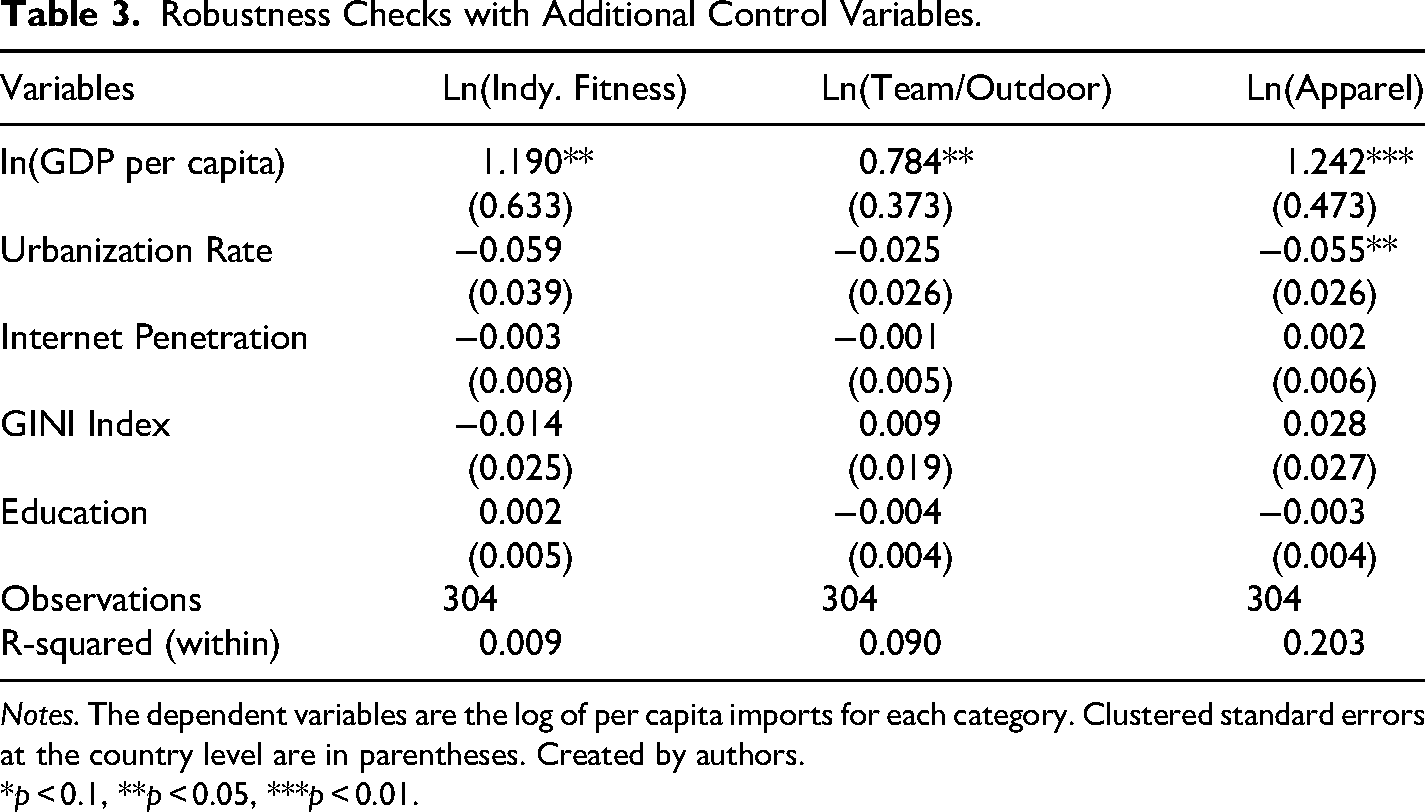
Notes. The dependent variables are the log of per capita imports for each category. Clustered standard errors at the country level are in parentheses. Created by authors.
*p < 0.1, **p < 0.05, ***p < 0.01.
Discussion
An Income-Driven Shift to Modern Leisure
The study demonstrates that the structural transformation of leisure in developing economies is driven primarily by rising income. Through disaggregation of demand, the analysis reveals additional context behind the notion that wealthier countries consume more sports goods. Particularly, the data corresponds to an evident consumption hierarchy (Gollin & Kaboski, 2023). Encompassing individual fitness equipment and lifestyle apparel, the ‘Modern’ category shows income elasticity greater than one, behaving consistent with the economic definition of luxury goods. In contrast, the ‘Traditional’ category has elasticity below one, behaving as a normal good. As the difference in elasticities is statistically significant, the analysis confirms that income growth leads not only to higher consumption but also to a fundamental shift in preferences. While recognizing that the precise magnitude of this elasticity may vary across specific national contexts, the aggregate data provides empirical support for the structural transformation view that economic development reshapes consumption patterns as households move up the ladder of needs and aspirations. The results align with studies showing that spending on recreation and culture is among the most income-elastic categories in developing economies (Leeds et al., 2022; Zereyesus et al., 2025). The analysis additionally reveals a stratification within recreational spending. Traditional sports goods continue to play a role but represent lower-priority purchases. In contrast, the modern wellness bundle absorbs a larger share of new discretionary income and reflects a shift toward aspirational, higher-order consumption.
However, the highlighted compositional shift should be interpreted with a caveat regarding the nature of trade data. Although the taken methodological choices were necessary for cross-country comparison, they may lead to an underestimation of the consumption of the ‘Traditional’ bundle, which is more likely to be supplied by domestic manufacturing or informal markets in developing economies. Conversely, high-tech fitness equipment and branded athleisure are predominantly imported through global supply chains (Lestan and Kabiraj, 2021). As a result, the observed modernization reflects not only a change in consumer preferences but also a deeper integration into the globalized consumption economy. Despite the direction of the modernization effect being robust, our estimate of its magnitude should be seen as a conservative lower bound, because the full extent of the domestic market for traditional goods is not observed. The high income elasticity of the ‘Modern’ bundle implies that access to globalized wellness standards acts as a luxury for the emerging middle class, in turn reflecting an emerging mass aspiration rather than exclusive elite status.
The disaggregated results support a more precise theoretical interpretation of modernization, revealing two distinct yet concurrent patterns. The first pattern pertains to a functional shift, as indicated by the high-income elasticity of individual fitness equipment. As rising incomes and wages increase the opportunity cost of time, it encourages households to adopt time-efficient and commodified forms of physical activity. Reflecting a rational adjustment to the constraints of modern life, such alternatives typically involve home equipment and gym-based routines (Cossu et al., 2023; Zhang et al., 2023). Aspirational in nature, the second pattern is reflected in the similarly high elasticity of lifestyle sports apparel. With demand for athleisure extending beyond functional use, it serves as a tool for social signaling and identity formation. In support of these findings is the literature review, indicating that lifestyle apparel communicates alignment with health, fitness, and modern values, consistent with theories of conspicuous consumption and symbolic status goods (Noh & Ahn, 2025; Webb, 2022). The strong responsiveness of apparel demand to income reinforces its role as a luxury good, though we note that with an elasticity of approximately 1.2, this reflects an emerging mass aspiration rather than an exclusive elite status. In this framework, leisure modernization represents a deeper change in how consumption is used to express identity and status.
The Urbanization Puzzle
The most counter-intuitive result of the study is the persistent negative coefficient on urbanization after controlling for income. Termed ‘urbanization puzzle’, this finding directly challenges the conventional assumption that cities, characterized by greater access to retail and modern infrastructure, uniformly boost demand for such goods. Nevertheless, the unexpected observation resonates with an emerging body of literature that identifies complexities in urbanization processes affecting developing countries (Huang et al., 2023). For example, the ‘consumption cities’ hypothesis may provide a compelling explanation. It posits that when urbanization is not rooted in a strong tradable goods sector, urban economies may shift toward non-tradable services (Jedwab et al., 2022). In such scenarios, rising incomes are more likely to be directed toward local services such as housing, transport, and dining, rather than toward imported goods like sports apparel. At the micro level, two mechanisms emerge as potential explanations for the urbanization puzzle. Whereas high urban living costs and urban congestion can limit discretionary spending on goods, urban consumers may also choose to access services instead of owning goods (Wan et al., 2022). For example, individuals may prefer a gym membership or fitness classes to purchasing and storing large equipment due to space constraints typical of dense urban environments. Furthermore, the scarcity of open recreational spaces in congested metropolitan areas may ultimately dampen demand for the ‘Traditional’ bundle, as the utility of owning outdoor equipment declines when accessible outdoor facilities are limited. Despite urbanization potentially increasing the frequency of physical activity and simultaneously reducing the demand for imported sports hardware, such substitution patterns would not be captured by the import-based data used in the current study. As such, the identified relationship raises a critical opportunity for future research to employ city-level microdata to separate the effects of urban cost structures from broader shifts in traded and non-traded leisure consumption.
Policy and Business Implications
The findings carry direct and actionable implications that challenge conventional development narratives revealed in the academic literature. For public health officials and urban planners, our results emphasize the emerging challenge of wellness inequality. Considering that modern fitness consumption is highly income-elastic, the following policy dilemma emerges: a strategy focused solely on economic growth may increase overall consumption while simultaneously widening the gap in access to health-promoting leisure between high- and low-income groups. This disparity poses a risk of exacerbating lifestyle diseases among lower-income populations who remain largely excluded from the modern wellness economy. The commodification of health suggests that without intervention, physical well-being will increasingly depend on purchasing power rather than remaining a public good. Policies aimed at fostering broad-based physical activity cannot rely exclusively on income growth and must extend beyond conventional infrastructure investments. To mitigate this new form of inequality, policymakers should consider utilizing tax incentives to lower the cost of fitness equipment for households, implementing targeted subsidies for access to commercial fitness facilities in low-income areas, establishing public-private partnerships to build or improve wellness infrastructure in underserved areas, or funding community-based wellness programs that bridge the gap between traditional recreation and modern fitness. Moreover, prioritizing active lifestyle interventions could serve as an effective fiscal tool to counteract the rising societal costs of sedentary behavior. For global sports and wellness brands, the data point to a clear strategic directive. In developing economies, GDP per capita growth offers a more reliable signal of market modernization in the wellness sector than urbanization rates. Drawn directly from the urbanization puzzle, the conclusion challenges the common use of urbanization as a proxy for market sophistication. The evidence strongly supports a shift toward income-based forecasting for market entry. In turn, marketing strategies should align with the aspirational values of the rising middle class, which appears to be the primary driver of growth.
Conclusion
This study investigated the drivers behind the modernization of leisure in developing economies by testing the relative importance of income growth against other structural forces. Based on a panel of 19 countries over 16 years, our analysis demonstrates that per capita income is the principal factor underlying this transformation. By disaggregating demand into theoretically distinct categories, we provide the first robust, multi-country quantification of a key compositional shift. As national income rises, consumption shifts away from traditional, community-based sports goods toward a modern bundle that includes individualized fitness equipment and lifestyle apparel. With the income elasticity for the modern bundle aligning with the behavior of luxury goods, the effect is significantly larger than the elasticity associated with traditional categories.
The core contribution lies in the empirical validation of a contemporary perspective on structural transformation. We demonstrate that instead of being confined to the production side of the economy, development is mirrored in the structure of consumption. Additionally, the findings position leisure as a measurable indicator of economic modernization rather than a purely sociological concern. By establishing a predictable pattern in consumer behavior tied directly to income, we provide a new indicator for development economists and an actionable marker for market strategists. Leisure consumption emerges as a reliable lens through which to observe how rising national wealth reshapes economic and social priorities.
The use of macro-level import data as a stand-in for consumption introduces a known limitation. Future work should test the findings using household expenditure microdata. Such data would confirm the national-level trends and help explain the ‘urbanization puzzle’ highlighted in the results. By comparing consumption choices of urban versus rural households while controlling for income, future studies can clarify whether this puzzle is driven by urban cost-of-living pressures or by a substitution toward non-traded leisure services. Analysis of consumption-side change plays a central role in understanding the next stage of development, where lifestyle and quality-of-life improvements become primary indicators of progress.
Footnotes
Acknowledgments
The author(s) are grateful to the anonymous reviewers for providing valuable insights on the discussed topics.

Funding
The authors received no financial support for the research, authorship, and/or publication of this article.
Declaration of Conflicting Interests
The authors declared no potential conflicts of interest with respect to the research, authorship, and/or publication of this article.
Data Availability
The data is available with the authors and shared on reasonable request.