



Abstract
We study the objectivity of officiating under extreme pressure by analysing additional time played at the FIFA World Cup and UEFA European Championship. Controlling for within-match events, rules should be applied consistently across both halves of a match. However, we argue that second-half time allocations could be increased by greater social pressure, intensity, and stakes, as payoffs become imminent. Our analysis shows that, even after accounting for major stoppages – and despite identical rules – referees add substantially more time in the second half than the first. Moreover, referees allow more stoppage time when the scoreline is close in the second half, but only at the World Cup because tight contests are cut short there in the first halves. These discrepancies raise concerns about the effectiveness of time-wasting strategies in the sport. More broadly, our results contribute to the discussion of decision-making under pressure and implicit biases in high-stakes environments.
Introduction
Adjudicators are relied upon in various settings to impartially and consistently apply rules, often under immense social pressure. While detecting biased decision-making in traditional socio-economic settings is challenging, sports provide a structured and controlled environment to evaluate the consistency of judgement (Bar-Eli et al., 2020; Dohmen & Sauermann, 2016; Flepp et al., 2025). The rules in sports are clear, and the outcomes of decisions are often measured precisely. Sport has now become a well-established setting for economic and behavioural science research, offering a natural domain to test theories that are otherwise difficult to study through field experiments (Ahmadi et al., 2025; Kahn, 2000; Palacios-Huerta, 2014, 2023). In this paper, we use data from sport to offer insights on a question we know little about empirically: do variations in social pressure affect the consistency of adjudicators’ decision-making? Addressing this question is important, as consumers and policymakers regularly demand that rules are applied objectively and consistently across markets and contests, even in the presence of structured breaks (e.g., day trading by session; auditing across fiscal years; evaluating educational outcomes across semesters).
Our setting is elite association football, where teams attempt to maximise outcomes within various constraints. These choices involve players, managers, and — the focus of this analysis — match referees. We use the structured nature of football to test whether the rules underpinning the same decision — the allocation of additional time – are applied consistently across both halves of a match. This represents a scenario where the rules are used under significant variation in social pressure; ipso facto, we hypothesise not only that social pressure is heightened toward the end of the second half, as the match outcome is imminent, but also that referees may extract greater personal benefit or enjoyment from prolonging the final moments, extending their time in the spotlight. In the final phase of a match, the consequences of referee choices are subject to greater attention and scrutiny, and it represents a final opportunity for a referee to project the optics of fairness and competence in their craft to the participants and viewers. Additionally, the emotions of all stakeholders (players, managers and supporters) are likely to intensify during the final stages of a match. These factors may impose disproportionate psychological pressure on referees compared to decisions made in the first half. While some may argue the end of the first half and second half are different, and no consistency in decision making is expected, the Laws of the Game suggest otherwise. A violation of consistency is indicative of a failure of objectivity by the referee.
We explore the idea that referees make additional time decisions within an implicit optimisation framework, balancing the benefits of continuing play against the perceived costs, including potential backlash from teams, spectators, and tournament organisers. Furthermore, and building upon prior research in behavioural decision-making as well as the economics and psychology of sports, we propose and test four key hypotheses. First, more additional time is played in the second half compared to the first half, even after controlling for stoppages. This is entirely the decision of the referee and, while it may be influenced by the behaviour of players, the decision remains the responsibility of the referee alone. This hypothesis is based on the idea that referees perceive the end of the second half as more consequential, leading them to err on the side of allowing more playing time. Second, major stoppages, such as injuries, substitutions and disciplinary, actions have a greater impact on additional time in the second half than in the first. This hypothesis suggests that referees may weigh similar stoppages differently depending on the timing within a match. Third, the scoreline margin influences additional time more significantly in the second half than the first. Specifically, closer scorelines may result in more additional time if referees attempt to avoid perceptions of prematurely ending a match where a single goal could change the outcome. Fourth and last, pre-match expectations about outcomes influence the amount of additional time allowed in the second half. This hypothesis explores whether referees unconsciously extend matches when the score deviates from anticipated results, potentially to mitigate perceived blame about an unexpected outcome.
To test these hypotheses, we construct a novel dataset by manually recording actual additional time played in each half of all matches at the 2022 FIFA World Cup and the 2024 UEFA European Championship. This dataset allows us to measure additional time more precisely than previous studies that have relied on journalist reports or official match summaries. By employing econometric models and controlling for various in-game factors, we aim to isolate some of the behavioural tendencies underlying the referees’ decision-making processes. In summary, we find strong evidence supporting our first hypothesis described above, evidence at the World Cup but not at the Euros in support of the third hypothesis, but no support for the second and fourth hypotheses.
In addition to contributing to the broader literature on social pressure exerted on agents and their decisions (for seminal economic theory, see e.g., Akerlof & Kranton, 2000; Bernheim, 1994; Bénabou & Tirole, 2006; and for a summary of field experiments see Bursztyn & Jensen, 2017), our tests add specifically to the branch of previous economics literature on additional time allocations in football (e.g., Békés et al., 2024; Butler & Butler, 2017; Dohmen, 2008; Garicano et al., 2005; Kocsoy, 2025; Rocha et al., 2013; Scoppa, 2008; Spilker et al., 2025; Sutter & Kocher, 2004; Watanabe et al., 2015). Our contribution departs from the literature in several ways. First, we take a novel approach by focusing on within-match officiating impartiality. The standard analysis so far has been to evaluate the final allocation decision only, at the end of the second half of a match. Second, we utilise unique data on the number of stoppages for player medical treatment — both serious and non-serious injuries — across both halves. This represents an underexplored determinant, and we offer methodological improvements by measuring a critical determinant of additional time played. Finally, we consider the bias and consistency of decision making in some of the highest profile and highest stakes international contexts possible. This setting is particularly relevant for assessing bias, since matches at the tournaments are played in neutral venues, mitigating home advantage effects (e.g., Page & Page, 2010; Ponzo & Scoppa, 2018; Reade et al., 2022; Scoppa, 2021; Sors et al., 2021), and it is expected that referees are selected to uphold the highest standards of officiating.
Additionally, this study provides practical insights for tournament organisers and governing bodies aiming to enhance transparency and fairness in football or wider sports officiating. Our findings demonstrate discrepancies in the application of the rules and raise questions regarding the ability of even the best referees to behave consistently and respond effectively to the time-wasting strategies by participants within the sport. More broadly, these findings raise questions about how people apply identical rules in different contexts, across structured phases with definite endpoints.
The remainder of the paper proceeds as follows: Section 2 explains the setting and motivates our four behavioural hypotheses. Section 3 presents our empirical strategy. Section 4 describes the data. Section 5 gives the results for each hypothesis; and Section 6 concludes.
Setting and Behavioural Hypotheses
In response to strategic and non-sporting attempts to end football matches after ninety minutes of play, the Football Association (FA) implemented a formal rule change in 1891, granting the match referee discretion to add on time at the end of each half when necessary (Butler & Butler, 2017). By the late twentieth century, technology had facilitated greater transparency in these decisions. During the 1998 World Cup in France, ‘fourth officials’ on the pitch sidelines, acting on instruction from the referees, held aloft electronic boards at the end of normal time in each half of play to display the minimum additional time. The original decision to introduce additional time in football matches, as well as the public display of the minimum amount remaining since 1998, aimed to promote transparency and fair play within the game (Butler & Butler, 2017).
Our analysis examines the referees’ additional time decisions in two recent men's international football tournaments. The 2022 World Cup in Qatar was staged from the 20th November to the 18th December 2022, involving thirty-two national teams playing in sixty-four matches. This included forty-eight group stage matches, in a round-robin format across eight groups of four teams, fifteen knockout matches including the final, and a playoff between the losing semi-finalists to determine third place. The 2024 Euros were held from the 14th of June to the 14th of July 2024, involving twenty-four national teams across fifty-one matches. This included thirty-six group stage and 15 knockout matches. Losses in the knockout matches marked the end of a team's tournament, and a defeat in at least one of the group stage matches often led to the same outcome for many teams.
These two tournaments, each played every four years, represent arguably the highest-stakes environment in men's football and one of the most intense settings in professional sport, attended by millions and watched by billions around the world. The World Cup and Euros serve as the pinnacle of achievement for many players, managers, and referees. The most elite referees are chosen to officiate at these tournaments, minimising the likelihood that any impartialities are due to errors or poor-quality refereeing. FIFA maintains that for the World Cup the “selected match officials represent the highest level of refereeing worldwide” (FIFA, 2022), and a rigorous selection process is used to recruit the world's best officials, all of whom undergo “intensive preparation,” including summer seminars, video analysis, and training sessions with players. This process is intended to uphold consistency and uniformity in officiating standards. Additionally, the selected referees are expected always to be neutral about match and tournament outcomes. Furthermore, all match officials for a match, including the referee, assistant referees, and fourth official, are strategically assigned so that their nationality differs from the competing teams, to mitigate any actual or perceived bias.
All matches in these two major tournaments are televised live and readily recordable or streamed online. This enables us to create a bespoke dataset by exactly recording the additional time played in both halves. The accessibility of the match content allows for precise recording of the exact moment when the referee blows the whistle at half-time and full-time, as matches can be viewed in real-time (or on recording) to observe these decisions. This contrasts with past studies (e.g., Békés et al., 2024; Butler & Butler, 2017; Kocsoy, 2025; Morabito & Scoppa, 2024; Rocha et al., 2013), which relied on journalist reports of full-time conclusions or websites that document the final actions of the match. Such sources serve as proxies rather than direct records of the referees’ actual decisions.
The match referee is the most important authority in the allocation of added time. While they should follow the laws of football when deciding how much to allow at the end of each half, the final decision is still their prerogative. Those laws, maintained by the International Football Association Board (IFAB), state that “Many stoppages in play are entirely natural (e.g., throw-ins, corners, or goal kicks). An allowance is made only when delays are excessive” (IFAB, 2024). The laws further specify “The fourth official indicates the minimum additional time decided by the referee at the end of the final minute of each period of play.” (IFAB, 2024). This is crucial for our analysis, as it confirms that the decision is solely at the referee's discretion, with no input from others. The rules also outline that the referee should add time for substitutions, assessment and/or removal of injured players, time-wasting, disciplinary sanctions, VAR checks and reviews, goal celebrations, and any other significant delay.
The amount of additional time added by a referee can have significant consequences for a match, a competition, and even career outcomes. For instance, one in four goals scored during the 2023/24 English Premier League season happened after the 75th minute, and thirty-five goals (3%) occurred in or after the 5th minute of additional time at the end of second halves (Soccer Stats, 2024). Although football is a relatively low-scoring game, there are many high-profile examples of decisive individual goals being scored in additional time, particularly during the second half of play, which have decided competitions or defined careers. For example, in May 1989, during the final round of fixtures in the English Football League season, Michael Thomas scored in the 91st minute of a match at Anfield for Arsenal. This goal meant that Arsenal, and not Liverpool, were crowned league champions for the 1988/89 season. There are also infamous examples where teams have scored even more than one goal in additional time to reverse a match result and win an overall competition. For example, in May 2012, Manchester City beat Queens Park Rangers 3-2 by scoring two goals during second-half additional time. Without these goals they would not have secured their first English Premier League title. Manchester United pulled off a similar feat in the 1999 UEFA Champions League Final, scoring in the 91st and 93rd minute, to beat Bayern Munich 2-1. In our setting of international football, in November 1993, Bulgarian striker Emil Kostadinov scored in the final minute of a World Cup Qualifier in Paris against France. This goal eliminated France from qualification to the 1994 World Cup in the USA, where Bulgaria went on to finish in fourth place. 1 We could list many more crucial and memorable additional time goals, but the implication is clear: the referee's decision on when to blow the whistle for the end of play – potentially denying one last chance for the scoreline to change – can matter greatly to the teams involved, their supporters, and other parties with financial or emotional stakes in the outcome.
Formally, and to help explain our behavioural hypotheses, we can represent a referee's decision to blow the whistle, signalling the end of play in a half of football, as a standard continuous time optimal stopping problem, with a binary and irreversible choice. We assume that referees make this decision while maximising their utility, subject to constraints. Let t be the state variable – seconds of additional time played – and the referee receives a constant flow benefit b > 0 from allowing the match to continue (utility flow of being a referee, derived from performing on the biggest stage, enjoying the job, officiating the most famous players, and making decisions in front of millions of football fans, etc.). We also assume that the referee faces a nonlinear convex accumulating cost function from playing additional time above the minimum number of seconds signalled by the fourth official at the end of normal time,
Consequently, our first behavioural hypothesis is based on the idea that the relative difference between the benefits and costs of letting the game play on are generally greater for a referee at the end of the second half than the first half of a football match. Given the match is near its conclusion at the end of the second half, the referee's involvement and decisions are more important and decisive, potentially increasing b relative to the first half. Further, the costliness to the referee of allowing the match to play on longer, determined by
It is possible that referees themselves contribute to the higher number of major events and stoppages in the second half, such as by issuing more yellow cards or pausing play for minor injuries. If this is the case, then even if we find no support for Hypothesis 1, we cannot fully rule out the idea that the increased additional time in the second half is influenced by referee behaviour. However, it is extremely difficult to determine, during a match, whether the increased frequency of yellow cards or stoppages is due to the referee's decisions or the players’ actions.
During each game, the referee operates within a comparatively well-defined institutional environment and makes the same decision twice, approximately one hour apart.
2
,
3
Any disparity between these allocations should be explained by the rules governing player actions. In theory, the added time allocation decision should be equivalent, on average, only if the exact same in-play events and stoppages occur in both halves, which is highly unlikely in reality. Perfectly impartial decision-making may not always be achievable. Furthermore, an extension of our first hypothesis is that referees may not only add on more time in the second half in general but that this could, at least in part, result from specific types of stoppages being treated differently. Some specific types of stoppages to play during the first half may have less of an impact on the referee's cost of allowing additional time compared with the equivalent stoppages during the second half of a match.
Although referees are asked to officiate consistently and impartially, the reflections of former FIFA President and match referee Sir Stanley Ford Rous highlight the challenges they face due to social pressure. After his retirement as a match referee, Palacios-Huerta (2014, pp. 121–122) describes a lecture that Rous gave in 1969 to a group of younger referees, saying: “Referees are basically honest and impartial, but they do react differently to situations. How many referees will give a penalty against a home team early in the match…We have all seen referees’ whistle for penalty offences inside the area, then place the ball a foot or so outside the area. Thus the degrees of punishment, instead of the correct disciplinary action are being applied”.
The analysis of potentially biased decision-making by referees in football has become an established area of study within economics, particularly for testing theories of behavioural decision-making. Sutter and Kocher (2004) were among the first to examine the biased behaviour of football referees, finding that home teams were significantly more likely to be granted more additional time when it could contribute to a favourable match outcome. Subsequent studies developed upon this, with Garicano et al. (2005) providing further evidence of favouritism, showing that referees were more likely to grant additional time to benefit home teams. Dohmen (2008) considered running tracks as a potential moderator of the social pressure on referees, as they increase the physical distance between referees and home team supporters in the stands.
5
More recently, Morabito and Scoppa (2024) find in club football that referees lengthen additional time at the end of a match both when the home team or the away team are behind on the scoreboard, reflecting general evidence of ‘inequity aversion’ in referee decision making or compensation tendencies (Considine et al., 2024). Overall, this evidence from football suggests that referees are likely to anticipate less backlash cost by ending the match later, allowing more additional time in the second half, when the score is close, where a single goal could shift the result for either team in an international tournament. Therefore, building on our first two hypotheses, we also propose that a narrow scoreline margin is associated with more additional time being played in the second half compared to the first.
Various other factors have been considered in relation to potential bias in football referee decision making, such as crowd size (e.g., Johnston, 2008; Unkelbach & Memmert, 2010)., the training of officials (e.g., Li et al., 2024; Nevill et al., 2013; Webb et al., 2018), and the impact of Covid-19 (e.g., Békés et al., 2024; Bilalić et al., 2021; Kocsoy, 2025; Lago-Peñas & Gómez-Ruano, 2021; Wolaver & Magee, 2022). Research has shown that the absence of crowds during Covid-19, with matches played in empty stadiums, led to a consistent and significant reduction in home advantage in football across elite competitions throughout the world. These effects were especially evident in the issuance of disciplinary cautions by referees (e.g., Benz & Lopez, 2023; Bryson et al., 2021; Cohen et al., 2024; Scoppa, 2021). Similar patterns have also been documented in one-off matches hosted behind closed doors (Pettersson-Lidbom & Priks, 2010; Reade et al., 2022). Further, the effects of removing spectators during Covid-19, on the decisions made by officials, have also been described in several other sports, such as cricket (Chowdhury et al., 2024), baseball (Losak & Sabel, 2021), ice hockey (Guérette et al., 2021), and rugby (Delbianco et al., 2023). Finally, laboratory experiments on football referees have demonstrated that their decision-making can be influenced by the noise of a stadium crowd (Nevill et al., 2002). Taken together, this evidence suggests that social pressure is an important factor influencing referee decision-making regarding additional time in either half of a match.
Referees come under intense scrutiny when the decision to end the game is about to be made. One potential source of this pressure could be related to pre-match expectations about the match outcome, and whether the referee fears being held responsible if the match does not conclude in line with the dominant expectations of players and spectators. For instance, if the expected outcome based on pre-match betting odds aligns with the state of play at the 90th minute (e.g., the pre-match favourite is winning), the referee may anticipate greater costs of allowing the match to play on, allowing less additional time, compared to a scenario where the actual outcome deviates from expectations (e.g., the pre-match favourite is losing). We suggest that such a ‘blame’ factor is less prominent to referees after forty-five minutes of play, as the second half still allows for sufficient time for the match outcome to align with pre-match predictions. One way the referee can remove, or at least limit any potential ‘blame’, is to increase the number of seconds of additional time and/or play beyond the number of minutes that are held up by the 4th official at the end of ninety minutes. Anedotally, referees almost never blow the final whistle when the losing team is attacking or has a set-play, and instead allow the phase of play to end, before ending the game. Our final hypothesis is based on these ideas:
Models & Estimation
Before describing the dataset, we first outline our approach to testing the four hypotheses motivated above. The dependent variable is the number of seconds of additional time played at the end of each half i in a football match m. To test Hypothesis 1, we estimate variants of the following linear regression model using least squares:

To test Hypothesis 2, we extend Equation (1) by incorporating interaction terms into the regression model. This allows us to examine whether specific types of events are related to different amounts of additional time, depending on whether they occur in the first or second half:

In this case,
To test Hypothesis 3, we extend the model by including the absolute scoreline margin between the teams at the start of additional time within the model, focusing on its interaction with

In this equation,
Our full regression model, which allows us to test Hypotheses 2–4 altogether, extends Equation (3) by adding terms that measure the extent to which the match situation aligns with pre-match expectations just before additional time starts in each half. To proxy these expectations, on average, we use the probabilities implied by pre-match betting odds

To convert the bookmaker pre-match decimal odds into implied probabilities, we normalise them over the three possible outcomes (i.e., dividing the inverse odds for one match outcome by the sum of the inverse odds over all three potential match outcomes). According to Hypothesis 4, if referees play more additional time in the second half when the favourite (underdog) team is losing (winning), for example, when the match outcome deviates from pre-match expectations, then
Returning to Hypothesis 1, we also consider results from models that allow for match fixed effects,

The match fixed effects control for specific characteristics of a match that could influence the number of seconds added at the end of each half. These can include the identity of the referee and their assistants, the teams, the managers, the stadium, and the timing or other unique circumstances of the match. Although this approach can be informative, including match fixed effects prevents us from testing whether specific events can explain the overall unexplained differences in added time between the halves. Further, with match fixed effects in the model,
Finally, we apply a two-fold Oaxaca-Blinder (Blinder, 1973; Jann, 2008; Oaxaca, 1973) decomposition using the estimates of Equation (3), to describe and test whether differences in the numbers of events can explain significant parts of the overall average differences between the observed additional time in the two halves of matches. We also use standard errors, robust to match-level clustering, for the Oaxaca-Blinder inference.
Data
The data on within-match variables are collected from live broadcasts of the 2022 World Cup and 2024 Euros carried on the British Broadcasting Corporation (BBC) and Independent Television (ITV). We extract additional time data by manually reviewing live footage from both broadcasters. These observations are recorded in real time at the end of each half of play, resulting in a dataset of 230 added time allocation decisions across the two tournaments (115 for each half). This allows us to measure the precise number of seconds of additional time played in each half and identify VAR interventions. Our dependent variable is to the “second”. Almost all score results services and text commentary only present this to the minute. Therefore, there is no difference between a match stopped exactly on six minutes and zero seconds of additional time and one stopped after six minutes and 59 seconds. Online timestamps of half time/full time can also be imprecise as they represent the time the event is inputted into a computer system rather than when the whistle is blown. Our dataset is extremely precise in this regard, which is crucial to the empirical tests. 6 We can also confirm that each data point has been checked repeatedly – to confirm accuracy – and no errors have been found.
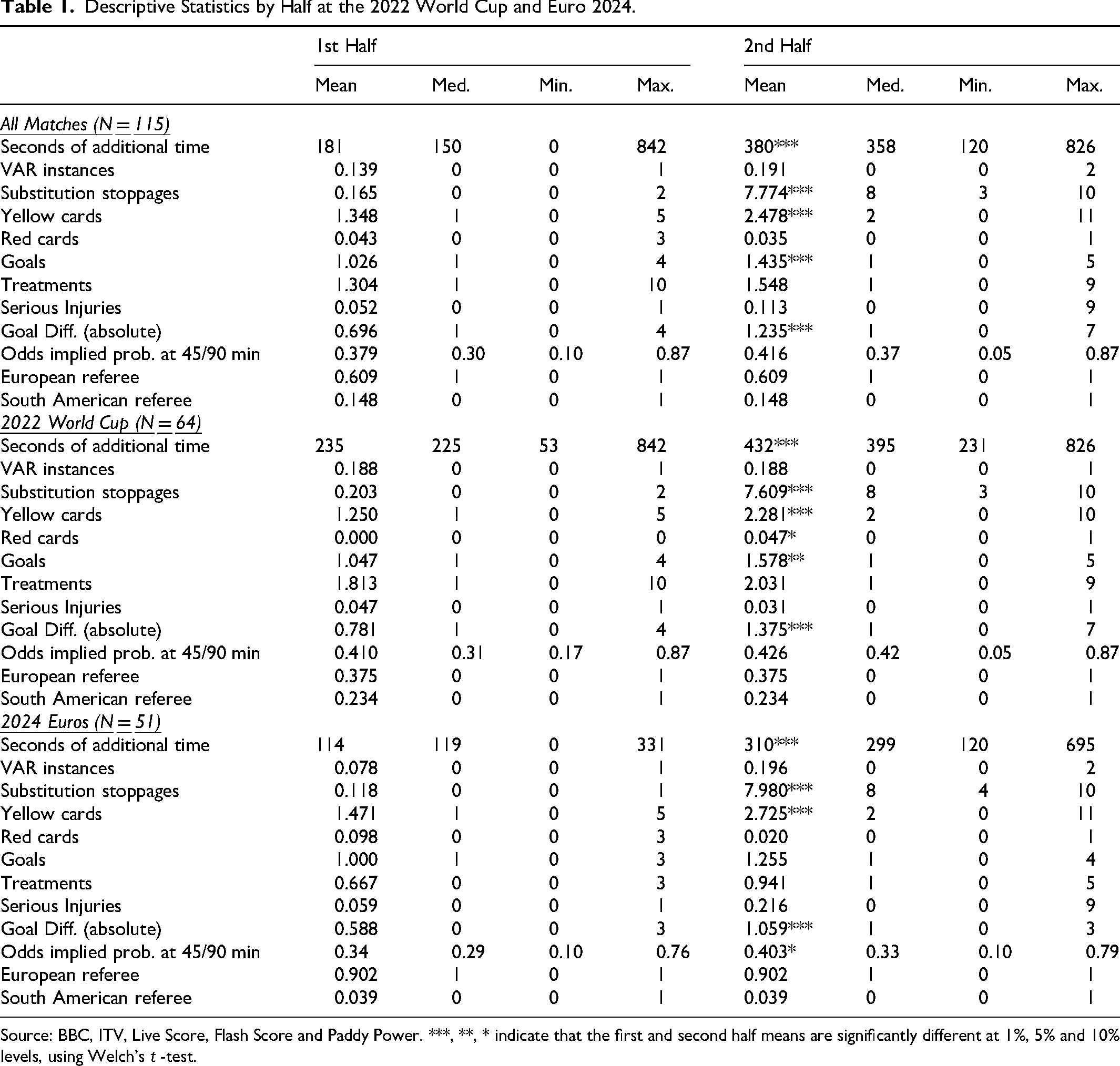
Additional data are sourced from the online results platforms Live Score (www.livescore.com) and Flash Score (https://www.flashscore.co.uk), including: first half and second half substitutions, yellow cards, red cards, goals, the margin between teams, treatments to players, and serious injuries. Treatments refer to stoppages where a player receives medical attention but can continue playing afterward. Serious injuries are classified as all stoppages where a player requires attention and then could not continue playing. This distinction is important for understanding how additional time is allocated, particularly in cases where referees must account for potential time-wasting tactics by players seeking treatment without genuine medical needs. Pre-macth odds are also recorded (www.paddypower.com). Table 1 presents descriptive statistics, including the key variable of interest - the actual additional time (in seconds), at the end of each half of play. The mean additional time in the second halves of matches is significantly longer than in the first halves, overall (380 vs 181 s), at the 2022 World Cup (432 vs 235 s), and at the 2024 Euros (310 vs 114 s).
Descriptive Statistics by Half at the 2022 World Cup and Euro 2024.
Source: BBC, ITV, Live Score, Flash Score and Paddy Power. ***, **, * indicate that the first and second half means are significantly different at 1%, 5% and 10% levels, using Welch's t -test.
Figure 1 presents scatter plots of the first and second half additional time observations over the sample matches and separately for each tournament. Similarly, Figure 2 shows the mean first and second half additional time for each referee at each tournament. These plots highlight two important patterns that already speak to our hypotheses. First, additional time in the second half of a match regularly exceeds that allowed in the first half. There is only one referee, at the World Cup, who on average allowed more additional time in the first than the second halves of matches. 7 Second, there appears to be a substantial difference between the two tournaments in how additional time is applied, with the World Cup witnessing far greater variation in both halves. Some of this variation can be attributed to FIFA's new directive at the 2022 World Cup, to ensure all “unnatural lost time” is accurately monitored and accrued, with signals and advice given to referees by other officials focused on recording stoppages – referees still made the final decisions about additional time. The head of FIFA's referees committee, Italian Pierluigi Collina, said “If we want to have more active time, we need to be ready to see this kind of additional time given…what we really want to do is to accurately calculate the time to be added… we must calculate time and add it on at the end of each half. We do not want matches where the ball is only in play for 43, 44 or 45 min. We must make sure the time is fair for both teams.” (Guardian, 2022).
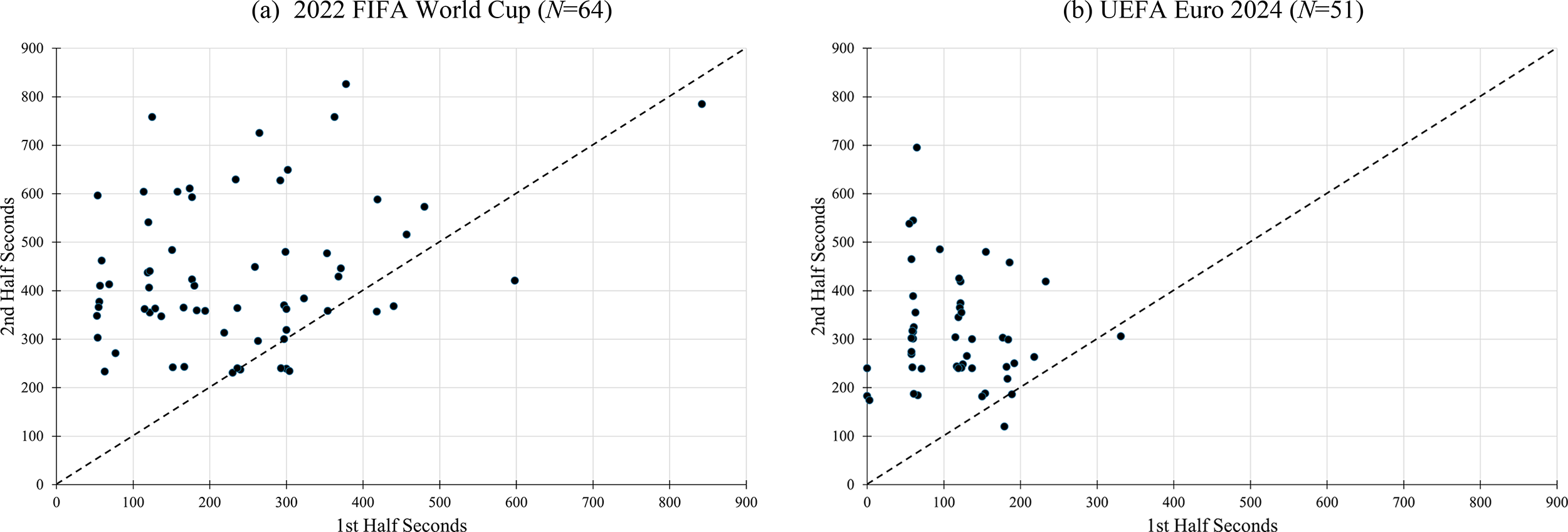
Time Added on in the First and Second Halves of All Matches at the 2022 FIFA World Cup and UEFA Euro 2024. Notes: author calculations using data from BBC and ITV live broadcasts. The dashed lines trace out the 45-degree line.
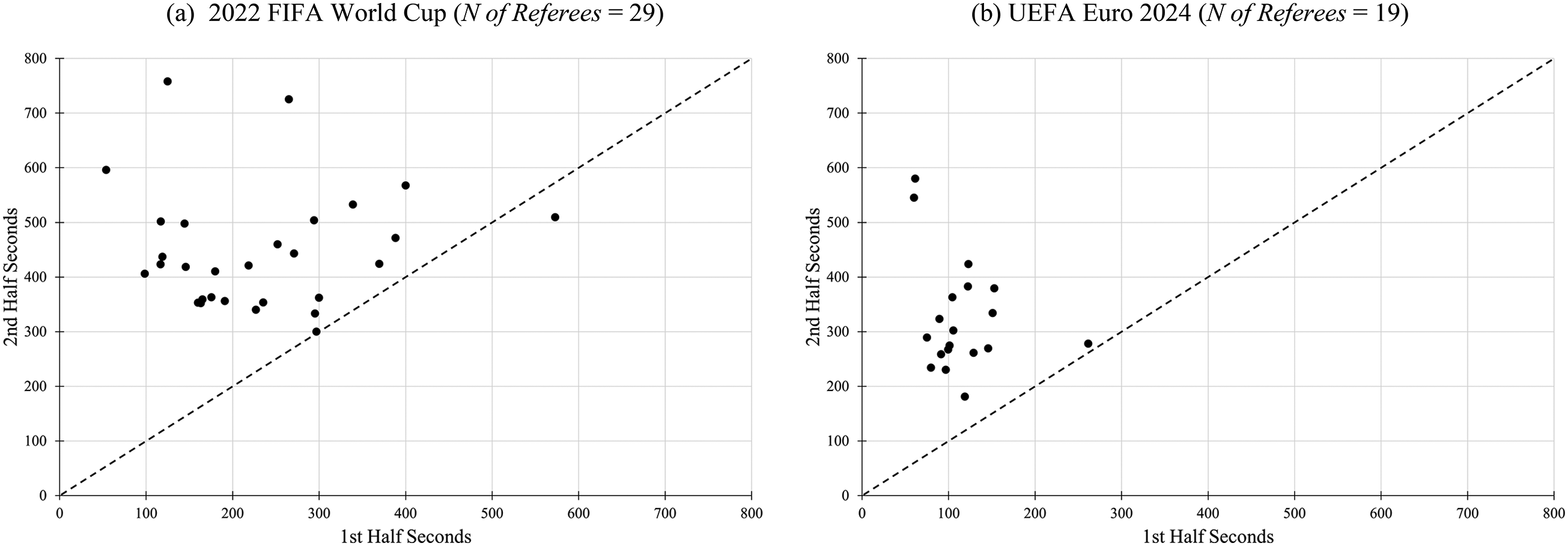
Mean Time Added on in the First and Second Halves by Each Referee at the 2022 FIFA World Cup and UEFA Euro 2024. Notes: author calculations using data from BBC and ITV live broadcasts. The dashed lines trace out the 45-degree line.
Our dataset has the advantage of representing actual added time (rather than a journalist or website proxy measurement of the length of added time). Importantly, this is not the amount of time in minutes prescribed by the fourth official (indicative additional time), but rather the exact time the half of play ends (actual additional time). For consistency purposes, we exclude all observations in extra time. 8
Researcher discretion is required when recording VAR observations. Some VAR interventions are trivial and do not require play to be stopped and so cannot be considered “excessive”. We document all instances where the referee reviews the pitch-side monitor or when VAR disallows a goal, leading to a delayed restart. This approach aligns with the rule that additional time should only be added for excessive stoppages. While we acknowledge that this criterion is open to interpretation, our reporting of this variable remains consistent across halves and matches. Overall, Table 1 shows that wherever there are statistically significant differences in the frequency of stoppage types between halves in our samples, both overall or within each tournament, that type of stoppage is more frequent during the second halves of matches.
Regarding Hypothesis 3, Figure 3(a) plots the observed seconds of additional time played against the absolute goal difference between teams at the end of normal playing time, for all 230 halves of football in our sample, separately indicating which observations are for the first or second half of a match. This shows approximately no correlation between these two variables for second half observations, compared with a positive correlation for the first half. Similarly, regarding Hypothesis 4, Figure 3(b) plots the observed seconds of additional time played, against the pre-match odds implied probability of the scoreline result outcome at the end of normal playing time, for all halves in our sample. The unconditional correlations between these variables, for both first and second halves, appear to be weak.
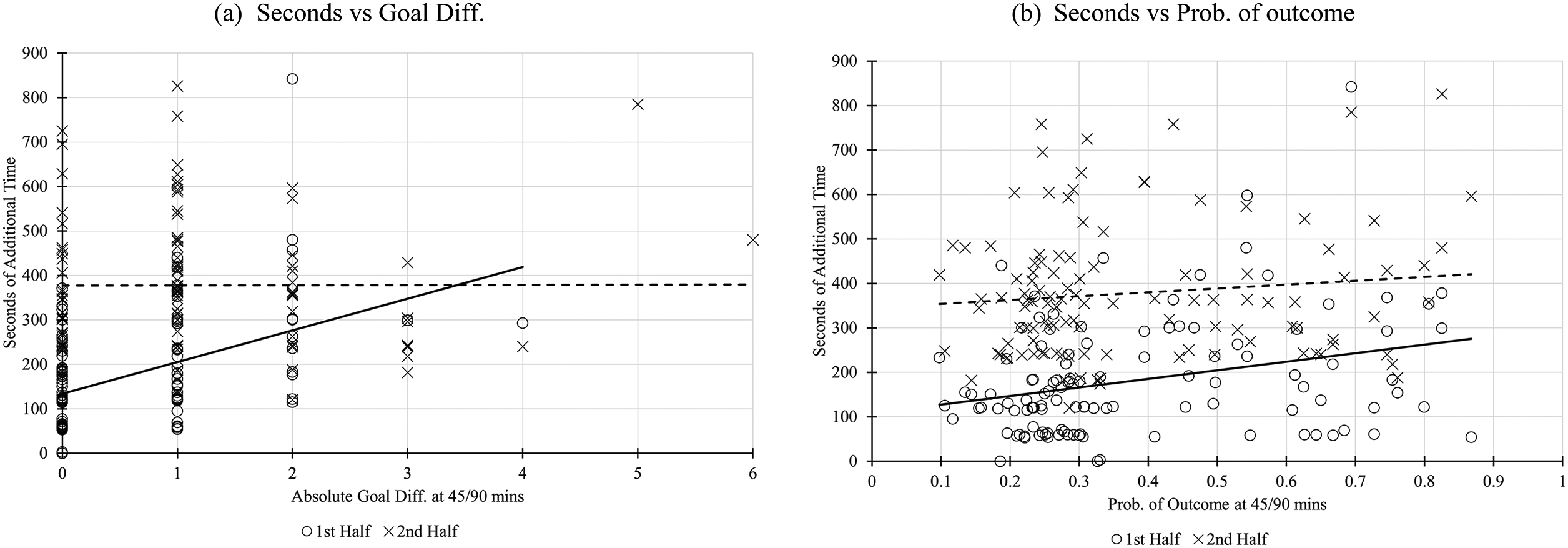
Time Added on in the First and Second Halves of All Matches at the 2022 FIFA World Cup and UEFA Euro 2024: Correlations with the Absolute Goal Difference and the Odds-Implied Probability of the Scoreline Outcome at the End of Normal Time. Notes: author calculations using data from BBC and ITV live broadcasts, as well as Paddy Power, for all 115 matches at both tournaments. In each sub-figure, the solid and dashed lines give the line-of-best-fit for the first and second halves, respectively.
Finally, we also collect information on the match officials, including their nationality. In May 2022, FIFA announced the list of match officials for the World Cup. This included 36 referees, 69 assistant referees, and 24 video assistant referees, a total of 129. Officials for UEFA Euro 2024 were announced in April 2024. 19 different refereeing teams were selected, consisting of 19 referees and 38 assistant referees. 9
Results
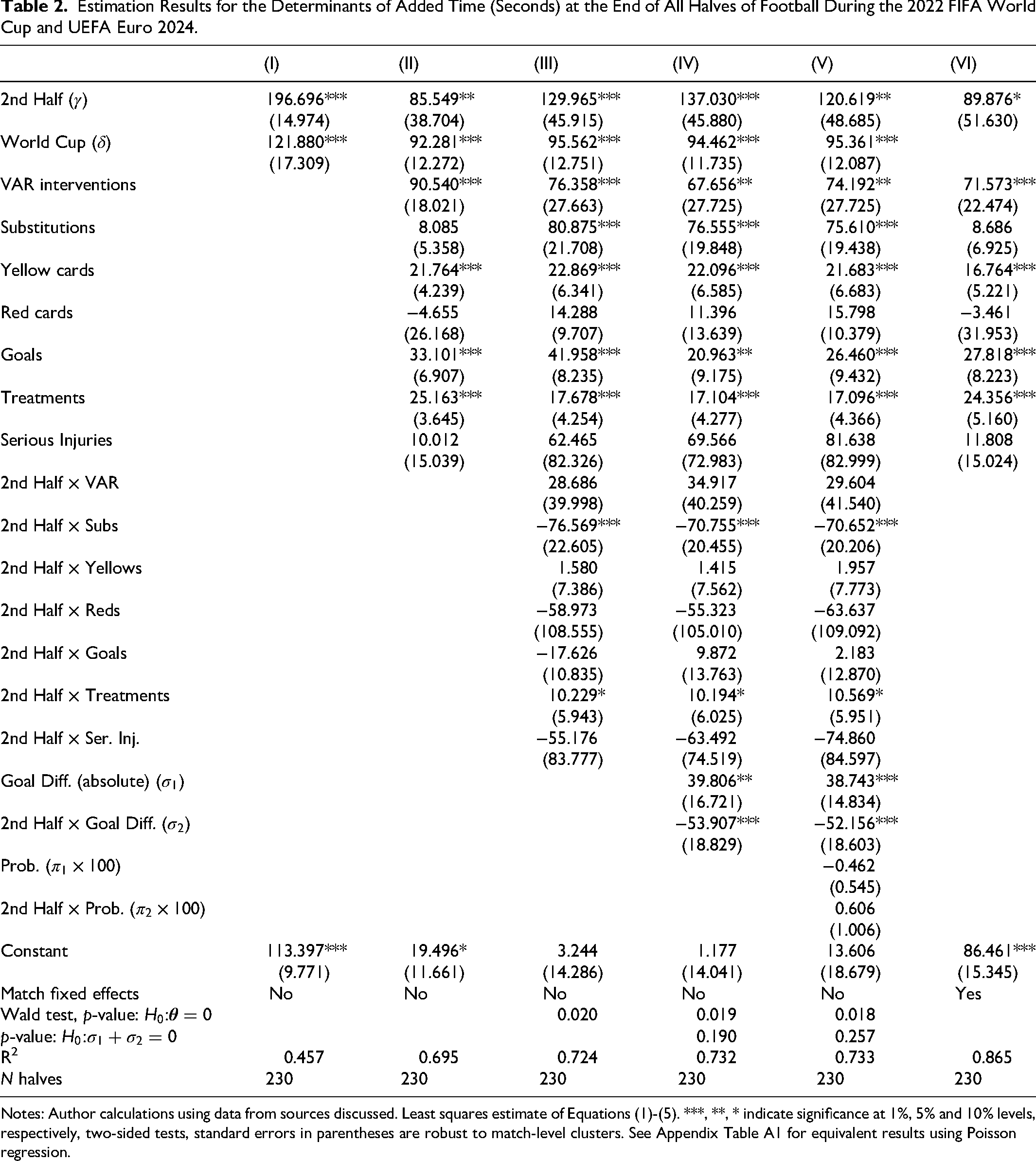
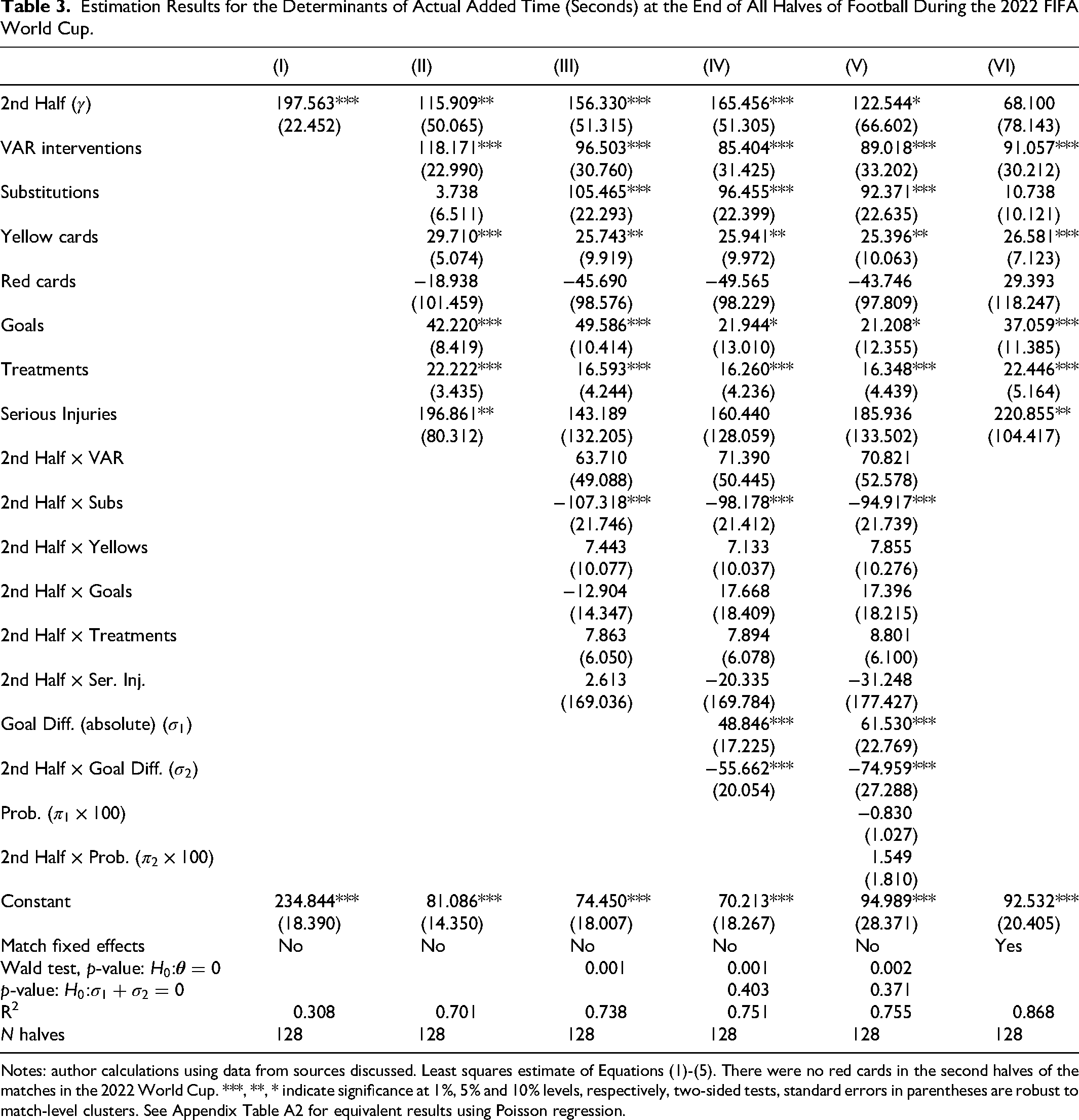
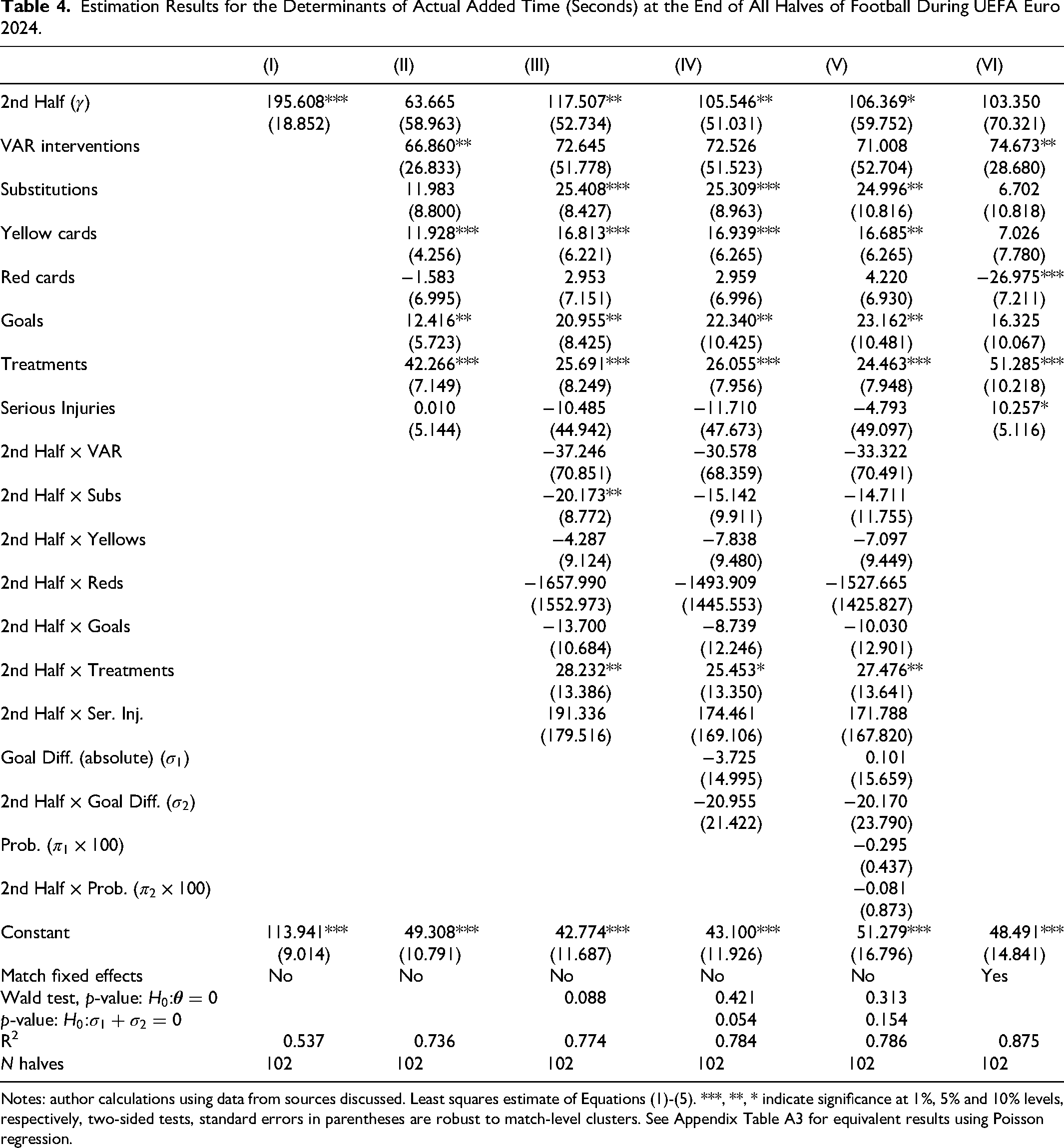
Tables 2–4 present the estimation results for the regression models specified in Equations (1)-(5) for the three samples in turn: the two tournaments pooled, only the 2022 World Cup, and only Euro 2024. Column (1) in each table confirms the descriptive statistics from Table 1 and Figure 1. Without conditioning on any of the within half events and stoppages, significantly more additional time is played in the second half compared to the first, and significantly more additional time is played during the World Cup than the Euros. Columns (II)-(V) in each of Tables 2–4 address each of the four hypotheses in turn for each sample. We first summarise the results for each of our four hypotheses, before further discussion.
Estimation Results for the Determinants of Added Time (Seconds) at the End of All Halves of Football During the 2022 FIFA World Cup and UEFA Euro 2024.
Notes: Author calculations using data from sources discussed. Least squares estimate of Equations (1)-(5). ***, **, * indicate significance at 1%, 5% and 10% levels, respectively, two-sided tests, standard errors in parentheses are robust to match-level clusters. See Appendix Table A1 for equivalent results using Poisson regression.
Estimation Results for the Determinants of Actual Added Time (Seconds) at the End of All Halves of Football During the 2022 FIFA World Cup.
Notes: author calculations using data from sources discussed. Least squares estimate of Equations (1)-(5). There were no red cards in the second halves of the matches in the 2022 World Cup. ***, **, * indicate significance at 1%, 5% and 10% levels, respectively, two-sided tests, standard errors in parentheses are robust to match-level clusters. See Appendix Table A2 for equivalent results using Poisson regression.
Estimation Results for the Determinants of Actual Added Time (Seconds) at the End of All Halves of Football During UEFA Euro 2024.
Notes: author calculations using data from sources discussed. Least squares estimate of Equations (1)-(5). ***, **, * indicate significance at 1%, 5% and 10% levels, respectively, two-sided tests, standard errors in parentheses are robust to match-level clusters. See Appendix Table A3 for equivalent results using Poisson regression.
The estimation results for Equations (1)-(5) are presented in columns (II)-(VI), respectively, of Tables 2–4. For completeness, the first column of each table shows the sample average differences in additional time between halves for each estimation sample, repeating the values in Table 1 but with standard errors that are robust to match-level clusters. After adjusting for the numbers of stoppages in either half of the matches, columns (II) show estimates of 86, 116, and 64 more seconds of unexplained additional time played in the second than the first half (
Further, for each tournament separately, we estimate a version of Equation (1) that includes referee fixed effects and their interaction with ‘2nd half’. Using these estimates, Figure 4 presents the estimated average marginal effects of ‘2nd half’ for each referee. Since the individual referees officiated, at most, 4 matches in each tournament, these estimates are not statistically robust – confidence intervals are wide. Even so, it is notable that after adjusting for the frequency of major events and stoppages at both tournaments, most referees (16/29 at the World Cup; 13/19 at the Euros) allowed at least 100 additional seconds in the second half compared with the first.
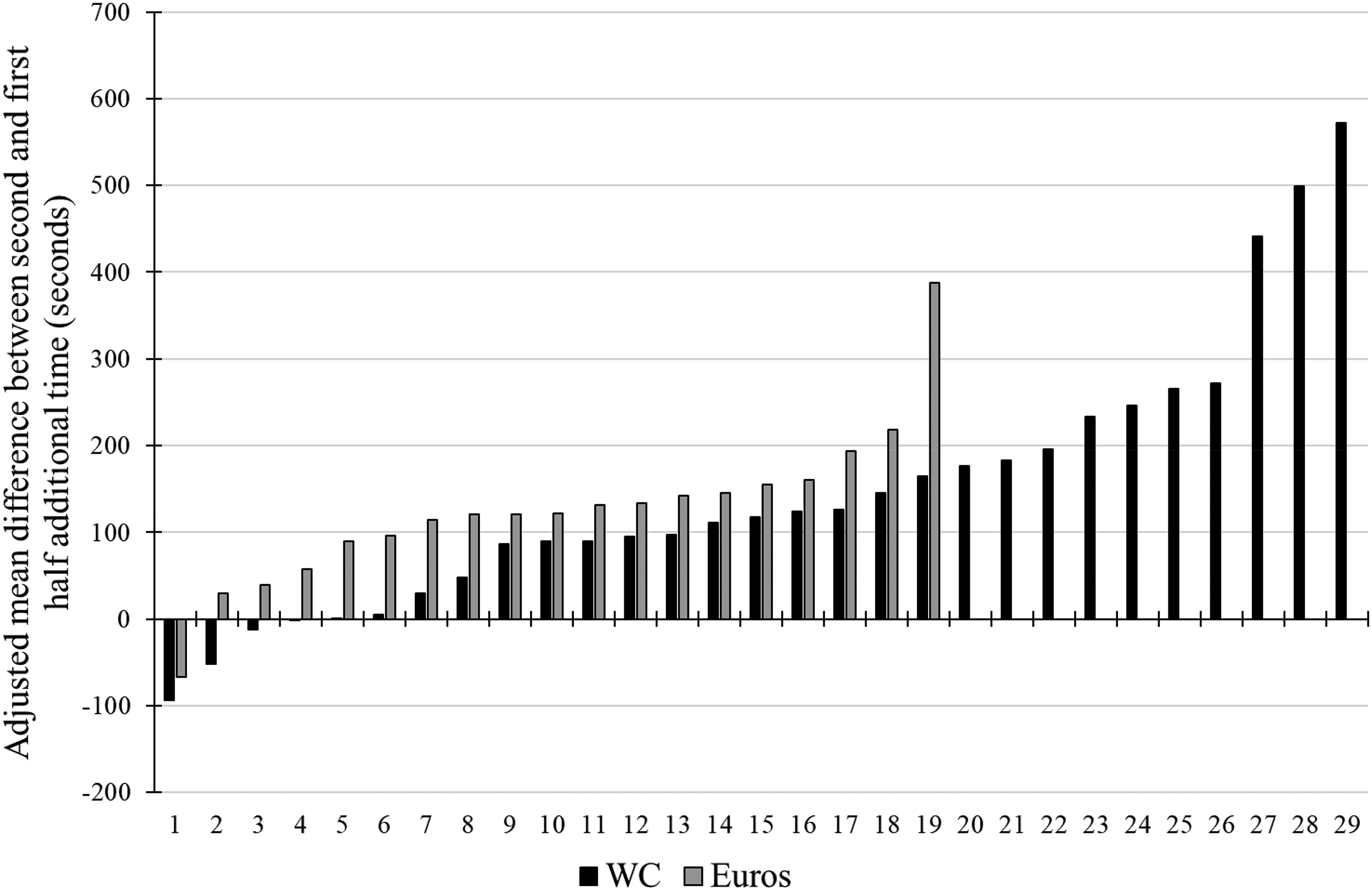
Average Additional Time Allowed in the Second than First Half for Each Referee at the 2022 FIFA World Cup and UEFA Euro 2024, Adjusted for the Frequency of Major Events and Stoppages. Notes: author calculations using data from sources discussed. Average marginal effects of ‘2nd Half’ for each individual referees, from least squares estimate of Equation (1) for each tournament separately, with the addition of referee fixed effects and their interaction with ‘2nd Half’.
Across columns (II)-(V), Table 2 shows significant estimates of 90–95 s more additional time being played in either half at the World Cup than at the Euros (
Columns (IV) of the results tables show estimates of Equation (3), with our test for whether more additional time is played in the second half than the first half specifically when the score margin between teams is small at the end of normal time. In the pooled and World Cup samples, the estimates of
Finally, there is no support for Hypothesis 4 in columns (V) of the tables for estimates of Equation (4), when we test whether a disparity between pre-match expectations and the scoreline at 45 or 90 minutes are associated with additional time played.
To add further robustness to our results, we estimate all the models across our three samples using Poisson regression models (see Appendix 1 to 3). The results are largely consistent, though some coefficients are estimated relatively more precisely for the Poisson regression models.
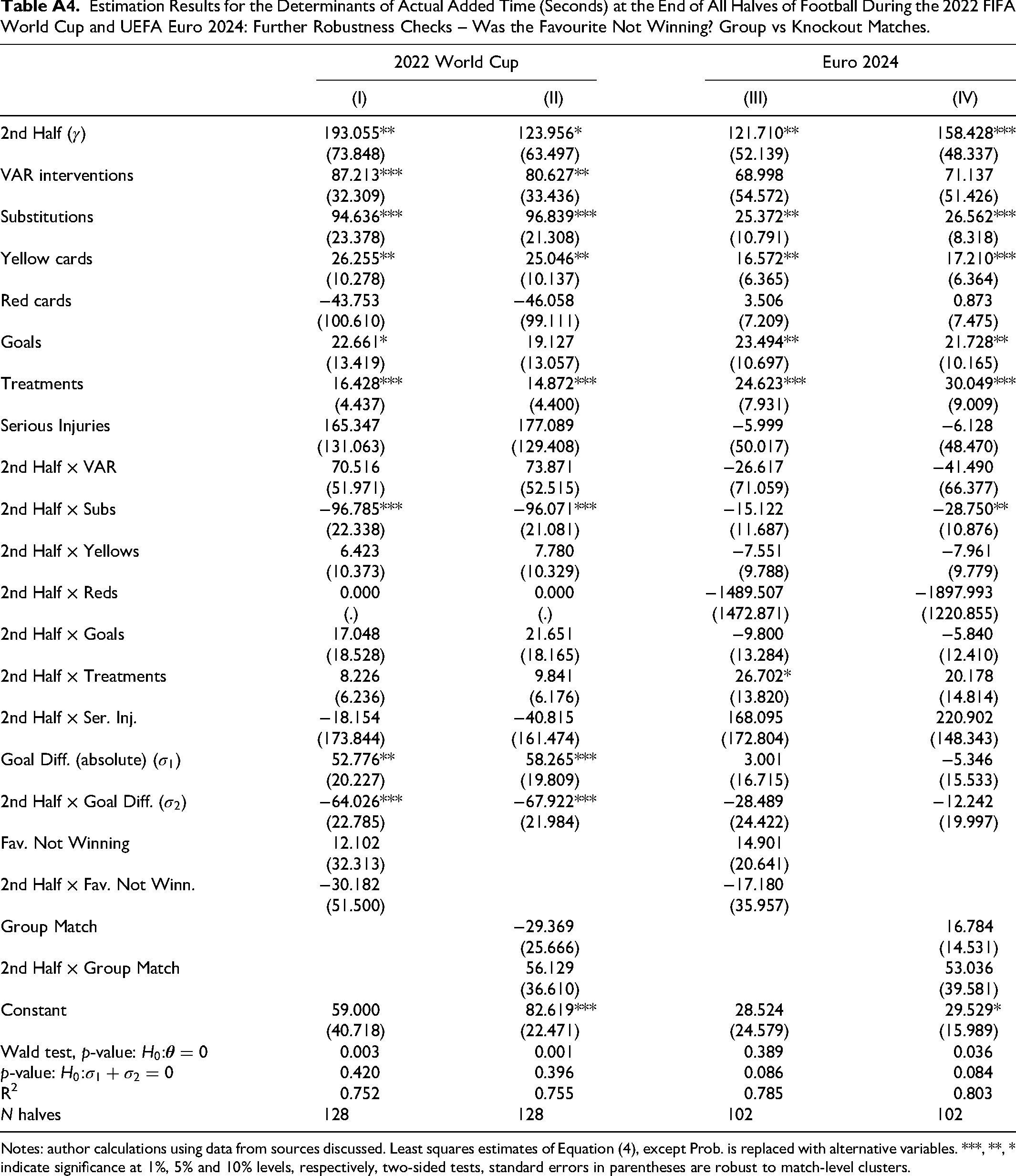
In Appendix Table A4, we also show the results of two further robustness checks. We again estimate Equation (4) separately for the World Cup and Euros, but instead of
Second, we present estimation results in Appendix Table A4 that relate to Hypothesis 4, testing whether there is greater inconsistency between halves in the additional time played when the pre-match favourite, according to betting odds, is not winning at the end of normal time. The estimates go in the opposite of this direction and are not statistically significant; there is no evidence that the pre-match favourite not winning in normal time influences the referee's decision to allow additional time.
Further Discussion
Overall, both the World Cup and Euros samples show that on average almost 200 seconds more are played in the second than the first halves of matches. We can use a standard two-way Oaxaca-Blinder decomposition to account for how much of this difference is ‘explained’ by the other observed factors in our regression models, namely the different numbers and types of stoppages and the score margin at the end of normal time. Column (I) of Table 5 shows that 148 of the 196 additional second half seconds played on average at the Euros can be ‘explained’, by there being more substitutions in second halves. The remaining total unexplained 48 seconds include a statistically significant 20 seconds from more additional time per treatment in the second half, offset by other stoppages tending to be associated with less added time in the second half; there is a statistically significant residual unexplained 92 seconds played in the second half compared with the first half.
Oaxaca-Blinder Decomposition for the Difference in Actual Added Time (Seconds) Between the First and Second Halves at the 2022 FIFA World Cup and UEFA Euro 2024.
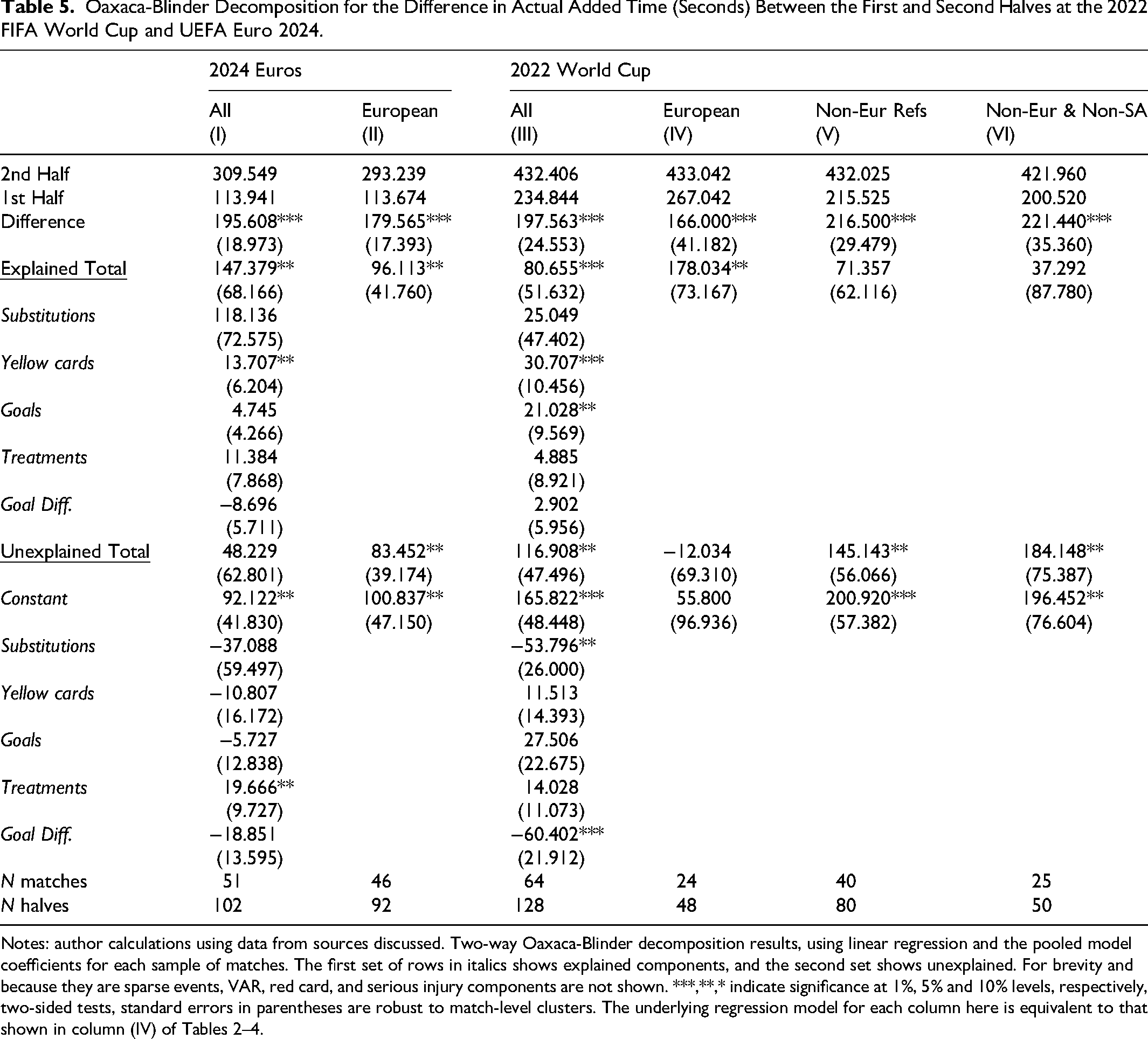
Notes: author calculations using data from sources discussed. Two-way Oaxaca-Blinder decomposition results, using linear regression and the pooled model coefficients for each sample of matches. The first set of rows in italics shows explained components, and the second set shows unexplained. For brevity and because they are sparse events, VAR, red card, and serious injury components are not shown. ***,**,* indicate significance at 1%, 5% and 10% levels, respectively, two-sided tests, standard errors in parentheses are robust to match-level clusters. The underlying regression model for each column here is equivalent to that shown in column (IV) of Tables 2–4.
The equivalent decomposition results for the World Cup in column (III) of Table 5 show that only 81 of the average 198 additional second half seconds are explained by the different distribution of the variables in the model between halves. The overall unexplained 117 seconds played per match in the second half relative to the first half at the World Cup is significantly compressed by substitutions and the score margin, which are both associated with less additional time per incident in the second than the first half. The residual unexplained additional time played in the second half compared with the first half is 166 seconds. One observable difference between the World Cup and Euros is that the former featured some European referees whereas the latter featured almost entirely referees based in Europe, which is generally regarded as featuring the world's best (highest revenue) domestic and continental club-football tournaments, with perhaps the highest professional football referee standards. By separating the World Cup sample into those officiated by referees from Europe or not, and repeating the Oaxaca-Blinder decomposition, the results in columns (IV) and (V) of Table 5 show that the unexplained additional time in the second half attenuates substantially for the European referees. When we focus on the 50 matches at the World Cup officiated by referees neither from Europe nor South America (the next highest-level continent according to FIFA rankings), the total unexplained additional time awarded on average by referees in the second half compared with the first half is 184 seconds. This result suggests FIFA may be better off selecting more European referees who appear to be less susceptible to (more aware of) unconscious bias. This could be due to the higher standard of football they generally officiate on. But more thorough investigation of this pattern is required and is an avenue for future research.
Conclusion
We have examined the consistency and objectivity of decision-making under social pressure by studying how elite football referees allocate additional time across the two halves of a match. This serves as a natural experiment, since the referees face the same rules when making their decisions twice within a match, approximately one hour apart. We studied these decisions and test some behavioural hypotheses at arguably the most scrutinised level in football, at two recent men's international tournaments: the 2022 FIFA World Cup and the 2024 UEFA European Championship. Our results reveal several key findings. First, significantly more additional time is played in the second half, even after accounting for major events and stoppages. Second, while incidences of major events and stoppages within a match are generally associated with less additional time in the second half at the World Cup, this relationship is not observed at the Euros. Third, a tight scoreline at the end of normal time in the second half results in more additional time played compared to the same margin in the first half, a finding that is also specific to the World Cup. Finally, we find no evidence that pre-match expectations regarding the outcome of a match affect the amount of additional time played. We are conscious that some caution is required when interpreting our results due to the relatively small sample size. However, as these tournaments are infrequent and often played under different directives or modifications to rules, further data from other historical international tournaments could also introduce a degree of heterogeneity that does not necessarily help to test our hypotheses more robustly; this is demonstrated by the clear differences between the results from the two tournaments in our current sample.
Besides general interest in whether elite and well-trained decision makers manage to maintain consistency under immense scrutiny and pressure, our findings have implications within the game of football and perhaps sport more broadly. While we observe a reasonable degree of consistency in referee decisions, football's governing body, FIFA, and the custodians of the Laws of the Game, IFAB, could alter the existing rules to provide greater transparency in how additional time is being calculated, thereby reducing pressure on referees. Another option would be to let significant stoppages result in the ‘stopping of the clock’ by the officials, a practice witnessed in other field sports such as rugby. This would remove the need to add on significant amounts of time for lengthy stoppages as well as eliminate any recall bias from the referees later in the game. This could be extended to all stoppages including goals, substitutions, and treatments, to minimise the amount of additional time actually played. It would also discourage timewasting tactics, strategic behaviour, or the feigning of injury – seeking medical treatment when no such treatment is required – to breakup play, which may be welcomed by football fans. A more radical step could be the complete removal of the timekeeping task from the referee. The use of technology to aid officials’ decision-making is already becoming widespread in football, not only at the major tournaments but also in national league and cup competitions. Given this trend, there is no obvious reason why timekeeping should remain the sole responsibility of the referee rather than be managed by an automated system, such as an AI-powered stopwatch.
As already noted, our estimation samples from the 2022 World Cup and 2024 Euros are naturally limited in size. This could motivate further research to explore within-match consistency with larger datasets from more historical or less elite tournaments, perhaps with more refined measures of variation in the degree of social pressure that the referee is facing. Further research could also focus on strategic delays, using real-time data on when the ball is in play. Teams defending a lead often engage in subtle but cumulative delays (e.g., delaying set-pieces), which may not be noticeable to referees over short periods but add up significantly. Future research could look to isolate specific types of stoppages, comparing the expected amount of additional time to the actual amount played. Such analysis could then determine whether time-wasting tactics in fact are rewarding those that seek to engage in this strategic behaviour, or whether referees are successfully adjusting their decisions to maintain consistency and fairness.
Footnotes
Acknowledgements
The authors wish to thank members of the Centre for Sports Economics and Law, University College Cork and participants at the Centre for Sports Business Seminar Series, University of Liverpool for helpful comments and suggestions on earlier versions of this work. They also wish to express their sincere thanks to Ronan Butler for his assistance with data collection during World Cup 2022 and Euro 2024.

Funding
The authors received no financial support for the research, authorship, and/or publication of this article.
Declaration of Conflicting Interests
The authors declared no potential conflicts of interest with respect to the research, authorship, and/or publication of this article.
Notes
Author Biographies
Appendix
Estimation Results for the Determinants of Actual Added Time (Seconds) at the End of All Halves of Football During the 2022 FIFA World Cup and UEFA Euro 2024: Further Robustness Checks – Was the Favourite Not Winning? Group vs Knockout Matches.
| 2022 World Cup | Euro 2024 | |||
|---|---|---|---|---|
| (I) | (II) | (III) | (IV) | |
| 2nd Half ( ) | 193.055** | 123.956* | 121.710** | 158.428*** |
| (73.848) | (63.497) | (52.139) | (48.337) | |
| VAR interventions | 87.213*** | 80.627** | 68.998 | 71.137 |
| (32.309) | (33.436) | (54.572) | (51.426) | |
| Substitutions | 94.636*** | 96.839*** | 25.372** | 26.562*** |
| (23.378) | (21.308) | (10.791) | (8.318) | |
| Yellow cards | 26.255** | 25.046** | 16.572** | 17.210*** |
| (10.278) | (10.137) | (6.365) | (6.364) | |
| Red cards | −43.753 | −46.058 | 3.506 | 0.873 |
| (100.610) | (99.111) | (7.209) | (7.475) | |
| Goals | 22.661* | 19.127 | 23.494** | 21.728** |
| (13.419) | (13.057) | (10.697) | (10.165) | |
| Treatments | 16.428*** | 14.872*** | 24.623*** | 30.049*** |
| (4.437) | (4.400) | (7.931) | (9.009) | |
| Serious Injuries | 165.347 | 177.089 | −5.999 | −6.128 |
| (131.063) | (129.408) | (50.017) | (48.470) | |
| 2nd Half × VAR | 70.516 | 73.871 | −26.617 | −41.490 |
| (51.971) | (52.515) | (71.059) | (66.377) | |
| 2nd Half × Subs | −96.785*** | −96.071*** | −15.122 | −28.750** |
| (22.338) | (21.081) | (11.687) | (10.876) | |
| 2nd Half × Yellows | 6.423 | 7.780 | −7.551 | −7.961 |
| (10.373) | (10.329) | (9.788) | (9.779) | |
| 2nd Half × Reds | 0.000 | 0.000 | −1489.507 | −1897.993 |
| (.) | (.) | (1472.871) | (1220.855) | |
| 2nd Half × Goals | 17.048 | 21.651 | −9.800 | −5.840 |
| (18.528) | (18.165) | (13.284) | (12.410) | |
| 2nd Half × Treatments | 8.226 | 9.841 | 26.702* | 20.178 |
| (6.236) | (6.176) | (13.820) | (14.814) | |
| 2nd Half × Ser. Inj. | −18.154 | −40.815 | 168.095 | 220.902 |
| (173.844) | (161.474) | (172.804) | (148.343) | |
| Goal Diff. (absolute) ( |
52.776** | 58.265*** | 3.001 | −5.346 |
| (20.227) | (19.809) | (16.715) | (15.533) | |
| 2nd Half × Goal Diff. ( |
−64.026*** | −67.922*** | −28.489 | −12.242 |
| (22.785) | (21.984) | (24.422) | (19.997) | |
| Fav. Not Winning | 12.102 | 14.901 | ||
| (32.313) | (20.641) | |||
| 2nd Half × Fav. Not Winn. | −30.182 | −17.180 | ||
| (51.500) | (35.957) | |||
| Group Match | −29.369 | 16.784 | ||
| (25.666) | (14.531) | |||
| 2nd Half × Group Match | 56.129 | 53.036 | ||
| (36.610) | (39.581) | |||
| Constant | 59.000 | 82.619*** | 28.524 | 29.529* |
| (40.718) | (22.471) | (24.579) | (15.989) | |
| Wald test, |
0.003 | 0.001 | 0.389 | 0.036 |
| 0.420 | 0.396 | 0.086 | 0.084 | |
| R2 | 0.752 | 0.755 | 0.785 | 0.803 |
| N halves | 128 | 128 | 102 | 102 |
Notes: author calculations using data from sources discussed. Least squares estimates of Equation (4), except Prob. is replaced with alternative variables. ***, **, * indicate significance at 1%, 5% and 10% levels, respectively, two-sided tests, standard errors in parentheses are robust to match-level clusters.