



Abstract
The present study analyzes all major international football tournaments organized by UEFA and CONMEBOL during a period of 30 years to assess the impact of the away goals rule (AGR). The study takes advantage of natural experiment given by the differentiated application of the AGR by both confederations, in order to assess the efficacy and the consequences of the rule in terms of both the total amount of goals being scored (the original intention of the rule) and the teams that progressed onto the next stages. The results show that the AGR seems to have failed to fulfill its original goal of increasing both scoring by teams playing away and scoring in general. The AGR is found to have a significant impact favoring the chances of the team starting the series at home. However, it still does not translate into a higher probability of progressing onto the next stage than the team closing the series at home. Closing the series at home has an intrinsic advantage, which is only countered, although not completely, by the impact of the AGR. Regarding tiebreakers, we observe that closing the series at home has a positive impact no matter whether overtimes with AGR or penalty shootouts are used as tiebreakers. However, playing an overtime, when no AGR is set in place has a determining influence favoring the team closing the series at home.
Introduction
In association football, the away goals rule (AGR) was first introduced by the Union of European Football Associations (UEFA) in the 1965–66 European Cup Winners’ Cup (UEFA, 2021). Since then, it was adopted by all major European association football competitions. The rule applies to tournaments organized on a straight elimination basis, in which two legs are disputed. Here, the first leg is played on the home field of the first team, while the second leg is played on the home field of the second team. The AGR postulates that in case both teams score the same amount of goals in the sum of both games, the team that has scored the largest amount of goals on the opposite team's home field (i.e., playing away) would progress onto the next stage (IFAB, 2020).
The original objective of the rule was to promote offensive game and scoring (Patterson, 2020; Jost, 2021; UEFA, 2021). In the early days of international football competitions, it was observed that teams playing away from home tended to deploy defensive strategies in order to minimize the number of goals being scored (and, consequently, the goal difference) in the game where the home-field advantage was on the other side. Hence, setting a higher valuation on goals scored away should have been detrimental to defensive strategies, which are considered to be less appealing for spectators and viewers (Jost, 2021). In this sense, the AGR seems to pursue the same objectives as the “Three points for a win rule” (Lenten & Kendall, 2021).
Despite its popularity in Europe, the rule was not immediately embraced around the world. The South American Football Confederation (CONMEBOL) as well as most of its associations did not immediately apply the rule. Besides the season 1988 (in which the rule was applied), it was not until 2005 that CONMEBOL adopted the AGR in international club competitions (by that time, the Copa Libertadores de América and the Copa Sudamericana). The rule, however, did not apply to the entire tournament, as the finals (played on two legs, opposite to single matches in UEFA competitions) were excluded (Olé, 2019).
From a scientific viewpoint, the differentiated application of the rule by the two major association football confederations constitutes a natural experiment and an opportunity to assess the efficacy as well as the consequences of the rule, as it allows to compare the evolution of the results before and after its implementation. Furthermore, the fact that the rule has been in place for over 50 years in UEFA competitions, allows using them as a control group to discard eventual changes in scoring as a result of the epoch, rules changing, or the implementation of new strategies.
However, the AGR cannot be analyzed in a vacuum, as it coexists with a series of other external effects that affect the outcome of direct elimination series. First and foremost, it coexists with the home-field advantage, which implies that the team playing on its home turf has a substantially higher probability of winning the match. This effect has been thoroughly analyzed in the literature (e.g., Carmichael & Thomas, 2005; Lago-Peña & Lago-Ballesteros, 2011), with differences being attributed to multiple factors including refereeing (Boyko et al., 2007), fans (Cross & Uhrig, 2020), among many others (Pollard & Armatas, 2017). Along these lines, it has also been established that, in two-legged direct elimination series, the impact of the home-field advantage varies from the first to the second match (Page and Page, 2007) and what can be considered a good result when playing the first leg at home (Flores et al., 2015). Opposite to the aforementioned phenomena, the impact of the AGR has received much less attention, most likely because it requires comparing competitions with and without the AGR. Thus, it has been considered by means of axiomatic analysis (Kongo, 2017) or simulations (Jost, 2021). Waquil et al. (2020) attempted to establish the impact of the AGR based on actual empirical data, but they limited their analysis to the Brazil cup, which, in turn, limits the validity of the study as all observations considered the application of the rule; hence, they can merely establish which team profited from the AGR in a given pairing and not comprehensive effect of the rule. To our best knowledge, the only study reported in the literature considering the AGR based on empirical data comparing tournaments in which the rule is applied with tournaments in which the rule is not applied is the one conducted by Varlera-Quintana et al. (2018). They compared results from CONMEBOL tournaments from 1988 to 2014 and find out that the introduction of the AGR improved the chances of the teams finishing the series away.
The present study analyzes all major international football tournaments organized by UEFA and CONMEBOL during a period of 30 years. The starting year is 1988, as it was the year when CONMEBOL's flagship tournament, Copa Libertadores de America, implemented a direct elimination system throughout the decisive phases (before that, the winner of successive round-robin groups progressed onto the finals) and the first time that a second major tournament was disputed in South America. Consequently, the results were analyzed up until 2018. The results are considered from the perspective of the total amount of goals being scored (the original intention of the rule) as well as the teams that progressed onto the next stages.
The paper is organized as follows: Section 2 presents a summary of the dataset being considered. Then, Section 3 analyzes the impact of the AGR on scoring, while Section 4 addresses the impact of the rule on deciding the winner of a pairing under different circumstances. Finally, Section 5 presents the results of our study as well as recommendations for football governing bodies.
Description of the Dataset
As previously mentioned, the database consists of all games played between 1988 and 2018 in international major club tournaments organized by UEFA and CONMEBOL. The following competitions are considered in the analysis:
European Cup / UEFA Champions League: The tournament, called European Cup up until the season 1991/92 and Champions League since the season 1994/95 (with intermediate tournaments using both names depending on the phase) is the Tier 1 tournament of European association football. It originally reunited the winners of the domestic league tournaments only, but since the season 1997/98, it has been expanded in order to include more teams of the major European leagues. During the entire period of analysis, the competition consists of a qualification phase (disputed by direct elimination between teams proceeding from lower-ranked domestic competitions), a round-robin phase (two between 1999/2000 and 2002/03), and a final knockout stage up until the final, which is disputed in a single game on a neutral field. Furthermore, during the entire period of analysis, two teams progressed from the round-robin groups, with the group winner being assigned to play the second game in their home field (otherwise the teams closing the series in their home fields were assigned randomly). In case of a tie, all direct elimination matches consider the AGR as well as an overtime in case both teams remain tied (also considering the AGR). If no goals are scored during the overtime (note that due to the AGR a tie is no longer possible if a single goal is scored during the overtime) a penalty shootout follows. In total, the database considers 1 338 two-legged knockout pairings from the UEFA Champions League, 148 of which have a non-random assignment of the home field (as a result of seeding after the group phase). 4 pairings could not be considered in the analysis, as at least one game of the series was not adequately disputed and the result was exogenously assigned. European Cup Winners’ Cup / UEFA Cup Winners’ Cup: The European Cup Winners’ Cup (UEFA Cup Winners’ Cup since 1994) was the second UEFA tournament in importance and it was contested by the winners of the domestic cup competitions. It considered only direct elimination series up to the final, which was disputed in a single match. It considered the same tiebreakers as the UEFA Champions League. In total, the database includes 427 pairings, none of which includes seeding (and a non-random assignment of the home-field) or irregularities. UEFA Cup / UEFA Europa League: Called UEFA Cup up until the season 2009/10, it was originally considered the Tier 3 tournament of UEFA, until the cancelation of the European Cup Winner's Cup after the season 1998/99, when it became second in importance. It includes the best-placed teams in their domestic league competitions that did not manage to qualify to either the UEFA Champions League or the European Cup Winners’ Cup as well as the cup winners since the season 1999/2000 (unless they qualify to the UEFA Champion League via their domestic league) and teams being eliminated in early phases of the UEFA Champions League. Up until the season 2003/04, only direct elimination legs were disputed. After, round-robin groups were introduced, with more than one team progressing and the home field being assigned non-randomly in the stage immediately after the group phase. The final is disputed in a single match. In total, the database considers 3 776 pairings, 207 of which include seeding; 11 pairings present irregularities. It considers the same tiebreakers as the UEFA Champions League. Copa Libertadores de América: CONMEBOL's top-tier tournament includes the best-placed teams in their respective domestic leagues. Up until 2004, it started with a group phase, followed by knockout stages. Since 2005, it also includes direct elimination preliminary phases before the group stage. The first direct elimination round after the group phase includes seeding and the final is also disputed in two legs (up until 2019, when it started being disputed in a single match, but these years are not considered in the database). No overtime is disputed (until 2019, and after that only in the final), and the AGR was used in 1988 and since 2005. In case of a tie in the regulation time, a penalty shootout is directly contested (no overtime is played). The database considers 560 pairings, 242 of which include seeding (pairing between two teams finishing second in their groups were considered to be unseeded) and 300 the AGR. Two matches have some irregularities. Copa Sudamericana: CONMEBOL's tier 2 tournament started in 2002 and up until 2021 it only included non-seeded knockout stages. Traditionally, it was disputed in the second half of the year, allowing for teams taking part in Copa Libertadores to also dispute Copa Sudamericana, after the end of the former (although several countries imposed restrictions against teams taking part in both tournaments). Since 2017, it is disputed in parallel to Copa Libertadores and it applies the same tiebreakers. The database includes 653 series, 561 of which consider the AGR. No match presented irregularities. Supercopa Sudamericana: It was disputed between 1988 until 1997 and it was contested in the second part of the year, after the end of Copa Libertadores. It was considered the second tournament of CONMEBOL in importance. It was open to all teams which have previously won Copa Libertadores and, consequently, it had neither a fixed number of participants nor a fixed structure. In some years, it considered only knockout stages and, other times, it included a group phase. However, only one team progressed from each group and, consequently, there was no seeding. The tiebreakers were the same as in Copa Libertadores. In total, 125 pairings were disputed, 12 of which considered the AGR (in 1988). No game presents irregularities. Copa Mercosur: Copa Mercosur was an invitational tournament disputed by the 20 most popular teams of Argentina, Brazil, Chile, Paraguay, and Uruguay and it was disputed between 1998 and 2001. It considered a group-stage followed by a direct elimination phase. In total, the database considers 28 pairings, 12 of which are seeded, and 0 considered the AGR. A particularity of the tournament is that the finals from the first three versions considered a third game, if both teams obtained the same amount of points in both games. Two finals were decided in a third game. Copa Merconorte: Also an invitational tournament, parallel to Copa Mercosur, and disputed by 12–16 teams from Bolivia, Colombia, Ecuador, Peru, Venezuela as well as invitees from Costa Rica, Mexico, and the USA. It considered a group phase, followed by semifinals and final. As only one team progressed from each group, no seeding was considered. In total, 12 knockout pairings were disputed, none of which was seeded, considered the AGR or presented irregularities. The tiebreakers were the same as in Copa Libertadores. Copa CONMEBOL: The tier 3 tournament of CONMEBOL between 1992 and 1999, disputed in parallel to Copa Sudamericana, and later to Copa Mercosur/Merconorte. It was only open to teams taking part in neither the aforementioned tournaments nor in Copa Libertadores. It considered knockout stages only and the same tiebreakers as Copa Libertadores. In total 120 direct elimination series were disputed, none of which considered the AGR, seeding or presented irregularities.
In total, 7 039 direct elimination series are considered. Table 1 presents a summary of the games considered in the dataset. It is important to take into account that the tiebreaker “Overtime” was only considered in UEFA tournaments; thus, it is completely confounded with any particularity affecting European association football.
Summary of Pairings Considered in the Dataset.
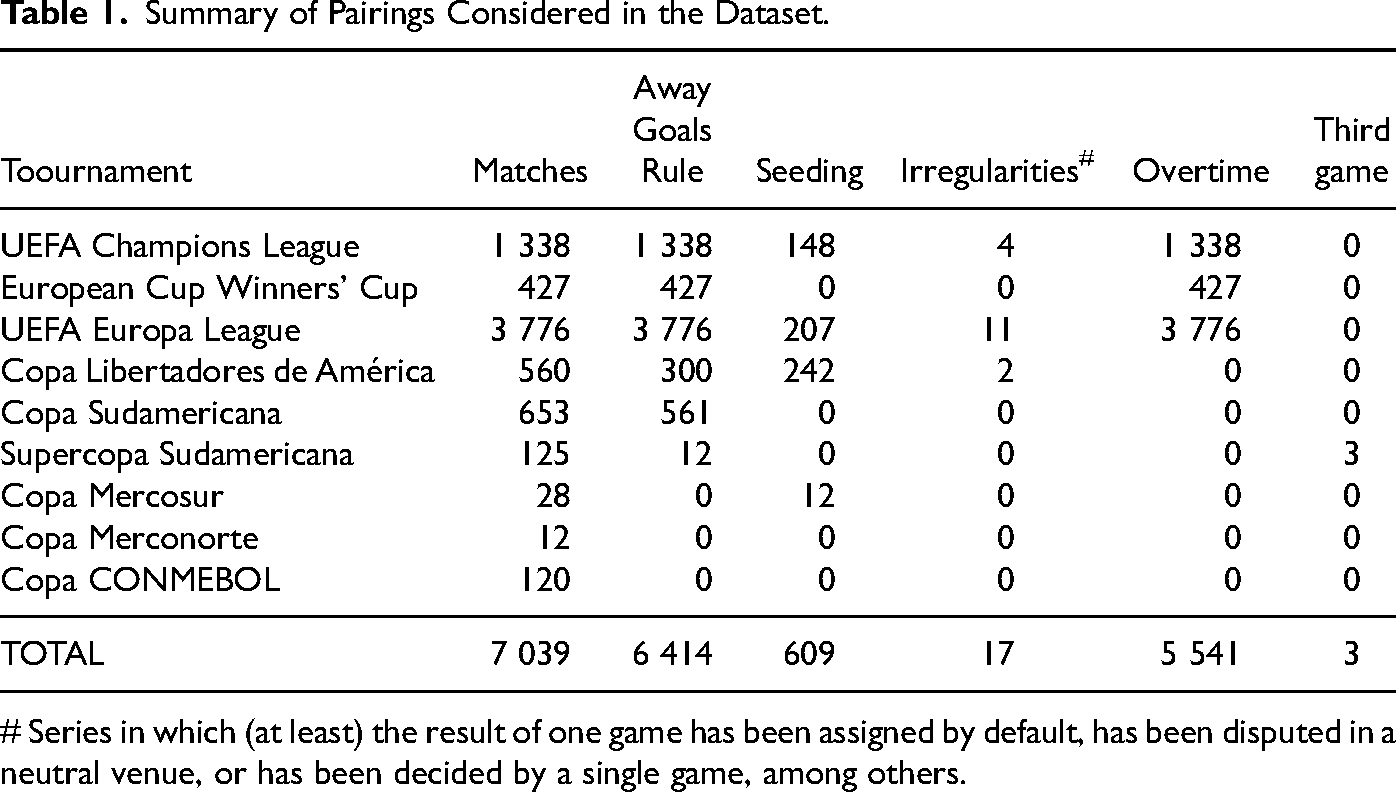
# Series in which (at least) the result of one game has been assigned by default, has been disputed in a neutral venue, or has been decided by a single game, among others.
Effect of the Away Goals Rule on Scoring
The main motivation for the AGR is to encourage a more aggressive strategy by the teams playing away. Hence, the impact of the rule should be judged on the basis of the total amount of goals being scored, as well as on the total amount of goals being scored by teams playing away.
For the purpose of the analysis, all direct elimination series considered in the database were taken into account, besides pairings presenting irregularities (e.g., for which the final score of one of the games was assigned by default), or considering seeding. The latter were discarded as seeding implies that one team is considered stronger than its counterpart. It induces a systematic bias as higher-seeded teams close the series at home. Only goals scored during the regulation time (i.e., with injury time but without overtime) are considered.
Note that opposite to previous studies, such as Eugsten et al., (2011), Lenten et al. (2013), Varlera-Quintana et al. (2018), among others, we have deliberately left aside any considerations related to the pairings. As the teams involved in the pairings are fully randomized (within the universe of participants in the aforementioned competitions), we are basically marginalizing out any consideration related to them (be it the strength, the characteristics of the stadiums, the weather, etc.). 1 This approach guarantees unbiased estimators at the expense of lower predictive power. The latter, however, is compensated by working with a large sample.
Table 2 summarizes the number of goals and away goals scored in direct elimination series, disaggregated at the level of first and second legs, and by the application or not of the AGR. The table presents the average number of goals per game/series as well as the standard deviation. Furthermore, it includes the t-statistic characterizing the null hypothesis that the average number of goals scored considering the AGR was equal or larger than the number of goals scored when the rule was not applied (a one-tailed test is considered as the intention of the rule is to increase scoring).
Goals Scored in all Tournaments (1988-2018). 2
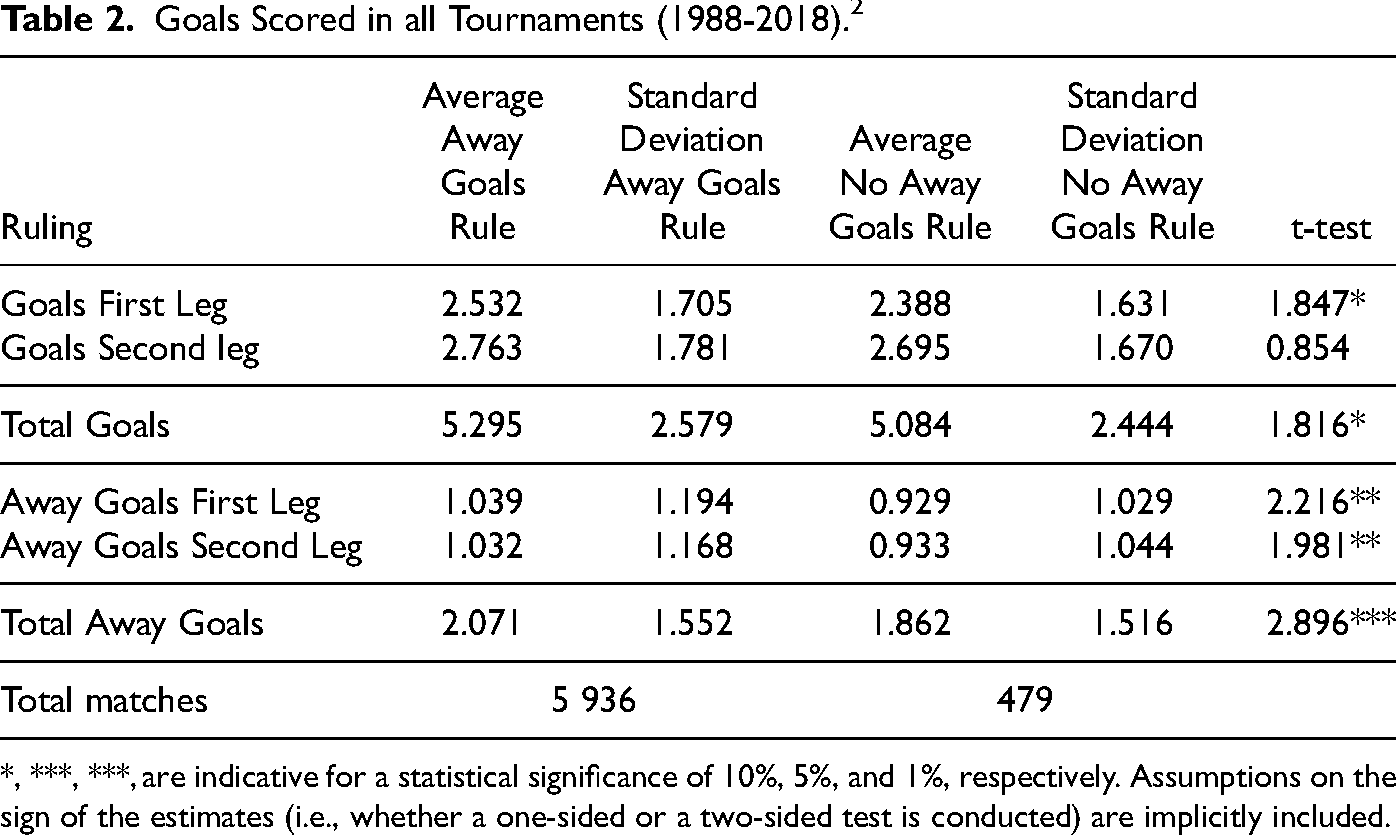
are indicative for a statistical significance of 10%, 5%, and 1%, respectively. Assumptions on the sign of the estimates (i.e., whether a one-sided or a two-sided test is conducted) are implicitly included.
At first sight, it seems as if the application of the rule would have a clear effect on the number of away goals being scored in both the first and the second leg (and, consequently, also on the total number of away goals being scored). Furthermore, the average of the total number of goals scored in the first leg as well as the average of the total number of goals scored throughout the entire series is also statistically significantly higher when the rule is applied (α = 5%, as given the hypothesis, a one-tailed test is considered).
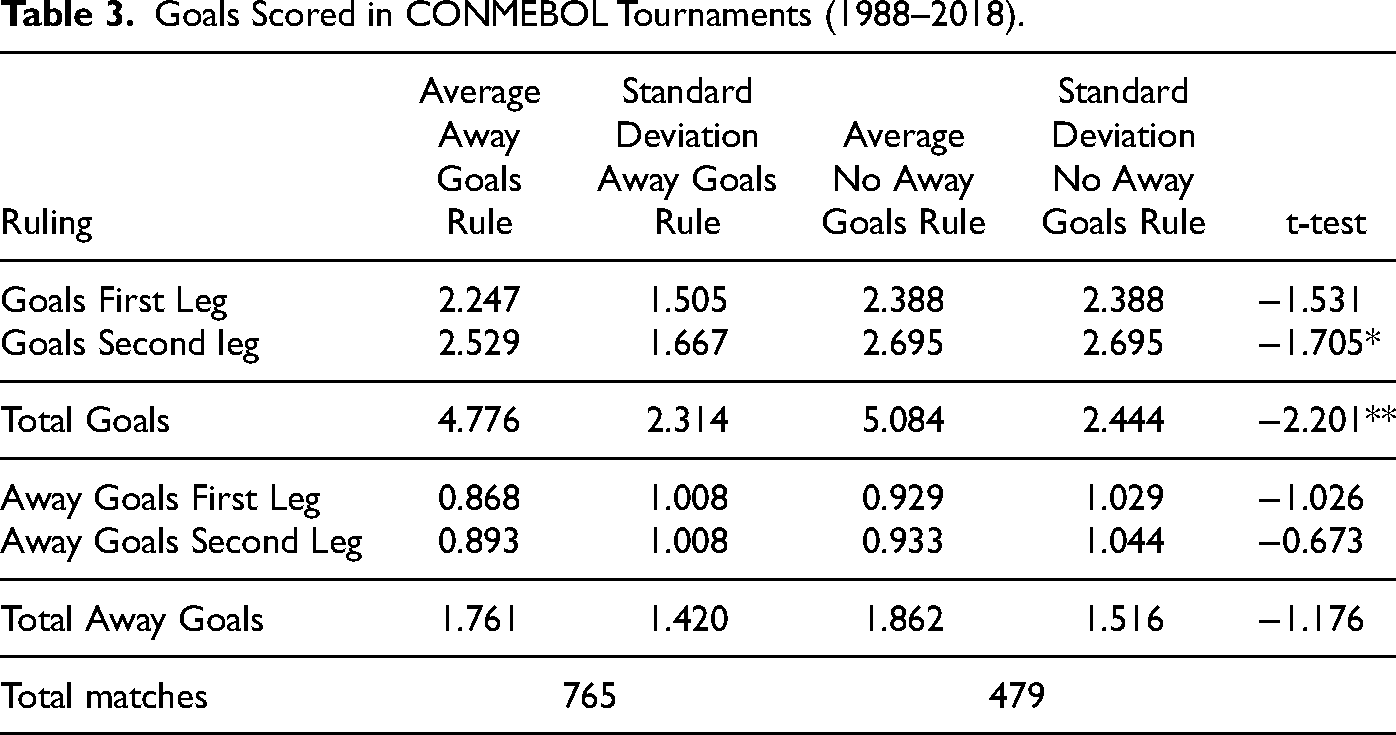
However, the previous comparison does not allow isolating the effect of the AGR, as matchups from UEFA competitions largely dominate the games in which the AGR was applied. If we compare only CONMEBOL tournaments in which the AGR was applied (1988 and after 2005) with tournaments in which the rule was not applied, the results look fairly different.
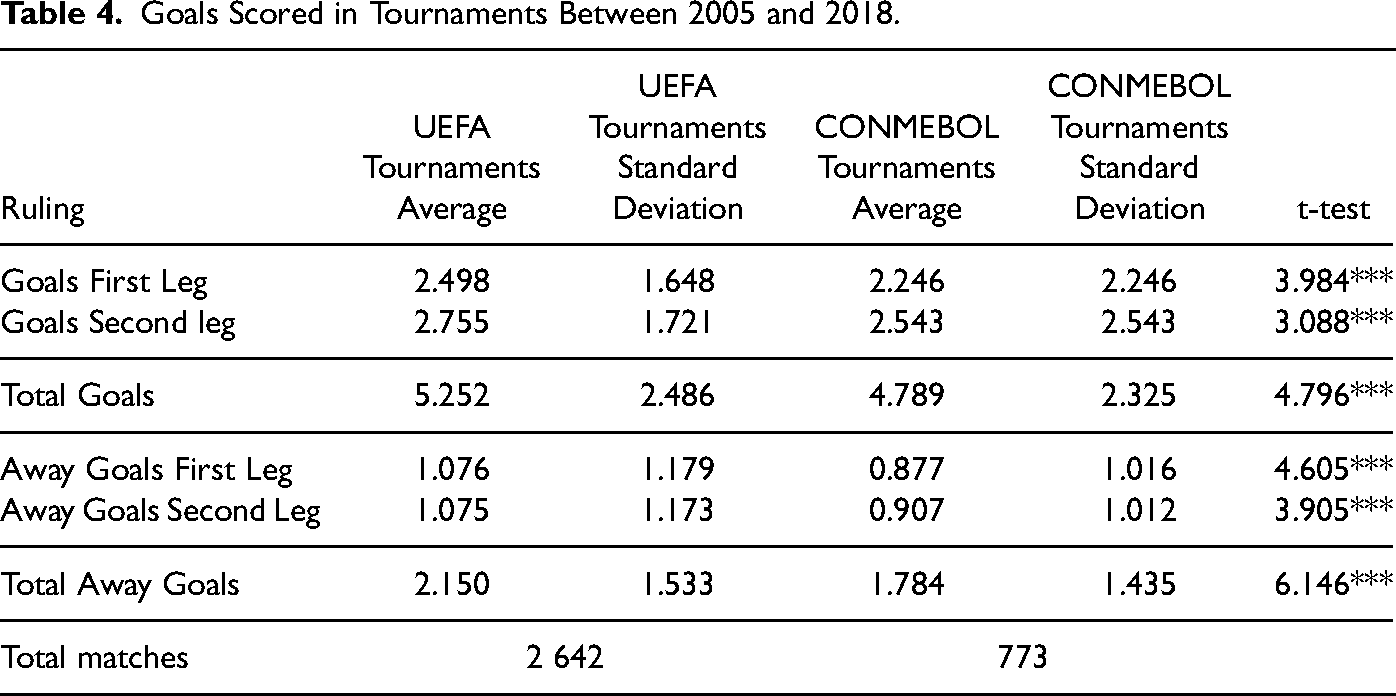
As it can be observed from Table 3, the rule does not seem to have any effect on the goals being scored away, while it seems to have a rather negative impact on the total amount of goals being scored (in each leg and also in total). Hence, it could be postulated that the previously identified impact of the AGR on scoring, seems to be rather associated with differences among European and South American football than with the rule itself. Thus, it seems expedient to make the same comparison for matchups disputed in tournaments of both confederations between 2005 and 2018, when the AGR was applied by both UEFA and CONMEBOL (CONMEBOL tournaments from 1988 were left aside due to potential epoch effects).
Goals Scored in CONMEBOL Tournaments (1988–2018).
As it can be observed from Table 4, there is a clear statistically significant difference in both the amount of goals beings scored away as well as in the total amount of goals being scored throughout the series between European and South American competitions (on average 0.5 additional goals per direct elimination series were scored in UEFA tournaments when compared with CONMEBOL tournaments). As UEFA and CONMEBOL have different tiebreak rules (with UEFA competitions considering an overtime and CONMEBOL tournaments proceeding directly to penalty shootouts – goals scored during overtime were not included in the analysis), it cannot be certainly established that the difference can be ascribed to different strategical approaches of the teams playing in different associations (and not to the different tiebreak rules), although this explanation seems to be highly plausible.
Goals Scored in Tournaments Between 2005 and 2018.
As Tables 2–4 show, the impact of the AGR cannot be isolated from the environment, the most expedient approach to quantify its actual impact is to regress the amount of (away) goals being scored as a function of the application of the rule among other regressors. For the purpose of the analysis, it was assumed that the number of goals can be modelled as a continuous quantity (the total number of goals scored in direct elimination series range from 0 to 18) and that the error terms are normally distributed. Table 5 presents the results of the estimation.
OLS Model. Goals Scored per Series.
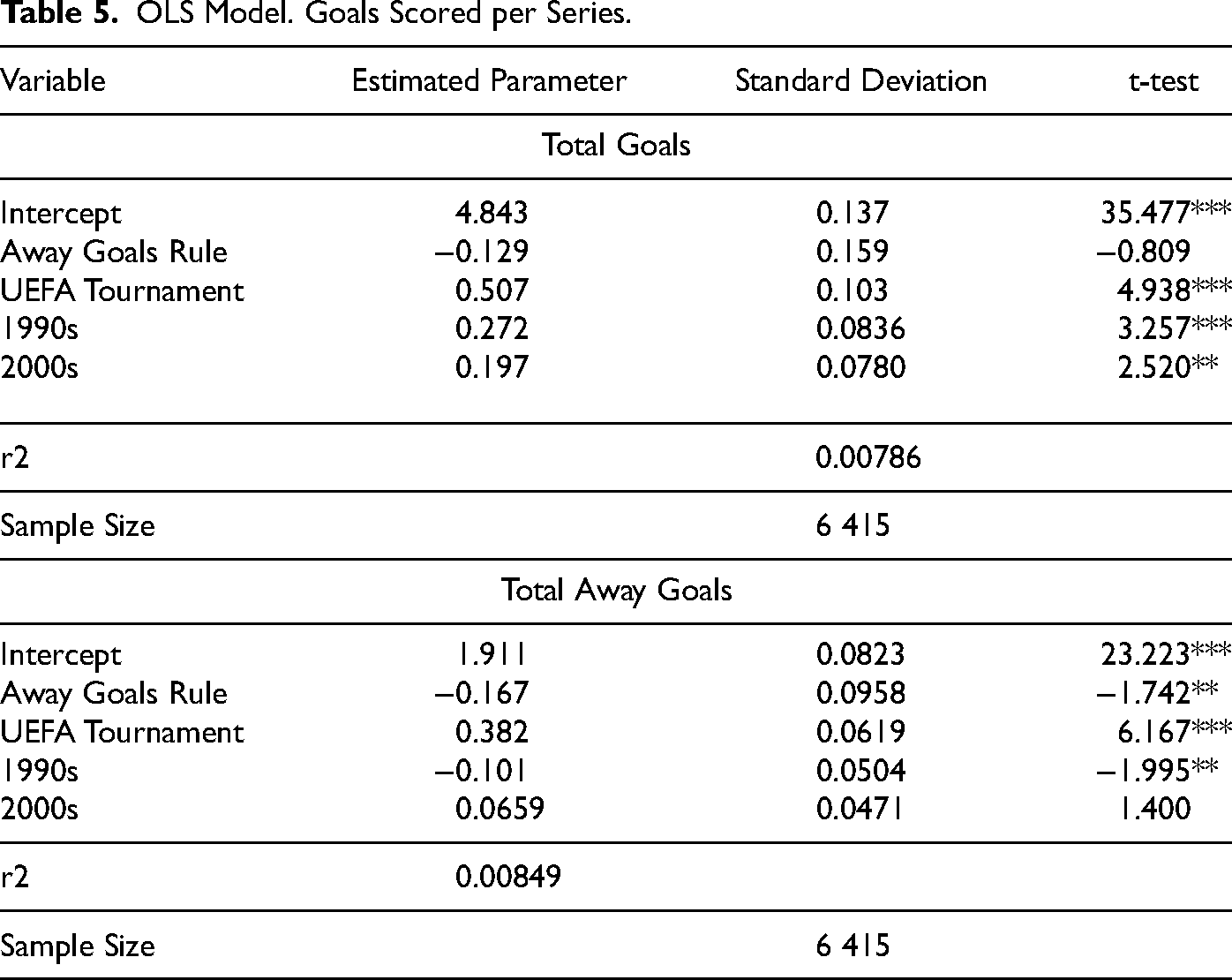
As it can be observed, both models explain only roughly 0.8% of the observed variability. This low explanatory power is in line with the expectations, as football results are mostly explained by the strength of the teams being involved in the competition (and even then, results are considered to be highly unpredictable). Interestingly, and along the lines of the previous analysis, UEFA tournaments are associated with a significantly higher amount of goals being scored both away and in total. Also, recent tournaments (disputed after 2010) are characterized by a smaller total amount of goals than tournaments played in the 2000s and in the 1990s (the latter also including 1988 and 1989). This effect is larger and statistically significant for the total amount of goals scored in each series. Finally, the AGR is associated with a small, but statistically insignificant reduction in both the total amount of goals scored in each series, as well as the number of away goals.
In that sense, the away goals rule does not seem to have contributed to increasing either the number of goals scored by teams playing away or the total number of goals scored per series. These results are quite disappointing, as this was the primary objective of the rule. However, it cannot be completely ruled out that the AGR may have indeed had a positive impact. UEFA tournaments, in which the rule has been applied for over 50 years, are characterized by higher (away) scoring than CONMEBOL tournaments. Hence, it is possible that the rule has indeed contributed to shape the way in which football (and football strategy) is approached in Europe.
Effect of the Away Goals Rule on Deciding the Winner
While a positive impact of the AGR on scoring cannot be established (and its effects seem to be actually the opposite), from the analysis of Tables 2 to 4, it becomes evident that the number of goals scored on second legs seems to be larger than the amount of goals scored in first legs. Table 6 presents a comparison of the amount of goals scored in the first and second legs with and without the AGR.
Goals Scored Disaggregated by leg.
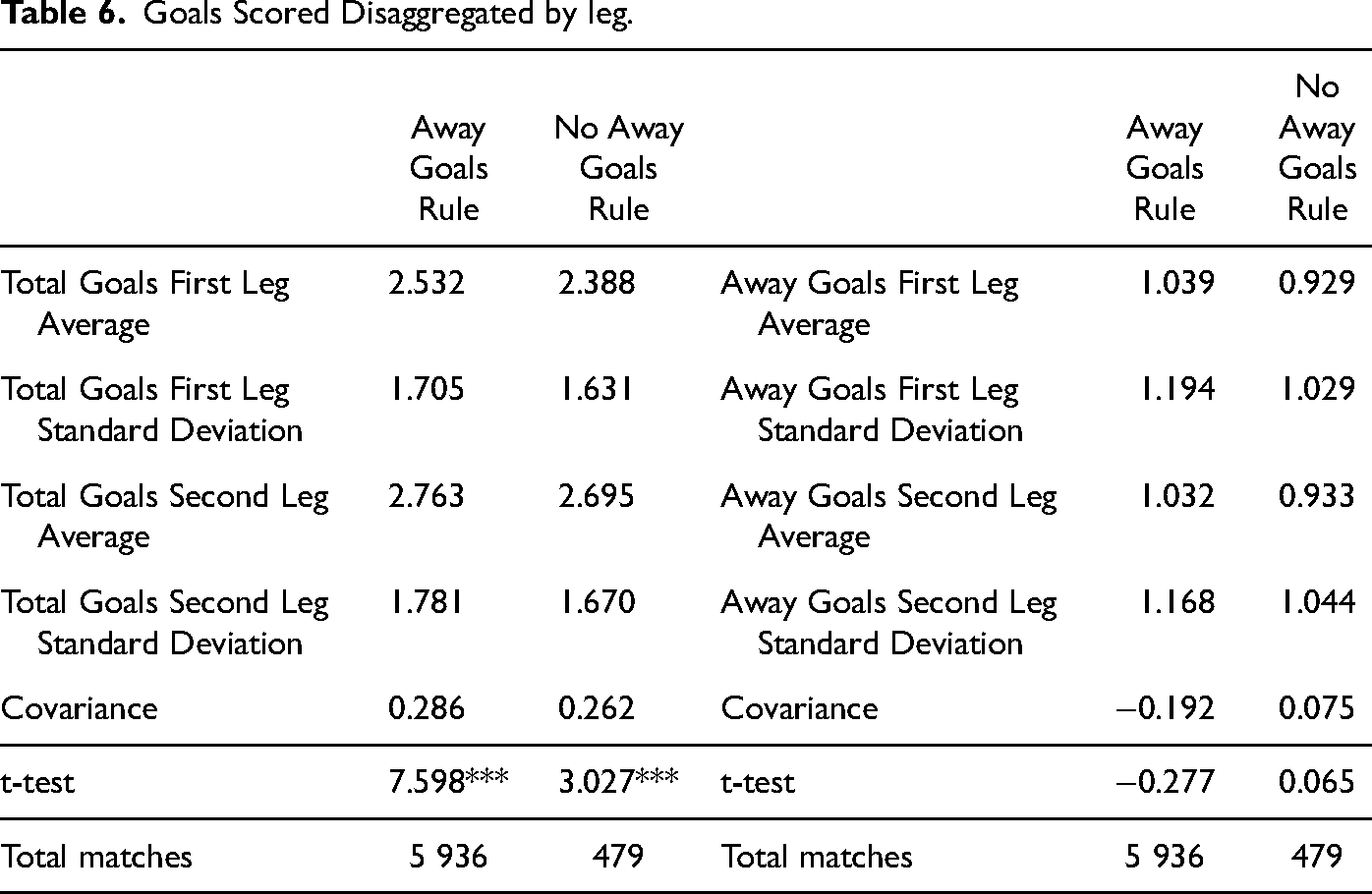
As it can be observed, both with and without the AGR, the second legs are characterized by a statistically significantly higher amount of goals being scored. It aligns with the expectations as one team is eliminated at the end of the second leg; hence, while during the first leg the team being outscored may still pursue a conservative strategy in expectation of a better outcome in the second leg, during the second game, the team being outscored has no other option than playing aggressively (as it faces elimination otherwise). It results in more open games, which is reflected by the average amount of goals being scored.
Surprisingly, however, it does not translate into a statistically significantly higher amount of goals being scored by the away team during the second game. A possible explanation for the phenomenon is that 48% of the teams finishing their series away start the second leg ahead in the scorecard (opposite to 27% of the teams closing at home); hence, teams closing the series away may start those games following a defensive strategy (to preserve the advantage), which seems to neutralize the effect of more goals being scored during the second leg.
The difference in scoring between the first and second leg does not only hold when tournaments are disaggregated by the application of AGR, but also when disaggregating by UEFA and CONMEBOL tournaments and by the different decades being considered.
Given the aforementioned differences in scoring and that the AGR favors scoring during the first game for the team finishing at home and during the second game for the team starting at home (hence, the AGR shall favor the team finishing the series away), it raises the question on to which extent the rule impacts which team progresses onto the next phase. To provide an answer to this question, we conducted a binomial regression on the outcome of the series. We modeled the probability of the team closing the series at home progressing onto the next round and considered i.i.d. EV1 distributed error terms, which lead to Logit probabilities (Domencich & McFadden, 1975; Ortúzar & Willumsen, 2011). Opposite to the previous analysis, in this opportunity, we did consider the series in which seeded teams took part, as it is straightforward to capture the effect of being seeded on the probability of winning the series. Table 7 presents the results of the analysis.
Logit Model. Probability of the Team Closing the Series at Home Winning.
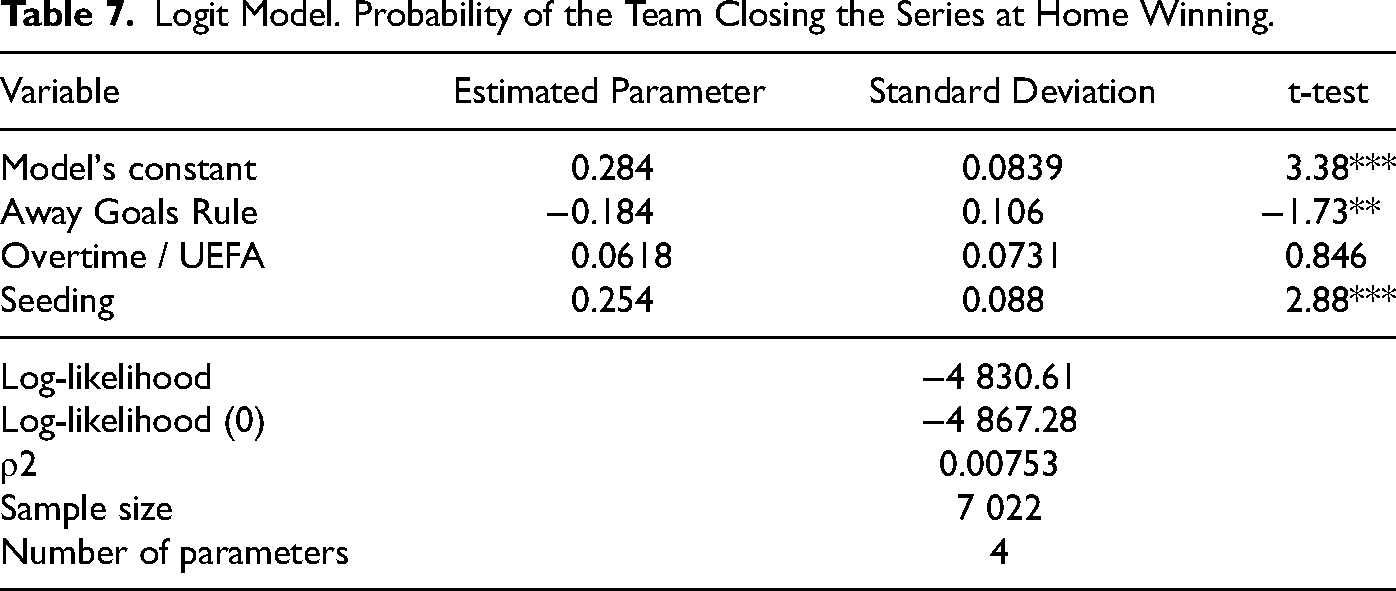
Akin to the model presented in the previous section, and in line with the expectations, the level of adjustment of the model is quite poor. However, it is still possible to identify statistically significant effects, which should not be there if external conditions would have no impact on which team progresses onto the next stage. First of all, it can be observed that the model's constant (associated with the probability of the team closing the series at home winning) is statistically significant, which implies that ceteris paribus the team closing the series at home has significantly better chances of progressing onto the next stage. The odds-ratio is 1.32, which basically implies that if no away goals rule is considered, no overtime is played and no team is seeded a priori, the team closing the series at home is 32% more likely to move into the next round (the probabilities are roughly 57% vs 43%; note, however, that this ratio is altered if other variables are active). This difference is enormous for a subject that is randomly decided and should have no major impact on the outcome of the series. The most likely explanation is that the two legs are not equally important and the home-field advantage weights more during the conclusion of the series. The latter, in turn, has been explained by Varela-Quintana et al. (2018) on the basis of behavioral biases, such as psychological pressure, time inconsistency, and loss aversion, among others. Furthermore, in case of a tie, the overtime and/or the penalty shootout are also disputed in the field of the team closing the series at home.
Also aligned with our expectations, the fact that a team is seeded as consequence of previous performances also translates into higher chances of winning the series. The AGR, in turn, is associated with a statistically significant reduction of the chances of the team closing the series at home, which aligns with the hypothesis that the rule favors teams finishing the series away (consequently, a one-tailed test is performed and the effect is significant at α = 5%). Interestingly, the AGR counters, to a large extent, the advantage of closing the series at home; hence, while it may be argued that the rule indeed induces an unfair advantage for the team finishing away, it basically just levels up the intrinsic disadvantage of finishing away.
Finally, whether an overtime is played after regulation time does not seem to have a statistically significant effect on the probabilities of each team progressing onto the next round. However, it is important to be careful, as this effect is fully confounded with the UEFA tournaments. 3 Furthermore, all UEFA tournament consider the AGR (which, as previously discussed, seem to favor the team finishing away) during the overtime; most likely, a different effect could be expected if the AGR is not considered during overtime (as the team closing the series at home would have the home-field advantage). Different variables related to the years in which the matches have been disputed, or the tournament phase have been considered (both as independents variables as well as in interaction with other variables), but none of them was found to have any statistically significant effect.
Along the previous lines, it becomes expedient to analyze the tiebreakers besides the away goals rule, namely, how deciding the series via overtime or via penalty shootouts impacts the results. For this purpose, series that were tied after regulation time were analyzed following the same approach as done in the previous analysis. As regressors were considered whether the series was decided in overtime (only UEFA tournaments and including the AGR), via penalty shootouts after overtime (only UEFA tournament) or via penalty shootouts immediately after the end of the regulation time. As the focus here was set on the impact on the different rules after the end of regulation time, anew we did not consider seeded matchups (although, the results are practically the same when considering them). As Table 8 reveals, all tiebreakers are found to benefit the teams closing the series at home, but they are found to be not statistically significant. However, the lack of statistical significance is most likely associated with the small sample size (only 471 series were decided after regulation time) and the fact the effect of the tiebreakers is rather small. In fact, the team closing the series at home is found to have a probability of advancing 19%, 10%, or 13% higher than its rival if the series is decided in overtime, a penalty shootout without overtime, or a penalty shootout after overtime, respectively.
Logit Model. Probability of the Team Closing the Series at Home Winning After a tie in Regulation Time.
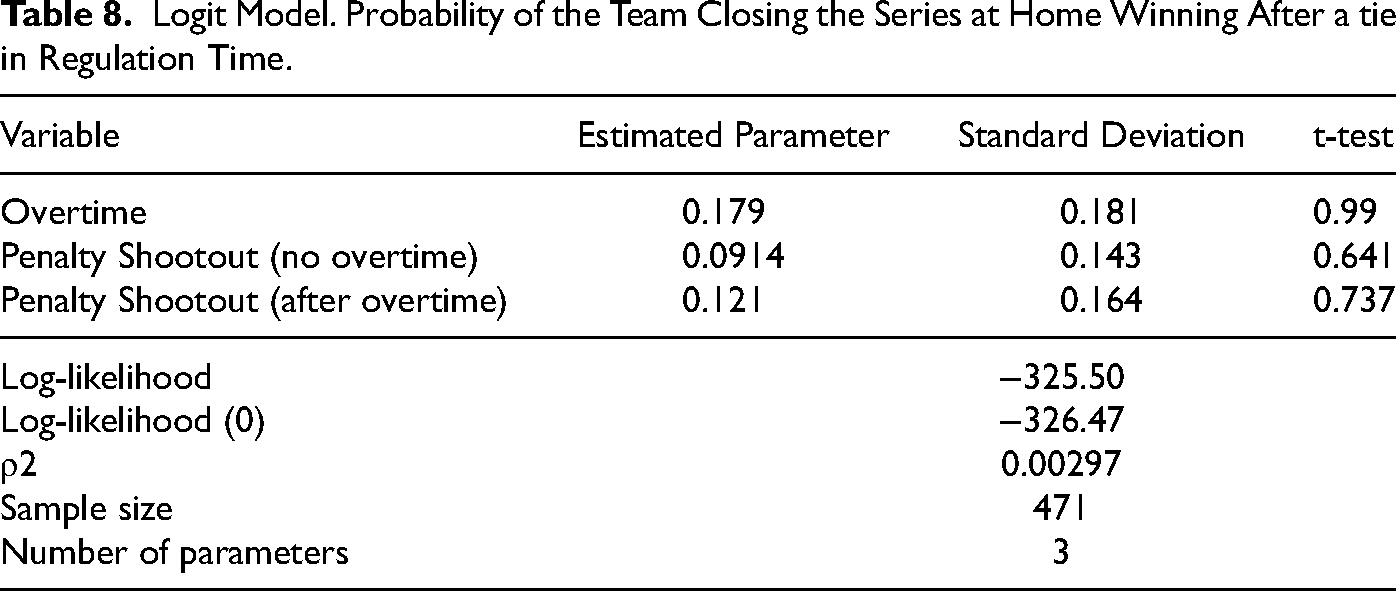
Finally, it is important to take into account that during the overtime, the AGR always favors the team finishing the series away (as an extra goal during overtime necessarily implies that this team scored more goals away). Hence, the advantage of the team closing the series at home associated with playing an overtime must necessarily be larger if the AGR is not considered. In fact, if we leave aside games decided in overtime due to the AGR (i.e., that would have progressed into a penalty shootout otherwise), we found that the effect of closing the series at home is statistically significant, as shown in Table 9 (again, seeded matchups were not considered, but the results are practically unaffected).
Logit Model. Probability of the Team Closing the Series at Home Winning in Overtime.
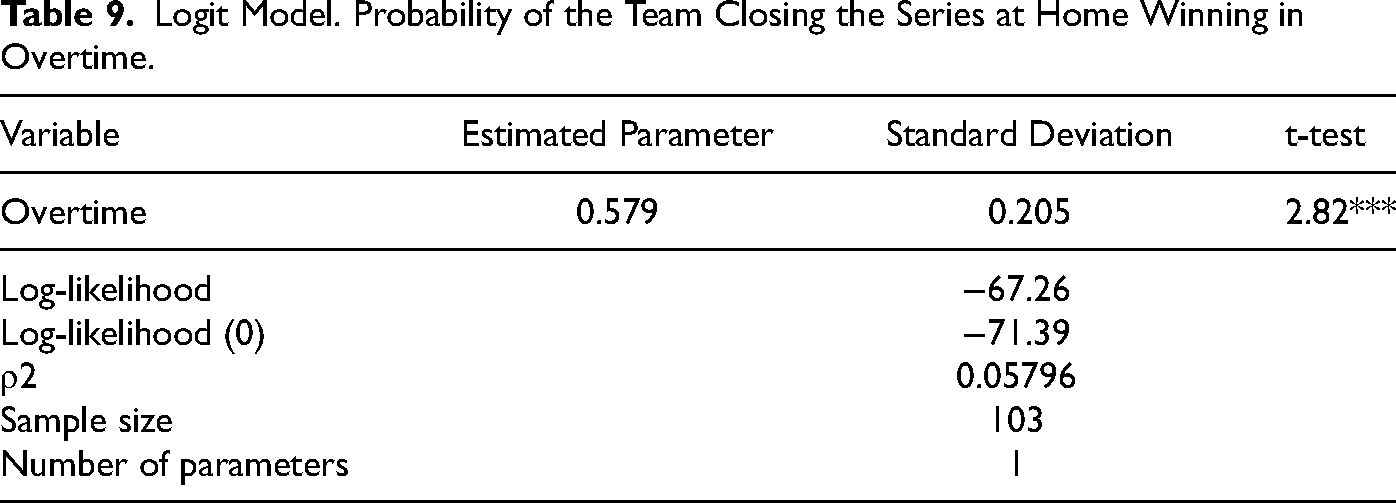
Here, even if the sample size is much smaller than in the previous case, that advantage of playing the overtime at home becomes so important that it is statistically significant at α = 1%. Furthermore, the model exhibits by far the largest explanatory power of all models considered in this work, which is indicative for the home-field advantage having an enormous incidence on the outcome: when the series is decided in overtime and the AGR does not apply, the team playing at home wins roughly 64% of the series and its chances to advance are 78% higher than the chances of its rival. It is important to note that in all series considered in the analysis, the team closing the series at home has been randomly decided and, consequently, it should have no impact on the result. The evidence, however, shows that it majorly impacts the outcome of the series.
Conclusions
Taking advantage of the different tiebreak rules implemented in different UEFA and CONMEBOL tournaments throughout recent years, we have analyzed a large database to consider the impact of the away goals rule (AGR). The database considers all major football tournaments in both confederations during a period of 30 years starting in 1988.
The results show that the AGR seems to have failed to fulfill its major goal, which was to increase scoring both by teams playing away from home as well scoring in general. If something, the effect of the rule on scoring seems to be negative, even though not statistically significant. 4 However, it is important to point out that UEFA tournaments indeed are characterized by higher scoring than CONMEBOL tournaments, and it is possible that the rule, which has been present in European football for over 50 years, has contributed to shaping the way football and strategy are approached by UEFA teams.
Despite its apparent lack of impact on scoring, the AGR is found to have a significant impact favoring the chances of the team starting the series at home. The most likely explanation for the phenomenon is that second legs are characterized by higher scoring; hence, the AGR benefits the teams playing away in that match. However, as significant as this effect might be, it does not imply that the team starting the series at home exhibits a higher likelihood of progressing onto the next stage than its opponent. Closing the series at home means an intrinsic advantage, which is only countered, although not completely, by the impact of the AGR.
Regarding tiebreakers, we observe that closing the series at home has a positive impact no matter whether overtimes with AGR or penalty shootouts are used as tiebreakers. This effect is, however, not statistically significant, most likely due to the small sample size and the limited effect of the rules. However, we can establish that playing an overtime, when no away goals rule is set in place, is likely to have a determining influence favoring the team closing the series at home.
Based on our results, we would strongly advise implementing the AGR anytime that no team should be favored by the order of the home games in direct elimination series, as it seems to be the only way to counter the intrinsic advantage of the team closing the series at home. This is particularly appropriate when the order of the games is decided randomly and no team should be favored by a supposedly fair draw. On the contrary, the AGR may be dropped when the team finishing at home should be favored (e.g., as a consequence of having obtained a higher seed in a previous phase). Along these lines, we also strongly advise against disputing overtimes to decide tied series, especially when the AGR is not considered, as it would induce a major advantage favoring the team closing the series at home. Even though no series with overtime and no AGR were considered in the database, the analysis shows that tournaments considering such a tiebreak criterion would result in an even larger advantage for the team closing the series at home. Furthermore, as previous research has established that the team kicking first in a penalty shootout enjoys an advantage (Apesteguia & Palacios-Huerta, 2010; Csató, 2021a), the first kick can be awarded to the team closing the series away as a compensation inspired by the Adjusted Catch-Up rule (Csató, 2021b, Chapter 4). However, further research is required on this specific subject.
As of June 2021, UEFA decided to abolish the away goals rule starting from the season 2021–22 (UEFA, 2021). As the main reasons for this change, they argue a decrease of the goals being scored since the mid-1970s 5 as well as a reduction in the gap between the number of home/away wins. These results align with the findings by Page and Page (2007), Eugster et al. (2011), Geenens and Cuddihy (2018), and Amez et al. (2020) that closing the series at home did not provide a statistical significant advantage. However, all these analyses include the AGR as a baseline (as they only considered UEFA tournaments). Our analysis, considering tournaments with and without the AGR, indicates that the AGR seems to be precisely the reason, why the effect of closing the series at home has diminished. Since 1988, no statistically significant effect can be found between the chances of progressing to the next round (given that a team started the series at home or away) and the years in which the tournament took place.
In November 2021, CONMEBOL also decided to abolish the AGR. However, other confederations, national federations, and FIFA still apply it (e.g., Cameroon and Ghana qualified for the 2022 FIFA World Cup due to the AGR).
Nevertheless, and as a consequence of the rule changing, in the forthcoming years further data would become available to validate the results of this paper, especially, as in our dataset all UEFA tournaments considered the AGR. However, it is to be expected that during the following seasons in European football the teams closing their series at home would have a decisive advantage, especially, as overtimes would be disputed without the AGR (note that such a big advantage has not yet existed in direct elimination knockout series in tournaments of the two major association football confederations, as even when CONMEBOL tournaments did not consider the AGR, they also did not consider overtime as tiebreakers and proceeded directly to penalty shootouts).
Disclaimer
Both authors are active in the statistics field and are avid sports fans. We initiated this research in the view that the AGR would unfairly benefit the team closing direct elimination knockout series away, especially when overtime was played, and it should be abolished. The empirical results, however, changed our viewpoint.
Footnotes
Funding
The author(s) received no financial support for the research, authorship, and/or publication of this article