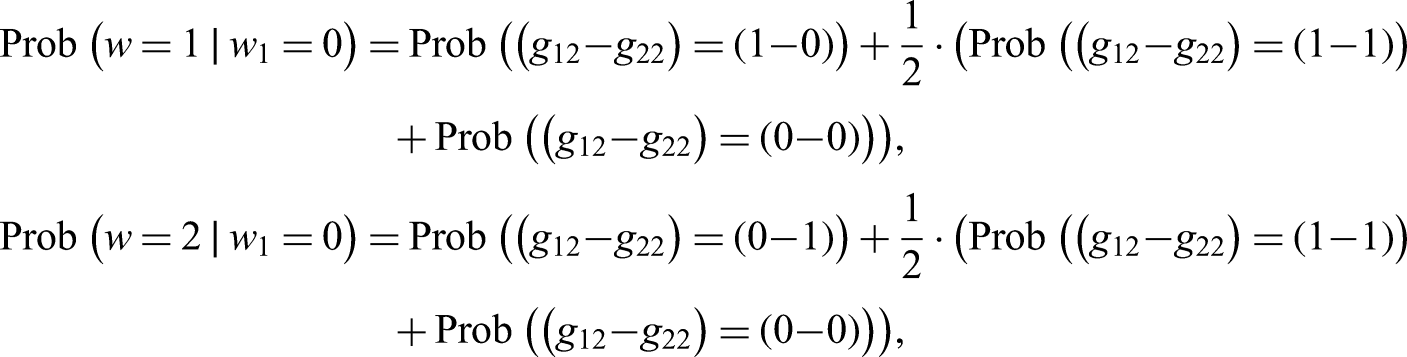
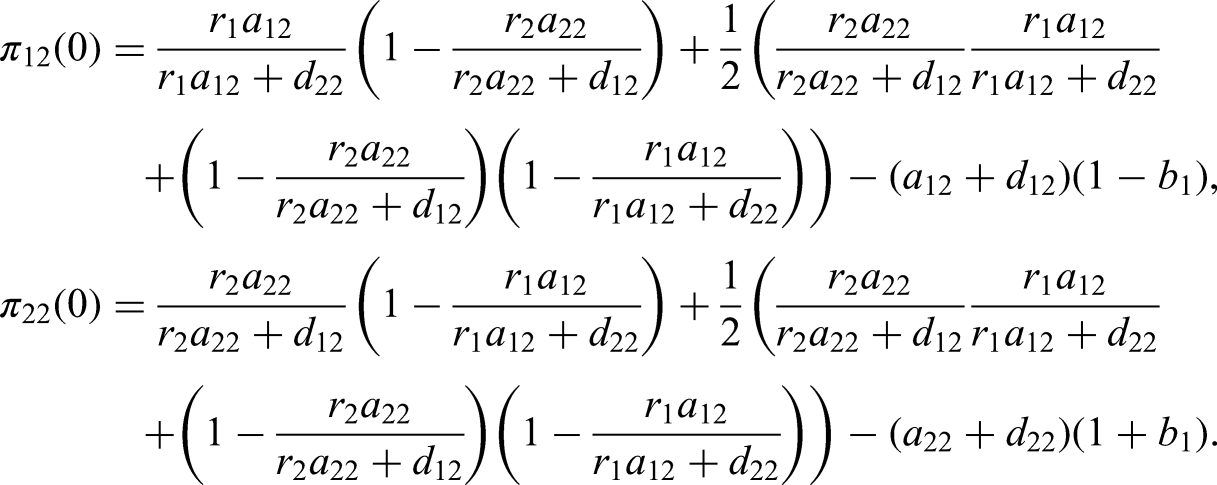
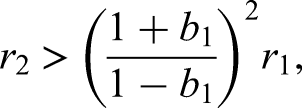
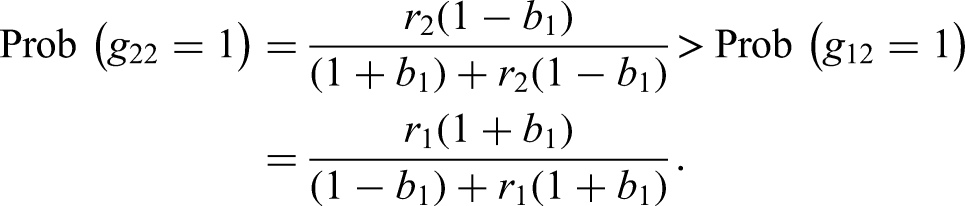
The Union of European Football Associations is currently reviewing the away goals rule during extra time in the knockout rounds of the Champions League. We model extra time as a two-stage contest. Assuming a home-field advantage we analyze the effect of the away goals rule on the competitive balance between teams. Our analysis suggests that the away goals rule levels the competitive imbalance introduced by the home-field advantage in the quarter and semi-finals and that in the round of 16 weaker teams should play first home and then away so that they benefit from the away goals rule during extra time.
On March 11, 2020, Liverpool F.C., winner of the 2019 Union of European Football Associations (UEFA) Champions League final, played its second leg in the round of 16 of the 2019-2020 Champions League at Anfield Road against Atletico Madrid after a 1-0 loss in the first leg in Spain. After 90 min and a goal by Liverpool in the first half, the match went into extra time. Atletico Madrid used these additional 30 min to score three goals and to win 4-2 on aggregate. However, the reaction of Diego Simeone, coach of Atletico Madrid, was somewhat surprising: “What I have to say, and will be saying at the next UEFA coaches’ meeting, is what I think is unfair. Today we had 30 minutes of extra time to score. Liverpool never had that. We had 30 more minutes to score an away goal. The rule favoured us today but it might go against us in the future. Liverpool had 30 minutes fewer to score an away goal. That’s wrong.”1
In a game-theoretic framework, the present paper analyzes whether Simeone is right or wrong with his statement. There are two forces driving our answer:
First, of course, it is a disadvantage for the second leg home team if there is no clear winner after normal time and the away goals rule also applies when the second leg goes to extra time.2 According to this rule, the team that scored more goals away wins if the total goals scored by each team are otherwise equal. Applied to extra time, the away goals rule implies that whenever the visiting team scores a goal, the home team has to score one goal more to be the winner of the two-legged tie.
Second, however, the second leg home team has an advantage because it is playing on its own ground. According to this home-field advantage, the team playing at its home court has an advantage over the visiting team, for one of the following reasons: The players of the home team are more familiar with their own venue and environment than players of the visiting team, or the visiting team suffers a disadvantage in traveling to the playing venue, or the home team receives a stronger crowd support, or the reactions of the crowd influence the referee’s decisions in favor of the home team.3
The tradeoff between these forces, of course, depends on several situational factors. Apart from the degree of the home-field advantage, an important factor is the relative strength of the visiting team’s offensive relative to the home team’s defensive. This relative strength influences the chances of scoring a goal and, therefore, the application of the away goals rule. This also becomes clear in the following statement of Arsene Wenger, manager of Arsenal London, after the knockout of his team in the 2014–2015 Champions League by AS Monaco: “This rule was created in the 60s to encourage teams to attack away from home, but football has changed since the 1960s and the weight of the away goal is too big today.”4 As a consequence, the UEFA is now reviewing the use of the away goals rule, as deputy general secretary Giorgio Marchetti said in an interview: “The coaches think that scoring a goal away is not as difficult as it was in the past so they think the rule should be reviewed and that’s what we will do.”5 Our analysis therefore is highly relevant for this discussion since the UEFA explicitly mentions in its mission statement that it seeks to examine sporting tools (e.g., the away goals rule) to support competitive balance, one of the core values in all UEFA competitions.6
The aim of the present article is to discuss these arguments and the pros and cons for the away goals rule during extra time in a game-theoretical model. Our analysis builds on the papers by Jost (2021a, 2021b). In the first paper, Jost (2021a), a soccer match between two teams is interpreted as a two-stage contest, where each team chooses its attacking and defending effort for each half of the match.7 The present paper follows this approach and interprets teams’ play during extra time as a match with two halves. From the second paper, we borrow the modeling of the home-field advantage by assuming that it stimulates the home team in their efforts to win the match and discourages the away team vice versa. However, different to Jost (2021b) who considers an alternating home-field advantage in a two-legged tie, the home and away team during extra time have a systematic advantage, respectively disadvantage, since the playing venue does not change. More important, however, is the introduction of the away goals rule as a tiebreaking procedure during extra time and its analysis on the competitive balance between the two teams.8 Here, we show the following results:
First, suppose that the two teams are symmetric in their strengths in the sense that the abilities of their forwards to score a goal as well as the abilities of their defenders to prevent a goal are identical. Without a home-field advantage, the match is then perfectly balanced in the absence of the away goals rule. However, as soon as the home team benefits from playing on its home grounds, its winning probability increases and the match becomes imbalanced. This competitive imbalance introduced by the home-field advantage during extra time can be counterbalanced by the away goals rule. In fact, as soon as the home-field advantage reaches a motivational effect of around 20%, the away goals rule offsets the corresponding disadvantage for the away team and results in an almost perfectly balanced match. This result, however, depends crucially on the relative strengths of both teams and only holds if their play is sufficiently defensive. As soon as both teams are too offensive, the away goals rule implies that the home team gives up the entire match in extra time.
Second, we consider a situation in which both teams are asymmetric in their strengths in the sense that the away teams’ offenders are equal in their abilities to the home teams’ defenders, but the away teams’ defenders could be a better or weaker than the home teams’ offenders. A home-field advantage in this situation then improves the competitive balance if the home team is too weak compared to the away team, but worsens the competitive imbalance in the opposite case. Introducing the away goals rule in this situation then has an U-shaped effect: If the home team is too weak, its winning probability is reduced which worsens competitive balance. If the home team is too strong, competitive balance is also reduced. In the latter case, the winning probability of the home team now becomes too high because the away team might give up the match even in the presence of the away goals rule. This happens, because the away team’s advantage due to the away goals rule is limited by the strength of its forwards. These two lines of reasoning imply that there exists a critical threshold of relative strength levels such that the away goals rule perfectly balances the match. Hence, around this critical value, there exists an intermediate range with respect to the home team’s strength such that the away goals rule improves competitive balance.
Our analysis not only contributes to the literature on sport economics but also to the recent literature on the design of dynamic contests, see Konrad (2009) or Vojnović (2015). By modeling extra time as a two-stage contest, our paper studies within this strand of literature a repeated match in which two players simultaneously choose their efforts in each match and these efforts in turn determine the match outcomes. If the overall competition consists of a sequence of , , matches and the winner is the player who is first to win matches, the competition is called a best-of- contest. In this sense, our model represents a best-of-2 contest, similar to Krumer (2013). He models each match as an all-pay contest with an alternating home-field advantage, different to our setting where each match is model as a Tullock contest and the home-field advantage in both matches is for one player only. With an alternating home-field advantage, the question of ordering becomes a crucial criteria for the competitive balance of the overall contest; for the case of a best-of-2 contest, see Jost (2021b); for the case of a best-of-3 contest, see Krumer (2015). Whereas in these articles the advantage for one of the players is exogenously given, there are also articles which endogenize this advantage. In contests with more than two matches, , Konrad and Kovenock (2009); Sela (2011) assume that there is not only a prize for winning the overall contest, but also a value for winning, Konrad and Kovenock (2009), or a value of losing, Sela (2011), in each single match. Also different to our modeling, there exists a growing number of articles which assume that the organizer of the overall contest can allocate intermediate prizes for the individual matches, see, for example, Clark and Nilssen (2021) for a best-of-2 all-pay contest, or Sela and Tsahi (2020) for a best-of-3 all-pay contest. More closely related to our modeling is the literature which studies contests on multiple battlefields, see , for example, Kovenock and Roberson (2010, 2018). In our model each team chooses an attaching and a defending effort for the different sides of the playing field. However, whereas the literature studies those contests on multiple battlefields as static in nature, the present model considers a dynamic interaction.
The paper is organized as follows: In the “Model” section, we introduce the basic model that describes play in extra time with and without the away goals rule. The “Equilibrium Play in the Presence of the Away Goals Rule” and “Equilibrium Play in the Absence of the Away Goals Rule” sections characterize the equilibrium play, first with the away goals rule, second without. In the “Competitive Balance and the Away Goals Rule During Extra Time ” section we then compare equilibrium and consider the initial question how the away goals rule influences competitive balance. The paper concludes with some final remarks and political implications. Proofs are collected in the Appendix.
The Model
In the following, we consider a two-legged tie between two teams and assume that after the end of the normal time of the second leg, no clear winner exists so that an overtime is played. This extra time is on Team ’s court. As in Jost (2021a), we divide this extra time into two half-periods and concentrate on the two central team activities, defending and attacking. We denote with the attacking effort and with the defending effort of team for each half . That is, at the beginning of extra time, team chooses for the first half and after half-time, for the second half of extra time.9 We call the tactic of team in half-period .
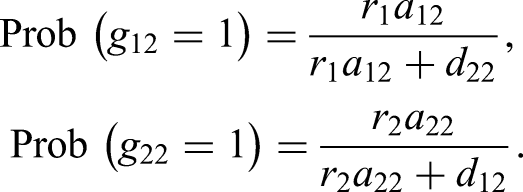
The probability that team scores a goal in half-period depends not only on its own attacking effort and the ability of its forwards, but also on the defending effort of the opponent team and the ability of the opposing defenders, In particular, we assume that the scoring probability of team is given by the following success function, see Tullock (1980),10
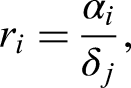
In this way, the scoring probability of team is increasing in its attacking effort and the ability of its forwards, with decreasing marginal probability. On the other hand, the scoring probability of team is decreasing in the defending effort and the ability of the opposing team ’s defenders, with increasing marginal probability. Defining the relative strength of team ’s offensive as the ratio of its forwards quality to the quality of the opposing defenders,
we denote team as being offensive relative to its opponent if , and as being defensive if .
When choosing its efforts, each team incurs effort cost. Since the second leg is on the home court of Team , it benefits during extra time from its home-field advantage so that its marginal effort cost are lower than the one of Team . Similar to Jost (2021a) we model this home-field advantage by assuming that the marginal effort cost of Team are , whereas Team as the away team suffers from Team ’s home-field advantage and has marginal effort cost of We interpret as the degree of Team ’s home-field advantage.11
Let be the tactic of team for half-period of extra time. Both teams decide on their tactics simultaneously, depending on the score up to that point: For the first half, each team chooses its efforts independent of its opponents tactic ; for the second half, team chooses its efforts also independent of its opponents tactic but taking into account the score at half-time. Since our modeling implies that only one goal can be scored per team in one half of extra time, there are four possibilities for the score at half-time, namely where denotes the score after the first half.12 A strategy for team for the extra time then is a tuple for all scores .
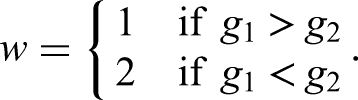
The winner of the two-legged tie with extra time depends on the final score and the use of the away goals rule. Let be the score for the second half, that is, . The final score then is denote by . Then there are nine possibilities for the outcome of extra time, . If the final score is not tied, the winner is the team that scored more goals than the other team, that is,
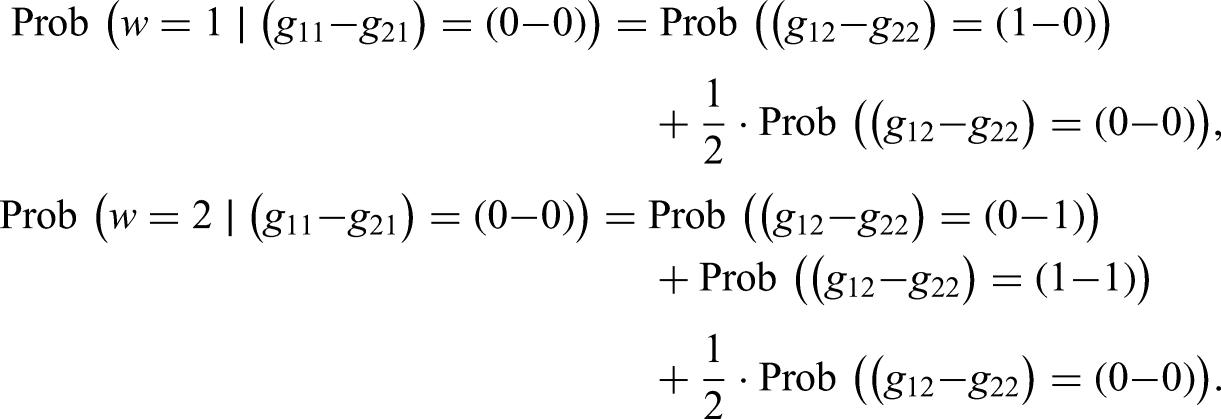
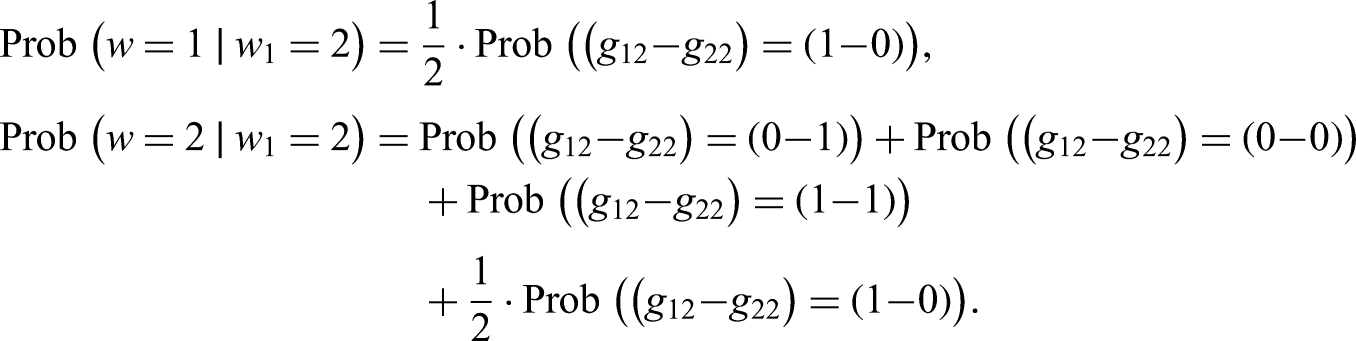
In case of a tie where the number of goals is equal, the winner depends on the use of the away goals rule. In the absence of the away goals rule, the winner is decided by drawing lots with equal chances.13 In the presence of the away goals rule, the team that scored more away goals is the winner. In our case, the away goals rule implies that Team is the winner whenever . For , we still assume that the tie is decided by equal chances.
Since the two-legged tie is part of an overall tournament, we assume that the losing team after extra time is eliminated from the tournament, which it then values with The winning team advances to the next round of the overall tournament which it values with . Both teams are risk-neutral. Their objective is to maximize the expected award net of effort costs.
Equilibrium Play in the Presence of the Away Goals Rule
We first analyze the optimal strategies of both teams during the extra time if the away goals rule is used as a tiebreaker. We use the subgame perfect equilibrium concept. Depending on the score at half time, we first discuss equilibrium play in each of the subgames in the second half. We then turn to the play in the first half.
Play in the Second Half
Let be a tactic of the two teams in the second half of extra time. The probability that team scores a goal in the second half is then given below:
Of course, when team chooses its attacking and defending effort in the second half, it takes the outcome of the first half into account. Since under the away goals rule a goal of Team in the first half might count double, we have to consider each teams’ tactic for all four possible scores after the first half. They are ordered according to the degree of disadvantage, that Team incurs from the away goals rule.
Team won the first half,
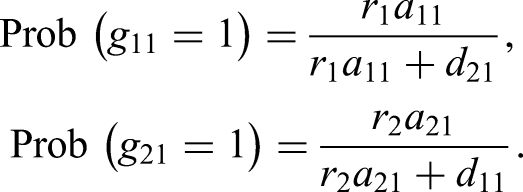
In this case, Team always wins the contest independent of whether Team scores in the second half or not, that is,
Effectively, Team is eliminated from the tournament because it cannot leapfrog Team ’s goals of the first half. Hence,
Tie in the first half with two goals,
The situation for Team is less dramatic, if it also scored in the first half and the score at half time is . In this case, Team wins whenever it scores in the second half but not Team , that is,
The teams’ payoff functions then are as follows:
Proposition 1. Suppose the extra time is played at Team 1’s home field, the score at half-time is , and the away goals rule applies.
If equilibrium payoffs are as follows:
Otherwise, if equilibrium payoffs are as follows:
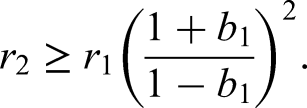
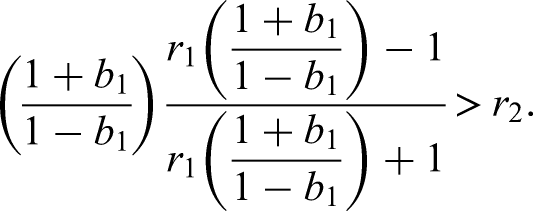
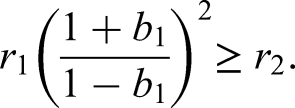
The proposition distinguishes between two cases: Either Team is sufficiently strong such that Team might be discouraged and gives up the match with a certain probability because of the away goal in the first half, or Team is sufficiently weak, so that Team sees a chance to actively advance to the next round despite the away goal in the first half. The critical value where Team ’s behavior switches thereby depends on the relative strengths of both teams and Team ’s home-field advantage.
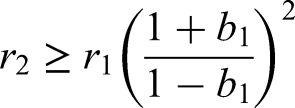
Consider first the case in which Team is sufficiently strong, that is,
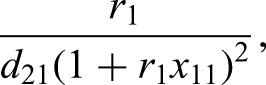
Then, the implications of Team ’s away goal from the first half are so negative that Team ’s payoff is zero in equilibrium. Note that the right hand side of this condition is increasing in and . That is, the weaker Team and the smaller its home-field advantage the less strong Team has to be.
Giving up with certainty and exerting no effort as in the previous scenario, however, is not an equilibrium behavior for Team in this case: As a response, Team would also reduce its efforts but then Team would be a better offer by not giving up. This implies that Team only gives up with some probability which induces Team to take a positive attacking and defending effort. The probability of giving up then is zero for and increasing if its home-field advantage gets smaller or if it gets weaker,
However, if it does not give up, Team ’s offense chooses higher effort levels than Team ’s defense, that is, , and its defense invests more than Team ’s offense, that is, .14 This follows from the fact that Team is stronger than Team , The probability that Team then wins in extra time is
which is increasing in the home-field advantage and its strength .
In the opposite case, when Team is not strong enough to discourage Team , the equilibrium payoffs of both teams are positive. The only way for Team to advance to the next round then is to score a goal and to prevent a goal from Team . In fact, under these circumstances, Team exerts more effort in its offense than Team in its defense, and, simultaneously, its defense chooses more effort than Team ’s offense, The probability that Team then wins in extra time is
which is increasing in its own strength and its home-field advantage and decreasing in Team ’s strength . Team then is more likely to advance to the next round whenever these factors are sufficiently high, that is,
Tie in the first half without goals,
Given this score at half time, it is even more likely that Team reaches the next round. In fact, Team wins whenever it scores in the second half but not Team or, given no team scores, when it wins by chance. Hence,
The teams’ payoff functions then are as follows:
Proposition 2. Suppose the extra time is played at Team 1’s home field, the score at half time is and the away goals rule applies.
If equilibrium payoffs are as follows:
Otherwise, if equilibrium payoffs are as follows:
Similar to the case before, the away goals rule implies an imbalance between the two teams: Depending on the strengths of both teams and Team ’s home-field advantage, Proposition 2 shows that the home team is at a disadvantage. In fact, if Team is sufficiently strong, Team might give up the match because of the fear of an away goal in the second half. Different to the case in which the score at half-time is , the critical value for Team ’s strength, however, is higher,
Also, even if Team is sufficiently strong and this condition satisfied, Team ’s probability of giving up in case of a score at half-time is lower than the one in case of , that is,
Moreover, Team exerts less attacking and defending effort, that is, and . As a response, Team then chooses higher attacking and defending effort, that is, and .
If Team is not strong enough such that the condition above is satisfied, it is again Team that is more active than Team . This is because the presence of Team ’s home-field advantage encourages its activities but discouraged the ones of Team . In fact, the home-field advantage implies that Team has lower marginal effort costs whereas Team has higher ones. Since the marginal benefits of an increase in attacking by one team are identical to the marginal benefits of an increase in defending by its opponent, the optimal attacking and defending efforts of Team are higher than the defending and attacking efforts of Team . Proposition 2 then shows that the factor is equal to the relative marginal effort costs , that is,
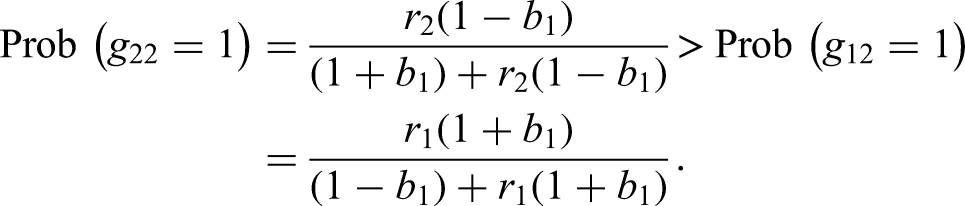
Whether this results in a higher scoring probability for Team then depends on the strength of Team . If the away team is too weak, its scoring probability is lower than the one of Team . However, in an intermediate range,
the scoring probability of Team in equilibrium is higher than the scoring probability of Team
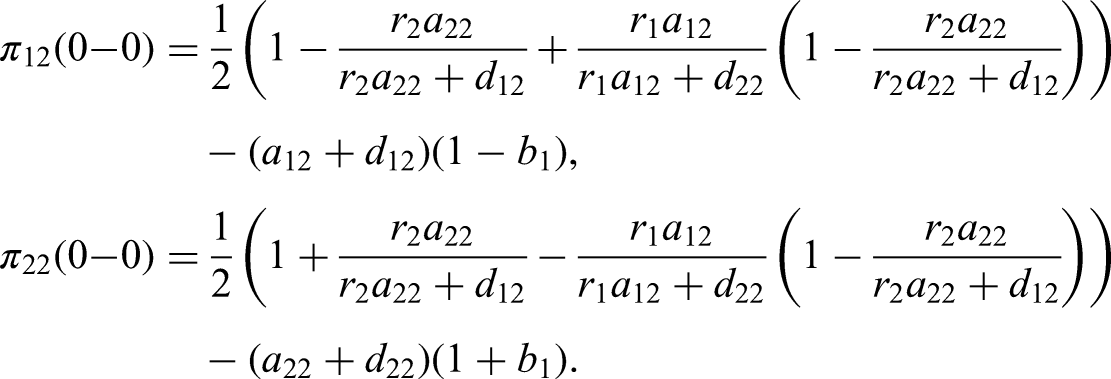
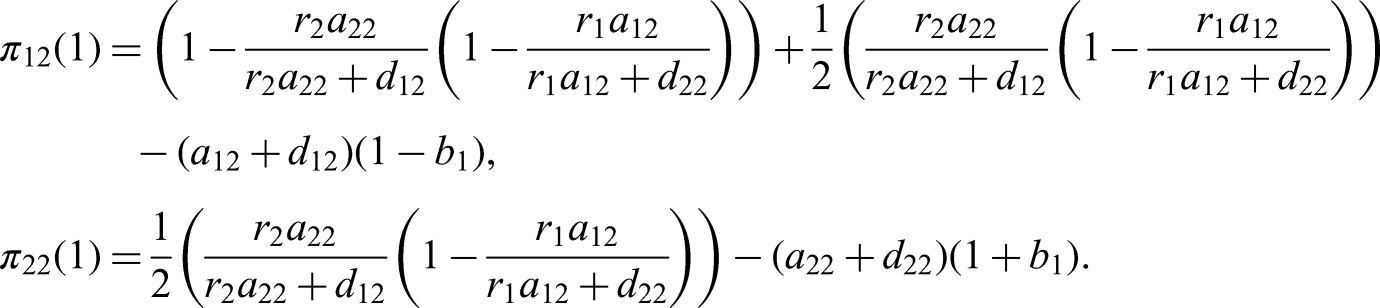
When we finally compare teams’ playing in the two different scenarios of a tie, the offensive efforts of the away Team are higher if it did not score in the first half, that is, . This is because an away goal in the first half makes it more likely that Team advances to the next round, even if there is no goal in the second half, different to a score after half-time. As a response, Team then invests more in its defensive activities, . Since the home team has to score after a in the first half, , hence . Note that although the probability of scoring remains unchanged in these two scenarios, Team ’s payoff is higher if no goal is scored in the first half, , whereas the one of Team is lower, .
Team 1 won the first half,
Advancing to the next round is much more likely for Team if it scored in the first half but not Team . Then Team only wins when it scores in the second half and Team does not. That is,
Maximizing teams’ payoff functions
then gives the following result:
Proposition 3. Suppose the extra time is played at Team 1’s home field, Team 1 won the first half and the away goals rule applies.
If equilibrium payoffs are as follows:
Otherwise, if equilibrium payoffs are as follows:
In this scenario, it is the away Team that might give up the second half. Depending on the relative strengths of both teams and Team ’s home-field advantage, Proposition 3 distinguishes between the two cases: Either Team is sufficiently strong to actively win the contest, or it is sufficiently weak to be discouraged and to give up the match. The first case requires that
and ensures that Team ’s payoff is positive. If this condition is satisfied, Team exerts more attacking than defending effort, if its attacking abilities are lower than Team ’s defending abilities, This is the only chance for Team to win the two-legged tie with a goal in extra time. Of course, Team reacts to this offense by investing more in its defensive than offensive activities, that is, . The probability that Team actually proceeds to the next round then is
which is increasing in its own strength and decreasing in Team ’s relative strength and home-field advantage .
In the second case, when Team is too weak to receive a positive payoff, that is, if , Team gives up with a certain probability. Of course, choosing to exert no effort with certainty cannot be an equilibrium behavior as this would imply that Team would win with some small attacking effort. In turn, Team would be better offer by not giving up. As a consequence, Team chooses a mixed strategy to keep Team guessing whether or not it will give up. The probability of giving up then is zero for and, otherwise, positive and lower than one. Moreover, the probability of giving up increasing in Team ’s home-field advantage as well as in Team ’s relative strength . In case Team chooses positive effort, these efforts are higher than the ones of Team , that is,
for As before, this is the only possibility for Team to proceed to the next round. The probability that Team then wins in extra time is
which is decreasing in the home-field advantage or the strength of Team .
Play in the First Half
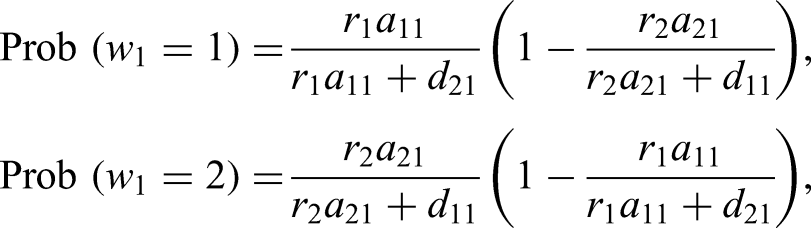
In the first half of extra time, both teams choose tactics . The probability of scoring a goal in the first half is then given by the following equations:
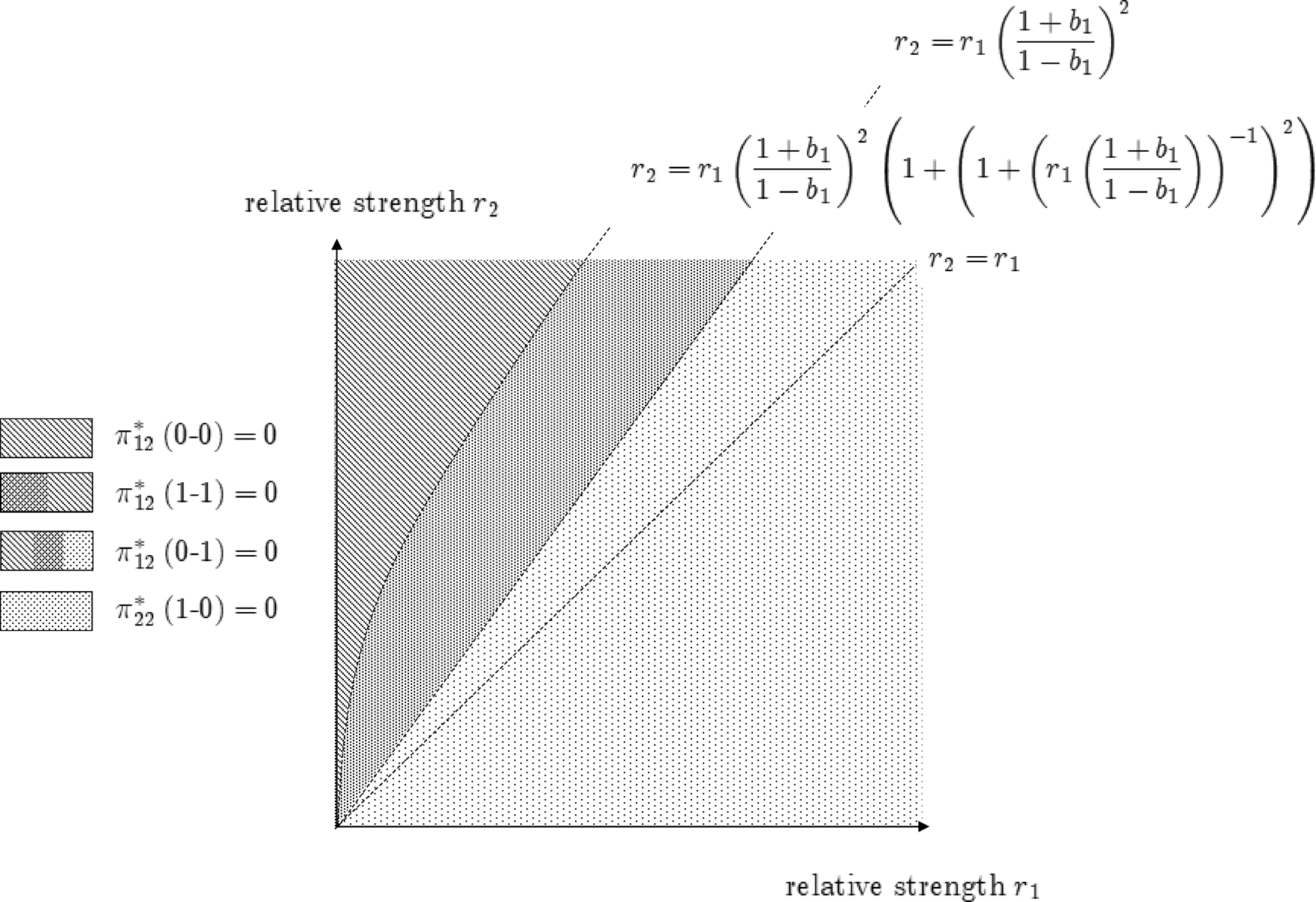
and determines the possible score at half time. The equilibrium payoffs of the second half for all four possible scores then determine teams’ playing in the first half. Figure 1 summarizes the four scenarios and illustrates in which regions teams’ payoffs in the second half are positive or zero:
Teams’ payoffs in the second half as a function of and the score at half time.
Using these equilibrium payoffs in the second half, the expected payoff of Team for the entire extra time is then given by the following equation:
and for Team expected payoffs are as follows:
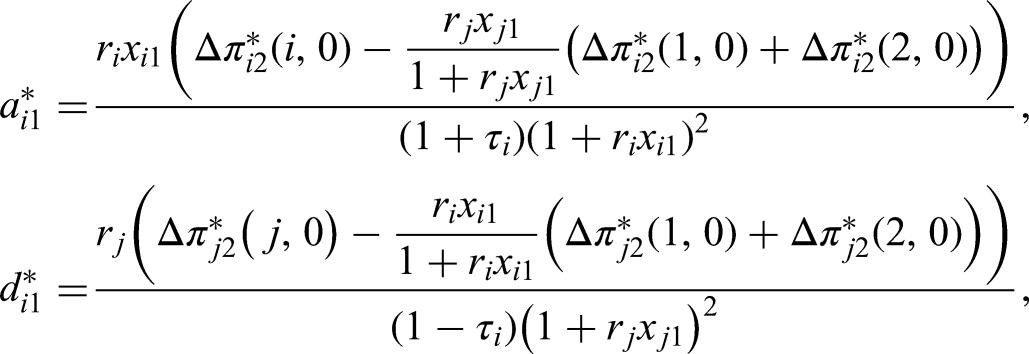
Maximization of these payoffs with respect to the attacking and defending efforts then leads to the following result:
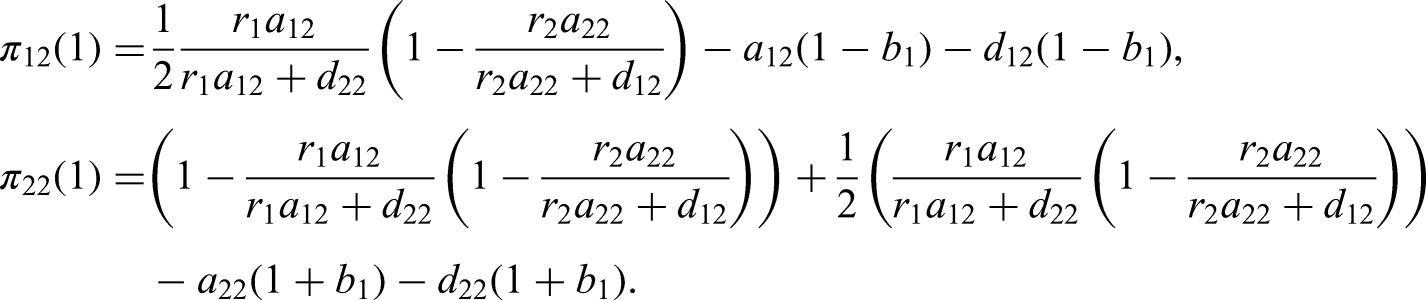
Proposition 4. In the presence of the away goals rule, and if extra time is played at Team 1’s home field, the following holds: If no team gives up in the first leg, the tactics of each team in the first half of extra time are as follows15 :
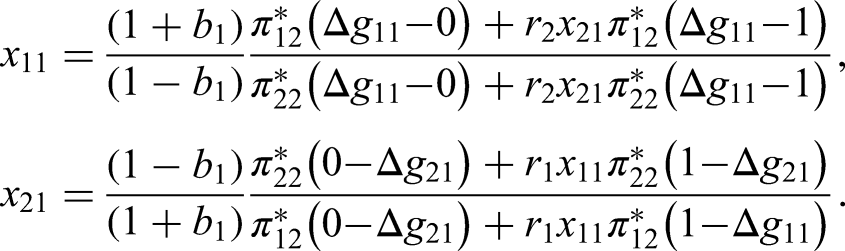
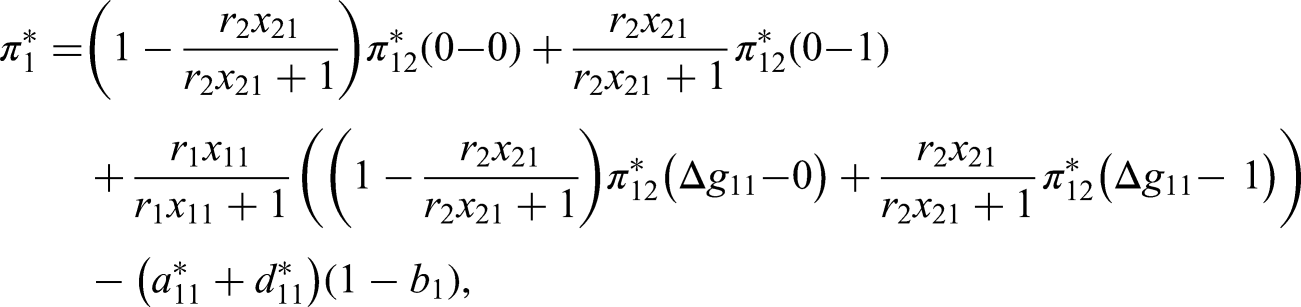
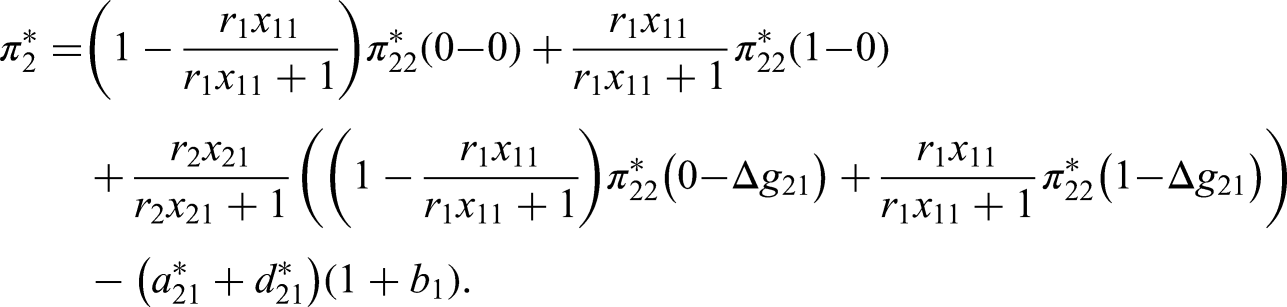
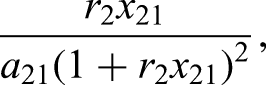
with , , , and
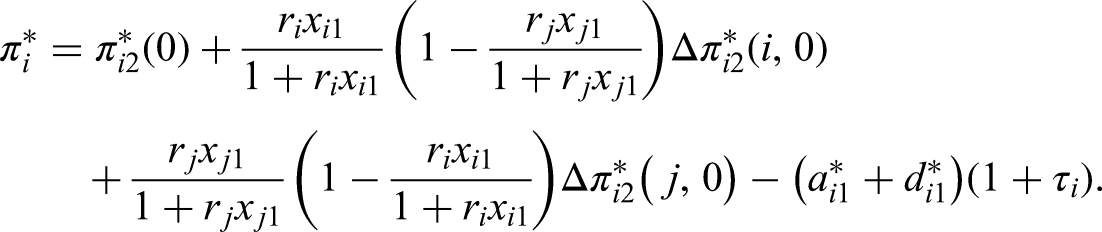
The resulting expected payoffs then are as follows:
and
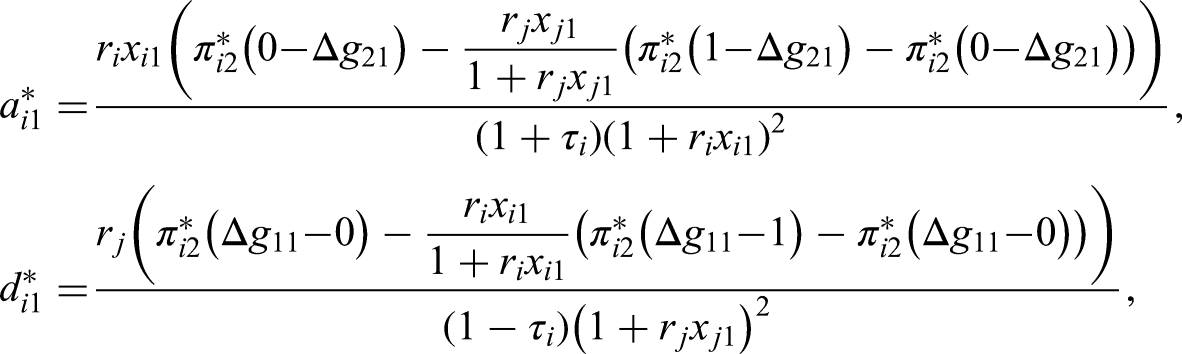
Equating marginal benefits with marginal costs for each team and effort level determines the best response functions. Mutually solving these best response functions then leads to the optimal attacking and defending efforts of both teams. To understand the driving forces behind the above result, consider, for example, the away Team : Its marginal costs for both effort choices are given by which reflects the home-field advantage of Team . The marginal benefits for Team depend on the particular activity it chooses. Consider first its marginal benefits from attacking. An increase in its effort level then implies a higher marginal scoring probability
so that Team benefits in the second half from a better score at half time,
These benefits in the second half depend on whether the home Team scores a goal or not which happens with a probability In the first case, Team benefits from scoring a goal since it avoids being behind at half time. These benefits are reflected in the payoff difference . In the second case, when Team does not score in the first half, the benefits for Team result from the fact that it leads at half time, that is, by the payoff difference . In a similar way, we can discuss Team ’s marginal benefits from defending. In this case, an increase in its effort level decreases Team ’s marginal scoring probability
which gives Team a better score at half time. The resulting benefits then are
and depend on whether it scores a goal or not. In the first case, the benefits from the payoff difference between leading at half time or having a tie, that is, . In the second case, Team benefits from not loosing at half time, that is, from .
Equilibrium Play in the Absence of the Away Goals Rule
In the following, we modify our analysis by considering teams’ equilibrium behavior in the absence of the away goals rule. Different to the previous section, the winner is then decided by drawing lots with equal chances not only in case of but also in case, the final score is a tie with . Of course, this change in the tiebreaking procedure has implications for the optimal attacking and defending efforts of both teams. Similar to the previous section, we first analyze the optimal strategies of both teams during the second half of extra time and then turn to the play in the first half.
Play in the Second Half
As before, we denote with the tactics of the two teams in the second half of extra time. Different from the analysis in the previous section, however, we consider each teams’ tactic only for three possible scores at first half. To differentiate our notation, let be the winner of the first half with the following interpretation. If the score at half time is or , then if it is then and if the score is then . Hence, in the following we consider each teams’ tactic for all three possibilities . We order our discussion according to the degree of disadvantage that Team incurs from the score at half time.
Team won the first half,
Given Team leads at half time, the only possibility for Team to advance to the next round is to score a goal in the second half and to win the penalty shootout. In all other cases, Team is the winner. For given tactics , the probability that team then wins during extra time is given by the following equations:
The expected payoffs of both teams then read as follows:
Proposition 5. Suppose the score at half time is and the away goals rule does not apply.
If equilibrium payoffs are as follows:
Otherwise, if equilibrium payoffs are as follows:
The absence of the away goals rule makes playing in the second half totally different. Instead of giving up completely, Proposition 5 shows that Team now fights for winning the contest, if it is sufficiently strong and its home-field advantage is sufficiently high, that is, if
In fact, if this condition is satisfied, Team invests more in attacking and defending to score and avoid a goal than Team , that is, and . Moreover, Team exerts more effort in its offense, whenever Team ’s offense is weaker than Team ’s defense, that is, . In the opposite case, if and Team ’s attacking abilities are higher than Team ’s defending abilities, Team exerts more attacking than defending effort, that is, . The probability that Team advances to the next round then is
which, of course, is lower than the one for Team ,
In case Team is not sufficiently strong, , its expected payoff has to be zero and it gives up the match with a positive probability less than one. With the corresponding counterprobability, Team then chooses higher effort levels than Team , that is, and . The probability that Team then advances to the next round is
which is increasing in its home-field advantage and its strength .
Tie in the first half,
If the first half of extra time ends with a draw, team wins the two-legged tie if it is the only team that scores in the second half, or in case of a tie, wins with a chance of 50%. The probability that team then advances the next round is given by the following equations:
and the expected payoffs of both teams are then given by the following equations:
Proposition 6. Suppose the score at half time is tied, or and the away goals rule does not apply. Then equilibrium payoffs are as follows:
Different from the play in the presence of the away goals rule, a tie at half time does not discourage any team in the absence of the away goals rule. In fact, the proposition shows that both teams exert positive efforts independent of their strengths and the home-field advantage. Of course, these factors influence the teams’ play in the second half: The home-field advantage implies that the optimal attacking and defending efforts of Team are higher than the defending and attacking efforts of Team due to lower, respectively higher marginal effort costs, that is,
Moreover, the relative strength of both teams determines which team has the higher scoring probability. In fact, whenever Team is sufficiently strong,
its scoring probability is higher than the scoring probability of Team
The above condition also determines whether it is more likely that Team or Team advances to the next round, since their winning probabilities in the second half are given by the following equations:
Moreover, the probability that the extra time ends in drawing lots is given by the following equation:
Team won the first half,
In the absence of the away goals rule, a score with is role-inverted to a scenario with : The only possibility for Team to advance to the next round is to win the second half and the following penalty shootout,
However, different from the case where Team won the first half, Team cannot benefit from lower effort costs due to the home-field advantage of Team . The expected payoffs of both teams are then given by the following equations:
Proposition 7. Suppose the score at half time is and the away goals rule does not apply.
If equilibrium payoffs are as follows:
Otherwise, if equilibrium payoffs are as follows:
Play in the First Half
Let be the tactic of team for the first half of extra time. Then, the probability that team leads at half time is given by the following equations:
and the probability that the first half ends with a tie, , is given by the following equation:
Using the equilibrium payoffs in the second half, the expected payoffs of both teams in the first half are given by the following equations:
with and Similar to the previous section, the following proposition describes teams’ play in the first half.
Proposition 8. In the absence of the away goals rule, if no team gives up in the first half, the tactics of each team in the first half of extra time are as follows:
with and
The resulting expected payoffs are as follows:
Competitive Balance and the Away Goals Rule During Extra Time
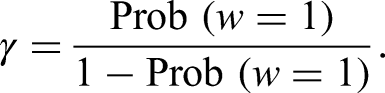
In the following, we want to assess the effect of the away goals rule during extra time on the competitive balance between the two teams. As it is common in the economic literature on sports, we measure competitive balance by the uncertainty of the outcome of the match. We follow Hoehn and Szymanski (1999); Vrooman (2007, 2009) and assume, without loss of generality, that competitive balance is given by the ratio of teams’ winning probabilities,
If it is equally likely that either Team or Team advances to the next round, we call the match perfectly balanced and . If Team ’s winning probability in equilibrium is higher or lower than , this leads to an imbalance in the match and , respectively, .
Of course, the question of whether the extra time in a two-legged tie is better balanced with or without the away goals rule crucially depends on the relative strengths of both teams and the home-field advantage . For a given scenario , denote the competitive balance in this match by , where refers to a situation when the away goals rule is used as a tiebreaker and refers to a situation when this is not the case.
We start answering the posed question with a scenario in which the away goals rule would lead to an imbalance in the match.
Proposition 9. Suppose that both teams are symmetric in their strengths, , and that Team 1 has no home-field advantage, . Then,
In the absence of the away goals rule and without any home-field advantage of Team 1, this result is straightforward: If both teams are symmetric, they are equally offensive or defensive, depending on whether or . In both cases, this implies that their attacking and defending efforts in the second half of extra time are asymmetrically identical. Team 1’s effort choices in case of - are identical to Team 2’s effort choices in case of lead, and the same is true in case Team 1 or Team 2 is loosing at half time. If the score at half time is leveled, both teams play identically. This results from two observations. First, the teams’ marginal benefits from any additional effort are identical as they are symmetric in their strength, and, without the away goals rule, the value of a goal is identical for both teams. Second, their marginal costs from any increase in attacking or defending are equal because the home team does not enjoy any home-field advantage. However, an asymmetric identical playing in the second half implies a similar behavior in the first half. Again, the teams’ marginal benefits from an increase in effort are identical as they have the same payoff differences between leading or losing at half time or having a tie, and their marginal costs are also identical. But this implies that winning is equally likely for both teams and the match is perfectly balanced.
Introducing a home-field advantage for Team 1 into this scenario, of course, leads to an imbalance in the match,
which is increasing in the size of . This follows from the fact that in both half periods of extra time Team 1 has lower marginal costs of increasing its efforts than Team 2. And, of course, introducing the away goals rule into the scenario has the opposite effect and leads to an imbalance
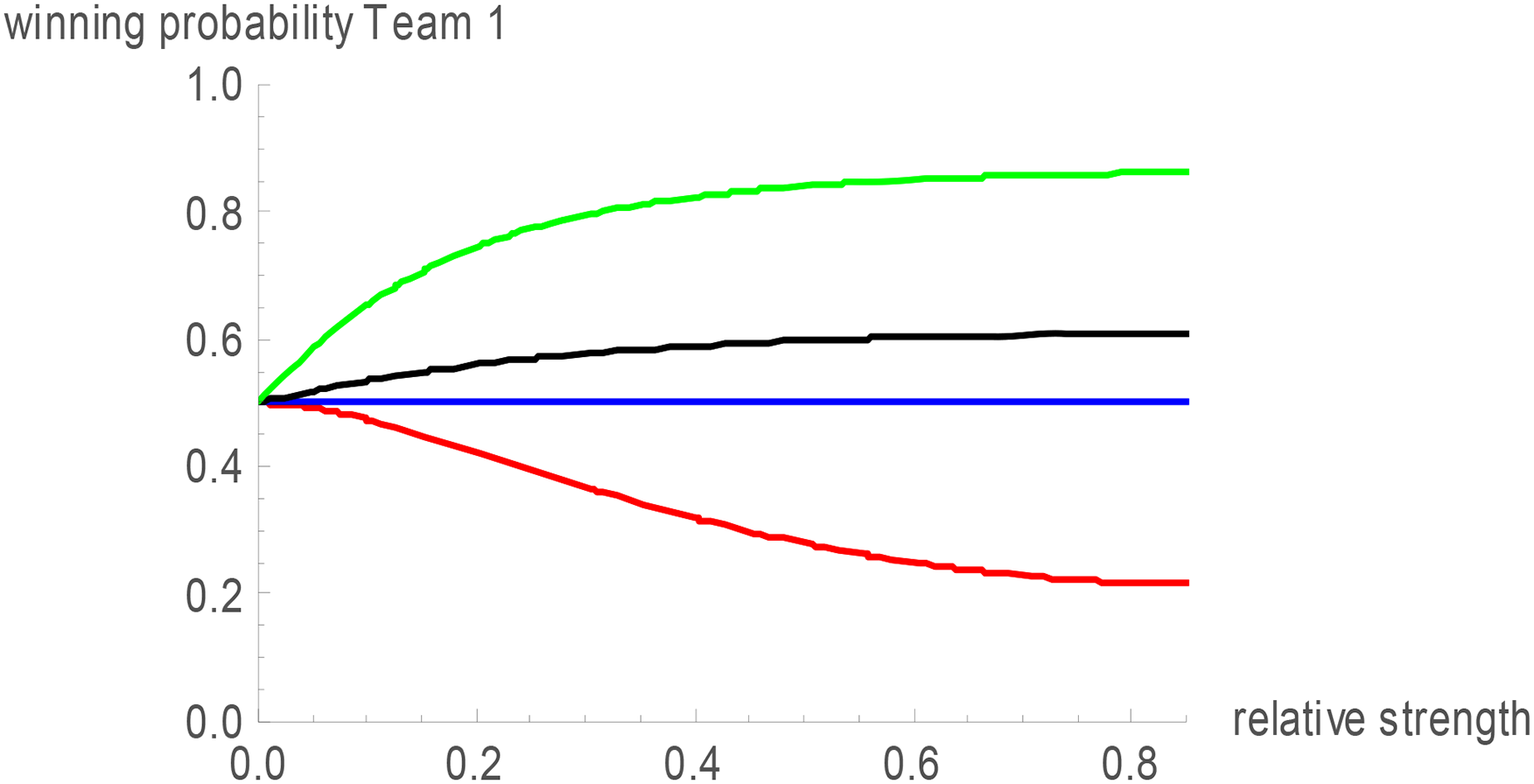
in the match. This is because the marginal benefits from scoring a goal are now higher for the away Team 2 than for the home Team 1. Figure 2 illustrates these effects with , and , respectively. It indicates that the positive effect of Team ’s home-field advantage on its winning probability as well as the negative effect of the away goals rule on its winning probability are both increasing in teams’ relative strengths . That is, the more offensive the teams are, the more the home Team benefits from its home-field advantage and the more the away Team benefits from the away goals rule. Figure 2 also indicates that the competitive imbalance introduced by the away goals rule might well be counterbalanced by the competitive imbalance due the home-field advantage of Team .
Winning probability of Team 1 without the away goals and no home-field advantage (blue line), only with the away goals rule (red line), and only with a home-field advantage (black line), respectively (green line) in the symmetric case.
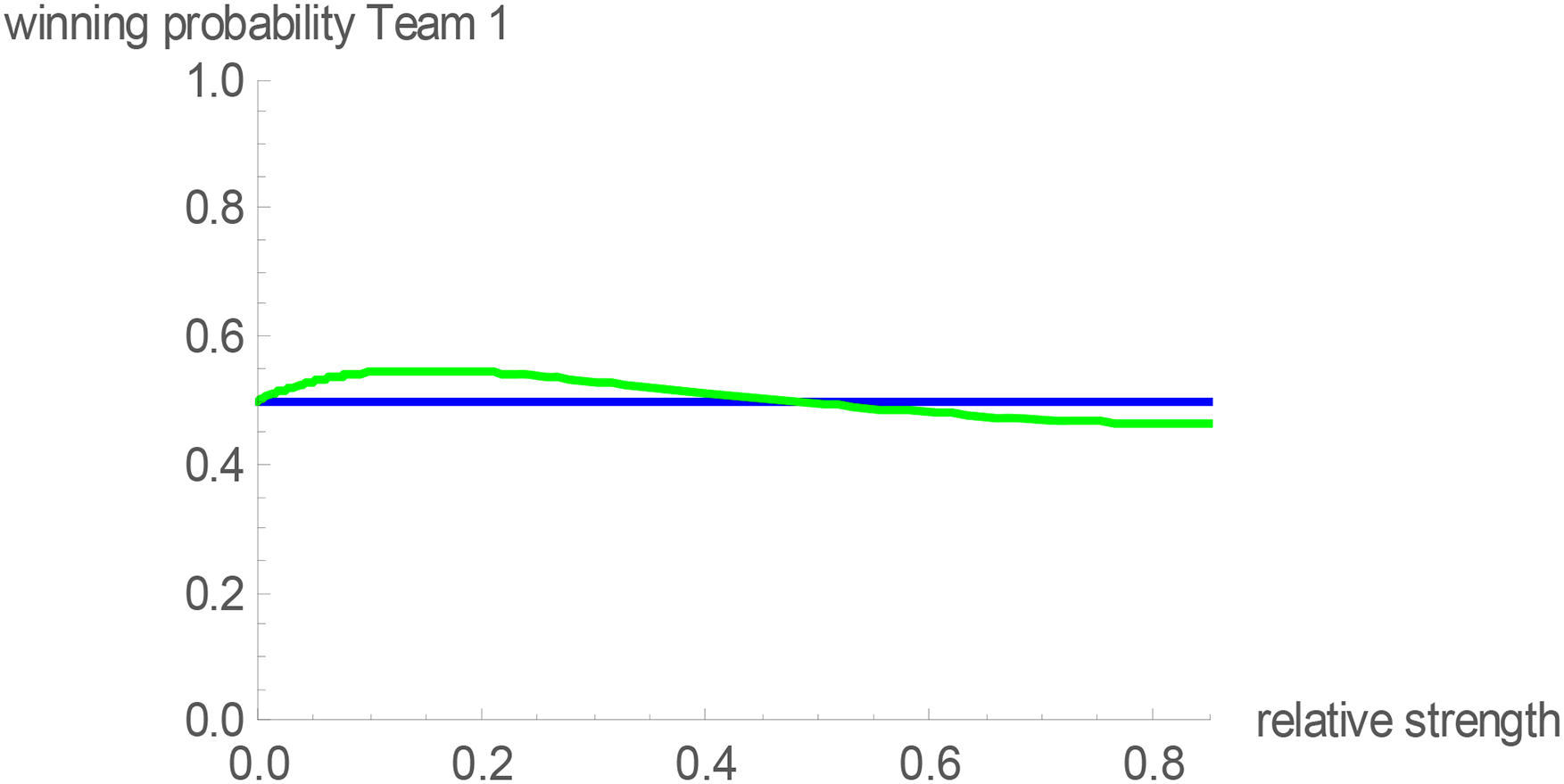
Whereas Figure 2 suggests that this counterbalance only works if the home-field advantage is high—a motivation effect of 40% effort cost reduction, the green line with , is necessary to match the demotivation effect due to the away goals rule, the red line, for —this consideration neglects the fact that both effects influences teams’ equilibrium play simultaneously. In particular, the negative effect of the away goals rule on Team 1’s winning probability is less dramatic in the presence of its home-field advantage as shown in Figure 3. However, the counterbalance not only depends on the size of Team 1’s home-field advantage but also on the relative strengths of both teams. In fact, as soon as both teams are too offensive, the away goals rule implies that the home Team 1 gives up the entire match in extra time.
Winning probability of Team 1 without the away goals and no home-field advantage (blue line), and with the away goals rule and a home-field advantage (green line) in the symmetric case.
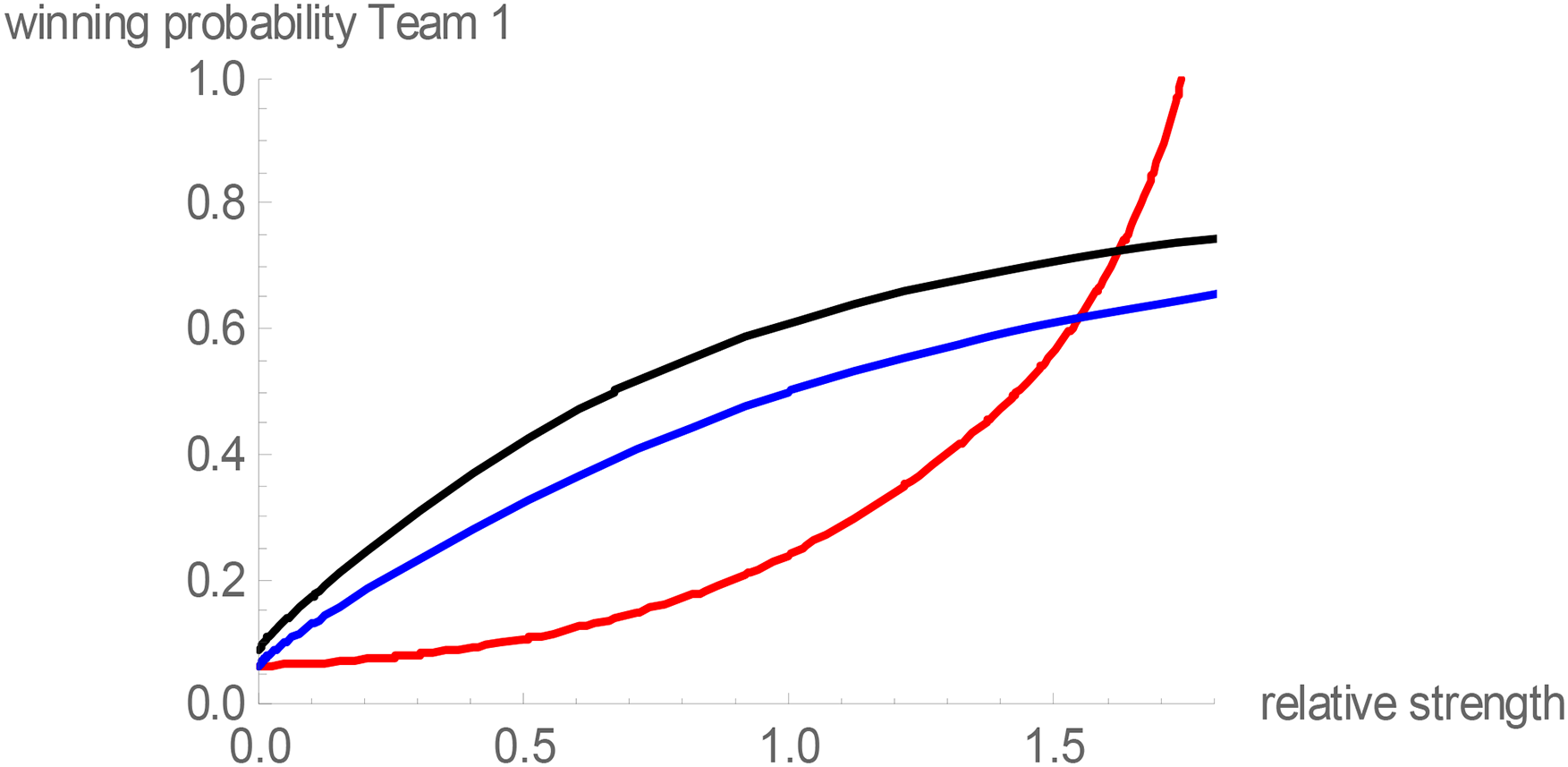
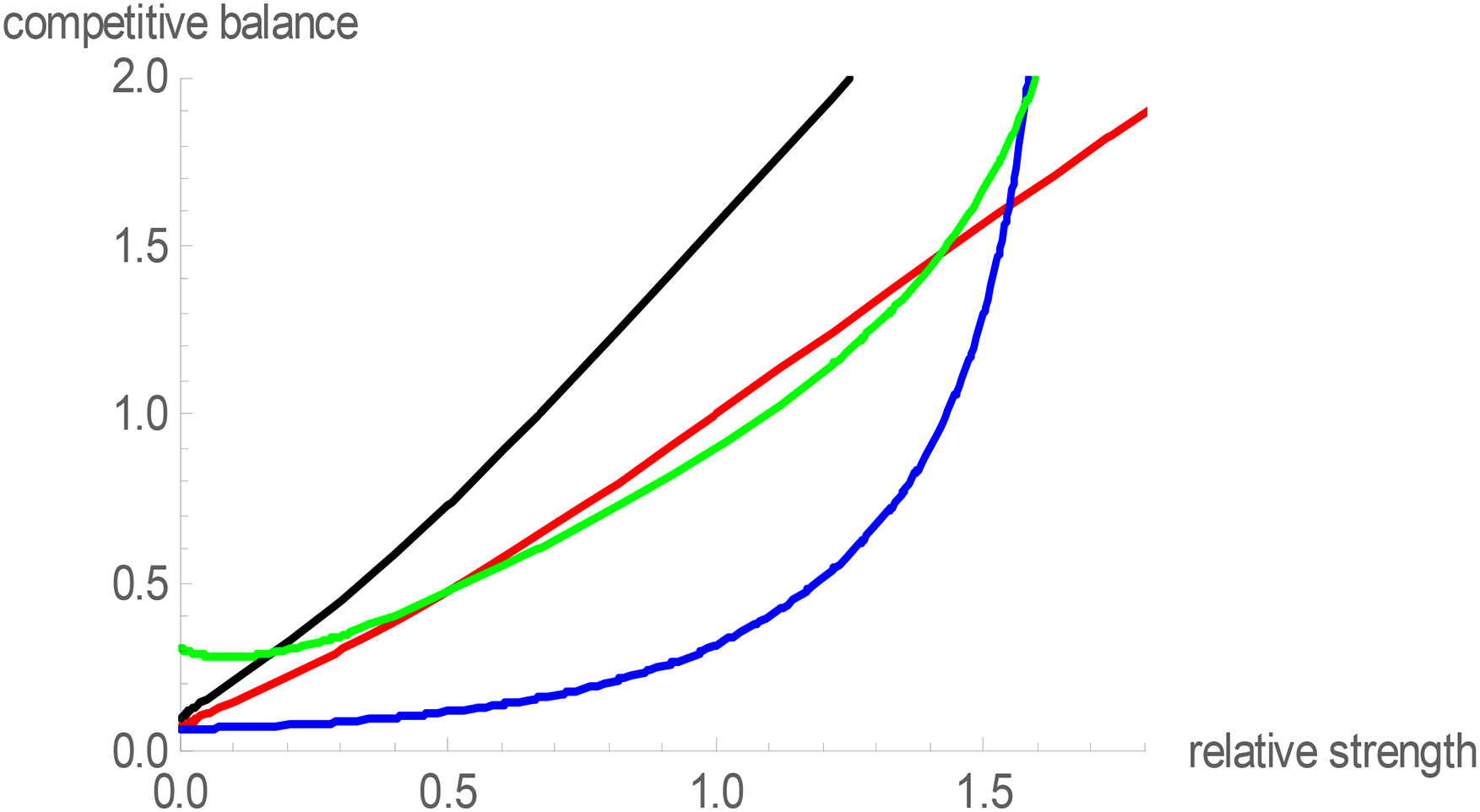
Whereas these observations hold true for a situation in which both teams are symmetric in their strengths, competitive balance looks different if both teams are asymmetric in their strengths. To see this, consider a situation in which , that is, the ability of the away teams’ offenders is equal to the ability of the home team’s defenders, . Of course, the match between both teams is always imbalanced in the sense that it is more likely that the stronger team advances to the next round with a higher probability—the blue line in Figure 4.
As before, the introduction of a home-field advantage for Team 1 increases its winning probability—the black line in Figure 4. But this implies that there exists a critical value , such that a home-field advantage improves competitive balance if Team 1 is sufficiently weak, , but worsens competitive balance if Team 1’ strength is not too weak, .
Winning probability of Team 1 without the away goals and no home-field advantage (blue line), only with the away goals rule (red line), and only with a home-field advantage (black line) in the asymmetric case.
Proposition 10. Suppose that both teams are asymmetric in their strengths, and , and that Team 1 has a home-field advantage, . Then, there exists a critical value such that the home-field advantage improves competitive balance for , but worsens competitive balance otherwise.
The effect of the away goals rule on Team ’s winning probability also depends crucially on its relative strength—the red line in Figure 4. If the ability of Team ’s forwards is lower than the ability of Team ’s defenders, the away goals rule decreases its winning probability but does not demotivate Team such that it gives up. This, of course, is due to the fact Team ’s offensive is equally stronger than Team ’s defense, . However, if Team is sufficiently strong relative to Team , the away team might give up the match in the presence of the away goals rule. This, of course, happens, because Team ’s advantage due to this rule is limited by the strength of its forwards, . The effect of the away goals rule on competitive balance then is as follows:
Proposition 11. Suppose that both teams are asymmetric in their strengths, and , and that the away goals rule is used as a tiebreaker. Then there exists a critical interval with such that the away goals rule improves competitive balance for , but not otherwise.
Our previous discussion of the away goals rule on Team ’s winning probability has the following implication on the competitive balance between the two teams. First, it implies that if Team is too weak, the away goals rule reduces competitive balance because its winning probability is reduced. And, on the other extreme, if Team is too strong, the away goals rule also worsens competitive balance because now Team ’s winning probability is too high. Second, continuity of Team 1’s winning probability implies that there exists a critical value such that
Competitive balance without the away goals and no home-field advantage (blue line), only with the away goals rule (red line) only with a home-field advantage (black line), and with a home-field advantage and the away goals rule (green line) in the asymmetric case.
Since , there necessarily exists an interval around such that the away goals rule improves competitive balance. Moreover, if we simultaneously consider the away goals rule and the home-field advantage—the green line in Figure 5 with —competitive balance is even more improved as the respective interval around with is enlarged. This is because the home-field advantage improves competitive balance even if the home Team is weak.
Political Implications and Conclusion
The present paper investigated the effect of the away goals rule as a tiebreaker during extra time in a game-theoretic model. We showed that the effects of the away goals rule and the home-field advantage might well be counterbalancing each other. The tradeoff between these two forces then depends crucially on the degree of the home-field advantage and the relative strengths of both teams. In particular, we showed that if none of the two teams is too offensive, the negative effect of the home-field advantage on competitive balance can be leveled by the away goals rule.
How can the UEFA use these insights when reviewing the use of the away goals rule in the knockout rounds of the Champions League? According to our analysis, the answer to the question whether the away goals rule during extra time should be kept or abandoned depends on three driving factors: the degree of the home-field advantage, the relative strengths of the remaining teams in the knockout phase and the degree of offensive/defensive play of these teams. These are empirical questions which have to be studied for the respective leagues. A conservative interpretation of the existing empirical studies and stylized facts on these issues suggests the following:
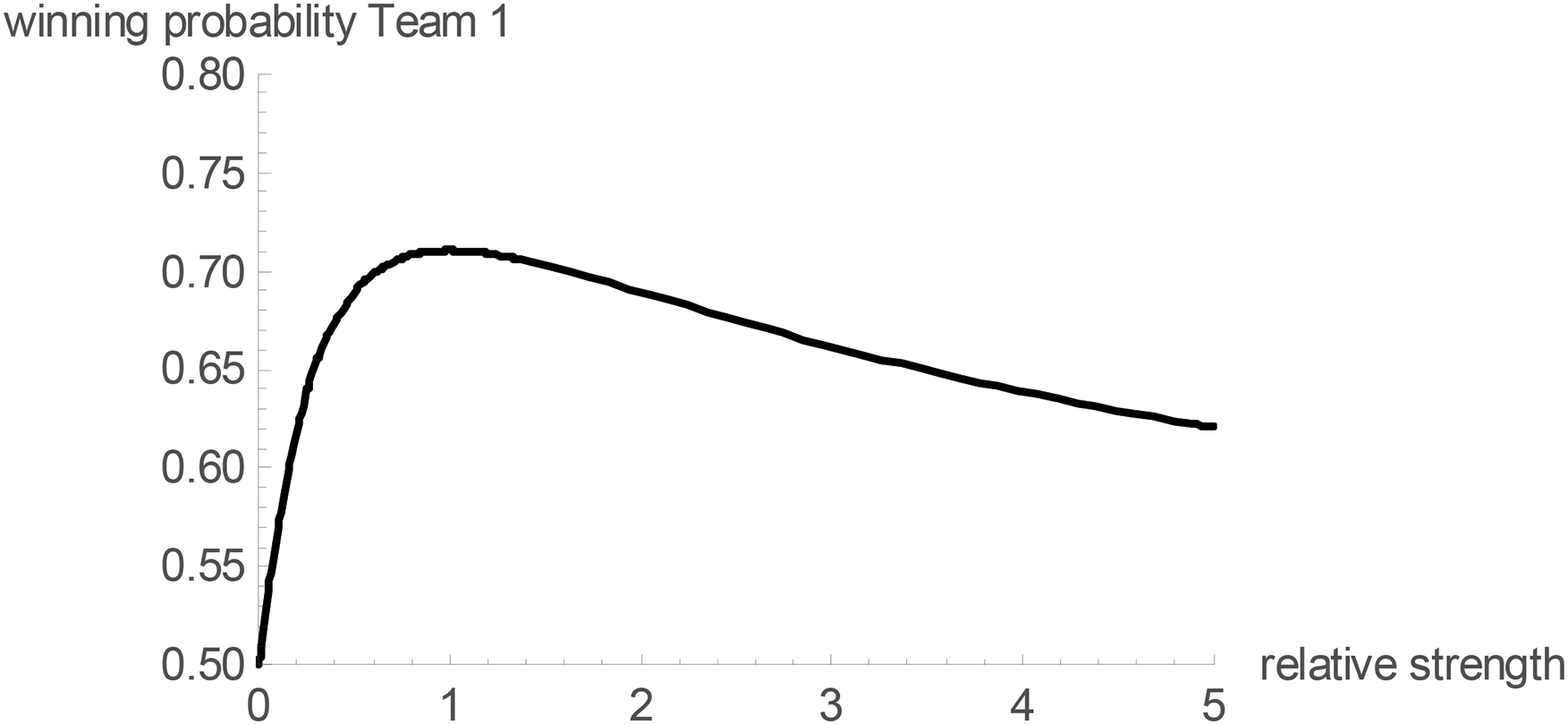
First, studies which measure the degree of the home-field advantage come to the conclusion that the winning probability of the home team ranges somewhere between 60% and 70%.16 Although in our model the influence of the home-field advantage on the winning probability depends on the strengths of both teams, Figure 6 shows that a home-field advantage of 20% effort cost reduction comes close the estimated winning probabilities for the case of symmetric teams. Together with our finding in the previous section that under these circumstances the away goals rule improves competitive balance between symmetric teams and just balances the negative effect of home-field advantage, as shown in Figure 3, is perfectly justified.
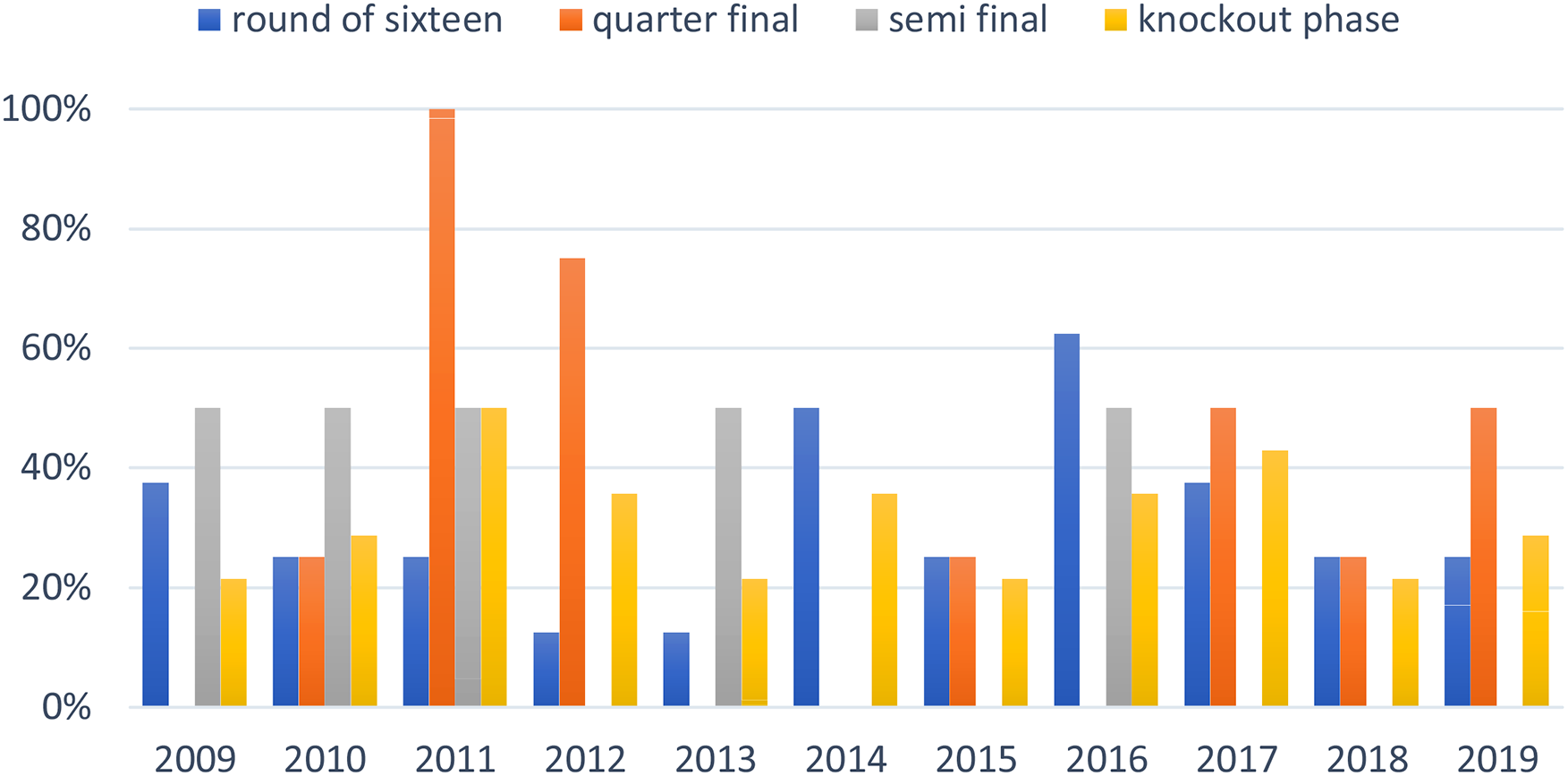
Second, the knockout phase in the UEFA Champions League is only the second stage of the entire tournament which begins with a group stage in which teams are divided into eight groups of four. Only the winning team and the runners-up from each group then progress to the knockout round. This mechanism as well as the seeding procedure for the group stage where teams are allocated to the four groups according to the “UEFA coefficients” should ensure that the best teams do not meet until the knockout phase begins. In terms of our model this would imply that the relative strength of teams in the knockout stage is relative similar. In particular, one would expect that teams become more symmetric from the round of 16 to the semi-finals. Figure 7 supports this tend.
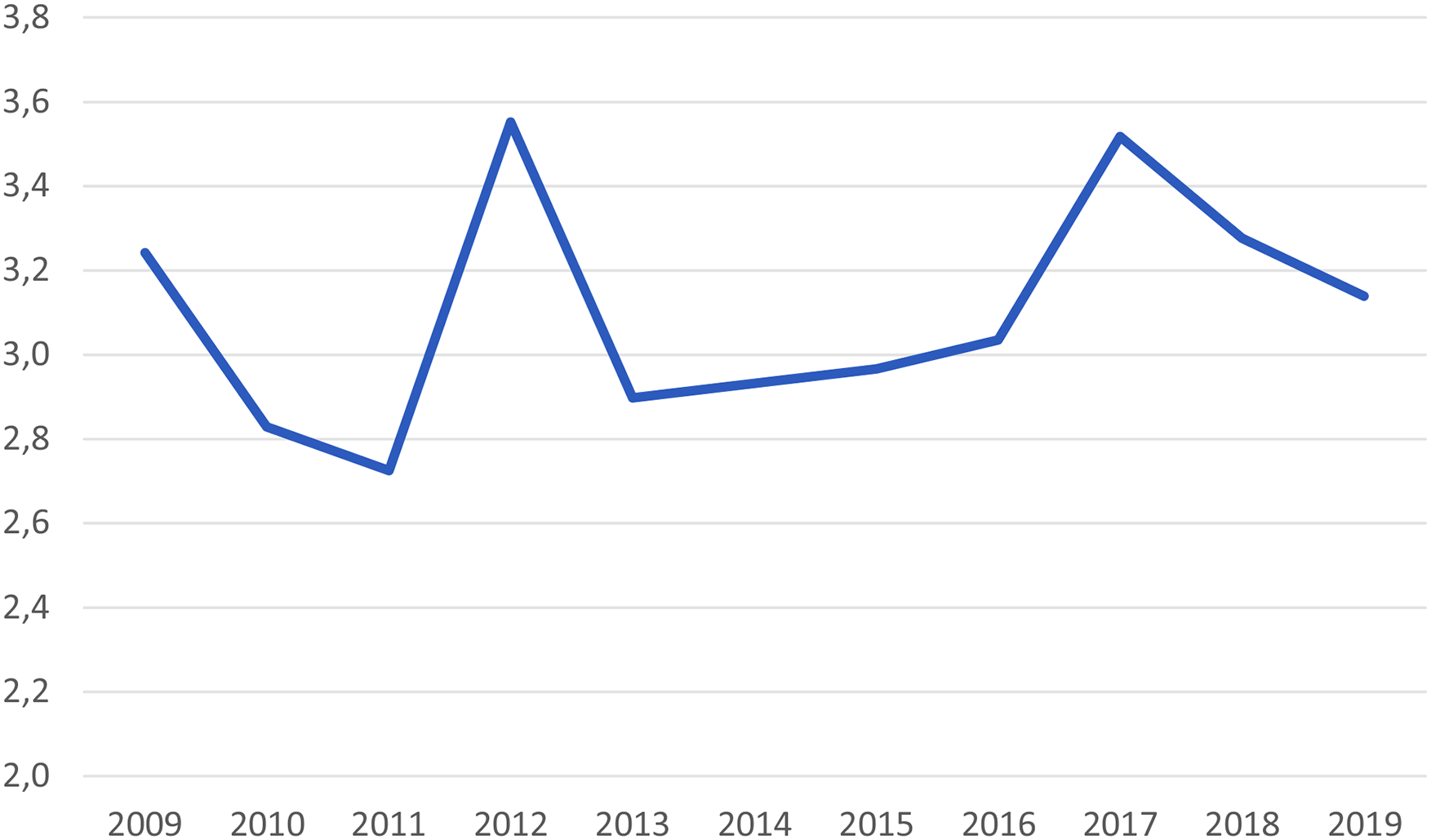
Third, the relative strengths of teams defined as the ratio of teams’ offensive quality to the quality of the opposing defenders seems to be constant over the last years in the knockout phase. In fact, the average number of goals did not change very much which implies that even if teams attack more than in the 60s according to the introductory statement of Arsene Wenger, teams defense improved as well, as shown in Figure 8.
Winning probability of the home team with in case of symmetric teams.
Number of matches in percentage where one team won both the first and the second leg.
Average number of goals per match in the knockout phase of the Champions League.
Taken together, the following conclusion seems admissible: First, in the absence of the away goals rule during extra time, competitive balance worsens and home teams have a great advantage over the away teams. Second, in the presence of the away goals rule during extra time the home-field advantage has a counterbalance. Wheather this improves competitive balance or not depends on the stage of the knockout phase. In the quarter and semi-finals with more or less symmetric teams in their strengths, it levels the competitive imbalance introduced by the home field advantage. In the round of 16 when teams are more asymmetric in their strengths, the weaker teams should play first home and then away so that they benefit from the away goals rule during extra time. This, however, is already in accordance with the UEFA rules where after the group phase the winning team from one group plays first away against the runners-up from another group.
Of course, our modeling of extra time in a soccer match as a sequential contest in which teams can choose their attacking and defending efforts only for each half-time, is a stylized representation of actual matches. An immediate consequence of this assumption is, for example, that leapfrogging by a losing team after the first half is not possible because it can score only one goal in the second half. In reality, of course, a team can even win the match in extra time, if it is one goal behind. From a theoretical perspective, this requires the modeling of a soccer game as a continuous interaction between the two teams. In such an extension, extra time would consist of a discrete number of unit time intervals so that teams can score one goal within each of these time intervals. Modeling a match as a repeated contest with a finite-time horizon, however, is a very demanding extension and beyond the scope of this paper. From a political perspective, such an extension would be very fruitful in considering a soccer tactic called “parking the bus”: This term is used for a highly defensive tactic where all eleven players of a team are playing behind the ball. In the extreme, they all line up all between the goalposts to block the goal. Since in our model, the away team always wins the contest if it scores the first goal in extra time, parking the bus is not necessary in the presence of the away goals rule. When modeling extra time as a repeated contest, however, the away goals rule may introduce an undesired effect in reducing competitive balance and making the game less attractive for the audiences. This is because the away goals rule may incentivize the away team to park the bus in an attempt to preserve a lead or to play for a 1-1 draw. In this sense, the away goals rule contributes to those sporting rules which create a dual incentive problem, see Preston and Szymanski (2003) or Price et al. (2010): Initially designed to increase the effort to win the contest, these rules can lead teams to undesired tactical behavior. For this phenomenon in specific sports, see e.g., Kendall and Lenten (2017), and especially for soccer, see Zhao and Zhang (2021).
Footnotes
Acknowledgments
The author thanks two anonymous referees and Anna Ressi for helpful comments and suggestions. All errors remain my own.
Declaration of Conflicting Interests
The author declared no potential conflicts of interest with respect to the research, authorship, and/or publication of this article.
Funding
The author received no financial support for the research, authorship, and/or publication of this article.
ORCID iD
Peter-J. Jost
Notes
Appendix A. Equilibrium efforts ( a 12 ∗,d 12 ∗,a 22 ∗,d 22 ∗ ) in second half
The general approach to solve for the optimal efforts in the second half is as follows: Let be the score at half-time and suppose that teams’ payoffs are written as follows:
Then the following first-order conditions characterize an interior solution:17
Since
with Conditions (A1) and (A4), respectively, (A2) and (A3), then imply that
Hence,
and the scoring probabilities are
Using these characterizations, Conditions (A1) and (A3) then give the optimal defending efforts for Team , respectively, for Team , and the equilibrium payoffs and follows.
In case, for sufficiently small, , let be the probability such that Team does not give up. Team ’s expected payoff then is
Constraints (A3) and (A4) together with the modified constraints
and the zero payoff property
then characterize an interior equilibrium. Conditions (A1') and (A4), respectively, (A2') and (A3), now imply that
hence,
Using these characterizations, Conditions (A1') and (A3) then give the optimal defending efforts for Team , respectively, for Team . The zero payoff condition (A5) then determines as a function of and which then gives the final equilibrium efforts of both teams. In case, for sufficiently small, , let be the probability such that Team does not give up. Team ’s expected payoff then is
Constraints (A1) and (A2) together with the modified constraints
and the zero payoff property
then characterize an interior equilibrium. Conditions (A3') and (A1), respectively, (A4') and (A2) then imply that
hence,
Similar to the case in which Team gives up, Conditions (A1) and (A3') then give the optimal defending efforts for Team , respectively, for Team . Using these characterizations, the zero payoff condition (A5') then determines as a function of and which then gives the final equilibrium efforts of both teams. Using this general approach, equilibrium efforts in the second half in the presence of the away goals rule are as follows:
In case : If Team 2’s tactic in the second half is given by the following equation:
whereas Team 1 chooses
with probability and gives up with probability . Otherwise, if each team’s tactic in the second half is given by the following equations:
In case : If Team 2’s tactic in the second half is given by the following equation:
whereas Team 1 chooses
with probability and gives up with probability . Otherwise, if each team’s tactic in the second half is given by the following equations:
In case : If each team’s tactic in the second half is given by the following equations:
Otherwise, if Team 1’s tactic in the second half is given by the following equation:
whereas Team 2 chooses
with probability and gives up with probability .
In the absence of the away goals rule, equilibrium efforts in the second half are as follows:
1.
In case : If each team’s tactic in the second leg is given by the following equations:
Otherwise, if Team 2’s tactic in the second leg is given by the following equation:
whereas Team 1 chooses
with probability and gives up with probability .
2.
In case : Each team’s tactic in the second leg is given by the following equations:
3.
In case : If each team’s tactic in the second leg is given by the following equtions:
Otherwise, if Team 1’s tactic in the second leg is given by the following equation:
whereas Team 2 chooses
with probability and gives up with probability .
▪
Appendix B. Equilibrium Efforts (a * 11,d * 11,a * 21,d * 21 ) in First Half
Given the equilibrium payoffs for the second half as a function of the score at half time, the general approach to solve for the optimal efforts in the first half is as follows: Rewrite the expected payoff of Team as follows:
with as payoff difference for Team when it scores one instead of no goal, given Team scores goals, and the expected payoff of Team as follows:
with as payoff difference for Team when it scores one instead of no goal, given Team scores goals. Using the notation in the text, the payoffs and correspond to and in the absence of the away goals rule and the payoffs and are identical and correspond to . Using these characterizations, the following first-order conditions define an interior solution:
with . Conditions (B1) and (B4), respectively, (B2) and (B3), then imply
which gives two quadratic equations in and with coefficients
Note that and for since , , and are all negative. Since , the only solutions are
▪
Proof of Proposition 7. Without a home-field advantage and in the absence of the away goals rule, equilibrium payoffs in the second half of extra time are identical for symmetric teams, that is,
for But then the marginal incentives in the first half are identical
and, with identical marginal efforts, each team plays identical in the first half,
leading to identical overall payoffs
with Note that the scoring probability is
▪
Proof of Proposition 8. Since Prob is greater than Prob for and all the competitive balance with a home-field advantage is always greater than the competitive balance ≷without a home-field advantage,
Whether or then is closer to then depends on and . Note first that for a given , there exists a critical value than that
Hence, for ,
Moreover, for ,
hence
Since the function is continous in both arguments and , there exists a critical value such that
that is
▪
Proof of Proposition 9. Since Team 1’s probability of winning is lower in the presence of the away goals than in its absence only if it is sufficiently weak, there exists a critical value such that
Whether or then is closer to then depends on . Of course, since for ,
competitive balance is worsened with the away goals rule,
Moreover, for ,
hence,
Since , there must exist an such that
Continuouity of the function and in then implies there exists an interval such that
for all of course, ▪
References
1.
CarmichaelF.ThomasD. (2005). Home-field effect and team performance: Evidence from English premiership football. Journal of Sports Economics, 6(3), 264–281.
2.
ClarkD. J.NilssenT. (2021). Competitive balance when winning breeds winners. Social Choice and Welfare, 56(2), 363–384.
3.
ClarkeS. R. (2005). Home advantage in the Australian football league. Journal of Sports Sciences, 23(4), 375–385.
4.
ClarkeS. R.NormanJ. M. (1995). Home ground advantage of individual clubs in English soccer. The Statistician, 44, 509–521.
5.
CourneyaK. S.CarronA. V. (1991). Effects of travel and length of home stand/road trip on the home advantage. Journal of Sport and Exercise Psychology, 13, 42–49.
6.
DietlH. M.FranckE. P.GrossmannM.LangM. (2009). Contest theory and its applications in sports. University of Zurich Institute for Strategy and Business Economics Working Paper, (105).
7.
GollerD.KrumerA. (2020). Let’s meet as usual: Do games played on non-frequent days differ? evidence from top European soccer leagues. European Journal of Operational Research, 286(2), 740–754.
8.
GürkanO.ErtetikG.MünirogluS. (2017). Analysis of goals scored in UEFA champions league by the time periods. International Journal of Sport Culture and Science, 5(3), 140–147.
9.
HoehnT.SzymanskiS. (1999). The Americanization of European football. Economic Policy, 14(28), 204–240.
10.
JostP. J. (2021a). The ball is round, the game lasts 90 minutes, everything else is pure theory. Journal of Sports Economics, 22(1), 27–74.
11.
JostP. J. (2021b). First home or first away? Optimal ordering in two-legged ties, Discussion paper.
12.
KendallG.LentenL. J. (2017). When sports rules go awry. European Journal of Operational Research, 257(2), 377–394.
13.
KonradK. (2009). Strategy and Dynamics in Contests. Oxford: Oxford University Press.
14.
KonradK.KovenockD. (2009). Multi-battle contests. Games and Economic Behavior, 66, 256–274.
15.
KovenockD.RobersonB. (2010). Conflicts with Multiple Battlefields.
16.
KrumerA. (2013). Best-of-two contests with psychological effects. Theory and Decision, 75(1), 85–100.
17.
KrumerA. (2015). The order of games in a best-of-three contest. Journal of Sports Economics, 16(2), 185–200.
18.
LeiteW. S. (2013). Euro 2012: Analysis and evaluation of goals scored. International Journal of Sports Science, 3(4), 102–106.
19.
MichailidisY.MichailidisC.PrimpaE. (2013). Analysis of goals scored in European Championship 2012.
20.
NevillA. M.HolderR. (1999). Home advantage in sport: An overview of studies on the advantage of playing at home. Sports Medicine, 28, 221–236.
21.
PollardR. (1986). Home advantage in football: A retrospective analysis. Journal of Sports Sciences, 4, 237–248.
22.
PollardR. (2006). Worldwide regional variations in home advantage in association football. Journal of Sports Sciences, 24, 231–240.
23.
PollardR. (2008). Home advantage in football: A current review of an unsolved puzzle. The Open Sports Sciences Journal, 1, 12–14.
24.
PollardR.GómezM. A. (2014a). Components of home advantage in 157 national soccer leagues worldwide. International Journal of Sport and Exercise Psychology, 12, 218–233.
25.
PollardR.GómezM. A. (2014b). Comparison of home advantage in men’s and women’s football leagues in Europe. European Journal of Sport Science, 14, 77–83.
26.
PollardR.PollardG. (2005). Long-term trends in home advantage in professional sports in north America and England (1876-2003). Journal of Sports Sciences, 23, 337–350.
27.
PonzoM.ScoppaV. (2018). Does the home advantage depend on crowd support? Evidence from same-stadium derbies. Journal of Sports Economics, 19(4), 562–582.
28.
PrestonI.SzymanskiS. (2003). Cheating in contests. Oxford Review of Economic Policy, 19(4), 612–624.
29.
PriceJ.SoebbingB. P.BerriD.HumphreysB. R. (2010). Tournament incentives, league policy, and NBA team performance revisited. Journal of Sports Economics, 11(2), 117–135.
SelaA.TsahiO. (2020). On the optimal allocation of prizes in best-of-three all-pay auctions. Social Choice and Welfare, 55(2), 255–273.
32.
SzymanskiS. (2003). The economic design of sporting contests. Journal of Economic Literature, 41(4), 1137–1187.
33.
TullockG. (1980). Efficient rent seeking. In: BuchananJ.TollisonR.TullockG. (eds.) Toward a Theory of the Rent-Seeking Society (pp. 97–112). College Station: Texas A&M University Press.
34.
Van DammeN.BaertS. (2018). Home Advantage in European International Soccer: Which Dimension of Distance Matters? GLO Discussion Paper Series, 314.
35.
VojnovićM. (2015). Contest Theory: Incentive Mechanisms and Ranking Methods. Cambridge University Press.
36.
VroomanJ. (2007). Theory of the beautiful game: The unification of European football. Scottish Journal of Political Economy, 54(3), 314–354.
37.
VroomanJ. (2009). Theory of the perfect game: Competitive balance in monopoly sports leagues. Review of Industrial Organization, 34(1), 5–44.
38.
YiannakosA.ArmatasV. (2006). Evaluation of the goal scoring patterns in European championship in Portugal 2004. International Journal of Performance Analysis in Sport, 6(1), 178–188.
39.
YildizparlakA. (2013). A Contest Success Function Allowing for Ties with an Application to Soccer. Available at SSRN 2270351.
40.
ZhaoY.ZhangH. (2021). Investigating the inter-country variations in game interruptions across the big-5 European football leagues. International Journal of Performance Analysis in Sport, 21(1), 180–196.