



Abstract
Contestants enter a risky contest when pursuing a sports career or choose a secure outside option. If contestants enter this contest but their sports career fails, they may have asymmetric career opportunities outside of sport. Greater opportunities reduce the risk of entering this contest. However, contestants’ incentives to exert effort decrease. Two types of equilibria exist if the initial pool of contestants is large. Either only types with high opportunities or only types with low opportunities enter the sports contest. If the initial pool of contestants is low, both types of contestants participate in the contest.
Introduction
Roger Federer pursued a high-risk strategy. At an early age, he put all his eggs in one basket; i.e. the tennis basket. Ex-post, this strategy seemed to be optimal. However, Roger Federer points out that this choice was fraught with risk (Bowers, 2016): It was a pretty big risk for me to stop school at sixteen because I didn’t have an ATP ranking at that time. Maybe I was 800th or something, and in the juniors I was, like, 60th or something. But somehow I felt that school was disturbing me from being one hundred per cent focused on tennis.
The anecdotal example of Roger Federer shows that athletes obviously weigh up the opportunities and risks of leaving school and pursuing a career in sports. The risks are reduced by institutions offering competitive sports in which school education is integrated. Traditionally, the connection between sports and education is particularly strong in the US where highly talented student athletes are often supported by sports scholarships.
4
In the end, however, successful sports careers are relatively rare. Insler and Karam (2019) mention an advertising campaign on national television by the National Collegiate Athletic Association (NCAA): There are over 380,000 student athletes, and most of us go pro in something other than sports.
In this paper, I provide a theoretical model which analyzes the discussed issues. In the model, a large number of contestants either enter a risky sports competition or choose a secure outside option.
5
Risky sports competitions can be interpreted as a long-lasting competition between contestants in which a contestant invests at an early age and may or may not be successful in later years.
6
Thus, the outcome of the competition is either a successful or unsuccessful international sports career. Two different types of contestant exist; these types differ with respect to their life-time value
The main results of the paper are as follows. On the one hand, greater opportunities reduce the risk when a contestant enters the contest, because there is a softer landing in the case of unsuccessful participation. As a consequence, the contestant’s expected payoffs increase. On the other hand, the incentives to exert effort decrease due to two effects: (i) greater opportunities directly decrease the marginal revenue of effort and (ii) marginal revenue of effort decreases indirectly as higher payoffs in the contest attract more contestants. Moreover, I derive that there exists no equilibrium in which both types participate in the sports contest if the number of contestants within both types is large. In this case, equilibria exist only when contestants with high values of
Literature on Contest Theory
Note that, technically, this model corresponds to a contest with asymmetric second prizes. My paper provides a new interpretation of second prizes in the contest literature.
First, the optimal allocation of the prize sum on one or more prizes depends on the functional form of effort costs (Moldovanu & Sela, 2001). The authors conclude that several prizes can only be optimal for the contest organizer if effort costs are convex. For linear and concave costs, a single prize for the winner of the contest is always optimal.
Second, while an increase in the first prize usually increases efforts, an increase in the second prize may have an ambiguous effect on incentives (Sisak, 2009). 7 In the literature, the prizes are usually assumed to be symmetrical for contestants, whereas, in my model, the second prizes are asymmetric. Clark and Riis (1998a) consider an all-pay auction with n symmetric prizes, but in which contestants have different prize valuations. 8 They neglect the case where an asymmetry between contestants exists only in the second prizes. Clark and Riis conclude in their paper that only the contestants with higher prize valuations participate in the contest because these contestants have larger effort incentives. In contrast, my model predicts equilibria with low types (i.e., contestants with low valuations of the second prize) participating in the contest. The reason for this result is that low types have higher effort incentives compared to high types. The prize gap between winning and losing is larger for low types such that high types do not enter the contest.
Literature on Career Decisions and Outside Opportunities in Sports
Some papers consider athletes’ career decisions. One line of research analyzes the age of young basketball, football and baseball players entering the NBA, NFL and MLB after college (Arel & Tomas, 2012; Böheim & Lackner, 2012; Winfree & Molitor, 2007), respectively. Arel and Tomas (2012) examine basketball players’ optimal entry date into the NBA draft. Players can return to school for 1 year or enter the draft early. The authors argue that the player’s decision is similar to an investor’s financial decision of an early exercise of an American style put option. Depending on the draft position, the authors estimate the value of the player’s option. The trade-off for a player is as follows. On the one hand, the argument for an early draft is that a player has a higher number of expected years in the league.
9
On the other hand, going to school for 1 year longer can be worthwhile, because the draft position can be improved in the following year guaranteeing higher salaries in the future. The authors find that players should enter the draft early only if they are expected to be drafted in the first round. For weaker players, returning to school for 1 year could be profitable. Böheim and Lackner (2012) analyze data from the NFL using an instrument variable test to estimate salaries. The month of birth serves as an instrument for entry age, which in turn affects salaries. They empirically show that 1 more year in college increases the starting salary of football players in the NFL by 6%. However, the longer schooling probably leads to a shortened career, such that the advantage can be overcompensated. Winfree and Molitor (2007) analyze the decision of high school athletes to either immediately play professional baseball or attend college. They apply a model based on the calculation of expected discounted present value of lifetime earnings. The underlying model considers the benefits of college education after a baseball career. Unsurprisingly, the authors empirically find that it is better for baseball players drafted in lower rounds in the MLB to return to school. Additionally, they quantify the effects in monetary terms. In contrast to these papers, I use a game-theoretic approach. Moreover, I focus on incentive effects of prize differentials (between the value of outside option, the prize in the competition and
Empirical studies show that education and athlete performance are correlated. For instance, Insler and Karam (2019) analyze data from the U.S. Naval Academy and conclude that sports participation has a small (but statistically significant) negative impact on grades. Gandelman (2009) analyzes data from the Uruguayan soccer league. The author finds that better-educated soccer players and players of higher socioeconomic background are expected to perform better. Therefore, there is a positive relationship between education and performance and socioeconomic background and performance. 10
This paper has the following structure. First, I analyze the main model under the assumption that the pool of each type of contestant is large. Then, I present the results, considering the case with homogeneous and heterogeneous contestants; as well as comparing different types of equilibria. After that, I additionally analyze the model in relation to small pools of each type. Finally, the paper concludes.
Model
In stage one, contestants decide whether to enter a sports competition or not. If contestants do not participate in the sports competition, they choose the outside option with value
Two types of contestants exist. In the main part of the model, I assume that there is a large number of high (low) types A
If a contestant participates in the contest, the expected profits of representative n


where the last term in (1) and (2) represents the linear effort costs. The winning probability pn (and, similarly, pm ) is determined according to the classical Tullock contest success function (CSF) 14 in which the ratio of effort xn of contestant n relative to the aggregate effort X determines the winning probability of contestant n 15 :

The model is solved using backward induction. First, contestants solve their stage two optimization problem.
Optimization at Stage 2
Optimization of the objective functions (1) and (2) requires the following first-order conditions for representatives n (type A) and m (type B).


with
Entry at Stage 1
At stage one, contestants anticipate their optimal second stage behavior. They enter the sports competition at stage one if the expected second stage profit in the sports competition is larger than the value of their outside options.
The paper concentrates on subgame-perfect equilibria in pure strategies in which identical types choose symmetric effort levels if they decide to enter the contest.
Results
Homogeneous Contestants
As a reference, I first sketch the results in the case of homogeneous contestants, i.e.
the number of participants in the contest is
contestant i chooses effort
aggregate efforts are
the expected profit of contestant i is
Result (i) of this lemma implies that
Based on Lemma 1, I obtain the following three corollaries 17 :
increasing in V,
decreasing in
increasing in
increasing in V,
increasing in
decreasing in
increasing in V,
decreasing in
increasing in
The results of these corollaries are intuitive. (i) A larger prize V increases effort incentives
Heterogeneous Contestants
Suppose that the lifetime value of an unsuccessful sports career
As a first result, I derive that there exists no equilibrium in which both types are active in the sports contest.
Assuming
Thus, this proposition refutes the idea that there is a crowding out of type A contestants. Even if type A contestants are less motivated in the sports contest due to a softer landing opportunity in the event of an unsuccessful career, there exists an equilibrium in which only A types enter the contest. The reason for this result is as follows. Greater opportunities of type A contestants increase their expected profits in the contest. As a result, more type A contestants enter the contest such that there is a crowding out of type B contestants. Thus, greater opportunities do not necessarily destroy risk-taking behavior. 20
However, Lemma 2 and Proposition 1 together do not imply that an equilibrium in which only B types enter the sports contest can be excluded.
Thus, this proposition shows that an equilibrium with B types exists if a critical condition holds. It is worth considering the critical condition
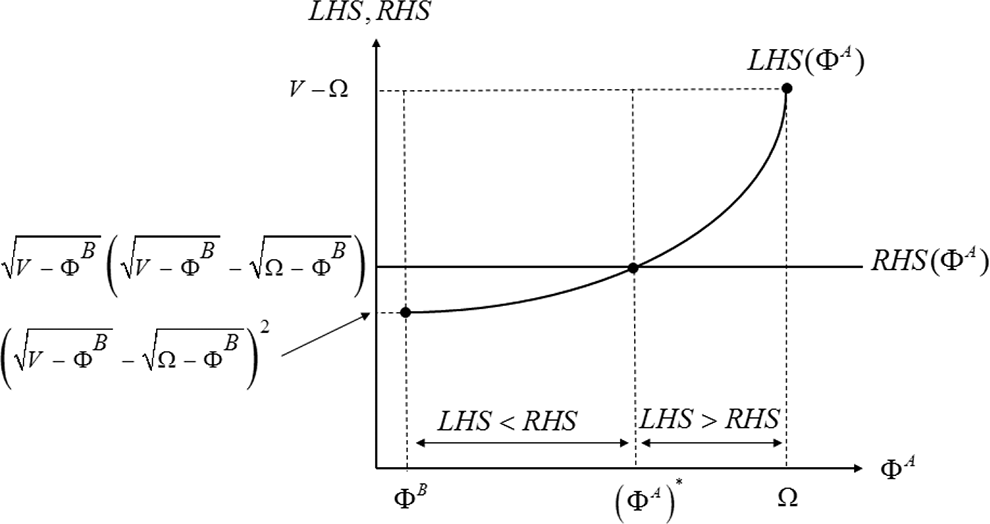
Critical condition.
It is easy to show that the
(a) monotonically increasing in
(b) strictly convex in
The
(c) independent of
(d) larger than
Conditions (a) to (d) guarantee that a unique intersection of the
For
For
Therefore, we generally conclude 21 :
This result is highly intuitive. Suppose that
Comparison of Equilibria
Propositions 1 and 2 show that two possible types of equilibria generally exist if the critical condition holds. It is not clear (game theoretically) which type of equilibrium will be realized. In this section, I compare the two types of equilibria.
The following proposition summarizes the equilibrium comparison.
A representative of a league or association
22
is interested in the quality of the tournament. The quality of the tournaments can be measured by the individual effort or aggregate efforts. Proposition 3 demonstrates that high individual (aggregate) effort results when B
Extension
In this extension, I assume that the number of high (low) type A


contestant n chooses effort
contestant m chooses effort
aggregate efforts are
the expected profit of each contestant is at least
This proposition stands as a counterpoint to Lemma 2. Lemma 2 claims that no equilibrium exists with both types of contestants participating in the contest simultaneously in the case of a large pool of each type. Proposition 4 shows, however, that the simultaneous participation of both types is possible in equilibrium if the pool of each type is small. A non-binding participation constraint is responsible for both types participating in the contest in the case of a small pool of each contestant. By contrast, in the case of large pools, only one type enters the contest until the expected profit corresponds to the value of the outside option.
the low types’ effort is larger than high types’ effort, and
the aggregate effort increases
Result (i) of Proposition 5 is qualitatively similar to the result of Proposition 3. Low types have larger incentives to exert effort. Thus, greater opportunities partly destroy effort incentives independently of the size of the pools. However, result (ii) of Proposition 5 stands as a counterpoint to Proposition 3. While aggregate effort is larger for a larger proportion of low types in the case of small pools, aggregate effort is larger if only high types enter the contest in case of large pools. The reason for this difference is that the assumption of a large pool (instead of a small pool) has additional implications as the number of participating contestants is endogenously adjusted. A larger number of high types entering the contest overcompensates the lower individual effort levels.
Conclusion
This paper analyzes a sports competition which is interpreted differently from the typical sports contests discussed in the literature. The period between the entry decision of contestants (aspiring to an international sports career) and the realization of the contest (a successful or unsuccessful sports career) is protracted in the model. Due to this temporal characteristic, the model differentiates between an ex-ante outside option of a sports contest and the remaining lifetime value
In the model, contestants either decide to enter a risky sports contest or choose a secure outside option. Contestants differ with respect to their opportunities in the case of an unsuccessful sports career. In the main part of the paper, the pools of the two types are large. On the one hand, the paper can explain the participation of only contestants with greater opportunities in sports contests. Contestants with greater opportunities enter a risky sports contest because they are secure in the event of contest failure. Thus, greater opportunities can increase risk-taking behaviors. However, greater opportunities partly destroy effort incentives due to the better fallback position. On the other hand, the model also shows that an equilibrium can exist in which only contestants with low opportunities participate in the contest. A precondition for this result is that the opportunities in the case of failure of the contestants with greater opportunities are not too close to the ex-ante value of the outside option.
The model reveals new effects of asymmetric opportunities outside the sports field on the self-selection process of the field of participants in competition. However, the model is not able to provide policy implications. There are three reasons for this:
If the critical condition (see Proposition 2) holds, multiple equilibria exist. The model does not predict which type of equilibrium will be realized. Depending on which type of equilibrium results: either the individual effort is large and aggregate efforts are small or the individual effort is small and aggregate efforts are large.
In the introduction,
The model does not suggest which policies are optimal from a welfare perspective. For this, the perspectives of all economic actors would have to be taken into account. Moreover, the optimal effort levels are likely to be different from the perspective of the fans, the players, the leagues/associations and the economy as a whole.
In the extension of this paper, I show that the coexistence of both types in the contest is possible if the pools of the two types are small. In this case, contestants may have higher expected profits participating in the contest compared to the value of their outside option. For future research, it would be interesting to analyze the interaction between asymmetric talent and asymmetric second prizes and its effect on contestants’ entry decision. Alternatively, the degree of heterogeneity could be generalized, assuming a large number of contestants each with a different second prize valuation. The analysis would be fundamentally different when compared with my paper, because the number of contestants for each type is large in my model.
Footnotes
Appendix
Acknowledgment
The author would like to thank the participants of the conference “Contests: Theory and Evidence” in Norwich (2019) for helpful comments and suggestions.
Declaration of Conflicting Interests
The author(s) declared no potential conflicts of interest with respect to the research, authorship, and/or publication of this article.
Funding
The author(s) received no financial support for the research, authorship, and/or publication of this article.
