



Abstract
We find evidence that being a foreigner decreases the chances of surviving (i.e., keeping the license) on the first season on the PGA TOUR. This phenomenon does not affect all foreigners equally—it is present amongst the non-elite group (those playing the second-tier tour), but we found no evidence amongst the elite group (those playing the first-tier tour). We discover that the international experience acquired by foreigners in other circuits prior to their arrival on the PGA TOUR mitigates this disadvantage. Not keeping the card has hazardous financial consequences for both the golfer and the corporations whose products he endorses.
A global labor market is one in which talented professionals can move to the country where they can earn the highest return and where there are few immigration restraints that disrupt the efficient allocation of talent (Farrell et al., 2006). It stands in contrast to labor markets constrained by restrictive immigration policies or protectionist stances from local professional associations (Turchick Hakak & Al Ariss, 2013). A well-documented global labor market is that of security analysts, who are employed by investment banks to make stock recommendations. They are regarded in the industry as professionals with high international mobility (Hakim & Rao, 2016), partly because their performance is published in recognized rankings and their ability is seen as highly portable by hiring banks (Groysberg et al., 2008). Another labor market in which there is high cross-country mobility is that of professional sports. For instance, there is evidence of large international migration in professional football (Berlinschi et al., 2013; De Luca et al., 2015; Kleven et al., 2013), to the extent that some European teams are comprised solely of migrant players. The ability of these players is seen as highly transferable across countries, and football clubs hire them with the expectation of raising the performance of the team (Royuela & Gasquez, 2019). In such labor markets characterized by the high mobility of talent across borders, are foreigners at disadvantage relative to its domestic counterparts?
At the firm level, there is ample evidence that companies operating in a market overseas incur in additional costs that local firms would not incur, thus exhibiting lower survival rates than its domestic counterparts (for a review, see Denk et al., 2012). However, at the individual level, researchers have only started to explore whether foreigners are at disadvantage vis-à-vis locals when competing in the host market. Fang et al. (2013) find that migrants underperform relative to natives when competing for employment in the Canadian labor market. They argue that this result is driven by foreigners’ lack of familiarity with the host labor market (i.e., which method to use for an effective job search) and discrimination due to a lack of legitimacy (i.e., employers cannot assess foreigners’ schooling credentials as easily as those of local candidates). Mata and Alves (2018) find that the rate of survival amongst foreign entrepreneurs in Portugal is lower than that of comparable native entrepreneurs, a result explained by foreign entrepreneurs’ lack of familiarity with local business practices and discrimination due to lack of legitimacy (i.e., clients cannot adequately assess whether foreign entrepreneurs’ skills suit the local market). Yet despite these empirical advancements in various national contexts, it remains unclear whether foreigners’ disadvantage vis-à-vis locals would persist in a labor market in which there are no immigration restrictions (i.e., individuals qualify strictly based on performance criteria), where an unbiased measure of individuals’ ability is publicly available, and where discrimination from the market’s governing body is non-existent.
The purpose of this study is to provide such a conservative test by examining foreign newcomers and whether they are at a greater disadvantage relative to local newcomers in the global labor market of professional sports. This is a novel research question that contributes to a growing body of research that examines the consequences 1 of athlete migration. There are at least two important research streams within this literature. First, there is a series of studies providing evidence that athlete migration has allowed sports organizations to enhance their performance. At the national level, there is ample evidence indicating that an increase in the number of foreigners in a domestic league generates improvement in the performance of the national team (Alvarez et al., 2011; Milanovic, 2005), that national teams benefit from having athletes playing abroad in stronger leagues (Allan & Moffat, 2014; Gelade & Dobson, 2007), and that the migration of players to foreign clubs improves the national team performance of their countries of origin (Berlinschi et al., 2013; Lago-Penas et al., 2019). At the club level, evidence shows that clubs from countries with regulations that are more permissive in terms of migration display better results in the world rankings (Royuela & Gasquez, 2019), and that migration has allowed top clubs to strengthen their position in international competitions (Binder & Findlay, 2012). Overall, this stream of research has allowed us to gain a better understanding of the positive performance outcomes of athlete migration in team sports, but there is still limited understanding of the performance downsides of athlete migration, particularly in individual sports. In this respect, our examination of whether foreign individuals are at competitive disadvantage when compared to locals in the host market is a distinct question that has not been hitherto examined.
The second research stream that examines the consequences of athlete migration focuses on the acculturation challenges of foreign athletes. Specifically, these studies examine how migrant athletes must navigate through and adapt to unfamiliar norms and practices in the hosting country (Schinke et al., 2013). This research stream describes how athletes may go through phases of psychological burden and social isolation (Ryba et al., 2016; Schinke et al., 2016), and the mechanisms that can help the migrant to adapt to the new host environment (Ryba et al., 2015, 2016). Overall, this literature has allowed for an understanding of the social and psychological challenges that migrant athletes endure, yet thus far there has been less emphasis on quantifying the impact of those challenges on athletes’ performance. Our study contributes to this research stream precisely by providing a conservative test of whether foreign newcomers are at disadvantage vis-à-vis local newcomers in a sports labor market with high cross-country mobility and experienced agents.
We focus on the PGA TOUR, which is a high-skill and high-stakes labor market located in the US (Hickman & Metz, 2015). Similar to other labor markets where workers earn money by selling their skills to employers, golfers in the PGA TOUR earn money by participating in tournaments (roughly 40 tournaments per season; Rinehart, 2009). The PGA TOUR has the most prestigious reputation among golf circuits, and playing the PGA TOUR season is the aspiration that many golfers vie for, among other reasons because of the unparalleled tournament purses, the possibility of signing endorsement deals, or to prove their abilities competing against the best players in the world. Non-US players represent over one third of the PGA TOUR players and come from over 30 different countries.
There are four attributes of the PGA TOUR that contribute to the conservativeness of our test.
First, individuals cannot be discriminated against based on immigration considerations (e.g., nationality quotas) because they qualify to play on the PGA TOUR based on their athletic performance. Second, the fact that individuals go through a rigorous qualification process ensures that players can cope with competitive pressure. That is, contrary to low-ability workers who are largely influenced by their peers (Mas & Moretti, 2009), Guryan et al. (2009) showed evidence that PGA TOUR golfers’ performance is less subject to detrimental effects from peer pressure. Third, foreigners in the PGA TOUR cannot be discriminated against by press, fans or sponsors based on a biased perception of their ability, because in professional golf there is an objective and publicly available measure of ability to which all players are compared regardless of citizenship: a player’s rank in the Official World Golf Ranking (OWGR). And fourth, the PGA TOUR, which depends financially on international sponsors and international broadcasting deals, positions itself as an inclusive professional sports circuit. 2
The main results of our paper are as follows. First, even though the PGA TOUR poses no immigration restrictions and enjoys great diversity in terms of players’ nationalities, we still find that foreign newcomers (vis-à-vis local newcomers) suffer a lower probability of keeping their card (i.e., license that gives the right to play in PGA TOUR) at the end of their first PGA TOUR season. However, this disadvantage does not affect all foreigners equally—it is present amongst the non-elite group (those playing the second-tier tour), but we find no evidence amongst the elite group (those playing the first-tier tour). Second, we find that amongst the non-elite group of individuals (second-tier tour), foreign newcomers’ probability of survival is positively moderated by their prior experience in other international golf circuits. More specifically, the intensity of foreigners’ international experience (i.e., distance travelled per season) and the degree of competitiveness of international golf circuits in which they built their experience, contribute to mitigate foreign newcomers’ disadvantage vis-à-vis local newcomers.
The remainder of the paper is structured as follows: Section 2 explains how the PGA TOUR is organized, the additional costs that foreign newcomers will face that local newcomers would not incur, and how foreign newcomers’ prior international experience may help them mitigate that disadvantage. Section 3 describes the methods and our empirical strategy. Section 4 provides our primary results and the series of robustness checks we have conducted. Section 5 discusses our results and conclusions.
Liability of Foreignness in the PGA TOUR
The PGA TOUR is the organizer of the first-tier and the second-tier tours. Both tours feature skilful professionals, but the first-tier tour features the highest-ability players, while the second-tier tour is a developmental tour that features emerging players or players who lost their first-tier tour card and are trying to regain it. In the fist-tier and the second-tier tours, the season consists of dozens of tournaments (one per week). First-tier and second-tier tour tournaments are independent from one another and are held in different venues, every week moving to a new location across the United States. In the first-tier tour, players compete for large stakes: average prize per tournament in 2019 revolved around US$6 million 3 and players’ endorsement deals go from $250,000 to millions per season. In the second-tier tour, players compete for more modest stakes: average prize per tournament in 2019 revolved around US$600,000 and players’ endorsement deals go up to $50,000 per season. 4 As a result, second-tier players are on the fringe between making a wealthy living (if they promote to the first-tier tour) or struggling financially if they do not promote—in 2019, only half of the second-tier tour players earned enough prize money to cover their own travelling expenses and tournament fees. As such, PGA TOUR players see the second-tier tour as proving ground in their path to the first-tier tour.
Both local and foreign players must qualify for the first-tier or second-tier tours through the Qualifying Tournament. 5 Players who qualify for the first-tier (second-tier) tour earn a card that gives them the right to enter the first-tier (second-tier) tour tournaments for the upcoming season. Yet, players will be confronted with the risk of losing that card at the end of their first season. The criterion to keep the card is the player’s rank in the cumulative prize money ranking at the end of the season. In the first-tier tour, every season there are 250 players who have a card that gives them the right to play in first-tier tour tournaments. Of those 250 players, the bottom 125 players, as ranked by cumulative prize money at the season, lose their card and exit the first-tier tour (i.e., are demoted to the second-tier tour). Similarly, every season there are 220 players who have a second-tier tour card. Of those 220 players, the bottom 100 players, as ranked by cumulative prize money at the season, lose their card and exit the second-tier tour. Player turnover is high in both tours. 6
We hypothesize that even in a labor market in which there are (1) no immigration restrictions, (2) where individuals have gone through a rigorous qualification process guaranteeing that players can cope with competitive pressure and the attendant social influences of high-stakes competition, and (3) where individuals cannot be discriminated against based on a biased perception of ability, foreign newcomers face additional costs that local newcomers do not incur. In line with Fang et al. (2013) and Mata & Alves (2018), who argue that foreign newcomers face unfamiliarity and discrimination hazards 7 that local newcomers do not face, we contend that foreign golfers who move to the US to play in the PGA TOUR face hardships stemming from unfamiliarity with the host competitive environment and lack of support, which may have potentially adverse consequences for their performance. We describe these hazards next.
The PGA TOUR both chooses and conditions its courses using specific guidelines, such as very long-distance courses, deep rough (i.e., an area outside the fairway that features thicker grass to penalize imprecise shots) and fast greens (i.e., an area where the hole is located). Foreign newcomers may be less familiar with the courses than local newcomers, since the latter may have had more opportunities to play on these courses because they are open to the public the rest of the year, outside the PGA TOUR season. As a result, foreign newcomers may incur in higher costs when adapting to these new playing conditions (Feinstein, 2011). Moreover, the difficulty of adapting to these unfamiliar conditions may be particularly detrimental for foreigners who do not master English language, since they are limited in their ability to socialize and therefore access valuable information about the specificities of courses. Also, a poor command of the language may add extra pressure each time a foreigner has to interact with the press (Crouse, 2016), thus hampering his popularity among American fans (Diaz, 2017). 8
Furthermore, foreign newcomers in the PGA TOUR may not receive the support that local players do. Home-field advantage is a well-documented phenomenon in sports (Garicano et al., 2005). It not only refers to playing on one’s home court (i.e., stadium), but also to playing within one’s own geographical territory (Monks & Husch, 2009), such as Americans playing in the US. Indeed, fans’ cheering is a growing tendency in the PGA TOUR (Crouse, 2013), which has applied the stadium concept to golf courses, with large grandstands constructed along the course that can fit up to 600,000 spectators. On this respect, some foreign players in the PGA TOUR, when inquired by the journalists, have been vocal about the lack of support they receive from local fans (Golfing World, 2018). This lack of support to foreigners may be particularly detrimental when reflecting upon the realities of daily touring life: with many weeks per season on the road, loneliness is a frequent symptom of life on tour (Noer, 2012). This phenomenon may be aggravated by some local journalists playing upon nationalistic themes and fueling discrimination by using the term “invasion” when referring to the arrival of foreign players to the PGA TOUR (e.g., Burke, 2017; Figueroa, 2001).
Although foreign golfers may be disadvantaged vis-à-vis natives due to unfamiliarity with the host environment, we argue that this disadvantage may be partly overcome through their international experience. Indeed, empirical evidence shows that agents who have been exposed to experiences overseas are better prepared to overcome the unfamiliarity of a new foreign destination (Mudambi & Zahra, 2007). This is because individuals are likely to compare unfamiliar circumstances with prior international experiences in order to identify valid courses of action (Delios & Henisz, 2000; Delios & Beamish, 2001). Accordingly, foreign golfers who have built an intense international experience in the other international golf circuits (Asian, Australian, Canadian, European, Japanese, South African, and Latin American tours), and who are therefore used to adjust their game to varying playing conditions, may be better equipped to adapt to the unfamiliar conditions of the PGA TOUR.
Moreover, after years of competing internationally, foreign newcomers may find on other players they met during the years of international experience, and who are now part of the PGA TOUR, a buffer against adversity (Wacker, 2017). As explained in Rosaforte (2012), these pre-existing ties may help foreign newcomers to overcome the lack of support they receive from local fans and to mitigate the loneliness associated with touring life. Indeed, previous empirical research has shown that social ties can be an important source of support for foreigners facing uncertain work environments (Manev & Stevenson, 2001) or work settings in which foreigners are underrepresented vis-à-vis natives (Mollica et al., 2003).
Method
Data
We exploit three rich databases that make it possible to address our research question. First, we use the ShotLink® database, which allows us to examine the performance of 776 newcomers in the PGA TOUR between 2002 and 2016, as well as to trace their prior athletic trajectory in any given international golf tour since 1996. This allows for the creation of precise measures of international experience. Second, we created a database from PGA TOUR’s Media Guides (2002–2016), which contains rich biographic features about the players, such as their age, or college they attended. Third, we used the Official World Golf Ranking (OWGR) database, which provides an accurate measure of each player’s ability every week during the period under study.
Sample
Our sample only includes newcomers in order to isolate the phenomenon under study from the effects of having players with varying degrees of experience (i.e., liability of newness) on the PGA TOUR (Mudambi & Zahra, 2007). In our sample, a player is considered a newcomer from the moment he earns a card for the first time on either tour, and until he loses his card for the first time. Therefore, a first-tier tour newcomer will only be considered as such until the end of the season when he loses his first-tier tour card. Similarly, a second-tier tour newcomer will be considered as such until the end of the season he loses his second-tier tour card; or, if he is promoted to the first-tier tour while he is still a newcomer, he remains as such until the end of the season when he loses his first-tier tour card (section 3.5.5 explains how the econometric model accounts for this possibility).
The 15-year period under study starts in 2002 and ends in 2016. Prior to 2002 we do not have access to players’ biographical information. During the period 2002-2016 on the first-tier tour there were 131 newcomers, 74 of whom were foreigners of 22 different nationalities. First-tier newcomers are on average 28 years old, turned professional six years prior to arrival on the PGA TOUR and have 2.8 seasons of international experience. The average OWGR at the time of entry is 230 (i.e., the lower the ranking, the better the player is), and 52% of these professionals attended university in the US. Within the period 2002-2016 on the second-tier tour there were 645 newcomers, 187 of whom were foreigners of 30 different nationalities. Second-tier newcomers are on average 27 years old, turned professional four years prior to their arrival on the PGA TOUR, and have 0.5 seasons of international experience. The average OWGR at the time of entry is 579, and 79% of them have attended university in the US. These statistics indicate that entering the PGA TOUR through the first-tier tour is the most frequent path for more talented, internationally experienced golfers. In contrast, entering through the second-tier tour is the most frequent path for golfers with less international experience, many of whom come from college golf in the US.
Dependent variable
Binary variable that reflects whether the player survives by keeping his card at the end of the season. For every season on the first-tier tour, there are 250 players who receive a card that gives them the right to play in first-tier tour tournaments. On the first-tier tour, a player maintains his card if he finishes among the top 125 players in the cumulative tournament prize money ranking by the end of the season. For each season on the second-tier tour, there are 220 players who have a card that gives them the right to play in first-tier tour tournaments. On the second-tier tour, a player keeps his card if he finishes among the top 100 players in the cumulative tournament prize money ranking by the end of the season. The few cases in which a player does not keep his card because of a voluntary exit or the need for a medical leave were identified and excluded from the sample.
There are three reasons why we chose survival at the end of the season as our dependent variable: First, survival is the most common measure to assess liability of foreignness in the literature (e.g., Kronborg & Thomsen., 2009; Mata & Freitas, 2012; Mata & Alves, 2018). Second, in golf, not surviving at the end of the season (i.e., not keeping the card and being demoted to a lower-order circuit) is unequivocally a measure of failure because it has hazardous financial consequences for players and the corporations whose products they endorse (Feinstein, 2011). Third, a season-long measure of performance (as opposed to focusing on tournament-level performance) is the appropriate level of analysis. On the one hand, it is the cumulative effect of many tournaments throughout the season that, overall, make foreigners to be at disadvantage relative to locals, thus making the season the appropriate level of analysis. On the other hand, it allows us to level out tournament-specific factors that could be influencing the outcomes of a golf tournament, such as the average strength of the players entering the tournament (Guryan et al., 2009), the presence of superstars (Brown, 2011), or the level of monetary and non-monetary tournament incentives (Kali et al., 2018).
Main explanatory variables
Foreigner
Binary variable that indicates whether the player is local or a foreigner. For the few cases in which foreigners have acquired American citizenship prior to arrival on the PGA TOUR, we consider them to be local players.
International experience
In golf, a well-established measure of international experience is the average distance per season that a golfer has travelled to play in tournaments outside of a home country (Murray, 2017). Such a measure, which reflects the amount of experience that an agent accumulates per unit of time, has been referred to in the international business literature as the intensity of international experience (Clarke et al., 2013). Our calculations of international experience intensity start in 1996 (first season with available records) and end in 2015, which is the last season that a 2016 PGA TOUR newcomer could have played abroad. The international golf tours comprised therein are the most relevant ones according to the OWGR (Asian, Australian, Canadian, European, Japanese, South African, and Latin American tours) and only the tournaments played outside a player’s home country are included in our calculations. After having identified the coordinates (i.e., altitude and latitude) of each international tournament in which the newcomer participated, and also the coordinates of the player’s residence (updated every season), we computed the distance between locations using the Haversine formula, which is commonly used to calculate the distance between points on the surface of a sphere. When calculating the geographic distance between tournaments, we considered two possible scenarios: the first scenario occurs when golfers enter tournaments that take place on consecutive weeks—in that case players generally fly directly from one tournament location to the next because there are only three days between two tournaments, which are most often dedicated to practice rounds. The second scenario occurs when golfers enter tournaments that do not take place on contiguous weeks—in that case players generally fly back to their residence before going to the next tournament.
Controls
Age
Prior studies in sports show that seasoned athletes are better at handling strain than inexperienced athletes (Hickman & Metz, 2015; Kali et al., 2018). Thus, it may be that experienced players have an advantage when confronted with a demanding situation, such as having to adapt to a new country. On the other hand, studies in psychology have found that youth is an important determinant of acculturation (Yoon et al., 2013); more specifically, individuals who migrate at a younger age to the US go through an easier adaptation process (Ghorpade et al., 2004). In order to account for the possible effect of age on player’s performance, we control for a player’s age at the time of their arrival to the PGA TOUR.
College
College golf in the US, under the umbrella organization of the National Collegiate Athletic Association, provides student athletes opportunities to travel and compete in collegiate contests. It may be that players who attended a US university will be more acquainted with both touring golf and local culture, thus facilitating their adaptation to the PGA TOUR. Indeed, out of the total number of PGA TOUR newcomers attending college golf in the US, the percentage of Americans is nearly 75%, so one could argue that a hypothetical worse performance (i.e., lower survival rates) of foreign newcomers could be due to the fact that many of them did not attend US college golf. We control for this by adding a binary variable that indicates whether the player studied in a college golf program in the US prior to their arrival on the PGA TOUR.
Country’s golf popularity
Golf popularity varies by country. A well-known measure of a country’s golf popularity is the total number of golf courses divided by the total population of the country (Royal & Ancient, 2019). Countries where golf is popular, like the US, exhibit a better record of survival in the PGA TOUR than countries where golf is not popular, like India. Accordingly, one could argue that a hypothetical worse performance of foreign newcomers in the PGA TOUR could be due to the fact that foreigners come mainly from countries where golf is not popular as popular as in the US. Adding countries golf popularity as a control allows to account for the possibility that foreign golfers underperform because they come from countries where there is a smaller pool of talent, rather than due to unfamiliarity with the host competitive environment or lack of support.
Official world golf ranking (OWGR)
Although all players on the first-tier and second-tier tour have exceptional golf skills, they vary in terms of ability. We control for the ability of each player at the beginning of the season by their position in the Official World Golf Ranking (OWGR). Published records of the OWGR range from 1 (i.e., top of the ranking) to 1300 (i.e., bottom of the ranking). We transformed the OWGR into a categorical variable because some second-tier tour players are not registered in the OWGR at their time of entry (i.e., their rank does not fall within the top 1300 OWGR), which would imply losing those observations. The OWGR categories for first-tier tour players are: 1 (ranks 1–10); 2 (ranks 11–50); 3 (ranks 51–100); 4 (ranks >101). The OWGR categories for second-tier tour players are: 1 (ranks <300); 2 (ranks 301–400); 3 (ranks 401–600); 4 (ranks >601). Note that the models not only account for a player’s OWGR at their time of arrival to the PGA TOUR, but also at the beginning of each of the subsequent seasons.
Eligibility ranking
On the first-tier and second-tier tours there are 250 and 220 cards, respectively. However, not all players who want to enter a given tournament can do so. 9 This is because tournaments on the first-tier and second-tier tours cannot exceed 150 players. The PGA TOUR regulates this through a set of rules, known as the eligibility ranking, which determines the order of preference to enter a tournament. Thus, it may be that players with a bad eligibility ranking (i.e., lowest entry priority) have lower chances of surviving (i.e., keeping their card at the end of the season) because they cannot decide the tournaments into which they will enter. In order to account for this possibility, we control for players’ eligibility ranking at the beginning of each season. Following the eligibility ranking categories of the PGA TOUR, the eligibility categories for first-tier tour players are: 1 (i.e., highest entry priority) to 3 (i.e., lowest entry priority), while for second-tier players they are 1 (i.e., highest entry priority) to 4 (i.e., lowest entry priority).
Promotion (included only in the second-tier tour model)
The models account for the fact that second-tier tour players may promote to the first-tier tour during the period they are still considered newcomers. If a second-tier player promotes to the first-tier tour, this may affect the probability of keeping the card at the end of the season. That is, since the first-tier tour is more competitive, a player who promotes from second-tier to first-tier tour may see the probability of keeping the card be diminished.
Model
Our dependent variable indicates whether a player keeps his card at the end of a season. Accordingly, we model the probability of survival (i.e., keeping the card) at the end of the season. While some players lose their card in the time window that we observed, others keep it through. We thus have multiple observations for a same player, and in the case of some players, we never observe card loss. While the data could be interpreted as a censored time to failure which is often analyzed with Cox regression (Cox, 1972), we are here in a special case where events occur at discrete times: players retain or lose their cards but only at the end of each season. In this case, an appropriate modelling proposed by Cox (1972) is a logistic regression to a set where each season for each player is a different line in the dataset (Allison, 2010). It should be noted that within this framework, covariates are allowed to change through time, as long as they are constant within a season. For instance, the eligibility ranking of a player varies from season to season, so their survival during each season takes into consideration their eligibility for that season. Other variables, such as age at entry, remain constant through a player’s career, so the same value is repeated on multiple lines. Because we use a logistic regression, the interpretation of the exponentiated coefficients (odds ratios) corresponds to a multiplicative effect on the odds of keeping the card.
Results
Tables 1 and 2 provide means, standard deviations, and correlations among the variables. We computed the variance inflation factors and detected no signs of multicollinearity.
First-Tier Tour.
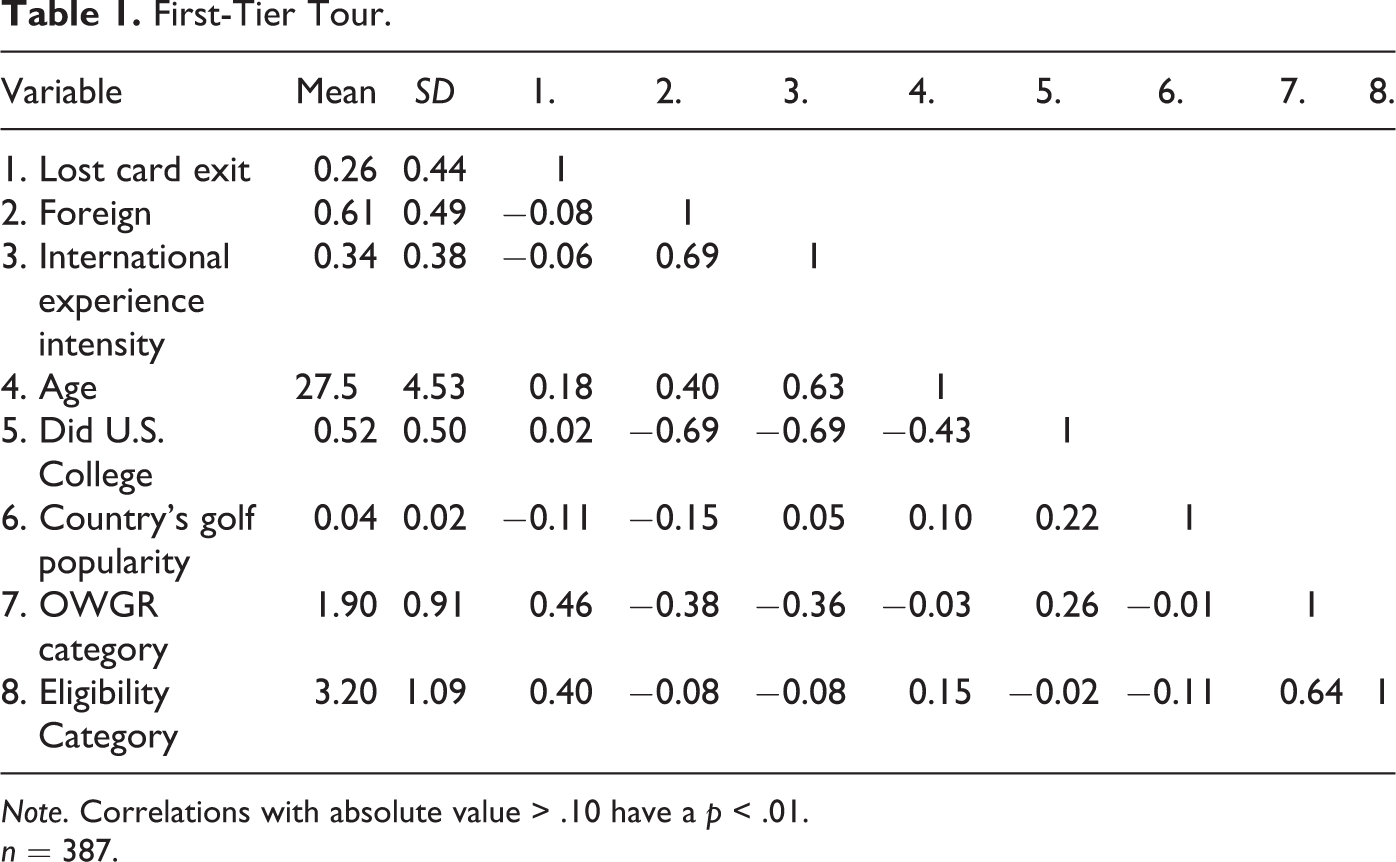
Note. Correlations with absolute value > .10 have a p < .01.
n = 387.
Second-Tier Tour.
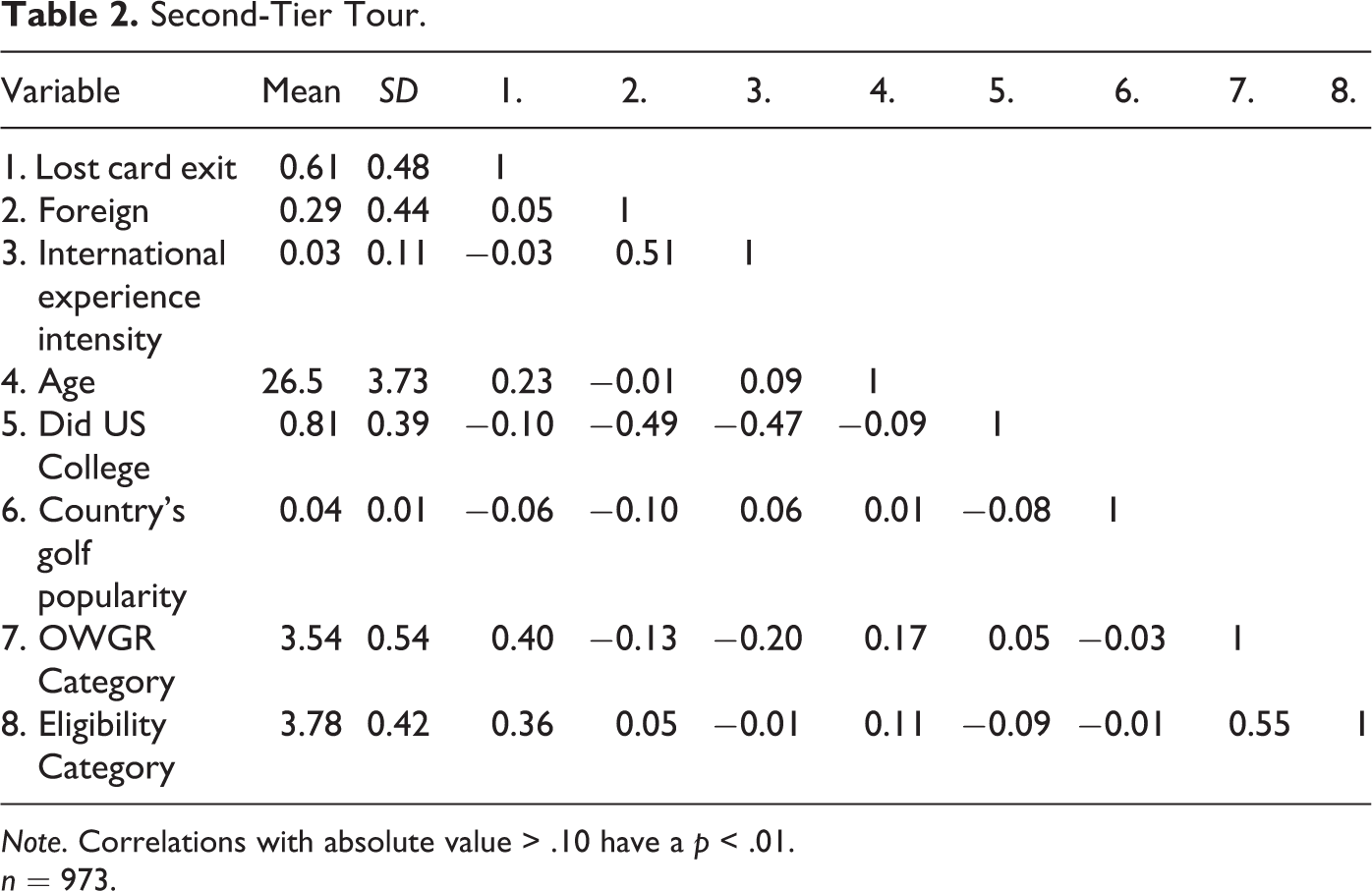
Note. Correlations with absolute value > .10 have a p < .01.
n = 973.
The results of the first-tier tour (Models 1 and 2) presented on the left-hand side of Table 3, indicate that there is no evidence that being a foreigner on the first-tier tour has a significant impact on the probability of keeping a card (Hypothesis 1). Results of the second-tier tour models (Models 3 and 4) presented on the right-hand side of Table 3 indicate that being a foreigner on the second-tier tour has both a negative and significant impact on the probability of keeping the card at the end of the season, thus supporting the idea that foreign newcomers are at competitive disadvantage relative to local newcomers on the second-tier tour (Hypothesis 1). This effect is sizeable—if the player is a foreigner, and with controls at their mean value, the odds ratio will be exp(−0.38) = 0.68.
Models for First-Tier and Second-Tier Tours.
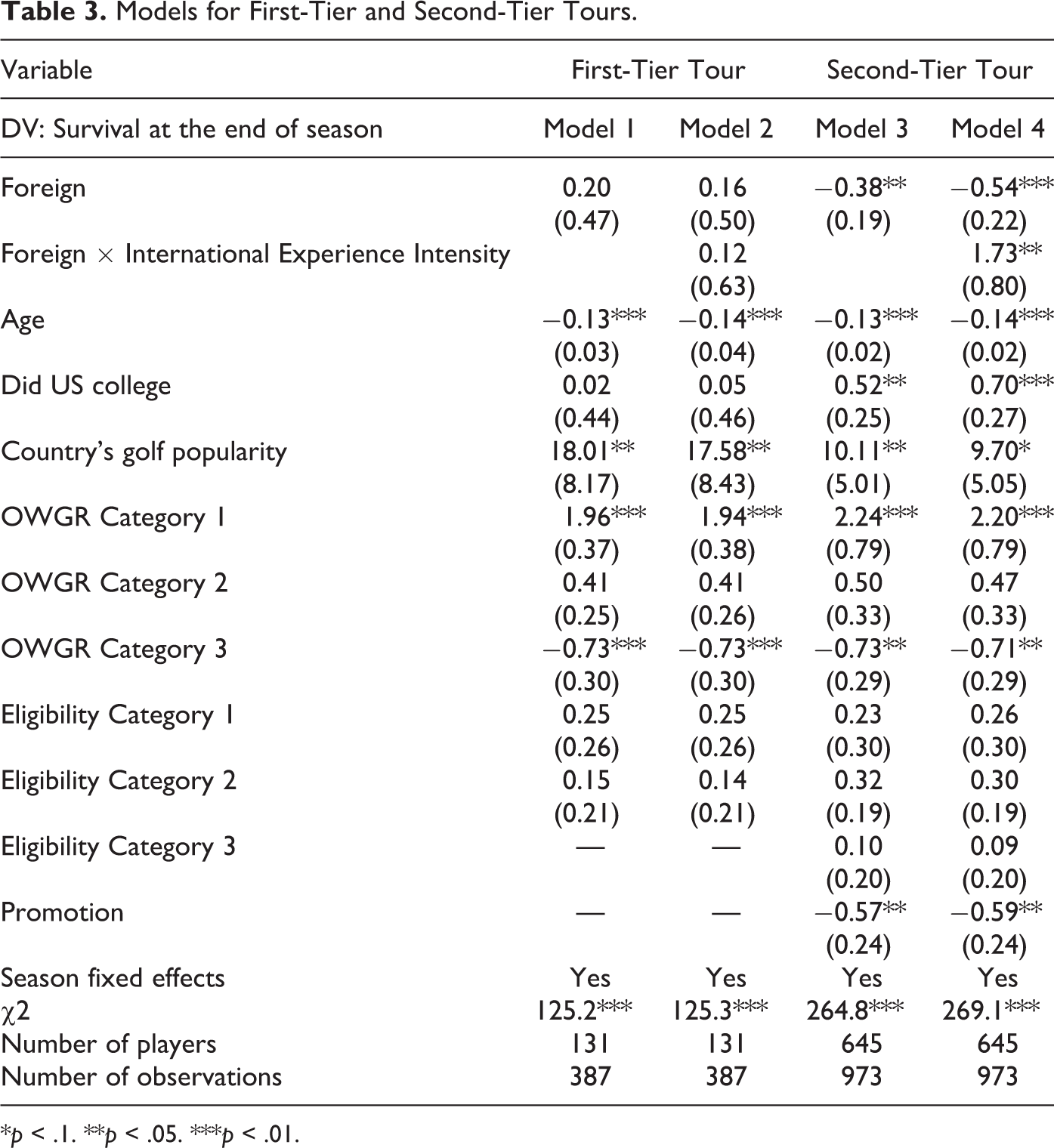
*p < .1. **p < .05. ***p < .01.
Model 4 on Table 3 provides support to Hypothesis 2, indicating that liability of foreignness in the second-tier tour is moderated by international experience intensity (i.e., distance travelled by a player). The moderating effect of international experience intensity is shown graphically in Figure 1. This figure indicates that the greater the distance travelled per season by foreign newcomers prior to their arrival on the PGA TOUR, the greater their probability of keeping the card, as stated in Hypothesis 2.
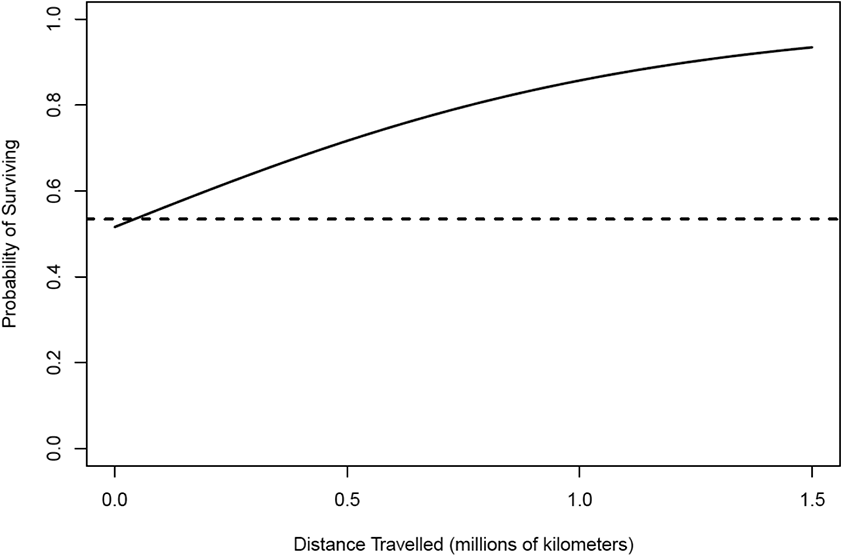
ILOF moderated by international experience intensity—Second-tier tour.* *Note. Locals are represented by a discontinued line: - - - - -; foreigners are represented by a continuous line: -----.
Robustness Test: Alternative Measures of International Experience
Here we are attempting to verify whether the moderating effect of international experience on the ILOF is subject to the measure we used. Prior studies indicate that, besides intensity (i.e., distance travelled per season), there is both the scope of the international experience and the length of the international experience to be considered (Clarke et al., 2013). Scope refers to the geographical diversity of an agent’s international experience, and it has been operationalized as the number of foreign countries where the agent has gained international experience (Le & Kroll, 2017). In our study, we measure scope as the number of countries in which golfers have competed professionally before their arrival at the PGA TOUR. Length refers to the duration of an agent’s international experience, and it has been operationalized as the number of years that an agent has engaged in international activities (Brouthers et al., 2009). In our study, we measure length as the number of seasons a player has had a card in a professional golf circuit outside his home country.
In addition to the intensity, scope and length of international experience, past research shows that agents who forged their experience in demanding competitive contexts are better prepared for international competition (Sakakibara & Porter, 2001). Exposure to strong competition prevents agents from being complacent (Miller & Pakhe, 2002). Thus, one could argue that foreign players who build their experience in highly competitive international tours will be better equipped to overcome ILOF. We tested whether the moderating effect of international experience is robust to the inclusion of a competitiveness measure of international experience. The competitiveness of the international experience was calculated by averaging the competitiveness of the tournaments entered by the foreigner prior to arrival on the PGA TOUR. Each tournament’s competitiveness was determined using the formula provided by the OWGR. 10
The results for the second-tier tour are presented on Models 6 through 8 of Table 4. First, we find no evidence indicating that the number of countries in which players have developed their international experience or the length of time accumulated in gathering international experience has a positive moderating effect on foreigners’ probability of keeping the card in the PGA TOUR. A possible interpretation of this is that since qualifying to play in the PGA TOUR is the ultimate goal that many US and non-US golfers vie for, the fact that it takes a non-US player longer to qualify for the PGA TOUR may be an indication of a lack of adaptability to new competitive environments. Second, we find evidence that the competitiveness of the international contests in which second-tier tour foreigners participated prior to their arrival to the PGA TOUR, has a positive moderating effect on foreigners’ probability of keeping the card. Figure 2 shows graphically the moderating effect of the competitiveness of international experience. Overall, these results indicate that second-tier tour players who have forged their experience in highly competitive contests and have gain that international experience intensively (i.e., long distance travelled per season), are better equipped to compete on the PGA TOUR.
Robustness Test. Alternative Measures of International Experience.
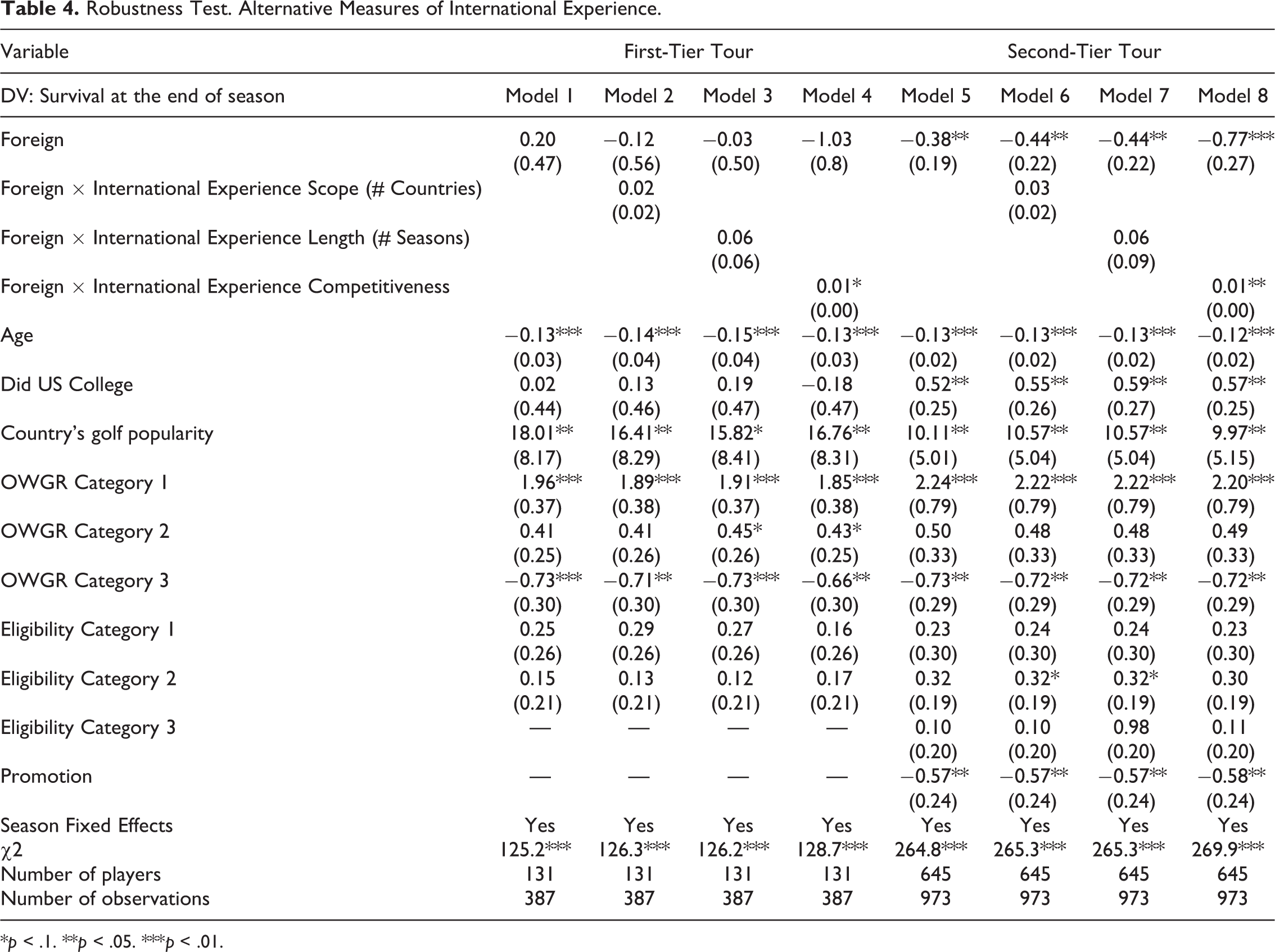
*p < .1. **p < .05. ***p < .01.
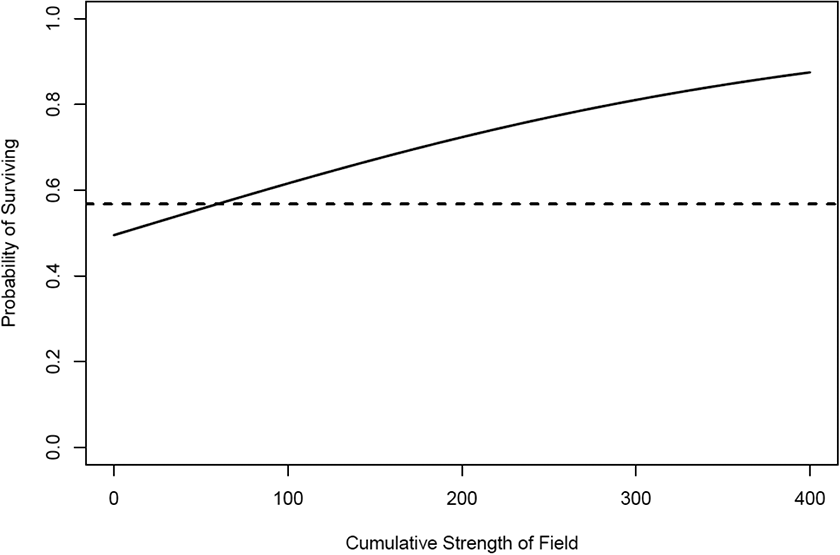
ILOF moderated by international experience competitiveness—Second-tier tour.* *Note. Locals are represented by a discontinued line: - - - - -; foreigners are represented by a continuous line: -----.
Discussion
In a labor market like the PGA TOUR, where there are no immigration restrictions (i.e., individuals qualify strictly based on performance criteria), where an unbiased measure of individuals’ ability is publicly available, and where discrimination from the market’s governing body is non-existent, we still find that foreign newcomers are at a competitive disadvantage vis-à-vis local newcomers in the second-tier tour. This is the case even though it is in the best interest of the PGA TOUR that foreigners thrive upon their arrival in order to attract international corporate sponsors and international broadcasting deals. Foreign newcomer’s disadvantage not only has potentially deleterious financial implications for the PGA TOUR, but also for the foreign golfers themselves and the global corporations whose products they endorse (Knittel & Stango, 2014).
There are two plausible interpretations as to why first-tier tour players would not suffer from liability of foreignness. The first explanation has to do with the fact that foreigners who qualified directly into the first-tier tour (through the Qualifying Tournament) may not only possess superior golfing skills, but also a superior ability to adjust to unfamiliarity hazards, such as the specificities of the PGA TOUR course design. Furthermore, they may also be particularly resilient to social pressures in the workplace (Guryan et al., 2009), such as the lack of home-field advantage (i.e., fan support). The second plausible explanation is related to status of first-tier tour foreigners at the time of their arrival to the PGA TOUR. After achieving a direct qualification for the first-tier tour, these players may be perceived by other players as extraordinarily skillful and, consequently, enjoy high status. It has been shown that high-status individuals receive more interpersonal help than low-status individuals (Van der Vegt et al., 2006). Thus, it may be that foreign newcomers in the first-tier tour enjoy a privileged position (vis-à-vis low-status foreigners) from which they can access resources (e.g., information, support) that mitigate the liability of foreignness.
Two limitations in this study are worth mentioning. First, admittedly one could raise a concern that the results found in the labor market of sports may not be perfectly transposable to other labor markets. Contrary to what happens in individual sports, where ability can be assessed frequently and with precision thanks to publicly available rankings, there are markets where this may not be feasible. In the absence of commonly accepted mechanisms to identify an individual’s ability, employers (even in global labor markets) may select contenders based on other criteria that is not strictly performance-based (Lee et al., 2015); for instance, employers may favor nationalities that enjoy a high level prestige in a specific profession, such as French chefs in the high-end restaurant market (Rao et al., 2003).
The second caveat relates to the fact that, although we argue that unfamiliarity and lack of support are two factors that put foreign newcomers at disadvantage vis-à-vis local newcomers (Hypothesis 1), our data does not allow us to identify which of the two factors is more influential in driving our results. Similarly, we cannot conclude whether or not the moderating effect of international experience on ILOF (Hypothesis 2) is operating primarily via the reduction of unfamiliarity hazards (i.e., by comparing new challenges with previously experienced situations in order to identify valid courses of action) or via the mitigation of lack of support (i.e., by relying on the players they met through their international experience route). The use of mixed methods (Williams & Shepherd, 2017) may be particularly helpful to address this issue in forthcoming studies.
In a more speculative vein, one could wonder whether there is a difference in the supply of local versus foreign talent feeding the PGA TOUR, so that if the pool of local talent is bigger and of better quality, it negatively impacts the likelihood of a foreigner’s survival. In our paper, we already control for two factors that potentially influence the supply of foreign and local talent differently: First, we account for the popularity of golf in the country of origin (which we use to proxy each country’s pool of talent); second, we account for college golf attendance in the US (which facilitates the transition to professional touring life and in which Americans represent 75% of total students). A third, more general factor that could influence the supply of local versus foreign talent differently is the cross-country variation in labor market dynamism. That is, the difference in labor market opportunities (i.e., outside professional golf) between the US and the rest of the world, which could influence the supply of athletes, so that the size and quality of the pool of local talent (i.e., US players) versus foreign talent (i.e., non-US players) feeding the PGA TOUR differs. This is an interesting yet complex question that requires exploring the relationship between labor market dynamism (or lack of) and self-employment choices, such as those that golfers take when they decide to become professional touring players. Although a detailed exploration of how cross-country differences in labor market dynamism may influence the supply of athletic talent is beyond the scope of our study, it is a question that is worth exploring.
Future research may also examine the mechanisms through which foreign athletes could overcome the liability of foreignness. Social network methods may be a particularly fruitful path to explore this issue. According to social network theory, individuals form networks and ties in order to access information and social support. Future research may use social network methods, for instance, to explore how the density of the network that an individual has developed prior to host-market arrival, or how central his same-nationality peers are in the host-market network, could play a role in his ability to mitigate unfamiliarity hazards. More research is needed into these issues.
Footnotes
Acknowledgments
The authors are grateful to the PGA Tour for providing access to ShotLink® data and the Official World Golf Ranking for their data set. We are also grateful to David Emond (Delta Statistique) for his coding.
Declaration of Conflicting Interests
The author(s) declared no potential conflicts of interest with respect to the research, authorship, and/or publication of this article.
Funding
The author(s) received no financial support for the research, authorship, and/or publication of this article.

Notes
Author Biographies