



Abstract
Background:
This study compares the outcomes of endovascular repair using pre-curved fenestrated endografts and open surgery with total arch replacement for aortic arch aneurysm repair.
Methods:
Patients who underwent aortic arch aneurysm repair with fenestrated endograft or total arch replacement between 2009 and 2021 were retrospectively analyzed. Subjects were limited to true aortic arch aneurysms, and cases with a history of thoracic aortic surgery, connective tissue disorder, or concomitant procedure were excluded. The Kaplan–Meier method was used to calculate cumulative survival and freedom from aorta-related death, and the Fine and Grey methods were used for re-intervention rates.
Results:
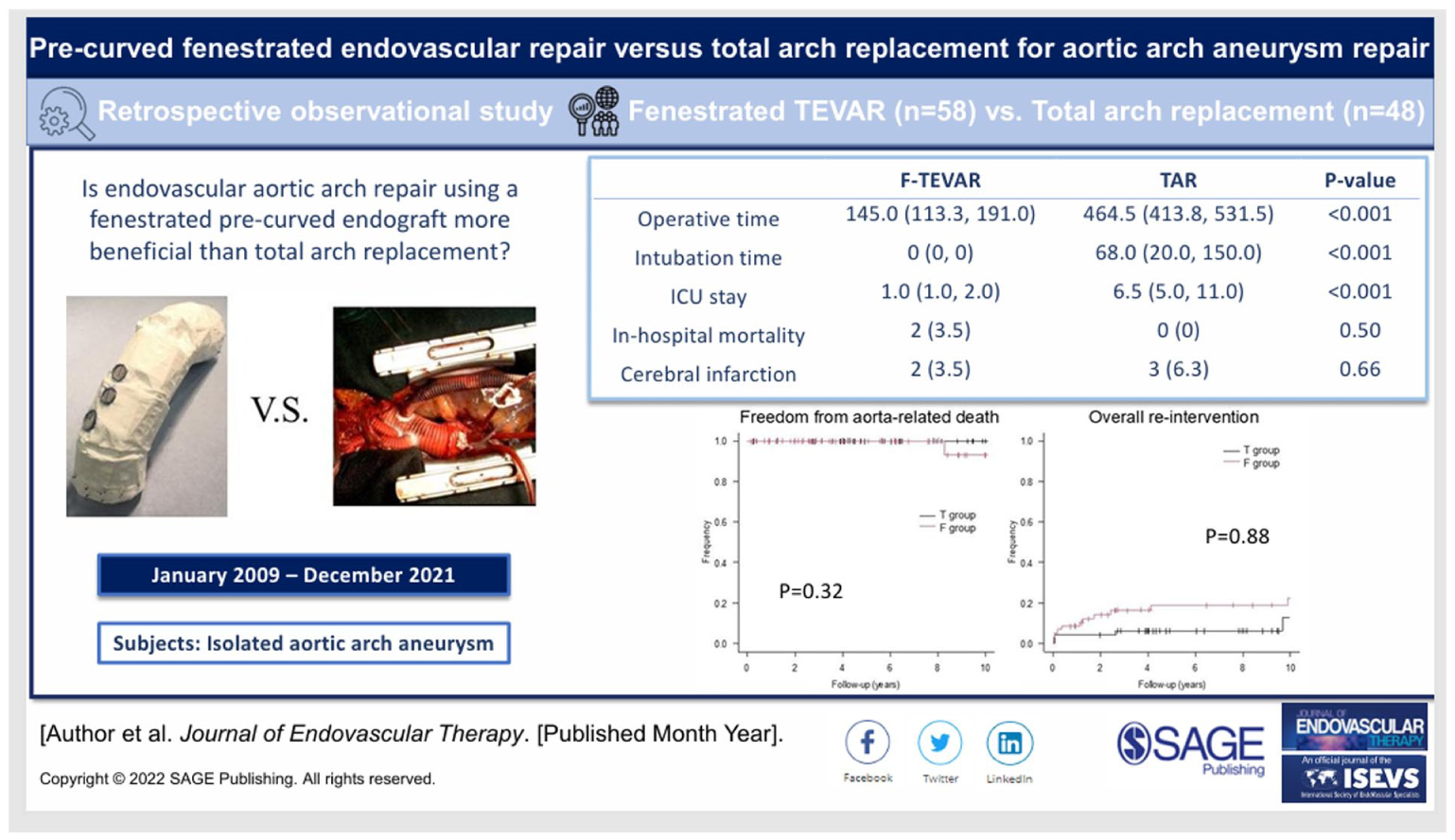
A total of 106 cases were included, with fenestrated endografts (F group, n=58) and total arch replacement (T group, n=48). The median follow-up times were 48.0 (25.5, 94.8) and 62.5 (46.0, 110.8) months (p=0.038) in the F and T group, respectively. The median age (76.5 [71.3, 80.0] vs 71.5 [66.0, 77.0], p<0.001) and European System for Cardiac Operative Risk Evaluation II (11.0 [10.0, 14.0] vs 8.5 [6.0, 11.0], p<0.001) were higher in the F group. Intraoperative blood transfusions (19 [32.8%] vs 48 [100%], p<0.001), operative times (145.0 [113.3, 191.0] vs 464.5 [413.8, 531.5], p<0.001), postoperative intubation times (0 [0, 0] vs 68.0 [20.0, 150.0], p<0.001), intensive care unit stays (1.0 [1.0, 2.0] vs 6.5 [5.0, 11.0], p<0.001) and in-hospital stays (10.0 [8.0, 12.0] vs 27.0 [22.0, 41.3], p<0.001) were significantly reduced in the F group. In-hospital mortality (2.0 [3.5%] vs 0 [0%], p=0.50), perioperative cerebral infarction (2 [3.5%] vs 3 [6.3%], p=0.66), and spinal cord injury (1 [1.7%] vs 0 [0%], p>1) were comparable between the 2 groups. The 5-year survival rates were 68.9% (standard error [SE]=6.85) and 81.5% (SE=6.00) in the F and T groups, respectively (p=0.003); however, freedom from aorta-related death rate (100% vs 100%, p=0.32) and the re-intervention rates (19.0% vs 6.30%, p=0.08) at 5-year showed no significant difference.
Conclusions:
Fenestrated endovascular aortic repair reduces operative time, postoperative intubation, intensive care unit and in-hospital stays, and blood transfusions. The 5-year freedom from aorta-related death and re-intervention rates were comparable to those of total arch replacement.
Clinical Impact
Pre-curved fenestrated endografts provide a less-invasive yet effective option for aortic arch aneurysm repair, compared to total arch replacement. They offer shorter operative and intubation times, reduced transfusion rate, and shorter ICU stays, without increasing aorta-related mortality or reintervention during follow-up. This approach expands treatment opportunities for elderly and high-risk patients who previously could not undergo conventional arch repair.
Keywords
Get full access to this article
View all access options for this article.