



Abstract
Young children are known to make significant progress in learning their native language during the first 4 years of their life. Nonetheless, delays or differences in patterns of language acquisition can be cautiously determined and be sensitive indicators of developmental issues. The current paper displays an investigation that examines plural suffixation skills in preschool bilectal Cypriot-Greek (CG)-speaking children with developmental language disorder (DLD) as compared with their age-matched typically developing peers. Predictions have been made based on the Interpretability Hypothesis (IH) theoretical context postulating that grammatical features (inflections for Tense and Case Features) will be differentially affected in DLD depending on the phonological saliency inherent to specific inflection typology. Developmental language disorder diagnosis was based on exclusionary criteria and on clinical markers based on the language samples analyzed for grammatical errors, including the omission of articles in obligatory contexts, clitic misplacement, incorrect suffixation of plural targets, agreement errors, omission of negation, and reduced Mean Length of Utterance in Words (MLUw). A non-real-word experimental paradigm was used to test subject performance of plural suffixation. Findings revealed that plural suffixation difficulty was not an all-or-none phenomenon. Both erroneous and correct responses were identified during both experimental tasks. In addition, errors were observed in both groups of preschool children; nonetheless, the proportion of errors was recorded to be higher in the DLD group.
Developmental language disorder (DLD) is a nonacquired disorder of language. Children with DLD of this age group show typical auditory, oral motor, and nonverbal cognitive functioning and do not exhibit symptoms that can be related to autism spectrum disorders or to neurological conditions (Leonard, 2014). Data suggest that the prevalence of DLD in the United States is approximately 7% with higher prevalence in boys than girls and reported familial aggregation indicating that the disorder bears hereditary underpinnings (Tomblin, 1989; Ullman, 1999). According to Conti-Ramsden and Durkin (2012), preschool children who develop DLD are known to present with language difficulties from the outset of the process of language acquisition. This would mean that instead of reaching developmental language milestones within the expected chronological age window, these youngsters appear to show protracted language skills from early on and that it can be roughly marked by the late onset of expressive language (e.g., late talkers) evidenced around the age of 24 months (Rescorla & Dale, 2013; Rice & Hoffman, 2015). Moreover, researchers and clinicians have stressed the need to study DLD with the context of a dialect, to avoid underidentification of culturally and linguistically diverse children (Oetting et al., 2016). It has been shown that DLD can be reliably diagnosed approximately around the age of 4 years through the implementation of numerous protocols, including composite scores on standardized language testing batteries, detailed clinical observations as per language sample analyses, and/or through the use of adapted language assessment tasks in the absence of language-specific norm-referenced test (cutoff scores based on subject performance on certain linguistic tasks, including sentence repetition, use of clitics, syntax complexity, morphosyntactical accuracy, narrative skills, and expressive vocabulary; Gagarina et al., 2019; Georgiou & Theodorou, 2022; Kambanaros et al., 2013). Timely and accurate assessment is of utmost importance given that children with DLD show long-term adverse sequelae and poor communicative interactions (Redmond & Rice, 1998; Rice & Hoffman, 2015). The child’s academic development is also at stake in the sense that many children with DLD are at risk of developing reading disorders and/or more global learning disorders (Aram et al., 1984; Bishop et al., 2016).
Language Profiles and Inflectional Morphology in DLD
In the past 15 years, the examination of language skills of children with DLD has received keen research interests particularly from the cross-language perspective Law (Law et al., 2019). From a linguistic perspective, grammatical/inflectional morphology has been characterized as the “Achilles Tendon” in DLD. Converging evidence from a cross-linguistic perspective corroborate as to the impact of the disorder on the formation of inflectional and derivational morphology (see Leonard, 2014, for a thorough review) with findings contributing to the understanding of the way a particular language determines what is lost and what is spared in linguistic profiles of afflicted individuals. Of particular interest is the child’s “. . . vulnerability to the more challenging details of the language they are learning . . .” (Leonard, 2014, p. 14). Clinically, DLD difficulties can be seen in different modalities, which implies that the impairment may be affecting underlying linguistic mechanisms (e.g., formation and use of grammatical inflections) rather than specific channels of the use of the language (Dalalakis, 1999).
Nevertheless, grammatical inflections and morphosyntactic abilities on par with DLD performance are not uniformly marked across speakers, an observation that forms the springboard for advancing keen research interest in this particular area of the language domain (Leivada et al., 2017; Leonard, 2014; Marshall & van der Lely, 2006, 2007; Mastropavlou & Tsimpli, 2011). Difficulties encountered by children with DLD in the formation of grammatically correct structures have been examined in a number of languages (without this being an exhaustive list), including English (Bishop et al., 2016, 2017; Paradis, 2016; Pine et al., 2008), German (Clahsen et al., 1997), Dutch (Bol & de Jong, 1992; de Jong et al., 2013; Rispens & De Bree, 2014), French (Paradis & Crago, 2001), and Greek (Mastropavlou & Tsimpli, 2011; Stavrakaki et al., 2012; Tsimpli, 1999) as well as in the Greek dialectal variation of Cypriot Greek (CG; Kambanaros et al., 2013; Mastropavlou et al., 2019; Petinou & Terzi, 2002).
Despite the heterogeneity one encounters in DLD across variable languages, a key emerging observation is that atypical linguistic symptomatology has a common denominator suggesting that areas of special weakness vis-à-vis DLD include domains that are also harder to acquire even by typically developing (TD) children. Because children with DLD find language learning effortful in the first place, the acquisition and use of the more challenging aspects of the language are “. . . even less accessible and almost indecipherable . . .” (Leonard, 2014). As a result of the availability, systematicity, and transparency of morphophonological cues in each language, the severity of the impairment varies among languages (Leonard, 2014). This raises concerns regarding the identification and delineation of particular areas of grammar that can hypothetically become affected as a function of a particular language (Bishop et al., 2017). Although it can be challenging in languages with distinct typologies, nominal morphology (i.e., category used to group together nouns and adjectives based on shared properties) has gotten less attention than the verbal domain. Although children with DLD perform poorly, studies on children who speak Germanic languages, including English (Rice & Oetting, 1993), Dutch (Boerma et al., 2017), and German (Scholer & Kursten, 1995), have found that plural formation is less difficult than tense formation, although children with DLD have a depressed performance compared with their monolingual TD age-matched peers. This contrasts with studies on Icelandic and Hungarian (Lukács et al., 2010; Thordardottir, 2008, 2016), where DLD children either performed similarly on verbal and nominal morphemes (i.e., referred to the grammatical category, gender, case, and number; Thordardottir, 2008) or they did not differ from their TD peers (Lukács et al., 2010; Thordardottir, 2016). In these languages, verbal and nominal morphemes are acquired early by TD children.
Theoretical Accounts Revisited
Few of the theoretical accounts on the nature of the disorder caused by DLD have acknowledged the role of morphophonology in determining linguistic profiles. In this context, a theoretical framework, the Low Phonetic Substance Hypothesis (LPSH; Leonard, 2014), postulates that children with DLD appear to face difficulties with morphemes of low perceptual salience due to a deficit that impedes on the perception of linguistic sounds. So, morphemes such as the plural /-s/, the third-person singular /-s/, and the past tense /-d/ and /-t/ are not perceived by children with DLD in the same way they are by children of typical language development, leading to problematic acquisition patterns in language disorders. A plausible locus of such linguistic challenges stems from the low-phonetic substance/saliency of inflections such that unstressed inflections and inflections with no real-word references become less accessible to children with DLD. Conversely, difficulties encountered by children with DLD are milder in languages where morphemes bear higher phonetic substance, aiding the acquisition of grammatical morphology (Boerma et al., 2017; Bortolini et al., 2006; Leonard, 2016). Several studies have argued that DLD children’s general processing capacity limitations affect short-term memory (STM), specifically phonological memory, the speed of processing and retrieving words, such that consonant and morpheme clusters may be omitted in the process of production (Archibald & Gathercole, 2006, 2007; Bishop, 1997; Marton & Schwartz, 2003). Leonard and Bortolini (1998) and Conti-Ramsden (2003) have reached two possible conclusions for these omissions: (a) the morpheme is not always perceived, which leads to children unable to fully grasp and learn the morphological paradigm, and (b) producing /-gʑ/ and /-ps/ require increased phonological STM and processing capacity.
In the context of Standard Modern Greek (SMG), Stavrakaki and Tsimpli (2000) proposed the Interpretability Hypothesis (IH hereafter), formulated under the principles of Chomsky’s Minimalist framework (Chomsky, 2014). The IH postulates that DLD affects the acquisition of grammatical features that are semantically uninterpretable (syntax agreement & morphosyntactic rules). On this account, children with DLD have difficulties in accessing and producing features that lack direct semantic content. Interpretable features, on the contrary (person & number), might be more accessible to DLD grammars because they are associated with semantic/conceptual features in the mental lexicon (Mastropavlou et al., 2019; Mastropavlou & Tsimpli, 2011). Most importantly though, IH is also relevant at a phonetic level of representation or Phonetic Form (PF hereafter), so that interpretable features at PF are those that bear phonetic substance (Chomsky, 2014). According to IH, semantically uninterpretable features also lacking interpretability at the phonetic interface should be harder to acquire than features involving higher levels of interpretability at PF (i.e., phonetic/phonological realization). Depending on the relative strength of phonological saliency characterizing the morphophonological properties of a given language, learnability of such features should be affected accordingly, as in the case of DLD. Despite the scarcity of investigation in the context of CG-speaking children with DLD, the available data suggest that morphophonology and grammaticality forms pose particular challenges to these youngsters. Specifically, CG-speaking children with DLD presented with difficulties in producing low-phonetic morphophonological verb forms of low-phonetic saliency (e.g., lack of stress and syllable augmentation) during experimentally manipulated tasks, including real-verb and non-real-word stimuli (Mastropavlou et al., 2019). However, a profiling analysis of the data from the CG performance suggested that this was not an all-or-none phenomenon. Experimental stimuli during real-word and pseudo-work tasks were produced with more accuracy when the corresponding inflections were characterized by a stress shift and syllable augmentation ([ˈvafo] → “I paint” vs. [
The Present Study
Drawing from cross-linguistic data regarding the importance of phonological salience and its interface with grammatical inflectional morphology, the present investigation was set to examine plural suffixation skills in dialectal CG-speaking children with DLD. Given the scarcity of research findings in understudied linguistic varieties, including DLD, the present investigation aspired to enrich cross-language databases through the implementation of theory-motivated research. Specifically, this study proposes a new methodology for determining the relationship between phonological salience and its differential, if any, impact on plural formation in child language skills. It illustrates that the use of a non-real-word paradigm (Mastropavlou et al., 2019) can be implemented in delineating the locus of possible inflectional deficits in DLD from a dialectal perspective. The current investigation draws from findings regarding morphophonological challenges in DLD and expands the investigation onto features related to plurality and suffixation skills in dialectal CG children with DLD.
Purpose of Investigation
In the current investigation, the researchers made predictions vis-à-vis the LPSH. Overall, the LPSH hypothesis would predict a selective deficit in plural formation with difficulty on targets requiring the addition of a syllable in the process of pluralization (i.e., [paˈpu-s] Sg (grandfather) vs. [paˈpu-ð-es] Plr) (grandfathers) or addition of morphophonological /-s/ (i.e., [ˈmbala] Sg “ball” versus [ˈmbal-es] Plr (balls)). Overall, the LPSH would predict a progressive difficulty starting with what should be the least to what should be the most difficult inflection for a young child with DLD to produce: vowel stressed < vowel unstressed < vowel consonant stressed < vowel consonant unstressed < addition of a syllable. Following the theoretical framework of LPSH, the study aspired to answer the following questions:
(a) Do the deficits seen in CG-speaking with DLD stem from rule-governed bases? In this scenario, it is expected that the formation of plurality through experimentally manipulated non-real words would yield an isomorphic performance of plural suffixation across all word stimuli.
(b) Do the deficits seen in CG-speaking with DLD vary as a function of the phonological characteristics of each stem? In this scenario, we expect to see differential performance on the plural suffixation as a function of the phonological salience of inflectional typology (e.g., stressed inflection being easier to mark as opposed to unstressed counterparts).
(c) Do CG-speaking children with DLD show typical or atypical patterns of development in the realization of inflections? This is a crucial question as it will contribute more information about the nature of developmental language deficit, including the mechanisms employed by children with DLD in dealing with challenging linguistic elements.
The CG Dialect—A Brief Description
The current investigation study was carried out in the Greek-speaking Republic of Cyprus situated in the Easter Mediterranean Sea. Cypriot Greek is spoken by the Grecophone population of Cyprus and is classified as a South-Eastern dialect of SMG (Mackridge, 1985; Newton, 1972). The Greek-speaking population in Cyprus is diglossic in the sense that CG is the vernacular form (low variety) used in everyday communication, whereas SMG (as the high variety) is used in educational settings, government bodies, and the media. Recent reports propose the emergence of a dialectical continuum of CG with an emerging “Koine” or “Urban” form of CG (Tsiplakou et al., 2006). Usually children come to a more frequent contact with SMG during the early years of schooling (around 3;0–6;0 years of age; Petinou & Armostis, 2016). According to Rowe and Grohmann (2013), CG children can be considered as bilectal rather than bilingual speakers of the two varieties. The consonantal system of CG has been described by several researchers. However, there are discrepancies regarding the number of phonemes and/or allophones comprising the dialect’s segmental inventory (Armosti, 2011; Arvaniti, 2010; Petinou & Theodorou, 2016). Cypriot Greek contains 36 segments, including plosives, fricatives, affricates, nasals, laterals, and rhotics in word-initial and word-internal positions. Many consonantal segments have geminate (long) realizations, most of which contrast with their singleton (short) counterparts: that is, [l] as in [ˈmila] “talk” versus [l:] as in [ˈmilːa] “fat.” The gemination contrast in the case of CG voiceless stops and affricate segments is realized by an aspiration contrast, such as that geminates are produced with aspiration, while singletons are realized as unaspirated: that is, [ˈkato] meaning “down” and [ˈkatʰ:os] meaning “cat” with voiced stops surfacing as pre-nasalized such as [kuˈmbin] “button” versus [kuˈpin] “paddle” (Okalidou et al., 2010). Moreover, the distinct differences between CG and SMG are lexical and (morpho) phonological properties of the language. The grammatical categories of SMG are gender, case, and number. Gender distribution of nouns neuter > feminine > masculine is usually determined by the morphological/inflectional paradigm in which it belongs. There are three definite articles /o/, /i/, /to/ corresponding to masculine, feminine, neuter gender in nominative case respectively (singular number), whereas /i/ and /ta/ are the counterpart articles in the plural number. There are four cases such as nominative, genitive, accusative, and vocative to which the corresponding inflectional marker is assigned as a function of gender and number. According to Pavlou (2012), on the morphological level we encounter a number of differences between SMG and CG, for example, differences in the use of plural accusative and genitive masculine nominals (SMG: [to#ˈspiti#ton#papuðon#mas], CG: to [to#ˈspiti#tus#paˈpuðes#mas] Sg the house of our grandfathers, and the use of older /es/ instead of /tis/ in the accusative plural of the feminine article (SMG [tis ˈmiteres] CG [tes ˈmiteres]). Nonetheless, CG is not officially acknowledged as a formal linguistic system or codified, and research on the dialect is limited (Grohmann & Kambanaros, 2016). However, according to Tsiplakou and colleagues (2006), there is semi-standardized Cypriot orthography, which uses clusters of letters from the Greek alphabet to represent Cypriot phones. Due to the country’s linguistic identity, CG children can be considered as discrete bidialectal, rather than bidialectal speakers of the two varieties (Rowe & Grohmann, 2013).
Method
Participants
The participants were six CG-speaking children from the wider areas of Nicosia and Larnaca with DLD ages 5;6 to 5;10, and six TD children of comparable ages who served as the control group. The children were selected upon diagnosis and were matched for age, nonverbal intelligence, socioeconomic status, and gender. Nonverbal intelligence was measured with the Raven’s Colored Progressive Matrices (Raven et al., 2004) and socioeconomic status was determined based on a list of educational levels available via the Cyprus Ministry of Internal Affairs. It is important to mention that preschool children within the Cypriot context are included in a broad-based learning experience, where social, motor, communicative, and cognitive development are facilitated. The Cypriot preschool curriculum has been created according to principles of developmentally appropriate practice (Bredekamp, 1992). All DLD participants were formally diagnosed by speech therapists in Nicosia, Cyprus, recruited through private speech and language therapy centers, and their caregivers signed a written consent prior to their engagement in the study.
Documentation of DLD
The clinical diagnosis of DLD was determined by two certified SLPs, also two of the authors of this article. The diagnostic criteria were based on the exclusionary list adopted by Stark et al. (1988) and Leonard et al. (1988). In addition, suggestions by Dunn and his colleagues (1996) were considered regarding the use of spontaneous language measurements as criteria for identifying DLD. Based on the language samples that were collected during the diagnostic procedures, an average of 50 spontaneously produced utterance collected based on language sample collection tasks were analyzed for grammatical errors, including omission of articles in obligatory contexts, clitic misplacement, incorrect suffixation of plural targets, agreement errors, omission of negation, and reduced Mean Length of Utterance in Words (MLUw).
Specifically, the following parameters were taken into consideration: significant language difficulties established through evaluation with various nonstandardized clinical language assessment protocols, nonverbal cognitive development within typical level range, and absence of any anatomical, neurological, auditory, or psychological conditions justifying language delay. An adaptation of the Preschool-Language Scale (PLS-4) (Petinou et al., 2011; Zimmerman et al., 2002) and the nonstandardized Diagnostic Verbal Intelligence Quotient (DVIQ) language tool designed in SMG (Stavrakaki & Tsimpli, 2000) was also used. For the purposes of language testing in CG, some adaptations were performed for morphosyntax, vocabulary, and sentence recall, including allophonic and allomorphic variations (i.e., CG enclitic, for example, [‘pcian:i ton], take-3rd/sing him, instead of the SMG proclitic version ton [‘perni] him taking -3rd/sing, and for the demonstrative pronouns used in CG, as in [tùton] instead of the SMG [aftón] “him”). Note that only one of the DLD CG children was receiving speech/language intervention at the time of the study. In the current study, all participants were speakers of the native dialect, with the urban form of CG being the predominant productive variety.
Procedures and Stimuli
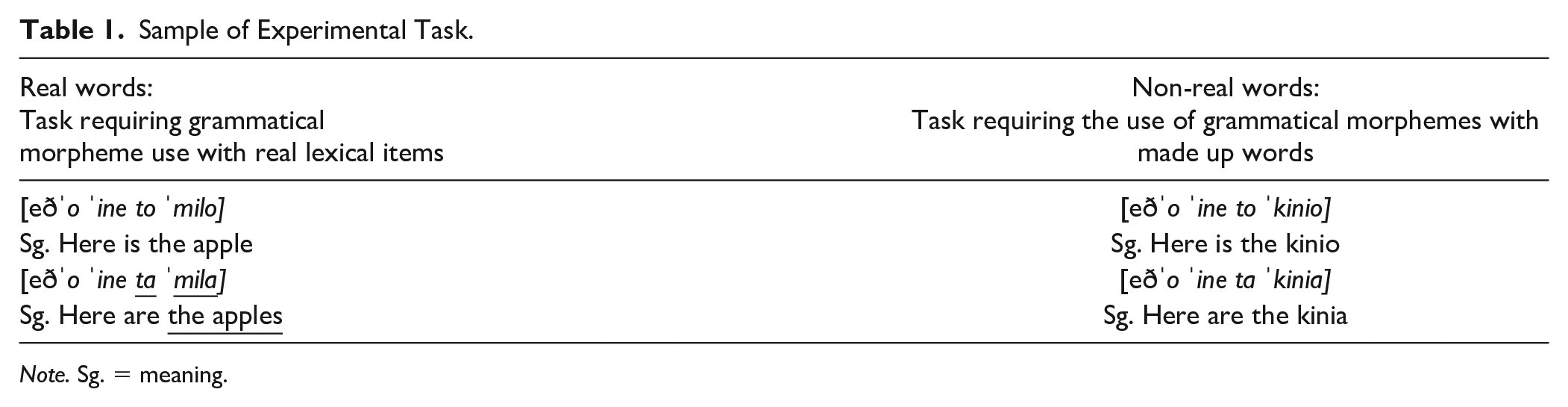
The present study has employed a non-real-word paradigm (Berko, 1958). This was done to test the subject’s ability to use grammatical morphemes with non-real words, as grammatical morpheme use with non-real words cannot be attributed to rote learning. The children were encouraged to provide the correct plural inflection when presented with cartier targets in the singular form (i.e., “Here you have one [γupi]”). “Here there are______ target → ]γupia]”). The researchers presented each child with a book containing the targets depicted on black-white line drawings. Stimuli included a total of 148 items, 97 familiar and 51 unfamiliar/novel targets, which were distributed across the three SMG genders and were constructed according to Greek phonotactic rules, but the words were nonexistent. Usually, the initial and middle phoneme was changed from a real word to a non-real word (e.g., [ˈmelisa] Sg bee → [ˈmekasa] with a novel item depicting an amusing looking figure). This was done to ensure that the children’s phonological abilities were not obstacles to the use of grammatical morphemes of interest. In addition, all subjects scored over 80% on a picture naming articulation test requiring them to produce final consonants in monomorphemic words, such as [eˈmis] Sg → /us/, and [petaˈluðes] pl → /butterflies/. Table 1 displays a sample of the experimental tasks used for the needs of the study.
Sample of Experimental Task.
Note. Sg. = meaning.
Response Coding System
Each session was audio recorded and phonetically transcribed verbatim using the International Phonetic Alphabet (1999). The targets, based on a sample from four children, were 100% for real words and 88% for non-real words. All subjects completed all test items. In cases where there were spontaneous changes in the subjects’ initial response, the second response was scored:
Error patterns were coded based on the following criteria:
Omission of inflection (bare stem) resulting in lack of pluralization.
Substitution of the target inflection.
No response.
Neologistic responses (a nonsense word that does not correspond to the real target).
Substitution of unfamiliar with a familiar target.
Final consonant deletion and stress change.
The coding was completed by the first author and was through the use of guidelines provided by the International Phonetics Association (1999). The transcription was completed for all the sessions across all speech samples for all children. The reliability was performed by a research assistant transcribed phonetically over 10% of randomly selected samples. Reliability on the relevant phonetic categories was based on the number of agreements divided by agreements plus disagreements after the two coders had jointly listened to the tapes and had compared their transcriptions with regard to place and manner of articulation. Disagreements were resolved by discussion. Inter-rater transcription reliability for all productive suffixes was 80%.
Results
The dependent variable was the proportion of errors observed within each experimental paradigm (familiar vs. non-real-word task) across all children. Proportions were transformed to arcsines before the statistical analyses were employed. A three-way analysis of variance (ANOVA) was performed with the groups (DLD vs. TD) as the between-subject variable and task (REAL WORDS vs. NON-REAL WORDS) and noun gender (MASCULINE vs. FEMININE vs. NEUTER) as the within-subject variables. Statistical analyses revealed a group main effect, F(1, 10) = 9.35, p < .01, suggesting that the percentage of errors within the DLD (M = 35, SD = 13) group was significantly larger comparable with the TD group performance (M = 16, SD = 8). A task main effect was also significant indicating that more errors were made on the non-real word (M = 36, SD = 12) versus the familiar word tasks (M = 18.5, SD = 12), F(1, 10) = 39.84, p < .01. The gender main effect also reached statistical significance, with F(2, 20) = 12.85, p < .01. Post hoc Tukey main effect revealed that the fewest errors were made on feminine targets (M = 22, SD = 8) when compared with the masculine (M = 32, SD = 18) and neuter gender (M = 28, SD = 12) word-stimuli targets. The only interaction that reached statistical significance was A word task × gender factor variables, F (2, 20) = 21.13, p < .01, indicating that percentage of errors in all groups increased significantly for the masculine (M = 38, SD = 12) and for the neuter (M = 39, SD = 20) genders, respectively, especially during novel tasks.
The differences between the two groups were quantitative rather than qualitative. Albeit differential performance, both experimental groups made errors across all experimental tasks and across all word targets. However, TD children made less errors overall. It appears from the data that the most difficult task was in completing non-real-word targets especially for neuter and masculine genders with DLD subjects having the poorest performance revealing an order of performance in the form of error responses masculine > neuter > feminine.
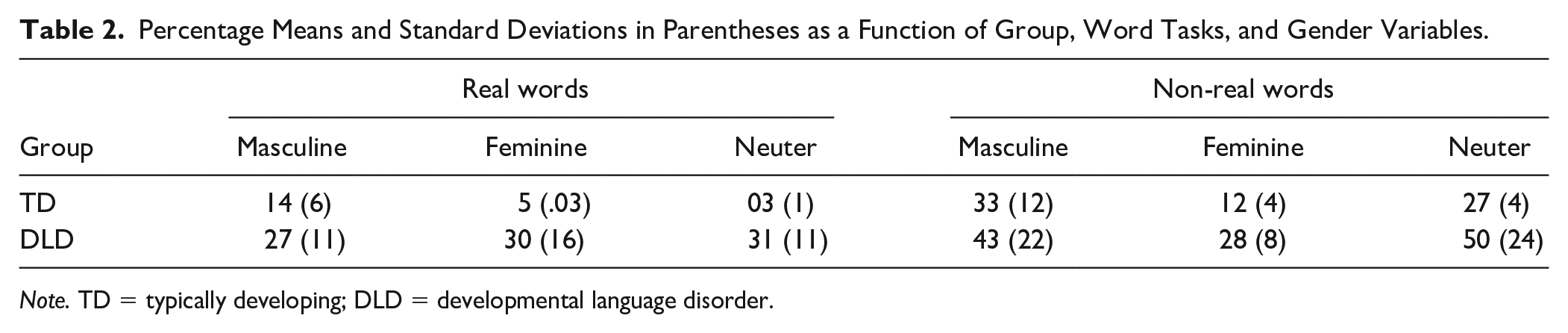
It is important to clarify that a qualitative/descriptive analysis of the data was motivated by the typology of errors, which includes inflectional substitutions, no responses, lack of pluralization, and neologistic forms. Most of the errors observed in this study were in the form of substitutions, meaning that one inflection substituted another, and this was usually the feminine /-es/ used with the highest frequency or the morphophonological stressed inflection /-i/in word-final position (ultimate position). According to the analysis, this was a pattern exhibited by both groups of children on both experimental tasks across all gender targets, although on the novel task the number of errors increased. Along these lines, a phonological salience issue, the only pattern that could be explained and justified by this framework was the difficulty all subjects had when the plural formation paradigm required the addition of a syllable (e.g., [ˈpatoma] (floor) vs. [paˈtom-ata] (floors)). This specific difficulty was remarkable within the DLD group as a function of each task. Particularly, the proportion of errors in the familiar versus the novel task on targets that required an addition of a syllable was 33% and 70% for the DLD group, respectively, and 8% versus 3% for the TD group, respectively. The substitution errors were in the form of vowel stressed < vowel unstressed < vowel-consonant stressed < vowel-consonant unstressed < adding a syllable. Table 2 reports means and standard deviations as a function of group, task, and gender. Participant performance is depicted in Figure 1.
Percentage Means and Standard Deviations in Parentheses as a Function of Group, Word Tasks, and Gender Variables.
Note. TD = typically developing; DLD = developmental language disorder.
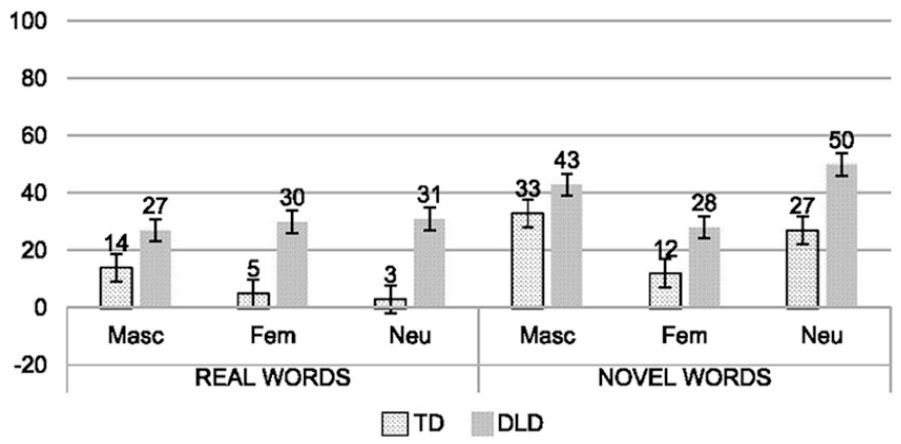
Performance of Groups as a Function of Group, Word Tasks, and Gender Variables.
Discussion
The present study reported on plural suffixation skills via the implementation of a non-real-word paradigm that tackled rule-based formation of noun inflections in children with DLD. Specific hypotheses were advanced vis-à-vis the overarching theoretical framework of LPSH along with the IH, both postulating that the realization of inflectional use by children with DLD is governed by morphophonological saliency inherent in the characteristics of inflections per se. Typically developing children performed better than their chronologically matched DLD peers on the use of phonological inflections. In account of the observed results, a support of the hypothesis advanced was supported. The examiners of the current investigation focused on the understudied dialect of CG with findings serving a twofold purpose: a corroboration to previous reports and a contribution to the existing cross-language DLD databases (Giannikas et al., 2021).
In account of the observed findings, it was revealed that plural suffixation performance was not an all-or-none phenomenon. Both erroneous and correct responses were identified during both experimental tasks. In addition, errors were observed in both groups of preschool children; nonetheless, the proportion of errors was recorded to be higher in the DLD group. Furthermore, in the current research, preschool children with DLD did not present rule-based suffixation skills, a finding contrary to previously reported pattern in Greek-speaking children with DLD (Dalalakis, 1999). In the current investigation, the DLD group rarely showed error patterns in the form of “lack of pluralization” (e.g., providing the singular fowl instead of the plural), a pattern that accounted for less than 3% of the data. In this case, the pattern of performance is best explained from a developmental perspective where the errors observed were similar to what has been documented in the comparable studies focusing on verb inflectional formation in CG-DLD patterns, with findings being in accordance with Mastropavlou et al. (2019) regarding a differential realization of inflectional morphology. It appears that inflectional phonological saliency determines the correct versus erroneous productions such that inflections that are stressed and hold word-final position (stress in ultimate stress position) are the easiest to mark during tasks implementing both a real-word and a non-real-word experimental paradigm. Cypriot-Greek-speaking children with DLD Greek appear to have the most difficulty on word stimuli requiring an unstressed inflection ([ˈanemos] sg. → “wind” vs. [aˈnemi] pl. → “winds”) and/or required the addition of syllable ([ˈpatoma] → Sg. → “floor” versus [paˈtom-ata] → pl. “floors”). Specifically, a profiling of error patterns revealed that both TD and DLD groups faced the most challenges on stimuli that require the addition of a syllable (e.g., [γalaˈtas] sg. → “milkman” vs. [γalaˈtaðes] pl. → “miklmmen”). In addition, more difficulties were revealed in forming targets where the inflection /-ðes/ assumed a morphophonological role, as in the case of [ale’pu-ðes] pl → foxes, as well as on less frequent inflections ([ˈðasos] sg. → “p. → and/or forest” vs. [ˈðasi] pl. → “forests”). In all aforementioned cases, all children, especially DLD subjects, substituted target inflections with a more frequent inflection in the form of a “default” morphophonological item such as /-es/.
The authors have concluded that in present investigation, the CG-speaking youngsters with children with DLD, appeared to have knowledge of plurality formation but skills related to the production of the correct inflection was affected by the morphophonological and statistical properties (frequency) of the given inflectional paradigm used as “compensatory” cues in differential performance (correct vs. incorrect responses). In line with the aforementioned, the authors propose a number of synergistic factors contributing to what determines sparing versus loss of plural suffixation skills in both their TD and DLD participants. Preliminary, such factors include the frequency of the inflection as it is distributed within and between genders. The less frequently an inflection is used, the more children may rely on learning its pluralization via memory. Consequently, the more frequent an inflection, the earlier will be hypothesized by the child or even be used as a “default” in replacing other more linguistically challenging forms (i.e., the word [keˈntim-ata (Sg. laces) is produced as *ˈkentim-es (laces)]). The data suggest that these children follow a delayed rather than a disordered mode of plural suffixation. In fact, this pattern is also reported in other publications regarding the English, Italian, and Dutch language (Boerma et al., 2017; Rice & Oetting, 1993). For example, Oetting and Rice (1993) have suggested that DLD does not present with frequency independence. In their study, they suggest delayed independence of rule use that is governed by inflection frequency, which can be considered an aspect of rule use (i.e., frequency) that chronologically takes longer to develop. Regarding the present study, the results should be considered preliminary and be interpreted with caution due to the limited number of subjects. A more complete picture will be developed in the authors’ further large-scale research, with the addition of a younger language-matched group that will help the researchers delineate whether DLD in this case is a form of language delay or language disorder.
Limitations of the Study
One limitation of this study is the small sample size, a factor that compromises the generalization and robustness of the patterns observed. In addition, the experimental data were not a priori tested on adult populations; thus, the selection of the particular stimuli could potentially have masked real responses such as erroneous production on specific targets, which might have been the result of an inappropriate stimulus selection. Although the responses observed were isomorphic (i.e., particular patterns that were observed in terms of performance) across all members within each group, individual data analyses could have potentially delineated further the effects of particular nouns as a function of gender, number of syllables, and inflectional typology formation. Given the current limitations, the current findings should be considered preliminary and warrant careful interpretation. Had these variables been controlled, more of the variability in performance might have been explained. However, these we used experimental paradigm administered to numerous DLD population as reported in previous studies (Mastropavlou et al., 2019; Petinou and Hadjigeorgiou, 2001). similar to our study described morphophonological compensatory mechanisms engaged by subjects with DLD in accounting for the inflectional variability observed in plural formation.
Clinical Implications and Future Directions
The process of assessing and identifying DLD can be performed via the implementation of standardized language batteries that tackle all linguistic subsystems, including phonology, morphophonology, morphology, morphosyntax, syntax, and semantic and pragmatic aspects. Samples of such can be seen in Hadley and Rice (1996), who used the Peabody Picture Vocabulary Test–Revised, and the expressive subtest of the Reynell Developmental Language Scales (Reynell & Gruber, 1990), which was conducted to evaluate changes in language levels. Nevertheless, in the absence of standardized assessment tools, children can be assessed through nonstandardized language measures that are research-based and are the product of small-scale studies from specific language communities and/or dialectal varieties (Theodorou et al., 2017).
Intervention and assessment of language skills in the Republic of Cyprus are incredibly sparse. Therefore, taking into consideration the international literature on the prevalence of childhood language impairment, it is possible that in Cyprus, given the size of student populations (total of 90,648 students according to the Ministry of Education, Culture, Youth and Sports 2018) approximately 6,345 students might present with childhood DLD (Giannikas et al., 2021). Language intervention with preschool children, despite the early language stage, has great potential as it can change the developmental course of children’s language difficulties and improve long-term language outcomes. Research suggests that there is more fluency in language growth in the preschool years (Bishop & Edmundson, 1987), so the above considerations and evidence of the linguistic background of young children make a strong argument for early detection of language impairments within the Cypriot context. In the context of the current findings, plural suffixation skills from non-real-word against real-word paradigms could potentially serve as sensitive clinical markers in supporting the diagnosis of DLD and in developing specific intervention goals through a hierarchical tackling of specific plural paradigms for which correctness and/or vulnerability is explained by morphophonological and word-level variables. In conclusion, future research should continue to examine the cross-linguistic manifestation of DLD as research findings and theory-motivated research can be translated to clinical settings and eventually can inform evidence-based practice.
Footnotes
Declaration of Conflicting Interests
The author(s) declared no potential conflicts of interest with respect to the research, authorship, and/or publication of this article.
Funding
The current study was supported by grants from the Cyprus Research Promotion Foundation and an Internal Research Grant from the Cyprus University of Technology awarded to the first author.
Ethics
Parents and caregivers of participants were informed about the study and were given and signed a written consent. The study was conducted, complied with guidelines for human subjects’ studies and as these are stated by Cyprus University of Technology Ethics standards and in line with Cyprus National BioEthics Committee.
