




Abstract
The few reports on the language skills of children with attention-deficit/hyperactivity disorder (ADHD) offer conflicting evidence on whether they face significant challenges, and if so, whether these challenges are present in all aspects of language. Here, we investigated a sample of Greek-speaking children with ADHD (n = 29) using a structural language (vocabulary, grammar) and a pragmatic language assessment. To ascertain the extent of strengths and weaknesses, we compared the performance of children with ADHD to typically developing (TD) peers (n = 29) and also to children with developmental language disorder (DLD; n = 25), who face challenges particularly in structural language. As regards structural language, ADHD children performed significantly lower than their TD peers but significantly higher than the DLD group. In pragmatics, ADHD children performed numerically lower than any other group, but differences did not reach statistical significance. Children with ADHD face difficulties with language skills and especially with structural language. Sophisticated linguistic assessment is crucial, as it facilitates the identification of children with different challenges by measuring performances on distinct components. Language difficulties in ADHD should not be overlooked but must be evaluated thoroughly for more effective intervention planning.
Language Development in Children With Attention-Deficit/Hyperactivity Disorder
Attention-deficit/hyperactivity disorder (ADHD) is a neurobiological condition, commencing at childhood, with inattention and/or impulsivity and hyperactivity as predominant characteristics. According to the Diagnostic and Statistical Manual of Mental Disorders (5th ed.; DSM-5; American Psychiatric Association, 2013), children with inattention have difficulty in maintaining attention during activities and following instructions, they avoid tasks that involve persistent mental effort and they are distracted by irrelevant stimuli. Children with hyperactivity/impulsivity often fidget with their hands and feet, talk excessively, and have difficulties waiting for their turn.
The relevant literature suggests that children with ADHD are to some extent challenged in language as well, in structural and pragmatic aspects (Korrel et al., 2017; Staikova et al., 2013). Structural language skills are core language skills and pertain to competence in vocabulary, morphosyntax, and phonology and are required for comprehension and production of well-formed sentences (Reetzke et al., 2015). Pragmatic skills entail using language appropriately in different conversational contexts and social situations (Andrés-Roqueta & Katsos, 2017). They include topic management, understanding non-literal language, constructing narratives, deriving inferences, forming requests, providing information, and using polite register (Matthews et al., 2018). Structural and pragmatic language have been proven vital for academic achievement and employment as well as social and emotional development (St Clair et al., 2011). Moreover, behavioral and academic problems in ADHD may in fact be mediated by language skills (Gremillion & Martel, 2012; Staikova et al., 2013). This further emphasizes the importance of studying the latter.
Nevertheless, difficulties with language are deemed secondary in ADHD research, assessment, and intervention. Although language difficulties have been documented in a number of studies (Helland et al., 2014; Jonsdottir et al., 2005), there is still debate on whether they exist and to what extent (Hawkins et al., 2016; Purvis & Tannock, 1997). The variation in results and the failure to determine a specific association between ADHD and language difficulties can be attributed to various reasons. First, behavioral problems usually attract more attention than language difficulties. Additionally, systematic language evaluation in children with ADHD is not often completed (Camarata & Gibson, 1999). Assessment of ADHD usually relies on parental and teacher ratings, and the scales used contain items that are indicative of problems in language but are not characterized as such. Specifically, behaviors associated with these items are misattributed as symptoms of ADHD. This raises further difficulties in estimating rates of comorbidity between ADHD and language impairment (LI; Mueller & Tomblin, 2012). In other words, it is difficult to conclude whether LI is a distinct condition some children with ADHD face or if the very nature of ADHD entails language difficulty. Finally, pragmatic skills were not evaluated until recently, possibly due to a lack of relevant tests (Westby & Watson, 2021). Yet, recent studies suggest that even with structural language skills intact, children with ADHD may struggle with pragmatics (Hawkins et al., 2016; Helland et al., 2012; Staikova et al., 2013).
Structural language in ADHD
Several studies on the language skills of children with ADHD argue that difficulties in structural language are not a primary feature of ADHD, whereas pragmatic deficits are widespread among the general ADHD population (Cohen et al., 2000; Geurts & Embrechts, 2008). However, on a theoretical level, it can be argued that ADHD-related behaviors can affect structural language development. Inattention and hyperactivity/impulsivity may interrupt early transactions between mother and child. Both conversational partners are likely to abandon the interaction, the child due to inattention and the mother because of the child’s irresponsiveness. Constant interruptions in these early stages of language acquisition could therefore impact the development of grammar and vocabulary (Väisänen et al., 2014).
The relation between language and ADHD has been tackled empirically as well. There is evidence that ADHD is associated with speech and structural language difficulties, with indications that the onset of speech for children with ADHD takes place slightly later than that of typically developing (TD) children (Szatmari et al., 1989). Problems in word articulation have been reported, as well as difficulties in sentence imitation, pointing toward an underdeveloped grammar (Kim & Kaiser, 2000). Children with ADHD have been found to be more likely to produce ungrammatical sentences than TD controls (Engelhardt et al., 2009). Poorer comprehension and verbal intelligence have also been reported (Andreou et al., 2005; Dyck & Piek, 2014).
In a recent review on language problems in ADHD (Korrel et al., 2017), results on semantic measures were contradicting. Some studies report significant differences between ADHD and control groups (Jonsdottir et al., 2005), but others fail to confirm any difference (Purvis & Tannock, 1997). Helland et al. (2014) found equivalent difficulties between an ADHD and a specific language impairment (SLI) group in the semantic scale of the Children’s Communication Checklist-2 (CCC-2; Bishop, 2003), and Gremillion and Martel (2012) found poor receptive and expressive vocabulary skills in ADHD preschoolers. Difficulties in syntax have also been reported (Jonsdottir et al., 2005), but this is not a unanimously accepted finding (Helland et al., 2014). Thereby, there are indications that structural language may be an area of weakness for children with ADHD, but it has not yet been studied sufficiently or appropriately.
Pragmatic language in ADHD
Despite the debate on structural language skills of children with ADHD, a general consensus seems to be developing that pragmatics is indeed a challenging area. Clinical levels of inattention, like being easily distracted and unable to understand instructions and feedback, make it difficult to converse efficiently. Hyperactive behaviors, such as excessive talking and interrupting, negatively affect topic management and can disrupt conversation. Impulsive behaviors, like giving answers before a question is finished, reveal an inability in turn-taking. Therefore, ADHD traits can hinder pragmatic development (Camarata & Gibson, 1999).
Empirical evidence suggests that pragmatics is a challenging area. Children with ADHD perform marginally better than children with autistic spectrum disorder (ASD), who are widely known to face difficulties with pragmatics, “but nevertheless below TD level” (Bishop & Baird, 2001). Particularly low scores have been observed on the scales of inappropriate initiation, stereotyped language, conversational rapport, and social relationships (Geurts & Embrechts, 2008). Inappropriate initiation, coherence, and use of context subscales are also challenging, with a study showing that 82.1% of the ADHD group satisfied the CCC-2 criteria for pragmatic deficiency (Helland et al., 2012).
When more direct means of assessment, such as observation of peer interaction, are employed, children with ADHD are found to be less competent in adjusting conversational behavior to the needs of a task (Clark et al., 1988). In studies measuring pragmatic abilities in natural conversations with adults, children with ADHD often interrupt their interlocutor, fail to respond to questions, and their speech lacks cohesion (Cohen et al., 2000).
Nevertheless, there is evidence that children with ADHD may possess the appropriate pragmatic knowledge but face difficulties in the level of performance. In other words, they may recognize the correct alternative when presented in an experimental setting but are incapable of producing a suitable response in more natural situations (Kim & Kaiser, 2000). Finally, discrepancies in the literature concerning pragmatic skills of children with ADHD may arise due to the breadth of the term “pragmatics.” Andrés-Roqueta and Katsos (2017) have suggested two terms for discussing pragmatics, each one contributing differentially to different types of tasks, and relying on different skills. “Linguistic pragmatics” skills refer to cases where structural language and pragmatic norms (in the sense proposed by Grice, 1975/1989) suffice to succeed in a task and therefore are less reliant on extra-linguistic aptitude. Linguistic-pragmatics skills are required, for example, in informativeness tasks, where children must assess the meaning of scalars (“some” meaning “not all”). Children can complete these tasks successfully as long as they have the relevant vocabulary knowledge and are sensitive to the pragmatic maxim that instructs speakers to avoid being under-informative. The term “social pragmatics,” on the contrary, pertains to circumstances that may require, in addition to structural language and norms of conversation, representation of other people’s intentions or viewpoints; hence they have a strong social dimension and can involve the Theory of Mind (ToM) skills. These are more relevant in tasks involving irony, for example, as in those cases one must attribute a certain belief to the speaker (Happé, 1993).
Studies often fail to make such a distinction when discussing differences between types of pragmatic skills, when this may in fact explain discrepancies in results, as children with different disorders may be challenged disproportionally in the two areas.
Developmental Language Disorder
Developmental language disorder (DLD) is the current term used for children whose primary presentation is that they face exceptional difficulties with language. Their language difficulties impede everyday communication and are unlikely to be resolved by 5 years of age (Bishop et al., 2017). DLD incorporates SLI, which was previously used for language difficulties faced by children in the absence of other neurodevelopmental conditions or impairments.
Children with DLD are primarily challenged in structural language. Deficits in morphosyntax are the most commonly reported finding. Difficulties in morphology were in fact a hallmark for DLD in English-speaking children (Bedore & Leonard, 1998). Syntax also poses challenges. From early on, children with DLD face receptive and expressive difficulties, experiencing an overall delay. At school age, they are less competent than TD peers in understanding complex sentences and use less varied structures (Thordardottir & Weismer, 2002). Weaknesses are evident in semantics, as children with DLD generally demonstrate less lexical diversity in their speech, experience problems in word-finding, and need more exposures for novel word acquisition (Nash & Donaldson, 2005).
Children with DLD may also face difficulties in pragmatics. They struggle in topic management, responsiveness (Bishop et al., 2000), and contingency (Craig & Evans, 1993). Difficulties in narrative construction are also reported, not only in morphosyntactic aspects but in terms of cohesion and inclusion of necessary information (Norbury & Bishop, 2003). Pragmatic competence has been further evaluated in terms of the ability to make inferences. Katsos and colleagues (2011) assessed DLD children’s competence with the pragmatic maxim of informativeness as well as the logical meaning of quantifying expressions. Children with DLD underperformed compared with their TD age-matched (AM) peers but were at approximately the same level as younger, language-matched peers. This indicates that informativeness as well as the logical meaning of quantifiers are both challenging areas for DLD children, but their performance is on par with their overall language difficulties. The results are in line with literature suggesting that structural language areas, that is, morphosyntax, vocabulary, and phonology, are the ones primarily affected in DLD but also illustrate that there is a relation between grammatical and pragmatic competence, as deficits in the former contribute to challenges in the latter. Hence, performance in pragmatic tasks is still reliant on structural language domains, such as semantics and syntax, to the extent that access to pragmatic meaning can only be achieved if basic structural language abilities are intact.
Aim
The dearth of studies comprehensively evaluating language profiles of children with ADHD makes research in this direction imperative. In our study, we aim to thoroughly and directly assess the structural and pragmatic language of children with ADHD and to understand the extent to which children with ADHD are challenged in each type of language, by comparing them to TD and DLD peers. This enables us to ascertain areas of relative strength and weakness by including a group known to face weaknesses in structural language, that is, children with DLD.
Consequently, the research question we pose in this study is how children with ADHD perform in structural and pragmatic language aspects compared to TD children and children with DLD.
Method
Participants
In total, 108 children participated in the study. They were native speakers of Greek, ages 4.02 to 8.15 years. The sample included 29 children with ADHD (18 boys and 11 girls; mean age = 6.58) and 29 AM TD children (19 boys, 10 girls, mean age = 6.60), as well as 25 children with DLD (17 boys, 8 girls, mean age = 6.61) and an additional TD group, specifically AM to the DLD group (16 boys, 9 girls, mean age = 6.61), for the purposes of establishing the extent of any structural language difficulties in our DLD group.
TD participants were randomly selected from mainstream schools across Greece. Regarding non-typical groups, children were indicated by teachers and parents as facing any kind of difficulty, and most of them had a diagnosis by independent diagnostic carriers. Before we included a child in one of the nontypical groups, we implemented our independent screening process. This included the administration of certain standardized tests by trained examiners and/or filling of forms by their teachers (see Measures). All children scored over 85 in a non-verbal IQ measure (Raven-CPM; Sideridis et al., 2015) indicating that they were within the typical range. None of the children had experienced brain injury or sensorimotor problems. Children who were included in the ADHD group presented features of inattention/hyperactivity, according to the ADHD Rating Scale (Kalantzi-Azizi et al., 2012). Children included in the DLD group had low performance (−1.5 SD) on the Expressive Vocabulary Test (Vogindroukas et al., 2009), and they could not be included in another developmental disorder group (based on their performance on tests evaluating ADHD and ASD symptoms).
The aforementioned screening process yielded the groups of interest: TD, ADHD, and DLD.
Procedures
The research program had received approvals from the Greek Ministry of Education and the Institute of Educational Policy in Greece. Schools and parents were asked to sign consent forms in which they were informed about the aim of the study and data use. To analyze data for this study, we were granted ethical approval by Chair’s action of the MML Ethics Committee of the University of Cambridge.
Children were tested individually, within their schools and during school time. The assessment was completed in 3 sessions of 45 min. All the testing was conducted by postgraduate students in psychology or education, who were trained and assessed in administration procedures, to ascertain uniform assessment. Structural and pragmatic language were measured through Logometro, a comprehensive battery of language tests in Greek (Mouzaki et al., 2017), hosted on an Android application for mobile devices (tablets). The touchscreen enabled direct recording of children’s oral responses. Data (language samples) were uploaded to the web-based application for later scoring and analysis. The evaluation process was completed within a week, to avoid the effect of language and cognitive development, which is rapid at this age.
Measures
Screening
Nonverbal reasoning
Nonverbal IQ was evaluated through the Greek standardized version of the Raven-CPM test (Sideridis et al., 2015), which includes 36 trials, divided into 3 sets of increasing difficulty.
Evaluation of ADHD
The ADHD Rating Scales standardized in a Greek student population (Kalantzi-Azizi et al., 2012) was used to detect children with symptoms of inattention and/or hyperactivity. The scale includes two forms, one filled by teachers and one by parents. Each consists of 18 items, based on the ADHD diagnostic criteria of the Diagnostic and Statistical Manual of Mental Disorders (4th ed.; DSM-IV; American Psychiatric Association, 1994). Children who scored more than 85% on inattention or hyperactivity scales, on teacher ratings, were included in the ADHD sample.
Evaluation of DLD
Children of the DLD group scored below the 10th percentile in the Expressive Vocabulary Test (Vogindroukas et al., 2009), with performance equal to 1.5SD below the mean. Children in this group did not meet the criteria for another developmental disorder group (ADHD or ASD).
Testing
Structural language
Vocabulary and Morphosyntax measures were obtained through the Logometro tasks (Mouzaki et al., 2017) described below:
Receptive vocabulary
Children had to select the image that best depicted the word they listened to among four images. For example, when the target was “dolphin,” the following distractors were also presented: pictures of a shark, a whale, and a scooter (phonological distractor as it rhymes with dolphin in Greek). Words were presented in order of increasing difficulty. Children’s responses were scored with 0 or 1. The score amounted to the number of correct responses. The task included 30 items in total but was discontinued after the child made 6 consecutive errors (Cronbach’s α = 0.88).
Expressive vocabulary
Expressive vocabulary was assessed with two different tasks: definition production and naming. In the definition task, children were asked to define the meaning of 28 words, including nouns and verbs. Scoring was done manually, ranging from 0 to 2 points per answer. A proper definition or valid synonym received 2 points, a less accurate description received 1, and answers that were clearly wrong or irrelevant received 0 points (Cronbach’s α = 0.93). In the naming task, children had to name a series of images. The task included 20 items (Cronbach’s α = 0.72) and children’s answers received 0 (wrong answer) or 1 point (correct answer). (For a detailed description of the vocabulary tasks: Diamanti et al., 2017).
Receptive morphosyntax
The first task included 8 items and assessed children’s ability to select the correct inflectional morpheme for verbs. The second consisted of 3 items and involved the same process for nouns. Each item contained an image of one or two characters performing an action. At the same time, two other characters uttered two different sentences using pseudowords, one of which described the displayed scene. Children had to select the character that uttered the sentence that correctly described the picture. Each sentence within a pair contained a critical pseudoword with a different inflectional suffix, either singular or plural (Cronbach’s α = 0.67). For example, in a picture with two turtles taking photographs, the two sentences were “the turtles skeni (3rd SG) photos” and “the turtles skenoun (3rd PL) photos” (the critical pseudoword is shown in italics).
Expressive morphosyntax
Expressive morphosyntax was evaluated through three tasks. The first included 8 items and focused on the production of inflectional morphemes on nouns. The second included 8 items and focused on inflectional morphology of verbs. The third task had 8 items and focused on derivational morphology of nouns and adjectives (Cronbach’s α = 0.88). In the inflectional morphology tasks, children were presented with two pictures, differing in the number of agents or patients of the action illustrated. The description of the first image was presented, containing a pseudoword, either a verb or a noun. Then, the beginning of a second sentence was uttered, describing the second picture. The children had to verbally complete the sentence by changing the number of the pseudoword. For example, the first sentence/picture would be something like “Turtle plays with zagon” (pseudoword for wagon), and the second one would be “Turtle plays with . . .” requiring “zagons.” In the derivational morphemes task, children were presented with a picture and listened to a sentence with a critical word and the first part of a second sentence with a different syntactic structure. To complete it, children had to use the appropriate derivational morpheme. For example, the first sentence would be “The sea deepens” and then the second one would be “The sea is . . .” requiring “deep.” (For a detailed description of the morphosyntax tasks: Diamanti et al., 2017, 2018).
In general, morphological acquisition in TD Greek children is mostly achieved by the beginning of primary school (Diamanti et al., 2018). Grammatical gender is acquired early (Tsimpli & Hulk, 2013), as are case and number for adjectives and nouns, and person and number for verbs (Mastropavlou, 2006). The verb aspect is more challenging (Varlokosta & Nerantzini, 2015). Morphological awareness of inflectional processes is usually developed by the first school years, while derivational processes take slightly longer (Diamanti et al., 2018).
Language composite
The four aforementioned language measures were combined into one Language Composite (LC) score. The score for each measure was transformed into a percentage. When combined into the LC, each measure accounted for one quarter of the composite score. Measures were statistically significantly correlated within the sample, 5 of the correlations >0.53 and the correlation of Receptive Vocabulary–Receptive Morphosyntax > 0.44 (p < .001).
Pragmatic language
Children’s pragmatic skills were evaluated via a pragmatic task from the Logometro battery (Mouzaki et al., 2017). Children were asked to produce suitable responses to 21 questions accompanying 11 illustrated scenarios. The items were validated during an extensive pilot and aimed to assess the following pragmatic aspects: (a) comprehension of the communicative situation (context interpretation: initiating and participating in interaction, joining a conversation); (b) ability to communicate (communicative intent: forming requests, rejecting, greeting, giving information); and (c) interactional skills related to the context (response to context: gaining someone’s attention, interest in interaction, understanding gestures, understanding speaker’s intentions and negotiation; Cronbach’s α = .81).
Children were familiarized with the task by responding to three example questions and receiving feedback. Children’s answers were scored with 1 to 7 points for each of the main aspects, depending on quality and richness. Specific criteria for scoring each item were established. For example, in a scenario with a happy child sitting on the only available swing and two sad children looking at him, one of the related questions was “What should the children say to the boy in order to swing as well?” Criteria used to assess responses include understanding speakers’ intention (i.e., children are requesting something), request for a specific reaction (e.g., for the child to get off the swing), politeness/kindness (e.g., use of the word “please”), expression of feelings (e.g., we are sad that we cannot swing too), and so on. (For a more detailed description of the task, see Mouzaki et al., 2020).
In this study, we were interested in linguistic rather than social pragmatics, that is pragmatic aspects pertaining to language and not to other elements, such as ToM skills for example (Andrés-Roqueta & Katsos, 2017). We therefore chose to include Request, Informativity, and Politeness and only calculated points for these pragmatic aspects. Specifically, we focused on children’s ability to form requests for action, help, and information. With the term “informativity” we mean children’s ability to provide adequate information (in terms of both quantity and quality) about a certain event. Politeness was evaluated based on the use of appropriate lexical markers.
Pragmatic composite
We therefore constructed a pragmatic composite score. In items assessing Request, children received a point when they formed any kind of request, direct or indirect. For Informativity, children would receive a point were they to provide a piece of information related to the depicted event, covering the interlocutor’s communicative needs. To receive a point for Politeness, they had to employ explicit lexical markers for politeness, that is, use phrases like “thank you,” “you’re welcome,” “sorry,” and so on. Three distinct percentages were created for Informativity, Request, and Politeness. These were in turn summed up and divided by three to create a mean PC score. The range of scores was 0 to 100.
Results
We performed analysis of variance (ANOVA) and pairwise comparisons with t tests to explore differences in the structural and pragmatic language skills of children with ADHD in comparison to TD and DLD peers.
Our main comparison included the ADHD group, a TD group specifically age-matched to ADHD (TD-AM-ADHD), and the DLD group, whose age did not differ significantly either (p = .36). When the normality criteria were not met, parametric tests were employed. For Age, Mann–Whitney U and Kruskal–Wallis H p values are reported (see Table 2). This analysis was core in answering our research question which was to comprehensively assess the structural and pragmatic language skills of children with ADHD in comparison to the skills of TD and DLD children.
We also conducted a secondary analysis to establish that the DLD group indeed faced challenges with structural language, as measured by the LC score, and thus further support the results from our three-way comparison. This simply involved a comparison between our DLD group and an explicitly age-matched TD group (TD-AM-DLD).
ADHD vs. DLD vs. AM-TD Participants (TD-AM-ADHD)
A 2 × 3 Mixed ANOVA with language skill (two levels: structural language [LC] vs. pragmatics [PC]) as a within-subjects factor and group (ADHD vs. DLD vs. TD) as a between-subjects factor revealed a significant main effect of group, F(2, 80) = 1,013.240, p < .001, ηp2 = 0.224, and a significant interaction between language skill and group, F(2, 80) = 12.737, p < .001, ηp2 = 0.242 (see Figure 1). Note that because structural and pragmatic language are measured in different scales, and moreover because we selected only a subset of the pragmatic assessment of the Logometro battery, whereas we used the whole structural language assessment, we do not explore whether there is a main effect of language skill. Nevertheless, this does not prohibit us from drawing conclusions about strengths or weaknesses in LC or PC, because we can meaningfully compare the ADHD group’s performance in one or the other language skill to that of their TD or DLD peers.
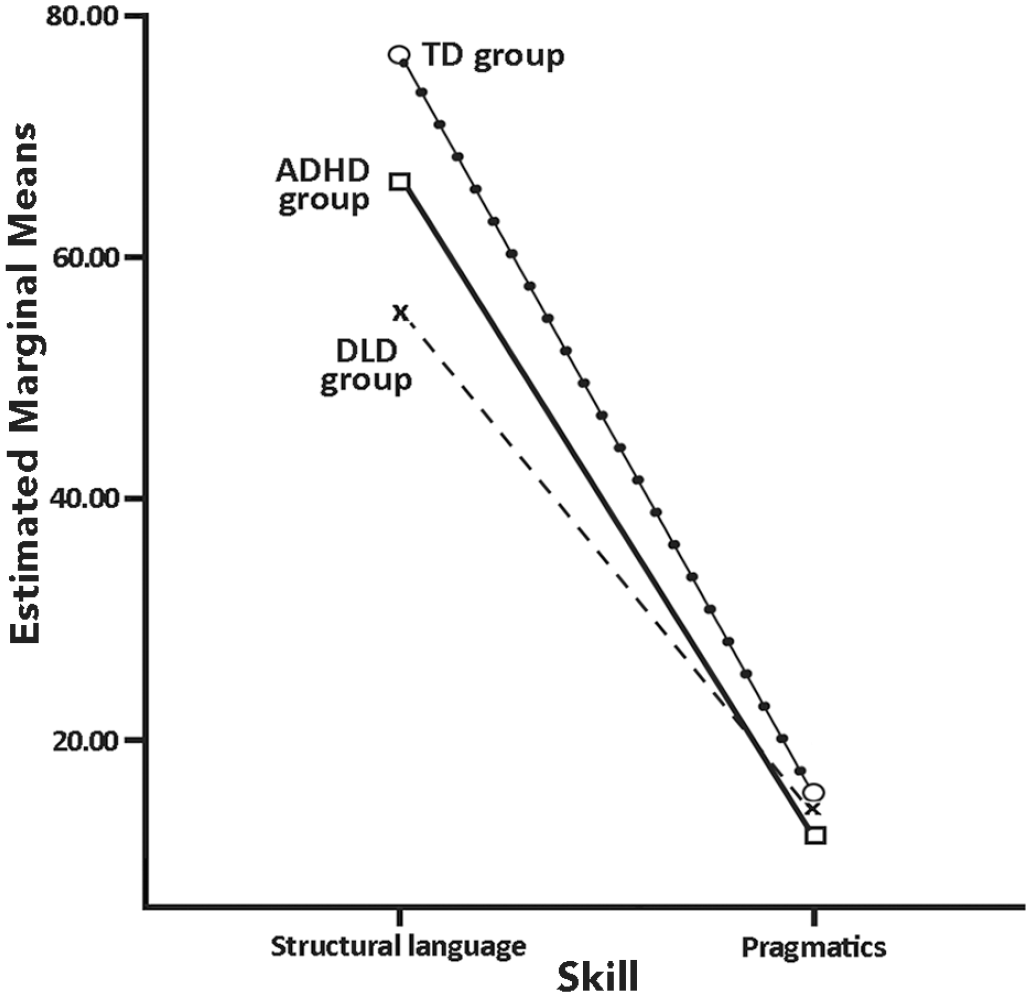
Interaction of language skill (structural—pragmatic language) and group (ADHD vs. DLD vs. TD-AM-ADHD).
The interaction was further investigated with an omnibus ANOVA and pairwise comparisons. There was a significant main effect of group on LC, F(2, 80) = 15.21, p < .001. The TD group performed significantly higher than the ADHD group, t(56) = 3.1503, p = .0026 (and this was the case for the average LC score, as well as for all individual LC components, except for Expressive Morphosyntax; see Table 1). The ADHD group in turn performed significantly higher than the DLD group, t(52) = 2.6264, p = .0113. However, the omnibus ANOVA on PC did not reach significance (p > .2). Pairwise comparisons revealed that the TD group’s score on the PC did not differ significantly from the DLD group’s score, t(52) = 0.54, p = .592, while it tended to approach significance over the ADHD group’s score, t(56) = 1.8016, p = .077 (see Table 2 for the overall comparisons). Based on the current data, observed differences between the TD and either clinical group on the pragmatic score were in the small to moderate range, Cohen’s d =.15 (DLD) and .47 (ADHD).
Age-Matched Comparisons (ADHD vs. TD) on RV, EV, RM, EM.
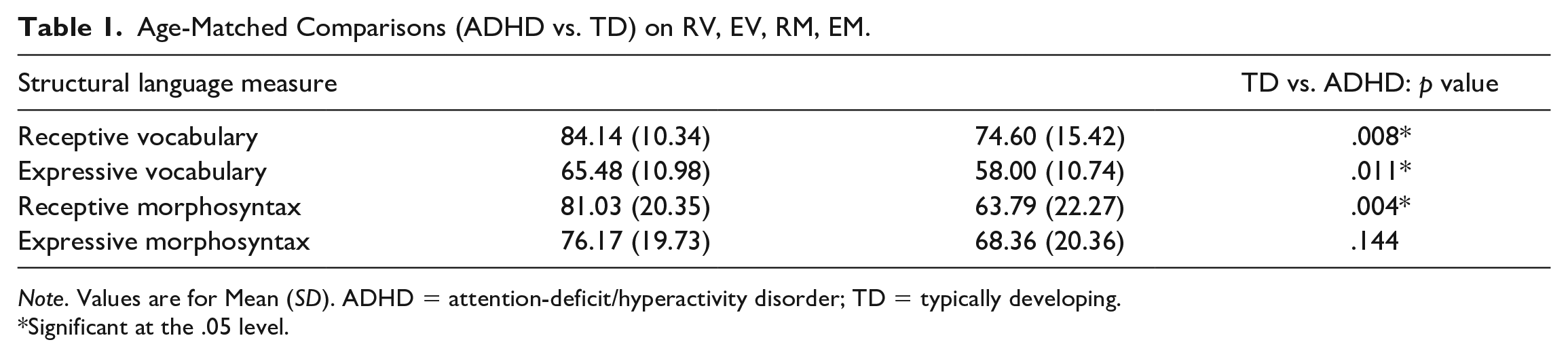
Note. Values are for Mean (SD). ADHD = attention-deficit/hyperactivity disorder; TD = typically developing
Significant at the .05 level.
Age-Matched Pairwise Comparisons (ADHD vs. DLD vs. TD-AM-ADHD).
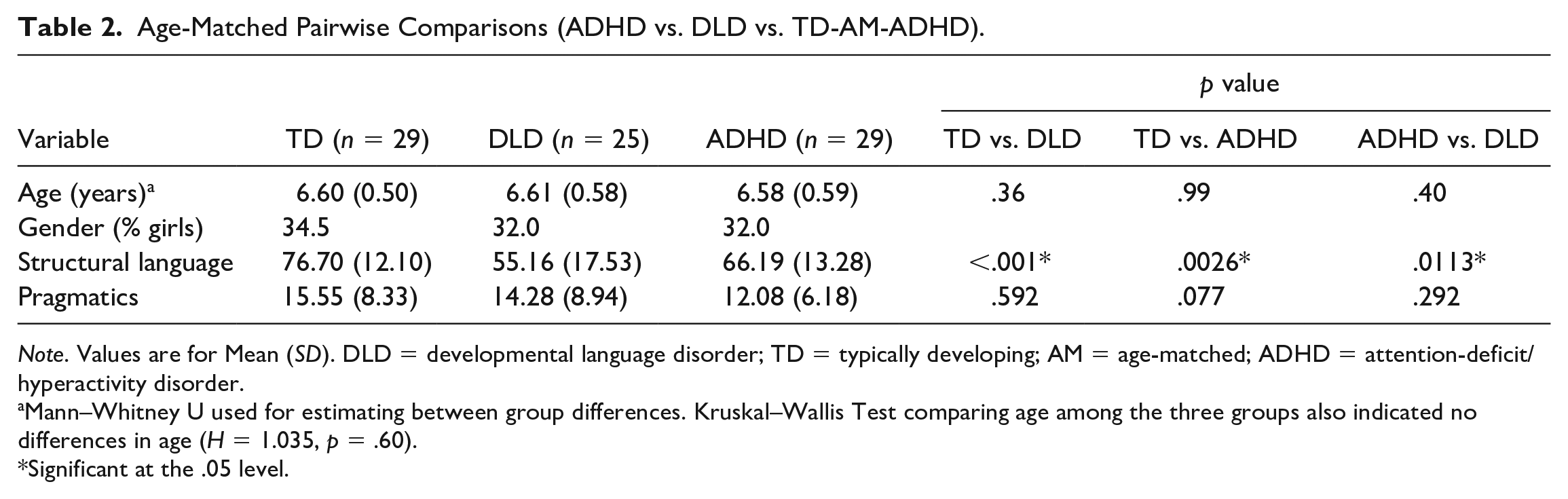
Note. Values are for Mean (SD). DLD = developmental language disorder; TD = typically developing; AM = age-matched; ADHD = attention-deficit/hyperactivity disorder.
Mann–Whitney U used for estimating between group differences. Kruskal–Wallis Test comparing age among the three groups also indicated no differences in age (H = 1.035, p = .60).
Significant at the .05 level.
DLD vs. AM-TD participants (TD-AM-DLD)
As the TD group used in the main three-way analysis was AM to the ADHD group instead of the DLD group (even though it did not differ significantly from the DLD group in terms of age), we conducted this secondary analysis including a TD-AM-DLD to confirm the pattern we saw in our main analysis.
A 2 × 2 Mixed ANOVA with language skill (LC vs. PC) as a within-subjects factor and group (DLD vs. TD) as a between-subjects factor revealed a significant main effect of group, F(1, 48) = 20.388, p < .001, ηp2 = 0.298, with the AM-TD group outperforming the DLD group, and a significant interaction between skill and group, F(1, 48) = 16.25, p < .001, ηp2 = 0.253 (see Figure 2). To explore the interaction, we ran planned pairwise comparisons which indicated that differences in LC between groups were significant (p < .001; for the average LC score, as they were for all individual LC components; see Table 3). However, differences in PC between groups did not reach significance (p = .29). This corroborates the findings emerging from our main analysis.
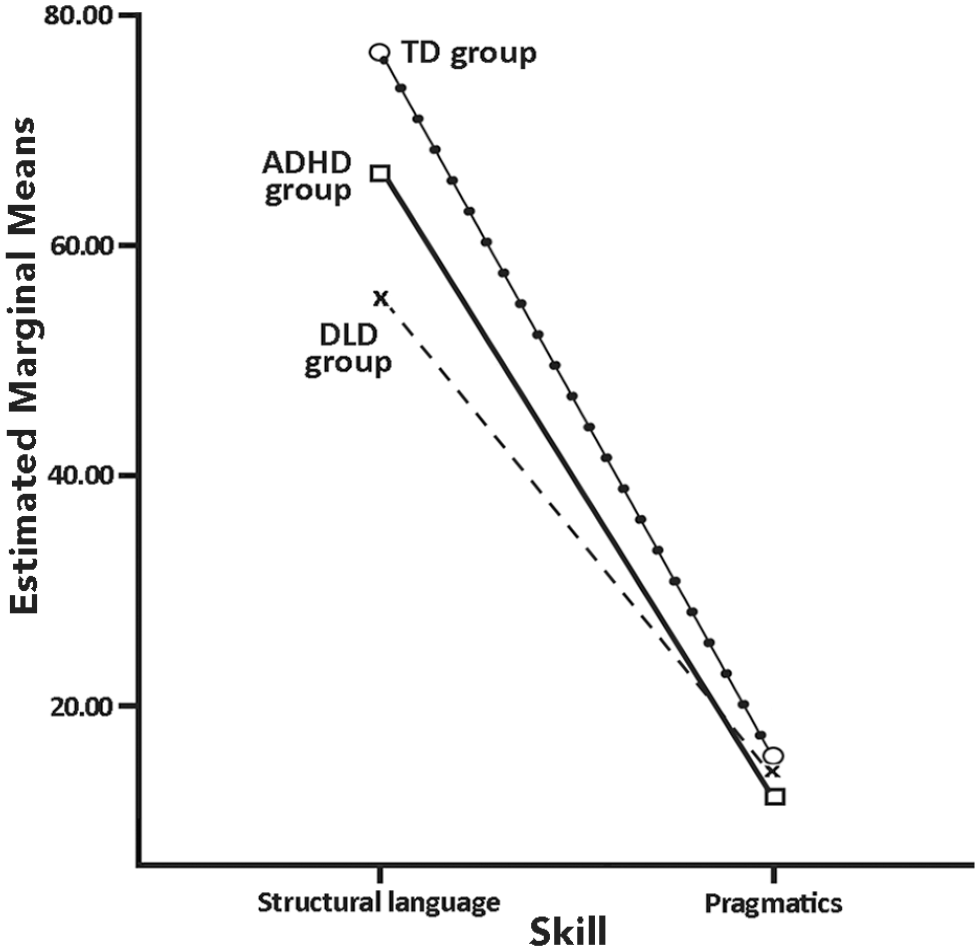
Interaction of language skill (structural—pragmatic language) and group (DLD vs. TD-AM-DLD).
Age-Matched Comparisons (DLD vs. TD) on RV, EV, RM, EM.
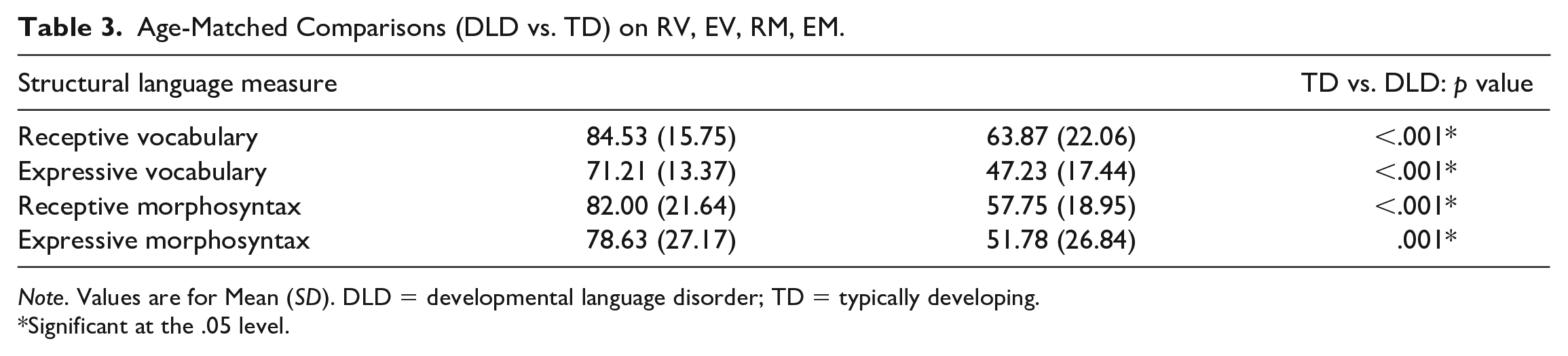
Note. Values are for Mean (SD). DLD = developmental language disorder; TD = typically developing.
Significant at the .05 level.
In sum, our results indicate that in structural language the TD group (as represented by the AM-TD-ADHD group) performed significantly higher than both the ADHD and the DLD groups, and the ADHD group performed significantly higher than the DLD group. As regards pragmatic skills, the groups did not differ significantly from each other; however, there was a tendency for the AM-TD group to perform higher than the ADHD group (p = .077).
Discussion
We examined the structural and pragmatic language skills of children with ADHD, DLD, and their TD peers to evaluate the language profiles of children with ADHD. Structural language was measured through scores on a LC, consisting of Receptive and Expressive Morphosyntax and Vocabulary. Regarding pragmatic language, the assessment involved three explicit linguistic pragmatic abilities: forming a request, offering adequate information, and using politeness markers. These abilities were selected from a broader task, which extensively evaluated children’s communicative performance. In that sense, performance in these three specific areas is not an indicator of overall pragmatic competence, although these pragmatic skills are essential for effective communication.
Apart from our main analysis, comparing children with ADHD to AM TD controls as well as children with DLD (also matched on age), we performed a secondary one aiming to verify that our DLD group indeed faced substantial structural language difficulties, as reported in the literature, and therefore further back up the findings from our primary analysis. This comparison, which included a TD group specifically matched to the DLD group, corroborated the results of our main study and confirmed that the hallmark for DLD is indeed significant challenges in structural language (Bedore & Leonard, 1998; Nash & Donaldson, 2005). Pragmatic competence, as measured by our Pragmatic Composite, was found equivalent to that of the TD peers.
Overall Comparison of ADHD, DLD, and TD Children
Our main analysis aimed to address our research question and reveal the extent of the difficulties children with ADHD face in language, by using two baselines for comparison: TD children and children with DLD, a group defined by impairment in structural language.
The main effects of group and interaction were significant. The planned pairwise comparisons revealed that the TD group outperformed the other two in language skills. More specifically, when investigating the significant effect of interaction, we found that differences among groups were not the same within both levels of the language skill factor. In structural language, differences were significant in all pairwise comparisons. This resulted in the following ordering: TD children outperformed ADHD children which in turn outperformed their DLD peers. In linguistic pragmatics, the order of performance was not the same: The TD group performed better than the DLD group, which performed better than the ADHD group, although differences between the three groups were not significant in any of the pairwise comparisons. Significance was approached only between the TD and the ADHD groups. Cohen’s d signified a medium-size effect in terms of pragmatics score, revealing a moderate difference between ADHD and TD group.
The slopes of the three lines presented in Figure 1 are indicative of the trends described earlier. Performance differences are evident in structural language but less obvious in pragmatics. Still, children with DLD, despite impoverished structural language skills, are almost as competent as TD peers in pragmatics and more competent than ADHD children who, in turn, are significantly challenged with structural language but are less impaired than the DLD group. They are however more challenged in pragmatics.
Structural Language Skills in the ADHD Group
Structural language difficulties have not been considered a principal characteristic of children with ADHD, albeit clinical features of ADHD theoretically justify impairment in structural language because attention limitations and hyperactivity traits may negatively impact a child’s early transactions, hindering language acquisition (Väisänen et al., 2014). Furthermore, evidence of structural language difficulties in children with ADHD is not inexistent. Studies report difficulties of varying degrees in semantic and syntactic language aspects. Nonetheless, several studies examining the language skills of children with ADHD report normal levels of structural language and only emphasize problems in pragmatics (Geurts & Embrechts, 2008). It should, however, be noted that in most of the relevant literature, children’s structural language is estimated by reports given by parents and teachers who may tend to disregard or minimize the importance of language difficulties due to the severity of behavioral problems (Kim & Kaiser, 2000). In our study, we used a comprehensive battery of direct child assessments which involved in-person testing and included measures of vocabulary and morphosyntax. This allowed us to detect difficulties in language that other studies may have failed to report.
There are studies reporting comorbidity of LI and ADHD in 50% of the ADHD population (Mueller & Tomblin, 2012). Children with “comorbid LI” are included in some of the previous literature. In such studies, structural language difficulties are obviously reported (Cohen et al., 2000). However, “comorbidity” implies that difficulties observed in the ADHD population are the same as those faced by children with DLD. This assumption has not been thoroughly examined in our article, as it requires a careful investigation of the errors children make. Our three-party comparison among ADHD, DLD, and TD groups sheds light on this issue and is further discussed in the next sections.
Pragmatic Language Skills in the ADHD Group
As mentioned, differences between ADHD children and TD peers in the pragmatic LC score approached significance. Previous studies on ADHD children’s pragmatic skills generally focus on their conversational skills, so reported weaknesses are in topic management, conversational rapport, and speech coherence. Assessment mostly relies on parent and teacher reports (Bishop & Baird, 2001), yet observation in natural settings yields similar results: excessive talking, interruptions, and unsuitable responses (Clark et al., 1988).
When pragmatic competence is evaluated with standardized tests in experimental settings, results are somewhat different. The divergence between TD and ADHD groups is more subtle, possibly because the instructions are explicit and children have distinct alternatives (Kim & Kaiser, 2000). Children in our study were assessed in an experimental setting. Responses were collected based on specific scenarios. Such replies should not be considered authentic communication, as the child was directed to a certain extent. Nevertheless, children’s responses were formed spontaneously, as they alone formed requests, used politeness markers, and offered information. An experimental setting may reveal that, while children with ADHD face difficulties in performance, on the level of knowledge, differences from TD peers are not as pronounced (Bignell & Cain, 2007) and that is corroborated by our findings. Additionally, our study focused on a subset of linguistic pragmatics, rather than evaluating broader pragmatic skills which entail extra-linguistic, social skills. Therefore, differences may have been more profound had we included such measures (Hawkins et al., 2016), and the conclusions we draw from this study are specific to linguistic pragmatics, a subset of pragmatic skills that is related to observing norms of conversation (Andrés-Roqueta & Katsos, 2017, following Grice, 1975/1989).
The Issue of Comorbidity
Our three-way comparison allowed us to evaluate the language ability of children with ADHD as compared with two control groups. Our methodological process enabled us to entertain a new understanding of the ADHD phenotype, as regards language ability.
Specifically, children were included in the ADHD group based on their scores on inattention and hyperactivity scales; thus, the group consisted of children presenting typical ADHD behaviors. Additionally, participating children’s structural language ability was directly assessed through various tasks, evaluating expressive and receptive grammar and vocabulary. Structural language in most of the current literature is rarely measured as extensively and is usually estimated based on parent or teacher ratings. Our comprehensive battery helped reveal differences in structural language between the ADHD children and the two other groups.
By including both TD and DLD control groups in our analysis, we were able to quantitatively estimate ADHD children’s areas of relative strength and weakness. Our findings show that while both DLD and ADHD groups face difficulties in structural language compared with TD peers, these difficulties are not quantitatively the same, as the DLD group had significantly lower scores in structural language aspects.
This finding is linked to the issue of comorbidity. We cannot safely conclude whether the existence of a structural language deficiency in the ADHD group is indicative of comorbid LI (or DLD). This would require a thorough qualitative and quantitative assessment. Our findings do allow us to quantitatively assess the degree of severity: Difficulties in children with ADHD are not as pronounced as in children with DLD. We cannot however say whether the difficulties are qualitatively similar and only differ in degree of severity. Future research should aim to identify the qualitative characteristics of structural LI in children with ADHD. Only then should we refer to ADHD children’s structural language difficulties as “comorbid LI/DLD” and children with ADHD may be included in DLD groups only after going through extensive screening of language ability. This will help to further understand the nature of ADHD and whether the disorder actually entails some form of language deficiency. In our study, while language skills of children with ADHD were extensively assessed at the testing phase, they did not receive an initial evaluation with the Expressive Vocabulary Test (Vogindroukas et al., 2009) during the screening phase, as did children with DLD.
Taking a broader look at the differences between ADHD and DLD groups, it is worth noting that both performed significantly lower than the TD peers in structural language, and none performed significantly lower in pragmatic language. This is an important finding because it indicates that differences between the two groups are not likely to be easily detectable by the non-specialist observer. A parent or even a non-specialist professional (such as a trainee teacher) may be unable to distinguish children with ADHD from children with DLD based on their linguistic skills. Moreover, given that children with DLD are often inattentive in classrooms because they are unable to follow the curriculum due to poor language understanding, the two profiles may be hard to distinguish overall. Sophisticated linguistic assessment is crucial as it facilitates the identification of children with different challenges by relying on relative performances on distinct linguistic components.
Finally, it could be argued that our study contradicts previous research which suggests that impairments in formal aspects of language are not as strongly associated with the ADHD phenotype as are weaknesses in pragmatics (Hawkins et al., 2016). Nevertheless, our findings are in line with reports of structural language difficulties in ADHD (Gremillion & Martel, 2012; Helland et al., 2014; Jonsdottir et al., 2005). In addition, we are not claiming that the prominent feature of ADHD symptomatology is weakness in structural language. Our analyses showed that the problem is not as extensive as that of children with DLD. We did however find that it is a challenging area for children with ADHD as well. Importantly, our results pertain to linguistic-pragmatics only, a subset of pragmatic skills related to observing norms of conversation (Andrés-Roqueta & Katsos, 2017, following Grice, 1975/1989). This aspect of pragmatics has not been investigated by direct experimentation to date. It is of course possible that had we also assessed a broader range of pragmatic skills, results would have been different.
In sum, we found that children with ADHD exhibit substantial difficulties in structural language when compared with TD peers yet not as extensive as those faced by a DLD group. Children with ADHD performed lower than their TD and DLD peers in linguistic pragmatics, but differences do not reach significance, as they do in broader evaluations of pragmatic and communicative competence. Our findings underline that assessing the language skills of ADHD children comprehensively and by focusing on distinct linguistic components is crucial and would allow for more accurate identification of children with different disorders. It would also be beneficial for tackling behavioral and academic issues (Gremillion & Martel, 2012; Staikova et al., 2013).
Conclusion
Findings from this study offer novel insights into ADHD phenotype in terms of language. Our methodology enabled us to meet our research aims and thoroughly assess the linguistic profiles of children with ADHD by testing them directly with a variety of tasks. We managed to answer our research question and identify the extent of existing language difficulties in children with ADHD by comparing them to TD children and children with DLD. Children with ADHD face difficulties in linguistic pragmatics, but these are not as profound as those reported by other studies on social pragmatics. They also face weaknesses in structural language. These difficulties are not—quantitatively—as severe as those of children with a language disorder. What remains to be explored is whether the challenges are qualitatively similar. In either case, our findings signify that the substantial problems children with ADHD face in language should not be overlooked or considered unimportant. It is imperative that they are taken into account for planning proper interventions. This will also attenuate academic and behavioral problems.
Footnotes
Authors’ Note
Part of the data analyzed for this study were collected in the context of the standardization and validation of the assessment battery Logometro.
Declaration of Conflicting Interests
The language measures reported here form part of a commercially available assessment battery (Logometro, produced by Inte*Learn Multimedia Educational Applications) designed by some of the authors (A. M., F. A., A. R., V. D., and S. P.), who receive part of the proceeds from its use
Funding
The author(s) received no financial support for the research, authorship, and/or publication of this article.
