



Abstract
Background:
The overdose crisis remains a major public health emergency across North America, exacerbated by the presence of highly potent synthetic opioids and disproportionate access to harm reduction resources. To improve engagement with overdose response technology, this study employs a community co-design approach to develop and evaluate naloxone kit-based messaging, aiming to enhance awareness and uptake among people who use substances.
Methods:
An online workshop was conducted with eight participants to generate insights for improving public health messaging and engagement with overdose response technology. Using co-design-based methods and thematic analysis to interpret the results, the study identified several key messaging strategies and refined naloxone kit-based messaging through an iterative design process.
Results:
Participants highlighted a significant gap in public awareness of overdose response technology, particularly outside of harm reduction circles, and emphasized the need for messaging that conveys safety, support, and empathy. Preferred dissemination strategies included social media campaigns, naloxone kit inserts, and partnerships with community organizations, while participants also called for increased public awareness of harm reduction resources.
Conclusion:
This study highlights critical gaps in public awareness of overdose response technology and emphasizes the need for strategic messaging to enhance accessibility. Participants stressed the importance of expanding outreach beyond harm reduction communities, using non-judgmental, supportive language, and leveraging digital and community-based dissemination methods to reach high-risk populations effectively.
Keywords
Background
The overdose crisis remains a public health emergency, with more than 100,000 overdose deaths in the United States in 2021 and similar trends in Canada, largely driven by potent synthetic opioids and an unregulated and unpredictable drug supply. As a result, integrated public health strategies are needed to reduce the significant morbidity and mortality resulting from this epidemic.
Harm reduction measures, including naloxone kits, supervised consumption sites, and more recently, overdose response technologies (ORT), have all been central to these efforts (Humphreys et al., 2022). Since 2012, over 500,000 naloxone kits have been distributed and have saved the lives of tens of thousands of individuals in Canada, aided by free government programs and rural outreach (Canadian Research Initiative in Substance Misuse [CRISM], 2019). Expansion of these programs in the United States could similarly reduce mortality.
Rural communities are found to face higher rates of mortality, likely in part due to fewer harm reduction services. Overdose response technologies (ORT; e.g., National Overdose Response Service or “Safespot” hotline) address this gap by offering anonymous monitoring and more timely EMS dispatch. While effective, rural uptake remains limited among PWUD. One proposed solution is to leverage existing naloxone kit distribution networks to promote ORT.
Community co-design, actively involving people with lived and living experience, can improve engagement and trust in harm reduction programs and foster shared ownership, resilience, and equitable solutions. Our study used co-design strategies to identify the most effective messaging and promotion strategies for ORT.
Methods
A collaborative workshop was held on July 13, 2024, facilitated by two female facilitators with no prior participant relationship. Recruitment used convenience and snowball sampling through networks of the principal investigator, an addiction medicine physician. Eight participants (two People Who Use Drugs (PWUD), two hotline operators, four academics) attended via Zoom for 2 hr. Activities encouraged visual and emotional expression of service perceptions. Data sources included audio/video recordings, field notes, and participant-created materials.
Thematic analysis informed prototype messaging designs, which were iteratively refined with asynchronous participant feedback. Where possible, the COREQ guidelines were used to guide the reporting of the results.
Results
Eight participants of the collaborative co-design workshop, including PWUD, ORT operators, and academics. Results were stratified according to major themes, including current awareness of services and value perception, messaging preferences, and methods for information sharing.
Knowledge and Awareness
Participants reported major gaps in public awareness of ORT. Messaging should emphasize basic functionality, reliability, and its benefits, namely, their accessibility and anonymity. Many at-risk individuals, including those in marginalized or rural communities, remain unaware of these services.
Messaging Preferences
Participants favored messages highlighting safety, empathy, and support, such as “You’re never alone,” and “It’s okay to use. We are with you.” Phrases stressing compassion, lived experience of operators, and confidentiality, “Anonymous, private, and free,” were seen as relatable and stigma-reducing. Participants preferred positive, affirming tones over fear-based messaging. Concepts like “Connection that Cares” and “Rapid, Reliable, Resourceful” were suggested for memorability.
Prototypes
Three different prototypes were suggested, including (1) a non-judgmental tone and text that positions the service as a peer network, (2) a focus on reducing shame and promoting acceptance, and (3) emotional support, accessibility, and availability. Designs used black-and-white elements for clarity, low-light readability, and cost savings. Designs were then recirculated to participants, where a final design was chosen. A QR code was added based on participant feedback to enable access to more detailed information. The final design prototype can be seen in Figure 1.
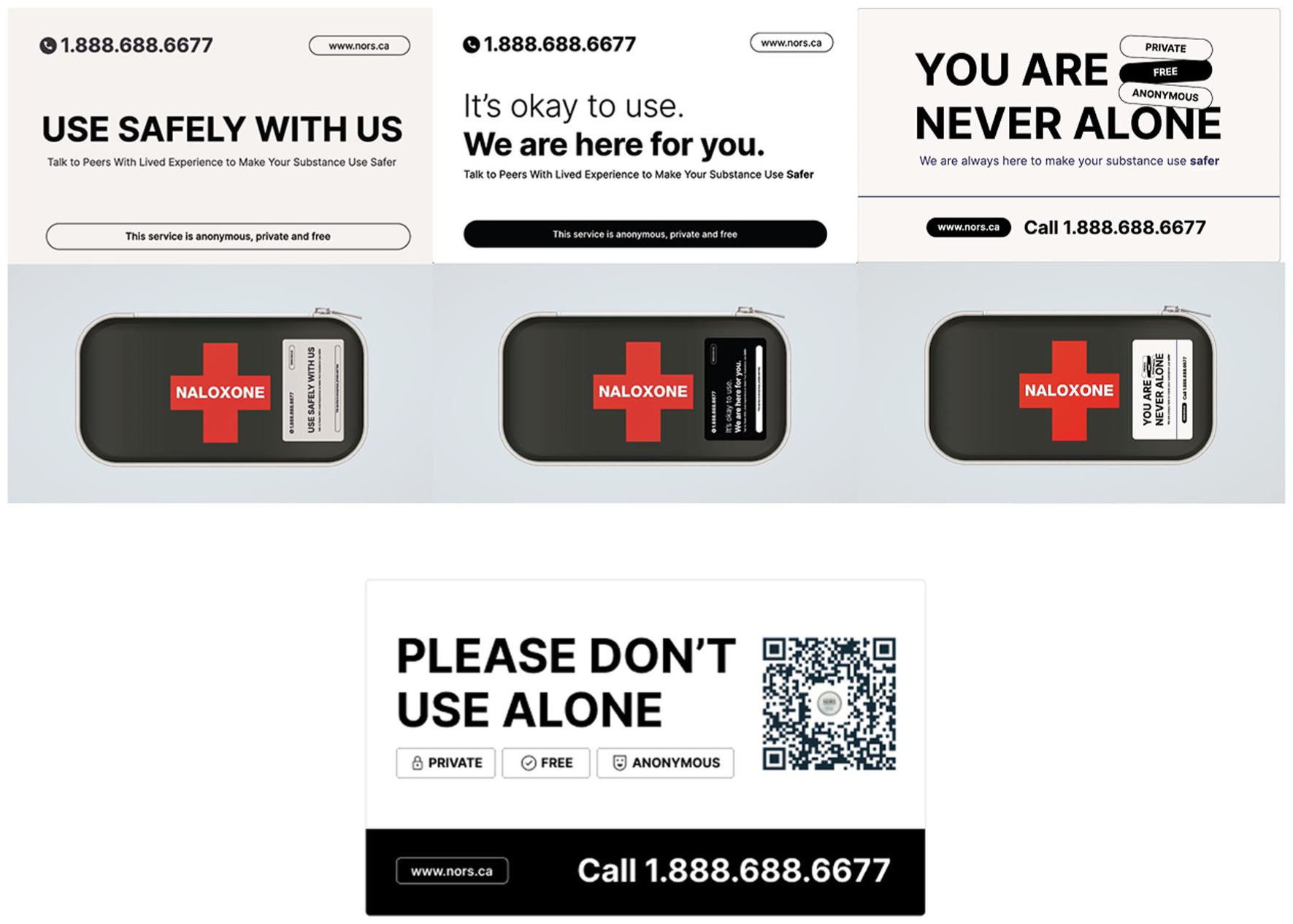
Final Design Prototype
Methods for Information Sharing
Key strategies for information dissemination were also identified and voted upon, with participants preferring social media campaigns (including Facebook, Instagram, TikTok etc.) and naloxone kit-based messaging as methods for knowledge sharing. In addition, identified strategies included using community health services and community organizations.
Discussion
The findings of this collaborative co-design workshop highlight significant gaps in knowledge surrounding ORT and provide key insights into effective dissemination strategies. Participants’ reflections underscore an urgent need for increased awareness and the importance of crafting messaging that is empathetic, informative, and easily accessible.
Knowledge and Awareness
The lack of awareness of ORT mirrors national survey findings (Rider et al., 2025). Limited outreach may fail to convey critical service details, particularly to groups at high risk (including young men, laborers, and rural residents) who face barriers to in-person harm reduction. (Gomes et al., 2022). Messaging should prioritize these groups with clear, accessible information that addresses misconceptions and builds trust through lived experience integration.
Messaging Preferences
Participants’ suggestions for messaging reinforce the need for plain language that is non-judgmental, supportive, and reflective of lived experience. The strong preference for messages emphasizing safety, empathy, and confidentiality suggests that stigma remains a significant barrier to engagement.
Methods for Information Sharing
Key methods for disseminating information indicate a strong preference for digital and community-based outreach. The prioritization of social media aligns with current trends in health communication that leverage online spaces for rapid and widespread knowledge dissemination. The inclusion of naloxone kit-based messaging is a novel approach that leverages an existing harm reduction tool as a vehicle for increasing awareness of ORT and has previously been identified as a potential strategy to provide public health information to PWUD (Safi et al., 2023). Combined with mail-order naloxone kit programs, this strategy may prove additionally effective.
Implications for Policy and Research
Current and future partnerships aim to leverage existing naloxone kit distribution channels to promote widespread dissemination of this service. Future studies will aim to assess the uptake in service resulting from this information dissemination strategy to PWUD, particularly at-risk and underserved populations.
Limitations
The small Canadian participant pool limits the generalizability of our findings. In addition, the convenience/snowball sampling may introduce bias. Finally, a single 2-hr workshop restricted in in-depth discussion and longitudinal assessment.
Conclusion
This workshop revealed substantial gaps in awareness of ORT and provided practical strategies for improving engagement for PWUD and additional awareness among the general public. Messaging that is empathetic and rooted in lived experience is essential for uptake. Integration into existing harm reduction tools, like naloxone kits, in addition to expansion beyond those not engaged in addiction and harm reduction care, could extend reach to high-risk, underserved populations.
Footnotes
Authors’ Note:
The authors declared the following potential conflicts of interest with respect to the research, authorship, and/or publication of this article: S.M.G. is a co-founder of NORS; S.M.G. does not have any financial interest in this work. The remaining authors are not affiliated with NORS or any other mobile overdose response services and certify that they have no competing interests. Every author has approved the final manuscript for submission, and the content of this publication has not been submitted for publication elsewhere. The authors disclosed receipt of the following financial support for the research, authorship, and/or publication of this article: This study was funded by a contribution from Health Canada’s Substance Use and Addictions Program (SUAP Grant ID: 2122-HQ-000021). This study was made possible by funding from the Canadian Institute of Health Research (CIHR FRN:181006) and Grenfell Ministries. The funders had no role in study design, data collection and analysis, decision to publish, or preparation of the manuscript.
