



Abstract
Peer interactions and influence affect adolescent physical activity (PA) and mental health. Social emotional learning (SEL) can be key to adolescent development and well-being. This study aimed to evaluate the ripple effects and preliminary effectiveness of EmpowerHER, an integrated PA and SEL pilot intervention, on changes in adolescent girls’ PA levels and friendship networks during an 8-week summer care program. Adolescents (n=47, ages 10–14 years) wore accelerometers to measure PA and completed surveys on psychological distress, social connectedness, and friendship nominations at the start and end of summer. EmpowerHER consisted of biweekly 90-min PA and SEL skill-building sessions over 4 weeks for 11 girls within this larger sample. Stochastic actor-oriented modeling (SIENA) analyzed selection and influence processes related to changes in PA engagement and socioemotional well-being. Girls participating in EmpowerHER significantly increased their PA levels (b = 1.57, SE = 0.73) and were more likely to send new friendship connections over time (b = 1.71, SE = 0.73). Higher social connectedness was associated with elevated PA (b = 0.31, SE = 0.12) and increased friendship connections (b = 0.39, SE = 0.18) across summer. The overall sample showed significant increases in daily MVPA (mean difference 9.04 min/day, p = .03) and friendship connections (p < .001) from start to end of summer. This exploratory study demonstrated preliminary efficacy of an integrated PA and SEL curriculum implemented through a summer care program. Participation bolstered objective PA levels and improved positive peer dynamics. The findings highlight the potential of holistic interventions addressing multiple aspects of adolescent health and development simultaneously.
Physical activity (PA) provides numerous health benefits for adolescents, including improved cardiovascular fitness, bone health, reduced risk of obesity, and better mental health outcomes (Laurier et al., 2024; Moeini et al., 2021). The 2018 PA Guidelines for Americans recommend that children and adolescents ages 6 to 17 years should engage in at least 60 min per day of moderate-to-vigorous PA (MVPA) and incorporate muscle-strengthening activities at least 3 days per week (Piercy et al., 2018). However, national and international data suggest that girls are significantly less physically active than boys (Aubert et al., 2021). Prior studies have proposed various reasons why girls tend to be less physically active than boys. Research indicates that compared with boys, girls take part in fewer organized sports, may receive less support from others to be physically active, and may find less enjoyment and fun in physical education and PA (Corr et al., 2019). Although PA provides extensive health benefits, most adolescents fail to achieve recommended activity levels necessary to reap these advantages.
Moreover, disparities may worsen over the summer months when school sports and physical education classes cease, denying adolescents key structured outlets for PA. Studies consistently demonstrate decreased MVPA over summer break compared to during the school year (Brazendale, Beets, Weaver, Chandler, et al., 2017; Brazendale, Beets, Weaver, Pate, et al., 2017). This reduction in summer activity coincides with accelerated weight gain, disrupted fitness trajectories, and increased obesity prevalence during summer compared with the school year (Baranowski et al., 2014; von Hippel & Workman, 2016). Structured days filled with physical education and recess get replaced by largely unstructured summer days lacking prompts for activity (Brazendale, Beets, Weaver, Pate, et al., 2017). However, summer care programs through organizations like the Boys & Girls Club and YMCA may help provide much-needed outlets for PA over summer break (Brazendale, Beets, Weaver, Chandler, et al., 2017). These programs give youth access to active play, sports, exercise classes, and outdoor recreation during the summer. In fact, children accumulate nearly 90 min of MVPA on average while attending summer care programs (Brazendale et al., 2020; Brazendale, Beets, Weaver, Chandler, et al., 2017). More specifically, implementing evidence-based PA curricula through summer care programs can not only promote health, but potentially buffer against typical activity declines over summer.
In addition to providing PA opportunities, summer care programs and youth programs aim to facilitate social emotional learning (SEL) critical for healthy development. SEL involves developing key socioemotional competencies like self-awareness, social awareness, responsible decision-making, relationship building, and self-management (Payton et al., 2000). SEL equips youth with essential skills, such as emotional regulation, goal-setting, empathy, relationship building, and responsible decision-making. Enhancing these social-emotional capabilities helps youth navigate complex interpersonal situations and developmental tasks. By focusing on cooperation, empathy, problem solving, and conflict resolution, programs provide tools to avoid peer pressure and recklessness. Such SEL programming facilitates personal growth and cultivates the knowledge, attitudes, and skills necessary for youths to become responsible, caring adults (Payton et al., 2000). Ultimately, promoting social-emotional competencies allows summer programs to fulfill their missions of holistic youth development.
Two prominent elements of SEL are social awareness and interpersonal relationships (Payton et al., 2000). Peer relationships take on heightened importance in adolescence and strongly influence development across social-emotional and physical domains. Through friendships, adolescents garner social support, experiment with identity, achieve autonomy from parents, and develop interpersonal skills (Jiao et al., 2017). Peer interactions shape social norms, model behavior, and reinforce actions through social networks. Consequently, friends become key agents of SEL, transmitting norms around conflict resolution, teamwork, and responsible choices (Jiao et al., 2017). Likewise, studies consistently link higher PA levels among adolescents with having active peers and friends (Prochnow, Delgado, et al., 2020). Beyond modeling active lifestyles directly, friends motivate activity through encouragement, shared interests, invitations to participate, and introducing one another to new activities.
Social network analysis (SNA) offers a valuable framework and set of methods to investigate how peer influence and selection dynamics shape health behaviors, such as PA engagement. SNA focuses on the connections between individuals rather than simply examining personal attributes in isolation (Valente, 2010). Previous research on friendship networks in summer care settings indicates that adolescents viewed as popular tend to be seen as more physically active, and that self-reported PA levels may play a key role in forming new friendships and sustaining relationships throughout the summer months (Prochnow et al., 2021; Prochnow, Patterson, Bridges Hamilton, et al., 2022; Prochnow, Patterson, Umstattd Meyer, et al., 2022; Prochnow, Patterson, et al., 2020). Specifically, these studies used exponential random graph modeling (ERGM) to determine network factors associated with tie formation like popularity, homophily (similarity between friends), and social proximity (Borgatti et al., 2018). While insightful, these past studies relied on self-reported PA and techniques that did not allow for modeling changes in behavior. Longitudinal social network analyses using stochastic actor-oriented models (commonly performed by the R package SIENA; Simulation Investigation for Empirical Network Analysis) provide additional insights into behavioral co-evolution dynamics among friends (Snijders et al., 2010). Actor-oriented models, like the ones calculated in the SIENA framework, can simultaneously model changes in behaviors and friendship networks over time by using a chain of stochastic equations (Snijders et al., 2010). More specifically, these models can estimate peer influence effects, where friends adopt behaviors from one another over time as well as peer selection effects, in which adolescents befriend others who share similar behaviors or characteristics (Snijders et al., 2010).
Considering the vulnerabilities of PA reductions and social isolation over summer, focused programs are needed to promote healthy lifestyles and relationships when school is out. However, a recent systematic review of interventions blending PA and socioemotional instruction highlighted a gap in rigorous evaluations within out-of-school contexts (Jackson, Prochnow, et al., 2024). While school-based initiatives demonstrate overall positive effects on developmental assets, few studies have examined program impacts in summer care programs or the role of peer relationships in driving outcomes. Implementing integrated PA and SEL curricula through community summer programs represents a missed opportunity. Therefore, this paper aims to evaluate the preliminary effectiveness of a combined PA and SEL pilot program designed for adolescent girls (aged 10–14 years) at a summer care program using longitudinal social network modeling.
Method
Participants
Researchers invited all adolescents aged 10 to 14 years (potential n = 57) attending a Boys & Girls Club summer program in central Texas to complete surveys at the beginning (Time 1) and conclusion (Time 2) of the summer, with an 8-week interval between assessments. Surveys were administered by a research assistant using a computer in a separate room during regular program hours to minimize disruption. Parents received information about the study and had the option to withdraw their child at any point without affecting their care or benefits. Before each survey, adolescents were required to provide written assent indicating their willingness to participate.
Girls at the summer care program were also made aware of the SEL and PA pilot program (named EmpowerHER) through an informational session at summer care sign-up, daily announcements, and direct recruitment. All girls in the age group (10–14 years old; potential n = 27) were invited to participate in EmpowerHER but needed parental consent to take part. Girls that did not want to participate in EmpowerHER were able to continue with normal programming at the summer care program. In total, 11 girls were recruited for the pilot program. This study was approved by the Institutional Review Board of the referent University before its start.
EmpowerHER Program
The EmpowerHER program aimed to provide fun, engaging activities to promote PA and socioemotional development among participants. Over the 4-week program held twice weekly, 90-min sessions incorporated emotional, physical, and social components. See Figure 1 for timeline. To start each session, girls participated in emotion check-ins and discussions to facilitate expressiveness within the group. Participants also engaged in reflective dialogue and storytelling throughout activities. Structured physical activities taking place in a gym fostered teamwork, movement, and creative expression. Additional sessions held in a classroom focused on building empathy, relationships, and other social skills. See Table 1 for a brief overview of curriculum components and lessons. A complete explanation of the curriculum and implementation (including process evaluation) can be found elsewhere (Jackson, Brown, et al., 2024). Girls were compensated with a $5 gift card for each session in which they participated.
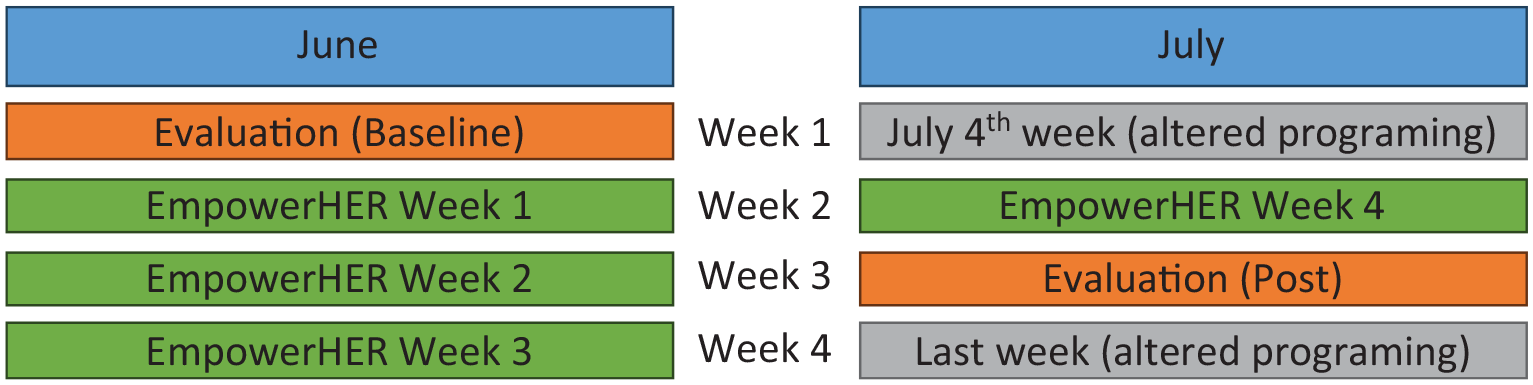
Timeline for Evaluation and EmpowerHER
EmpowerHER Program Overview of Educational Sessions
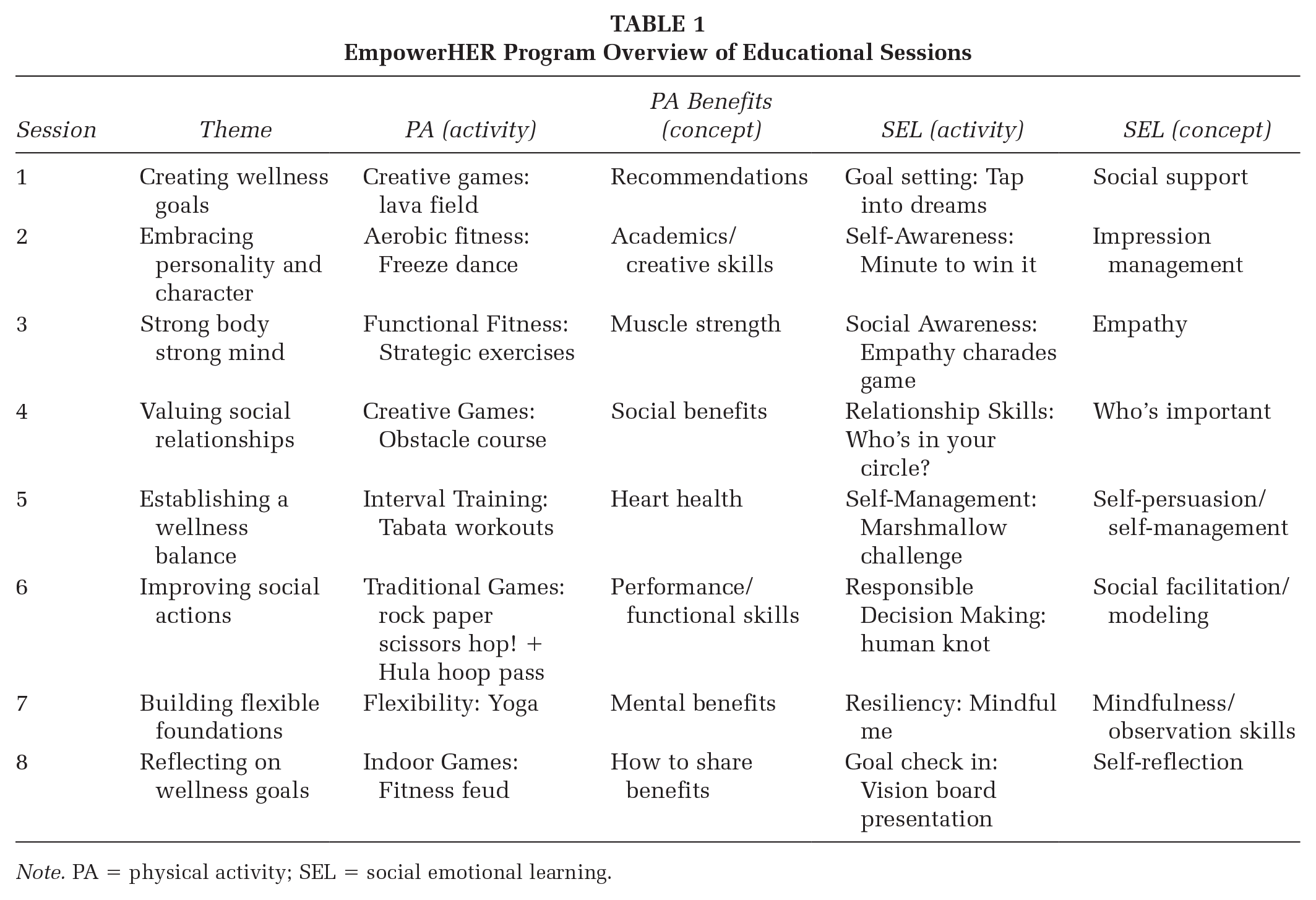
Note. PA = physical activity; SEL = social emotional learning.
Measures
All adolescents (both in and outside of the EmpowerHER program) self-reported age, sex, race, and ethnicity. PA was measured using accelerometers while additional covariates of social network connections, feelings of social connectedness, and mental health were self-reported by the adolescent. Adolescents were also given a dummy code based on whether they participated in the EmpowerHER program or not.
Physical Activity
During the evaluation weeks, participants wore ActiGraph GT9X accelerometers (ActiGraph Corporation, Pensacola FL, USA) on their non-dominant wrist while attending the program. The raw accelerometer data, collected at 30 Hz, was processed using a machine-learned random forest classifier specifically designed and validated for measuring PA in school-aged youth (Chowdhury et al., 2017; Trost et al., 2017). This activity recognition algorithm analyzes features in the raw acceleration signal to identify and quantify time spent in various activities, including sedentary behaviors (sitting or lying down), light-intensity activities, walking, running, and moderate-to-vigorous intensity activities and games (Chowdhury et al., 2017; Trost et al., 2017). More details on machine-learning algorithms and their application to accelerometry can be found in Narayanan et al. (2020). For each adolescent, MVPA was calculated as the sum of daily time spent walking, running, and engaging in moderate-to-vigorous activities and games, and then averaged across all valid wear days to determine their mean daily MVPA.
Social Network Data
Based on a network-generator question used in previous studies investigating adolescent health and social networks in summer care programs, adolescents were asked to report the names of peers with whom they hung around with, talked to, and/or did things with the most at the summer care program (Prochnow et al., 2021; Prochnow, Patterson, Bridges Hamilton, et al., 2022; Prochnow, Patterson, Umstattd Meyer, et al., 2022; Prochnow, Patterson, et al., 2020). Peer nominations were coded as a directed friendship tie (1 = tie, 0 = no tie) for that time point. To be concise, the connections between adolescents will be termed friendships from this point on. Adolescents were provided with a full roster (in the form of a list of names) of all adolescents 10 to 14 years old at the summer care program they could nominate. If an adolescent was enrolled in the program anytime during the summer, they were added to the list for the second time point. There were no limits to the number of names adolescents could report.
Social Connectedness
Social connectedness was used as a proxy for SEL development. An abbreviated version of the Hemingway Measure of Adolescent Connectedness scale (MAC Version 5.5) (Karcher, 2001) was used in this study. The measure includes 20 items such as, “My parents and I get along well” (parent connectedness), “I spend as much time as I can with my friends” (friend and peer connectedness) and “I try to get along with my teachers” (teacher connectedness). Each item is answered on a 5-point Likert-type scale ranging from 1 (not true at all) to 5 (very true). Scores are calculated by summing items. This instrument has good reliability with Cronbach’s alpha ranging from .83 to .89 for the subscales in the adolescent population (Karcher, 2001).
Mental Health
Psychological distress was measured as a covariate because of the co-occurrence of depressive and generalized anxiety symptoms in adolescence and the reciprocal associations between mental health, PA, and SEL (Kessler et al., 2002). Psychological distress was operationalized through the 10-item Kessler Psychological Distress Scale (K-10) (Kessler et al., 2002), a validated and reliable scale (Cronbach’s alpha = .92) (Larzabal-Fernandez et al., 2023). The K-10 assesses non-specific psychological distress based on the frequency in which adolescents endorse symptoms of depression and anxiety over a 30-day period (e.g., In the past 30 days, how often did you feel so nervous that nothing could calm you down) on a 5 point-response scale ranging from 1 (none of the time) to 5 (all of the time). Items are then summed to create a scale score.
Data Analysis
While this is an exploratory analysis and not powered for efficacy, an intention-to-treat model was used for participation in EmpowerHER (Gupta, 2011). In addition, multiple imputation was used to handle missing data which was found to be less than 10% of total data with no discernible pattern of missingness (Lee & Simpson, 2014). Means, standard deviations, frequencies, and percentages for demographics were calculated using SPSS v. 28. Cleaning and management of network data was done using statnet package in R Studio (Hunter et al., 2008).
Stochastic actor-based models were used to determine statistical significance of changes in MVPA, social connectedness, psychological distress, and friendship networks throughout the summer. (Snijders et al., 2010) Stochastic actor-based models provide researchers with the ability to model network change over time as a function of characteristics of the people in the network and of characteristics of relationships between the people in the network (Snijders et al., 2010). The SIENA (Simulation Investigation for Empirical Network Analysis) package provides a useful framework for modeling network evolution as a continual process driven by the structural tendencies and attributes of individuals embedded within the network (Snijders et al., 2010). These statistical models estimate two functions based on the observed network data: (a) the objective function, representing factors that make certain network configurations more or less likely to appear, and (b) the rate function, governing the frequency of network changes. In this study, objective functions were specified to model structural network effects like reciprocity, transitivity, and homophily. Rate functions tied changes in adolescent PA levels, mental health, and feelings of social connectedness to changes in the friendship network structure over time. The combination of these effects models the complex co-evolution of friendships, attitudes, and behaviors among adolescents attending the summer program. The SIENA package moves beyond cross-sectional analyses by estimating peer influence effects where youths in a friendship nominated one another and became more similar over time. Selection effects are also tested based on homophily and popularity, determining patterns driving friendship tie formation and dissolution over the program duration. Dummy codes were used to designate participation in the EmpowerHER program. More specifically, the model determined if girls who participated in the program were more likely to make new friends and be more physically active. SIENA requires dependent variables (in this case MVPA) to be on an ordinal scale. Hence, the continuous MVPA variable was changed to ordinal (1–5 scale) using equal groupings in each ordinal score at time point. The SIENA 4.0 package in R Studio enabled creating, fitting, and testing of these sophisticated stochastic actor-based models given the study’s longitudinal friendship network data (Ripley et al., 2018).
Results
In total, adolescents (n = 47; M = 11.0 years old; SD = 1.3; 51.1% female) reported mild levels of psychological distress (M = 20.33; SD = 8.34) at Time 1, indicating they were “likely to have a mild disorder” on average and low levels of psychological distress (M = 18.82; SD = 7.52) at Time 2, indicating they were “likely to be [psychologically] well.” However, this difference was not statistically significant, t(46) = 0.85, p = .20. Adolescents reported significantly more friendship connections at Time 2 (M = 6.85; SD = 5.77) compared with Time 1 (M = 4.09; SD = 2.83), t(46) = 4.01, p < .001. Pairwise comparisons showed MVPA was significantly higher at the end of summer (M = 62.7, SD = 26.6) compared with the start of summer (M = 53.7, SD = 17.0)—a mean difference of 9.04 min/day. There was a significant main effect for time, F(1,46) = 4.92, p = .03, partial η2 = .06. See Table 2 for more demographic information on the total sample.
Sample Demographics
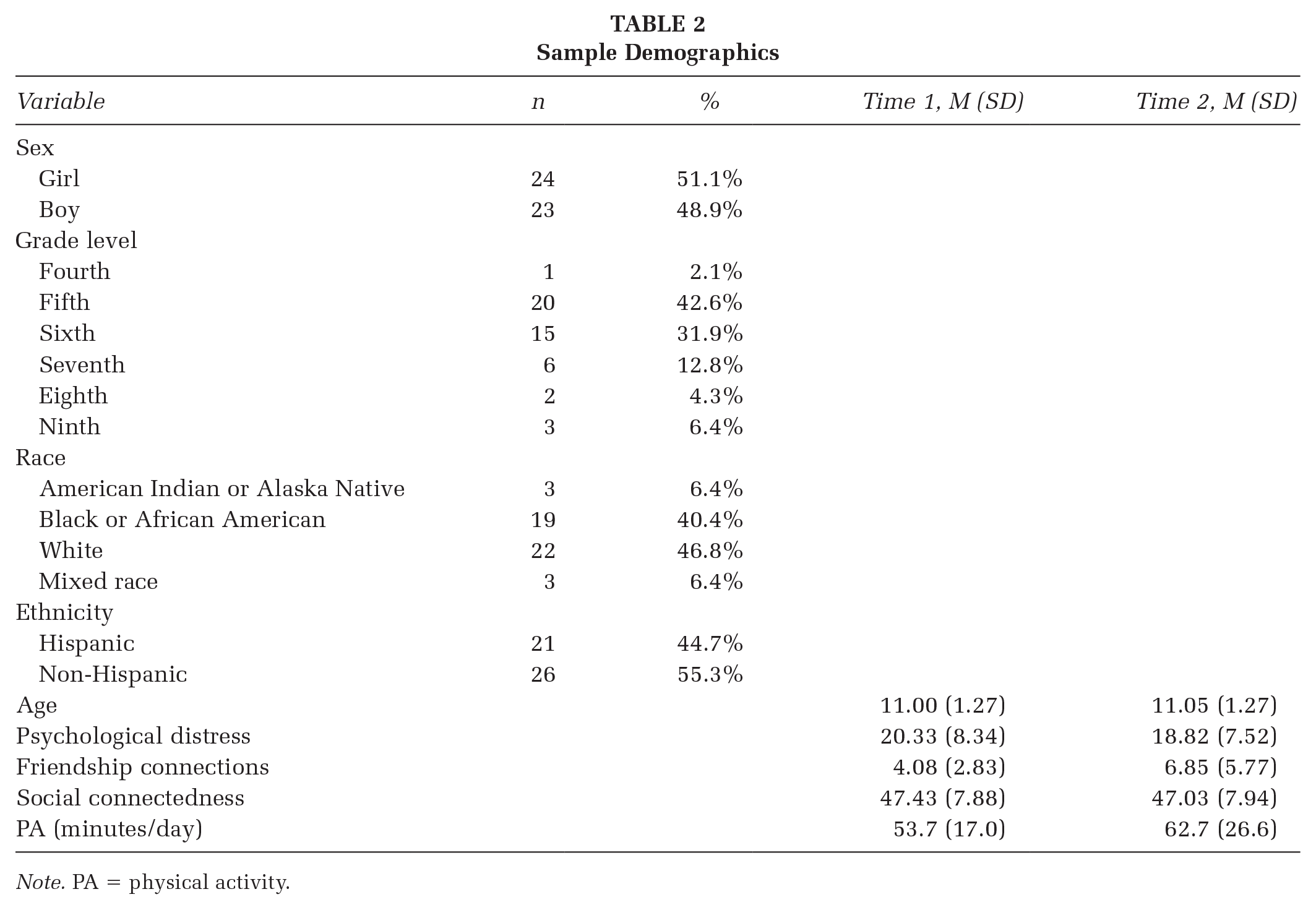
Note. PA = physical activity.
EmpowerHER Participants
Paired t-tests were conducted specifically for girls participating in the program (n = 11; M = 10.73 years old; SD = 1.27). For the social connectedness scores, there was no statistically significant change from pre (M = 50.64, SD = 4.08) to post (M = 47.82, SD = 8.16), t(10) = 1.32, p = .10. The Cohen’s d effect size value of .39 suggests a small to medium effect. For the K10 psychological distress total score, there was a statistically significant decrease from pre (M = 24.91, SD = 10.77) to post (M = 20.45, SD = 10.34), t(10) = 2.20, p = .02. The Cohen’s d effect size value of .664 suggests a medium effect. For minutes of MVPA, there was no statistically significant change from pre (M = 42.20, SD = 11.32) to post (M = 53.22, SD = 24.13), t(10) = −1.24, p = .12. The Cohen’s d effect size value of .39 suggests a small to medium effect. However, due to the sample size and assumption of peer influence, advanced modeling was conducted.
Stochastic-Actor Oriented Model
The stochastic actor-oriented modeling results (see Table 3) reveal several significant dynamics in the friendship networks and peer influence processes over the course of the summer program. Specifically, the positive and significant reciprocity (b = 2.94, SE = 1.45) and popularity (b = 0.29, SE = 0.14) parameters confirm the presence of mutual friendship nominations and preferential attachment to well-connected peers over time. In addition, the positive and significant rate of network change (b = 6.43, SE = 2.86) coupled with negative network density effects signify a high rate of friendship turnover, as connections form and dissolve across the measurement occasions.
SIENA Model Results for Friendships and Physical Activity Across a Summer
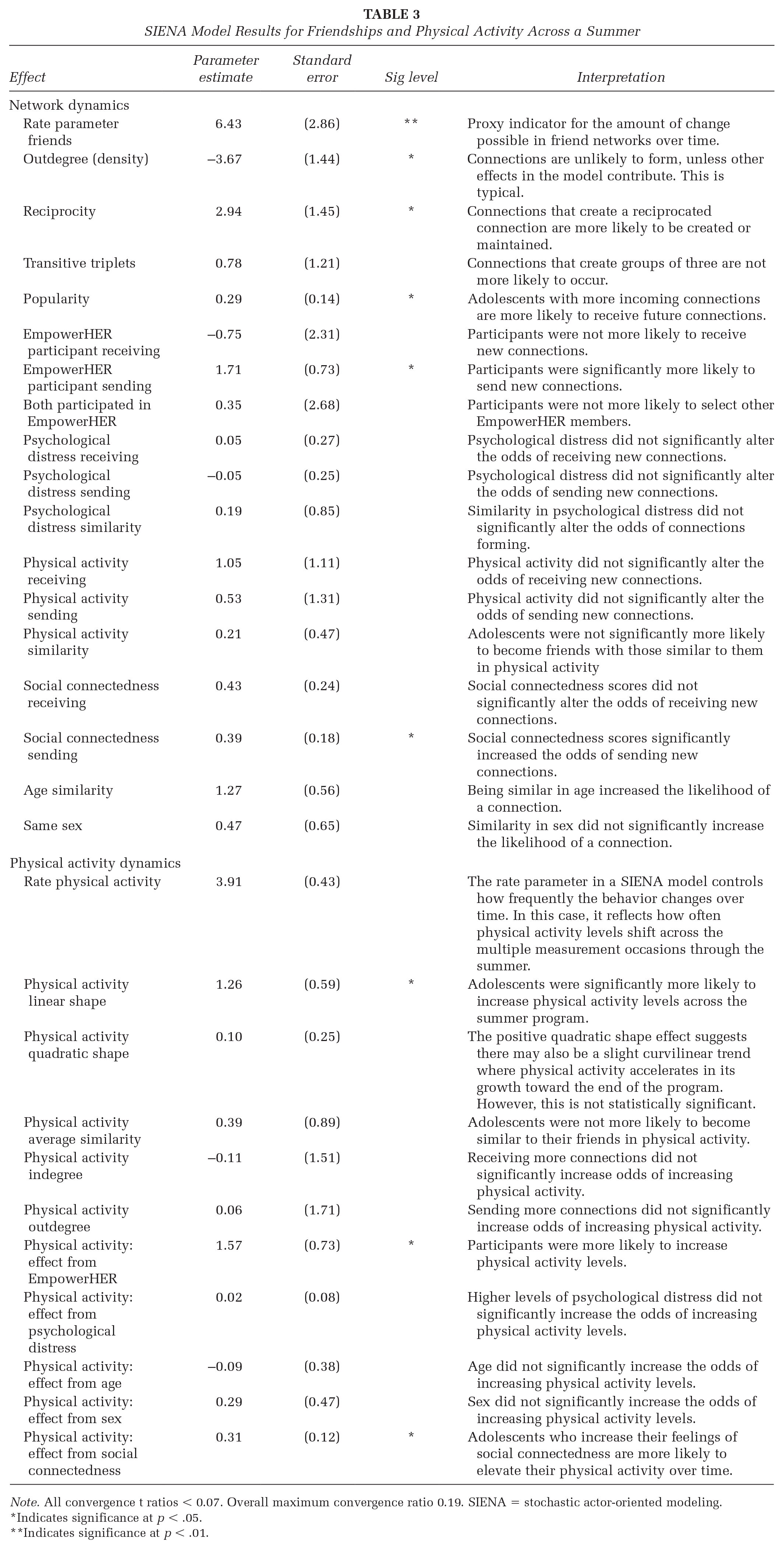
Note. All convergence t ratios < 0.07. Overall maximum convergence ratio 0.19. SIENA = stochastic actor-oriented modeling.
Indicates significance at p < .05.
Indicates significance at p < .01.
Regarding attributes of EmpowerHER participants, the significant and positive sending effect (b = 1.71, SE = 0.73) denotes girls in the program displayed higher outdegree centrality, nominating more peers as friends across the summer. Most critically, participation in EmpowerHER positively predicted changes in physical activity levels over time (b = 1.57, SE = 0.73). Exposure to the integrated curriculum increased the probability of enhancing physical activity engagement across the program.
Adolescents were significantly more likely to increase physical activity levels across the duration of the summer program (b = 1.26, SE = 0.59). In addition, the significant effect from social connectedness to physical activity (b = 0.31, SE = 0.12) indicated that youth increasing their connectedness also elevated their activity levels across the summer. Furthermore, adolescents with higher social connectedness scores were significantly more likely to send connections (b = 0.39, SE = 0.18) over time.
Discussion
The purpose of this study was to provide a nuanced evaluation of a PA and SEL program, EmpowerHER, tailored for adolescent girls attending a summer care program. More specifically, the pilot intervention aimed to address declines in PA levels and lack of social-emotional support prevalent when school is out of session (Baranowski et al., 2014; Brazendale, Beets, Weaver, Pate, et al., 2017). The study examined how participation in EmpowerHER related to changes in device-measured PA, self-reported social connectedness, and friendship connections over the summer. A key strength of this study was the use of advanced longitudinal social network analyses using stochastic actor-oriented modeling (SIENA). These models were leveraged to determine complex patterns of peer influence and selection tied to participants’ changes in PA engagement and socioemotional assets (i.e., feelings of social connectedness and psychological distress).
Effect of EmpowerHER
Pilot implementation results suggest girls participating in the EmpowerHER program were significantly more likely to elevate their PA levels over time compared with peers in the standard summer curriculum. Exposure to the integrated intervention focusing on teambuilding, creative movement, empathy, and relationship skills may increase participants’ probability of enhancing MVPA across the program duration. On average, participants showed a mean increase of 11 additional minutes of PA per day from baseline to endline, although this was not statistically significant based on paired t-tests. Yet, when accounting for social influence and selection, this effect was statistically significant in stochastic modeling. This aligns with previous school-based research confirming overall positive effects of blended PA and SEL curricula on developmental outcomes (Durlak et al., 2011). It also reflects prior work showing summer care programs can help children accumulate nearly 90 min of PA per day on average to sustain activity in the absence of school supports (Brazendale et al., 2020; Brazendale, Beets, Weaver, Chandler, et al., 2017). Consequently, implementing focused PA lessons through community-based summer care settings represents a promising health promotion strategy.
In addition, girls who participated in the EmpowerHER pilot program were significantly more likely to send new friendship nominations across the summer compared with peers. This suggests that exposure to the integrated PA and SEL curriculum may help facilitate an openness to make new friends, a key component of socioemotional learning and well-being (Payton et al., 2000). By focusing on cooperation, personal expression, empathy, and conflict resolution, the program curriculum seemingly provided participants with tools to initiate more social connections. This aligns with previous research showing that interventions targeting socioemotional competencies can impart adolescents with the knowledge, attitudes, and skills necessary to establish positive relationships and responsible social behaviors (Durlak et al., 2011). Furthermore, participation in the EmpowerHER pilot may have acted as a catalyst for expanding friendship networks among attendees. Fostering emotionally close and supportive peer relationships facilitates well-being during the increasingly autonomous adolescent developmental stage.
Effect of Social Connection
Beyond PA outcomes, higher self-reported social connectedness significantly increased adolescents’ likelihood of elevating PA over the summer months. Students reporting greater emotional connection with parents, bonding with peers, and positive student-teacher relationships showed higher odds of boosting their activity levels across the program. This expands previous research linking social support to youth PA by underscoring the interconnected influence of family, peer, and teacher relationships (Laird et al., 2016). Fostering multidimensional social bonds and integration may motivate adolescents to maintain involvement in healthy behaviors. Building socioemotional competencies such as empathy, teamwork, and responsible decision-making can facilitate deeper relationship building (Durlak et al., 2011).
PA Selection and Influence Effects
A notable deviation from previous research was the lack of significant peer selection and influence effects tied to changes in PA engagement across the summer months (Prochnow, Delgado, et al., 2020). A peer influence effect would have indicated that adolescents adopted similar PA levels to match their friends’ PA engagement over time, while a homophily or selection effect would indicate that adolescents tended to form friendship connections with peers demonstrating similar PA levels (Prochnow, Delgado, et al., 2020). Specifically, adolescents did not preferentially befriend peers with similar PA levels, nor did their activity involvement shift to match friends. The absence of these key social processes facilitating healthy behaviors highlights alternative mechanisms driving PA changes in this sample. This effect may have been due to limited sample size and limited opportunities for friend selection and alternative PA opportunities. More specifically, the size of the summer care program may have limited the potential for adolescents to select different friends based on PA. Simultaneously, the structure provided by the program may have limited the range of PA as well leading to more similarity across all adolescents. Previous research also suggests that simultaneous exposure to an environment that promotes PA can override any influence or selection processes (Prochnow, Delgado, et al., 2020). Given the girls involved in EmpowerHER experienced notable improvements in their PA compared with other BGC attendees, it could be that the specific environment EmpowerHER provided was important in driving connectedness and PA simultaneously.
Limitations
As an initial pilot study, conclusions from this study are limited by the small sample size and lack of randomized controlled design. The low participation rate in the optional EmpowerHER program also introduced potential self-selection bias. In addition, the study relied entirely on self-report questionnaires for assessing social-emotional assets, which can suffer from reference bias and social desirability bias. Finally, the current analysis focused solely on changes in PA and peer relationships occurring within the summer care program environment. Broader social connections, such as friends, family, and other adults external to the care program likely contribute meaningful variance to health and development outcomes. Furthermore, measurements of MVPA outside of the program were not conducted. Nonetheless, this pilot work provides impetus for larger investigations into multicomponent youth programming leveraging positive peer influence dynamics.
Implications for Practice
The study findings indicate that it may benefit adolescent girls to participate in gender-specific programs that blend PA and SEL components. Summer care programs may be a vital context to provide these programs especially integrating PA and SEL rather than treating these as separate domains. These pilot results are promising but further efficacy testing is needed to determine if these positive results are applicable in other samples and communities. Results also indicate program staff may want to remain mindful that higher social connectedness was associated with elevated PA levels, indicating the value of intentionally fostering positive peer relationships alongside physical activities. Additional work is also needed to better understand the pathway by which this association may enhance programming long term.
Implications for Research
Future research should address several limitations of this pilot study to advance understanding of integrated PA-SEL programming. Larger randomized controlled trials are needed to definitively establish program efficacy and determine optimal “dosage” of combined PA-SEL sessions. Studies should incorporate objective measures of social-emotional skills beyond self-report surveys, such as behavioral observation or teacher/parent ratings. In addition, research should examine whether program benefits extend beyond the summer months and investigate potential moderators of effectiveness (e.g., age, initial activity levels, friendship network position). Finally, studies should explore how integrated PA-SEL programs might be adapted for different populations while maintaining their core elements of combined physical activity and relationship building.
Conclusion
While exploratory in nature, this pilot study demonstrates preliminary efficacy of an integrated PA and SEL curriculum implemented through a summer care program. The combination of PA and interpersonal benefits experienced by EmpowerHER participants reiterates the importance of addressing health holistically. Previous research has shown that PA interventions can have positive impacts on children’s SEL skills, including self-awareness, self-management, social awareness, relationship skills, and responsible decision-making (Moon et al., 2024). Similarly, programs that combine PA and SEL content have demonstrated overall benefits for adolescents’ well-being and development across several domains, though more research is still needed (Jackson, Prochnow, et al., 2024). These findings highlight the interconnected nature of physical, mental, and emotional health, suggesting the value of integrated approaches that address multiple aspects of health and development simultaneously (Moon et al., 2024). The outcomes of the present EmpowerHER program align with this prior work emphasizing the merit of holistic interventions.
