




Abstract
While literature suggests that youth physical activity (PA) behaviors are affected by network influences, less is known about network influences on perceived skill competency, a component of physical literacy and self-efficacy. This study aims to provide an understanding of potential network characteristics which are associated with youth PA skill competency. Youth (n = 158) between the ages of 8 and 12 years recruited from two summer care programs (i.e., Boys & Girls Clubs) participated in researcher-administered surveys. Youth self-reported their age, sex, involvement in team sports, weekly PA, and skill competency assessed using a version of the PLAYself measure. Youth were also asked to report up to five people in the summer program and five out of the program with whom they interacted the most. Linear regression was used to evaluate associations between skill competency and demographics, PA, and social network characteristics. Skill competency was significantly associated (R2 = .17) with age (β = −.06, p = .01), sex (β = −.06, p = .01), sports team involvement (β = .16, p < .001), and weekly PA (β = −.20, p < .001). Skill competency was also significantly associated with the number of connections with whom the youth played frequently (β = .09, p < .001), the number of connections that helped the youth to be active (β = .18, p < .001), and the heterogeneity of the type of relationships within the youth’s network (β = .11, p < .001). Skill competency scores were significantly associated with both individual variables and social network composition. In addition, youth with networks comprising several types of relationships (heterogeneity) reported a significantly high skill competency. PA interventions can be most effective when considering the reinforcing aspects of networks and skill competency.
Keywords
Engaging in physical activity (PA) regularly in adolescence has shown positive effects on executive functions, attention, and academic performance (de Greeff et al., 2018). The recommended PA for youth is 60 min daily of moderate to vigorous exercise (Piercy et al., 2018). Despite the many benefits of engaging in PA, studies report youth show significantly low levels of PA across the globe (Aubert et al., 2022). Youth perceive one of the barriers to participating in PA is the negative PA experiences at school and physical education (Shepherd et al., 2006). Meanwhile, perceived benefits of participating in PA are positive physical education experiences, personal factors (fun, perceived competence), support of family and friends, and access to PA programs (Allender et al., 2006, 2007; Shepherd et al., 2006). Perceived physical skill competency, or confidence in one’s ability to perform movements related to physical activities, is significantly associated with increased youth PA (Inchley et al., 2011). In this way, physical skill competency is similar to self-efficacy, but further narrows the definition to specify skills related to PA (Rodgers et al., 2014). Fostering physical skill competency could translate to improved health and well-being (Powell et al., 2018). Furthermore, understanding the social dynamics around skill competency may provide insights on how to improve these feelings in youth.
School environments offer many opportunities for students to be physically active during the school day (Lewallen et al., 2015). School days (i.e., typical weekday) are fundamentally different from less-structured days, such as weekend days or summer days, due to the fact that they consistently contain a daily structure and routine with intentional (e.g., recess, physical education, before/after school programs, organized sports programs) and unintentional (e.g., regular transitions between activities, walking to school) PA opportunities for the majority of youth through the school day (Brazendale et al., 2017). In contrast, youth are often less physically active during summer compared to school (McCue et al., 2013). In addition, youth participate in more screen time, minimize consistent sleep schedules, and increase access to unhealthier foods at home during the summer (Brazendale et al., 2017). Consistently, during summer days, youth PA has been found to decrease by 18% when compared with school days (Volmut et al., 2020). Programs with PA programming, such as summer care programs, can provide opportunities to increase youth PA during this time of decline (Beets et al., 2016).
Research studies have suggested that social connections play a significant role in youth PA (Prochnow, Delgado, et al., 2020). The social connections among youth can help to understand their health behaviors (Prochnow, Delgado, et al., 2020). Social network analysis (SNA) is a set of approaches that define the meaning of connections and describe the influence of social influences within a network (Valente et al., 2010). Friendships have been shown to play an important role in shaping PA behaviors; conversely, PA has also been known to shape friendship selection (Macdonald-Wallis et al., 2012). Specifically, social network concepts of homophily and heterogeneity are common network structures that researchers highlight to define and analyze networks. Homophily is defined as the tendency for people to affiliate and associate with others like themselves (Valente et al., 2010). For example, individuals are more likely to become friends based on similarities in sex, ethnicity, socioeconomic status, religion, and behavior (McPherson et al., 2006). Heterogeneity, on the other hand, is a measure of variety or variability in the connections present within a network (Jadbabaie et al., 2013; Uchino et al., 2004; Valente et al., 2010). Helping youth find commonalities (homophily) or learn from differences (heterogeneity) could increase the likelihood that they will choose to continue being physically active. Adolescence is a sensitive period that triggers or enables a shift in health behavior due to family, friends, and educational experiences. Health behavior in adolescence is influenced by neighborhood and school environment, as well as family and friends’ influences (Blum et al., 2012). Furthermore, these influences can be conceptualized as social support and expectations of certain behaviors through interpersonal relationships based on an ecological perspective (Heaney & Israel, 2008). Therefore, such network diversity can bring in different ideas, resources, and new perspectives to make the individual feel more encouraged and confident in their ability to be physically active.
Purpose
The composition of youth social network and social connections can affect the way they think and behave (McCarty et al., 2019). While literature suggests that youth PA behaviors are affected by network influences (Prochnow, Delgado, et al., 2020), less is known about network influences on perceived PA skill competency. This study aimed to determine network characteristics which are associated with PA skill competency for youth. In summer care programs, a better understanding of how social networks may influence PA skill competency could shed light on how the programs’ practitioners may help foster and improve skill competency through programming and social reinforcement.
Method
Design and Sample
All data were collected at two summer care programs (i.e., Boys & Girls Clubs), and youth participating in this study were 8−12 years old. All youth between the ages of 8 and 12 years were invited to participate in the study. This age was selected to correspond to age groupings at these summer programs. Programs were based in Wisconsin and Texas. Parents/guardians were informed of the study and were able to withdraw their youth from the study at any time. Youth were asked to provide written assent prior to participating. All youth were able to participate in researcher-administered surveys at the beginning of the summer care program. This study was approved by the Institutional Review Board of the referent University prior to the start of the study.
Demographic Information
Demographic information was collected by self-report survey, including age (in years), sex (boy or girl), race, and ethnicity. Respondents were also asked to report how many sports teams they were involved with over the last year from response options of 0, 1, 2, and 3 or more.
Physical Activity
A portion of the World Health Organization’s Health Behavior School Aged Children survey was used to assess PA (Booth et al., 2001). Youth were asked to report how often they engaged in PA each week. Youth were given examples of PA such as sports, dance, or any active play that makes them sweat or breathe hard. The youth was then asked, “How many hours are you usually physically active in your free time, so much that you get out of breath or sweat each week?” A Likert-type scale was used with the following response options which were then coded 0 to 5, respectively: “none,” “about half an hour per week,” “about one hour per week,” “about 2–3 hours per week,” “about 4–6 hours per week,” or “about 7 hours per week or more.”
Perceived Skill Competency
Perceived skill competency was measured by an adaptation of the PLAYself physical literacy assessment form (Cairney et al., 2016). The PLAYself assesses youth perceived skill competence in a variety of settings. Youth were asked to report “how good do you feel you are at physical activities . . .” with specific items for locations such as at school, outdoors, on the playground, and in your yard (outside your home). Youth could respond “never tried,” “not so good,” “okay,” “very good,” or “excellent,” which were then coded 0 to 4, respectively. Items were summed to provide a scale sum score, with a possible range of 0 to 16.
Network Data
Youth were asked to report the names of up to five peers at the summer care program (in-program) and up to five people outside the program (out of program) with whom they interacted the most. In SNA, these people listed as members of the youth’s network are termed “alters.” Youth answered several questions regarding each alter they listed, including the alter’s sex (“boy” or “girl”), age, relationship (“sibling,” “friend,” “mother,” “father,” “relative”), where the alter’s live (“in household,” “in neighborhood,” “outside neighborhood,” or “I don’t know”), how often the youth actively played with each alter (“often,” “sometimes,” “rarely”), how many hours the youth thought each alter was active each week (“none,” “about half an hour per week,” “about one hour per week,” “about 2–3 hours per week,” “about 4–6 hours per week,” or “about 7 hours per week or more”), and if the alter helped the youth to be active (“yes,” “no”). These network questions were developed from previous studies and experience (Prochnow et al., 2021a, 2021b; Prochnow, Patterson, Bridges Hamilton, & Umstattd Meyer, 2022; Prochnow, Patterson, Meyer, & Umstattd Meyer, 2022; Prochnow, Patterson, & Umstattd Meyer, 2020; Prochnow, Patterson, Umstattd Meyer, et al., 2022).
Data Analysis
Network composition variables were created for each youth to show social norm of PA (average PA hours per week perceived in network), social support (number of alters that helped the youth to be active), co-participation (number of frequent play partners in network), preference for same sex alters (percent of network of the same sex as youth), and variety in social connection (heterogeneity of relationships present within the network). A linear regression model was used to examine significant associations between youth perceived skill competency and age, sex, grades, self-reported PA, participation in team sports, and the network composition variables listed above. Data analysis was conducted with IBM SPSS v. 28 (IBM, Chicago, IL, USA).
Results
In total, 158 youth responded to the survey, 46.8% were boys (n = 74) and 53.2% were girls (n = 84), with a mean age of 10.04 years (SD = 1.26). In this sample, 34.7% of the youth identified as Black or African American (n = 84), 24.4% as White (n = 51), 10.2% as multiracial (n = 18), and 3.2% as other (n = 5). In addition, 26.9% of youth identified as Hispanic and/or Latinx (n = 58). Regarding team sport participation, 24.0% (n = 50) of youth reported no team sport participation, 21.8% (n = 42) participated in one team, and 17.3% (n = 33) participated in two or more teams. Youth reported a mean perceived skill competency sum of 11.54 (SD = 2.47) and a mean weekly PA of 3.25 (SD = 1.41), which indicates youth reported just over 2 to 3 hours of PA per week. Sample characteristics can be found in Table 1.
Sample Characteristics (n = 158 Adolescents)
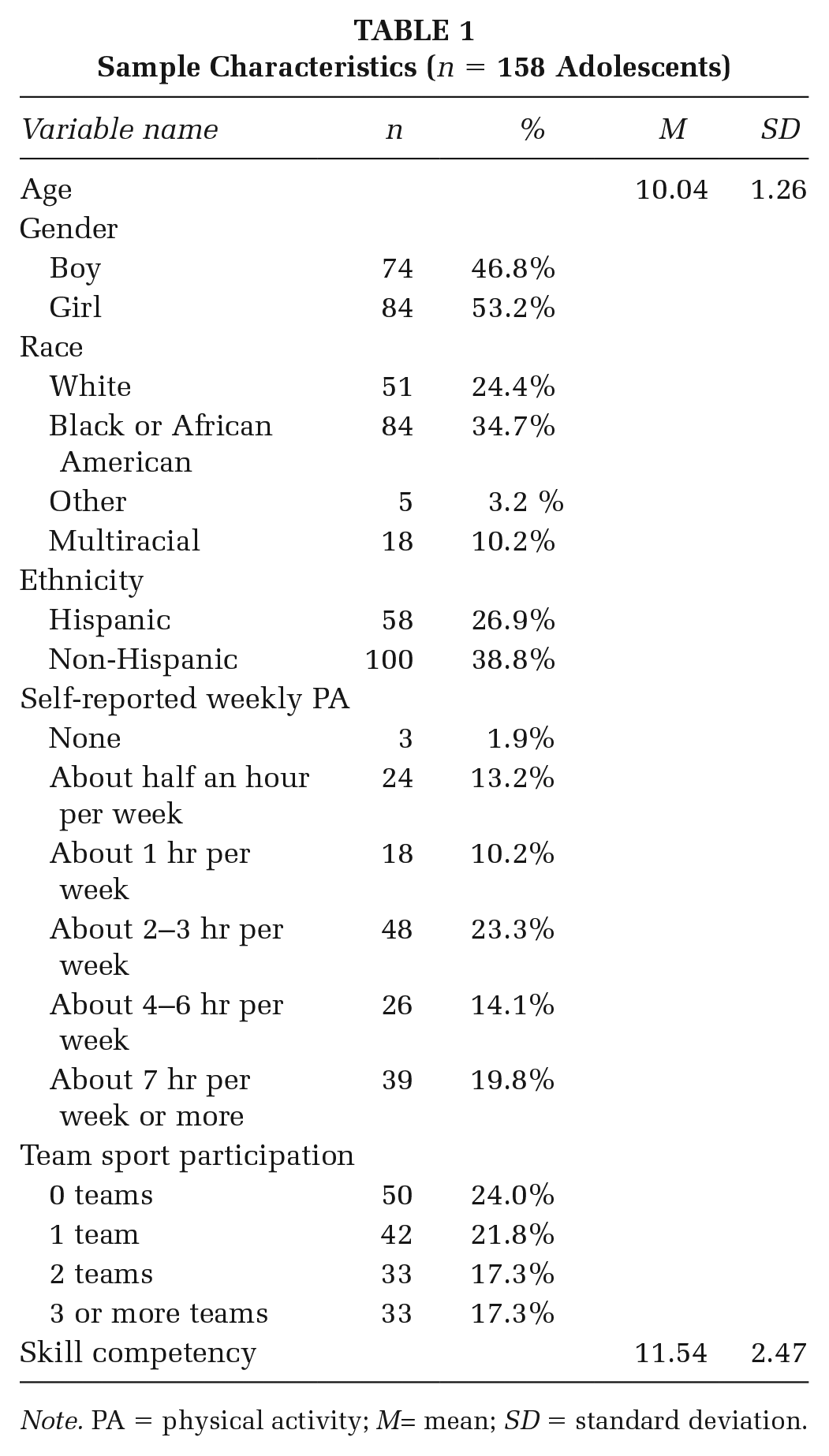
Note. PA = physical activity; M= mean; SD = standard deviation.
Youth reported 1,066 alters in their networks and had a mean of 6.75 alters per youth. Out of these alters, 50.9% (n = 543) were boys while 49% (n = 522) were girls. Alters consisted of 3.4% (n = 36) mothers, 2.1% (n = 22) fathers, 15.5% (n = 165) siblings, 61.2% (n = 652) friends, and 17.8% (n = 190) other relatives. Youth reported that they rarely actively played with 52.5% (n = 560) of alters reported. Furthermore, youth reported that 73.4% (n = 782) alters helped them to be physically active. Additional network details can be found in Table 2.
Alter-Level Characteristics (n = 1,066, Mean of Alters per Network = 675)
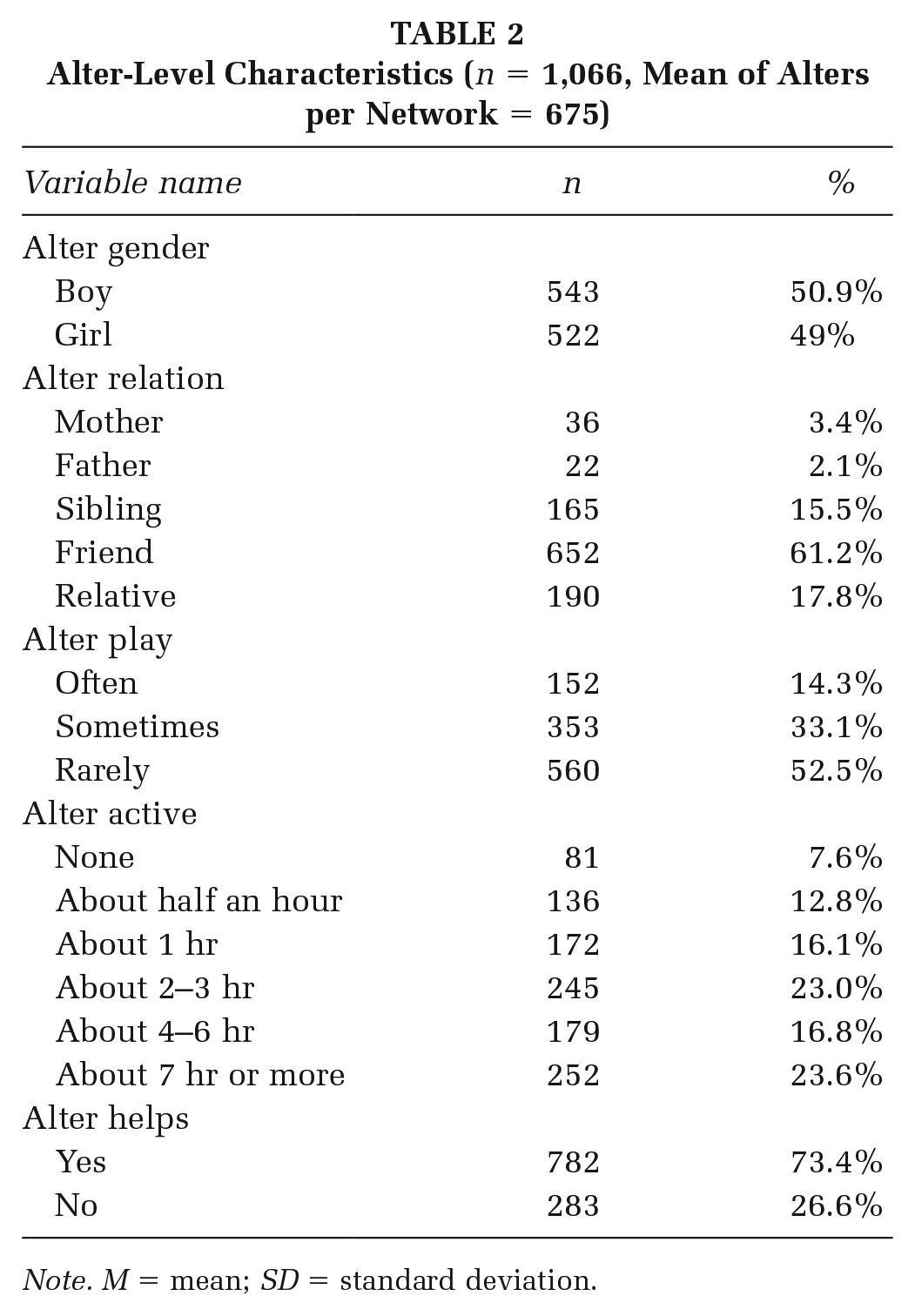
Note. M = mean; SD = standard deviation.
A significant model was found explaining 17.1% of the variance (R2 = .17). Skill competency was significantly associated with age (β = −.06, p = .01), sex (β = −.06, p = .01), sports team involvement (β = .16, p < .001), and weekly PA (β = −.20, p < .001). Skill competence was also significantly associated with the number of alters with whom the youth played frequently (β = .09, p < .001), the number of alters that helped the youth to be physically active (β = .18, p < .001), and the heterogeneity of the type of relationships within the youth’s network (β = .11, p < .001). See Table 3 for regression models.
Linear Regression Model Results Describing Skill Competency Among Adolescents
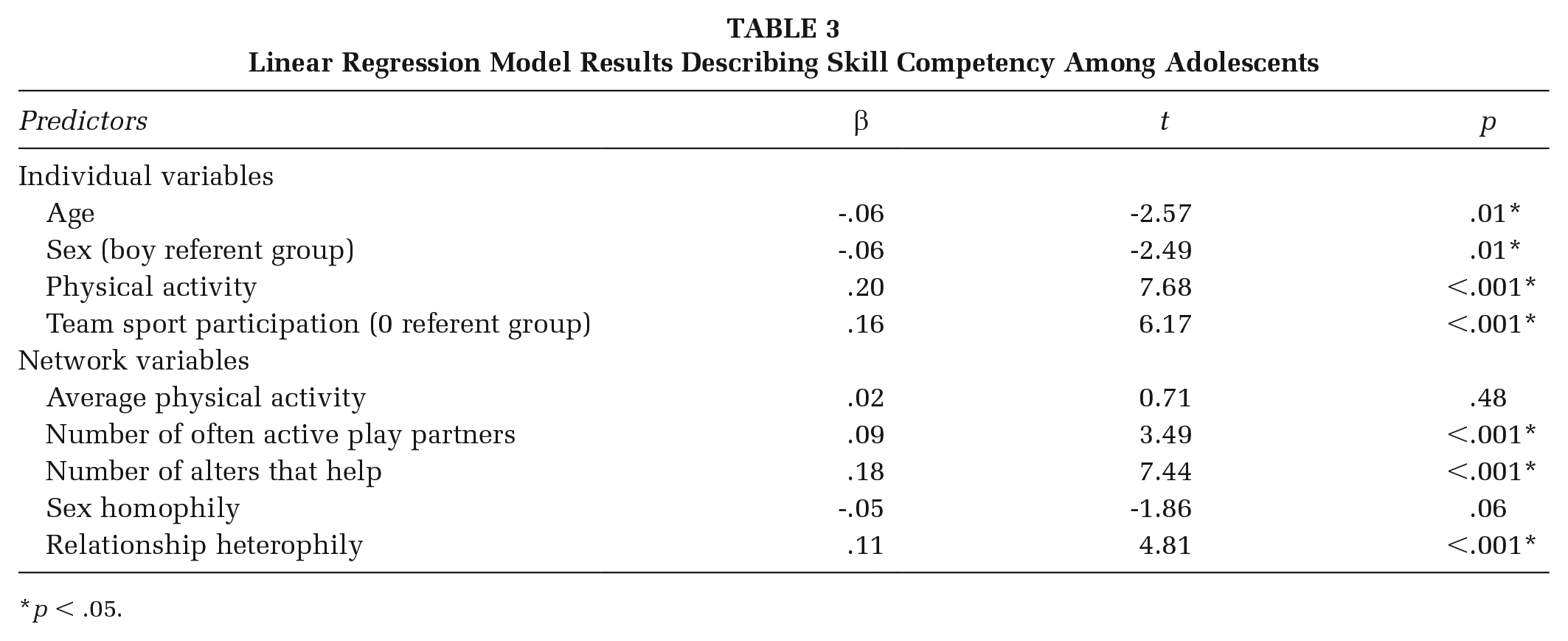
p < .05.
Discussion
This study aimed to expand on the significance of social connection and to give knowledge of possible network variables linked with youth PA skill competency. Findings from this study indicated that youth who were younger, boys, played team sports, and had diverse networks were more likely to report higher PA skill competency.
Our findings suggest that youth who reported connections with alters who helped them to be active and frequently play together also reported high skill competency. Past research aligns with our findings that identify a link between social support, social norms, and co-participation with increased PA levels. For example, an increase in active friends was significantly associated with a higher probability of being physically active (Arango-Paternina et al., 2021). This may suggest that increasing daily PA of popular youth in these networks may have the potential to also improve skill competency in others through social influence (Zhang et al., 2015). Practitioners of summer care programs should understand the process by which they choose alters within the network and establish an efficient intervention strategy in the environment in which the intervention will be implemented. The effectiveness of peer selection in networks also affects the programs that aim to increase PA (Gesell et al., 2012).
Youth who had social connections encompassing a variety of relationship types—including mothers, fathers, friends, and extended family members—were more likely to rate themselves as highly competent in physical activities. Having a heterogeneous mix of individuals providing support, modeling active behaviors, sharing knowledge, and offering encouragement appears to reinforce positive perceptions of capability among adolescents (Blum et al., 2012). The diversity introduces different perspectives: parents may provide logistical support like transportation and equipment that allows youths to hone athletic skills, friends may motivate through co-participation and healthy competition, and relatives may share tips from their own experiences being active (Heaney & Israel, 2008). With several sources of input around PA, adolescents may receive more constructive feedback to aid ongoing development as well as hear more messages that empower them to feel skilled. In addition, seeing diverse social contacts enthusiastic about their participation gives adolescents representatives to identify with and draw inspiration from, further bolstering their self-assessments of competence. Intentional reinforcement of PA skill competency from a variety of relationships—not just peers—can shape adolescents’ mindsets and confidence in their abilities.
Implications for Practice
This study highlights several implications for summer care programs and other practitioners aiming to promote and develop PA skill competency in adolescents through programming and social reinforcement. First, understanding and facilitating diverse social connections related to PA may be an effective strategy. Programs could integrate activities that bring together adolescents across different ages, backgrounds, sports interests, and so on. Facilitating connections with various types of relationships (friends, family members, coaches, etc.) around PA may also foster skill competency. In addition, intentionally promoting peer support and co-participation in PA aligns with these findings. Programs could designate peer mentors, implement a “buddy system,” highlight peer role models, and explicitly encourage adolescents to invite others to be active together. Highlighting the social benefits and making PA a collaborative activity could enhance perceptions of competency. Furthermore, skill-building could be an intentional component of PA programming. Programs could incorporate skill-based games, challenges related to fundamental movement skills, and opportunities to try new sports/activities. Giving adolescents tools to feel competent and confident in PA skills is key. Feedback and encouragement from program leaders and peers around skill development creates a supportive environment. Finally, equipping adolescents with strategies to navigate barriers and build self-efficacy related to PA skills is warranted. Discussing challenges openly, problem-solving solutions, celebrating small wins, and facilitating mastery experiences gives adolescents agency in becoming more competent movers. Summer care programs are well suited to foster these competencies.
Limitations
Allowing participants to complete a self-reported survey factored into this study limitations. Self-reported surveys have a limitation in which variables are over- and/or under-estimated. Participants’ perceptions of themselves being physically active might be reported higher than their peers to document themselves as if they are more engaged or vice versa. Regarding nominated peers, participants could only nominate up to five people in the summer care program and five people out of the program. This may limit children with expansive networks and introduce an artificial constraint on the data; however, limited nominations have been used in the past as a way to reduce respondent burden while eliciting the most salient connections.
Conclusion
In conclusion, this study provides valuable insight into the importance of social networks in shaping PA skill competency among adolescents. The results highlight that both individual activity patterns and social dynamics affect perceived competence. Moving forward, additional research should further explore the mechanisms through which diverse social relationships and networks tangibly influence competency beliefs. Quantifying the roles that social support, modeling, access to resources, motivation, and information sharing play can aid targeted interventions. Studies could also track how interventions promoting collaborative participation for PA affect perceived and actual skill development over time compared to individual practice. Experimental designs parsing how competence evolves across ages and stages as new connections emerge may clarify ideal timing for interventions. Longitudinal data can also capture bidirectional effects between social networks and skill competency. On the applied side, community programs aiming to bolster PA skills among youth should consider network-based initiatives that leverage peer support through joint participation, integrate skill-building games, promote relationships with adult role models, and teach self-efficacy strategies. Partnerships between schools, families, sports leagues, summer camps, and other youth-serving agencies to reinforce active skill development across settings may prove impactful. Overall, this research spotlights that PA competence relies on both individual and social factors. Amplifying future explorations of how to cultivate supportive social ecosystems for enhancing skill-related assets can maximize health promotion among adolescent populations.
