



Abstract
Background
Sex trafficking of persons, a pervasive public health issue disproportionately affecting the most marginalized within society, often leads to health as well as social consequences. Social service provision to meet the resulting needs is critical, however, little is known about the current pandemic’s impact on providers’ capacity to deliver requisite care.
Method
To examine social service providers’ perspectives of care provision for domestically sex-trafficked persons in Ontario, Canada, during the COVID-19 pandemic, we conducted semi-structured interviews with 15 providers and analyzed these using Braun and Clarke’s analytic framework.
Results
Impacts of the COVID-19 pandemic on social service care provision were connected to individuals’ increased vulnerability to trafficking, difficulties safely and effectively providing services to sex-trafficked persons amid pandemic restrictions, and reduction in in-person educational activities to improve providers’ capacity to serve this client population. Securing safe shelter was particularly difficult and inappropriate placements could at times lead to further trafficking.
Conclusion
The pandemic created novel barriers to supporting sex-trafficked persons; managing these sometimes led to new and complex issues. Future efforts should focus on developing constructive strategies to support sex-trafficked persons’ unique needs during public health crises.
Human trafficking, including forced labor and sexual exploitation, disproportionately affects marginalized populations, especially those with intersecting vulnerabilities (International Labour Organization et al., 2022; Recknor et al., 2022). Those trafficked for sexual labor often have complex needs, which can be challenging for providers to address (Lederer & Wetzel, 2014). For example, controlling tactics used by traffickers (e.g., psychological, sexual, and/or physical violence, forced drug use, social isolation) can result in significant and sustained physical and/or mental health consequences, which together can present an insidious burden on the health care system (Lederer & Wetzel, 2014; Ottisova et al., 2016).
Disparities in accessing services and receiving quality care to address complex needs existed pre-pandemic (Koegler et al., 2021), but emergent global data suggest such disparities may have worsened during the COVID-19 pandemic (Organization for Security and Co-operation in Europe Office for Democratic Institutions and Human Rights, & United Nations Women, 2020). Social service providers are uniquely positioned to address sex-trafficked persons’ needs and connect them to requisite supports (Duncan & DeHart, 2019), yet there are prominent gaps in what is known of social service providers’ experiences and challenges in delivering care to sex-trafficked persons during this time. Exploring the effect COVID-19 had on their efforts to provide care is important as the resulting insights may highlight strains to social service provision during the pandemic, while building the body of knowledge required to prepare for future public health crises.
Method
Impacts of the COVID-19 pandemic on caring for sex-trafficked persons emerged during a larger study of social service providers’ knowledge, attitudes, and practices concerning service delivery for domestically sex-trafficked persons in Ontario, Canada, which was approved by Women’s College Hospital Research Ethics Board in December 2021 (REB# 2021-0133-E; for more detail, see Jacobson et al., 2023). The collective expertise of the research team, including a social worker and senior qualitative researchers, informed the development of a semi-structured interview guide.
Purposive sampling of English-speaking social service providers living and working in Ontario occurred during January and February 2022 via Twitter, Facebook, and targeted emails to staff at social service organizations across Ontario. Those interested signed and returned sociodemographic and informed consent forms. Semi-structured interviews with 15 providers (one-to-two hours) were held and recorded on Zoom. Participants were assigned a pseudonym by which they are referred in this manuscript. Interviews were discontinued after reaching saturation. Zoom-recorded audio and video files and transcriptions were saved to a secure drive and deleted from Zoom. Participants received a $25 e-gift card as a gesture of thanks.
Interview data were analyzed using Braun and Clarke’s (2006) six phases of thematic analysis in Dedoose Management Software (Version 9.0.46., 2022). After repeatedly reviewing transcripts, two authors (D.J., F.M.) independently coded one transcript, reconvened to discuss areas of concurrence and dissension, then independently coded and compared two more. Codes were refined and a codebook was developed and used to code five more transcripts. The codebook was determined to be effective and reliable and one author (D.J.) coded the remaining transcripts. Codes were organized into descriptive themes and sub-themes and merged, as applicable (see also Jacobson et al., 2023; Recknor et al., 2023). Field notes, reflexive journals, and frequent team meetings facilitated by senior researchers with expertise in gender-based violence and qualitative research methods contributed to the trustworthiness and dependability of the analysis (Nowell et al., 2017).
Results
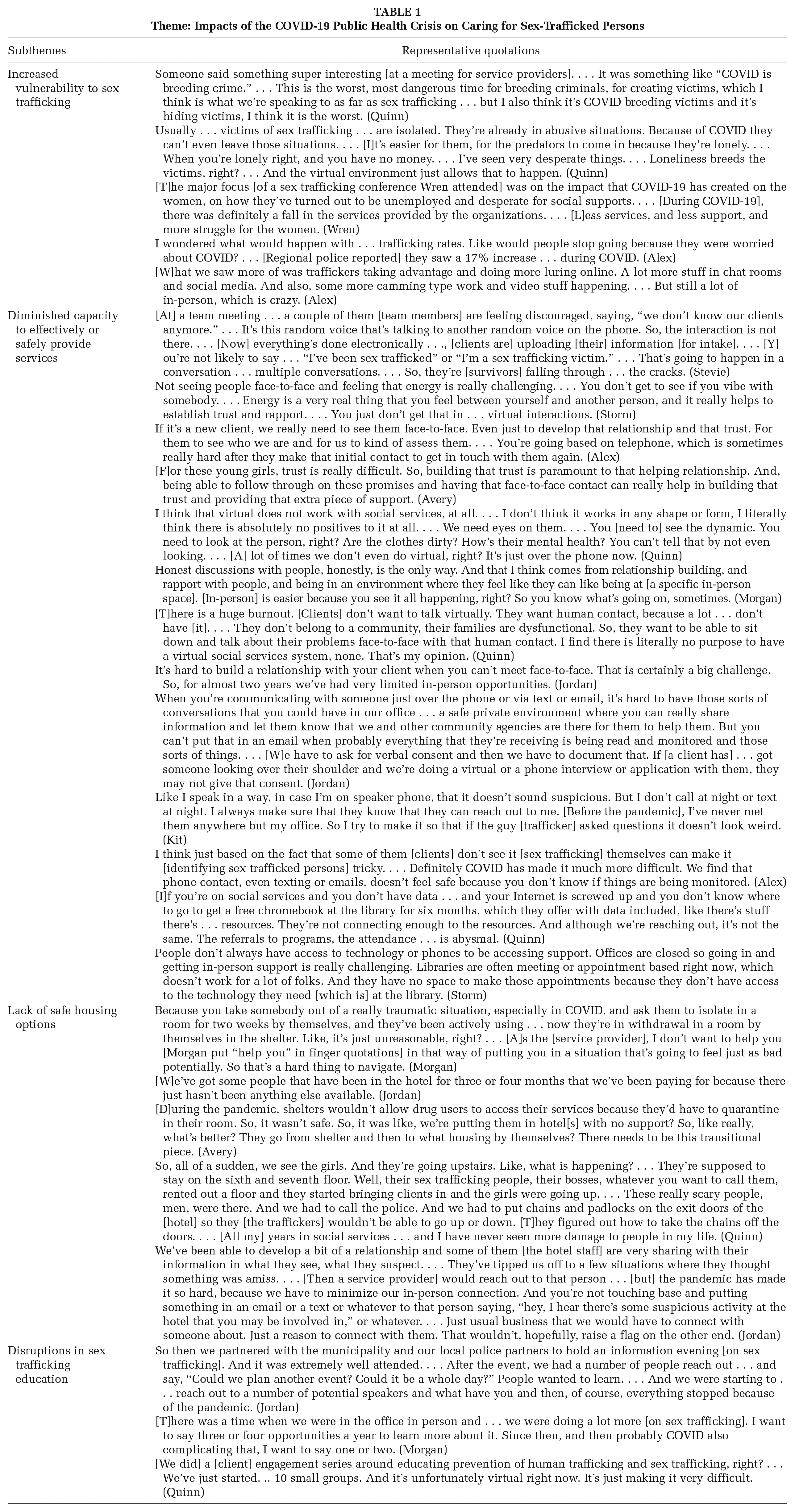
Twelve of the 15 participating providers identified as women and three as men, with an average age of 39 years. Seven identified as White or Caucasian, five as Black, two as “Canadian,” and one as South Asian. Seven had been in social services for 0–5 years, three for 6–10, and five for more than 10 years. The majority had an undergraduate and/or master’s degree (for more details see Jacobson et al., 2023). Four key impacts of the COVID-19 pandemic on social service provision emerged (see Table 1).
Theme: Impacts of the COVID-19 Public Health Crisis on Caring for Sex-Trafficked Persons
Subtheme 1: Increased Vulnerability to Sex Trafficking
Pre-existing vulnerabilities to trafficking were exacerbated by the pandemic, creating new and difficult circumstances for participants delivering services. Quinn described how social isolation wrought by COVID-19 was “breeding crime . . . and victims” and those isolated at home did “desperate things”: Usually . . . victims of sex trafficking . . . are isolated. They’re already in abusive situations. Because of COVID they can’t even leave those situations. . . . [I]t’s easier for them, for the predators to come in because they’re lonely. . . . When you’re lonely right, and you have no money. . . . Loneliness breeds the victims, right? . . . And the virtual environment just allows that to happen.
While Alex had anticipated a decrease in trafficking due to fear of contracting COVID-19, sex trafficking continued and took different forms; police in Alex’s locale reported an increase in online luring and sex trafficking generally. There was “[a] lot more stuff in chat rooms and social media. And also, some more camming type work and video stuff happening. . . . But still a lot of in-person.”
Subtheme 2: Diminished Capacity to Effectively or Safely Provide Services
With the onset of the pandemic, being asked to work from home and cease meeting in-person with clients resulted in arrangements that were not always conducive to participants connecting well with clients and completing full assessments. Participants viewed support, safety, and trust as important for trafficking disclosure and recovery; needs best met within a healing relationship built over time. However, this could not readily occur over the telephone and led to sex-trafficked clients “falling through . . . the cracks,” according to Stevie, who stated, It’s this random voice that’s talking to another random voice on the phone. So, the interaction is not there. . . . [Now] everything’s done electronically . . ., [clients are] uploading [their] information [for intake]. . . . [Y]ou’re not likely to say . . . that “I’ve been sex trafficked” or “I’m a sex trafficking victim.”
Not having in-person meetings made engaging and sustaining a relationship difficult, particularly with new clients. Alex stated that this led to difficulties “get[ting] in touch with them [clients] again.” Storm commented, “Energy is a very real thing that you feel between yourself and another person, and it really helps to establish trust and rapport. . . . You just don’t get that in . . . virtual interactions.” Quinn added that the lack of in-person interactions made it hard to accurately assess client needs stating, “We need eyes on them. . . . You [need to] see the dynamic. You need to look at the person, right? Are the clothes dirty? How’s their mental health? You can’t tell that by not even looking.”
There were participants who reported taking exceptional steps to ensure client safety and privacy. As it was not always possible to know if a potential trafficker was monitoring a client’s conversation or emails, they implemented elaborate strategies to send messages without endangering clients, which limited the assistance they could provide: When you’re communicating with someone just over the phone or via text or email, it’s hard to have those sorts of conversations that you could have in our office . . . a safe private environment where you can really share information and let them know that we and other community agencies are there . . . to help them. But you can’t put that in an email when probably everything that they’re receiving is being read and monitored. (Jordan)
It was further noted that some clients lacked access to technology (e.g., phones, data plans). Storm pointed out the irony that while libraries had computers for use, they required online bookings. Quinn elaborated, “[People are] not connecting enough to the resources. And although we’re reaching out, it’s not the same. The referrals to programs, the attendance . . . is abysmal.”
Subtheme 3: Lack of Safe Housing Options
Finding suitable shelter worsened with the pandemic, exacerbating exsiting issues inherent to a lack of space, lengthy waitlists, and sobriety requirements that many sex-trafficked clients could not meet. Social distancing required increasing space between beds, decreasing the number of available beds in shelters. Instead, hotel placements were often offered but resulted in unforeseen difficulties. Avery relayed: [D]uring the pandemic, shelters wouldn’t allow drug users to access their services because they’d have to quarantine in their room. So, it wasn’t safe. So, it was like, we’re putting them in hotel[s] with no support? So, like really, what’s better?
Quinn described an incident at one hotel, where women housed on two floors were actively being sex trafficked: So, all of a sudden, we see the girls. And they’re going upstairs. . . . They’re supposed to stay on the sixth and seventh floor. Well, their sex trafficking people, their bosses, whatever you want to call them, rented out a floor and they started bringing clients in and the girls were going up. . . . These really scary people, men, were there. And we had to call the police. And we had to put chains and padlocks on the exit doors of the [hotel] so they [the traffickers] wouldn’t be able to go up or down.
Sheltering sex-trafficked women in hotels added to the demands on participants and the complexity of already difficult situations due to the involvement of law enforcement.
Subtheme 4: Disruptions in Sex Trafficking Education
In-person opportunities to learn about sex trafficking were “complicat[ed]” by COVID-19 (Morgan), impacting participants’ ability to identify and serve sex-trafficked clients. Jordan described an “extremely well attended” event for professionals on sex trafficking that took place pre-pandemic: After the event, we had a number of people reach out . . . and say, “Could we plan another event? Could it be a whole day?” People wanted to learn. . . . And we were starting to . . . reach out to a number of potential speakers and what have you and then, of course, everything stopped because of the pandemic.
Client-facing educational events on “prevention of human trafficking and sex trafficking . . . unfortunately” had to change to a virtual format “making it very difficult,” according to Quinn.
Discussion
Findings from this study suggest that the COVID-19 pandemic exacerbated existing inequalities and created new vulnerabilities to trafficking, posing unique barriers to social service providers caring for sex-trafficked individuals. As traffickers exploited new opportunities brought on by the pandemic (e.g., lost employment, social distancing, increased use of online media) (Todres & Diaz, 2021; United Nations Office on Drugs and Crime [UNODC], 2021), varied forms of human trafficking appeared to increase globally (UNODC, 2021). Restricted movement and financial hardship compounded existing social and economic inequalities–already antecedents to trafficking–resulting in a confluence of factors that positioned marginalized persons at heightened risk (Todres & Diaz, 2021; UNODC, 2021). The marked increase in vulnerability to sex trafficking after the onset of the pandemic, identified by social service providers in this study, reflects this trend.
COVID-19-related restrictions inhibited a strong and timely response to this increased vulnerability; the pandemic both amplified the issue of sex trafficking and stymied attempts to address it. Providers working with varied populations faced difficulties balancing social distancing requirements, quality of care, and increased workloads, as identified in other jurisdictions (e.g., McCoyd et al., 2023). Our findings support intimate partner violence studies that have indicated clients’ difficulty accessing shelters during the pandemic (e.g., Mantler et al., 2021). Temporary hotel placements used in this context in their stead often posed unique safety concerns (Mantler et al., 2021); in our study, this led to increased exposure to sex trafficking. In the face of these challenges, providers could have benefited from additional training on sex trafficking, yet educational activities were often curtailed or offered in less desirable formats.
Limitations
Given the qualitative nature of the study, findings may not be generalizable, although they may be transferable to jurisdictions of similar contexts. Pandemic-related restrictions in Ontario may have differed from those in other jurisdictions, which may have impacted the results. Furthermore, findings concern one theme from a larger research project; while this emerged as salient and pressing, warranting specific consideration, additional research could further illustrate the topic.
Conclusion And Implications For Research And Practice
The current study supports emergent literature on COVID-19’s impact on service provision while identifying novel challenges to supporting sex-trafficked persons. While social service providers shifted service delivery to accommodate restrictive public health measures necessitated by the pandemic, working within these limitations sometimes led to new and complex issues to manage. Future efforts should focus on ensuring accessible, safe, and high-quality care for those vulnerable to inequities exacerbated by public health crises. As further evidence of the pandemic’s impact on care provision to sexually trafficked persons emerges, it is incumbent upon practitioners and policy-makers alike to take a “lessons learned” approach to avoid miscalculations of the past and better serve those in precarious situations.
Footnotes
Authors’ Note:
The research team wishes to thank the social service providers who participated in our study, without whom the study would not have been possible. We also express gratitude for the funding support given to us by the HART Foundation. The views expressed in this article are solely those of the authors and do not necessarily reflect those of the funder.
