



Abstract
Transgender (trans) people face high rates of sexual assault and often encounter systemic barriers in accessing appropriate care and supports, including, among others, stigma, discrimination, and a lack of provider knowledge. Trans communities and allies in research and the service sector have emphasized the potential of advocacy as a tool to dismantle barriers for trans people; however, to date, few advocacy efforts have been undertaken in the sexual assault context. To address this gap, we developed and implemented #TRANSformativeKnowledge, a social media campaign to promote awareness among providers about the damaging attitudes, beliefs, and reactions that often impede trans survivors’ access to appropriate services. Based on insights from a recorded consultation with trans community members and health and social service professionals, we designed seven posters for circulation on Twitter, each containing a representative quote, key message, and associated call to action. The campaign was launched May 17, 2021, with posters Tweeted twice weekly, including one final summary post on June 30, 2021. The campaign reached approximately 100,000 Twitter users, with almost 2,000 engagements. As demonstrated by these findings, our social media advocacy campaign represents a viable method for disseminating knowledge about sexual assault against trans people, which could be replicated by others aspiring to advance health equity through advocacy.
Keywords
Assessment of Need
Sexual assault is a pervasive health equity issue for transgender (trans) communities, with rates ranging from 26% in the past 5 years to 47% across the lifespan (James et al., 2016; The Trans PULSE Canada Team, 2020). Trans survivors of sexual assault can face complex health and/or psychosocial issues that require appropriate support from diverse providers, including those in health care and social services (Du Mont et al., 2021). However, due to the prevalence of transphobia and other intersecting forms of stigma and discrimination, trans survivors may also encounter systemic barriers to sensitive care postvictimization (Du Mont et al., 2020). In the Canadian context, little is known about these barriers.
Trans communities and allies from across academia and the service sector have emphasized the potential of advocacy as a tool to address barriers to support (Reisner et al., 2015; Transgender Law Center, 2012). Existing literature on advocacy has focused largely on improving general health and social care for trans clients through institutional initiatives and grassroots community organizing (Reisner et al., 2015; Transgender Law Center, 2012). Examples of advocacy focused specifically on enhancing the response to sexual assault against trans people are rare and none, to our knowledge, have used original research to inform and mobilize a social media campaign (https://forge-forward.org/resource/trans-advocacy-and-activism/, https://forge-forward.org/resource/self-help-guide-for-trans-survivors/, https://vawnet.org/material/serving-trans-survivors-101-training-advocates).
In this practice note, we describe the development and implementation of a novel social media advocacy campaign undertaken as a first step toward addressing barriers to services for trans survivors.
Description of the Strategy
In August 2019, we conducted a survey with representatives of trans-positive health care and social service organizations across Ontario, Canada (the trans-LINK Network) to identify barriers and challenges to providing appropriate supports for trans survivors (Du Mont et al., 2020). Sixty-seven respondents identified and described numerous systemic issues, including an underrepresentation of trans voices in advocacy, a lack of professional competence to provide trans-affirming sexual assault care, and the absence of platforms and tools to aid in organizational transformation and knowledge exchange.
In October 2020, we then convened a working group of eight trans-LINK Network members and peer leaders from trans communities with interest and expertise in advocacy. We held a 2-hour recorded consultation, during which we elicited insights from the group on potential advocacy activities the trans-LINK Network could undertake to address the barriers to appropriate supports identified in our earlier research (Du Mont et al., 2020).
A preliminary review of the consutlation transcript revealed that insights clustered into two broad conceptual categories, one focused on advocacy strategies (e.g., audiences, platforms, tactics) and the other on potential content for an advocacy campaign. The working group identified social media, and Twitter in particular, as an important platform for advocacy geared towards a target audience of health care and social service providers. Further coding resulted in the synthesis of data into six themes to inform campaign content: “A Complete Afterthought,” “Healing is Inhibited,” “A Regular Human Being,” “The Treatment is the Trauma,” “The Virtuous Victim,” and “Incompetent to Care.” Within each theme, we selected one or two representative quotes (e.g., “The reality is that . . . when [you] don’t have the training . . . it leaves us vulnerable”) and distilled these into key messages (e.g., “Trans people commonly cite a lack of provider knowledge as a significant barrier to care. Whether in health care, counseling, housing, employment, or other services, it is important that providers are adequately trained to address the diverse needs of trans survivors of sexual assault”).
We then examined the key messages and identified a common thread that came to form the central purpose of the campaign: to dispel common myths and misconceptions held by service providers about trans survivors. Our campaign, called “#TRANSformativeKnowledge,” therefore focused on “promoting awareness to counter damaging attitudes, beliefs, and reactions related to sexual assault against trans people.” Seven posters and accompanying tweets were then produced, each also containing a call to action that directed audiences to our evidence-informed trans-LINK WebPortal (https://www.translinknetwork.com/). The WebPortal, hosted on Squarespace, includes an array of resources for providers to advance their knowledge on the provision of trans-affirming post-assault care and supports (Du Mont et al., 2021).
Campaign materials were reviewed on several occasions by our working group and revised based on their feedback. Once finalized, the posters were disseminated twice weekly through a lead author’s Twitter account (@DrJaniceDuMont), beginning on May 17, 2021, International Day Against Homophobia, Biphobia, and Transphobia (IDAHOBIT), and ending June 30, 2021, the last day of Pride month. Twitter impressions and engagements were collected using the analytics feature on July 7, 2021 (see Table 1 for results). We also reviewed Squarespace analytics prior to, during, and after the campaign to examine changes in traffic on the trans-LINK WebPortal. In the period leading up to the campaign (April 19–May 16, 2021), our WebPortal was visited, on average, 53.5 times/week. During and a week after the campaign, visits rose to an average of 96.1 times/week.
Overview and Analysis of the #TRANSformativeKnowledge Campaign
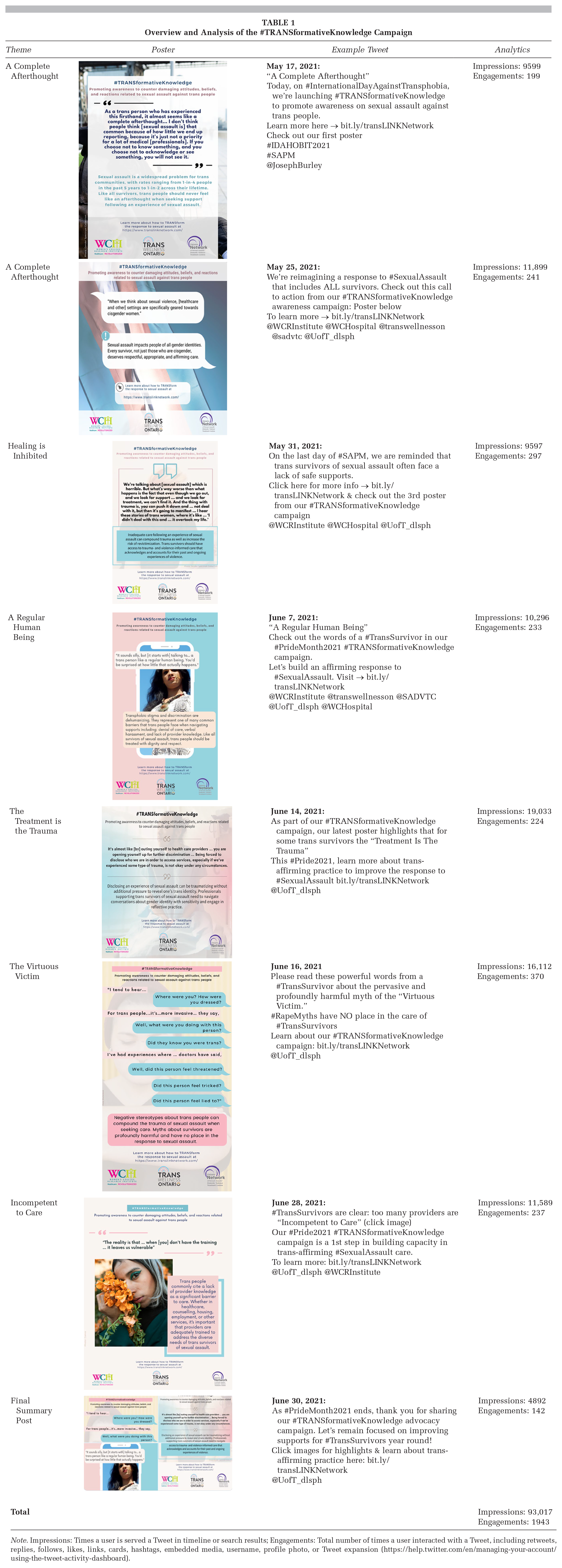
Note. Impressions: Times a user is served a Tweet in timeline or search results; Engagements: Total number of times a user interacted with a Tweet, including retweets, replies, follows, likes, links, cards, hashtags, embedded media, username, profile photo, or Tweet expansion (https://help.twitter.com/en/managing-your-account/using-the-tweet-activity-dashboard).
Implications for Practice
Our social media advocacy campaign, the first of its kind in Canada, reflects an important initial step in addressing the damaging myths, misconceptions, and reactions that often underpin barriers to appropriate care and supports for trans survivors of sexual assault. As demonstrated by the almost 100,000 impressions and 2,000 engagements with content from many health care and social service organizations (e.g., MAX Ottawa, Herizon House, Kind Space, Parkdale Community Health Centre, Sexual Assault Support Centre of Ottawa) and other significant stakeholders (Nursing Network on Violence Against Women International, Canadian Forensic Nurses Association, Egale Canada, Canadian Centre for Gender and Sexual Diversity, Canadian Armed Forces, Ottawa Coalition to End Violence Against Women, Temerty Faculty of Medicine), and the related near two-fold increase in traffic to our trans-LINK WebPortal, our approach represents a viable method for disseminating knowledge about sexual assault against trans people. This approach could be replicated by other researchers and health promoters aspiring to advance health equity through advocacy. However, as raising awareness is not always sufficient to effect meaningful change, additional interventions are necessary to alter the attitudes, beliefs, and behaviors of those supporting trans survivors (Cristiano & Neimand, 2017). Our campaign, for instance, encouraged audiences to access capacity-building resources on our WebPortal, including our competency-based trans-affirming care curricula for health and social service providers (https://www.translinknetwork.com/curricula). Elsewhere, trans-led educational workshops have demonstrated positive impacts on attitudes about gender-diversity among youth (Burford et al., 2017). Targeted educational interventions such as these, in conjunction with broader awareness-raising initiatives, may therefore prove vital in addressing the systemic barriers to care experienced by trans survivors.
Footnotes
Authors’ Note:
We wish to thank the members of our advocacy working group for their vital contributions to this campaign. We would also like to recognize the valuable contributions of Sarah Daisy Kosa to the larger trans-LINK Project. The research on which this article is based received funding from the Social Sciences and Humanities Research Council (Grant Number 890-2019-0047).
Ethical Approval
The research on which this article is based received ethical approval from the Women’s College Hospital Research Ethics Board. All members of our advocacy working group were asked to read a letter of information and complete a consent form prior to the recorded consultation, which addressed its purpose, potential risks and benefits of participation, and confidentiality.
