




Abstract
According to the Pew Research Center, approximately one quarter of American adults do not have access to broadband internet. This number does not account for the millions of people who are underconnected or lacking a stable internet connection. Although digital disparity in America is not new, the COVID-19 (coronavirus disease 2019) pandemic has increased our societal dependence on the internet and widened the digital divide. Access to broadband internet has become a basic need in this connected society, linking people to vital resources, such as jobs, education, health care, food, and information. However, it is still an overlooked and understudied issue in public health. In this article, we highlight five key points for why advocating for the expansion of affordable and accessible internet for all should be a priority issue for public health and health promotion. Recent studies offer evidence that digital disenfranchisement contributes to negative health outcomes, economic oppression, and racial injustice. Now more than ever, health advocacy to promote digital equity and inclusion is critical to our meaningful progress toward health equity.
One of the biggest lessons from the COVID-19 (coronavirus disease 2019) pandemic is that access to high-speed, reliable internet (e.g., broadband) is an essential resource for thriving in today’s digitally dependent world. While the number of households in America with access to high-speed broadband service has increased rapidly over the past two decades, digital equity continues to be a lingering issue. According to a study by the Pew Research Center, about 15% of the all households with school-age children in the United States lack an internet connection, and this proportion goes up to 59% among households earning less than $20,000 per year (Vogels et al., 2020). These figures do not account for those who are “underconnected,” meaning they have unstable or slow internet. COVID-19 has magnified how internet access works as a social determinant of health. People’s reliance on the internet to access everything from one’s job to online school, to telemedicine and food underscores how broadband internet, from a social ecological perspective, must be viewed as a basic need rather than a privilege. In this article, we highlight five key points for why advocating for the expansion of affordable and accessible internet for all should be a priority issue for public health and health promotion.
Over a Quarter of the U.S. Population Are Without Broadband Internet at Home
A key misconception about broadband internet in America is that it is ubiquitous. More Americans lack access or are underconnected than is commonly assumed. According to the Federal Communications Commission (FCC; 2019), an estimated 21 million Americans do not have access to broadband internet. However, the accuracy of this number has been debated due to internet providers overstating the availability of their services and self-reported data (Poon, 2020). This number, for example, does not account for those who live in areas with broadband infrastructure but cannot afford it or those who cannot use the internet in home due to its slow speed (Poon, 2020). A 2020 study conducted by Broadband Now suggests that the number of Americans without broadband internet is closer to 42 million. Recent data from Pew Research Center align with the Broadband Now estimates (Anderson, 2019). According to the Pew report, more than a quarter of the U.S. population is without broadband connection in their homes, and this percentage is even lower for those living in tribal and/or in rural areas (63%) and for those who earn less than $30,000 per year (56%; Vogels et al., 2020; see Figure 1). What reports fail to capture, however, are the estimates of underconnectivity, or those without fast or stable internet connections. With work, education, and much of health care going online throughout much of 2020 and 2021 due to the COVID-19 pandemic, the issues of nonaccess as well as underconnectivity have only become more dire.
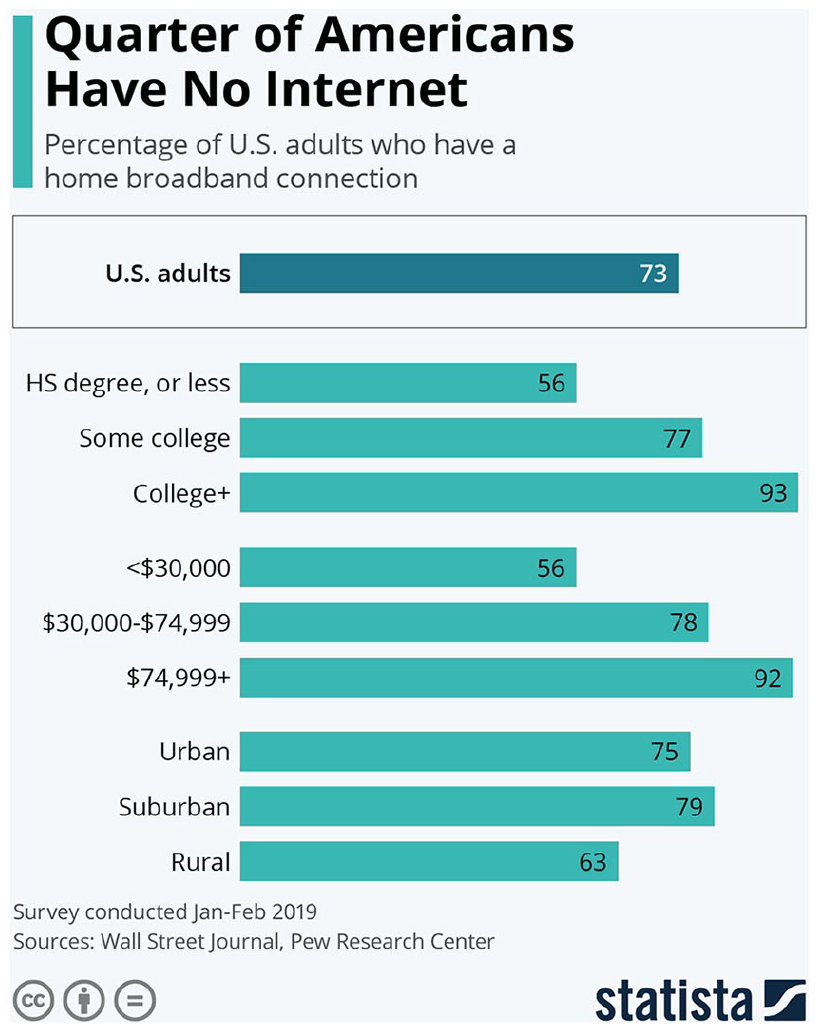
Percentage of U.S. Adults Who Have a Home Broadband Connection
Research from Pew also suggests there is an increasing trend of accessing the internet through smartphones. Some 46% of smartphone owners say when they are using the internet, they do so on their phone (Vogels et al., 2020). This percentage is larger for young adults: 60% of 18- to 29-year-olds report they primarily use their smartphone to access the internet. Using smartphones for internet access is especially popular for lower income adults, with nearly 1 in 4 lower income adults stating they are “smartphone-only” internet users (Anderson, 2019). Although using a smartphone is more convenient, it does not guarantee internet access. In 2019, for example, 81% of Americans reported having a smartphone, but 37% of those smartphone owners reported not having high-speed internet connection at home (Anderson, 2019).
COVID-19 Widened the Digital Divide and Amplified Systemic Racism
The COVID-19 pandemic has exacerbated the digital divide and perpetuated systemic racism and poverty. Black and Hispanic/Latinx adults surveyed by Pew are twice as likely to have canceled or cut their internet service due to financial strain than those identifying as White (Vogels et al., 2020). Indigenous and American Indian communities are the hardest hit by the pandemic and are the least connected when it comes to high-speed internet. According to data from the U.S. Census Bureau, there is a stark gap in high-speed internet access and usage by American Indian and Indigenous communities compared with those who do not identify as American Indian or Alaska Native (U.S. Census Bureau, 2018; Wang, 2018). Less than half of American Indian and Indigenous people living on reservations or tribal lands with a computer have access to high-speed internet service compared with 75% to 82% nationally (Wang, 2018). A major obstacle for expanding broadband internet on tribal lands is convincing service providers to build infrastructure in rural, less populated areas since it is less profitable for them. With less than 1% of FCC funding going toward expanding broadband to tribal areas and a lack of interest by internet companies, the digital disparity will continue to grow (Wang, 2018).
Recent studies also shine a light on how income disparity and poverty compound the effects of the pandemic for communities of color, further exacerbating digital inequity. There are examples of this everywhere, even in a tech hub like Seattle, Washington. Figure 2 compares households without internet access in New Mexico with those in King County, Washington, the state with the highest percentage of households connected. The percentage of those without access or with low speed can vary significantly depending on part of the county, ranging from 2.1% to 55.7%. According to the 2020 King County Broadband Access Study, households that made less than $75,000 a year for a family of four, in this expensive part of the country, faced significantly larger barriers to internet access. Black, Latinx, and Asian households participating in this study were disproportionately affected by income and digital disparity than those identifying as White (King County, 2020). Respondents in this survey who reported not having access to the internet in their homes were also less likely to have access to the training needed to navigate the online environment. These glaring inequities exemplify the digital divide that communities face throughout the United States; mapping these inequities by county and/or by census tract is helpful in communicating the extent of the problem to policymakers (see Center for Applied Research and Engagement Systems: https://careshq.org/map-room/).
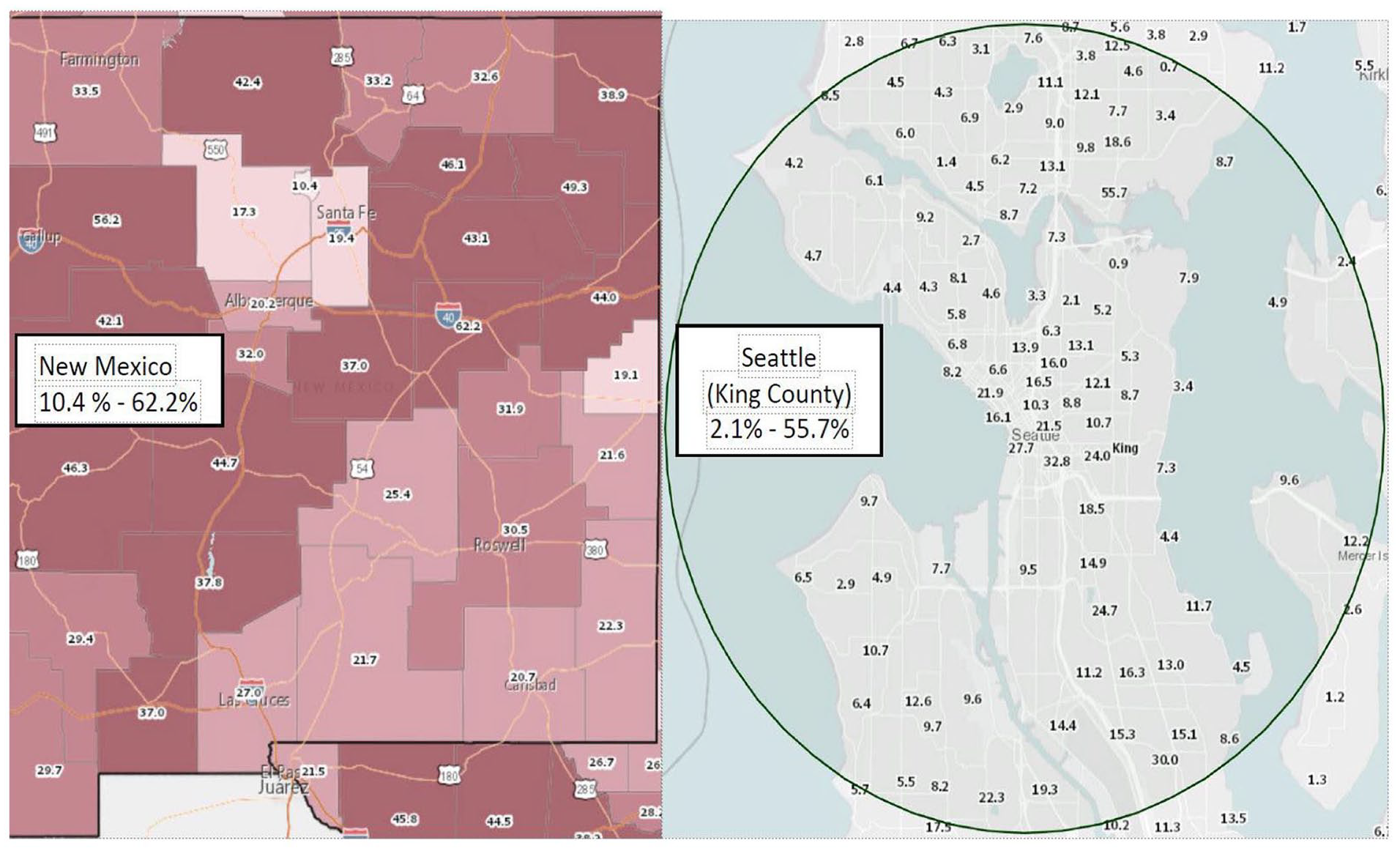
Households With No or Slow Internet, Percentage by County—New Mexico and Percentage by Tract—Seattle (King County, Washington)
Digital disenfranchisement, racism, and other structural barriers faced by communities of color have contributed to devastating loss of life from COVID-19. Lack of internet access is emerging as a barrier to vaccination as well. There is now evidence that the lack of broadband access is leading to unequal vaccination rates, with Black and Latino Americans receiving the COVID-19 vaccine at significantly lower rates than White adults (O’Brien, 2021). According to reports from the Centers for Disease Control and Prevention as well as popular news channels such as CNN, many state protocols privilege those with internet access to register online (O’Brien, 2021). While Wi-Fi and mobile devices do help bridge the gap for those without broadband, adults identifying as Black, Indigenous and people of color are twice as likely than Whites to have canceled or cut their phone or Wi-Fi service due to the expense (Vogels et al., 2020).
Broadband Internet Access Is a Social Determinant of Health
The COVID-19 pandemic has underscored the strong link between digital equity and health equity—a relationship that deserves more attention in public health. In a recent article published in the American Journal of Public Health, Benda et al. (2020) made the case that “now more than ever, broadband Internet access (BIA) must be recognized as a social determinant of health” (p. 1123). Having access to broadband internet, especially in times of pandemic and disaster, is vital for connecting people to the most basic of necessities, such as housing, food, health care, education, and income.
Broadband internet and Wi-Fi access affect one’s financial health. The COVID-19 pandemic has further widened the economic and health disparities between those in “white-collar” professional positions (who can work online from home), and those working in lower paying service jobs that require people to be physically on-site. For many in the United States, the only choice for economic survival is to work on-site. Less than 30% of workers in the United States can work from home, and the ability to work from home differs greatly by race and ethnicity (Gould & Shierholz, 2020). According to a recent study by the Economic Policy Institute, just 20% of Black workers and 16% of Hispanic/Latinx workers in the United States are able to work from home online, compared with 30% of non-Hispanic/Latinx White workers and 37% of Asian workers. This is largely due to systematic racism and economic oppression: A larger proportion of Black and Hispanic/Latinx workers are employed in essential service, domestic, and lower wage jobs compared with those who identify as non-Hispanic Whites and Asians (Gould & Shierholz, 2020).
Access to broadband internet also affects education. National- and state-level data during the time of COVID-19 demonstrate large gaps in students’ access to broadband internet as well as hardware, such as computers and laptops. As many schools moved to virtual instruction during the pandemic, students and families struggled not only to access technical equipment but also for access to Wi-Fi and broadband. In Washington State, for example, some districts reported 50% or more of students and families not having access to internet at home (Equity in Education Coalition, 2020). Even King County, one of the country’s technology hubs, showed how the digital divide persists. Results from the King County Broadband Access Study (King County, 2020) reported that 20% of households lacked any internet access at home and another 17% were “access stressed,” having problems connecting online due to slow speeds or unstable connections (Schachter et al., 2020). Additionally, 500,000 households relied solely on limited cell phone plans, while 30,000 still reported using slower dial-up services (King County, 2020). Results from a 2020 Pew Research Center national survey (n = 4,720) showed that 59% of low-income (≤$37,500) parents said their child had problems with completing schoolwork because they had to do it on their phone, use public Wi-Fi due to slow home internet, or did not have access to a home computer (Vogels et al., 2020).
Broadband internet is also vital to health care delivery, health literacy, and public health (Benda et al., 2020; Estacio et al., 2019; Raths, 2020). People experiencing poor health outcomes are more likely to have low or no broadband connection (FCC, 2017; Raths, 2020). This disparity widens even more during the times of pandemic when many health services and patient appointments are forced to go online. Consequently, the least connected countries generally have the highest rates of chronic disease, and preventable hospitalizations (i.e., hospital stays that could have been avoided with appropriate care) are 1.5 times higher in the least connected counties compared with other counties (FCC, 2017).
Internet access is also significant to public health prevention and surveillance efforts. Public health departments may leverage online and digital strategies for social marketing, phone-based apps and data tools that help monitor and prevent transmission of a virus, text messaging (for contract tracing and alerts), and mobile health education.
Internet Service Providers Are Not Held Accountable for Failing to Deliver
The United States has struggled to achieve broadband for all for many reasons, but a major factor is that the federal government currently views broadband internet as free enterprise rather than a regulated resource (like public utilities). Large communications companies that dominate the industry have been allowed to self-govern in the United States with little accountability. Although they are overseen by the FCC, little has been done to penalize them when they fail to deliver on their subsidized promises of expanding broadband to areas and communities most in need. For example, in 2015, the FCC pledged a total of $505 million over the course of 6 years to internet provider CenturyLink. These federal funds were to be used in expanding broadband availability in rural communities (McCabe, 2020). Although the company consistently failed to reach its broadband targets, it was not sanctioned by the FCC and continued to be eligible for federal funding. These inconsistent standards fell even further when the Trump administration voted to repeal net-neutrality regulations, which stripped the FCC of the little authority it had over internet providers.
With more and more Americans shifting to life online during the COVID-19 pandemic, providers like Charter and Xfinity have pledged to help individuals with fewer resources get connected. These companies have offered free and low-cost internet resulting in scores of people signing up, relieved to finally get assistance with staying connected. Unfortunately, these programs do little to address broadband inequity in the long term, as those enrolled in these programs faced hurdles to service, including language barriers, long wait times, surging prices, and not meeting the reduced cost qualifications. Many grassroots efforts have helped mitigate these issues locally, but they fail to address the problem on a broader scale, leaving many people out.
Access to Broadband Is a Health Advocacy Issue
We can all play a role in advocating for digital equity. People can contact their representatives at the local and state levels to discuss the need for expanded broadband access and emphasize the need for policymakers to take action. Individuals can vote for those who lead or support efforts to expand digital inclusion, and they can participate in county, state, and national coalitions, and task forces to achieve internet for all. Advocacy efforts locally could include community organizing to drive policy change and volunteering to provide training and education to build digital literacy skills that complement broadband expansion.
Additionally, building coalitions that include state agencies, nonprofits, and corporations can help secure funding and resources (e.g., “hotspots” or computers) for those in need as well as heighten social consciousness of the issues. For example, the California Emerging Technology Fund (CETF) has worked for over a decade to build partnerships and to pass public policy that promotes digital equity (CETF.org). CETF became a “catalyst for action” by setting overarching goals for broadband deployment and adoption and then enlisting existing civic leaders and community organizations to help achieve them. In addition to offering seed grants to nonprofits to provide technologies as well as digital literacy training to California residents, CETF worked at the policy level. They pushed for sufficient funding to improve implementation of broadband, which resulted in the former CA governor, Jerry Brown, signing the Internet for All Now Act of 2017 into law. It provided $330 million for broadband infrastructure expansion and adoption in California.
Nationally, public health and other health organizations can put digital equity on their advocacy agendas to align with national and global objectives. Connecting broadband to other policy priorities, including economic development, transportation, and education will also help underscore its importance and increase alliances, partnerships, and funding opportunities.
Advocating for access to broadband internet should also go beyond just calling for adequate infrastructure for widespread connection: Access also includes making it affordable, creating inclusive technologies, and enhancing people’s digital literacy to use the technology (Equity in Education Coalition, 2020). Increasing research relating to digital equity and evaluating strategies to improve it is also another form of advocacy.
The time has come to make digital inclusion and equity a reality. In March 2021, House Majority Whip James E. Clyburn (D-SC) and U.S. Senator Amy Klobuchar (D-MN), cochair of the Senate Broadband Caucus, introduced comprehensive bicameral broadband infrastructure legislation to expand access to affordable high-speed internet for all Americans. If passed, the Accessible, Affordable Internet for All Act (H.R. 1783) will invest more than $94 billion to build high-speed broadband infrastructure in unserved and underserved communities to close the digital divide and ensure Americans have internet. Additionally, it would provide $5 billion in grant funding for states to close the digital gaps through community-level strategies and programs and provide funding and resources for students who need internet to learn remotely (Accessible, Affordable Internet for All Act, 2021). Passing H.R. 1783 would be a show of bipartisan efforts toward improving digital inclusiveness and health equity in America.
Conclusion
The COVID-19 pandemic has unearthed our reliance on broadband internet, not as a luxury but as an essential utility such as water and electricity. Bauerly et al. (2019) referred to broadband internet access a “super determinant of health” because so many other social determinants (e.g., education, health care, food, income) hinge on it. Although we have made strides as a nation to increase broadband internet, a digital divide persists, especially among groups that have experienced economic and racial oppression. Other countries, such as South Korea and Sweden, have offered some promising solutions: Their governments have invested in building out broadband infrastructure across their countries like interstate highways. Sweden, for example, set the goal of having 98% of their population being connected to broadband internet by the year 2025 (Swedish Ministry of Enterprise and Innovation, 2016). Their national broadband plan includes public and private efforts to expand infrastructure for broadband with government investment and to provide incentives for private companies that include accountability measures.
Achieving digital equity calls for an ecological, systemic approach that involves many facets of our society, including public health and health care. Some have called digital equity “a civil rights issue of our day” (Lynch, 2017). Yet access to the internet is often overlooked in our discussions and agendas pertaining to health equity. Collectively, we can help close the digital gaps in multiple ways, including digital equity in our organization’s strategic plans and on our advocacy agendas, partnering with communities and organizations to provide solutions for improving access and digital literacy, and contributing to the growing research that explores the impact of digital connectivity on health and well-being.

References
Supplementary Material
Please find the following supplemental material available below.
For Open Access articles published under a Creative Commons License, all supplemental material carries the same license as the article it is associated with.
For non-Open Access articles published, all supplemental material carries a non-exclusive license, and permission requests for re-use of supplemental material or any part of supplemental material shall be sent directly to the copyright owner as specified in the copyright notice associated with the article.
