



Abstract
This study synthesises the prevalence of self-reported child sexual exploitation and abuse (CSEA) perpetration by adults from the general population. We conducted a systematic review and proportional meta-analysis, searching eight electronic databases and grey literature sources up to August 1, 2025, supplemented by citation tracking. Inclusion criteria specified quantitative observational studies in English that sampled community-based adults (aged 18 and older) and reported primary, self-report data (numerator and denominator) on CSEA perpetration (contact or noncontact) against children (under 18). Studies using clinical, forensic, or specialised samples were excluded. Thirty-eight studies met the inclusion criteria. Proportional meta-analysis using random-effects models (with Hartung–Knapp adjustment to account for sparse data) yielded a sex-standardised prevalence for contact offending of 4.5% (any child age), 2.0% (pubescent), and 1.5% (prepubescent). Noncontact offending prevalence was 6.5% (any age), 6.2% (pubescent), and 1.7% (prepubescent). Subsequent analysis of sex-separated estimates, excluding influential outliers, found the prevalence of contact and noncontact offending against prepubescent children to be 1.6% and 2.5% for men and 1.0% and 0.5% for women, respectively. Among men, noncontact offending was approximately twice as prevalent as contact offending, whereas for women, contact and noncontact prevalences were similar. These findings are the first attempt to provide population-level benchmarks for self-reported CSEA perpetration, though results should be interpreted cautiously due to high heterogeneity and reliance on non-representative samples.
Keywords
Introduction
Child sexual exploitation and abuse (CSEA) is the actual, attempted, or threatened sexual use of a person under age 18 years (WHO, n.d), and encompasses a range of acts including rape, indecent communications, sex trafficking, and the production and consumption of child sexual abuse material (CSAM). Globally, CSEA is widespread: recent meta-analyses indicate that the international lifetime childhood prevalence of sexual assault and rape were 8.7% and 6.1% (Piolanti et al., 2025), while online solicitation and sexual exploitation were 11.5% and 7.3% (Fry et al., 2025), respectively. Rates of contact and noncontact abuse also appear to be more frequent in girls than boys (Ruiz-Ramos et al., 2025). According to UNICEF (2025), approximately 650 million girls and women and 500 million boys and men experienced unwanted sexual acts during childhood, around half of whom were forcefully penetrated or sexually assaulted.
The harms associated with CSEA extend beyond the immediate trauma of abuse, impacting survivors’ long-term health and well-being. For example, an umbrella review of 19 meta-analyses found that childhood sexual abuse substantially increased the risk of a range of health and psychosocial adversities in adulthood, including HIV, substance misuse, self-harm, mood disorders, and criminal offending (Hailes et al., 2019). Recent largescale epidemiological evidence also indicates that adults sexually abused during childhood reportedly experience significantly more days of poor mental and physical health per month (Akinyemi et al., 2025). The economic costs attributed to CSEA are likewise substantial. In the United States, a single year of new victimisations were associated with a lifetime economic burden of approximately USD $9.3 billion (Letourneau et al. 2018), while the potential annual aggregate productivity loss is between USD $38 billion to USD $44 billion (Henkhaus 2022). In the United Kingdom, the lifetime economic burden of undetected online CSEA offenders were estimated to be £1.4 billion (Giles et al., 2024).
Technological advances and global mobility have expanded the marketplace for CSEA. The widespread availability of high‑speed internet and encrypted platforms has enabled offenders to trade CSAM and interact with victims across borders at an increasing rate. The National Center for Missing & Exploited Children (NCMEC, 2024) received over 36 million reports of online CSEA worldwide in 2023: a 23% increase from 2021, including a 300% increase in online enticement of children for sexual acts. Likewise, in 2024 the Internet Watch Foundation (IWF, 2025) identified 291,273 URLs containing CSAM – the highest on record. Despite this upward trend, the number of reports of online CSAM are expected to decline as mainstream social media platforms increasingly adopt end-to-end encryption, effectively making it impossible for electronic service providers to detect and remove abusive content (Teunissen & Napier, 2022).
While the prevalence of CSEA victimisation is increasingly documented, far less is known about the prevalence of adult perpetrators in the general population. Estimates of perpetrator numbers vary depending on the data source (Lussier et al., 2020). For example, victim‑based prevalence data can overestimate offender counts as a single perpetrator can abuse multiple victims (DeLisi et al., 2016; Wortley & Smallbone, 2014), or underestimate it given sexually groomed children are often manipulated to believe that they are not victims (Wolf et al., 2018). Conversely, data from criminal justice systems only capture identified perpetrators and therefore represent a lower bound; many perpetrators remain hidden, and those who are caught often have an extensive history of undetected sexual offences (Drury et al., 2020; Neutze et al., 2012). The same issues also apply to self‑report studies drawn from forensic or clinical samples, as they rely either on known perpetrators or those at risk of offending. Anonymous self‑report surveys administered to community‑based samples offer a relatively more accurate means of estimating the prevalence of CSEA offenders, including those who have evaded detection, because they allow individuals to disclose sensitive information without fear of legal or personal repercussions (Gnambs & Kaspar, 2015; Gomes et al., 2019).
Improving estimation of the prevalence of adult CSEA perpetrators is critical for sound policy, service provision, and prevention. Underestimates risk leaving child protection services underfunded, while overestimates can trigger moral panic and overly punitive responses that divert resources away from prevention and rehabilitation (Klein & Cooper, 2019). While community-based studies offer valuable insights, their findings vary widely by sample, setting, and methodology, making it difficult to draw reliable conclusions. For example, the prevalence of self-reported contact and noncontact offending against children under age 18 years by adult men can range from as low as 0.3% (Alanko et al., 2013) and 1.0% (Brown 2003) for large representative samples, to as high as 20.6% (Stroebel et al., 2020) and 21.1% (Ray et al., 2014) for smaller non-probability based samples. Critically, reliance on any single study risks misrepresenting the true prevalence of perpetrators.
Systematic reviews and meta-analyses are the preferred approach for synthesising evidence because they reduce bias, increase precision, and improve generalisability by pooling data across studies (Borenstein et al., 2021), while explicitly modelling between-study heterogeneity and subgroup differences (Higgins, 2008). Currently, no such studies have collated self-report data on the prevalence of CSEA perpetrators in the general population. To address this gap, we conducted a systematic review and proportional meta-analysis of self-reported CSEA perpetration among adults drawn from community-based samples, specifically excluding clinical, forensic, and other specialised groups. We estimated pooled prevalences stratified by victim age (any, pubescent, and prepubescent) and contact type (contact and noncontact) to accommodate variation in operational definitions and measurement. We also conducted sex-specific subgroup analyses to descriptively compare prevalences for men and women because of the fact that that men account for most detected child sexual offences (e.g., Cortoni et al., 2017).
Methods
Protocol and Reporting
This study was reported according to PRISMA 2020 (Page et al., 2021) and the Meta-analysis Of Observational Studies in Epidemiology recommendations for meta-analyses of observational studies (Stroup et al., 2000). Our study protocol was pre-registered (https://doi.org/10.17605/OSF.IO/NCFDX), specifying our research questions, expectations, eligibility criteria, data items, and analysis plan. We deviate from the protocol by excluding the specified secondary analyses (i.e., prevalence estimates moderated by study region, quality, and period) due to insufficient data.
Eligibility Criteria
Our focus was on quantitative observational studies reporting the prevalence of self‑reported perpetration of CSEA by adults aged 18 years and older. Observations were limited to adult samples to minimise the risk of misclassifying consensual and/or legal acts between minors as CSEA. Eligible studies had to: (a) be published in a peer‑reviewed journal or identified through a structured search of grey literature; (b) report primary data (not reviews or conference abstracts); (c) be published in English; (d) be available on or before 1 August 2025; (e) sample adults aged 18 years and older from general community‑based populations, explicitly excluding clinical and forensic samples, as well as specialised samples of community members with self-identified sexual interests in children; (f) report a numerator (number of perpetrators) and denominator (sample size), or provide sufficient information to calculate these; and (g) obtain CSEA perpetration rates directly from self‑reports of offending, excluding self-reported arrests, charges, and/or convictions for child sex related offences, as these only capture detected offenders. Studies covering both contact and non‑contact forms of CSEA were eligible; those measuring sexual interests or feelings towards children without engagement in CSEA related behaviours were excluded.
We define CSEA perpetration as any behaviour involving engagement in or viewing of sexually explicit acts or content involving a child aged under 18 years. This includes, but is not limited to: (a) physical sexual contact with a child, including touching and oral, vaginal, or anal penetration; (b) producing, accessing, possessing, purchasing, or distributing CSAM or other explicit images of a child; (c) interactive offences via digital media, such as online grooming, sexual solicitation or enticement, sexually explicit communication with a child, and viewing or facilitating livestreamed sexual abuse; and (d) knowingly participating in or facilitating commercial sexual exploitation of children.
Search Strategy
The electronic databases Criminal Justice Abstracts, OSF, ProQuest, PsycINFO, PubMed, Scopus, SSRN, and Web of Science were used to search for scholarly journal articles (including pre-prints), government and non-government reports, and theses/dissertations published in English any time up to 1 August 2025. Searches were conducted on 10 August 2025, flagging studies with the following key terms in the title or abstract: ([“child sexual abuse” OR CSA OR “child sexual assault” OR “child sexual exploitation” OR CSEA OR “sexual offending against children” OR “sexual offence against children” OR “child molestation” OR “contact offense*” OR “contact offence*” OR pedophilia OR paedophilia OR ephebophilia OR ephebephilia OR “image-based sexual abuse” OR IBSA OR “child sexual abuse material” OR CSAM OR “child exploitation material” OR CEM OR “child pornography” OR “online grooming” OR “child luring” OR “online solicitation” OR sexting OR “livestream abuse” OR “commercial sexual exploitation of children” OR CSEC OR “child sex tourism”] AND [perpetrat* OR offend* OR abus* OR aggress*]) AND (prevalence OR rate* OR frequency OR proportion* OR epidemiology OR survey* OR statistic* OR incidence) AND (“general population” OR “community sample*” OR “survey*” OR “population*” OR “representative sample”). Additional search methods included examining the reference lists and forward citations of included studies and relevant systematic literature reviews (e.g., Fry et al., 2025; Piolanti et al., 2025), as well as AI suggestions produced from GPT-5 (OpenAI, 2025), Gemini 2.5 pro (Google DeepMind, 2025), and Elicit (Ought, 2025).
Study Selection
Figure 1 details the study identification and screening process. The database search yielded 4,492 documents, while 60 were identified via other methods. After excluding duplicates (n = 2,222) and inappropriate document types (n = 120), the titles and abstracts of the remaining 2,210 studies were extracted to Microsoft Excel and reviewed for eligibility. Two human reviewers independently screened titles and abstracts with near perfect agreement (Cohen’s k = 0.90). Additional screening was also conducted using an AI assistant (Elicit) as a supplemental check and to strengthen the robustness of the screening process. Agreement between the AI and human reviewers was fair (Cohens k = 0.41), and disagreements were resolved by the lead author.
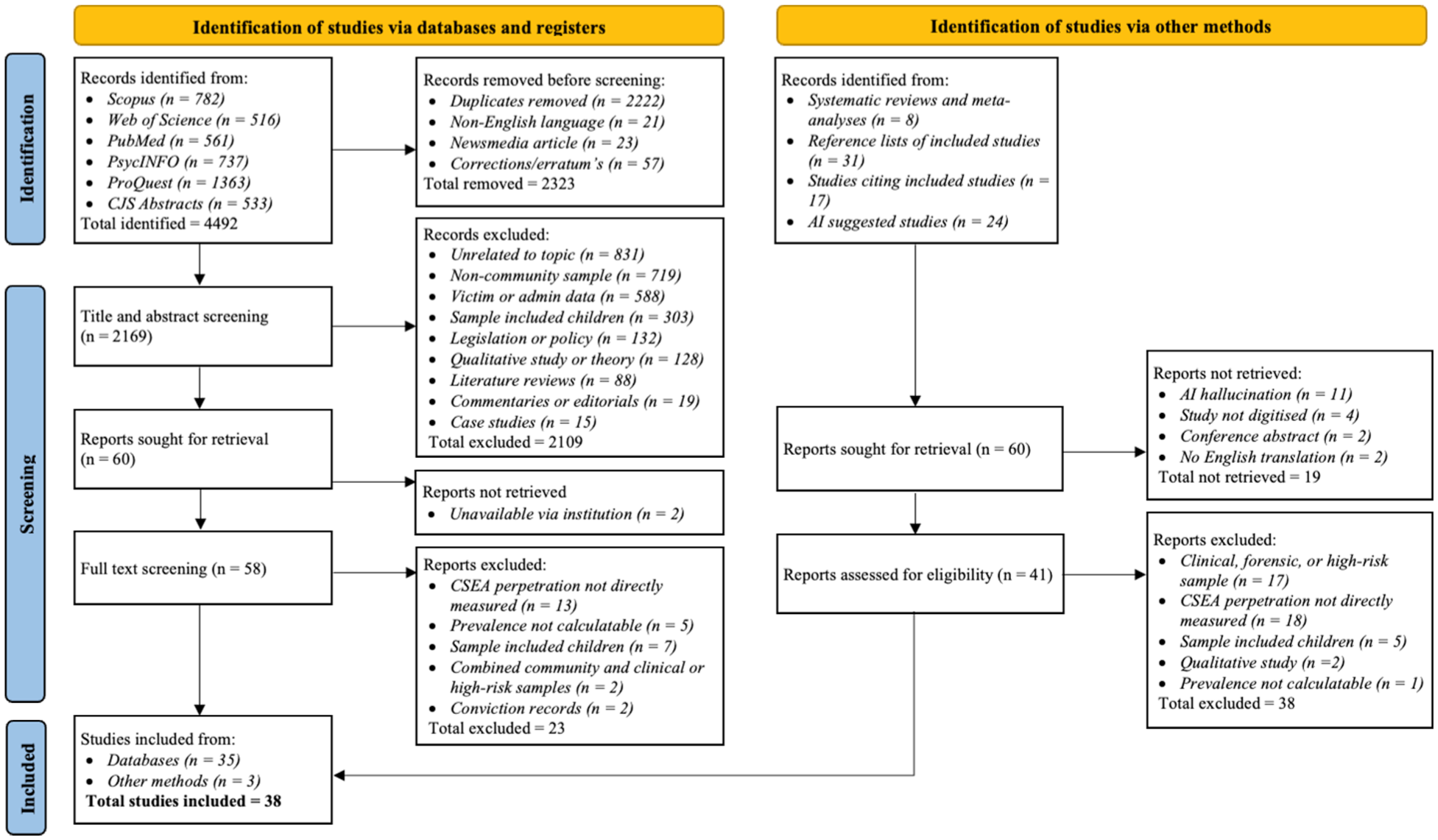
PRISMA study selection flowchart.
Most studies (n = 2,109) were deemed ineligible, often due to the research not related to CSEA (e.g., adult sexual assault and domestic violence), inappropriate sampling frame (e.g., clinical and forensic samples), and use of victimisation or administrative data. Full-text screening was conducted on the remaining 99 articles available for retrieval by two human reviewers (Cohens k = 0.89). Sixty-one studies were excluded, typically due to not including a direct self-reported measure of CSEA perpetration. Several studies also reported estimates from the same dataset; those with the most complete information were retained. Thirty-eight studies were ultimately included. All disagreements about study inclusion were resolved by consensus between co-authors.
Quality Assessment
Methodological quality and risk of bias were assessed using an ad hoc adaption of the JBI critical appraisal checklist for prevalence studies (Munn et al., 2015). Several items were reworded to be more specific to this review and reduce ambiguity between reviewers. Three additional questions created by the authors were also included to assess potential response bias from the self-disclosure of sensitive behaviours (Gnambs & Kaspar, 2015; Yan, 2021). Responses to the following questions were coded as 1 (yes) or 0 (no, unclear, or N/A), with scores summed to reflect overall quality of prevalence data: (a) was the sample frame appropriate for targeting adults from the general community; (b) did participant recruitment aim for representativeness (e.g., probability sampling, quota benchmarks, and post-stratification weights); (c) was the denominator for CSEA prevalence, including for subgroups, greater than n = 239; 1 (d) did the response and completion rate exceed 60%, or was non-response bias addressed; (e) were descriptive statistics provided for age, sex, and at least two other demographic characteristics (e.g., educational attainment, relationship status, and ethnicity); (f) were the distribution of demographic factors relatively proportionate to the expected distribution of the target population; (g) were surveys conducted anonymously online; (h) were participant honesty, attention, and response patterns examined, and low-quality respondents removed; (i) were validated measures of CSEA perpetration used; (j) did items measuring perpetration explicitly specify acts committed since turning age 18 years; (k) did items use neutral, non-judgemental wording to avoid stigmatising labels (e.g., person under 18, minor, and underage person); and (l) was CSEA perpetration measured in a standard, reliable way for all participants. Quality assessment (QA) scores for each item are provided in Supplemental Table 1.
QAs were conducted by two independent human reviewers with excellent single (ICC = 0.92) and mean (ICC = 0.96) rater reliability (Koo & Li, 2016). As an additional check, the methodological quality of publicly available studies were also assessed by two AI agents (OpenAI, 2025; Google DeepMind, 2025); interrater reliability was excellent when combined with human scores (single ICC = 0.90; mean ICC = 0.97). The derived QA score was based on consensus. Scores can range from 0 to 12, with higher scores indicating greater methodological quality. Disagreements between human reviewers were resolved by consensus between co-authors; differences between human and AI scores were decided by the lead author.
Data Extraction
For each included study, we recorded: (a) bibliographic details; (b) data source; (c) study design; (d) year and country survey was administered; (e) total and subgroup sample size; (f) age and sex composition; (g) measurement of CSEA perpetration; and (h) the numerators and denominators needed to compute prevalence, including sex‑specific estimates if reported. 2 Prevalence estimates were extracted separately by CSEA type (contact and noncontact offending) 3 and victim age (any, pubescent, and prepubescent). 4 Survey-weighted prevalence estimates were extracted when available; otherwise, unweighted proportions were calculated from the reported numerators and denominators. All data were extracted by the lead author; for publicly available studies, the accuracy of the data extracted were checked by two AI agents (Cohens k = 0.86).
Statistical Analysis
We estimated pooled prevalences of self-reported CSEA perpetration via proportional meta-analysis, stratified by contact type and victim age, analysing adults combined and stratified by sex. Proportions were synthesised with random-effects models with Hartung–Knapp adjustment (IntHout et al., 2014) using the Freeman–Tukey double-arcsine transformation (PFT) to accommodate sparse and zero event data, then back-transformed to the proportion scale using inverse PFT (with harmonic-mean sample size safeguards). Primary analyses used multilevel meta-regressions (restricted maximum likelihood; REML) with a study-level random intercept to account for clustering of sex-specific strata within studies. Sex composition was centred to 50% male so that the intercept produced the sex-standardised prevalence, with model predictions back transformed to provide 95% confidence intervals (CIs). We used cluster-robust (CR2) standard errors with Satterthwaite degrees of freedom to account for small-sample within-study dependence (Tanner-Smith et al., 2016). For descriptive purposes, we also fit unadjusted (non-sex standardised) fixed and random-effects model (REML with Hartung–Knapp adjustment), first with sex strata collapsed to account for clustering, and second for men and women separately.
We identified influential outliers on the PFT scale using Cook’s distance (D), hat values (leverage), and Difference in Fits (DFFITS) from the random-effects model. Studies were flagged if they exceeded (a) Cook’s D above the 95% of its empirical distribution, (b) hat values greater than twice the average leverage (2p/k), or (c) DFFITS greater than 2√(p/k), where p is the number of model parameters and k the number of studies (Viechtbauer & Cheung, 2010). We then conducted supplementary sensitivity analyses refitting the meta-analysis without the flagged studies to evaluate the robustness of the pooled estimates and heterogeneity.
Small-study effects were assessed using the Luis Furuya–Kanamori (LFK) index (Furuya-Kanamori et al., 2018). This assesses asymmetry, denoted as systematic imbalance where smaller, less precise studies yield different prevalence estimates than larger studies (consistent with small-study effects such as publication bias or methodological heterogeneity). An LFK score between −1 and +1 suggests no asymmetry, while scores exceeding −2 and +2 indicate major asymmetry. Between-study heterogeneity was assessed using the I2 statistic; scores greater than 50% indicate that variability in effect estimates is likely due to study heterogeneity rather than sampling error (Higgins et al., 2009). Heterogeneity is usually higher in proportional meta-analyses due to differences in the time and place studies were conducted; this does not necessarily indicate inconsistencies across data, and the I2 statistic ought to be interpreted conservatively (Barker et al., 2021). However, to aid interpretation, we also present the 95% prediction intervals (95% PI), which reflect the expected range of the true prevalence in similar studies. For all meta-analyses, we prioritise interpretation of the random-effects models. All analyses were conducted using R version 4.4.2 (R Core Team, 2024) using the “meta” (Balduzzi et al., 2019), “metafor” (Viechtbauer, 2010), “clubSandwich” (Pustejovsky, 2025), “metasens” (Schwarzer et al., 2025), “brms” (Bürkner, 2021), and “posterior” (Bürkner et al., 2025) packages.
Results
Summary of Included Studies
Table 1 provides the details of the 38 studies, including QA scores and the numerators and denominators used to calculate prevalence. All studies guaranteed participant anonymity. The majority relied on convenience samples (k = 29) or were administered online (k = 27). In-person surveys were rare (k = 9), especially among more recently published research. Most studies were based on North American or European populations; 12 drew participants from multiple countries. Contact offending was measured more often than noncontact offending. Victim age targets most commonly referred to prepubescent children (k = 26), followed by any child age (k = 19), then pubescent children (k = 11). Twenty-one studies provided estimates for both men and women, 14 for just men, and 3 for only women. Denominators ranged from 61 to 10,044, with subsamples ranging from 23 to 8718 for men and 28 to 6832 for women. The largest studies were based on online surveys. QA scores ranged from 3 to 9, with a mean score of 6.45 (SD = 1.67; Q1 = 5, Q3 = 8).
Details of Included Studies.
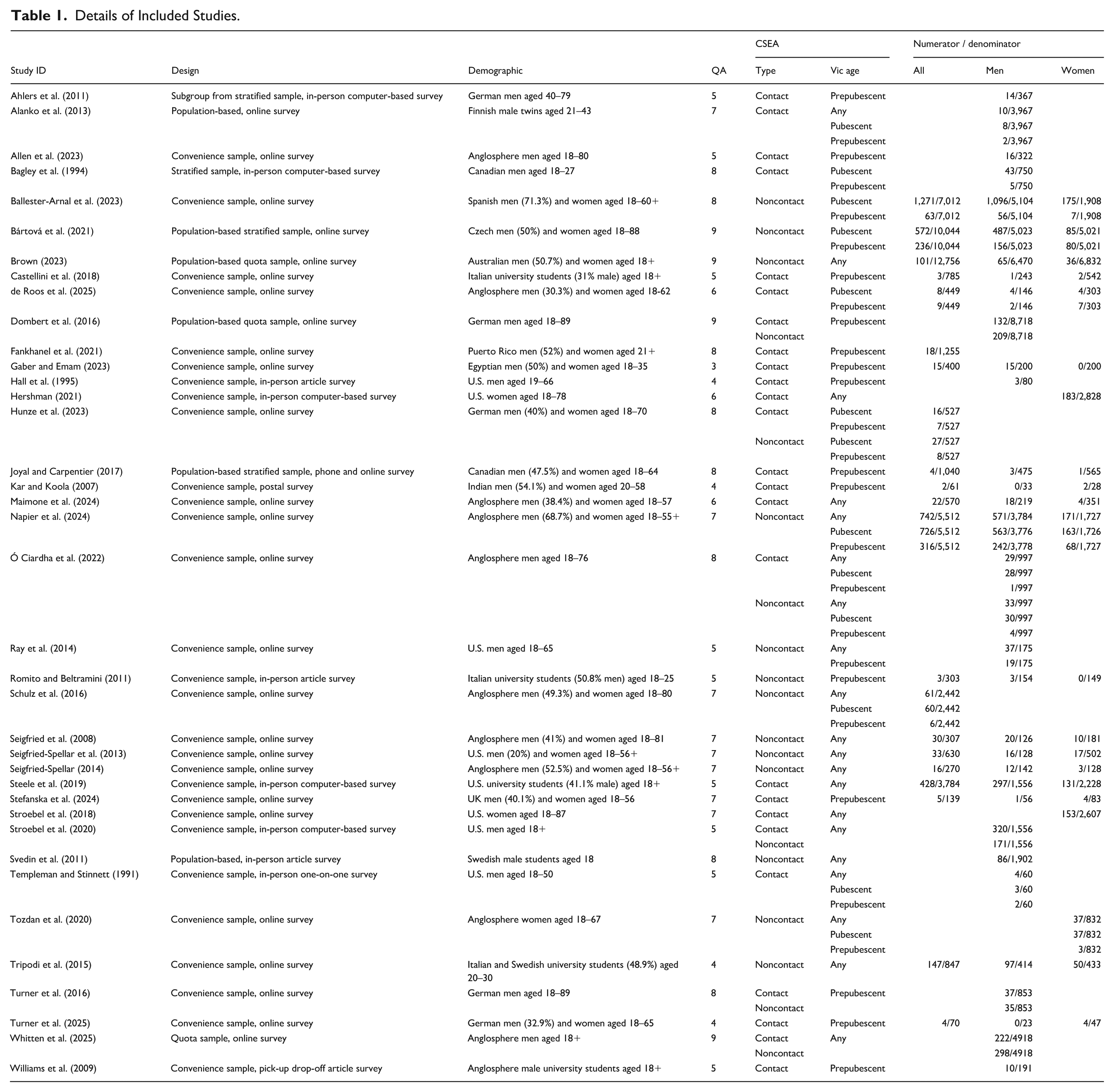
Across studies, CSEA perpetration was measured using a heterogeneous mix of validated multi-item scales and bespoke survey items spanning contact behaviours, image-based offences, and online interaction. Many prevalence estimates were extracted from larger scales measuring paraphilic behaviour, interest, and fantasies, typically as binary indicators for specific acts or as Likert-type frequency responses later dichotomised as never versus once or more. Age thresholds varied from explicit prepubescent cut-offs to broader under 18 definitions. Some surveys applied additional age-gap rules between perpetrators and children (e.g., offender 10+ years older) to exclude sexual activities with closely aged peers. Recall periods were inconsistent, including lifetime, past-year, or since turning 18. Contact measures ranged from fondling and caressing to penetrative acts, often listed as behaviourally specific items. Noncontact measures included CSAM access (searching, viewing, downloading, and sharing) and online solicitation and sexual communication with children, sometimes distinguishing prepubescent and pubescent targets.
Small Study Effects
Major positive asymmetry (LFK > +2) was evident in around half of the primary meta-analysis models (LFK range 2.45–5.17), indicating that smaller studies were producing relatively higher prevalence estimates. Major negative asymmetry (LFK < −2) was only found in three models (LFK range −3.04–−2.18), suggesting relatively lower prevalence estimates among smaller studies. This pattern may reflect publication bias, where small studies reporting higher or “noteworthy” prevalences are more likely to be published, as well as true between-study heterogeneity, or methodological artefacts (Furuya-Kanamori et al., 2025). Major asymmetry was somewhat attenuated in sensitivity analyses that excluded influential outliers.
Sex-Standardised Perpetration Prevalence
Table 2 presents the unadjusted and adjusted fixed and random-effects proportional meta-analysis models for contact CSEA stratified by victim age. The sex-standardised random-effects prevalence of contact offending was 4.5% (95% CI [0.9, 10.6]; 95% PI [0.0, 29.8]; I2 = 97.3%; LFK = −0.63) for children of any age, 2.0% ([0.1, 5.7]; 95% PI [0.0, 12.1]; I2 = 82.8%; LFK = 2.59) for pubescent children, and 1.5% ([0.7, 2.7]; 95% PI [0.0, 6.7]; I2 = 60.8%; LFK = 3.82) for prepubescent children. Funnel plots for the unadjusted models are presented in Supplemental Figures 1 to 3. Sensitivity analyses excluding outliers slightly reduced heterogeneity and small-study effects while also increasing prevalence estimates to 5.2% ([1.3, 11.4]; 95% PI [0.0, 26.1]; I2 = 95.0%; LFK = −0.63), 2.7% ([0.7, 5.7]; 95% PI [0.3, 7.0]; I2 = 41.4%; LFK = 1.05), and 1.7% ([0.8, 2.9]; 95% PI [0.0, 6.6]; I2 = 55.7%; LFK = 3.34), respectively (see Supplemental Table 2).
Pooled Prevalence (95% CI) of Self-Reported Engagement in Contact CSEA by Adult Men and Women.
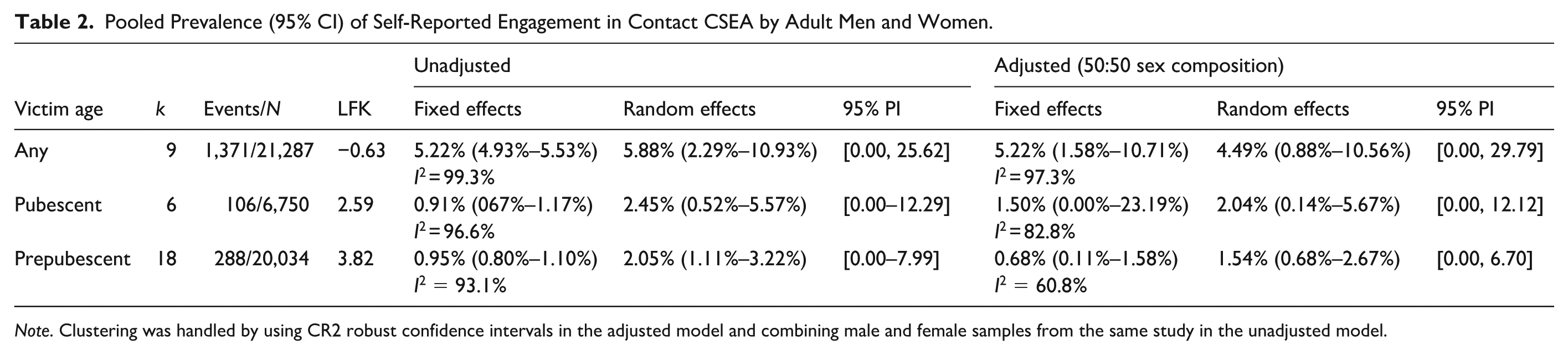
Note. Clustering was handled by using CR2 robust confidence intervals in the adjusted model and combining male and female samples from the same study in the unadjusted model.
Estimates for noncontact CSEA were somewhat higher. Presented in Table 3, the sex-standardised prevalence of noncontact offending against any aged children was 6.5% (95% CI [3.8, 9.8]; 95% PI [0.0, 22.2]; I2 = 94.0%; LFK = 2.8), for pubescent children 6.2% ([2.3, 11.6]; 95% PI [0.0, 23.5]; I2 = 98.5%; LFK = −0.86), and for prepubescent children 1.7% ([0.6, 3.3]; 95% PI [0.0, 8.7]; I2 = 92.4%; LFK = −0.48). Funnel plots for the unadjusted models are presented in Supplemental Figures 4 to 6. Exclusion of outliers marginally decreased estimates to 6.0% ([3.2, 9.5]; 95% PI [0.0, 21.5]; I2 = 93.7%; LFK = 1.32), 6.1% ([2.5, 11.1]; 95% PI [0.0, 23.0]; I2 = 98.3%; LFK = −0.99), and 1.6% ([0.6, 2.9]; 95% PI [0.0, 7.0]; I2 = 91.0%; LFK = −0.79), respectively (see Supplemental Table 3). Notably, within each victim age group, the sex-standardised prevalence was similar for contact and noncontact offending against any and prepubescent aged children, whereas for pubescent children, noncontact offending was around twice as prevalent as contact offending.
Pooled Prevalence (95% CI) of Self-Reported Engagement in Noncontact CSEA by Adult Men and Women.
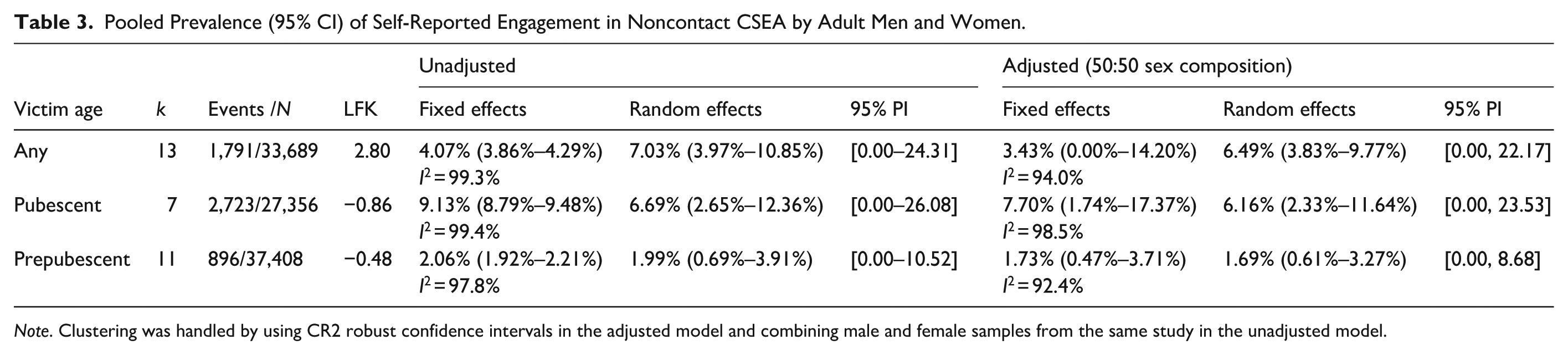
Note. Clustering was handled by using CR2 robust confidence intervals in the adjusted model and combining male and female samples from the same study in the unadjusted model.
Sex-Separated Contact Perpetration Prevalence
Table 4 presents the proportional meta-analysis models for contact CSEA separately for men and women and stratified by victim age. Sensitivity analyses are provided in Supplemental Table 4. The prevalence of contact offending against children of any age by men and women were 5.7% (95% CI [0.7, 14.8]; 95% PI [0.0, 35.6]; I2 = 99.4%; LFK = 2.19) and 4.7% ([1.3, 10.1]; 95% PI [0.0, 18.0] I2 = 88.5%; LFK = −2.72), respectively. The direction of these estimates flipped when removing influential outliers, to 4.8% ([1.6, 9.5]; 95% PI [0.1, 15.3]; I2 = 77.1%; LFK = 3.4) for men and 6.1% ([5.0, 7.3]; 95% PI [5.0, 7.3]; I2 = 0.1%; LFK = 1.38) for women, noting that the paucity of female data likely produced unreliable estimates.
Pooled Prevalence (95% CI) of Self-Reported Engagement in Contact CSEA Separately for Adult Men and Women.
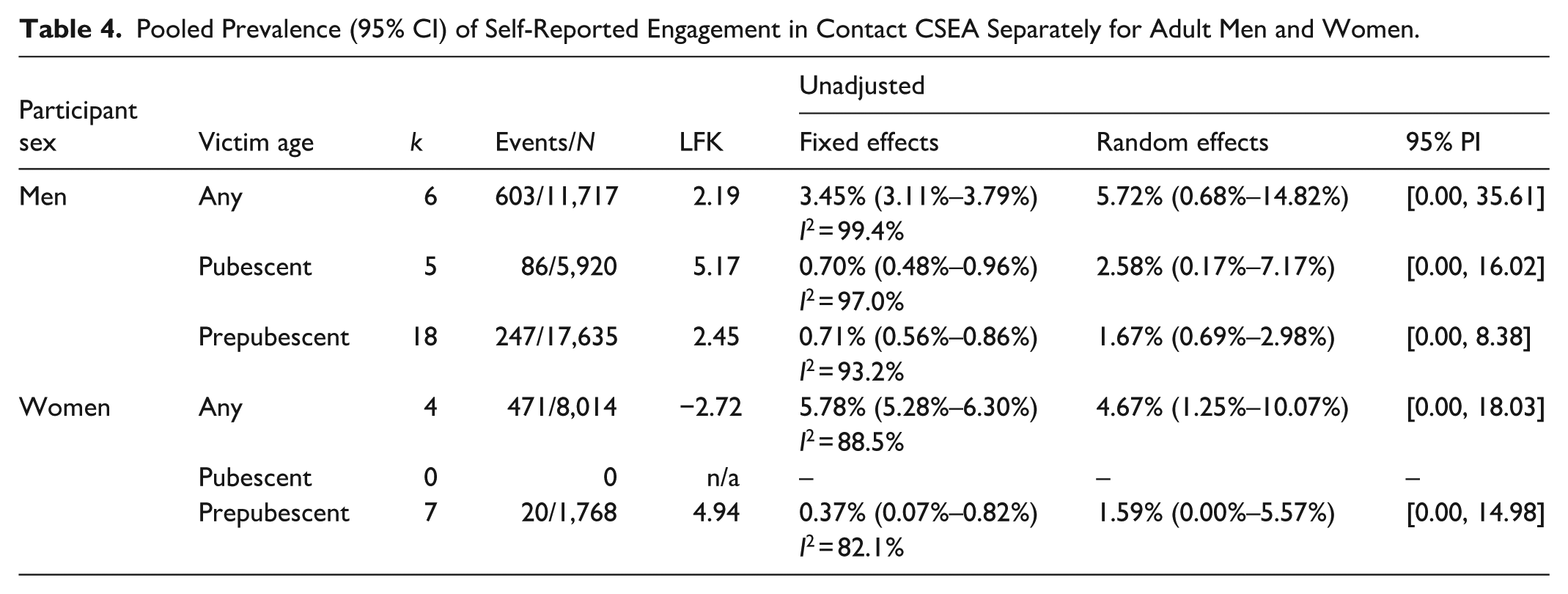
For contact offending against pubescent children, the male prevalence was 2.6% (95% CI [0.2, 7.2]; 95% PI [0.0, 16.0]; I2 = 97.0%; LFK = 5.17), increasing to 3.8% ([1.4, 7.3]; 95% PI [0.2, 10.7]; I2 = 69.9%; LFK = 2.03) when excluding influential outliers. Too few studies provided female data to compute prevalence estimates for pubescent victims. Initial estimates suggest that a similar proportion of men and women engaged in contact offending against prepubescent children: 1.7% ([0.7, 3.0]; 95% PI [0.0, 8.4]; I2 = 93.2%; LFK = 2.45) and 1.6% ([<0.1, 5.6]; 95% PI [0.0, 15.0]; I2 = 82.1%; LFK = 4.94), respectively. Although small study effects were present in both models, asymmetry was far greater for female than male samples. This could reflect a publication bias favouring small sampled studies with unusually high numbers of female perpetrators. After removing influential outliers, male perpetrator prevalence (1.6%; [0.7, 2.8]; 95% PI [0.0, 7.0]; I2 = 85.2%; LFK = 2.03) was 66% higher than female perpetrator prevalence (1.0%; [<0.1, 4.3]; 95% PI [0.0, 10.9]; I2 = 79.3%; LFK = 4.11).
Sex-Separated Noncontact Perpetration Prevalence
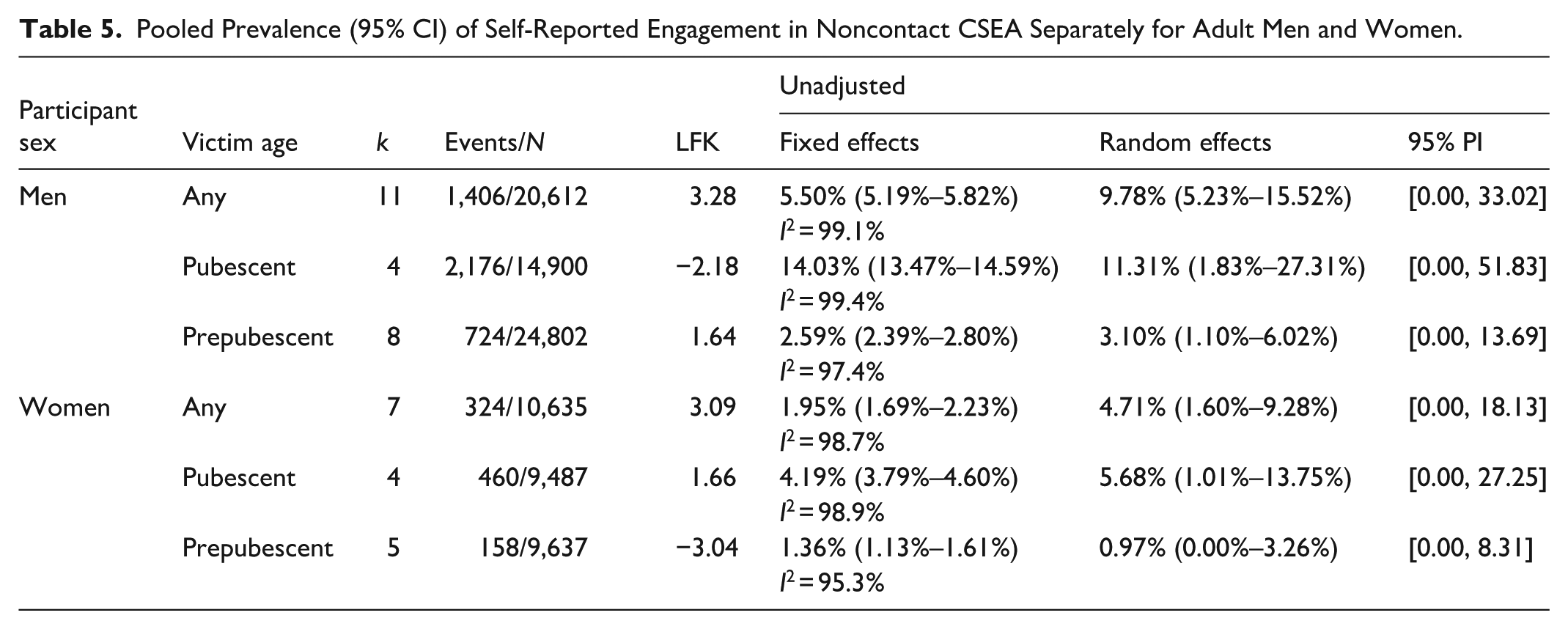
Among men, noncontact offending was approximately twice as prevalent as contact offending, whereas among women the prevalences of contact and noncontact offending were similar. The results of the proportional meta-analyses for noncontact CSEA are presented in Table 5; corresponding sensitivity analyses are provided in Supplemental Table 5. The prevalence of noncontact CSEA perpetration against children of any age was 9.8% (95% CI [5.2, 15.5]; 95% PI [0.0, 33.0]; I2 = 99.1%; LFK = 3.28) for men and 4.7% ([1.6, 9.3]; 95% PI [0.0, 18.1]; I2 = 98.7%; LFK = 3.09) for women. Excluding outliers resulted in a sizeable increase in prevalence estimates for men (11.1%; [6.6, 16.6]; 95% PI [0.6, 31.5]; I2 = 97.7%; LFK = 2.46) and women (6.0%; [2.8, 10.2]; 95% PI [0.2, 18.2]; I2 = 91.4%; LFK = −0.75).
Pooled Prevalence (95% CI) of Self-Reported Engagement in Noncontact CSEA Separately for Adult Men and Women.
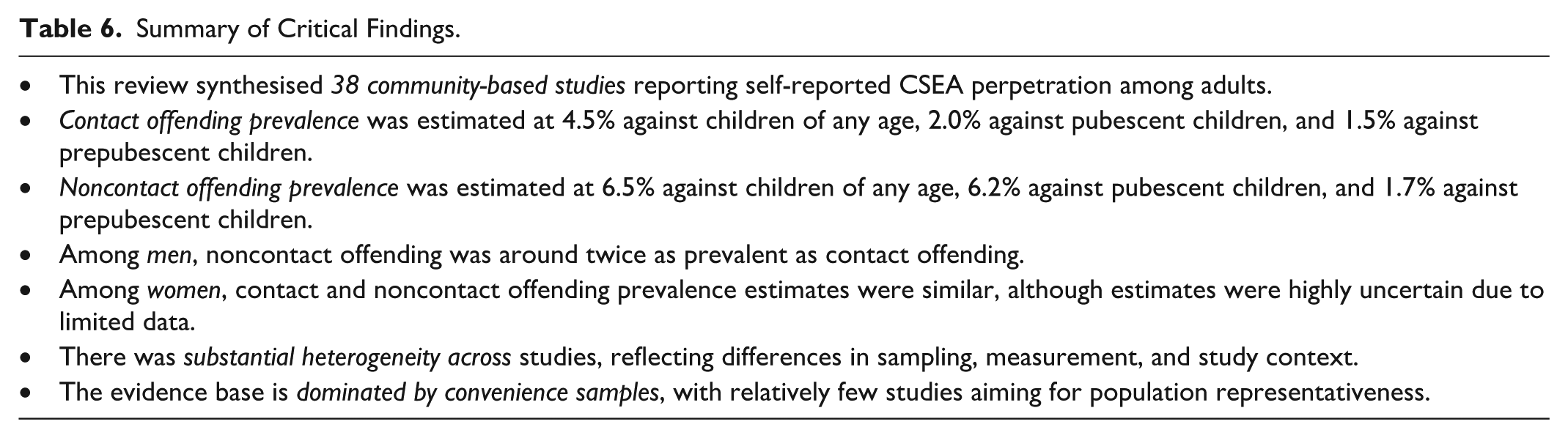
Summary of Critical Findings.
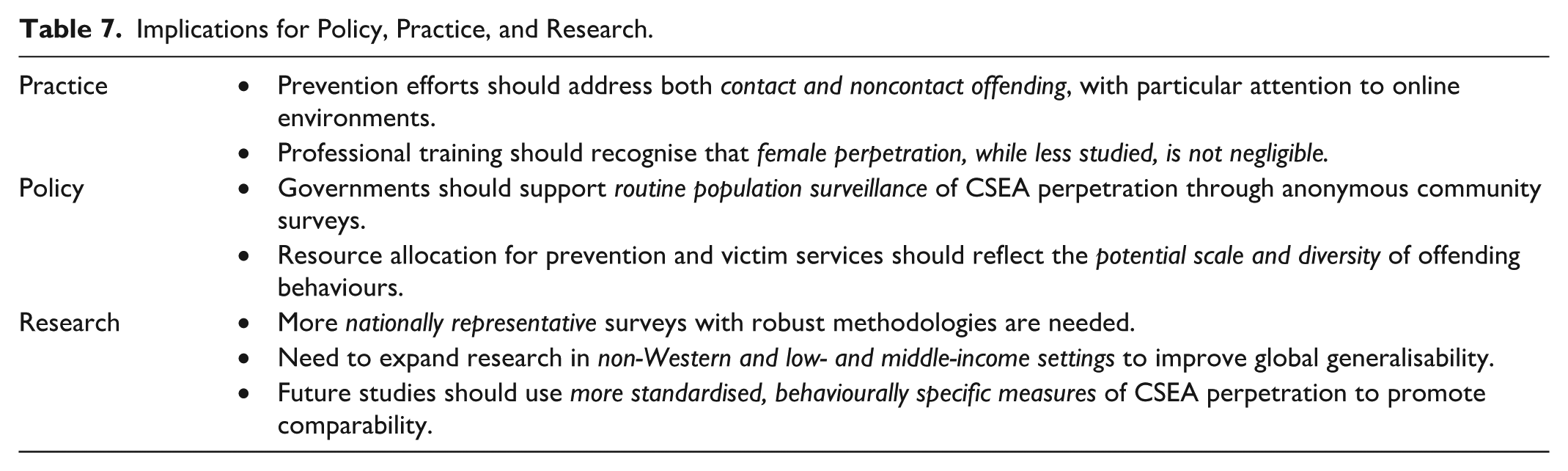
Implications for Policy, Practice, and Research.
The prevalence of noncontact offending against pubescent children was twice as high for men (11.3%; 95% CI [1.8, 27.3]; 95% PI [0.0, 51.8]; I2 = 99.4%; LFK = −2.18) than for women (5.7%; [1.0, 13.8]; 95% PI [0.0, 27.3]; I2 = 98.9%; LFK = 1.7). Excluding influential outliers increased prevalences to 15.0% ([3.7, 32.2]; 95% PI [0.0, 52.3]; I2 = 99.3%; LFK = 0.02) and 7.6% ([2.0, 16.4]; 95% PI [0.0, 26.9]; I2 = 92.1%; LFK =−2.25), respectively. However, the wide PIs coupled with the small number of included studies suggest these estimates are likely unreliable. The prevalence of noncontact CSEA perpetration against prepubescent children was 3.1% ([1.1, 6.0]; 95% PI [0.0, 13.7]; I2 = 97.4%; LFK = 1.64) for men and 1.0% ([<0.1, 3.3]; 95% PI [0.0, 8.3]; I2 = 95.3%; LFK = −3.04) for women. These estimates decreased to 2.5% ([1.0, 4.7]; 95% PI [0.0, 10.1]; I2 = 97.6%; LFK = −0.18) and 0.5% ([< 0.1, 1.9]; 95% PI [0.0, 4.1]; I2 = 90.4%; LFK = −6.52), respectively, after removing influential outliers.
Post hoc Secondary Analyses
Secondary analyses examined whether sample representativeness (convenience samples vs. studies that aimed to approximate population representativeness) and offending timeframe (past year or adulthood vs. lifetime) moderated estimates, but only among studies assessing male contact CSEA perpetration against prepubescent children (k = 18), as this was the only subgroup with enough studies to support moderation analysis. Mixed-effects meta-regression indicate that representativeness did not significantly moderate perpetrator prevalence (F(1, 16) = 3.21, p = .09). However, the direction of the association (β = −.06, SE = 0.04, 95% CI [−0.14, 0.01]) suggests that representative studies tended to report lower prevalence estimates (1.0% ([0.1, 3.2]; k = 5) vs. 2.2% ([0.8, 4.1]; k = 13)). By contrast, separate moderation analysis suggests that offending timeframe significantly moderated perpetrator prevalence (F(1, 16) = 7.76, p = .01), with the direction of the association (β = .09, SE = 0.03, [−0.02, 0.15]), indicating a higher estimate for lifetime prevalence (2.7% ([1.3, 4.5]; k = 12) than past year or since adulthood (0.8% ([<0.1, 2.7]; k = 6)).
Secondary analyses were also conducted to examine the odds of male relative to female perpetration by estimating the within-study contrasts wherever both male and female prevalences were reported, then meta-analysing study-specific log-odds with a random-effects model (REML with Hartung–Knapp adjustment). Only three studies reported both men and women’s perpetration prevalence for pubescent or any aged children. The odds of contact offending against these age groups were 3.83 (95% CI [2.33, 6.29]; 95% PI [2.41, 6.08]; I2 = 13.5%) times greater for men than women. Seven studies provided data on contact offending against prepubescent children, with no sex differences found (OR = 0.98; [0.20, 4.86]; 95% PI [0.05, 19.89]; I2 = 44.8%). By comparison, the odds of noncontact offending by men compared to women were 2.26 ([1.55, 3.29]; 95% PI [1.05, 4.86]; I2 = 56.5%) times greater for children of any age (k = 6), 3.04 ([0.59, 15.76]; 95% PI [0.12, 78.80]; I2 = 97.3%) times greater for pubescent children (k = 3), and 1.87 ([1.44, 2.44]; 95% PI [1.39, 2.55]; I2 = 10.2%) times greater for prepubescent children (k = 4).
Discussion
This study provides the first synthesis of CSEA perpetration prevalence derived from anonymous, self-report data in community-based samples. Drawing data from 38 studies, our proportional meta-analyses estimated that approximately 1-in-20 adults have sexually offended against children of any age and around 1-in-50 against prepubescent children, pooling across perpetrator sex and contact type. Examined separately, contact offending initially showed similar prevalence among men and women, although small study effects inflated female perpetration prevalence. However, among men, noncontact offending was around twice as prevalent as contact offending, whereas in women, contact and noncontact prevalences were comparable. Nonetheless, these estimates should be interpreted cautiously: the evidence base is sparse and dominated by non-representative samples. Secondary analyses suggest higher estimates for convenience samples and those reporting lifetime prevalence, although high heterogeneity and the small number of representative studies preclude firm conclusions. Accordingly, these findings should be considered exploratory and may change as the evidence base grows. A summary of critical findings and implications for policy, practice, and research are presented in Tables 6 and 7, respectively.
The estimated sex-standardised prevalence of 4.5% for contact sexual offending against children should be interpreted in light of the broad definitions used across the included studies. Specifically, this estimate referrers to sexual contact involving a person under 18 years of age and therefore encompasses a range of victim age groups, including adolescents as well as younger children, rather than abuse against prepubescent children alone. This broad definition likely contributes to the size of the estimate. A similar point applies to noncontact offending, for which the pooled prevalence was 6.5%, also reflecting behaviours against children of any age under 18. Importantly, these findings are not inconsistent with existing victimisation data. Prior meta-analyses have reported childhood victimisation rates of 8.7% for sexual assault, 6.1% for rape, 11.5% for online solicitation, and 7.3% for sexual exploitation, indicating that children’s exposure to both contact and noncontact sexual abuse is substantial (Fry et al., 2025; Piolanti et al., 2025).
Prevailing theory and the empirical evidence-base is clearly consistent in the fact that men commit contact CSEA at a far higher rate that women (Cortoni & Gannon, 2016). Over time this has also meant that the vast majority of studies have targeted male perpetrators in research to inform the evidence base for treatment. Conversely, far fewer studies have considered female perpetrators, particularly in the context of CSEA. As such, in the current review, the finding of similar contact offending prevalence between men and women needs to be interpreted in light of this pattern; the literature pertaining to female perpetrators is comparatively sparse, with small samples and heterogeneous measures, which in the current context, inflates uncertainty around female estimates (Augarde & Rydon-Grange, 2022). In addition, there was also evidence of potential publication bias along these lines, as prevalence estimates were skewed towards smaller studies with a higher proportion of female perpetrators; higher than expected counts of female perpetrators may have motivated publication of otherwise methodologically limited studies. This is consistent with the findings of our sensitivity analysis, where the exclusion of the study by Turner et al. (2025), which identified 4 out of 47 women as contact offenders, reduced the perpetration prevalence of females to almost half that of males.
The higher noncontact offending prevalence among men is consistent with evidence that online CSAM consumption, solicitation, and other noncontact sexual offences are overwhelmingly male dominated, and online-only offenders systematically differ from contact offenders (e.g., Babchishin et al., 2015). Contributing to this is the fact that men consume pornography at substantially higher rates than women and show stronger voyeuristic and exhibitionistic tendencies (Bőthe et al., 2024; Thomas et al., 2021). Opportunity structures likely further amplify these differences: online ecosystems facilitating CSAM collecting and trading lower the effort and social exposure required for noncontact offending (Quayle & Taylor, 2004). Anonymity and asynchronicity online can also weaken deterrents and social controls, producing higher observed male prevalence where baseline sex differences in pornography use and sociosexuality are already pronounced.
Unlike contact offending, which showed similar prevalence for pubescent and prepubescent victims, noncontact offending was substantially more prevalent against pubescent than prepubescent children. There are several explanations for this pattern. First, adolescent secondary-sex characteristics are closer to adult attraction templates, lowering motivational and moral restraints relative to prepubescents (Seto, 2018). Second, the opportunity is greater, as adolescents are the dominant users of social platforms where noncontact offences, such as solicitation and indecent communications, often occur (e.g., Mitchell et al., 2010). Third, some adults may perceive online sexual interactions with adolescents as less serious or even consensual, particularly where age is vague or misrepresented, with this ambiguity further compounded by cross-jurisdictional variations in age of consent laws. Finally, sexualised teen content (e.g., sexting) is prevalent and becomes more common with age, lowering search costs and normalising engagement with pubescent content compared to prepubescent material (Madigan et al., 2018).
These estimates may provide a preliminary population benchmark for self-reported CSEA that policymakers and practitioners can use, with caution, to set priorities, allocate resources, and track change over time. In practice, agencies and researchers can: (a) incorporate these baselines into routine surveillance – ideally via repeated, nationally representative surveys using harmonised items that separate contact and noncontact offending as well as pubescent and prepubescent targets, and report sex-disaggregated results; (b) standardised measurement and reporting (e.g., pre-registration, shared codebooks, and open metadata) so future studies are comparable; and (c) plan services on the assumption that noncontact offending is more prevalent and female perpetrated contact offending is non-trivial. For prevention, results support targeted online safety measures focused on adolescents (e.g., platform age-assurance, proactive moderation of self-generated sexual imagery, and rapid takedown channels), coupled with accessible early intervention services for adults at risk of offending. Finally, funders and regulators can use these benchmarks to assess programme effectiveness, require transparent reporting standards in grant and ethics approvals, and incentivise collaborative data infrastructures that enable timely, comparable, and policy-relevant monitoring.
This proportional meta-analysis has several strengths. It synthesises community-based, anonymous self-report data and distinguishes prevalence by contact versus noncontact and by victim developmental stage, with sex-standardised and separated estimates. Methodologically, variance-stabilising transformations for proportions, multilevel random effects with robust variance to handle within-study dependence, PIs to reflect between-study dispersion, small-study effect checks, and multiple sensitivity analyses improve inferential robustness and transparency. Nonetheless, important limitations remain. Heterogeneity was high and PIs were wide, indicating that the pooled prevalence estimates should be interpreted as average estimates across diverse study contexts rather than precise estimates for any single setting. Measurement was uneven across studies (e.g., definitions, age cut-offs, and item wording), and self-report surveys are vulnerable to misclassification and social desirability bias. Sampling frames were often non-probability online panels with uncertain coverage and non-response bias, and data were sparse for women and for some offence subtypes, inflating uncertainty and limiting subgroup inference. Cross-jurisdictional legal and cultural differences (e.g., age of consent laws, platform use, and cultural customs) likely contribute to residual between-study variance that cannot be resolved with study level moderators. Due to the absence of reliable translation services, non-English language studies were excluded, potentially hindering the generalisability of findings to non-English speaking countries. Finally, publication and availability biases remain possible, especially in the context of female perpetrators.
In sum, this proportional meta-analysis synthesised community-based self-report evidence to provide the first population benchmarks of adult-perpetrated CSEA across contact and noncontact behaviours and by victim developmental stage. We found notably higher prevalence for noncontact offences (especially against pubescent children), and comparable contact offending prevalence among men and women, though female estimates are imprecise. These findings emphasise both the scale and heterogeneity of the problem, the need for harmonised measurement, and the importance of sex-disaggregated reporting. Standardised, repeated population surveys and transparent analytic practices are necessary to refine these estimates, monitor trends, and inform prevention, detection, and service responses.
Supplemental Material
sj-docx-1-tva-10.1177_15248380261439140 – Supplemental material for The Prevalence of Self-Reported Child Sexual Exploitation and Abuse by Adults in the General Population: A Systematic Review and Proportional Meta-Analysis
Supplemental material, sj-docx-1-tva-10.1177_15248380261439140 for The Prevalence of Self-Reported Child Sexual Exploitation and Abuse by Adults in the General Population: A Systematic Review and Proportional Meta-Analysis by Tyson Whitten, Jesse Cale and Michael Salter in Trauma, Violence, & Abuse
Supplemental Material
sj-docx-2-tva-10.1177_15248380261439140 – Supplemental material for The Prevalence of Self-Reported Child Sexual Exploitation and Abuse by Adults in the General Population: A Systematic Review and Proportional Meta-Analysis
Supplemental material, sj-docx-2-tva-10.1177_15248380261439140 for The Prevalence of Self-Reported Child Sexual Exploitation and Abuse by Adults in the General Population: A Systematic Review and Proportional Meta-Analysis by Tyson Whitten, Jesse Cale and Michael Salter in Trauma, Violence, & Abuse
Footnotes

Funding
The authors received no financial support for the research, authorship, and/or publication of this article.
Declaration of Conflicting Interests
The authors declared no potential conflicts of interest with respect to the research, authorship, and/or publication of this article.
Supplemental Material
Supplemental material for this article is available online.
Notes
Author Biographies
References
Supplementary Material
Please find the following supplemental material available below.
For Open Access articles published under a Creative Commons License, all supplemental material carries the same license as the article it is associated with.
For non-Open Access articles published, all supplemental material carries a non-exclusive license, and permission requests for re-use of supplemental material or any part of supplemental material shall be sent directly to the copyright owner as specified in the copyright notice associated with the article.
