



Abstract
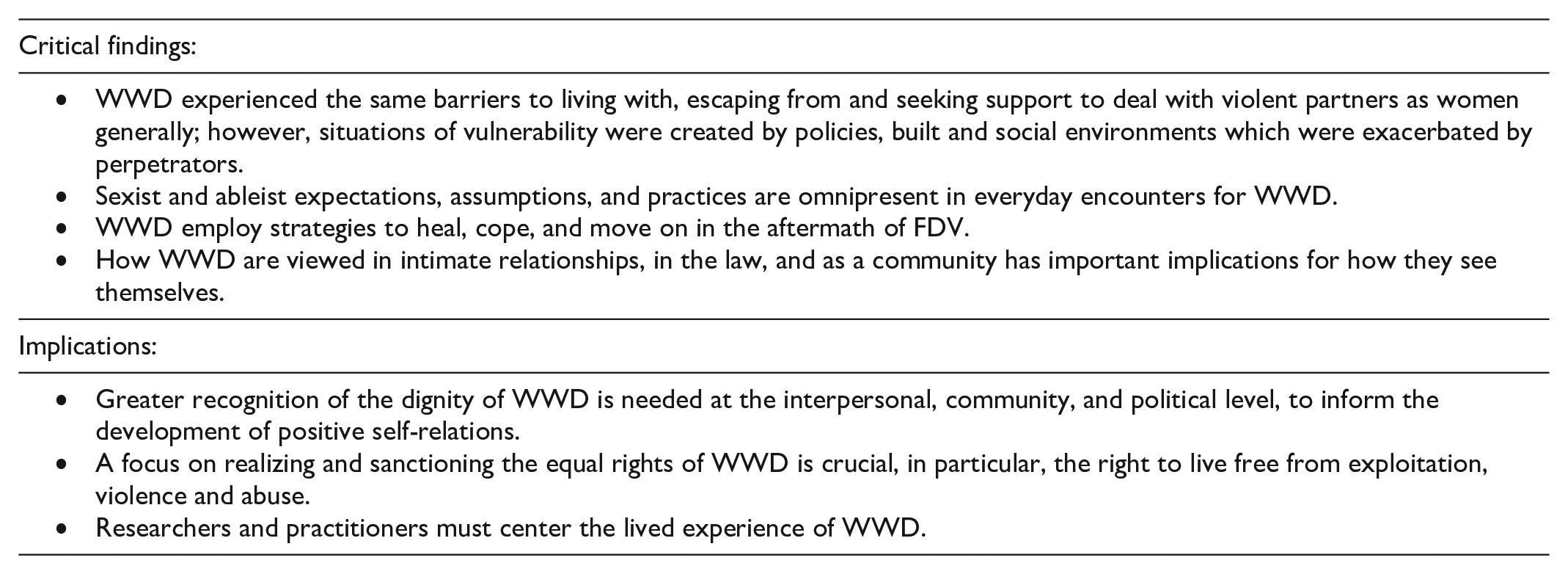
This article reports on a scoping review exploring understandings of family and domestic violence (FDV) against women with disability (WWD) within the literature and constitutes the second article in a two-part series, the first critiquing the categorization and measurement of FDV and disability. We report findings from qualitative studies included in the review, predominantly interpretivist and critical in orientation. The scoping review included 43 articles, 15 of which are included here, as they draw upon data directly from the perspectives of WWD. Reflexive thematic analysis was conducted, utilizing both inductive and deductive coding, and consultation between the authors. The analysis highlighted experiences of disability-based abuse, the nexus of ableism and sexism within the everyday, and meanings of justice and resilience for WWD. Disability-based abuse was perpetrated primarily by intimate partners, including financial and physical disability-based abuse, and was used to exploit and perpetuate situations of isolation. Sexist and ableist expectations, assumptions, and attitudes converged in everyday encounters within the community, with workers and systems. However, WWD reported strategies of resistance, healing, coping, and moving on in the aftermath of FDV and indicated what can be done to promote justice, both personally and within systems. The findings were discussed drawing on Axel Honneth’s theory of recognition to highlight the mechanisms by which recognition and respect can be enhanced to enable full access to citizenship, in particular, for WWD to live free from violence.
Introduction
Family and domestic violence (FDV) against women with disability (WWD) is understood in particular ways within the literature. This scoping review is presented as a two-part series of articles: the first part, critiquing the categorization and measurement of disability, and FDV (Walter et al., 2023), highlighted how quantitative, prevalence studies engage in categorization and dividing practices to create a particular view of reality, as it is useful for the creation of policy and further research. While useful, these practices may also limit the scope of what is measured, that is, by using narrow definitions of FDV and disability, and fall short of providing contextual information and detail about the nature and experience of FDV for WWD. In this second article of the series, we provide an account of the analysis of qualitative research articles concerned with the lived experience of WWD who have experienced FDV, and some of the practitioners who work with them, and provide discussion of what may be required to shift focus toward the context in which FDV is perpetrated and how responses may be improved.
We use the term “lived experience” as is now ubiquitous in many areas of teaching, research, and popular culture, however, we also wish to acknowledge it has become a new identity category in which widely heterogenous bodies of experience have been grouped and essentialized (Voronka, 2016). The term is closely linked with the phenomenological tradition, standing in contrast to positivistic approaches, and concerned with critical understandings of the world; however, the term has increasingly been employed axiomatically (McIntosh & Wright, 2019). We do not consider the lived experience of disability, women, and/or FDV as undisputed and cohesive categories (Voronka, 2016) but rather use the term to indicate both individual experience itself, and as it relates to the experience of the collective. As we discuss, intersectionality holds an explicit focus on deconstructing and challenging taken for granted categories (Yuval-Davis, 2006), such as disability, and the authors hold this understanding while discussing lived experience.
WHO defines disability as “the outcome of the interaction between individuals with a health condition and personal and environmental factors” (World Health Organization, 2021, p. 10). This broad definition allows for acknowledgement of disability as an umbrella term capturing a vast and fluid range of experiences. The first article in this series (Walter et al., 2023) explored in the use of scales to categorize and measure disability in ways which often restricted a deeper understanding of the unique experiences of people classed as having disability. “Disability” constituted one inclusion criterion for this scoping review, though it carries with it a range of medical, administrative, and social definitions which range widely between countries and regions. We acknowledge that, due to this variation, large bodies of knowledge may not be explored; for example, articles exploring intersecting experiences of FDV and mental health (though some were included if using mental health as a category of disability).
Part one of this article (Walter et al., 2023) found WWD experience FDV at disproportionately high rates compared to women without disability and people with disability generally, which can be understood by deploying a framework of intersectionality. Intersectionality offers theoretical resources to explain interlocking forms of violence and oppression experienced by WWD. Pioneered by Crenshaw (1991), intersectionality was first deployed to explain the experience of those situated at the overlap of multiple axes of oppression and the compounding effects of oppression, as systems failed to recognize and respond to the barriers faced by multiply marginalized groups. While originally aimed at deconstructing categories of race and gender, Crenshaw’s ideas have since been extended to other fields of inquiry, including the area of FDV against WWD. Intersectionality acknowledges intragroup differences experienced by individuals belonging to other political and social categories (Crenshaw, 1991), including women, Black, and disabled, and posits the interlocking and inseparable nature of oppressions. Yuval-Davis (2006, p. 199) cautioned against the use of “naturalized,” homogenous social categories, which are in fact, culturally and temporally specific. Rather, these social categories should be acknowledged as highly context-dependent, shifting political constructions of categorical boundaries and dynamic processes of positioning within structural and material inequalities (Yuval-Davis, 2006). Thus, it is crucial that intersectional analyses are not depoliticized as the theory is, at its heart, committed to eradicating injustice and dismantling oppression (May, 2015). This acknowledges the use of political and social categories to disadvantage and marginalize groups (though strategic essentialism and reappropriation have been employed by groups, using their assigned labels to resist).
Intersectionality is useful in analyzing particular social positionings impacted by multiple forms of subordination to compounding effect. In this way, intersectionality makes visible the processes by which misrecognition of groups is enabled—by the misunderstanding and misrepresentation of their experiences and needs—and the subsequent effects. The question then becomes, what can be done to counteract misrecognition, to better understand groups, and to increase their agency and power in determining their own legal and social status? Honneth’s (1995) theory of the struggle for recognition provides a framework to respond to such questions.
Honneth’s conception of the struggle for recognition draws links between the experience of recognition within close, loving relationships, within in the law and for communities (Allen, 2010). Honneth delineates three forms of recognition—love, legal rights, and community—and connects these to three primary forms of one’s self-relationship which, taken together, constitute the possibility of individual autonomy (Allen, 2010). Self-confidence is enabled through mutual recognition within familial and loving relations; self-respect by legal recognition; and self-esteem by membership to a culturally recognized and valued community (Allen, 2010). Conversely, these three forms of practical self-relations may be undermined by relations of disrespect or misrecognition. We note here that we do not imply these processes are binary; they may in fact be co-occurring, non-linear, and temporally specific. In the example from Allen (2010, p. 26), the young girl is both provided recognition and subordinating gender ideology in a single stroke by her parents’ love (“you are so beautiful,” “how well-behaved you are”). To understand how misrecognition occurs and is reproduced, an analysis of power is necessary, as forms of misrecognition (both official and informal) involve and articulate power relations (van den Brink & Owen, 2007). Within this study, we deploy recognition as a framework both to understand the formation of practical self-relations of WWD (developed through recognition) which are required for individual agency, and to understand misrecognition experienced as harm and injustice, which under favorable social conditions may motivate subject’s struggle for recognition (van den Brink & Owen, 2007). Interlinked with this struggle for recognition is access to human rights, which may be articulated through the concept of citizenship. The undermining of self-relations may decrease access to full citizenship while increased recognition may provide the necessary conditions for full citizenship to be realized.
Citizenship can be considered through a plethora of theories; however, according to Sayer (2011, p. 244) it “can be identified as (the terms and conditions of) political membership within a democratic society.” Pakulski (1997) considered citizenship in terms of a set of rights claimed by members of a political community and highlighted the complexities of the process by which rights are bestowed and granted. In particular, she drew attention to the disparities between claims for rights to protection, recognition, and provision and the extent to which they are legitimated and effectively sanctioned by the state. In fact, Pakulski (1997) noted asymmetries between rights claimed and rights sanctioned are more typical than their congruence. Marks (2001) argued people with disability are denied recognition and respect in ableist culture, and therefore, refused full citizenship, as well as formal rights and responsibilities. This refusal is interconnected with ableist and gendered attitudes and assumptions, including those which render people with disability and women as dependent, and which facilitate paternalistic practices and policies. Thus, we provide an account of our analysis of the literature which highlights the processes by which recognition and citizenship are undermined, conversely, how they may be promoted for WWD who have experienced FDV.
Methodology
We employed scoping review methodology (Arksey & O’Malley, 2005) to search databases from August to September, 2021. The purpose of the scoping review was to explore and report on the overlapping bodies of domestic and family violence, and disability literature. The scoping review, similar to a systematic review in transparency and rigor (Grant & Booth, 2009), aimed to capture the current foci of research in this area. Studies published between 2016 and 2021, inclusive, were included in the review (see Table 1 for databased search terms and inclusion criteria), with the narrow timeframe allowing the review to explore current trends in the literature. The review was conducted utilizing the five stages outlined by Arksey and O’Malley (2005); first, identifying the research question: how is FDV against WWD understood in the literature. The second stage employed searching ProQuest and Scopus databases, chosen for relevance to the areas of FDV and disability; searching returned 835 references for the third stage, title and abstract screening. Screening was conducted guided by key terms and inclusion criteria, with discussion between authors to further refine the focus of the review. For example, articles with focus on violence against people with disability generally and which did not provide disaggregated data on WWD and/or FDV specifically were considered peripheral. Following duplicate removal, 50 articles were included, whereas a further three-hand searched texts included upon recommendation, and 10 excluded (seven were found to be outside the scope of the review, two were conference abstracts, and two were not available from publishers). A total of 43 articles were included for review, 16 of which addressed the prevalence of FDV against WWD and were included in first part of this series of articles (Walter et al., 2023), with the remaining 27 included in this article (see Figure 1).
Database Search Terms and Criteria.
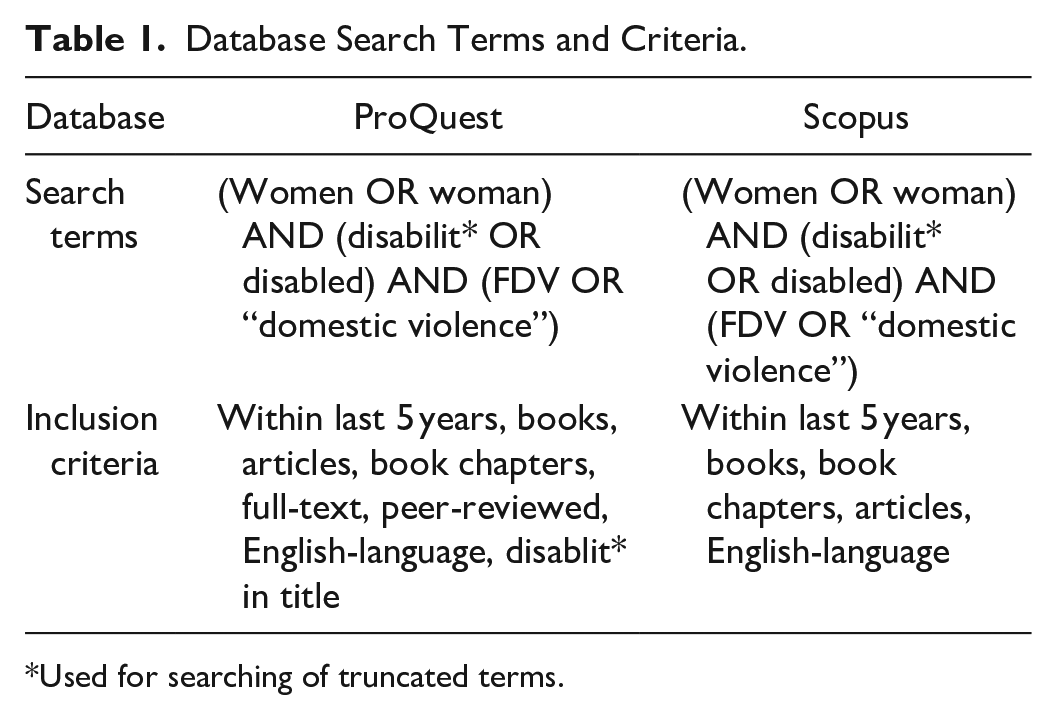
Used for searching of truncated terms.
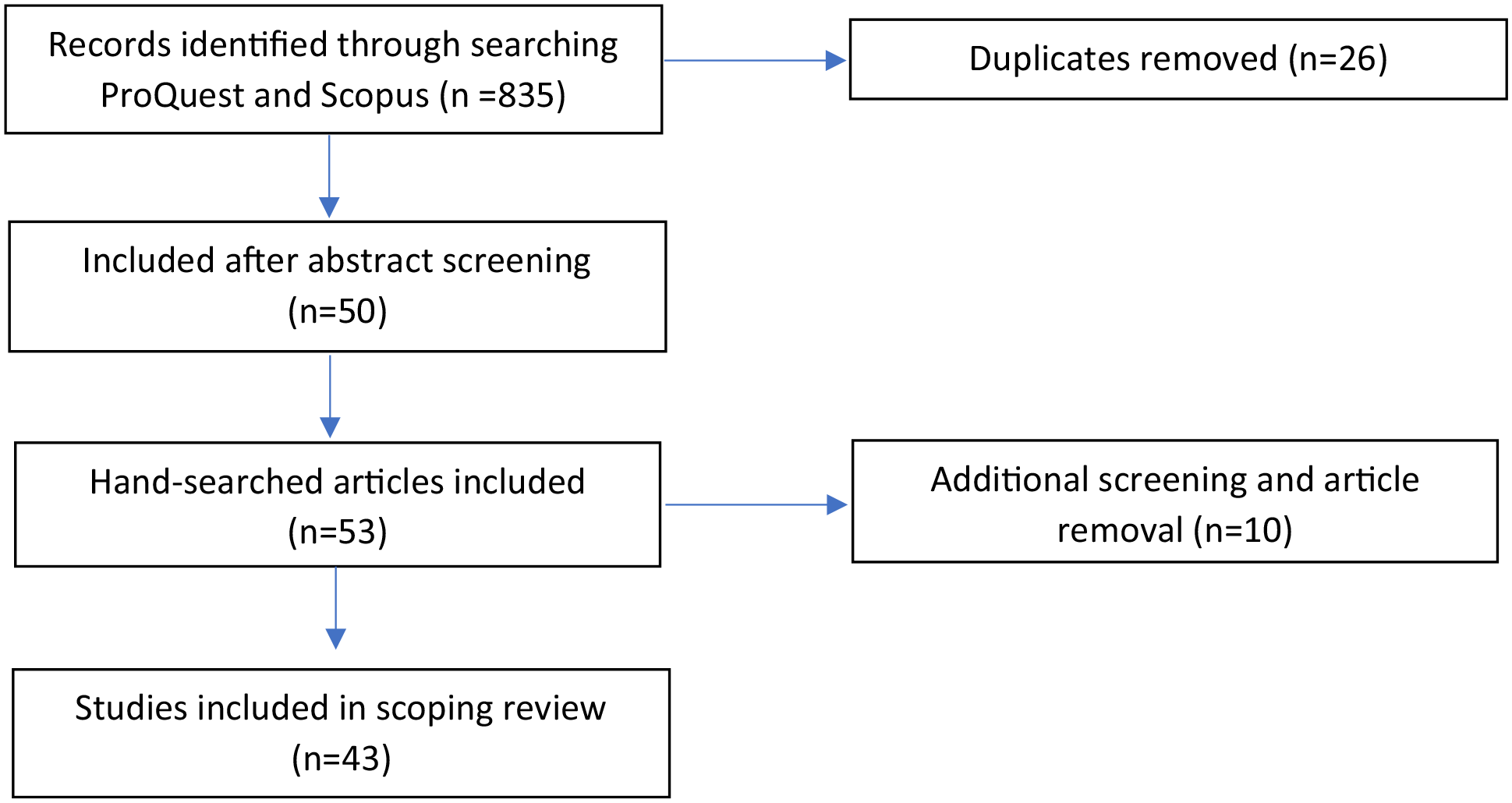
PRISMA flow chart.
Analysis
These 27 studies were categorized according to theoretical orientation, informed by Crotty’s (1998) elements of social research; positivist (8), interpretivist (15), and critical (4). Categorizing studies in this way revealed that, while all were concerned with the experiences of WWD, only those which were interpretivist and critical in orientation centered on the voices of WWD and listened to them as a primary data source. In general, positivist studies; measured practitioner attitudes, knowledge, and responses; provided practice recommendations for allied health professionals; or provided the state of knowledge on the topic area. As these studies did not center the voices and experience of WWD, they were considered peripheral to our focus and excluded from the analysis; however, one objectivist study utilized grounded theory methodology and interviews with WWD and was therefore included in the analysis. In consideration of the findings from the first article in the series (Walter et al., 2023), the research team chose to foreground the voices of WWD themselves within this article, and as such, only studies with WWD as participants were included, which sits in contrast to usual practices in research and policy development. For studies which recruited both WWD and service workers, all data were analyzed; therefore, this article contains a small amount of data from the perspective of service providers with the overall emphasis remaining on the lived experience of WWD. In total, 15 studies were included for analysis.
Using Lumivero’s NVIVO software, data were analyzed employing reflexive thematic analysis (Braun & Clarke, 2020), identified as appropriate to this part of the review as it requires researchers to provide an account of their process and reflexivity, and allows fluidity, consideration of context, and theory within the analysis (Braun & Clarke, 2020). Reflexive thematic analysis highlights the active role of the researcher in knowledge production (Braun & Clarke, 2019), as codes are understood as a representation of the researchers’ interpretation, incorporating the dataset, theoretical assumptions, and the skills and analytical skills of the researchers (Byrne, 2022).
First, the findings and discussion sections from each of the studies whose participants were WWD were coded both inductively, according to anticipated domains (Byrne, 2022) of information (such as types of FDV, practice responses, and coping strategies), and deductively, including findings which were unexpected, illustrated a particular opinion, worldview, or cultural perspective. While coding the data and in consultation as a team, themes were developed to act as “containers” for concepts and examples within the data, for example, women experienced stigma in various aspects of their life. Codes were organized into each of these preliminary themes (5), which allowed us to notice overlap and synergies between them and further refine to three themes, each with three subthemes.
Findings
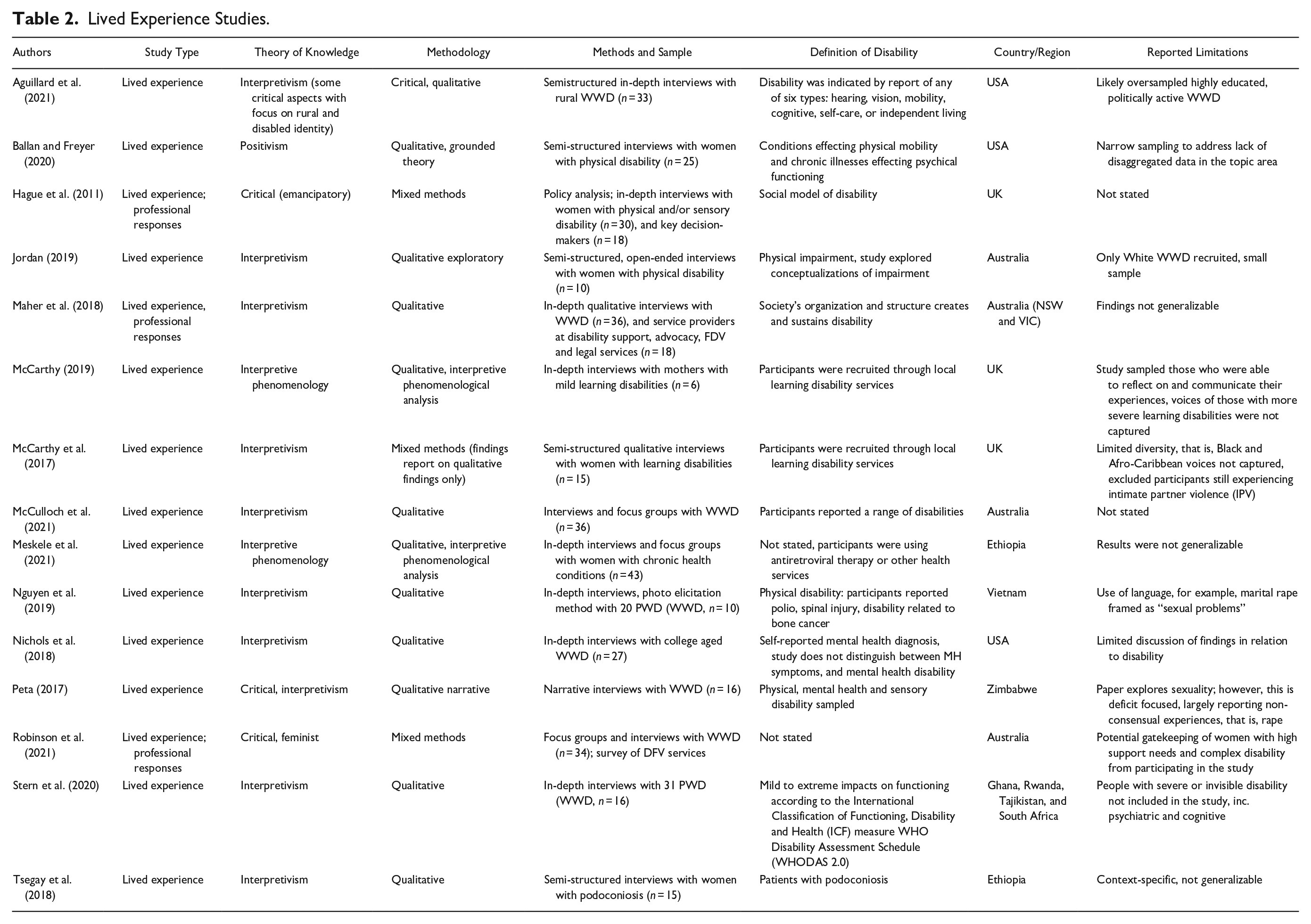
The findings are presented below as overarching themes relating to disability-based abuse; the nexus of ableism and sexism; and resilience and justice. Rather than an exhaustive representation of the data, themes employ illustrative examples from the literature to highlight the nature and significance of each theme. The studies included in this article are presented in Table 2.
Lived Experience Studies.
Disability-Based Abuse
Studies outlined women’s experiences of violence, ranging from covert and undermining tactics, social control, and isolation to extreme and consistent physical, sexual, and psychological abuse. WWD experienced same breadth of tactics, types of violence, and coercive control as women without disability. As articulated by McCulloch et al. (2021, p. 206), for WWD, “living with, extricating themselves from and seeking support in dealing with violent partners is mediated by the same barriers” as for women generally. However, what came to the fore in this review were the ways in which perpetrators facilitated and exploited women’s positions of vulnerability in relation to their disability. It was clear that situations of vulnerability were created by policies, built and social environments, and often exacerbated by perpetrators to control and exercise power over WWD.
Sexual violence was commonly reported by WWD (Hague et al., 2011; McCarthy et al., 2017; Nguyen et al., 2019; Peta, 2017; Tsegay et al., 2018), including coercion and assault. Due to the scope of this article and the volume of information produced in the analysis, we have not used sexual violence as an illustrative example of disability-based abuse here. However, we recognize that perpetrators’ attitudes and ideas were often underpinned by ableist attitudes and used in justification for their use of sexual violence against WWD. Tactics involving children were also reported, similarly to women without disability. These included refusing to support parenting, being humiliated, degraded, and sexually assaulted in front of children, and physical violence resulting in miscarriage and the death of children (McCarthy, 2019; Meskele et al., 2021).
Coercive Control; Manufactured Isolation, and Emotional Abuse
Perpetrators’ use of coercive control featured strongly in the narratives of WWD, as is common to the experience of FDV for women with and without disability. However, this could be amplified by tactics specifically targeting women’s disability, for example, by restricting access to medical care (Tsegay et al., 2018). As noted by Hague et al. (2011) and Meskele et al. (2021), women were often isolated from external support as a strategy by some abusive partners, often multiplying neglect and creating situations of increased dependence on and vulnerability to their abusive partners for everyday tasks. This was illustrated as an intense and painful experience within participants’ narratives (Hague et al., 2011). They could also be isolated from family and friends by the perpetrator (Meskele et al., 2021; Tsegay et al., 2018), either by intimidating women, or employing tactics to ensure friends and family stopped seeing women: “. . . I lost all my friendships with the neighbors. . . he accused them of stealing, so they wouldn’t come here again” (McCarthy, 2017, p. 274). Women were frequently threatened, insulted, shouted at, and nagged by their partners, both in private and with children, friends, and relatives present (Tsegay et al., 2018). As with tactics to isolate women, perpetrators often used emotional abuse in relation to women’s disability. Emotional abuse reported by women encompassed extreme emotional degradation, humiliation, and verbal insults, often daily (Hague et al., 2011; McCarthy et al., 2017; Stern et al., 2020). “He discloses my HIV status to everybody including my friends (Participant S1#6, woman aged 37)” (Meskele et al., 2021, p. 4).
He’d insult me with all those names, you “spassy” and so on, who’d want to marry you, just look at you. . . Shouting insults, you cripple, all that sort of thing. Once. . . he threw me on the floor with my dinner and said that’s where you eat your dinner, that’s where you belong. (Hague et al., 2011, p. 124) He always blamed me that I was lame. He repeats it 10 to 15 times a day. His insults me which makes me sad. I asked him repeatedly not to insult me. He used to insult me even if I do nothing wrong. (Tajikistan, female, physical impairment) (Stern et al., 2020, p. 5)
These examples of coercive control, isolation and emotion abuse make clear the particular ways in which perpetrators draw on wider social attitudes, norms, and notions of disability-related vulnerability to both abuse and further alienate WWD. McCarthy (2019, p. 108) noted women with learning disabilities were so often considered isolated, it had become a tacit fact, but that this “state of social isolation does not arise out of nowhere” and is rather “engineered by the domestic violence perpetrator. . . to increase his control over her.” This was echoed by Hague et al. (2011) who reported abusers deliberately amplified and reinforced WWD’s dependence on them as a means of control. This resulted in vulnerability, already felt by WWD, being multiplied when they were subjected to degrading violence. These findings point to the deliberate actions of perpetrators to exploit the social position of WWD, further contribute to their marginalization, and perpetuate internalized feelings and external attitudes of disability as inferior and less than human.
Financial Abuse; Disability Support, and Housing
Financial abuse was widely reported across and within studies. This often took the form of exploitation of women’s disability support income payments and their housing. Within many households, women’s disability payments were a critical sources of income, and this provided a platform for a range of financially abusive behaviors (Maher et al., 2018), including men partnering with women as a means to receive the carers allowance, and therefore maintaining low-level but consistent control over women’s lives which could be hard to recognize (Maher et al., 2018). McCarthy et al. (2017) in their study on women with mild intellectual disability reported men could access both women’s regular income or savings, with the use of force when necessary, and could leave women with debts long after the end of the relationship: “He would ask me for money and if I said no, he’d twist my arm. He took a lot, all the money I had been saving up” (p. 274). Robinson et al. (2021) highlighted that where both women and perpetrators were reliant on paid support, it could prove much harder for women to leave, or have the perpetrator removed.
Disability-appropriate housing could be difficult to acquire, and as such, women were understandably reluctant to leave due to a lack of alternatives. Women also held concerns about how breaking a lease to leave an abusive partner would impact their rental history and their ability to rent in the future (Maher et al., 2018). In a practice known as cuckooing, abusers took over the homes of WWD, moving in without paying rent, and in some cases jeopardizing their tenancies through their unreasonable behavior. For example, consistently playing loud music, and bring cannabis onto the premises and pressuring her to grow it there (McCarthy, 2019):
‘I’ve got a disability, it’s hard enough for me to be able to get a private rental with having a wheelchair and having a place that’s got access and then having the landlord or whoever to sign off on the rental agreement that it’s been okay with somebody in a wheelchair living in their property and all the rest of it’ (Maher et al., 2018, p. 45)
Lacking Care; Physical Abuse and Abuse From Carers
Access to care, including personal care and support with daily living, added complexity to situations of abuse, particularly where partners were also carers (Maher et al., 2018). Perpetrators could disrupt care, either by employing abusive tactics related to women’s disability, or disrupting care and support provided by others. Where abusive partners were carers, this often resulted in more control being exerted over the victim, making it harder for women to acknowledge or disclose abuse, and to respond to it (Hague et al., 2011). Neglect, including denying intimate personal care, access to medicines, sanitary and washing products, and bathroom tissue was associated with personal denigration and increased vulnerability (Hague et al., 2011).
He’d be in the living room and had a couple of drinks. I’d be in my bedroom and he’d shut the door on me so I couldn’t call him for anything, so he wouldn’t hear me. And if I wanted to like use the toilet or anything he’d tell me to just piss myself. (Hague et al., 2011, p. 125)
Physical violence targeting women’s disability was associated with negative physical and mental health outcomes. Serious assaults included being pushed down stairs, strangled, stabbed, beaten (sometimes with objects), or threatened with murder using knives, axes, and guns unless women remained silent or out of sight (McCarthy et al., 2017; Tsegay et al., 2018). Participants in the study by Meskele et al. (2021) reported serious beatings with sticks, having material thrown in their faces, and having their teeth and hands broken. One participant reported having her chest bone broken from being beaten, and having to sleep through a whole night with a knife in her body after being stabbed by her husband (Meskele et al., 2021). Perpetrators employed tactics targeting women’s physical disability, leaving women feeling powerless, inferior and with a reduced sense of their self-worth (Jordan, 2019): “He’d dump me on the middle of the stairs and leave me there, stuck. I was so frightened that I would fall down them. I’d just be stuck there, crying . . . (Interviewee, 54 years)” (Hague et al., 2011, p. 124). Tsegay et al. (2018) found frequent periods of FDV impeded women’s ability to manage their chronic health conditions, as men obstructed access to healthcare services and refused women necessities for self-care, such as bandages, water, and ointments. One study reported disability resulting from violence, where losing an eye had resulted in blindness (Meskele et al., 2021), however, as studies did not routinely report on the timeline of acquisition of disability in relation to onset of FDV, there may have been more cases of disability being cause or exacerbated by violence.
Abuse could also be perpetrated by external, paid carers. One study (Hague et al., 2011) reported that abuse by paid carers and assistants was generally considered widespread and common in lives of WWD. Participants highlighted authorities overlooking their use of psychological and financial abuse, abusive invasions of privacy, and in some cases, paid carers exercising perpetual and pervasive control. Where abuse by paid carers may be identified, Hague et al. (2011) noted agency protocols were considered largely ineffective in responding.
The Nexus of Ableism and Sexism in the Everyday
There were a multitude of examples illustrating how sexist and ableist expectations, assumptions, and attitudes converged in everyday encounters with friends, family, workers, and the world at large, to further marginalize and stigmatize WWD. We identify here two interconnected findings: the notion of an ideal victim in the eyes of services systems, maintained through the attitudes of workers, practices, and processes; and the continuum of ableism and sexism, spanning from overt discrimination, violence, and abuse to subtler organization and social practices.
Ideal, Legitimate, Deserving, Visible Victims
WWD did not often neatly fit into preconceived notions of what a victim may look like and what they may need. This was exemplified throughout studies, for example, within assumptions evident within systems which presupposed a certain type of service user, and in the ways in which women needed to be fit into system processes rather than the other way around. Services limited the choices of women by protecting them from information and each other; WWD were precluded from access to information which would assist them in identifying themselves as victims and allow them to seek help, including not being told their rights (Robinson et al., 2021). For some women, learning that abuse and violence were not in fact normal parts of everyday life and need not be tolerated was a significant moment (Maher et al., 2018). In one example from the study by Maher et al. (2018), a participant described not recognizing what was happening to her as a crime or domestic violence until she was tortured for 5 hours and had her leg broken.
When WWD were able to disclose their experiences to services and authorities, such agencies could be ill-equipped to respond appropriately, in part, due to assumptions imbedded in their ways of working and the barriers created by their working in isolation from each other. Victims could be pressured to modify their needs to fit system processes, rather than the other way around. In an example from McCarthy et al. (2017), a woman was inappropriately placed in a care home for older people and people with physical disability (she did not belong to either category). The staff lacked necessary understanding of FDV and encouraged her to visit the perpetrator in hospital. In another from Maher et al. (2018), police suggested a participant lower charges against the perpetrator to have the issue dealt with sooner:
The police said, “What do you want to happen to him?” and I said, “I want him to stop hurting me, I want him to leave me alone.” And they said, “Well, we can get it over if we lower the charges” but they didn’t tell me anything about what that would look like or how that could be manipulated against me. Because I didn’t know how the system worked, I trusted the system and it betrayed me, and that betrayal in its own way was worse than the crime itself, and that’s pretty horrific. (Maher et al., 2018, p. 51)
Victim-blaming in court processes, including undermining and accusing, was also reported (Maher et al., 2018; McCulloch et al., 2021). While this is not necessarily unique to WWD who have experienced FDV (compared to women without disability who experience FDV), there were particular ways in which WWD were undermined in relation to having disability. For example, disability status could be used to deny legal capacity, to disrupt pathways to seeking personal and legal justice, diagnoses could be used to discredit victims in court based on existing stereotypes, and as one specialist violence worker noted, there was a long history of police disbelieving WWD and viewing them as having diminished credibility (Maher et al., 2018). In relation to child protection processes, many women felt a deep sense of injustice, betrayal, and traumatization from the removal of children due to “failure to protect” or underlying issues may have been addressed through more support, for example, homelessness. “When we ask for help, no one’s there to help us. They seem to take your children away instead of helping you” (McCarthy, 2019, p. 110).
The cumulative impact of insufficient service responses, opaque processes and stigma was the feeling of many women that they were simply too much trouble. Some participants explained women themselves could be seen as “collateral damage” (Maher et al., 2018, p. 34; McCulloch et al., 2021). Another participant, Janet, described the impacts of FDV and insufficient responses on those around her:
(Women) who give up, they die, they take drugs, they drink themselves stupid, they do whatever they can to try and cope in a system that actually, I believe, subconsciously I hope. . . wants us to die because we’re too much trouble. And we’re really not asking for anything other than a safe place to be while we regain control (Maher et al., 2018, p. 34)
The Continuum of Ableism and Sexism
Ableist and sexist assumptions exist on a spectrum, from covert to overt. This was exemplified throughout the studies in the actions and words of perpetrators, friends, family, community members, and workers. At the most extreme end were the actions of perpetrators, mentioned here but outlined more extensively in the first section of the findings, while overtly discriminatory practices by community members were less common, they were also reported within some studies (Stern et al., 2020; Tsegay et al., 2018). For example, several participants from a study conducted in four African and Middle Eastern countries reported threats of disability-based violence from others in the community:
The other day I heard someone saying, “sometimes I wish I broke that arm of yours! You show those ugly thin arms; I will break them one day!” I told myself, if someone dares to say this openly to me in addition to saying it in an indirect way, this means that I am a burden for them. (Stern et al., 2020, p. 5)
Covert ableism and sexism were found to be more widespread, illustrated by the cultures of silence within organizations in relation to violence and disclosure, a lack of access and accessibility of services, built and social environments, and low expectations and negative attitudes imbedded in practice and policy.
What was common to all studies were the ways in which overtly sexist and ableist attitudes manifest in perpetrators’ psychological abuse and coercive control. One participant from Jordan’s (2019) study reported after acquiring physical disability following an accident, her husband told her he would have preferred she had died:
. . . even though he and the kids would have grieved for a year or two after that their lives would have got back on track and he could have remarried, and they would have had a normal mother and he would have had a normal wife. (Jordan, 2019, p. 169)
The decreased ability of women to work and fulfil normative, gendered roles in the home were used by perpetrators as rationales for physical violence (Tsegay et al., 2018). These sexist attitudes also contributed to emotional abuse used by perpetrators: “He says ‘while I am working hard, you only sit at home, and I should not feed such a weak woman’” (Tsegay et al., 2018, p. 6). In another example of the degradation and harm caused by disability-related emotional abuse, one participant noted she would rather have her husband use physical violence against her than endure insults about her disability (Stern et al., 2020).
Ableism and sexism were evident in the design of environments, and within policies and practices of organizations and system processes. Cultures of silence perpetuated the isolation of women, making it harder to speak out about their experiences, both in their personal lives and within services (Maher et al., 2018). Participants described the pressure not to disclose abuse, which led to a normalized culture of violence.
A culture of silence perpetuates their isolation and ultimately their risk. The culture of silence around experiences of violence by WWD has obscured devastating acts of violence and egregious infringements of human rights that women shared with us (Maher et al., 2018, p. 35).
However, demonstrating resistance to these barriers, some participants offered encouragement for other women in similar situations to speak up about their experiences: “Try tell someone who is close by. . . not keeping it a secret and not feeling ashamed by it” (Hague et al., 2011, p. 128); “No-one ever deserves it. . . you need to feel you’re worth something” (Hague et al., 2011, p. 128).
Speaking out was also made more difficult by the lack of information and education available to women which would help them to respond to violence and to know how to be safe (Robinson et al., 2021). There was a lack of access to information about services which led to the belief that shelters and FDV services are not appropriate for WWD (Hague et al., 2011). Hague et al. (2011) found there to be a lack of physical accessibility in built environments, limited adapted accommodation available to women, and they were often not allowed to take welfare care/disability support packages with them, all considered barriers to help-seeking. Attitudes and cultural norms which suggested WWD are burdensome and lucky to have any support pervaded the data (Maher et al., 2018). This fed into expectations and aspirations of WWD, contributing to tactics of endurance wherein women may seek relationships, however damaging. McCarthy et al. (2017) noted women with mild intellectual disabilities may live in social isolation and poverty, often with poor housing and, internalizing these negative community attitudes, seek such relationships as a source of connection.
. . .for somebody with a disability—for me, it was sort of, I think the best way to put it was “anybody that wanted to be with me, I had to be grateful for that” I guess is one way to describe it (Maher et al., 2018, p. 36)
Resilience and Justice
This theme reflects the forward-looking, hopeful experiences, and perspectives of WWD. Their meanings of personal justice and hopes for formal justice outcomes were elucidated, as well as forms of resistance, and the how of coping, healing, and moving on. WWD also identified increasing access to and accessibility of services as a key requisite for positive change.
Meanings of Justice
The concept of justice was addressed throughout the studies both directly (Maher et al., 2018; McCulloch et al., 2021) and through discussion of WWD’s aspirations, be they in relation to participation and engagement, support from agencies, or disability rights. Many WWD considered everyday security (economic, housing, care, and service support) crucial for achieving personal and legal justice (Maher et al., 2018), and many wanted to work or attend college, as an important stepping stone to gaining financial independence (Ballan & Freyer, 2020). Some WWD felt work was central to a sense of well-being and financial independence; however, disability stigma could prevent them from accessing employment and therefore limited their options to escape from the abuse (Ballan & Freyer, 2020). Tensions were identified between how WWD reported their experience of disability identity. At times, this was a source of pride and resilience, though it could also be (sometimes for the very same people) a limitation, impairment, and form of oppression. As articulated by Erevelles: “How can acquiring disability be celebrated as ‘the most universal of human conditions’ if it is acquired under oppressive conditions of poverty, economic exploitation. . . and lack of access to adequate health care and education?” (Erevelles, 2011, as cited in Peta, 2017, p. 377). This understanding of acquired disability highlights an uncomfortable reality of some wherein disability is a product of marginalization, disadvantage, and injustice—and perhaps seen as an injustice in itself.
Another important aspect of justice identified was access to and accessibility of services, built and social environments. WWD distinguished between access, that is whether they could access a service in the first place, and accessibility, or whether it is usable to them (Robinson et al., 2021). One key aspect of access was WWD knowing a service was there for them to use: “I think there needs more awareness for WWDs themselves. That these services . . . exist for them. They are not only for people, women, without disabilities. And I think that’s part of the problem.” (Robinson et al., 2021, p. 930).
The findings highlighted the importance of personal connections and strong relationships with workers. Workers were often required as a stand-in for the support of family and friends where needed, with part of their role being to recognize the areas in which WWD needed access to information and education, and to create a climate of acceptability (Robinson et al., 2021). Many WWDs may not have family around, a partner, or contact with people who will support them through the justice process, and as such, bolstering the social capital of WWD was a key concern (Maher et al., 2018). Studies indicated health and social care workers have a responsibility to teach WWD about relevant laws and how to invoke them (McCarthy et al., 2017): “They taught us that though we are disabled, no one has the right to commit violence against us” (Ghana, female, physical impairment) (Stern et al., 2020, p. 7). For women with learning disabilities with children, McCarthy (2019) highlighted workers must acknowledge women’s help, care, and support needs as a prerequisite for being able to protect their children: “The assumption that they cannot effectively protect their children and that the children must therefore be removed is an insidious one, which may keep women and children in harm’s way” (McCarthy, 2019, p. 111).
Resistance, Coping, and Moving On
Resistance to violence and abuse was evident in all studies included in this review. Resistance was intertwined with coping with perpetrator’s abuse and its aftermath, personally, financially, socially, and spiritually. Women demonstrated resistance by verbally opposing and standing up to perpetrators, hitting back, rejecting apologies, reporting animal abuse, and attempting to leave (McCarthy et al., 2017). Resistance might be as personal as women choosing to continue living their lives, despite violations against them and the immense impacts: “I’m going to live for seeing the world change. . . I thought ‘there is a reason to live’” (Rose) (McCulloch et al., 2021, p. 201). The experience of abuse allowed some women to develop and recognize their strengths, for example, having to problem-solve to exit the abusive situation helped one participant to realize their emotional strength and resilience, and some participants became more outspoken and less tolerant of harmful attitudes; this was exemplified through their resisting the disability stigma and traditional gender roles of rural areas (Aguillard et al., 2021).
Many of the examples of women’s coping strategies, including development of personal belief systems, were contained in the study with rural WWD by Aguillard et al. (2021). Women described their personal qualities honed through the experience of disability, which helped them to keep going. Aguillard et al. (2021) reported the strengths gained through disability, as it necessitated working through complex systems, self-advocating, problem-solving, negotiating, and navigating an ableist world. Participants emphasized the importance of findings ways to cope, working through feelings by journaling, exercising, spiritual practices, and connecting with nature (Aguillard et al., 2021). Engagement in gainful work or education was considered important in keeping WWD interacting outside the home and involved in their social spheres. Also evident were myriad ways WWD supported and had responsibility for those around them, including children and pets, contributing to their sense of purpose. This countered dominant discourse of WWD as burdensome, (unduly and innately) dependent on others, and vulnerable (Aguillard et al., 2021): “I think if I had not had a child, yeah, it would be great to not have any permanent ties to my ex, but at the same time I wouldn’t have had a reason to get better” (Aguillard et al., 2021, p. 11). By wanting to be a positive role model for their children, one participant reported trying to model positive self-esteem and curb negative thought patterns (Aguillard et al., 2021). Women reported a dedication to protect, serve, and support others, and they were integral to their social, familiar, and community networks (Aguillard et al., 2021). This emphasized the importance of opportunities for WWD to be a resource for others. Another notable finding in relation to rural WWD was that over half moved town after their experience of violence, to larger communities with more resources and more options for enhancing independence (e.g., transport, access to services). This highlights additional complexities for WWD in rural areas moving on, coping, and accessing the support needed to do so.
Requisites for Change
Access and accessibility were identified as important requisites for change, to contribute to justice for and the resilience of WWD. Data indicated key features of access, including accessible information, physical access, warm and informal entry to services, and reducing barriers for culturally and linguistically diverse WWD (Hague et al., 2011; McCarthy, 2019; Robinson et al., 2021; Stern et al., 2020). For women with intellectual and developmental disability, easy-read text, pictures, and videos could assist to educate them about their rights and responsibilities, which may be particularly helpful in relation to parenting (McCarthy, 2019). Authors stressed that people need time to understand and process information available to them without feeling overwhelmed or rushed; therefore, informal entry to services and warm referral are crucial (Robinson et al., 2021). There were additional barriers to accessing support for WWD whose first language is not English, including racism, not being understood, and having no recourse to public funds, which must be overcome to address violence against them (Hague et al., 2011). For some women, acknowledging they had been a victim was a slow process (Maher et al., 2018), for example, a participant took some time to acknowledge her experience as rape: “it just took me a while to be able to like say that’s what happened to me” (Nichols et al., 2018, p. 491). A key feature of increasing access reported throughout studies was identifying FDV in the first place, both for women themselves and those working with them. This was linked to women’s access to information about their rights and being able to recognize what is happening to them as abuse. McCarthy (2019) suggested services proactively identify FDV early in the relationships of women with learning disability, whether they have children or not. This was considered important as it was widely acknowledged by FDV practitioners the risks when women with learning disability (who may lack social support and live in poverty) were coupled with men without learning disability (but who may have issues with mental health, alcohol, and other drugs or criminal behavior). This information should be shared with WWD, both in general as young women, and specifically when women are forming a relationship with such men (McCarthy, 2019).
Discussion
The findings highlighted the diverse and disparate experiences of WWD who experienced FDV. These variations were related to not only social and political identities, such as disability and rurality, but also several other contributing factors including services access, levels of social interconnectedness, employment, and education. This highlighted that while socio-political identities matter, they are not deterministic. There were not only many commonalities but also differences between the vastly heterogenous group considered WWD. Intersectionality allows for understanding of overlapping and inseparable factors which compound experiences of FDV (Yuval-Davis, 2006), for example, the barriers women faced in accessing criminal justice responses, which were both presented and compounded by their experience of being women and having disability, including where victims were pressured to modify their needs to fit criteria and system processes, rather than systems responding to their needs. Intersectionality also affirms the need to challenge naturalized and uncontested political categories used to devalue and marginalize (Yuval-Davis, 2006). Honneth’s theory of recognition was deployed to understand the processes by which devaluing and dehumanizing occurs, and potential avenues to rehumanize and value WWD, enabling their full access to citizenship. The findings highlighted the intertwined nature of meso- and macro-level practices, and the individual experiences of WWD.
Government policies, institutional practices, and social interactions were imbedded with low expectations, ableist attitudes, and assumptions, which fed into the design of built and social environments. For example, welfare policies which led WWD to feel they were burdensome (Maher et al., 2018), or paternalism limiting women’s access to rights and education, as services felt they needed to protect WWD from information about violence and from each other (Robinson et al., 2021). Attitudes toward WWD, as conveyed through policies and practices, saw them as dependent, rather than interconnected and relied upon members of their communities, reinforcing negative stereotypes and further stigmatizing women. These understandings of WWD placed them in positions of vulnerability and manufactured isolation, seized upon by perpetrators. For example, disability was targeted in tactics of abuse and coercive control, and women’s perceived dependence and non-fulfilment of normative gender roles was emphasized and exploited by perpetrators.
Dehumanizing processes, which created the conditions for violence and abuse to be perpetrated, were linked to the notion of (mis)recognition. Paternalistic and ableist institutional practices amounted to disrespect and misrecognition of WWD at meso- and macro-levels. For example, when women were inappropriately institutionalized or had their children removed for “failure to protect.” Misrecognition and disrespect of ones’ community and legal status disallow the formation of practical self-relations imbued with self-respect and self-esteem (van den Brink & Owen, 2007), which are necessary for the exercise of individual agency. Forms of misrecognition involve and articulate power relations, and work to shape the identities of WWD such that they internalize a sense of powerlessness, inferiority, and maintain their “appropriate” place at the margins of society (van den Brink & Owen, 2007, p. 2). This was exemplified by the cultures of silence within organizations, which discouraged WWD’s disclosures of abuse. Countering these forms of subordination are actions, which indicate respect and recognition, such as workers providing a positive or definite sign (such as a sympathetic and helpful approach) that women will be supported should they disclose abuse to professionals (Hague et al., 2011).
The recognition of our dignity is crucial to well-being (Sayer, 2011) and to our formation as agents dependent on the care of others with respect to our needs, emotions, respect for our moral and legal dignity, and esteem for our social achievements (van den Brink & Owen, 2007). In this way, recognition provides a useful framework for understanding how processes of dehumanizing can be countered to promote the formation of practical self-relations for WWD and support the development of agentic citizenship. The findings presented some mechanisms through which recognition of the needs of WWD and respect for their legal status and community were demonstrated. For example, WWD’s inclusion in the workplace and education provided ongoing involvement in their social spheres and assisted coping and moving on in the aftermath of men’s use of FDV. This had positive impacts on women’s self-relations, as they were able to conceive of themselves as having self-respect and agency. Likewise, valuing of disability communities allowed WWD to feel pride in their disability identity, informing their positive self-regard and creating the space for them to conceive of themselves as agentic beings.
We note here it is not only intrinsic self-regard, but rather the extrinsic acknowledgement and sanctioning of one’s rights which confers citizenship. In this way, both aspects of the process of humanizing are key. First, recognition and acknowledgement of WWD’s care needs, legal and community status to inform their development of positive self-relations (van den Brink & Owen, 2007) and enhance their ability to have choice and freedom within their lives, and secondly, their claims to rights as equal and free citizens must be acknowledged and sanctioned (Pakulski, 1997); in particular, the right to live free from exploitation, violence and abuse (United Nations, 2008). The processes of dehumanization and humanization we have outlined here are dynamic and where WWD will sit within these processes will be temporally and socially situated. For example, the findings highlighted the ways in which service responses could both facilitate and inhibit WWD’s access to rights. The erosion and promotion of citizenship can therefore be co-occurring within various domains of life and between different time points.
Conclusion
This article centered the voices of WWD, rather than practitioners or researchers. We have provided a characterization of the extensive qualitative data contained in the reviewed studies using illustrative examples to evidence each theme; this was not exhaustive, but rather provides a snapshot of the current focus of the literature. Moreover, we have provided a discussion of the themes in relation to recognition and citizenship which has only briefly elucidated a large body of work within each of these areas. The first article in this series (Walter et al., 2023) provided an in-depth analysis of the prevalence and incidence data concerning the victimization of WWD globally and highlighted the need for more granular and localized data from the perspectives of WWD themselves. This we have explored with illustrative examples from the accounts of WWD and highlighted the processes by which recognition and citizenship can be promoted, so that WWD may live lives free from men’s use of FDV. This study highlighted the need for greater recognition of the dignity of WWD at individual, community, and political level, to bolster the development of positive self-relations. In particular, a focus is needed on realizing and sanctioning the equal rights of WWD, as well as centering the lived experience of WWD in research and practice.
Footnotes
Declaration of Conflicting Interests
The authors declared no potential conflicts of interest with respect to the research, authorship, and/or publication of this article.
Funding
The authors received no financial support for the research, authorship, and/or publication of this article.
