



Abstract
Sexual assault (SA) continues to be a serious problem on college campuses in the United States. This meta-analysis sought to identify correlates for SA victimization on college campuses, as well as examine if there were any differences in correlates for men and women. Database searches utilizing Boolean search terms were used to identify studies to be included in the meta-analysis. Studies were included if they provided quantitative data on correlates for SA victimization among college students. A total of 118 studies yielding 405 unique effect sizes were included in this study. The strongest correlates for SA victimization among college students were physical intimate partner violence (IPV) perpetration, physical IPV victimization, emotional IPV victimization, and prior SA victimization. Other significant correlates were related to mental health (e.g., hopelessness, suicidal ideation, trauma symptoms, anxiety symptoms, depressive symptoms), and factors related to a campus party culture (e.g., binge drinking, alcohol use, drug use, Greek membership). We were able to compare seven correlates between men and women. Results of the meta-analysis also highlight the need for future research to examine additional correlates for SA victimization, as well as examine race/ethnicity and gender as separate categories when trying to further understand correlates for SA victimization.
Sexual assault (SA), defined as “any nonconsensual sexual act” (Office of Violence Against Women, n.d.), is a serious problem on college campuses. In fact, nearly 26% of female undergraduate students, 7% of male undergraduate students, and 23% of gender minority undergraduate students have reported experiencing some form of SA by force or incapacitation since starting college (Cantor et al., 2020). SA can include attempted and completed forcible rape (anal, oral, or vaginal), unwanted sexual contact (e.g., fondling, kissing, or other sexual touching), incapacitated rape (i.e., intercourse while unable to consent), and sexual coercion (i.e., unwanted sexual contact by coercive behaviors; Fedina et al., 2018).
SA victimization can result in a variety of negative consequences for the individual, including physical (e.g., chronic health conditions, changes in appetite or eating habits, risky health and sexual behaviors, sleep disturbances; Kaufman et al., 2019; Santaularia et al., 2014), mental (e.g., anxiety, depression, eating disorders, posttraumatic stress disorder (PTSD), substance use; see Dworkin, 2020 for a review), and educational outcomes (e.g., declining grade point average (GPA), withdrawing from the university; see Molstad et al., 2021 for a review). Additionally, victimization can negatively impact relational well-being, including decreased relationship and sexual satisfaction, lower sexual desire, and decreased physical and emotional intimacy (Georgia et al., 2018; Goodcase et al., 2015; Kaufman et al., 2019; Rothman et al., 2019). Moreover, these consequences are often enduring, with individuals who experience SA reporting symptoms persisting for years (Bordere, 2017; Rothman et al., 2019). Therefore, it is important to examine factors correlated with SA victimization on college campuses.
Theoretical Framework
We applied Bronfenbrenner’s (1989) ecological theory to broadly explore correlates of SA victimization among college students. This theoretical framework posits there are multiple contexts or systems within an individual’s environment that interact, supporting the idea that no one factor can explain SA; we must examine the individual, their immediate environment, as well as the broader environment and interactions between these environments or systems. These systems include the microsystem, mesosystem, exosystem, and macrosystem, with the ontogenetic level or individual factors that are unique to their background (e.g., substance use, mental health) situated at the center (Bronfenbrenner, 1989). The most proximal systems include the microsystem, which consists of factors situated within the individual’s immediate environment and has the most direct influence on individuals (e.g., family, friends), and the mesosystem, which is the interconnection or interactions between microsystems. The exosystem includes social structures or institutions, such as schools or neighborhoods, in the individual’s life. The more distal system, the macrosystem, includes societal-level factors such as laws, culture, and societal attitudes or beliefs that indirectly affects individuals. Finally, the chronosystem accounts for temporal changes and interactions between levels across time (e.g., previous victimization, changes in SA policies across time).
Research on SA has focused mainly on ontogenetic and microsystem level factors (Moylan et al., 2019). At the ontogenetic level, previous research has mainly focused on demographic variables and behavioral factors as risk markers for SA victimization. In terms of demographic factors, previous research has found that students who identify as women, people of color, and gay, lesbian, bisexual, transgender, or nonbinary people are at an increased risk for experiencing SA (Cantor et al., 2020; Coulter et al., 2017). Intersections of demographic variables are important as well, as among transgender individuals, Black individuals were more likely to experience SA than White individuals (Coulter et al., 2017).
In regard to SA of college students specifically, first-year students are also at an increased risk for experiencing SA (Carey et al., 2015; Cranney, 2015). The most common behavioral factors associated with SA victimization are alcohol use (e.g., Abbey, 2002; Mellins et al. 2017; Messman-Moore et al., 2015; Moylan et al., 2019) and engaging in casual sex behaviors, such as hooking up (Flack et al., 2016; Moylan et al., 2019). These factors have been examined at the exosystem, or campus, level. The university itself is part of the exosystem that has been examined in several studies. For example, campus party culture has been found to increase the risk for SA (Ford, 2017; Moylan & Javorka, 2020; Moylan et al., 2019; Sutton et al., 2019). It is possible the campus environment influences ontogenetic factors, such as alcohol use.
SA has also been shown to be influenced by power structures that are deeply embedded within the macrosystem (i.e., social norms, rape myths; Chapleau & Oswald, 2010; Jozkowski & Wiersma-Mosley, 2017; Weiser, 2017), which, in turn, can influence the way individuals behave at individual (e.g., perpetrating violence) and environmental (e.g., fraternities, sports teams, parties) levels if they endorse such beliefs (Jozkowski & Wiersma-Mosley, 2017). Finally, in terms of the chronosystem, research has established that women are most at risk for experiencing SA within their first semester attending college (i.e., the “Red Zone”; Flack et al., 2008; Kimble et al., 2008). Prior research has also found that past interpersonal trauma, such as adolescent SA victimization, dating violence victimization, and childhood abuse were all associated with SA victimization in college (Carey et al., 2015; Christopher & Kisler, 2012; Conley et al., 2017; McGraw et al., 2022). In our meta-analysis, we included available correlates for SA on college campuses, with particular attention to the social ecology of correlates to best support prevention and intervention efforts.
Unique Contributions of the Study
There have been several meta-analyses conducted related to SA on college campuses. However, many of these studies have been related to prevalence rates of SA (Wilson & Miller, 2016) and bystander intervention programming (Katz & Moore, 2013; Kettrey & Marx, 2019, 2021). There have also been several meta-analyses that examined mental health factors and their association with SA victimization. These studies examined PTSD the year following SA victimization (Dworkin et al., 2021), the association between suicidal ideation and SA victimization (Dworkin et al., 2020), and the association between mental health disorders and SA victimization (Dworkin, 2020; Dworkin et al., 2017). Although previous studies have examined factors associated with SA victimization, this study expands on previous literature by examining all potential factors associated with SA victimization we could identify, rather than focusing exclusively on factors related to mental health. This approach is beneficial because there may be other influential correlates related to SA victimization, outside of mental health factors that need further examination. This meta-analysis will identify gaps and limitations in the current literature, highlight future research implications, as well as provides a summary of the current literature on a host of correlates for SA victimization and report on the strengths of these associations.
The Present Study
Due to the high prevalence rate and serious consequences associated with SA on college campuses in the United States, we sought to explore correlates with SA victimization using a meta-analysis. This study applied Bronfenbrenner’s (1989) ecological theory, and thus, examines correlates available in the literature to identify correlates most strongly connected to SA victimization. The first goal of this study was to identify all potential factors associated with SA victimization, and examine the strength of the relationships, to highlight factors that might be useful for potential prevention and treatment efforts for SA victimization on college campuses in the United States. Additionally, due to the gendered nature of SA, the second goal of the study was to see if there were any differences in correlates for SA victimization among men and women in college in the United States.
Method
Literature Search
We followed the procedures outlined by Card (2012) and Borenstein et al. (2011) to identify studies that could be used in this meta-analysis. Database searches using Boolean search terms were used to identify potential journal articles, dissertations, and theses published between January 2000 and April 2019 to be used in the analysis. Multiple databases were utilized in identifying articles, including Proquest, PsychInfo, Pubmed, Proquest Dissertations and Theses, Social Sciences Abstracts, and ERIC. Boolean search terms used to identify studies included keywords related to SA (sexual violen*, sexual assault, rape, unwanted sex, sexual abus*, and sexual coerci*), college campuses (college, campus, university, higher ed*, student, post-secondary), and associated factors (risk, factor, marker, predict*, path, correlate*, associate*).
Inclusion & Exclusion Criteria
Studies were included in the meta-analysis if they (a) focused on SA victimization, (b) included data that allowed for the calculation of at least one bivariate effect size, (c) focused on college students, and (d) utilized a sample from the United States. Articles were excluded from the analysis if they (a) did not look at SA victimization in the study, (b) did not have a sample of college students, (c) did not include statistical data needed to be included in the study, (d) were qualitative, (e) collected data from a sample outside of the United States, (f) were not written in English, and (g) were duplicate articles. Studies were excluded if they were not located in the United States in an attempt to account for the macrosystem, or societal-level factors, where the college experience (often influenced by societal and cultural beliefs, values, and norms) may differ depending on the region of the world someone is living in. Additionally, no one on the research team is fluent in any other language besides English, which is why studies were limited to those written in English.
The database search identified a total of 6,080 studies with the potential to be used in the analysis (see Figure 1). These articles were included in the first round of screening, where titles and abstracts were reviewed by two separate PhD students on the research team to see if there was any potential to be used in the study. If the study could potentially be used in the analysis, it was included in the second round of screening, which was conducted by a professor on the research team. We included 1,412 studies in the second round of screening, where full-text articles were reviewed to see if the study could be included in the analysis. In the second round of screening, there were 639 duplicates, leaving 773 studies for further examination. A total of 206 studies were removed because they did not examine SA while in college (e.g., looked at college students but looked at childhood sexual abuse), 188 did not examine SA at all, 162 did not provide usable statistics, 53 did not examine SA victimization, 15 were qualitative or review articles, 15 were not U.S. samples, 13 did not include college students, and one study was not written in English. This left a total of 118 studies, yielding 405 effect sizes, to be included in the analysis.

Flowchart of studies included in the analysis.
Coding Procedures
A 23-item code sheet was created to collect data from the 118 studies to be included in the meta-analysis. Data collected in the code sheet included information on the sample (e.g., sample size, sample location), the type of university setting, the gender of the victims, information on the study itself (e.g., article type, data collection methods, how variables were operationalized), and the statistical information needed to calculate at least one bivariate effect size examining the association between a factor and SA victimization. All studies included in the analysis were cross-coded by two separate researchers. Each study was coded by one PhD student and one professor. There was a 96.27% agreement rate between coders. If there were discrepancies, research team members came together to reach an agreement, or the question was taken to the research team leader, a professor at the university, to help reach a consensus if needed.
Analysis Plan
Comprehensive Meta-Analysis 3.0 software was used to enter and analyze effect sizes for the study (Borenstein et al., 2014). A random-effects approach was used in the study to account for between-study and within-study variance, which accounts for true population differences between studies, making the results more generalizable (Borenstein et al., 2010; Card, 2012). Using the study as the unit of analysis, for variables found in at least three unique studies, an aggregate effect size (Pearson’s r) was calculated examining the relationship between the factor and SA victimization. Cohen’s (1992) criteria for interpreting the strength of effect sizes were used in the study, where r < .01 is trivial, r = .10–.29 is small, r = .30–.49 is medium, and r = .50+ is a large effect size. Using data from 118 studies yielding 405 effect sizes, we were able to examine the association between 38 unique factors and SA victimization.
In meta-analyses, there is the potential for publication bias, which highlights that insignificant findings are often unpublished (Hunter & Schmidt, 2004). If insignificant studies are not published, they cannot be included in the meta-analysis. One way to account for this potential limitation is to run analyses to test if there is a potential for publication bias among significant results. First, we ran Duval and Tweedie’s (2000) trim and fill plot. Theoretically, a funnel plot should be normally distributed, and this calculation provides the number of potentially missing studies that would be needed to ensure the funnel plot is normally distributed. The smaller the number of potentially missing studies to create a normally distributed funnel plot, the more likely the results will be robust against potential publication bias.
Next, we calculated the classic fail-safe n (Rosenthal, 1979) for each significant association found, which provides the number of potentially missing studies it would take to nullify the significant association at a threshold of p > .05. Rosenthal (1979) provides a criterion to determine whether or not the results are robust against potential publication bias. If the number of potentially missing studies needed to nullify significant results is larger than the number of effect sizes present multiplied by five plus 10, the results are robust against publication bias. For example, if there are 10 unique studies that examine a specific factor, it means there will be 10 effect sizes included in the study. If the classic fail-safe n is larger than 60 (10 * 5 + 10), the result will be robust against potential publication bias. The results of the analyses to test for potential publication bias will be presented with the primary results of the study.
Lastly, we sought to examine potential gender differences in the strength of factors associated with SA victimization among male and female college students. For factors that were found in at least three unique samples of male college students and three unique samples of female college students, a Q-statistic was calculated using Comprehensive Meta-Analysis 3.0 software (Borenstein et al., 2014) using the subgroup as the unit of analysis. The subgroup was used as the unit of analysis in case one study looked at male and female samples separately. A Q-statistic examines if there is significant heterogeneity, or significant differences in strength, between male and female samples among a particular factor and its association with SA victimization. Studies that only reported on undifferentiated samples (i.e., included both male and female students, but did not provide statistical information on males and females separately) were not included in this analysis.
Results
The meta-analysis utilized data from 118 studies. The combined sample size from these studies was 333,722. Eight of these studies did not provide the racial/ethnic makeup of their sample. From the 110 studies that did provide this information (n = 294,387), 68.26% of the sample was White (n = 200,950), 8.33% was Hispanic/Latino (n = 24,525), 8.13% was Asian (n = 23,929), 8.13% identified as “other” (n = 23,962), 6.27% were Black (n = 18,472), and 0.87% were Native American/Alaskan Native (n = 2,549). There were 19 studies that did not have a majority White sample. A total of 73 studies examined male perpetrators (61.2%), two studies examined female perpetrators (1.7%), and 43 studies examined both male and female perpetrators or undifferentiated samples (36.4%). There were 76 studies that examined female victims (64.4%), three studies examined male victims (2.5%), and 39 studies examined both female and male victims/used undifferentiated samples (33.1%).
As for how studies operationalized SA, or the type of SA examined, the majority of the studies (n = 79; 66.9%) examined any form of SA (e.g., any unwanted touching/contact, penetration, or rape). There were eight studies (6.8%) that specifically examined sexual coercion, where an individual was non-physically pressured into sexual acts, five studies (4.2%) that examined alcohol-facilitated SA, and five studies (4.2%) that examined both alcohol-facilitated SA and rape defined by unwanted intercourse. Two studies examined only rape defined by unwanted intercourse, two examined both any form of SA and sexual coercion separately, two looked at alcohol-facilitated SA and sexual coercion, and two examined rape defined by unwanted intercourse and unwanted sexual touching separately. There were two studies that looked at any SA, rape, and two studies examined any SA, rape, attempted rape, and unwanted sexual touching separately. There were six studies that examined unique combinations of different types of SA.
***In order of strength, the strongest correlates for SA victimization among college students were physical IPV perpetration (r = .48, p < .001; see Table 1), physical IPV victimization (r = .43, p < .001), emotional IPV victimization (r = .41, p < .001), and prior SA victimization (r = .37, p < .001). The next strongest correlates for SA victimization were hopelessness, measured by the Beck Hopelessness Scale (Beck et al., 1974; r = .27, p < .001), suicidal ideation (r = .24, p < .001), binge drinking (r = .21, p < .001), trauma symptoms (r = .19, p < .001), anxiety symptoms (r = .18, p < .001), and disordered eating (r = .18, p < .01). Risky sexual behavior, defined by having unprotected sex, having sex with strangers, and/or having sex while intoxicated, was significantly related to SA victimization (r = .18, p < .001), but was not robust against possible publication bias, so it should be interpreted with caution. Additionally, depressive symptoms (r = .17, p < .001), number of sexual partners (r = .17, p < .001), alcohol use (r = .17, p < .001), being female (r = .16, p < .001), psychological distress (r = .16, p < .001), drug use (r = .16, p < .001), and childhood sexual abuse (r = .15, p < .001) were significantly, positively related to SA victimization among male and female college students.
Correlates for SA Victimization with Male, Female and Undifferentiated Samples Combined. Duval and Tweedie’s Trim and Fill (Random Effects) and Classic Fail-Safe N Tests for Publication Bias.
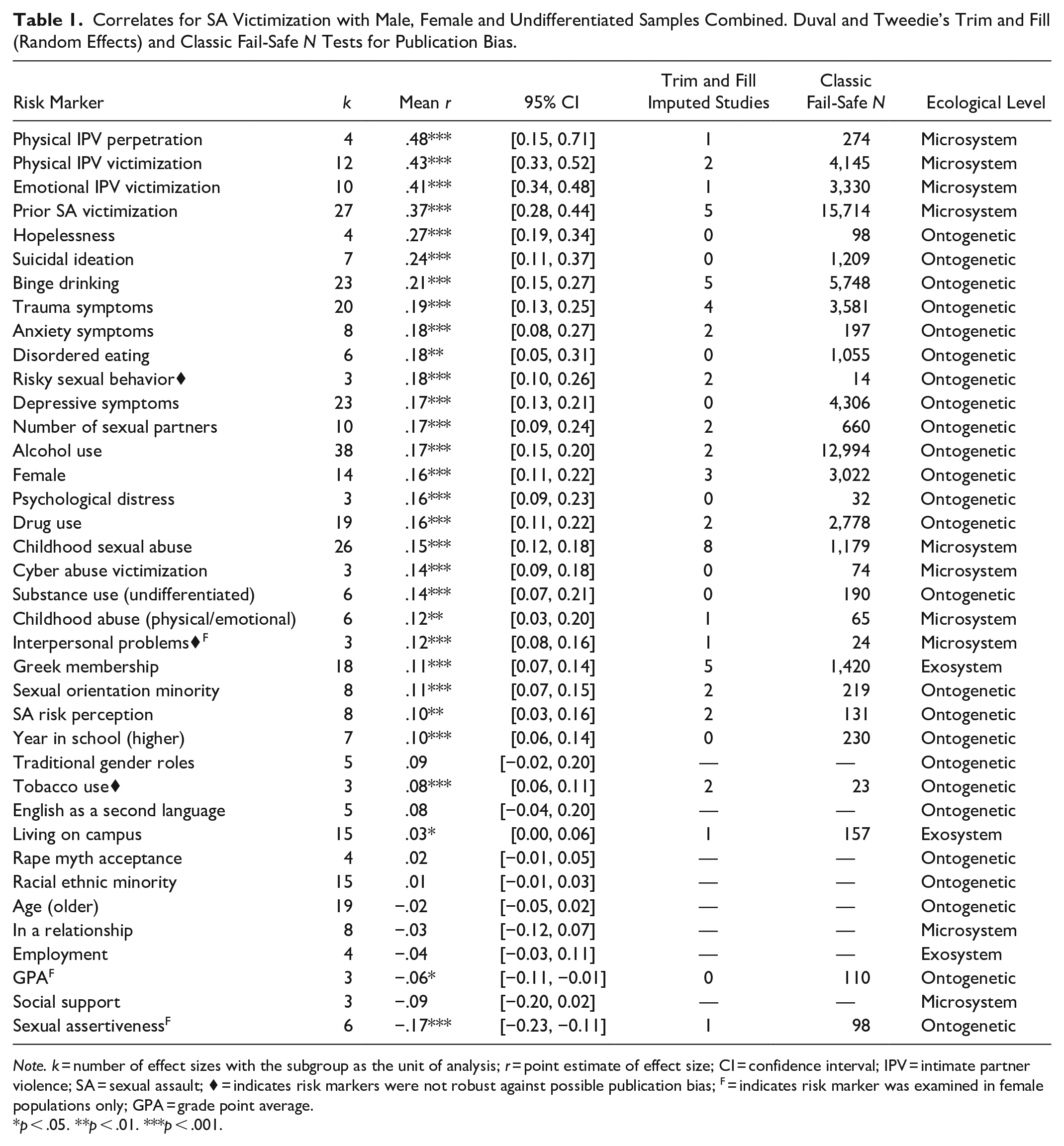
Note. k = number of effect sizes with the subgroup as the unit of analysis; r = point estimate of effect size; CI = confidence interval; IPV = intimate partner violence; SA = sexual assault; ♦ = indicates risk markers were not robust against possible publication bias; F = indicates risk marker was examined in female populations only; GPA = grade point average.
p < .05. **p < .01. ***p < .001.
Other significant correlates for SA victimization included cyber abuse victimization (r = .14, p < .001), substance use (r = .14, p < .001), childhood abuse (r = .12, p < .01), Greek membership (being a member of a sorority or fraternity; r = .11, p < .001), sexual orientation minority status (r = .11, p < .001), SA risk perception (belief that there is a higher risk of SA victimization; r = .10, p < .01), higher year in school (r = .10, p < .001), and living on campus (r = .03, p < .05). Interpersonal problems, defined by distress associated with interactions with others (r = .12, p < .001), and tobacco use (r = .08, p < .001) were significant correlates for SA victimization, but were not robust against potential publication bias, and thus should be interpreted with caution. Sexual assertiveness (the ability to assert boundaries, limits, and desires surrounding sex, r = −.17, p < .001) and GPA (r = −.06, p < .05) were significantly, negatively associated with SA victimization, but were only examined in samples of female college students. Lastly, adhering to traditional gender roles, speaking English as a second language, rape myth acceptance, being a racial or ethnic minority, older age, being in a relationship, being employed, and social support were not significantly related to SA victimization among college students.
A total of seven correlates for SA victimization were examined in at least three unique studies with female samples and three studies with male samples (Table 2). Of these, only one correlate significantly differed in strength between male and female college students. Being a racial or ethnic minority was a stronger, negative correlate for male students (r = −.12, p < .05) than female students (r = −.01, p > .05, Qb = 4.25, p < .05). Alcohol use, binge drinking, drug use, substance use, trauma symptoms, and year in school did not significantly differ in the strength of correlates for SA victimization between male and female samples.
Comparing Male and Female College Students on Strength of Correlates for SA Victimization.

Note. k = number of effect sizes with the subgroup as the unit of analysis; r = point estimate of effect size; CI = confidence interval; IPV = intimate partner violence; SA = sexual assault; Boldface indicates statistical significance.
p < .05. **p < .01. ***p < .001.
Discussion
This meta-analysis synthesized data from 118 studies examining factors associated with SA victimization on college campuses. To our knowledge, this is the first meta-analysis related to SA on college campuses that goes beyond prevalence rates, intervention programs, and mental health factors. Findings highlight that some of the strongest factors associated with SA victimization were microsystem factors such as other forms of violence victimization, followed by ontogenetic level factors such as mental health factors that are potentially consequences of SA victimization, and exosystem factors such as aspects related to the party culture on college campuses. This meta-analysis also explored potential gender differences between male and female college students and found that only one out of eight factors significantly differed between male and female college students.
The four strongest correlates for SA victimization were in the microsystem level and were related to IPV (i.e., physical IPV perpetration and IPV victimization, emotional IPV victimization, and prior SA victimization). This finding aligns with recent research that found poly-victimization was widespread on college campuses (DeKeseredy et al., 2019; Kaasa et al., 2016; Ross et al., 2016; Snyder et al., 2021). Effects of SA victimization have been viewed as cumulative, where the severity of symptoms increases with each assault (Campbell et al., 2009), which would also have an impact on other ontogenetic factors, such as mental health consequences of SA. These findings also highlight how individuals in relationships may be both perpetrating and be victims of violence in those relationships simultaneously. It is unknown if the perpetration of physical IPV is in self-defense related to SA victimization, but it is an important assessment point to examine in future research. It has been noted that many IPV measures find false positives because they do not account for self-defense or use language to differentiate between playful physical interactions and IPV (Hamby, 2016). This highlights the importance of contextualizing IPV when examining the relationship between IPV perpetration and SA victimization. Lastly, weaker significant associations were found for cyber abuse victimization, childhood sexual abuse, and childhood abuse.
The next strongest correlates for SA victimization were in the ontogenetic level and related to mental health. These include hopelessness, suicidal ideation, trauma symptoms, anxiety symptoms, disordered eating, and depressive symptoms. Rather than predictors, these correlates are likely consequences of SA, as longitudinal studies have shown that experiencing SA was associated with subsequent increases in negative mental health outcomes, including anxiety and depression (Carey et al., 2018), suicidal ideation (Sigurvinsdottir et al., 2020), PTSD symptoms (e.g., hypervigilance, feeling distant or cut off, feeling emotionally numb; Peter-Hagene & Ullman, 2018), increased somatic symptoms associated with PTSD (e.g., persistent fatigue, racing heart, difficulty sleeping; Ulirsch et al., 2014), and disordered eating behaviors (Groff Stephens & Wilke, 2016).
Other significant ontogenetic and microsystem level correlates, including binge drinking, alcohol use, and drug use, were related to the broader exosystem of campus party culture. Interestingly, binge drinking was the strongest of these correlates. Greek membership, an exosystem factor, was also related to SA victimization, although the effect size was small. Party culture refers to a college campus-level environment wherein partying is a normative, and perhaps even expected tradition, among students (Moylan & Javorka, 2020). College parties are likely to include access to alcohol and other substances, many of which have been previously shown to be associated with SA (Crawford et al., 2008; DiJulio et al., 2015; Testa & Cleveland, 2017). Party culture might be particularly relevant when considering specific subgroups of students such as those involved in Greek organizations, as previous literature has linked Greek membership with higher engagement in partying behavior like problematic alcohol and drug use (Boyle, 2015; Lasky et al., 2017). Relatedly, hookup culture is associated with drinking behaviors as well (DiJulio et al., 2015; Sutton & Simons, 2015). Taken together, these data help explain why our meta-analysis found significant risk markers for alcohol and drug use (also binge drinking, substance use, and tobacco use), number of sexual partners, and Greek membership. Importantly, we do not attempt to suggest causal connections between the correlates identified and SA victimization in any direction. Inasmuch as participation in college party cultures precedes SA, it is plausible that engaging in these behaviors serves as a coping mechanism for victims of SA. For example, Messman-Moore et al. (2015) found a cyclical relationship between drinking, being victimized, and drinking to cope with SA victimization. The same might be true of other substance use as well. It is also possible that survivors of SA engage in sexual activity with multiple partners following an incidence of SA to feel empowered or reclaim autonomy. These considerations require further investigation.
Within the ontogenetic system, we found that identifying as a female was the strongest demographic correlate for SA victimization on college campuses. This is not surprising as rates of sexual violence among college-attending females continue to remain high, at around one in four experiencing SA while in college (Cantor et al., 2020). In terms of other ontogenetic factors related to demographic information, we found a small correlation between being LGBTQ+ and SA victimization. Specifically, prevalence rates of sexual violence among LGBQ+ college students have been reported to be higher, particularly among those who identify as bisexual, as compared to their heterosexual peers (Cantor et al., 2020). These findings demonstrate a gendered power structure in society that supports and increases violence against women and/or those who hold one or multiple marginalized statuses (e.g., Messerschmidt, 2017). The strength of these findings highlights the importance of continuing to address the cultural and societal norms around standards of masculinity and SA (i.e., macrosystem level).
For female college students only, the ontogenetic factors of sexual assertiveness and GPA emerged as correlates negatively associated with SA victimization. Sexual assertiveness had a stronger negative relationship with SA victimization than GPA, as GPA only had a trivial association with SA victimization. Sexual assertiveness is conceptualized as an individual’s awareness of their sexual autonomy and ability to communicate their sexual needs and desires (Ménard & Offman, 2009; Rickert et al., 2002). This construct has been explored among women in relation to sexual violence (e.g., Kelley et al., 2016; Livingston et al., 2007; Rickert et al., 2002). Collectively, this body of research supports the notion that promoting sexual assertiveness among women is helpful in both promoting sexual satisfaction and reducing risk of sexual violence victimization or revictimization. Thus, it is no surprise that our meta-analysis found sexual assertiveness as a protective factor that reduced the risk of SA victimization for women. It is noteworthy, however, that this was not true of college men. Social norms privilege men’s expression of sexuality and support problematic ideas about masculinity and male sexual dominance (e.g., Fahlberg & Pepper, 2016; Messerschmidt, 2017). Although promoting sexual assertiveness among women appears to be an immediate way to prevent SA victimization, it is important not to place the onus on women to protect themselves from men. Thus, we must work diligently to combat masculine ideas that grant men undue power, and target prevention efforts toward men that teach about consent and healthy relationship strategies.
There were several correlates that were not significantly associated with SA victimization on college campuses including age, relationship status, being a racial or ethnic minority, employment status, English as a second language, level of social support, endorsement of traditional gender roles, and rape myth acceptance. These results do not indicate that these factors are protective against SA victimization, rather, that SA can occur despite whether these factors are present or not. Some of these factors might be important to contextualize experiences of SA victimization despite not necessarily emerging as a risk factor in our analysis. For example, rape myth acceptance has been found to be associated with not labeling a non-consensual sexual experience as SA (LeMaire et al., 2016); thus, it is possible that these factors help explain how individuals view their experiences after SA rather than contributing to the risk of experiencing SA. Relatedly, while gender norms are commonly implicated in SA research (as we argued above), adhering to/endorsement of traditional gender roles may not have emerged as a risk factor because acting in such a way may coincide with a lesser likelihood to report SA, particularly for women who feel as though it was their responsibility or obligation to have sex. However, this is a speculative insight and would require further investigation to know whether this could, in fact, explain why adherence to traditional gender norms did not emerge as a significant risk factor. It is surprising that being a racial or ethnic minority was not associated with a higher risk for SA victimization given that some women from racial minority groups experience much higher rates of victimization than White women (Black et al., 2011). However, this is not true for all racial or ethnic minority groups (Black et al., 2011), and it could be that combining a heterogenous group of people into one category impacted the analysis. Additionally, it may be related to where the data has been collected, as previous research has found that women at historically Black colleges or universities (HBCUs) have lower rates of SA victimization compared to women at non-HBCUs (Krebs et al., 2011).
Of the seven correlates for which we were able to compare the strength of the association between women and men, being a racial or ethnic minority was the only factor that significantly differed between men and women. Although this was not a significant correlate of SA victimization overall, it was negatively associated with SA victimization for men. This finding is contrary to research showing higher prevalence of SA victimization for racial or ethnic minority men (Black et al., 2011). It is possible this difference is due to other research on prevalence rates evaluating national samples (Black et al., 2011), whereas the current study only looked at college samples. Additionally, most studies included in this analysis were not racially diverse; they consisted of mainly White samples. Therefore, the effect sizes calculated in these studies were done with smaller samples than other effect sizes evaluated. This finding could also be similarly impacted by combining racial and ethnic groups as well as types of SA victimization when these factors have been found to impact prevalence rates in previous literature (Black et al., 2011; Smith et al., 2018). See Table 3 for a review of critical findings from this study.
Review of Critical Findings from the Study.

Note. SA = sexual assault; IPV = intimate partner violence; GPA = grade point average.
Practice, Policy, and Research Implications
Practice implications
These findings have important implications for universities and colleges. Given that college students are experiencing multiple forms of IPV (physical, emotional, and sexual), sexual education and healthy relationship programming should be prioritized so college students can understand the importance of consent in relationships, unhealthy behaviors in a relationship, and how to safely leave abusive or unhealthy relationships. Moreover, as psychological distress was strongly associated with experiencing SA, improving institutional responses and social reactions to survivors is crucial to minimize PTSD symptoms (Smith et al., 2016; Ullman & Peter-Hagene, 2016). Increasing the accessibility and quality of both on-campus mental health services available to survivors of SA and campus-wide SA education can help provide survivors with affirming resources and make them aware of what resources are available to them. As certain identities were significantly associated with SA victimization (e.g., women, LGBQ+ students, on-campus residents, Greek life members), it is especially important to connect with on-campus programs and organizations who serve these students, so that these organizations can help educate students of the SA resources that are available to survivors. Campus-wide SA education can also serve to educate the larger campus about SA facts, discuss more appropriate ways to respond to disclosures of SA, and help students learn to reject rape myths and challenge traditional gender norms.
Policy implications
The findings in the current study can inform policy at multiple levels. At the university level, it is clear that SA is far too common and has widely reaching effects on victims. University policies should mandate that all individuals are required to complete sexual violence prevention training which includes teaching about consent, healthy relationships, and how to handle situations related to SA for oneself and others they know. One potential program could be that of Enhanced Assess, Acknowledge, Act (EAAA) SA resistance education program that has shown to be effective at reducing SA of college women (Senn et al., 2015). Further, we strongly recommend that universities use a mechanism (e.g., climate surveys) to frequently assess incidence rates of SA, and related correlates such as those examined in the current study as relying on data that come from formal reports (e.g., policy reports, Title IX reports) of SA may not be accurately reflective of the rates of SA on campuses. Information gained could be used to inform university policy specific to the needs of the student body at that university.
Policy protecting people’s sexual health and autonomy must be a priority at the local, state, and federal levels too. At the time of this writing, policy related to sexual health in United States is being given much attention because of Roe v. Wade, the landmark Supreme Court case which ruled that unduly restricting access to abortion was unconstitutional, was overturned on June 24, 2022. It is imperative that research is consistently used to inform policy that protects the sexual health of all people and that current protections (i.e., Title IX) are not thought to be guaranteed forever. Legislators must continue to advocate for policies that grant sexual autonomy, prevent SA, and support survivors.
Research implications
We were unable to identify any macrosystem level factors to be included in the meta-analysis. This highlights a large gap in the literature that future research should examine to gain a more comprehensive perspective on factors associated with SA victimization. Additionally, we were unable to analyze several correlates for SA victimization because they were not found in at least three unique studies (e.g., self-blame, peer alcohol use, being a student athlete). There were also several ontogenetic or microsystem level correlates that were only found in three unique studies (e.g., cyber abuse victimization, social support, interpersonal problems, GPA). Even though they were included in our analysis, they are still understudied in the literature. Examining correlates not currently present in the literature, such as factors in the macrosystem, or factors that have only been examined in a few studies, could expand our current knowledge surrounding SA victimization.
Regarding the correlate of race/ethnicity, out of 120 studies included in the meta-analysis, only 15 studies examined race as a correlate for SA victimization. Additionally, of the 15 studies that examined race/ethnicity, the majority of the studies only included one variable combining all minority racial/ethnic identities. Therefore, we combined multiple racial and ethnic identities into one variable, which might explain why it was not significantly related to SA victimization overall. Additionally, the studies that did separate the results by race/ethnicity found varying results. One study found no significant differences between risk of SA victimization for Black, Asian, and Hispanic students when compared to White students (Howard et al., 2008), whereas another study did find that Black students, Asian students, and students who identified as “other” were more likely to experience SA victimization than White students, and there was no difference between White and Hispanic students (Daigle et al., 2019). Future research should examine different racial and ethnic groups separately. Similarly, we were only able to compare men and women on seven correlates. This was also related to many studies examining samples undifferentiated by gender, or only looking at male perpetrators or female victims. Future research should also examine gender identity separately when looking at correlates for SA victimization among college students. Additionally, we did not identify any studies specifically examining transgender and gender non-conforming (TGNC) individuals. Future research would benefit from examining correlates for SA victimization among TGNC individuals, as well as comparing correlates between TGNC individuals and cisgender individuals. See Table 4 for a review of implications from the study.
Implications for Practice, Policy, and Future Research.

Note. SA = sexual assault.
Limitations and Future Research
A common limitation for meta-analyses is the potential that we missed articles that could have been included in the analysis. To combat this potential limitation, we did conduct publication bias tests to ensure our results were not impacted by potential publication bias. Additionally, we identified literature to be included in the meta-analysis up to 2019. Additional meta-analyses should be completed over time in order to continuously update what is known about correlates for SA victimization. Another limitation of the study is that our results were correlational, and we could not determine whether or not the factors examined in the study were consequences of SA, risk factors for SA, or held a cyclical relationship with SA victimization. Future research would benefit from additional longitudinal examinations of SA to better understand the correlates of SA victimization, as well as the relationship between various forms of gender-based violence and the phenomenon of poly-victimization on college campuses. We used bivariate effect sizes in the analysis, and therefore could not examine control variables that may also influence correlates for SA victimization, as well as how correlates may be influencing one another. Lastly, not all factors included in the analysis were measured the same way. For example, of the studies examining physical IPV, the majority of studies used the Conflict Tactics Scale (Straus et al., 1996) to measure IPV, and there were two studies that had participants answer a series of questions asking them if they had experienced acts of physical violence from an intimate partner. It may be that the way questions were asked in individual studies makes a difference in participant responses.
Conclusion
This meta-analysis contributed to the literature by examining correlates for SA victimization on college campuses. Significant correlates for SA victimization included microsystem factors such as other forms of victimization (e.g., physical IPV victimization, emotional IPV victimization, prior SA victimization, childhood sexual abuse victimization, and cyber abuse victimization), ontogenetic level factors such as potential mental health consequences of SA victimization (e.g., hopelessness, suicidal ideation, trauma symptoms, anxiety symptoms, depressive symptoms), and exosystem factors related to campus party culture (e.g., binge drinking, alcohol use, drug use, Greek membership).
Moreover, men and women shared more commonalities in correlates for SA victimization than differences. Results of the meta-analysis highlight the importance of relationship education, SA education, and improving responses to SA survivors in an attempt to reduce symptoms associated with SA victimization. Lastly, future research should examine race/ethnicity and gender as separate categories; explore understudied correlates, particularly those at the macrosystem level, and conduct longitudinal studies of SA to gain a more nuanced understanding of correlates for SA victimization.
Footnotes
Declaration of Conflicting Interests
The author(s) declared no potential conflicts of interest with respect to the research, authorship, and/or publication of this article.
Funding
The author(s) received no financial support for the research, authorship, and/or publication of this article.
