



Abstract
In recent years, the act of stealthing, also termed nonconsensual condom removal (NCCR), has become an emerging important topic related to nonconsensual sexual experiences. We performed a rapid review by searches in Web of Science (245 articles), Medline (157 articles), and PsycINFO (72 articles). The studies, in English, French, Italian, or Spanish, that reported empirical data on stealthing were included, except for those focusing on the legal response to the phenomenon. The final sample of 16 articles of various design is analyzed. According to this review, more than 10% of women experience stealthing in their lifetime, and men having sex with men also experience stealthing. The article describes the empirical research literature in the field, explores terminological and conceptual challenges, and proposes a new and more comprehensive term (nonconsensual condom-use deception), and a revised definition and categorization of the behavior, according to the concrete manifestation of consent breach, the associated practices, or the underlying motivation. We argue that research, as well as policy and practice responses to this growing problem need to be guided by a conceptual framework that uses information gathered directly from those who experienced it.
Despite increased prevention efforts, sexual violence continues to be a prevalent global issue with enormous consequences for mental and physical health of the victims (World Health Organization [WHO], 2013). In recent years, sexual consent, commonly defined as freely agreeing to participate in sexual activity, has gained further interest. Sexual consent can be conditioned by the consensual use of a condom, which is a coitus-dependent contraceptive method associated with the male partner’s ability and willingness to enact. Using condoms requires joint decision-making between partners together with male cooperation (VanderDrift et al., 2013). Yet, research demonstrates that both men and women experience condom-use resistance from their partners, as well as engage in condom-use resistance (Davis, 2019), with men being more likely than women to engage in the latter (Wegner et al., 2018). Both coercive and noncoercive ways of resisting condom use have been described (Davis et al., 2014).
In this context, a novel term to name an ongoing problem arose through the internet: stealthing. It was first publicized by Alexandra Brodsky (2017), who argued that it was a widespread violence. Stealthing could be described as the surreptitious removal of a condom before or during intercourse, when consent has been given only for condom-protected sex. Nonetheless the term nonconsensual condom removal (NCCR), rather than stealthing, is currently preferred to refer to this phenomenon (Czechowski et al., 2019). Early studies analyzed stealthing as a form of reproductive coercion (Miller et al., 2014; Nikolajski et al., 2015; Sutherland et al., 2015; Teitelman et al., 2011). Studies conducted from this perspective coined terms such as “condom manipulation” or “condom sabotage,” that can include stealthing but they also include other conducts, such as intentional condom breakage (Davis et al., 2014). Furthermore, stealthing has been documented when male partners remove condoms or deceive their female (Brodsky, 2017; Rowlands & Walker, 2019) or male (Klein, 2014) partners about condom use. Therefore, stealthing cannot be exclusively understood from the reproductive-coercion perspective, and several other motivations for this conduct have been described.
Though stealthing has recently garnered major attention, public knowledge about this phenomenon is scarce (Ahmad et al., 2020) and very little is known about this practice. There remains a significant paucity of empirical scientific literature about the behaviors and dynamics involved. Research in this area is still in its early stages, therefore it suffers from a lack of consensus on basic aspects, such as the definition, and no categorization of the phenomenon has been proposed. This urgently needs to be addressed to strengthen the foundations of future research in the field, to guide interventions on the victims/perpetrators, and to better inform legal debate. The behavior is yet to be widely criminalized (Davis, 2019) and which legal framework should be applied is currently under discussion (Brodsky, 2017; Clough, 2018). But serious steps have already been taken, such as California Assembly Bill No. 453 (2021), that was signed into a law on October 7, 2021, defining stealthing as a form of sexual battery.
Regarding this gap in our scientific knowledge, and given rapidly changing sexual practices and legal concepts about them, in line with WHO recommendations (WHO, 2017), we performed a rapid review of the empirical evidence on stealthing, to help to better conceptualize this phenomenon. Therefore, the purpose of this review is to (1) clarify how stealthing has been operationalized in research, (2) provide published prevalence and incidence rates of the phenomenon, (3) depict stealthing practice, and (4) describe the reported motivations for stealthing.
Methods
Rapid review was conducted according to WHO recommendations and standards (WHO, 2017). We applied PRISMA guidelines (Preferred Reporting Items for Systematic reviews and Meta-Analyses) to protocol development, review reporting, and process tracking, to improve the transparency, accuracy, and quality of the study. Following PRISMA, a systematic search strategy with preselected search terms was performed. In the next stage, eligibility criteria were applied. Finally, we followed PRISMA to present results, covering all the aspects of the article.
A literature search was implemented in several databases by a single reviewer and the two researchers independently screened retrieved articles. Any discrepancies were discussed and the knowledge was put together in a narrative summary. Papers were identified by searches in Web of Science, Medline, and PsycINFO. The search, performed on February 18, 2021, was based on combining the term “stealthing” OR “condom removal” OR “condom manipulation” OR “condom sabotage” OR “reproductive coercion.” Other informal terms, such as “sneaking” or “stealthing fucking” (Klein, 2014), did not yield any results in scientific databases. No temporal restrictions were applied to the searches. Every study that reported empirical data on stealthing was included. Inclusion criteria were that studies had to report empirical data on stealthing experiences, and exclusion criteria were articles written in language other than English, Spanish, French, or Italian. Because they are not based on direct experiences of stealthing, articles focusing on the context of how the legal system respond to stealthing were excluded. References of selected studies were hand searched for further references. Both quantitative and qualitative studies were included to better understand the nuances of this form of violence and make conceptual inferences about this lived experience.
Results
The original search in Web of Science retrieved 245 articles, the Medline search retrieved 157 articles, and the PsycINFO search retrieved 72 articles, of which 12 included empirical data about stealthing and were selected for this review. After hand searching their reference lists, four additional articles were included. Table 1 summarizes the characteristics of the 15 selected studies (16 articles). Study designs varied widely, but they were included in this review.
Study Characteristics.
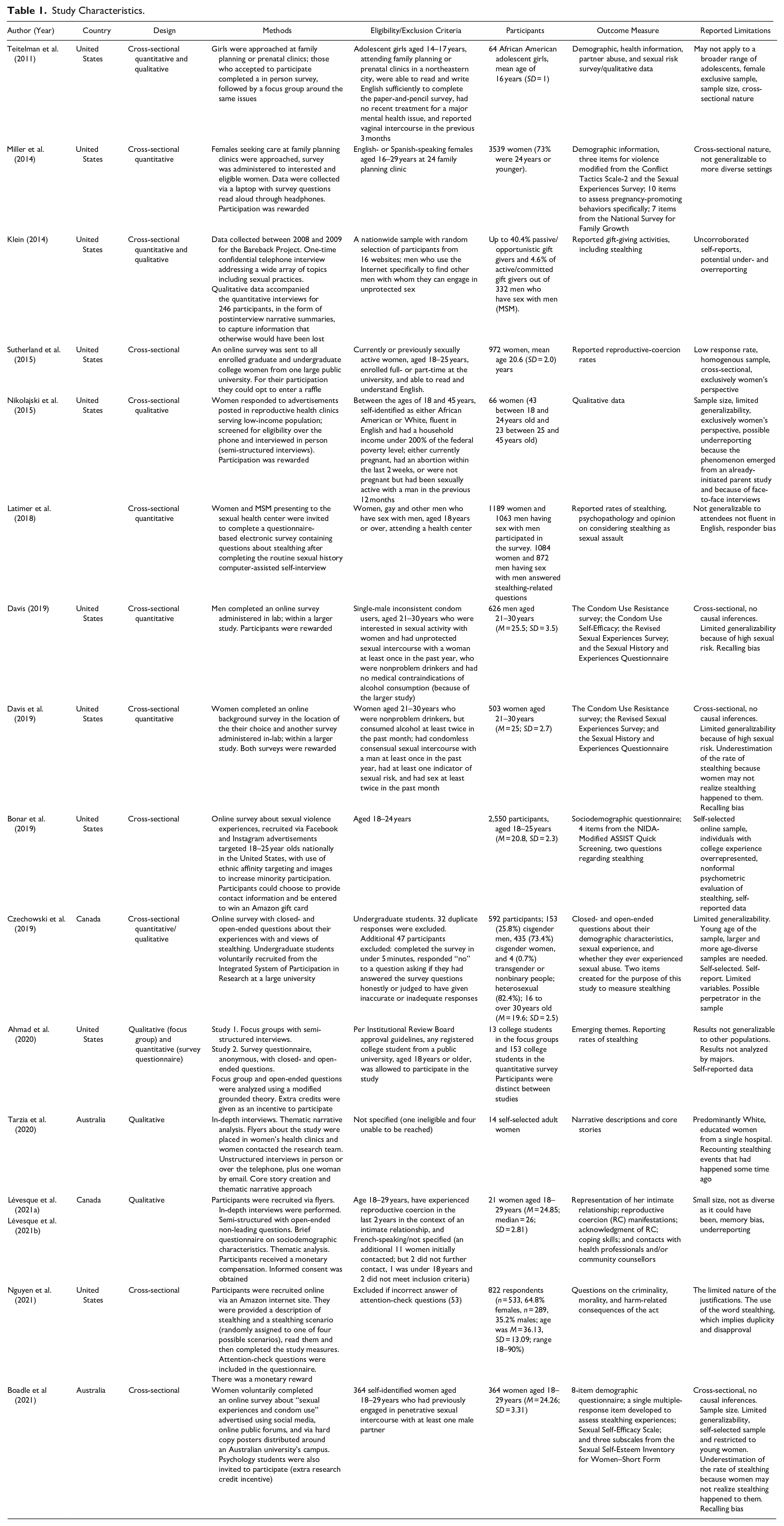
To achieve the objective proposed in this review, the information provided by different studies was organized into four sections: (1) stealthing operationalization in empirical research, (2) prevalence of stealthing, (3) stealthing practice descriptions, and (4) motivations for stealthing.
Stealthing Operationalization in Empirical Research
Stealthing is a newly described behavior, thus, it was measured by detailed questions developed specifically for each project. Accordingly, researchers operationalized stealthing in different ways in the reviewed articles (Table 2). Four key issues can be identified across studies’ conceptualization of stealthing: (1) consent, (2) timing of condom removal, (3) motivation, and (4) age.
Empirical Conceptualization of NCCD.
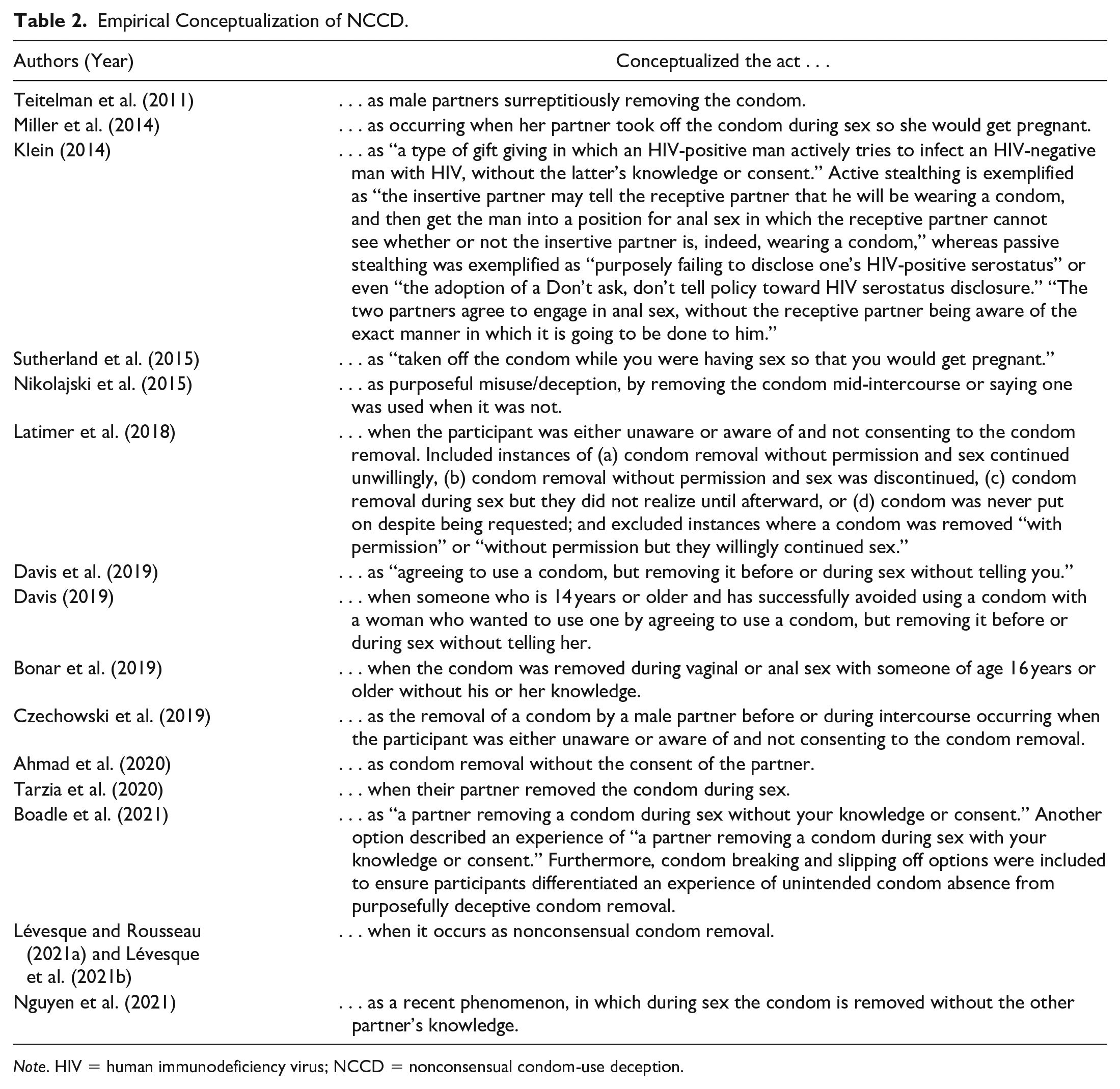
Note. HIV = human immunodeficiency virus; NCCD = nonconsensual condom-use deception.
Consent
Regarding consent, overall, empirical research highlights the lack of consent component of stealthing as the core of this problematic behavior (Czechowski et al., 2019). Davis et al. (2019) conceptualize the phenomenon as a form of coercive condom-use resistance: a perpetrator’s aggressive or manipulative tactic to avoid condom use with a partner who wanted to use one. Regarding the distinction between knowledge and consent, Boadle et al. (2021) advocate for the explicit inclusion of both “without consent” and “without knowledge” in stealthing definition, as condom use may not be explicitly discussed but implicitly included in sexual consent. Czechowski et al. (2019) reported their results in detail as stealthing experiences without consent, without knowledge, or without consent and knowledge, and their results suggest that some people may experience condom removal without their knowledge but not consider the experience “non-consensual.”
Furthermore, Latimer et al. (2018) consider whether and under what conditions sex continued after condom removal, therefore they exclude situations where a condom was removed without consent and the continued sex may be consensual.
Some of the articles reviewed do not even include consent/knowledge in the definition or in the question designed to measure stealthing experiences, although it can be inferred from the research context (Miller et al., 2014; Sutherland et al., 2015; Tarzia et al., 2020). From another perspective, some examples provided by Klein (2014) emphasize a lack of information about HIV serostatus, that would vitiate consent, rather than the fact that the agreed sex was protected.
Timing of condom removal
The timing of condom removal is also something that not all authors contemplate, but there seems to be no controversy in recognizing stealthing no matter whether the condom is withdrawn before or during the intercourse. Some authors even include under the umbrella of the informal term stealthing, those situations in which the perpetrator simply pretends to put on a condom. For example, Latimer et al. (2018) deemed to have experienced stealthing if someone reported that the condom was never put on despite being requested. Noteworthily, some of the examples provided by the literature refer to experiences in which the condom is not used—so it was never actually removed. In fact, a number of women interviewed by Lévesque et al. explained that their partner just pretended to put it on, unbeknown to the participant; and Klein’s description of the phenomenon suggests that once the perpetrator of stealthing escapes the victim’s field of vision, the condom would not necessarily be placed (Klein, 2014; Lévesque et al., 2021).
Motivation
Motivation for stealthing is sometimes included in its definition. Bonar et al. (2019) state that stealthing is considered as a form of reproductive coercion and referred to as condom manipulation or condom sabotage. From another perspective, Klein (2014) offers a conceptualization of the phenomenon limited to gift-giving behaviors.
Age
Discrepancies regarding victims or perpetrators’ age can also be found in the literature. Bonar et al. (2019) contemplate a 16 -year threshold for the victim and Davis et al. (2019) ask about experiences of those above 14 years of age.
Prevalence and Incidence of Stealthing
Only eleven articles provided quantitative data in our review and some of them did not provide specific data about stealthing prevalence (Ahmad et al., 2020; Klein, 2014; Nguyen et al., 2021; Teiltelman et al., 2011).
Those studies that focused on reproductive coercion provide clearly lower prevalence figures. Miller et al. (2014) surveyed more than 3,500 women at family planning clinics and 1.6% of them (58 women) reported their partner took off the condom during sex so that they would get pregnant in the past 3 months. Similarly, Sutherland et al. (2015) reported that 1.1% of almost 1,000 surveyed college women experienced the same situation, without clearly providing a time frame.
Those studies that did not limit the experience to reproductive coercion provide higher figures. Bonar et al. (2019) surveyed 2,550 people recruited via Facebook and Instagram advertisements. For males, 6.1% reported a history of stealthing perpetration (2.8% once, 1.2% twice, 1.5% 3–5 times, and 0.6% 6 or more times). Racial/ethnic minority individuals and those with greater frequency of binge drinking, cannabis use, other illegal drugs, and prescription drug misuse were significantly more likely to report perpetration of stealthing. Furthermore, 5% of males reported a history of stealthing against them (2.6% once, 1.1% twice, 0.7% 3–5 times, and 0.8% 6 or more times). Racial minority men, nonheterosexual men, and substance using men are significantly more likely to report having experienced stealthing. For females, 18.9% reported a history of stealthing (10.3% once, 5.2% twice, 2.5% 3–5 times, and 0.9% 6 or more times). Women who had experienced stealthing were significantly older and more likely to be racial minorities and substance users. Czechowski et al. (2019) surveyed 592 undergraduate students (73.4% women) and 18.7% of participants who had engaged in penetrative sexual intercourse with a male partner using a condom reported that their partner had stealthing perpetrated against them at some point in their life. Boadle et al. (2021) surveyed 364 women who had previously engaged in penetrative sexual intercourse with at least one male partner. The women were recruited via social media and online public forums, as well as via hard copy posters distributed around an Australian university’s campus; 9.34% of them reported they had experienced a male sexual partner deliberately removing a condom during sexual intercourse without their knowledge or consent. Having five or more male sexual partners annually was linked to the likelihood of them being subjected to stealthing; a disproportionate number of women who identified as nonheterosexual (excluding homosexual) had experienced stealthing.
Finally, those studies that use clinical samples report the highest prevalence and incidence rates in the literature. Latimer et al. (2018) surveyed 1084 women and 872 men having sex with men attending a sexual health center and 32% of women and 19% of men reported having ever experienced stealthing. Davis (2019) and Davis et al. (2019) surveyed 626 men and 503 women with elevated sexual risk characteristics; 9.8% of men reported engaging in stealthing since the age of 14, with an average of 3.62 times (SD = 3.87) and range of 1 to 21 times. Men who had engaged in stealthing were more likely to have ever been diagnosed with a sexually transmitted infectionn (STI) and to have had a partner with an unplanned pregnancy; 12.2% of women had a partner engage in stealthing, while none of them performed stealthing themselves.
Stealthing Descriptions
Evidence regarding practice descriptions comes from qualitative studies. Hereby we provide information regarding (a) conduct description, (b) prior agreement about condom use, (c) realization of stealthing, (d) drugs involvement, and (e) how the consent breach is identified by victims.
Conduct description
Stealthing has been explored mainly not only in the context of male–female relationships but also in male same-sex relationships (Klein, 2014). Men interviewed by Klein in the Bareback Project were specially explicit and described stealthing in anal intercourses: the insertive partner may tell the receptive partner that he will be wearing a condom, and then get him into a position for anal sex in which the receptive partner cannot see whether the insertive partner is, indeed, wearing a condom (Klein, 2014). Women surveyed by Lévesque et al. (2021) also recall being in a position where they could not see what their partner was doing.
Agreement about condom use
For how conversation evolves regarding condom use before stealthing, women who experienced stealthing clearly state it was clarified before the sexual encounter. Most women interviewed by Tarzia et al. (2020) articulated that they had been very clear about their desire to use condoms prior to the sexual encounter, either explicitly before having intercourse or as an ongoing conversation about condom use within a relationship. In Lévesque et al.’s (2021) study, women also reported that they had told their partner that they wanted to use a condom before having sex, they explained that their partner put the condom on at first and then removed it later but some just pretended to put it on, unbeknown to the participant. Furthermore, some reported that he would argue that it just “came off or whatever,” using excuses, so they never get to know what happened.
NCCD realization
About the realization that their partner had contravened their wishes and removed the condom during sex, histories varied widely. Some women reported realizing immediately or very soon afterward that the condom had been removed. They recalled that “he’d wear it to start with and then, if he was out of my line of sight, he’d take it off. Like really quickly [so I] didn’t even notice until afterwards” (Tarzia et al., 2020) or “at one point, I turned around, when we were changing position, and I realized he didn’t have the condom on anymore” (Lévesque et al., 2021). Some of them realized because they heard a sound and checked, or they saw it on the bed “not used” (Lévesque et al., 2021). In the study by Teitelman et al. (2011), adolescent girl participants of the focus groups indicated that they may not notice that the guy is not wearing a condom anymore, especially if they are sexually distracted. They highlighted that “Guys are real sneaky . . . guys slide condoms off . . . but they try to keep you entertained.” One of the women interviewed by Tarzia et al. (2020) stated that she had been very clear about it, because of being well educated about and very responsible in terms of her reproductive health and sexual health, and that her partner “had almost tried to trick me because it was dark, thinking I wouldn’t be aware of it!” Some victims of stealthing may even realize when they found out that they were pregnant. Nikolajski et al. (2015) conducted semi-structured interviews of women recruited through reproductive health clinics. Respondents described male partners’ behaviors around contraceptive control across a spectrum, from condom refusal or purposeful misuse/deception (removing the condom mid-intercourse or saying one was used when it was not) to overt sabotage of women’s contraceptive efforts. Some respondents described how they were led to believe that their partners were wearing condoms during intercourse only to find they had been deceived. A participant described one such experience that resulted in pregnancy: “I was like, how did I get pregnant when I put a rubber on you every time? He was like, ‘Oh I pulled it off three times’. And I’m like, when? I’m sittin’ here thinking, ‘when did he do that?’.” As this story shows, in Sutherland et al.’s (2015) sample the majority of women (61%) and MSM (55%) discussed the removal of the condom with their partners after the event.
It has also been described how stealthing experiences can lead to checking behaviors to make sure that the condom is still in place in future sexual encounters (Teitelman et al., 2011).
Drugs involvement
Drugs involvement in stealthing has also been described. Bonar et al. (2019) reported binge drinking, cannabis use, and prescription drug misuse in stealthing perpetrators. Sutherland et al. (2015) described alcohol and other drugs consume both in stealthing perpetrators and victims, both in their women and their MSM subsamples. Men interviewed by Klein (2014) explicitly described stealthing drug-associated practices, such as “booty bumping,” in which a man packs his unprotected penis’ foreskin with his drug of choice, he then inserts his penis, condomless, into the receptive partner’s anus and the drug gets into the receptive partner’s circulatory system through the anal capillaries. Drug use may facilitate stealthing, as the victim loses his sexual inhibitions regarding how the remainder of the sexual act unfolds. The receptive partner may become so high that he does not care anymore and “comes to crave the sex all the more.” Nevertheless, drug use does not necessarily have to be involuntary, as stealthing can occur in the context of recreational drug use by both partners. Substance use may be a proxy for general propensity for risk, and risk factors for men’s stealthing perpetration, reported by Bonar et al. (2019) involved binge drinking, cannabis use, and prescription drug misuse. Furthermore, Klein (2014) also described that victims under the effect of certain drugs may become too high to put up too much of a fight and that they also reported more violent situations in which if they asked him to pull out “he forces them down and makes them receive his semen anyway.”
Identification of consent breach
Stealthing deviates from the classic schema of sexual violence, because victims consent to initial penetration (Nguyen et al., 2021). Consistently, many women in reviewed studies stated that they were unsure whether the offense counted as violence because they had consented to intercourse (Brodsky, 2017; Lévesque et al., 2021).
On the other hand, Lévesque and Rosseau (2021) highlighted that stealthing is more readily and rapidly acknowledged than other forms of reproductive coercion because it is concrete and visible during sexual relations, as the condom is absent. The women they interviewed rapidly identified stealthing as reproductive coercion via two main processes. Most participants perceived it as problematic because it was a violation of a prior agreement about contraception, with consequences for the consent to have sexual relations. Condom use had been discussed and agreed upon in the previous contraceptive negotiation process, before sexual relations could take place, so the discovery led to rapid acknowledgment of the situation as inacceptable. For others, immediate and short-term reactions to the incident prompted the participant to think about the incident that provoked the distress. Yet, they highlighted that women reported self-responsibilization because of not making it clear that they had not consented or because of clouded memories after drinking (Lévesque & Rousseau, 2021).
Motivations for NCCD
Perpetrators’ discourse about motivation is key but it remains empirically unexplored
Acknowledging this important limitation, current review of the literature suggests that the majority of stealthing is probably sexual in nature, therefore considered as a form of sexual violence. Yet, it has been also widely described as a form of reproductive coercion in the context of male–female relationships and as a specific type of gift giving in the context of male same-sex relationships.
The first investigations on the phenomenon were mainly conducted from the perspective of reproductive coercion (Miller et al., 2014; Nikolajski et al., 2015; Sutherland et al., 2015; Teitelman et al., 2011). Miller et al. (2014) interviewed 61 adolescent females, with known history of intimate partner violence, from low-income neighbourhoods. Five subjects described inconsistent condom use during sexual intercourse, with their partner removing the condom. According to their results, around one-third of reproductive-coercion experiences involved stealthing. More recently, Bonar et al. (2019) also refered to stealthing as condom sabotage or condom manipulation.
Stealthing has been described both in formal and casual relationships, and both with or without intimate partner violence. Lévesque and Rousseau (2021) described that acknowledgment of reproductive coercion in stealthing victims varies according to the emotional bond with the perpetrator and the behaviors that were experienced. Lévesque et al. (2021) state that stealthing was the most readily identified form of reproductive coercion in their sample, whereas it could take longer to acknowledge pregnancy pressure and pregnancy coercion. Women who had experienced stealthing felt they had been denied their reproductive choices, defining the act as one of contraceptive disempowerment led by the wish to control their reproductive life.
Nevertheless, even when another motivation seems preeminent, sexual pleasure can also be involved. For example, in Nikolajski et al.’s (2015) study, which focused in contraceptive sabotage and pregnancy-promoting behaviors, some participants discussed their partner’s general refusal to use a barrier method, most commonly to enhance sexual pleasure. Similarly, a key element in women interviewed by Tarzia et al. (2020) was that the male partner was acting out of disrespect and selfishness, rather than seeking to promote pregnancy, noting that the perpetrator’s primary motivation was predominantly a dislike of condoms. In Lévesque et al.’s (2021) study, women involved in a committed violent relationship who experienced stealthing also reported that their partner wanted to increase his sexual pleasure. Furthermore, one of them was often criticized for not being sexually exciting enough, making it harder to use a condom due to a weak erection. Also women in casual uncommitted relationships felt that their partners wanted to increase their own sexual pleasure.
Finally and remarkably, we have located in the literature Klein’s (2014) empirical investigation that considers stealthing, together with “generationing,” as a specific type of gift giving—the process by which an HIV-positive person purposely infects an HIV-negative person with HIV. While in “generationing” one gift giver successfully infects a previously uninfected man with HIV, and then the two men collaborate in an effort to seroconvert another man, and so forth; in stealthing type of gift giving the knowledge or consent of the HIV-negative person does not concur necessarily.
Discussion
This review explores quantitative and qualitative empiric literature up-to-date regarding stealthing, both providing figures and analyzing narratives to better conceptualize the phenomenon.
Though articles in English, Spanish, French, or Italian were included in the review, only 16 of them could be selected. They were all in English and came from a limited number of countries (Australia, Canada, and United States), so the scope of this problem remains unexplored in a significant part of the world. Furthermore, the male perspective regarding stealthing is understudied in the current literature. Hence, we can affirm that, although stealthing is emerging as an important topic related to nonconsensual sexual experiences, there is still little empirical evidence available to guide public discussion.
Nevertheless, it is apparent from our review that a substantial minority of women and men having sex with men are being subjected to stealthing. Reported prevalence is 10% or higher in nonclinical community samples of women (Boadle et al., 2021; Bonar et al., 2019; Czechowski et al., 2019) and reach a third of women attending sexual health centers (Latimer et al., 2018). For men, data are scarce. Those who acknowledge perpetrating stealthing do not reach the 10% (Bonar et al. 2019; Davis, 2019) and experiencing stealthing has been described in almost 20% of men having sex with men attending a sexual health center (Latimer et al., 2018). Noteworthily, these figures are based on survey studies, so underestimation should be assumed because of expected underreporting of those who experience stealthing, and not only of perpetrators, as stealthing may be perpetrated without knowledge.
Notwithstanding underreporting bias, differences in the sample characteristics and recruitment and measuring methods; the disparity in the definition used by researchers was evident in our literature review and several authors have previously highlighted the difficulty with stealthing not having an agreed definition (Boadle et al., 2021; Czechowski et al., 2019). It follows from our review that scholars have operationalized stealthing in different ways in the scientific literature (Table 2), which generates confusion and limits the comparison between studies. Stealthing has been conceptualized differently depending on the main aspect authors’ focus, so we believe their operationalization of stealthing do not fully apprehend the phenomenon. Although most of the reviewed studies used the term stealthing, we strongly share Czechowski et al.’s (2019) insights about “stealthing” not appropriately reflecting the nonconsensual nature of the act and the risk of misinterpretation because of its popular and trendy condition. They believe NCCR to be a more accurate, descriptive, correct, and appropriate term. But, based on empirical data about the phenomenon, we propose a change to the term nonconsensual condom-use deception (NCCD), to fully apprehend every conduct described as stealthing in the literature. Based in our review, the definition that would cover all behaviors empirically described as stealthing would be: the nonconsensual (without knowledge or consent) removal of a condom before or during sex, or the deception of condom use, when consent has been explicitly or implicitly given only for condom-protected sex. Furthermore, according to our review, NCCD could be classified according to (a)whether there was no knowledge or there was knowledge but not consent, (b) whether there was drug involved (drug facilitated), and (c) the multiple possible motivations for NCCD: sexual pleasure, dominance, infectious disease transmission, and reproductive coercion.
The rationale for this definition and classification contemplates the following key elements identified in the literature and are discussed below: (a) consent/knowledge; (b) NCCD conduct; (c) motivation; and (d) perpetrators, victims, and sexual act characteristics.
Without Consent or Without Knowledge
From a criminal law perspective, stealthing has been described as “protection deception,” highlighting the dishonest nature of the behavior of not using the agreed-upon method of sexual protection (Clough, 2018). Overall, empirical research also highlights the lack of consent component as the core of NCCD. Consent to sex was given on the understanding that condom will be used, thus NCCD invalidates consent (Brodsky, 2017; Davis et al., 2019). From a theoretical perspective, Clough (2018) states that NCCD adds more intimacy and physical contact to sex than that all parties originally had consented. Accordingly, approximately two-thirds of Czechowski et al.’s (2019) respondents favored a literal approach to consent, which finds that NCCD victims consented to be touched by a condom and not to be touched by the skin of a penis. Yet, Czechowski et al. (2019) also identified a risk-based approach to consent in NCCD, which finds that NCCD vitiates consent because of a related increase in the risk of pregnancy or STI transmission.
Clough (2018) also highlights that relevant information is withheld from the sexual partner in NCCD, which affects the knowledge to make an informed decision. Condom removal without knowledge and without consent has been described as the potential for dual violation of a victim’s autonomy: a breach of her/his right to make an autonomous choice and the breach occurring without her/him knowing (Ebrahim, 2019). Boadle et al. (2021) emphasize that the person removing the condom has a responsibility to take reasonable steps to ascertain whether the other participant is aware of, and consenting to, the condom removal. Otherwise, he/she prevents the victim from being able to consent (or not) to condomless sex, making the behavior inherently deceptive and nonconsensual (Clough, 2018). Modern paradigms of sexual consent recognize it as being a fluid and changeable process and not as an act to be implied or assumed (Larcombe, 2011), particularly, when a participant makes changes to pertinent matters, such as condom use, during sex without the other participant being made consciously aware of it. What seems evident with respect to this dual via to NCCD is that those cases of NCCD without knowledge can occur in a relationship without the appearance of violence, while NCCD without consent but with knowledge entails a greater degree of coercion in the behavior. In this sense, we suggest that NCCD could be the first step to a higher level of violence.
In our opinion, there is no doubt that the essence of the NCCD is consent and it deserves a thorough discussion on the most appropriate way to represent it in the definition. Czechowski et al.’s (2019) study focused on both the lack of affirmative and explicit consent to removal of the condom. Even in those relationships in which, generically, unprotected sex has previously been agreed upon, valid consent must be given to a specific act and require confirmation if the circumstances in which sexual intercourse is taking place change.
We support the suggestion of Boadle et al. (2021) who advocate for the explicit inclusion of both “without consent” and “without knowledge” as condom use may not be explicitly discussed but implicitly included in sexual consent. Knowledge is the basis for consent, that is, there cannot be consent without knowledge. Therefore, including the term “without knowledge” may be theoretically redundant because it is included in “without consent,” yet, if it were not included, some victims may not identify the experience as NCCD. To our knowledge, Czechowski et al. (2019) are the only researchers who reported their results in detail as NCCD experiences without consent, without knowledge, or without consent and knowledge, and their results suggest that some people may experience condom removal without their knowledge but not consider the experience “non-consensual.” They suggest two possible explanations for this finding. First, they indicate that some people may rationalize condom removal without knowledge as something that was not necessarily nonconsensual—perhaps if consent was simply left unaddressed. Second, some people may experience condom removal without their knowledge; however, consent may be correctly implied by the person removing the condom. For instance, if the condom remover was the only person of the pair who wanted to use a condom in the first place. Thus, in some instances, condom removal may occur without knowledge, yet not exactly without consent. We consider that the study of Czechowski et al. (2019) gives results that provide empirical support to the explicit inclusion of both terms, and we support their recommendation that future research in this context should consider direct versus implied consent in further examination of NCCD.
Furthermore, Latimer et al. (2018) empirically considered whether and under what conditions sex continued after condom removal; and Czechowski et al. (2019) offered us an interesting reflection on the matter. They believe Latimer et al.’s (2018) definition is too narrow because they exclude situations where a condom was removed without consent and the continued sex may be consensual. Yet, they highlight that the condom removal is nonconsensual, whether people continue sexual intercourse willingly or unwillingly; thus, fitting within the definition of NCCR (Czechowski et al., 2019). In line with the operationalization of the concept made by Latimer et al. (2018), and sexual consent being a fluid and changeable process (Larcombe, 2011), we interpret that the willingness to continue sexual intercourse could be considered NCCR but distorts the essence of NCCD, and should not be considered as so. However, particular aspects that may condition consent in these cases should be explored, such as those indicated by Davis et al. (2019) when they described as noncoercive practice “getting you so sexually excited that you agreed to have sex without a condom.” In sum, we believe that the important thing is that the perpetrator has the intention of having condomless sex and intends to do so without the other partner consent. Accordingly, if the other person stops the sexual intercourse, it should be considered NCCD even though the sexual intercourse does not continue. Yet, if one partner removes the condom without the previous consent of the other partner, but there is knowledge on his/her part and he/she implicitly or explicitly consents to continue condomless sex, then the behavior is included in the fluent sexual intercourse consensual interactions, and therefore NCCD should not be considered. In our opinion, this would be one of the advantages of using the NCCD concept instead of NCCR, since the emphasis should not be on whether the condom has been removed or put on, nor on the moment in which it is decided whether the relationship will continue with or without condom, but rather on the nonconsensual nature in which the sexual act takes place.
NCCD Conduct
We agree with Czechowski et al. (2019) that the essential component of NCCR is not the timing of the removal, thus, we support to include the removal of the condom both before or during intercourse as NCCR and NCCD.
Yet, Czechowski et al. (2019) state that if a condom was never put on in the first place, it cannot be removed, and pretending to put on a condom would not constitute NCCR. Nevertheless, many authors do contemplate it as stealthing (Klein, 2014; Latimer et al., 2018; Lévesque et al., 2021). In our opinion, we agree that if someone pretends to put on a condom and sexual intercourse is started under the conviction that it is protected, it would be nonconsented condomless sex or nonconsented unprotected sex, but not NCCR. Nevertheless, this is widely described as stealthing in the literature and identified as stealthing by the victims. Furthermore, in terms of research, prevention and intervention with stealthing victims and perpetrators this is not the key issue. Therefore, we have suggested NCCD as a broader concept that includes both the deception of wearing a condom and the removal of the condom, to better assess this phenomenon.
Motivation
Although some authors include motivation in the definition of the phenomenon, we suggest avoiding it to better capture all NCCD experiences, and to rather contemplate the motivation in the classification of the phenomenon. Yet, some authors equate the phenomenon to a particular behavior of the multiple possibilities within this construct. Frequently, especially at the beginning of research on the phenomenon, NCCD was considered a form of reproductive coercion, as condom manipulation or condom sabotage (Bonar et al., 2019). Although NCCD can be a form of reproductive coercion, according to our prevalence figures coercive reproduction tactic barely accounts for one in 10 cases of NCCD and this conceptualization seems clearly insufficient. Many other motivations have been described in the literature. Furthermore, there is evidence that MSM perpetrates NCCR against other men (Latimer et al., 2018).
From another motivational perspective, Klein’s (2014) study offers a conceptualization of the phenomenon limited to gift-giving behaviors. Moreover, the examples provided emphasize a lack of information about HIV serostatus, that would vitiate consent, rather than the fact that the agreed sex was protected.
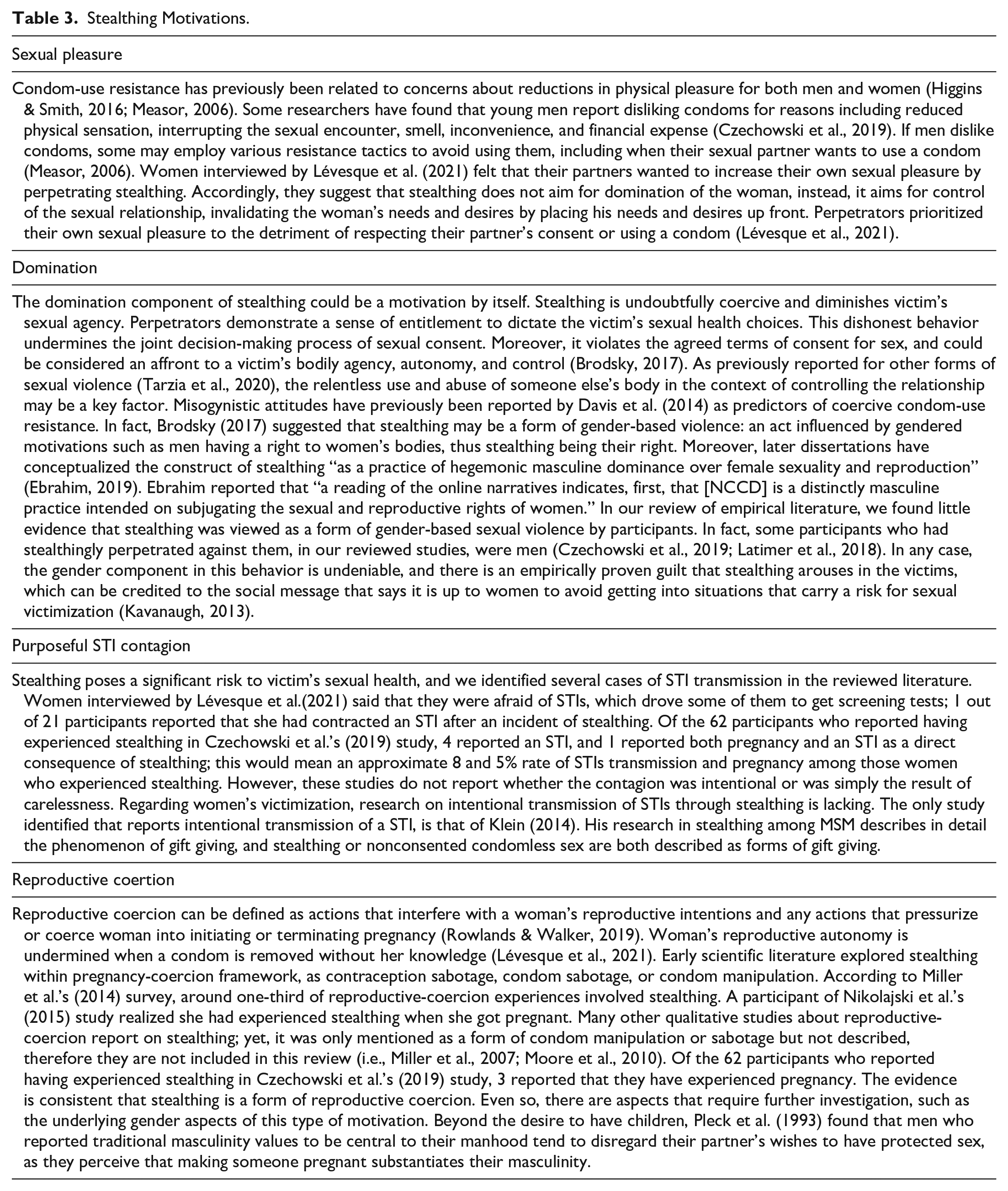
According to our review NCCD motivations are multiple and could be classified as: (a) sexual preasure, (b) domination, (c) STI contagion, and (d) reproductive coercion (Table 3). Victims consider that these motivations are not exclusive and may converge (NIkolajski et al., 2015) and we state that theoretically they could all be present in the same case.
Stealthing Motivations.
Perpetrators, Victims, and Sexual Act Characteristics
A couple of studies in our review limit their research to victims and perpetrators of a certain age (Bonar et al., 2019; Davis et al., 2019). In our opinion, any reference to the age should be avoided in NCCD research. Age of consent may vary by country and, regardless of someone’s legal capacity to consent or to be accused, the experience may occur below that age.
NCCD is conceptualized as a male-perpetrated sexual act, so it could be assumed that women or men who have sex with men are the expected target. Existing evidence suggests that most sexual violence is perpetrated against women and our results confirm higher prevalence of NCCD experiences among women than among men, even when a men-having-sex-with-men sample is considered (Latimer et al., 2018). Yet, our understanding of how sexual orientation and gender identity relate to risk of NCCD is limited. Despite indications that sexual minorities may be at high risk for sexual violence, it is unclear if these groups are at higher risk for all types of sexual violence (Mellins et al., 2017), and this does not appear to be the case for NCCD according to our review. Future research on NCCD should integrate gender dimension and any reference to the perpetrator’s biological sex should be avoided. We acknowledge that male condom is more practical and frequently used than the female one, therefore there is a predominance of men’s control over the condom. Nevertheless, female perpetration cannot be rejected, and gender diversity regarding this sexual behavior should not be neglected.
Similarly, any reference to the victim being the receptive partner should also be excluded, since theoretically, the recipient can also surreptitiously remove the condom without knowledge or consent of the insertive partner.
Remarkably, we acknowledge that this review does not provide an empirical substrate for these potentialities associated with gender, so future research is needed.
Finally, regarding the specific way NCCD evolves, stealthing can occur in the context of recreational drug use by both partners but the role of substance consumption in NCCD has only been barely explored in the literature. We know acute intoxication negatively impacts drinkers’ executive cognitive functioning capabilities, reducing their ability to attend to typically inhibiting situational cues (risk of STIs or unplanned pregnancy), and instead focusing their attention on impelling situational cues, such as sexual desire (Steele & Josephs, 1990). Substance use may be a proxy for general propensity for risk, and Bonar et al. (2019) reported that binge drinking, cannabis use, and prescription drug misuse are risk factors for men’s stealthing perpetration. It has also been proven that acute intoxication is indirectly related to unprotected sex intentions in women through reduced perceptions of negative health outcomes associated with condom nonuse (Stoner et al., 2008) and greater attention to cues of sexual arousal rather than to cues of their partners’ sexual risk (Davis et al., 2007). Furthermore, it could be considered as an aggravated form of NCCD if drugs are surreptitiously administered to make the victim loose her/his sexual inhibitions or to prevent her/him from realizing or fighting in this situation—approaching the concept of drug-facilitated sexual assault (Cruz et al., 2019). The role of acute substance intoxication or drug-related impairment in stealthing seems to us specially interesting regarding its legal correlates (Soria, 2021).
Conclusion
A substantial minority of women and men having sex with men are being subjected to stealthing. We strongly believe that the definition of stealthing needs to improve its accuracy and it should be expanded to be more inclusive of all stealthing experiences than NCCR. Therefore, after reviewing published literature and authors’ suggestions, we propose to change the term, from NCCR to NCCD. We state that there is sufficient empirical support to raise the following stealthing/NCCD definition: the nonconsensual (without knowledge or consent) removal of a condom before or during sex, or the deception of condom use, when consent has been explicitly or implicitly given only for condom-protected sex.
We strongly encourage future researchers to strengthen and enrich empirical evidence regarding NCCD practices by (a) using a comprehensive definition; (b) incorporating gender perspective and diversity in research; (c) analyzing how the processes regarding consent and condom use negotiation may unfold, both explicitly and implicitly; (d) exploring perpetrator reported motivations to better understand the nature of this complex behavior: and (e) analyzing NCCD relationship with other forms of violence. We hope our suggestion to use the term NCCD, and the definition and categorization proposals provided hereby are taken into account when addressing NCCD in future research to apprehend the entire constellation of stealthing behaviors, to enable comparison between studies and act as a guide to deepen our knowledge of this phenomenon.
Critical findings
Stealthing is a popular term, operationalized in different ways in the reviewed articles, that should be termed nonconsensual condom-use deception (NCCD) which includes nonconsensual condom-use removal.
NCCD has been explored mainly in the context of male–female relationships, and scarcely of male same-sex relationships.
NCCD deviates from the classic schema of sexual violence, because victims consent to initial penetration, yet they consent to protected sex, which implies contextualized and conditional consent.
The majority of NCCD is probably sexual in nature, therefore considered as a form of sexual violence; yet it has also been described as a form of reproductive coercion or of purposeful contagion of sexually transmitted diseases.
Implications for practice, policy, and research
We propose the following definition of stealthing: the nonconsensual (without knowledge or consent) removal of a condom before or during sex, or the deception of condom use, when consent has been explicitly or implicitly given only for condom-protected sex.
Subcategories of nonconsensual condom-use deception (NCCD) can be identified and explored specifically.
Further empirical research is needed to better address diversity and perpetrators’ motivations and how the processes regarding consent and condom-use negotiation may unfold in NCCD.
Information gathered directly from victims and perpetrators’ experiences should guide policy and practice responses to NCCD.
Footnotes
Acknowledgements
The authors would like to thank the researchers and the participants in their studies for sharing their knowledge and stories.
Author Contributions
ELGD and CMF designed the search strategy, implemented the literature search, and independently performed the screening; any discrepancies were discussed among themselves. ELGD carried out data extraction. ELGD wrote the first draft of the review with input from CMF. Both authors reviewed and validated the final version of the manuscript.
Declaration of Conflicting Interests
The author(s) declared no potential conflicts of interest with respect to the research, authorship, and/or publication of this article.
Funding
The author(s) received no financial support for the research, authorship, and/or publication of this article.
