



Abstract
The topic of sexual homicide encompasses various categories of both offender and victim and much research has shown that there are different typologies of sexual homicide offender (SHO). The aim of this study was to review the current literature regarding sexual homicides, with a focus on those SHOs that targeted children. Studies were selected for review based on the samples utilized. Studies that used a mixed sample of sexual homicide, for example, serial/non-serial, adult/child victim, stranger/non-stranger relationship were included, as well as those that exclusively investigated sexual killers of children. Relevant studies were found by utilizing online libraries and databases. Research studies (n = 39) and review studies (n = 3) were deemed suitable to be included in this review. Offender and victim characteristics, as well as crime scene behaviors, offender’s previous convictions, psychopathologies and paraphilias were reported. Geographical profiling of sexual homicides was also discussed. The review highlighted the current typologies of SHOs, including the Sadistic/Angry/Opportunistic model and the only current model dedicated to SHOs of children. There are mixed findings within this topic which may be caused by different cultures or different samples. Limitations, such as small sample sizes and the lack of comparison between sub-types of SHOs, were discussed. Suggestions for future research, including further exclusive study of sexual killers of children, were recommended.
Introduction
The study of sexual homicide has become increasingly popular in recent years with facets of this topic being independently investigated, such as stranger sexual killers or child sexual homicide offenders (SHOs). Although sexual homicide has been classed as a rare phenomenon, 1% to 4% of all recorded homicides across North America and the United Kingdom (Chan & Heide, 2009, 2016; Roberts & Grossman, 1993), the general public find these crimes abhorrent. When the victim is a child, this draws intense levels of media focus and public scrutiny toward the investigating police force and the pressure to make an arrest quickly is severe. Research that can help this type of investigation come to a conclusion in the most effective and efficient manner possible is surely of help. In more ways than one, assistance from academia in this type of case can increase public confidence in the police and also enhance the feelings of safety and security in the general public, especially parents of similar-age children to those that are victims of a sexual homicide.
In this paper, literature on sexual homicide will be discussed with a view to showcasing classic and current typologies of this type of offender, SHO characteristics that may assist law enforcement in matters such as previous convictions and spatial behavior, and a comparison of offender characteristics of those who targeted adult victims and those who killed children. These discussions will shed light on limitations within this type of research and how future study may be able to minimize the effects of these weaknesses.
However, there have been issues defining sexual homicide which has caused problems classifying these offences. Most studies reviewed in this paper have utilized the Federal Bureau of Investigation’s (FBI’s) operational definition (Ressler et al., 1988). This definition classified killings as sexual homicides if one of the following was evident at the crime scene: “victim attire or lack of attire; exposure of the sexual parts of the victim’s body; sexual positioning of the victim’s body; insertion of foreign objects into the victim’s body cavities; evidence of sexual intercourse (oral, anal, vaginal); and evidence of substitute sexual activity, interest or sadistic fantasy.” (Ressler et al., 1988, p. xiii).
Further to this, Chan (2015) proposed a definition that was hoped would standardize the classification of sexual homicide. It was suggested that to categorize a killing as sexually motivated, one of the following had to be present: “(a) physical evidence of pre-, peri-, and/or post-mortem sexual assault (vaginal, oral, or anal) against the victim; (b) physical evidence of substitute sexual activity against the victim (e.g. genitalia mutilation, exposure of the sexual parts or sexual positioning of the victim’s body, insertion of foreign objects into the victim’s body cavities) or in the immediate area of the victim’s body (e.g., masturbation) reflecting the deviant or sadistic sexual fantasy of the offender; (c) a legally admissible offender confession of the sexual motive of the offense that intentionally or unintentionally results in a homicide; and (d) an indication of the sexual element(s) of the crime from the offender’s personal belongings (e.g., home computer and/or journal entries)” (Chan, 2015, p. 7).
This new definition by Chan (2015) expanded on the FBI’s (Ressler et al., 1988) definition and included criteria that may not be available at the scene of the offence, such as an offender’s confession (Gacono & Meloy, 2013; Meloy, 2000), or the offender’s personal belongings, broadening the scope for what may be classified as a sexually-motivated homicide.
Aims
The main aim of this study is to review the existing literature of SHOs and compare the findings to those of SHOs of children. This is important when considering the practicality of investigating sexual homicides and any conceivable differences between those that target adults and those that kill children. Further avenues for research can hopefully be recommended that can build upon the existing literature and improve knowledge, and therefore, the resulting advice that may be offered to law enforcement.
Method
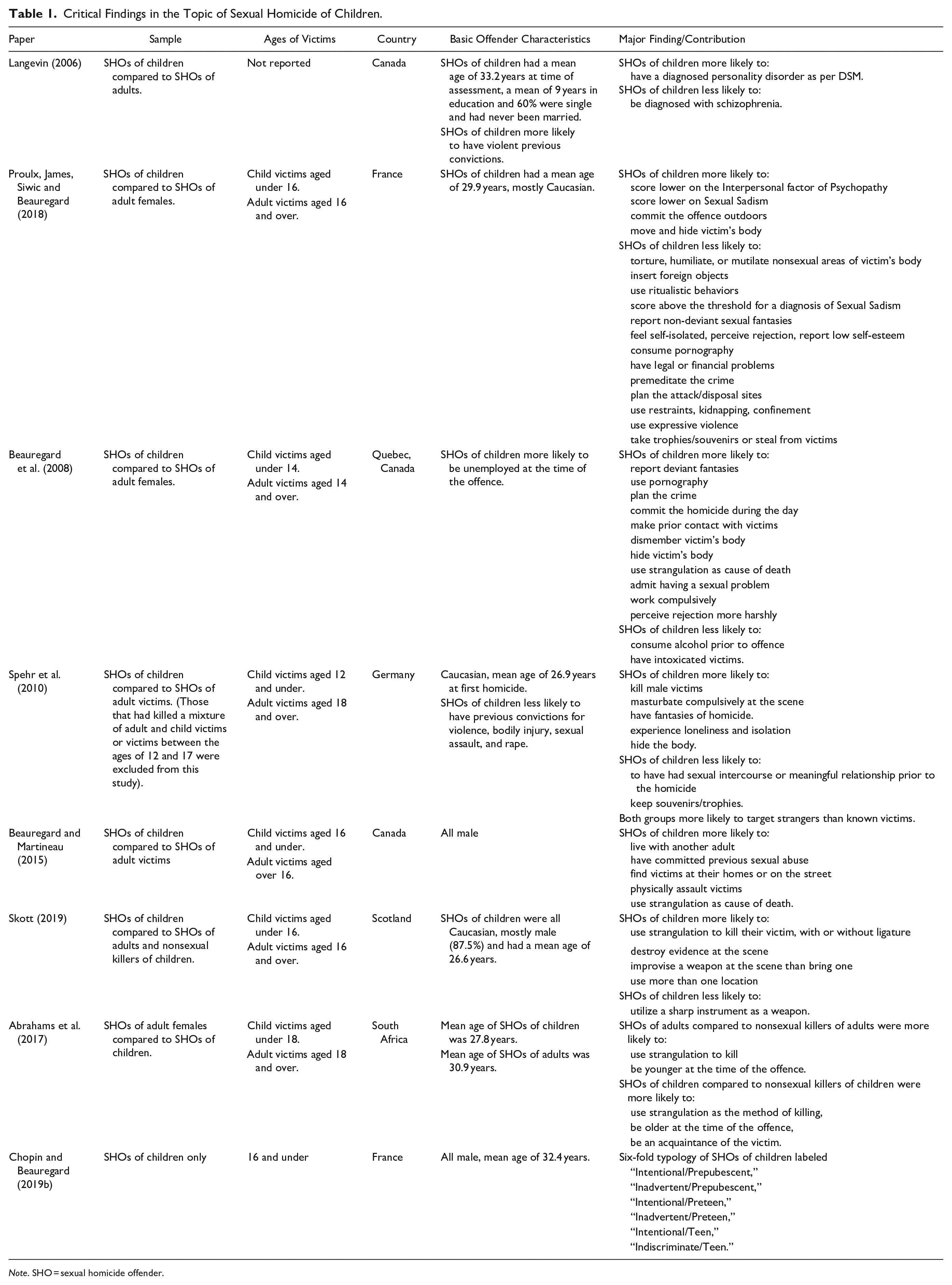
Utilizing online libraries and literature databases, such as The University of Huddersfield’s Summon access and Google Scholar, relevant studies for review were found by searching the following terms; “sexual homicide,” “SHOs,” “sexual homicides of children,” “SHOs of children,” “sexual killers,” “SHO types,” and “sexual homicide typologies.” The use of “SHOs” and “SHOs of children” ensured that those papers focusing on child victims appeared at the top of the search results when sorted by relevancy. Only studies written in English were considered due to the lack of access to other language speakers at the time of research. All papers, regardless of the year published, were considered for review. Searches were capped at the first 100 results when sorted for relevancy for each search term utilized. Of these, titles that were relevant to the aims were picked for the next stage; reading of abstracts was done to determine relevancy. In total, 72 abstracts were read. Of these, 42 studies were included in this review; 39 research papers and 3 literature reviews. Papers that studied generic SHOs and those that focused on sexual killers of children were all considered. Comparative studies that evaluated differences between SHOs and other types of offenders, for example, non-homicidal sexual offenders or nonsexual killers, were considered in this review. Those that investigated other specific sets of offenders exclusively, such as female SHOs (e.g., Skott et al., 2019) or killers that targeted prostitutes (e.g., Salfati et al., 2008), were discounted due to the focused nature of offenders that were not child killers. This would have added too many layers to this review when the main focus was comparing the literature of generic SHOs and those that killed children. There was no formal definition or cut-off age of children during the literature search. The ages used by the original researchers were collated and they are shown in Table 1 to show the differences. This is also discussed as a limitation of this type of research as part of the discussion.
Critical Findings in the Topic of Sexual Homicide of Children.
Note. SHO = sexual homicide offender.
Initially, papers focused on typologies or classifications of SHOs were considered and reviewed, leading to 16 relevant studies. This included classic typologies and lead to more current thinking, such as the Sadistic/Angry/Opportunistic classifications and a paper focused on developing a model of SHOs of children. This set of publications were based on samples from countries such as Canada, France, and the United States. All of the papers reviewed as part of the Classic Typologies section were based on USA samples (n = 8), whereas those that presented Sadistic/Angry/Opportunistic typologies had samples from Canada (n = 4, 44%), the United Kingdom (n = 1, 11%), and Scotland (n = 1, 11%). One paper had samples from both Canada and the United Kingdom (Healey et al., 2016) and one paper was a literature review (Higgs et al., 2017). The only current typology of those SHOs that target children was based on a French sample (Chopin & Beauregard, 2019b). Papers that provided insights into characteristics of SHOs of adults and could be compared to SHOs of children included samples from Canada (n = 5, 63%), Germany (n = 1, 13%), Scotland (n = 1, 13%), and South Africa (n = 1, 13%).
Of the 15 papers reviewed for the previous convictions section, two were literature reviews and a further three were unknown samples. Of the known samples for this section, the majority were from the United Kingdom (n = 4, 27%) and Canada (n = 3, 20%). The others in this section were from Germany (n = 1, 7%), France (n = 1, 7%), and China (n = 1, 7%). Of the four papers that studied geographical profiling of SHOs, 75% were based on samples from the USA (n = 3) and one paper was from France (25%). Of the papers that were selected for review, the majority were quantitative studies in nature (n = 28, 67%). There were five papers that utilized case studies as a methodology (12%), four that used mixed methods (10%), three literature reviews (7%), and two qualitative papers (5%).
Due to the aims of this review focusing on directing further research to be applied to policing and law enforcement, papers were mainly from psychological and criminological backgrounds.
Classic SHO Typologies
Previous research into sexual homicide has involved attempting to discern different types of SHOs. Hazelwood and Douglas (1980) proposed two types of SHOs: organized and disorganized. This was based on behaviors exhibited at the crime scene and indicated that organized offenders were more likely to be forensically aware, whereas disorganized killers’ actions suggested an unplanned attack (Ressler et al., 1986). Canter et al. (2004) attempted to validate this dichotomy by analyzing crime scene behaviors of serial sexual homicide. Their findings did not support the organized/disorganized model. Instead, they proposed a model that contained four themes of serial sexual killings: “Mutilation,” “Sexual Control,” “Plunder,” and “Execution.” This model does suggest different types of serial SHOs; however, one should be cautious as the behaviors utilized in this study were exhibited at the crime scene of the third offence in the series. Other sexual homicides committed by the same offenders were not considered and further research that took all sexual homicides committed by each killer into account was suggested.
Holmes and Holmes (1998, 2002, 2009) researched the motivations of serial killers and proposed four distinct types: “Visionary,” “Mission,” “Hedonistic,” and “Power-Control.” The “Visionary” killer was described as an individual that has had a psychotic break and has symptoms such as hearing voices or seeing visions. Unlike the “Visionary” killer, the “Mission” killer is not psychotic but kills because they want to rid the world of a certain type of “undesirable” person, for example, prostitutes. The “Hedonistic” type is characterized by the feeling of excitement experienced when killing. The “Sexual” homicide offender can be categorized as a sub-type of the “Hedonistic” killer; the other subtype being the “Thrill” killer. Finally, the “Power-Control” killer commits their offences because they obtain a feeling of pleasure from having absolute control of their victims, that is, as seen in individuals with psychopathic personality disorder. Unlike the sexual subtype of the “Hedonistic” killer, this gratification does not come from a sexual arousal; it is derived from the feeling of the power and control they hold over their victim. Canter and Wentink (2004) aimed to test the validity and reliability of Holmes and Holmes’ (1998) model. Using multi-dimensional scaling techniques, no support was found for Holmes and Holmes’ (1998) model. However, Canter and Wentink only used crime scene behaviors from the third homicide in each of the series, leading to the possibility that utilizing the actions from an entire series of offences may have elicited different results. This was suggested as a possibility for further research.
Keppel and Walter (1999) proposed a model for typologies of serial sexual killers. They based this model on Groth et al.’s (1977) model of rapists and Hazelwood and Burgess’ (1987) model of “rape-murderers.” The four types of sexual killer were listed as “Power-Reassurance,” “Power-Assertion,” “Anger-Retaliatory,” and “Anger-Excitation.” The “Power-Reassurance” killer was characterized by a planned rape but not a premeditated homicide, acting out a fantasy and seeking reassurance from the victim. Similar to the “Power-Reassurance” killer, the “Power-Assertive” killer does not plan the killing, only the sexual assault, and has an interest in exerting power over their victims to remain in control. Unlike these two types of killer, the “Anger-Retaliatory” killer plans both the rape and the homicide, and the main motivation is anger, as opposed to power and control. This type of offender commits the rapes and killings as revenge, usually choosing a victim that is symbolic, as opposed to the actual target of their revenge. Finally, the “Anger-Excitation” killer also plans the rape and the killing and is driven by anger. These offenders are characterized by the acting out of their fantasy, possibly including torture, mutilation, or exploitation. Keppel and Walter (1999) expanded these typologies to include crime scene behaviors and background characteristics that may indicate which type of killer committed the homicide. However, when Bennell et al. (2013) attempted to validate Keppel and Walter’s (1999) model, they did not find any evidence to support the four types.
More recently, however, research has focused on a three-dimensional typology for SHOs that appears to have been corroborated by different research terms: Sadistic, Angry, and Opportunistic offenders.
Sadistic/Angry/Opportunistic Sexual Killer Classifications
Beauregard and Proulx (2002) developed a model of SHOs which suggested two distinct modus operandi types; “Sadistic” and “Angry.” Proulx and Beauregard (2009, 2014) then expanded this model to include “Opportunistic” as a type of SHO. Other researchers have developed models that produced similar typologies based on crime scene behaviors, offender personality traits, and motivations as discussed below.
Sadistic
In the model by Beauregard and Proulx (2002), the “Sadistic” offender was more likely to premeditate the killing, mutilate, humiliate, and hide the body. In the expanded typology, the “Sadistic” offender was described as having an anxious personality, including avoidant, dependent, and schizoid personality traits, as well as deviant and hyper-sexuality. They were more likely to have low self-esteem, both physically and psychologically. There would have been a sophisticated approach to the victim, a high level of violence during the attack, and most victims would be killed. The modus operandi of the offence would be characterized by the subject’s deviant sexual fantasies (Proulx & Beauregard, 2009, 2014). Higgs et al. (2017) agreed with the exhibition of sadistic sexual behaviors in their “Sexualized Murder” type of SHO. They also added that this type of sexual homicide was characterized by the relationship of the sexual offending and the killing; the act of the homicide is linked to the sexual arousal and subsequent gratification of the offender. Stefanska et al.’s (2015) “Deviance-Driven” pathway was also characterized by the sadistic acts evident at the crime scene, such as anal sex, post-mortem sexual interference, and post-mortem mutilation. Darjee and Baron (2018) agreed with this characteristic in their model; the “Sadistic” crime scene behaviors included strangulation, foreign object insertion, mutilation, and use of restraints on the victim, demonstrating the offender’s sexually sadistic fantasies. Stefanska et al. (2015) also added that victims were most likely to be attacked immediately, although some offenders in this cluster used a “con” approach. This type of offence was often premeditated and there was little evidence of “overkill” or use of any other violence. The offender was unlikely to be intoxicated during the commission of the attack. Healey et al. (2016) proposed four types of killers in their model. Their “Sadistic” killer was described as a sexually sadistic offender, exhibiting such behaviors at the crime scene. These characteristics are similar to the “Sadistic”/“Sexualized” killer due to the sexually sadistic fantasies being the main motivation. The “Predatory” offender in this model would target strangers, largely premeditate their crimes, possibly using behavioral scripts that have been refined over time, and use weapons. However, there was little support for a sexually sadistic motivation for these offences. Regardless of the lack of sexually sadistic motivation, the other characteristics of this type of offender resemble the “Sadistic”/“Sexualized” killer the most. This may suggest that there are further sub-groups to the “Sadistic”/“Sexualized” offender types that may need developing.
Angry
Beauregard and Proulx’s (2002) “Angry” killer did not plan the offence but would be more likely to leave the body at the scene and experience loneliness before the killing. In Proulx and Beauregard (2009, 2014), the “Angry” pathway had dramatic personality traits, including characteristics from narcissistic and dependent personality disorders. These offenders would also have an antisocial lifestyle and would be promiscuous. Their modus operandi would be shaped by their desire for revenge against persons they believed to be responsible for their problems and would include high levels of anger, impulsivity, and extreme violence. Higgs et al. (2017) agreed within their “Grievance Murder” type that this offence is characterized by the intense anger that directly precedes the assault. The homicide is usually not planned, and the primary motivation may be to sexually assault the victim instead. Due to the level of anger and the extreme violence used, the killing of the victim may occur despite the sexual circumstances having initially been consensual. This type of offender does not sexually offend as a result of sadistic sexual fantasies; however, the line between using violence as a result of rage and seeing violence as sexually arousing may become indistinct. The “Grievance-Driven” offender in the model developed by Stefanska et al. (2015) appears to show similarities in the high levels of violence and “overkill” present at these crime scenes. This “Grievance-Driven” SHO was categorized as “hypersexual” due to their sexual interests and behaviors. This type of offence appeared to take place in an original context of consensual sex and occurred as a result of an action by the victim or the offender failing to become sexually aroused. This then appeared to result in high levels of violence as evidence of “overkill” was present in these homicides. The victim was most likely to die from strangulation, although there was often evidence of other assault having taken place during the offence. The “Grievance-Driven” killer was also significantly more likely to be intoxicated during the homicide. This type of offender did not premeditate the homicide; this could possibly be explained by the original consensual context of the situation, as also seen in the “Grievance Murder” type by Higgs et al. (2017). Darjee and Baron (2018) also described violent crime scene behaviors including overkill, stabbing, and beating, suggesting a high intensity of anger in their “Rage” SHO. Within Healey et al. (2016), the “Angry” type was characterized by low–moderate lethality, intense levels of anger, but no sadistic or sexual motivation; most comparable to the “Angry”/“Grievance” offender above (Higgs et al., 2017; Proulx & Beauregard, 2009, 2014; Stefanska et al., 2015). Healey et al. (2016) also included the “Situational Precipitated” killer in their model. This type of killer may have been planning the sexual assault, not the homicide. Anger levels would steadily increase as the victim resists the sexual assault, resulting in the homicide. This killer is also similar to the “Angry”/“Grievance” offender (Higgs et al., 2017; Proulx & Beauregard, 2009, 2014; Stefanska et al., 2015); indicating that there may be further categories to develop within these wider groupings of SHOs.
Opportunistic
Proulx and Beauregard (2009, 2014) developed the “Opportunistic” sexual offender which was described as having a dramatic personality profile, including traits from narcissistic and antisocial personality disorders. According to the offender themselves, they would have no problems in their life but would be sexually dissatisfied. The modus operandi of this offender would be characterized by their need for sexual gratification and the belief that other people only exist to satisfy their needs. The sexual assault is usually an offence of opportunity; for example, the primary offence may have been burglary, then sexual assault occurred as a result of an available victim. This type of offender would only use instrumental violence and the victims would rarely be killed. This model was developed with the use of data from both sexual killers and sexual aggressors of women who were extrafamilial. However, as Proulx and Beauregard (2009, 2014) did not utilize only sexual killers and included victims that were adult women, this model may not translate well to those offenders who kill children for sexual gratification. Higgs et al.’s (2017) “Rape Murder” type has been described as having the primary motivation to sexually offend but the homicide has not been premeditated. In this type of homicide, violence is used instrumentally, either to subdue the victim or as a forensic countermeasure to avoid detection, similar to the “Opportunistic” type above (Proulx & Beauregard, 2009, 2014). The distinction between this type of sexual killer compared to “Sexualized Murder” or “Grievance Murder” is that the violence is not usually associated to feelings of sexual arousal or anger. Within the model developed by Stefanska et al. (2015), the “Sexually-Driven” offender was also characterized by their “hypersexuality,” however, they usually premeditated their offences. The majority of this type of SHO had a previous conviction for rape or attempted rape. This was significantly higher when compared to both “Deviance-Driven” and “Grievance-Driven” killers in this model. This type of offender reported their primary motivation as sexual gratification most of the time, however, some did admit that they were prepared to kill victims in order to gain sexual satisfaction. It was proposed by Stefanska et al. (2015) that the homicide was a detection avoidance strategy to eliminate the witness. There were low levels of postmortem sexual interference, postmortem mutilation, “overkill” or unnecessary violence in this type of sexual homicide but significantly more evidence of vaginal sex only. This supports the idea that this type of offender is primarily driven by the need for sexual gratification. Due to the primary motivation for the sexual homicide being sexual gratification and the evidence to suggest a criminal history of sexual assault and/or rape, the “Sexually-Driven” type of offender is similar to the “Rape” or “Opportunistic” offender discussed above (Higgs et al., 2017; Proulx & Beauregard, 2009, 2014). Darjee and Baron (2018) also developed a “Criminal” offending pathway. Crime scene behaviors exhibited at these offences included dismemberment of the victim, postmortem sexual activity, and evidence of detection avoidance strategies, such as moving the victim’s body to a separate location after death. This indicates the offender’s forensic awareness, possibly due to a criminal background similar to the “Opportunistic” and “Rape” offenders described above (Higgs et al., 2017; Proulx & Beauregard, 2009, 2014).
SHOs of Children Typologies
With regards to typologies of SHOs of children, Chopin and Beauregard (2019b) developed their own model. This was borne from a literature review they conducted (Chopin & Beauregard, 2019b). The model was based on 72 French extrafamilial sexual homicides of children. The sample in this study showed that the offenders were all male, 17 to 59 years old, with a mean age of 32.4. A proportion of 43.1% self-reported they had at least one paraphilic behavior. The victims were mostly female (73.6%), 4 to 16 years old, with a mean age of 11.4. Utilizing Lanning’s (1994) theory, Chopin and Beauregard (2019b) labeled their six types as “Intentional/Prepubescent,” “Inadvertent/Prepubescent,” “Intentional/Preteen,” “Inadvertent/Preteen,” “Intentional/Teen,” and “Indiscriminate/Teen.” “Inadvertent” violence’s purpose was for sexual gratification, “Indiscriminate” violence was described as necessary, and “Intentional” violence was varied and included sadism and detection avoidance.
The “Intentional/Prepubescent” SHO (20.9%) was labeled due to the young age of the victims, approximately 9 years of age. Male victims appeared more often than in other types. The offenders and victims in this type were typically not strangers and a con approach was used toward targeted victims. The offenders would be familiar with the crime location and attacked their victims within a residence. Most of these offenders would sexually penetrate and fondle their victims, and move the body to another location after death. However, they would rarely use strangulation as the method of killing or act on the crime scene after the homicide. This type of offender would be more likely to consume alcohol or drugs before committing the homicide.
The second type was labeled “Inadvertent/Prepubescent” (11.1%). This cluster also includes some of the youngest victims and offenders, and more male victims were included in this type. This offender was more likely to be single, target stranger victims (75%), and be familiar with the crime location, which was never a residence. A con approach was more likely to be used, and victims were more likely to be assaulted during the course of sport or leisure activities. Most of these victims were killed by strangulation but were not sexually penetrated or moved after death, even though these offenders would be more likely to attempt to hide the body. The most likely type of sexual activity would be fondling. Most of these offenders would beat their victims and perform more unusual acts, however, they were less often angry.
The most common cluster was “Intentional/Preteen” (22.2%). Male victims were also more present in this cluster, but these victims were preadolescent. Similar to the “Inadvertent/Prepubescent” victims, they were more likely to be assaulted during sports activities and targeted via a con approach. These offenders were more likely to consume intoxicants prior to the crime and would be familiar with the location chosen for the offence, usually not a residence. Sexual penetration was always performed, and sexual humiliation happened often. Victims were also more often beaten. These offenders rarely used strangulation to kill their victims and did not attempt to hide the body, choosing to partially bury it. Most of these offenders utilized several detection avoidance strategies, distinguishing them from other clusters, although their semen was identified by police at the scene.
The “Inadvertent/Preteen” type of offender was one of the least common clusters (11.1%) and was characterized by the preadolescent ages of the victims and the exclusivity of female victims aged approximately 10 years old. Offenders always targeted stranger victims and mostly used a coercive approach (75%). These offenders were different from others as they were not familiar with the location they chose for their crime, usually not a residence. Sexual penetration was always performed, semen was identified by police at the scene, and the offender tended to act upon the crime scene; however, they rarely moved the victim’s body and did not attempt to hide it.
The fifth type of offender (16.7%), labeled “Intentional/Teen” targeted slightly older female stranger victims, aged approximately 12 years old. The crime locations were residential in all cases, but not familiar to the offender. Sexual penetration and strangulation as the method of killing were performed by all offenders, and approximately half of offenders acted on the crime scene and moved the victim’s body after death, burying it. These offenders appeared to avoid social contact with others and were more likely to exhibit sexually sadistic behaviors at the scene. Semen was identified at the scene by police and victims were more likely to physically resist the attack.
The final cluster (18.1%), “Indiscriminate/Teen,” was characterized by the offenders’ previous criminality. These killers were involved in diverse criminal activities throughout their lives, lived nomadic lifestyles, and avoided social contact. These victims would be females aged around 14 years old and were always strangers. This cluster included both the oldest offenders (52.3 years) and the oldest victims. These killers would not be familiar with the crime location, which was never a residence. These offenders would utilize a con approach to engage their victims. Sexual penetration was always performed, victims were often beaten, and most victims were killed by strangulation. Strategies to alter the scene were not utilized by this offender, but the victim’s body was always moved and hidden after death. This was the only type of SHO that did not partially undress their victim.
This model was the first classification developed exclusively on a sample of SHOs of children. It is a good model which discriminates between age of victim, includes crime scene behaviors, and gives approximate offender characteristics that could be utilized by police in the early stages of an investigation. However, it could be expanded to include previous criminality in more depth and the geography of the crime location(s) in relation to the offender’s and victims’ anchor points. This would bolster the model as a useful investigative tool. As it is recent, a corroboration of these findings would also be useful to establish if this model is consistent with SHOs of children from other cultures.
Offender Characteristics of SHOs of Children Comparisons with SHOs of Adults
With regards to SHOs of children, the findings have been mixed about characteristics of offenders and circumstances of the crimes. Some studies found that sexual killers of children were more likely to score higher on Psychopathy, Antisocial Personality, Paraphilias, and Sexual Sadism (Firestone et al., 1998). Langevin (2006) found that SHOs of children were more likely to be diagnosed with a personality disorder, although schizophrenia was more likely to be diagnosed in SHOs of adults. However, Proulx, James, Siwic, and Beauregard (2018), in Proulx, Beauregard, Carter, Mokros, Darjee, and James (2018) found the opposite for Psychopathy and Sexual Sadism. SHOs of children were found to have more deviant or homicidal fantasies prior to the offence (Beauregard et al., 2008; Proulx, James, Siwic, and Beauregard, 2018; Spehr et al., 2010). However, Proulx, James, Siwic, and Beauregard (2018) found no difference between SHOs of children and those that killed adult women when they carried out their own comparative analyses. There has also been disagreement as to whether SHOs of children consume more pornography than those that kill adults. Beauregard et al. (2008) and Proulx, James, Siwic, and Beauregard (2018) found that they did; however, Proulx et al.’s own comparisons showed they did not. Prior to committing the crime, offenders who killed children were more likely to experience social isolation and loneliness than those who targeted adults (Proulx, James, Siwic, and Beauregard, 2018; Spehr et al., 2010). However, once Proulx, James, Siwic, and Beauregard (2018) conducted their own analyses, this was disputed. These analyses also disputed the finding that SHOs of children are more likely to plan the offence than killers of adult women (Beauregard et al., 2008; Proulx, James, Siwic, and Beauregard, 2018).
The studies reviewed agreed that SHOs of children use alcohol and drugs less than their counterparts who targeted adults (Beauregard et al., 2008; Spehr et al., 2010) and also masturbated compulsively (Proulx, James, Siwic, and Beauregard, 2018; Spehr et al., 2010). There appears to be a consensus that SHOs of children are more likely to hide the victim’s body (Beauregard et al., 2008; Proulx, James, Siwic, and Beauregard, 2018; Spehr et al., 2010) and use strangulation as the method of killing as compared to those that kill adults (Abrahams et al., 2017; Beauregard & Martineau, 2015; Beauregard et al., 2008; Proulx, James, Siwic, and Beauregard, 2018; Skott, 2019), however, they were less likely to take trophies or souvenirs from the crime scene (Proulx, James, Siwic, and Beauregard, 2018; Spehr et al., 2010). Table 1 showcases the main findings from each of these reviewed studies, including the ages used to distinguish adult and child victims, the country where the study was carried out, and basic offender characteristics.
In summary, there appears to be some aspects of SHOs of children that have been corroborated throughout the literature, for example, their use of alcohol or drugs and the use of strangulation as the killing method. However, there are also characteristics that have been disputed, such as the likelihood of an offender being diagnosed with a personality disorder or levels of social isolation and loneliness felt by the killer prior to the offence. This disconnect may be helped by further research comparing distinct groups of SHOs that target adults and those that kill children, for example, adult female victims and child female victims only.
Previous Convictions of SHOs
There has been some disagreement in the previous literature as to whether SHOs have previous convictions for sexual offences, which would make them specialized offenders (Chopin & Beauregard, 2019a), and others suggest that criminal histories of SHOs have not been studied thoroughly enough (Nicole & Proulx, 2007a, in Proulx et al., 2007). Carter and Hollin (2010) reviewed the existing literature of non-serial SHOs. They cited papers that showed that the majority of sexual killers had previous convictions (Briken et al., 2006; Langevin et al., 1988; Nicole & Proulx, 2007b, in Proulx et al., 2007). Grubin (1994, as cited in Carter & Hollin, 2010) and Oliver et al. (2007, as cited in Carter & Hollin, 2010) indicated that slightly less, approximately one-third of, sexual killers had previous convictions for sexual offences. Further to this, Grubin (1994, as cited in Carter & Hollin, 2010) suggested that this figure was closer to one-half of SHOs when considering violent offences, not just sexual crimes. However, Milsom et al. (2003, as cited in Carter & Hollin, 2010) showed that SHOs were less likely to hold a previous conviction for a sexual offence, when compared to those convicted of rape.
However, the sexual killers were more likely to have a conviction for a previous nonsexual assault. Beauregard and Martineau (2013) studied Canadian SHOs and their results showed that SHOs had, on average, 1.7 previous convictions for violent crimes, 0.4 prior sexual offences, and 7.3 previous convictions for property crimes. They also stated that approximately 80% had no previous convictions for sexual offences and only 38% engaged in illegal activities. Similarly, Chan et al. (2019) found that 80% of Chinese SHOs had no previous convictions for any type of offence and 88% of the sample did not hold any prior convictions for sexual offences. These conflicting results may showcase a distinct difference between types of SHOs. Therefore, further development of this area is necessary to distinguish if the presence or absence of previous convictions is something that investigators can utilize when this type of crime occurs.
Chopin and Beauregard (2019c) compared SHOs with non-SHOs and violent sexual abusers. With regards to their engagement in criminal activities, the SHOs were the least likely to commit criminal offences (10.3%), compared with violent sexual abusers (18.4%) and nonsexual killers (19.7%). Beauregard et al. (2018) also compared similar groups; non-homicidal, non-violent sexual offenders, violent, non-homicidal sexual offenders, and SHOs. The SHOs were considered a versatile type of offender as they had criminal histories that included previous convictions such as armed robbery, kidnapping, and homicide. The non-homicidal, non-violent sexual offenders were deemed to be a specialized type of offender as they had the most previous convictions for rape/sexual assault, as well as other sexual offences that included exhibitionism. Finally, the violent, non-homicidal sexual offenders were labeled as the most prolific type of offender with regards to their criminal histories as they had the greatest number of previous convictions. They also appeared to commit the most varied list of offences, including crimes such as assaults, homicides, kidnappings, and aggravated sexual assaults. These findings indicate that SHOs do have some previous convictions that may show them to be generalist offenders rather than specialized.
Stefanska et al. (2015) studied non-serial sexual killers of females aged 14 or over in the United Kingdom. Of the three offending pathways they developed, “Grievance-Driven,” “Deviance-Driven,” and “Sexually-Driven” discussed above, the “Sexually-Driven” offenders were significantly more likely to have a previous conviction for rape or attempted rape when compared with the other two types of SHO. This makes for interesting reading as perhaps a subject’s previous convictions can indicate what type of SHO they may be. This could potentially be used in reverse to indicate a suspect with a previous conviction for rape or attempted rape based on the crime scene behaviors evidenced, as per Stefanska et al.’s (2015) “Sexually-Driven” SHO.
Cusson and Proulx (2007), in Proulx et al. (2007) studied the criminal histories of SHOs and developed a model that showcased four distinct offending pathways. The first, and most prevalent (41%), was labeled “Violent Polymorphism.” This offender had a diverse criminal career. Their route to committing a sexual homicide could be described as a result of their diverse criminal history coupled with anger, or a desire to eliminate the witness. The next type (27%) was titled “Sexual Aggression.” This SHO was characterized by a history of sexual violence; however, their criminal career may have included other, nonsexual offences. These offenders may have been initially motivated to commit a sexual assault and the amount of sexual offences committed suggests that this is the “true” sex offender; it is the quest for sexual gratification, often deviant, that leads this offender to sexual homicide. “Marginality” (22%) was the type of offender whose previous criminal convictions did not include violent or sexual offences. These offenders committed sexual homicide often as a result of anger or humiliation. The final 11% of offenders in this study were labeled as “Over-Control.” These sexual killers had almost no prior criminal record before the sexual homicide and they tended to live normal lives. The sexual homicide was thought to be a sudden explosion of intense, and fatal, levels of aggression. These types of SHO based on offending pathways and previous convictions is useful as it could allow law enforcement officials to prioritize potential suspects in an investigation, especially if these could be associated to particular crime scene behaviors.
With regards to the literature on SHOs of children, most studies reviewed showed that sexual killers of children had more previous convictions, charges, or admitted to more previous criminal behavior, including previous contact sexual abuse (Beauregard & Martineau, 2015; Firestone et al., 1998; Langevin, 2006; Proulx, James, Siwic, and Beauregard, 2018). However, Spehr et al. (2010) found that these offenders were less likely than those that killed adult victims to have previously committed violent offences, bodily injury, sexual assault, and rape. Proulx, James, Siwic, and Beauregard (2018) also reported in their literature review that SHOs of children were more likely to have been the victim of sexual abuse and neglect as a child. These differences need to be further studied in order to establish if there are confounding factors that may be influencing the difference in results seen across similar samples. Data from previous criminal behavior alongside crime scene behaviors and offender and victim characteristics may elicit details within typologies for this type of offender.
Geographical Profiling
With regards to SHOs, their spatial behavior can inform an investigation, just as crime scene behaviors can. Rossmo (1995, 1999) studied solved serial killer cases which all had at least five victims. Multiple crime scenes utilized throughout each homicide were examined. These included the Victim Encounter site (E), Attack site (A), Murder site (M), and the Body Disposal site (D), as well as key geographical points such as the offender’s residence. The importance of acknowledging more than one crime site was discussed and the eight possible combinations of the EAMD model were presented. It was indicated that offender characteristics, their method of searching for victims, their mobility, and organization levels could be inferred from how many separate crime locations are utilized; for example, a disorganized offender may be more likely to encounter, attack, murder, and dispose of the body in the same place (EAMD), whereas an organized offender may be more likely to encounter and attack the victims in one place, transport them to a separate site for the homicide and finally dispose of their bodies in a third separate location (EAMD). These locations were termed as “crime location set.” The offenders studied showed consistency in their choice of crime location set; 96% of victims were subject to either the most or second-most common crime location set of their killer (Rossmo, 1995, 1999).
Van Patten and Delhauer (2007) studied the geography of sexual homicides over a 25-year period in Los Angeles. Distances such as those traveled by both the offender and victim to the encounter and body disposal sites, and journeys taken by the offender after the offence were studied. They utilized Rossmo’s (1995, 1999) EAMD model to examine the most important distances. Median values were used as they were more representative of the actual distances traveled. The results highlighted that 41% of cases included the victim’s residence as D. The median distance between the victim’s home and D when these zero-distance journeys were excluded was 4.62 miles. The median distance between the offender’s home and D when zero-distances were excluded was 2.43 miles (80% of cases). When measuring the distance between the offender’s home and the victim’s, the median journey when including zero-distances was 1.34 miles, and when excluding zero-distances, 2.88 miles. In 85% of cases, the journey between the victim’s home and E was less than five miles, with 66.9% less than half a mile. Only 8.3% of cases had a distance over 10 miles between the victim’s home and E. The median distance from the offender’s home to E, excluding zero-distances, was 1.67 miles. 78.2% measured less than five miles and in 46.5%, this journey was less than half a mile. For a small proportion (11.9%), the journey between the offender’s residence and E was over ten miles. Van Patten and Delhauer (2007) discussed the travel between the offender’s home and E, stating that only 11% of these journeys were zero-distance. This indicates that 89% of offenders left their homes to engage in what the authors termed “predatory behavior” to gain access to victims.
Van Patten and Delhauer (2007) then analyzed these offenders to ascertain their hunting style, as per the Marauder/Commuter model (Canter & Larkin, 1993). Almost half of these SHOs (46%) were considered “Marauders,” as they traveled up to half a mile from their residence to hunt for victims; one-third (32%) were labeled as “Emerging Commuters” as they traveled up to five miles, and the remaining 22% were deemed “Clear Commuters” as they traveled outside of their neighborhoods to encounter victims. Distances between the encounter site (E) and the body disposal site (D) that were not zero were also presented. The mean distance was 6.9 miles and the median was 2.6 miles; the minimum distance was 33 feet, and the maximum was 42.5 miles, 62.7% were less than 5 miles and 20.4% more than 10 miles. The trips that appear as extreme, longer than 15 miles, were discussed, and in these cases, D was in the desert or the Angeles National Forest. When taking local topography into account, this makes sense as a larger distance, due to the non-residential areas available for disposal. One novel facet of this paper was the calculation of post-offence journeys taken from D. When including zero-distances, the median journey was 1.86 miles; without zero-distances, the median distance was 2.16 miles. Of these distances, 67.3% were less than 5 miles, 37.8% were less than 0.5 mile, and the most common destination for these journeys was the offender’s home. Van Patten and Delhauer’s (2007) findings indicate that most SHOs do not appear to travel large distances to either hunt for victims, kill their victims, and/or dispose of their body. The median values presented for all of these distances are below 5 miles, even when excluding zero-distances. This is an important finding as it goes some way to providing law enforcement with empirically supported evidence that can be used to prioritize suspects within a small area of the different crime sites. The study also advocates for identifying these locations quickly, due to the wealth of further information they can provide for forensic evidence and other analysis.
Chopin et al. (2020) studied the geographical patterns in French extrafamilial sexual homicide and analyzed the distribution between the offenders’ residences, victims’ residences, and crime scenes. The findings showed that most cases were within a 10 km area and 70.5% took place at a distance of less than 10 km between the offender’s home and the crime scene. In 90.2% of cases, the distance between the victim’s residence and the crime location was less than 10 km, and in 69.4% of cases, the victim and offender lived within 10 km of each other. There was a pattern of distance decay and in 50.4% of cases, the offender’s residence was within 2.25 km of the crime location; the offender and victim’s residences were also within that distance. In 58.4%, the distance between the victim’s home and the crime scene was less than 250 m, similar to Van Patten and Delhauer’s (2007) results. The most common mobility pattern in this sample, based on the Geometric Mobility Crime Triangle (Groff & McEwen, 2007), was the triangle pattern (75.7%); the three addresses (offender residence, victim residence, and crime scene) were all at different locations. Of the different types of Geographic Triangle patterns (Normandeau, 1968), the most common in this study was the Offender Mobility Triangle (38.7%); the victim’s residence and crime location were in the same neighborhood, but the offender had traveled outside of his home neighborhood to commit the offence. This was closely followed by the Total Mobility Triangle (26.6%); all neighborhoods of the three locations are at distinctly different locations, and the Neighborhood Triangle (23.1%); all three locations are within the same neighborhood. These three types of triangle pattern cover 88.4% of cases in this sample and suggest that most sexual homicides will fall into one of these patterns.
There have been no studies that have focused on the spatial behavior of SHOs of children exclusively thus far, therefore no comparisons can be made at present. A sample of the EAMD sites for relevant sexual homicides of children may elicit a distinct model of how these offenders operate in their hunting styles and mobility patterns, which can then be compared to the current literature to further understand sexual homicides. Cross-cultural comparisons may also be useful as local topographies have been shown to influence offenders’ use of geography in selecting disposal sites, as per Van Patten and Delhauer’s (2007) findings.
Limitations
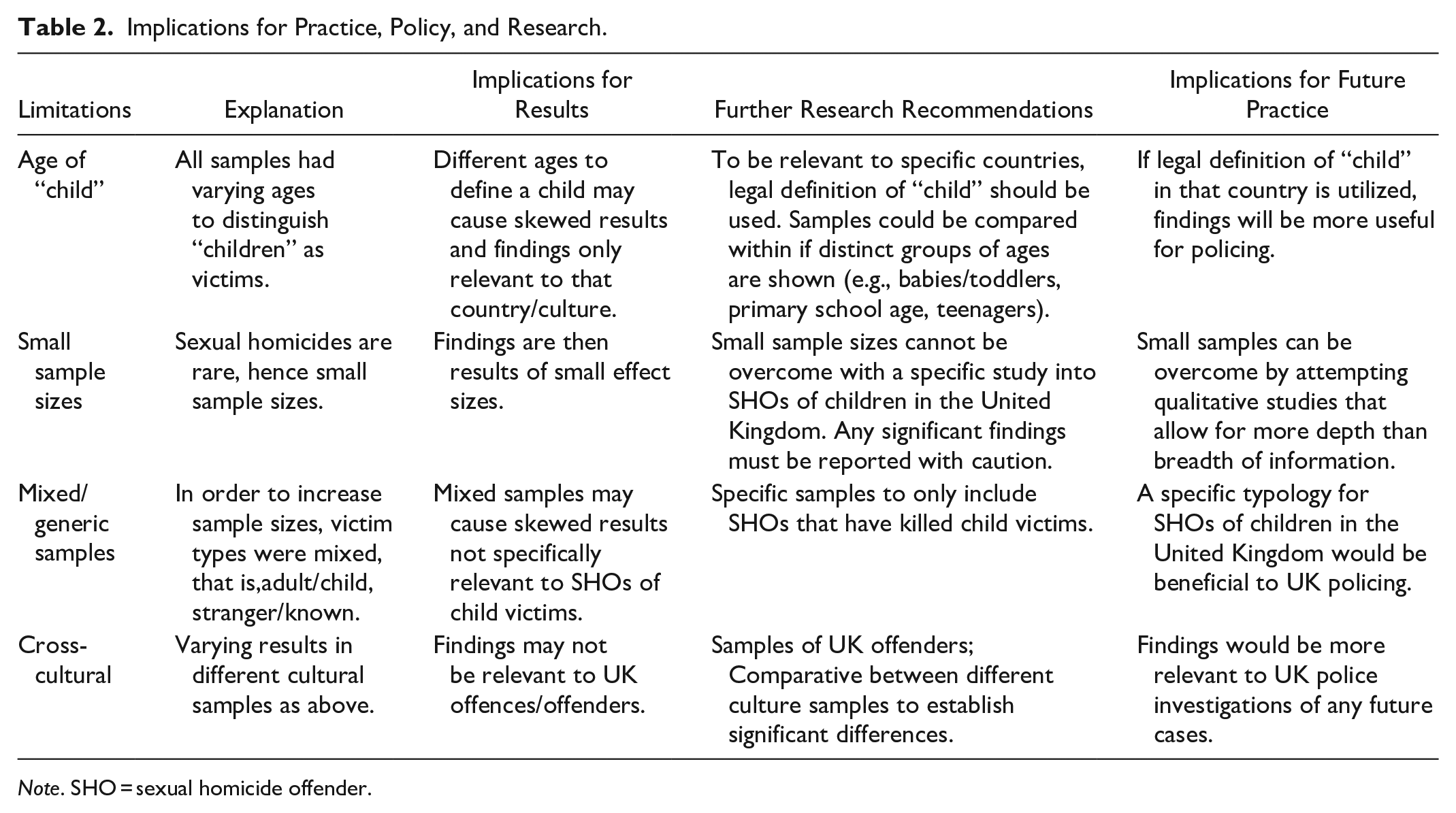
Table 2 indicates the common limitations within the literature of sexual homicide and what may be done to overcome these issues. As sexual homicides are a rare phenomenon, any study researching the topic must have to contend with relatively small sample sizes. The potential sample base then becomes even smaller, the more focused the research becomes, for example, only child victims. To overcome this limitation, researchers have utilized samples that will allow for a larger size; some studies utilized homicides with both adult and child victims, some mixed male and female victims, and some used data depending on different definitions of sexual homicide. This could account for different findings across the literature. However, as per Halsey and Deegan (2012) and Boddy (2016), small sample sizes can be justified where the target participant population is or is nearly saturated. This is the case in sexual homicide research thus far, as most relevant offences are considered, especially when drawing on data from police databases.
Implications for Practice, Policy, and Research.
Note. SHO = sexual homicide offender.
Use of mixed samples may also go some way to explain the mixed findings of the studies of child victims, as the cut-off ages for child victims were all different in the above studies. These different ages may be relevant to the different countries’ laws where the research took place, however, this does mean findings may not be relevant to the sexual homicide of children in the United Kingdom.
Recommendations and Implications
After reviewing the literature in this area, it is clear there are gaps within the research, especially within the sexual homicide of children. The mixed findings have shown that further research is required to fully understand the characteristics of sexual homicide of children. There is little research with UK samples and the only typology so far was developed utilizing a French sample (Chopin & Beauregard, 2019b). Research with a UK sample would be useful. Anything pertinent found in any such study would be useful to UK law enforcement when investigating this type of sexual homicide. Geographical profiling of SHOs has delivered findings that may be useful to policing, however these studies have only used generic samples. Therefore, further investigation utilizing data from those homicides of children may prove useful. An expansion of Chopin and Beauregard’s (2019b) model to include the geography of crime scene locations and relevant offender and victim anchor points, as well as previous criminality, could elicit further findings that could help with suspect prioritization in relevant UK investigations.
Improving police investigations into the sexual homicide of children may contribute to shortening the time it takes to apprehend the correct suspect and inform officers as to what evidence to search for to lead to a more robust prosecution, and therefore higher chances of a conviction. This stops a waste of taxpayers’ money from the outset of the police investigation and throughout the justice proceedings. Catching a child killer at the earliest possible point also ensures less children are victimized. Relevant research into this crime type may also inform treatment or rehabilitation programs once incarcerated, or inform decisions of parole boards to ensure dangerous criminals with a chance of recidivism do not get the chance to reoffend against the public. Further extensive research that could be based on initial papers such as the ones reviewed in this article may also broaden the scope of this area into how offenders like these may be identified before committing crimes against children. Research into offending pathways, utilizing information from childhood and other external factors from adolescence, could inform early interventions and youth programs to lessen the risk they will offend against children in the most heinous way in the future.
Including this type of research into UK policy where it can have the maximum impact on policing these type of investigations would start with the UK Home Office and institutions such as the College of Policing. Specific teams in regional police forces that would be the lead investigators, such as Major Incident Teams, and officers of the National Crime Agency, such as the Behavioral Investigative Advisers, Crime Investigation Support Officers, and the National Senior Investigating Officer Advisers, would be best placed to receive relevant research. This could be in the form of professional or industry newsletters or Professional Development courses and workshops, such as those organized by companies like The Investigator. Agencies such as HM Prison and Probation Service, could be sighted on this type of research via their Forensic Psychologists to inform parole decisions and prison interventions.
Conclusions
Research into sexual homicide has provided some significant results that may be useful for police investigations; for example, the Sadistic/Angry/Opportunistic typology that has been developed (Higgs et al., 2017; Proulx & Beauregard, 2009, 2014). However, as the samples used to create this model included many different types of offenders and victims, it may be too generic when focusing only on the sexual homicide of children. There have been mixed findings regarding the previous criminality of SHOs in general and with those that target child victims, as well as disagreement of offender characteristics in SHOs of children. One model has been created by Chopin and Beauregard (2019b) defining types of SHO that exclusively targets children, however, corroboration has been suggested due to the novelty of the model and the French sample, to ensure relevance to UK offences. Adding other characteristics such as geography of the offence and previous criminality were also suggested.
Footnotes
Declaration of Conflicting Interests
The author(s) declared no potential conflicts of interest with respect to the research, authorship, and/or publication of this article.
Funding
The author(s) received no financial support for the research, authorship, and/or publication of this article.
