




Abstract
The problem of defining “child sexual abuse” (CSA), and the need to define this concept, has been recognized by major policy bodies and leading researchers since the 1970s. Recent demands for a more theoretically robust, explicit definition of CSA show this challenge remains urgent. In this article, we identify problems caused by variance in definitions of CSA for five domains: research and knowledge formation, legal frameworks and principles, prevention efforts, policy responses, and the establishment of social norms. We review and analyze definitions used in leading international epidemiological studies, national and international policy documents, social science literature, and legal systems in the United States, Canada, and Australia to demonstrate the continuing use of different concepts of CSA and identify key areas of conceptual disagreement. Informed by our literature review, we use a methodology of conceptual analysis to develop a conceptual model of CSA. The purpose of this model is to propose a more robust, theoretically sound concept of CSA, which clarifies its defining characteristics and distinguishes it from other concepts. Finally, we provide operational examples of the conceptual model to indicate how it would translate to a classificatory framework of typologies of acts and experiences. A sound conceptual model and classificatory system offers the prospect of more appropriate and effective methods of research, response, regulation, and prevention. While total consensus is unattainable, this analysis may assist in developing understanding and advancing more coherent approaches to the conceptual foundation of CSA and its operationalization.
Background
Child sexual abuse (CSA) has been found to be widespread in all nations, although studies have used different definitions of the term (Barth, Bermetz, Heim, Trelle, & Tonia, 2013; Stoltenborgh, van Ijzendoorn, Euser, & Bakermans-Kranenburg, 2011; Sumner et al., 2015). Substantial adverse health, behavioral, and social sequelae have been identified, with studies again using different definitions of CSA (Chen et al., 2010; Dube et al., 2005; Edwards, Freyd, Dube, Anda, & Felitti, 2012; Paolucci, Genuis, & Violato, 2001; Trickett, Noll, & Putnam, 2011). Evidence of the etiology, prevalence, and sequelae of CSA has grown considerably since the late 1970s. There is a general consensus that CSA is a complex phenomenon occurring for multiple reasons, in various ways, and in different relationships within families, peer groups, institutions, and communities.
However, systematic and sophisticated policy and public health efforts to prevent, identify, and respond to CSA remain in their relative infancy. A central unresolved issue for the worldwide community is the lack of a conceptual model of CSA and the absence of a shared definition or understanding of what constitutes “child sexual abuse.” Different concepts have been used including child sexual abuse, child sexual assault, child sexual victimization, child sexual exploitation, adverse sexual experiences, and unwanted sexual experiences. Yet, these concepts are both unclear and diverse. The difference between classifying an event as CSA or an “unwanted sexual experience” is important and can readily be perceived, whether in research into prevalence or sequelae, legal or policy responses, prevention efforts, or establishment of social norms. For example, is CSA only able to be inflicted by an adult? Is it only present if there is sexual contact? Is it experienced through exposure to pornography and child marriage, and why or why not?
The problems in defining CSA, and the need to do so, have been repeatedly noted since the 1970s (Finkelhor & Korbin, 1988; Giovannoni & Becerra, 1979; Haugaard, 2000; Holmes & Slap, 1998; Ondersma et al., 2001; Wyatt & Peters, 1986). The World Health Organization (WHO; 2006) also identified this need when it stated (pp. 3–4), “The various sectors involved in addressing child maltreatment need to develop a common conceptual definition of child maltreatment and common operational definitions to enable case identification and enumeration.” Yet, the lack of progress has prompted renewed calls for a conceptually robust definition (Barth et al., 2013; Trickett, 2006; Veenema, Thornton, & Corley, 2015).
The prevalence and severe harms of CSA, together with cross-cultural recognition of its moral unjustifiability, have contributed to the inclusion of CSA as a specific target for action and prevention in the most recent version of the United Nations Sustainable Development Goals (United Nations General Assembly, 2015, Targets 5.2 and 16.2). This follows a declaration by Finkelhor and Korbin (1988, p. 16) that even on the most culturally sensitive approach, CSA should be classed as one of three domains of maltreatment demanding a “focus for concerted international action and attention.” Yet, the absence of a sound and shared conceptual model of CSA will impede such action.
This article responds to the need for a conceptual model of CSA. The overall purpose of the article is twofold. First, we identify fundamental differences in definitions and understandings of CSA by analyzing varying approaches in epidemiological studies, policy documents, and legal frameworks. Second, informed by these differences and by insights from social science, law, developmental psychology, and etymology, we conduct a conceptual analysis of the concept of CSA and its component parts to develop a conceptual model of CSA. Our model aims to propose a theoretically robust approach to how the concept of CSA should best be understood. In Part 2, we articulate the five significant problems caused by variance in definition of CSA, for research and knowledge formation, legal systems, prevention efforts, policy development, and establishment of social norms. In Part 3, we identify and analyze variance in definitions of CSA by reviewing evidence from epidemiology, policy and law, and in doing so will identify three key dimensions of conceptual dispute. In Part 4, we explain the nature of a conceptual model, explain the methodology for its development, and develop our proposed model using conceptual analysis informed by multidisciplinary insights. In Part 5, we suggest some operational classifications informed by the model.
Consequences of Variance: Five Significant Problems
In social science, public health, law, and public policy, the appropriate characterization of acts and experiences as CSA as opposed to another conceptual category can carry enormous significance. The lack of a shared understanding of what different experiences should be called, and why, can distort or limit the capacity of researchers, clinicians, legislators, policy makers and communities to measure, treat, prevent, interrupt, and respond to CSA.
First, problems are posed for research and knowledge formation. Different definitions of CSA in research into prevalence, etiology, and sequelae have led to substantial variance in findings about ostensibly the same phenomenon, meaning something as fundamental as shared knowledge of prevalence cannot be developed or traced over time. In their review of CSA rates across 55 studies from 24 countries, Barth et al. (2013) found much heterogeneity with rates for females ranging from 8% to 31% and rates for males ranging from 3% to 17%. Bolen and Scannapieco (1999) found a range of 2–62%. Different definitions also create the potential for both overestimation and underestimation of health sequelae and socioeconomic cost. In contrast, research using precise definitions produces more reliable outcomes. One such program of CSA research has analyzed the exact nature, duration, and frequency of the acts, the use of force or threats, age of onset, and the abuser’s identity, enabling a sophisticated association between specific types of CSA and sequelae (Negriff, Schneiderman, Smith, Schreyer, & Trickett, 2014; Trickett, 2006; Trickett et al., 2011; Trickett, Noll, Reiffman, & Putnam, 2001).
Second, problems are presented for legal systems, which play a key role in identifying, responding to, and preventing CSA. Different areas of law prohibit specified acts and provide remedies for breaches, hence also setting norms of conduct. Appropriate conceptualization of CSA is relevant for civil law (compensation for injuries), criminal law (prosecution of crime), child protection law (identifying and preventing CSA), telecommunications law (prohibiting use of electronic carriage services for CSA), constitutional law (limiting free speech by prohibiting CSA material: Osborne v. Ohio (1990) 495 U.S. 103; R v. Sharpe, 2001 SCC 2), and professional licensure (preventing offenders accessing children). In all these domains, conceptual ambiguity or absence of definition is problematic. Unwarranted exclusion of acts from the concept of CSA may preclude civil remedies and criminal prosecutions. Unwarranted inclusion of an act as CSA may result in negative outcomes.
Third, problems are posed for prevention efforts, which may have various targets: children (Walsh, Zwi, Woolfenden, & Shlonsky, 2015), offenders (adolescents and adults; Hanson & Bussière, 1998; Ward & Beech, 2006), parents (Mendelson & Letourneau, 2015), institutions (e.g., schools, churches; Letourneau, Nietert, & Rheingold, 2016; Wurtele, 2012), and the community. Yet, depending on what is included in the concept of CSA, such approaches may have different levels of theoretical soundness and will vary in their applicability and likelihood of practical success. Depending on its conceptualization and operational definition, prevention and policy approaches will require different content and mechanisms. Clinically, there may be consequences for appropriate therapeutic responses.
Fourth, problems are posed for international and national policy development and implementation. The WHO (2006), the Centers for Disease Control (Basile, Smith, Breiding, Black, & Mahendra, 2014), and other authoritative professional bodies have immense influence. Their approaches to CSA prevention can achieve large gains, but policy efforts may be compromised by use of unsound definitions of CSA.
Fifth, and perhaps most importantly, establishment of social norms of acceptable behavior may be impeded. The lack of a reference point against which to evaluate conduct facilitates continuance of harmful practices infringing children’s human rights. These rights are sourced in the liberal canon, such as the rights to bodily inviolability, sexual integrity and choice, equality, dignity, and healthy sexual development, and in the Convention on the Rights of the Child (United Nations, 1989), to which 196 nations are parties (United Nations, 2016). At its worst, some sexual experiences may not be considered by a society as CSA. One example of this may be sexual violence in dating relationships between adolescent peers, despite recognition of its adverse impact (Leen et al., 2013). Perhaps even more worrisome examples are those noted by Ondersma et al. (2001), with some organizations defending adult–child sexual interactions, and some researchers suggesting that only certain particularly severe kinds of CSA warrant moral censure. A sound conceptual model with sufficient consensus may therefore refute such claims.
Any effective approach toward measuring, preventing, identifying, and responding to CSA requires a sufficiently sound and shared definition of the concept. These five dimensions of social endeavor each require a robust understanding of CSA. In addition, connected social, health, and legal systems may work together more productively to respond to CSA if there is greater agreement about its conceptual nature.
Identification and Analysis of Three Dimensions of Conceptual Variance
A review and analysis of several bodies of literature demonstrates the variance in definitions and enables identification of key areas of conceptual dispute. First, a review of social science literature reveals the different definitions of CSA adopted by major epidemiological studies of prevalence. Second, comparative analysis of major policy definitions elicits different approaches to conceptualization of CSA. Third, a comparative legal analysis of key legal principles in Canada, the United States, and Australia shows further variance in legal systems. The analysis in this section will group the key areas of conceptual variance under three dimensions: first, the definition of the construct of CSA (which has three aspects: the child’s age, the relationship with the person inflicting the abuse, and the element of sexual gratification); second, the definition of the acts that can constitute CSA; and third, the nature of consent. These three dimensions of conceptual variance will then be a focus of attention and analysis in our development of the conceptual model in Part 4.
Epidemiological Studies
Systematic reviews and meta-analyses of prevalence studies have identified a wide range of reported rates of CSA. It is well established that methodological differences account for variance in rates of CSA across studies. Bolen and Scannapieco (1999) observed the influence on outcomes of different approaches to the number and specificity of questions. Some studies have used only 1 item (Dinwiddie et al., 2000), while others use as many as 12 (McGee, Garavan, de Barra, Byrne, & Conroy, 2002).
The definition of the studied construct is a core problem. Apart from individual studies’ variance, systematic reviews and meta-analyses—such as those by Holmes and Slap (1998), Stoltenborgh, van Ijzendoorn, Euser, and Bakermans-Kranenburg (2011), Chen et al. (2010), and Paolucci, Genuis, and Violato (2001)—have each needed to choose one of a range of possible definitions. Paolucci et al. (2001, p. 21) adopted a definition limited to contact abuse: “any unwanted sexual contact…[when] the victim is considered a child by legal definition and the perpetrator is in a position of relative power vis a vis the victim.” Violato and Genuis (1993, p. 37) asserted, the clearest and least restrictive definition is provided by unwanted contact [to eliminate consensual sex play]…we recommend that for research purposes, CSA be operationalized as unwanted sexual contact (genital touching and fondling to penetration) while the victim is a child by legal definition and the perpetrator is in a position of relative power vis a vis the victim (e.g., parent, adult, babysitter, guardian, older child, etc).
Demonstrating the difficulty of the problem, even instruments carefully developed by the world’s leading researchers of CSA prevalence have employed substantially different definitions (Dube et al., 2005; Dunne et al., 2009; Finkelhor, Shattuck, Turner, & Hamby, 2014; McGee et al., 2002; Zolotor et al., 2009). Table 1 presents the complete definitions used in six of these instruments. Analysis reveals three dimensions of conceptual variance:
Definitions of Child Sexual Abuse in Major Prevalence Studies.
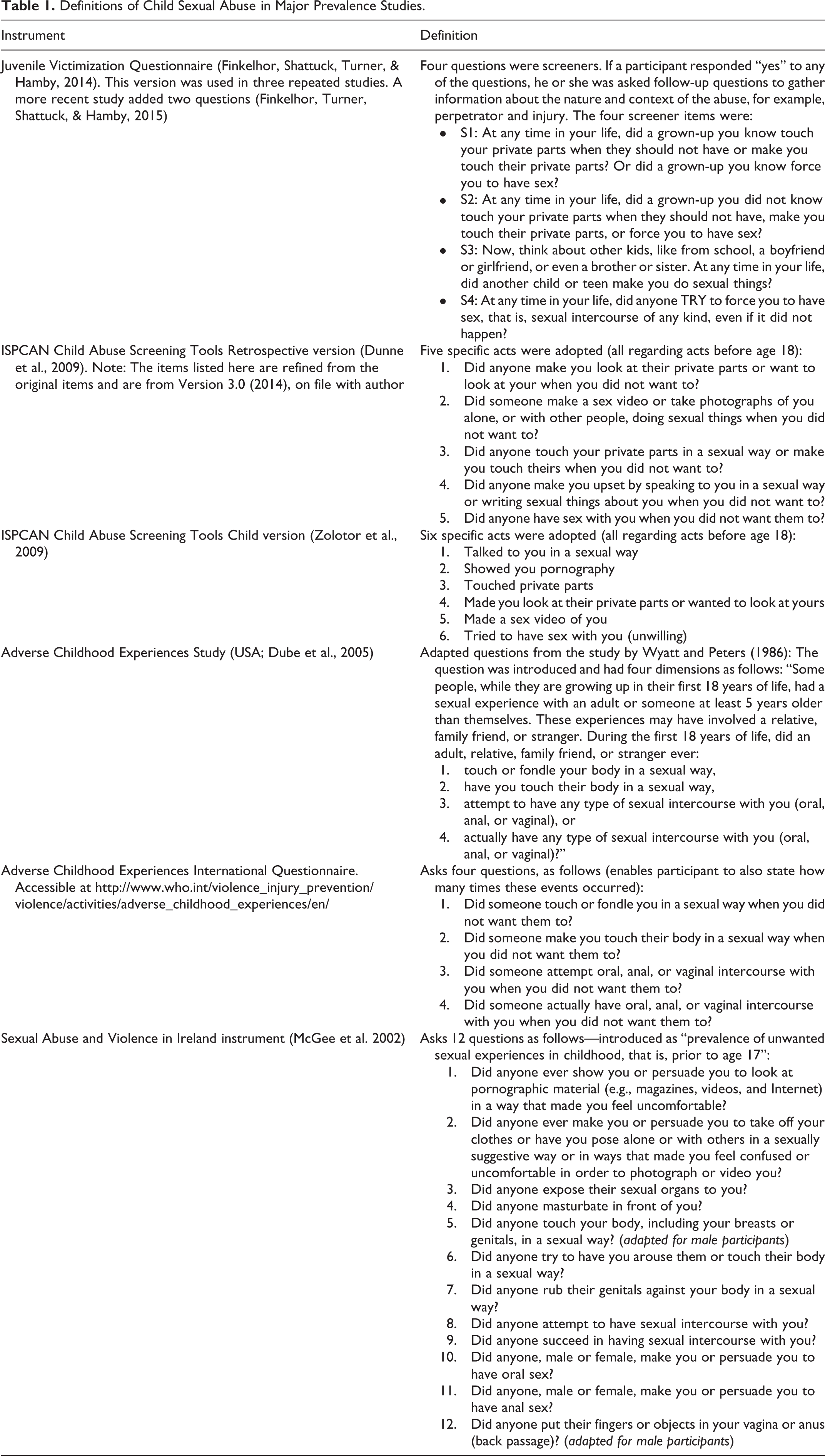
Dimension 1: The definition of the construct of CSA. Definitions vary in the upper age of the child. Most do not restrict the identity of the person who inflicted the abuse, but some limit it to adults or persons 5 or more years older. The identity or relational power position of the person inflicting the acts is usually not expressed. Most definitions do not include an element of gratification, but some refer obliquely to acts done “in a sexual way.”
Dimension 2: The definition of the acts that constitute CSA. The acts included range from 1 item limited to intercourse, to short lists of behaviorally specific items, sometimes limited to contact acts only, to longer lists of specific items including contact and noncontact events. In some cases, there is a broad inclusion, such as “make you do sexual things.”
Dimension 3: Consent. A part of the construct sometimes but not always stated is specifying that the acts are “unwanted” to exclude developmentally normal play and consensual peer–peer acts.
Major International Policy Documents
International organizations such as the WHO (2006) and the Committee on the Rights of the Child (2011) can influence substantial policy and practical gains. These bodies, some of which have themselves called for improved definitions and consensus (WHO, 2006), use different definitions of CSA. For example, in 1999, the WHO defined “CSA” as (pp. 15–16): the involvement of a child in sexual activity that he or she does not fully comprehend, is unable to give informed consent to, or for which the child is not developmentally prepared and cannot give consent, or that violates the laws or social taboos of society. Child sexual abuse is evidenced by this activity between a child and an adult or another child who by age or development is in a relationship of responsibility, trust or power, the activity being intended to gratify or satisfy the needs of the other person. This may include but is not limited to: the inducement or coercion of a child to engage in any unlawful sexual activity; the exploitative use of a child in prostitution or other unlawful sexual practices; the exploitative use of children in pornographic performance and materials.
This definition has been adopted by the WHO Regional Office for Africa (2004) and to develop guidelines for medicolegal care for victims of sexual violence (WHO, 2003, p. 75). International policy definitions show that while subtle aspects of cultural variance may present challenges, as will be seen later, core aspects of CSA are asserted to apply globally. This is supported by studies from many societies, showing that CSA is perceived as morally wrong (e.g., Lalor, 2004). However, as shown by Table 2, different definitions have been used by the WHO and the Committee on the Rights of the Child (2011). Analysis shows three dimensions of conceptual variance:
Definitions of Child Sexual Abuse in Major Policy Documents.
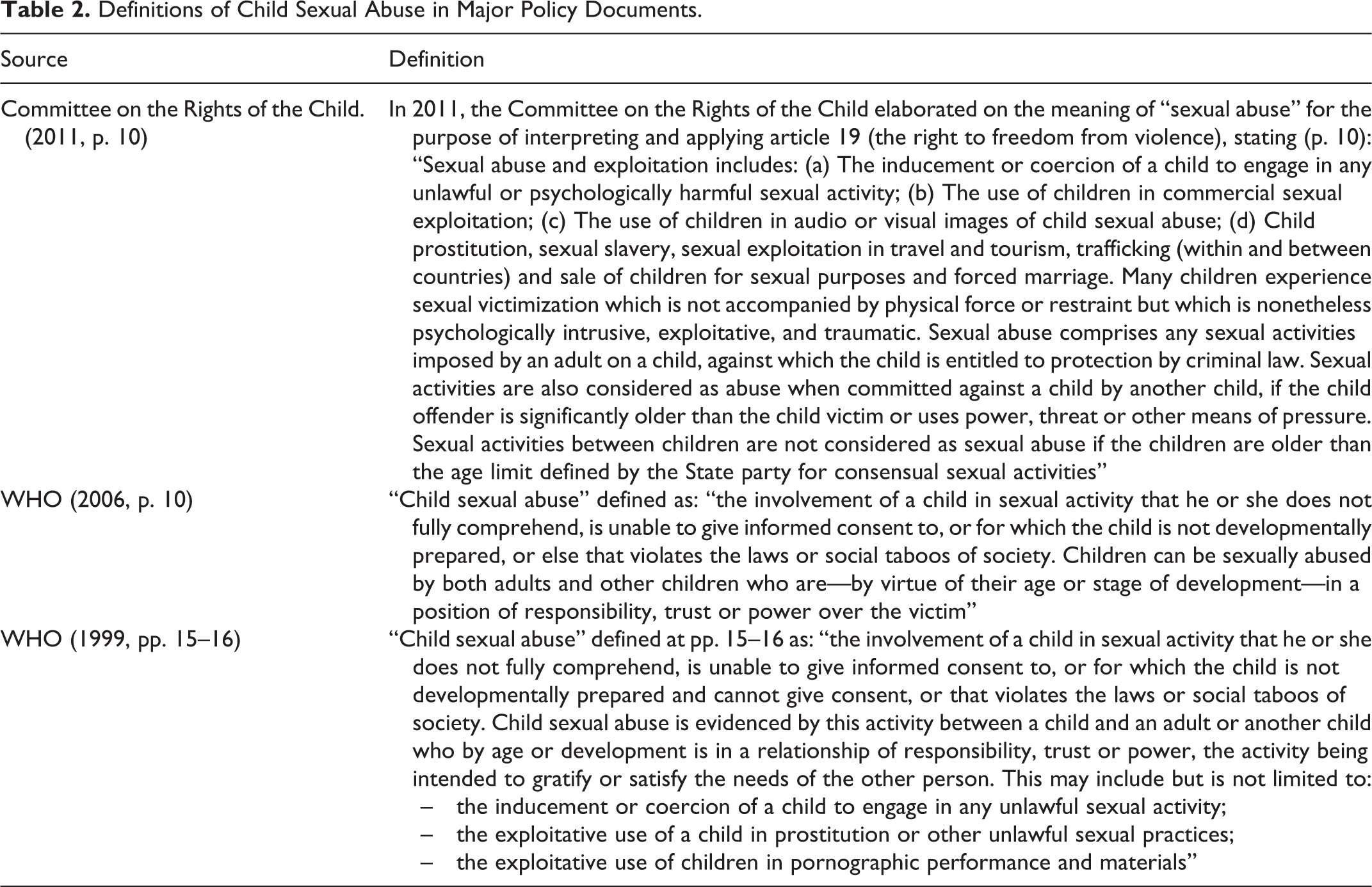
Dimension 1: The definition of the construct of CSA. The identity or relational position of the person who has inflicted the acts is expressed similarly. In some policies, it is noted that both adults and children can be abusers, with the added qualification that the abuser is in a position or relationship of “responsibility, trust, or power” over the victim. However, only one policy adds gratification or satisfaction of the abuser’s needs as an element of CSA.
Dimension 2: The definition of the acts that constitute CSA. In some instances, there is simply a broad reference to “sexual activity,” with the added alternative of taboo violation. In others, sexual activity is further elucidated as including inducement or coercion of a child to engage in any “unlawful sexual activity,” and exploitative use of a child in prostitution, other unlawful sexual practices, or pornographic performances or materials, as well as the additional alternative of taboo violation. Neither policy includes a detailed list of specific acts, in contrast to other extremely detailed approaches.
Dimension 3: Consent. Several definitions include three situations where consent is not present: Sexual activity the child does not fully comprehend is unable to give informed consent to, or for which the child is not developmentally prepared. Neither policy includes specific details of circumstances under which a child’s consent would be absent.
Legal Frameworks and Principles
Due to their role in providing victims with remedies, enforcing criminal laws, protecting children, and setting social norms, various branches of domestic legal systems require sound conceptual approaches to the construct of CSA. As shown in Table 3, analysis of legal principles from Australia, Canada, and the United States shows ambiguity and variance in approaches to this concept across jurisdictions. Jurisprudential variance in branches of law may be inevitable, yet inconsistency across jurisdictions within one nation is undesirable. As well, weaker and lesser coherent understandings of CSA can affect the capacity of civil law to provide remedies, the state to prosecute crimes, and child protection systems to protect children. While branches of law serve different purposes, which may support slightly different approaches to a concept, analysis of principles from several frameworks enables identification of three dimensions of conceptual variance. These are detailed in Table 3.
Legal Principles and Concepts.
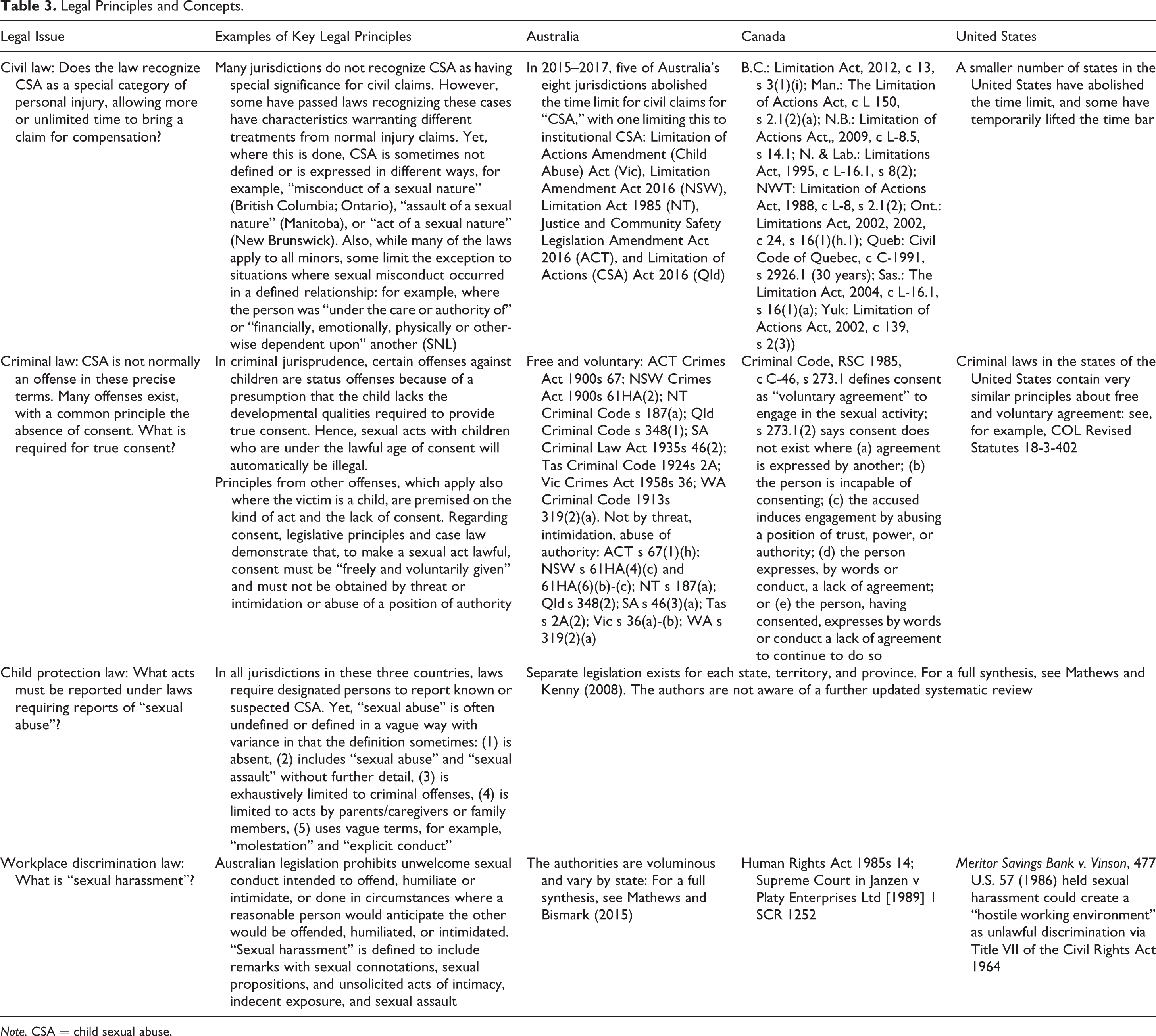
Note. CSA = child sexual abuse.
Dimension 1: The definition of the construct of CSA. Civil law and child protection law have different approaches to definition of the construct of CSA depending on the identity or relational position of the person who inflicted the acts. In some instances, CSA is limited to situations where this person is the child’s parent, caregiver, or family member; in others, it includes any person in a position of care or authority over the child.
Dimension 2: The definition of the acts that constitute CSA. Civil law and child protection law have different approaches to the definition of the acts that constitute CSA. In some instances, there is no definition; in others, a very wide approach is adopted, spanning “sexual assault,” “molestation,” or “acts of a sexual nature”; in others, specific acts are included. This wide approach may be designed to capture a wide range of acts, but it may be problematic if of uncertain application. Workplace discrimination law defines “sexual harassment” widely including acts from comments to rape.
Dimension 3: Consent. Criminal law sets a high threshold for consent. It must be freely and voluntarily given and is void if obtained by threat, intimidation, or abuse of authority.
Overall, the review and analysis of CSA definitions disclose three major dimensions of variance and conceptual dispute within each domain of epidemiological studies, policy instruments, and legal frameworks (Tables 1, 2, and 3, respectively). Across these domains, these three dimensions of variance are summarized in Table 4. First, there are different definitions of the construct of CSA, with variance in use of the child’s age, the relationship between the child and the abuser, and the element of sexual gratification. In epidemiological studies and in legal frameworks, the defined upper age of the child varies (e.g., before 18, before 17, and before 16), but in policy documents, the child’s age is consistently not stipulated. In epidemiological studies, the defined relationship between child and abuser always will include parents and caregivers but otherwise varies in multiple ways (e.g., anyone of any age; anyone at least 5 years older; any adult, relative, family friend, or stranger at least 5 years older; and adult only). In epidemiological studies and all legal frameworks, the element of sexual gratification is normally not expressly articulated. Variance in this dimension raises questions about how the construct of CSA should best be conceptualized. Can a 17-year-old be a victim of CSA? Can a 15-year-old be a person who inflicts CSA on another 15-year-old? Can CSA occur if the person who commits the act does not himself seek sexual gratification?
Dimensions of Conceptual Variance in Definitions of CSA in Epidemiological Studies, Policy Definitions, and Legal Frameworks.
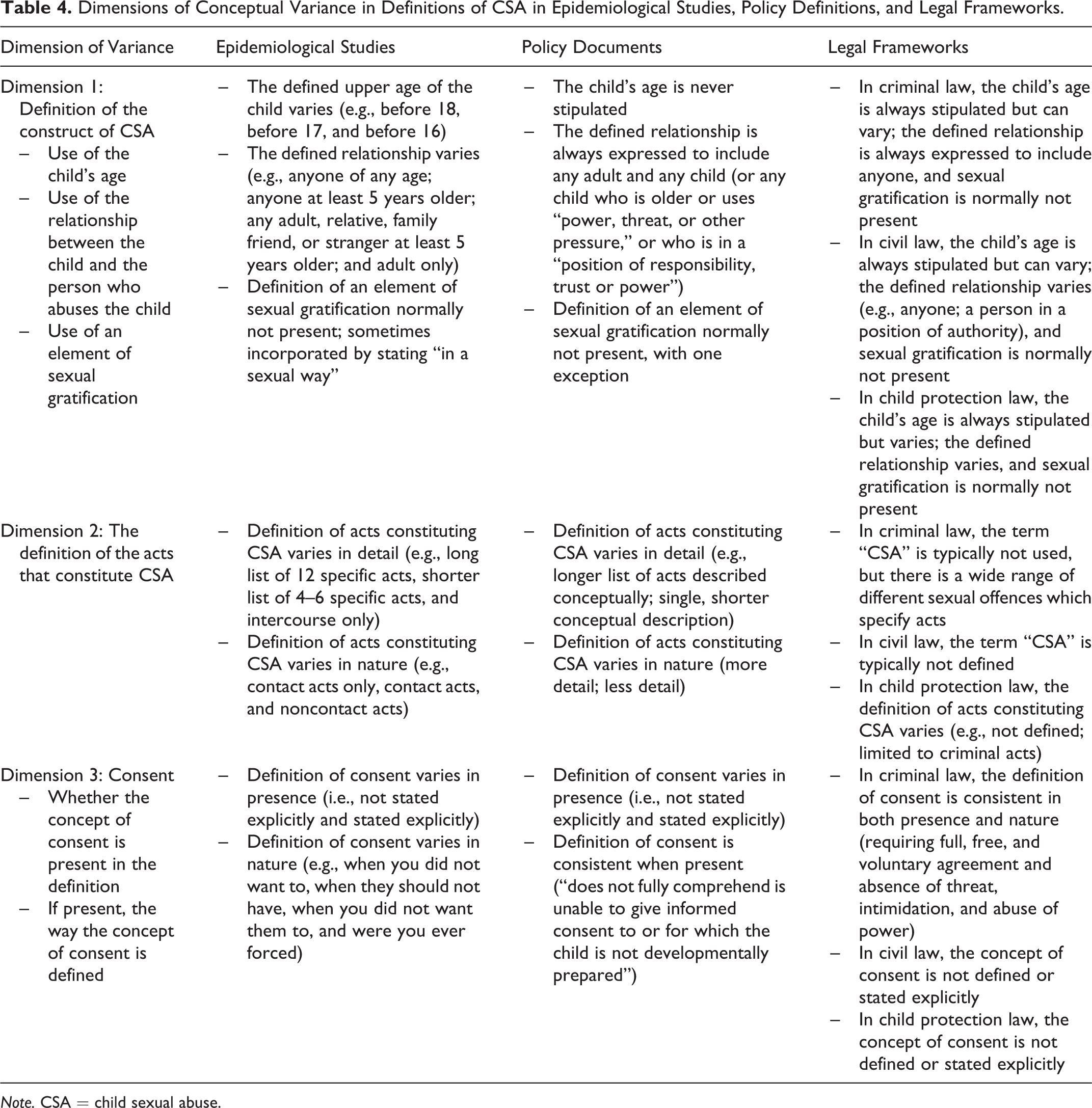
Note. CSA = child sexual abuse.
Second, there is variance in definitions of the acts that constitute CSA. There is some common ground such as the inclusion of intercourse between adults and young children. However, epidemiological studies vary in whether noncontact acts are included and in which noncontact acts qualify as CSA. Policy documents encompass a broader range of acts under the umbrella concept of CSA including any sexual act that violates a society’s laws; this, together, with a normally broad range of criminal law offenses covering a multiplicity of sexual acts both contact and noncontact, enables inclusion of many more kinds of acts within CSA. However, the narrower approach of some epidemiological studies’ definitions in excluding noncontact acts, and any narrower criminal law framework specific to a jurisdiction, raises questions about how the acts constituting CSA should be conceptualized. Should noncontact sexual acts be included as CSA? What qualities make an act sexual?
Third, there is variance in the presence and nature of the concept of consent. Epidemiological studies vary in whether the concept of consent is included, and how it is expressed, often related to whether the experience was “wanted.” Policy documents adopt a broader concept of consent including not only the child’s subjective experience but also developmental concepts such as the child not fully comprehending the act, being unable to give informed consent to it, or not being developmentally prepared for it. Criminal laws require full, free, and voluntary agreement to a sexual act for it to be consensual. Variance in this third dimension raises questions about how consent should be understood and expressed.
The three major dimensions of conceptual variance coalesce around the construct of CSA (including the nature of the “child,” the relationship between child and abuser, and the element of sexual gratification), the definition of what kinds of acts can constitute sexual abuse, and the presence and nature of consent. Our review has identified these dimensions within and across each of the three domains of epidemiological studies, policy, and legal frameworks. They constitute focus points for attention and conceptual analysis and must be accommodated by any conceptual model of CSA.
Conceptual Model: Nature, Methodology, and Design
As shown in our review and analysis, the term “child sexual abuse” has been defined differently, with epidemiology, policy, and law using different approaches to the construct of CSA, the definition of acts that constitute CSA, and the nature of consent. This variance produces multiple problems for research, policy, law, prevention, and the shaping of social norms. Our purpose is now to develop a conceptual model of CSA, which although based on an exercise that is inevitably normative and value-dependent, is grounded on a sound approach described below. It should be emphasized that this does not aim to criticize any previous definition adopted; rather, we aim to contribute to the ongoing development of a robust scientific understanding of CSA. Moreover, we do not claim to present a final solution or model or to solve all complexities in this context; we seek to make progress toward a conceptual model having firm theoretical support. Such a model can demarcate clear boundaries around the experiences that do or should have sufficiently complete consensus as constituting CSA and those which should not.
Nature, Methodology, and Design of a Conceptual Model
A conceptual model should describe the fundamental principles and features of the phenomenon. It should provide a more readily understood way to interpret a complex phenomenon that is prone to inconsistency and ambiguity. The model should integrate a range of concepts to assist in understanding the subject matter from a theoretical standpoint. In our context, such a model can then provide a theoretically sound basis upon which acts can be categorized as either capable of constituting CSA or as some other kind of experience.
In this way, a conceptual model can better isolate and integrate the relevant components of a multiform concept, enabling a clearer, more precise, shared communication about the meaning of CSA. The generation of more conceptual acuity and precise definitions responds to the general problem of technical imprecision identified by Hamby (2014) about all sexual violence research, which we here address in the context of CSA. A sound conceptual model can inform better choices about what specific phenomena to research, measure, or remedy. Ultimately, the model should enable the concept to be more fully and logically understood and to be a clearer subject of research, prevention, legal and policy responses, and social norm formation.
To avoid being arbitrary, developing a conceptual model requires a sound methodology. The methodology adopted here is conceptual analysis, informed by evidence from epidemiology, policy, and social science in the context of CSA. Conceptual analysis aims to clarify contested concepts (Wittgenstein, 1968). Concepts must be broken down into their constituent parts to more precisely understand the issue to which the concept relates (Beaney, 2015). This methodology is well suited to developing a conceptual model of CSA, as it is both a composite concept and contains three other concepts: “child” “sexual,” and “abuse.” This is a similar approach to that used in designing conceptual models of child neglect (Dubowitz, Black, Starr, & Zuravin, 1993; Dubowitz et al., 2005), and emotional abuse (Glaser, 2002). However, we also draw on law and developmental psychology in our analysis of the concept of “child” on sexual gratification-based and nongratification-based CSA in our analysis of when an act is “sexual” and on etymological distinctions and the legal concept of unconscionability in our analysis of what constitutes “abuse”.
Informed by our review and analysis, we will structure the conceptual analysis around the key subconcepts of child, sexual, and abuse and integrate analysis of the three dimensions of conceptual variance: the construct of CSA (including elements of the child, the relationship between the child and the person inflicting the abuse, and the element of sexual gratification), definitions of the acts constituting CSA, and consent. Our approach takes the primary unit of analysis as the child’s subjective experience of the acts (experiential validity); however, our analysis will also be informed by objective consideration of whether an act should be considered to be CSA and why or why not (face validity). This analytical process also enables identification of “central cases” of CSA (i.e., those with which all rational people can agree) and “peripheral cases” (i.e., those on which rational people may disagree). For illustrative purposes regarding specific concepts, we use examples of core cases (those that are definitely CSA), clearly excluded cases (those that are definitely not CSA), and more complex cases.
A Conceptual Model of CSA
On our model of CSA, the presence of all four factors is required for an act or experience to be conceptualized as CSA.
The person must be a child
This condition relates to an element of Dimension 1 (the construct of CSA). This condition will clearly be satisfied in many cases, as in all societies, it is uncontentious that sexual abuse of a person under a low age is inflicted on a child. It is impossible to make a rational case, for example, that any infant or other young or prepubertal individual is not a child: These are core cases of CSA.
However, there are complexities. Is a person a child because of their legal status, their developmental status (cognitive, psychosocial), a combination of the two, or some other factor? Suppose a society’s law sets an age of 12 as the age of adulthood. Based on all we know about the nature and sequelae of CSA, we would maintain that a child who is 12, 13, 14, 15, 16, or 17 years old can be a victim of CSA. So, the status of childhood cannot rest solely on a legal principle about the legal age of adulthood. While different cultures have different standards of expected child conduct and hence have different chronological ages of legal capacity, what seems a sounder theoretical basis for our purposes is that the person’s status as a child should be sourced in her or his developmental state and capacity to provide true consent to the acts as well as her or his status in law based on chronological age. We should acknowledge at this point the scientific literature which has shown that adolescents of around age 15–16 are generally able to exhibit adult-like cognitive processing ability but are still in the early stages of developing the psychosocial capacity to understand long-term consequences and regulate conduct (Albert & Steinberg, 2011). In particular, adolescents’ capacity to withstand social and emotional pressures is still developing (Albert & Steinberg, 2011; Steinberg et al., 2017). In decision-making contexts, adolescent cognitive capacity may generally be considered as “adult-like,” but adolescent behavioral decisions tend to be directed by still-developing self-regulatory capacity and the emotional and social rewards offered by the context (Casey, Jones, & Hare, 2008).
Accordingly, legal rules about the status of the individual in society (the legal age of adulthood or majority) and ability to participate in sexual activity (the legal age at which a child may provide consent) are relevant, but not determinative. Further, while a society’s laws may set the same age of adulthood and sexual consent, they may set a different, lower age at which a child may give sexual consent than for adulthood in general; but for our purposes here, we are primarily concerned with the individual’s general status as a child. Similarly, one’s status as a child cannot rest solely on developmental capacity: an adult with impaired capacity who experiences sexual assault has not experienced CSA; rather, she or he is an adult with impaired capacity who experienced assault.
One difficulty this position presents is that individuals have different developmental capacities, so a child who is developmentally advanced or “adult-like” may not be perceived as a child despite being younger than the age set by a legal or social norm. A resolution of this difficulty is that a child who has in fact attained adult-like developmental capacity, but whose age is under the legal threshold of adulthood, should still be classed legally and socially as a child, and an individual who interacts sexually with that person should be held to have breached a legal and social norm. So, a 15-year old of “advanced” or adult-like psychosocial development, in a society where the legal age of adulthood is 16, should still be classed as a child for this purpose. A second difficulty this position presents would arise in a society with an unusually low legal age of majority. The developmentally advanced 15-year old in a society where the legal age of majority is low, for example, 12, seems to meet both criteria for adulthood, and this is an example of a complex case. In general, it is evident that the complex cases of defining childhood in the broader endeavor of conceptualizing CSA arise most prominently when victims are in the teenage years; no longer clearly children, nor clearly adults. The inherent challenges produced by the developmental phase of adolescence will arise again in considering other concepts below.
Essence of the first condition
Overall, this first condition can be presented as the question: Is the person either developmentally a child or considered a child at law or by the society’s norms? (Figure 1). On this basis, a core case would be that a person who is both developmentally a child (and so cannot provide true consent), and who is below the legal age of adulthood, is a child. A clearly excluded case would be that a person who is both developmentally not a child (due to their psychosocial development and ability to provide true consent), and is above the legal age of adulthood, is not a child. A complex case would be a hypothetical 15-year old of advanced psychosocial development in a society with a legal age of adulthood higher than 15.
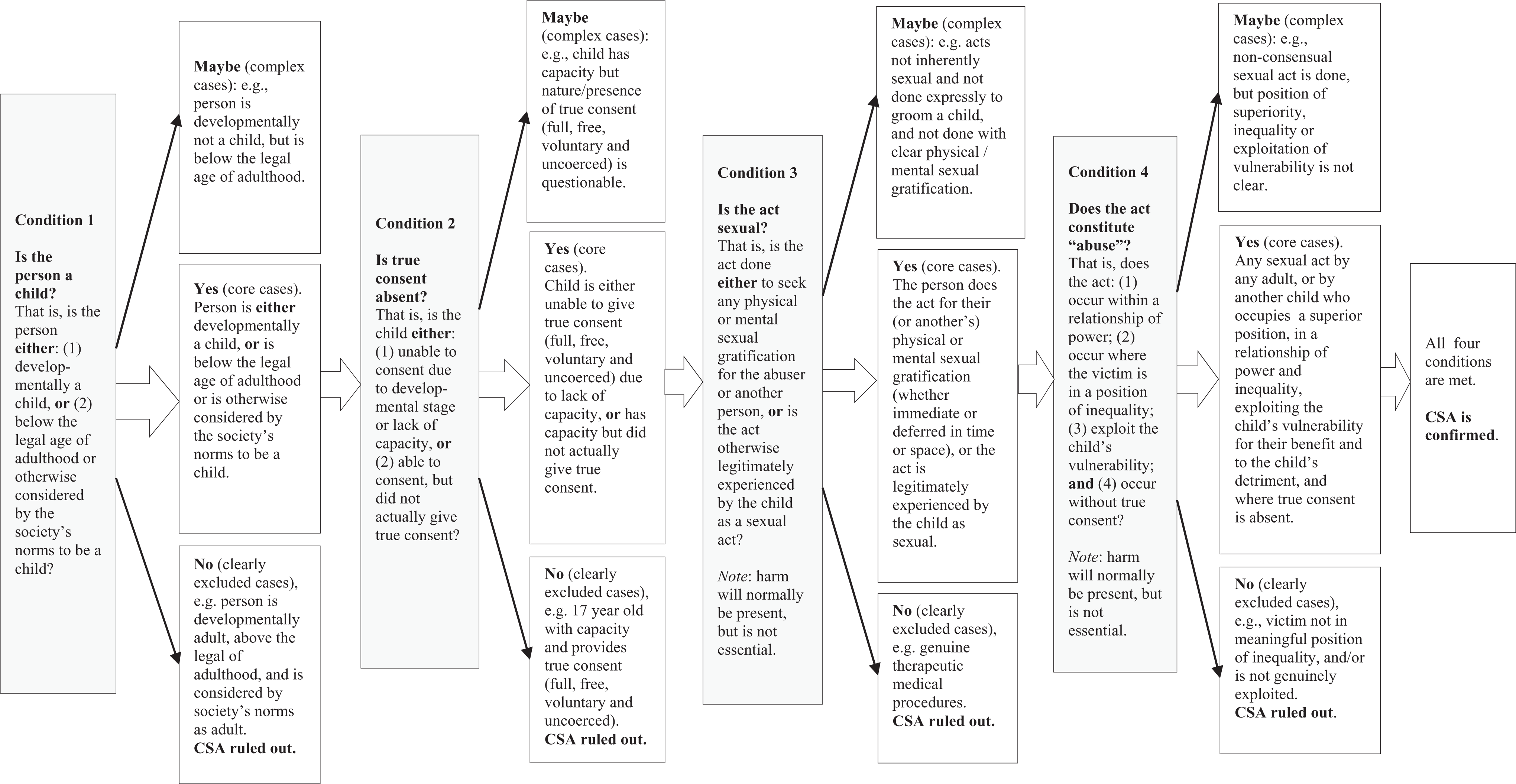
Conceptual model for classifying acts and experiences as child sexual abuse.
True consent must be absent
Various bodies of knowledge align in setting a high threshold for true consent, which has multiple components that should all be present. The WHO (1999, 2006) policy definitions include three situations where consent is not present: Sexual activity the child does not fully comprehend is unable to give informed consent to or for which the child is not developmentally prepared. In criminal law, true consent must be “freely and voluntarily given” and is void if obtained by threat, intimidation, or abuse of authority. In medical law, a child only has capacity to consent if possessing sufficient understanding and intelligence to fully understand what is proposed (AC v Manitoba 2009 SCC 30; Secretary, Department of Health and Community Services v JWB (1992) 175 CLR 218). Finkelhor (1979) posited the essence of CSA lies in the inability of the child to provide full informed consent and the lack of true freedom to accept or decline participation. Ondersma et al. (2001, p. 711) seemed to accommodate individual variance in capacity to consent by resorting to the bedrock assumption that there are societal beliefs that children do not possess the maturity to provide true consent and require protection from those who would exploit that vulnerability. On our analysis, coercion is incompatible with true consent and can be physical, emotional, psychological, cognitive, or economic. Consent and coercion overlap conceptually with the nature of “abuse” and should be considered with that concept.
Essence of the second condition
Overall, this condition can be presented as the question: Is the child unable to give true consent to the act or did the child have capacity but not give true consent to the act? (Figure 1). On this basis, core cases in which true consent is absent would include those in which a child either cannot or does not give true consent to the sexual activities. In most cases, because of their developmental stage, a child will not have the capacity to provide true consent to sexual acts; accordingly, any child lacking the necessary comprehension or developmental capacity cannot give true consent. In other cases, even where a child has the capacity to consent to a sexual act because of her or his advanced psychosocial state, true consent to the specific acts with the specific person will in fact be lacking due to clear coercion, force, or pressure.
In contrast, clearly excluded cases—that is, cases where true consent is present—are those where the child has ability or capacity to give consent and actually does give consent to the specific acts with the specific person at the specific time. Such cases would include two developmentally mature children who consent to the acts in which they engage and who meet all consent criteria (e.g., full comprehension; developmentally prepared; free and voluntary; not gained by threat, intimidation, or abuse of authority; having sufficient intelligence to fully understand the act). Complex cases may arise where it may be difficult to conclude if participation is truly consensual or is a product of coercion or social or economic pressure. Is true consent present where a psychosocially advanced child engages in transactional sex to survive (Lalor, 2004; Williams, Binagwaho, & Betancourt, 2012) or is this “consent” voided by abuse of authority? What of other extreme circumstances where ostensible consent is provided to protect one’s very survival? Is true consent present if a child captured in a combat situation forms a relationship with a captor to avoid violation by other soldiers and survive a situation of extreme danger (Denov, 2006)? Or consider two developmentally mature children who are in an equal, consensual relationship. Where one provides what ostensibly is consent, perhaps reluctantly, to a request for a certain act from her partner based on a perceived expectation to participate (from her partner or to conform with peer group practice), is consent freely given, or is it vitiated by coercion, manipulation, or social pressure? What about other situations of subtle, insidious manipulation, such as where a boyfriend over time persuades his girlfriend to participate in prostitution?
The acts must be sexual
This condition relates to Dimension 2. Consistent with epidemiological, policy, and legal approaches, the nature of the act must concern sex. A sexual act may directly involve the child when conscious or when unaware (e.g., voyeurism and filming). While in most cases the child will perceive the acts as sexual (exemplifying subjective experiential validity), this is not required to qualify the acts as such (e.g., the child may be asleep, preverbal, or acculturated to the “normalcy” of the acts, exemplifying objective face validity). On our analysis, noncontact acts can clearly be sexual—including photography, filming, exposure, and voyeurism—so we would categorize as unduly restrictive any definition of CSA limited to contact acts only (e.g., Violato & Genuis, 1993).
A related aspect of this condition is whether sexual gratification is required to qualify an act as sexual (either directly for abuser or victim or indirectly through production or supply of child pornography for others’ gratification). This question about sexual gratification relates to a component of Dimension 1 (the construct of CSA). The WHO (1999) definition requires intent to gratify the abuser, and some epidemiological definitions refer to acts done “in a sexual way,” implicitly embodying gratification. On our analysis, sexual gratification is a clear marker of a sexual act; we would add that sexual gratification may be mental or physical and may be immediate or deferred in time and space. Moreover, consistent with some studies (e.g., McGee et al., 2002), we would include as “sexual acts” some noncontact acts which may not themselves be inherently sexual, but which within their context are undeniably done for the purpose of having sex, such as verbal demands and other forms of coercive manipulation to engage in sex or attempt to do so. Many acts of grooming will also fall into this category, especially where the act—whether inherently sexual or not; for example, exposure to pornography, compared with giving a child a gift—is done with the clear intention to groom the child and where the person seeks or obtains mental or physical sexual gratification from the act. This analysis is consistent with some of the noncontact questions used in prevalence studies (e.g., McGee et al., 2002; Zolotor et al., 2009). More difficult examples can arise, such as where an adult does an act which is inherently nonsexual without the clear express purpose of grooming the child and without a clear intention to seek mental or physical gratification from the act. In contrast, genuine therapeutic medical procedures on a child’s genitalia are clearly not sexual acts and could not be said to be legitimately experienced by a child as such. Finally, on this point, it is possible that some acts may not clearly be related to obtaining sexual gratification, but they may be inherently related to sex and may be legitimately perceived by the child as a sexual act, whether at the time or retrospectively. One example of this is female genital cutting (FGC). While not typically conducted to obtain sexual gratification for any person, it is inherently related to sex (Barstow, 1999; Toubia, 1994). While FGC takes different forms and has different sequelae, a particular individual could legitimately perceive it as a sexual act because of its primary focus on sexual function and its impact on physical and psychological sexual capacity.
Essence of the third condition
Further clarity can be brought to the concept of sexual by reading it together with the concepts “consent” and “abuse”. However, overall, this condition of when an act is sexual can be presented as the question: Is the act done to seek any degree of physical or mental sexual gratification for the abuser or for another person or is the act otherwise legitimately experienced by the child as a sexual act? (Figure 1). On this basis, we suggest three categories of act are “sexual”: (1) any act where the person inflicting the abuse seeks or obtains any level of mental or physical sexual gratification, whether immediate or deferred in time and space, (2) any act where the person seeks sexual gratification for another person (e.g., the child victim or a third party who is directly involved in the abuse of the child or a third party who is involved more distally such as a consumer of child pornography), (3) any other act, which may not meet either of the sexual gratification categories, but which is legitimately experienced by the child as a sexual act.
Accordingly, core cases of sexual acts would include all acts of sexual intercourse and any other contact or noncontact act where the person seeks or obtains sexual gratification for any person and acts done expressly to groom a child with any level of mental or physical sexual gratification. Core cases would also include noncontact verbal or written requests or demands for sexual acts and other communication of sexual writing or imagery transmitted in person or electronically (e.g., sexting between romantic partners and the sharing of sexual imagery). Clearly excluded cases include developmentally normal play between children involving mere curiosity about bodily functions; other acts involving no sexual gratification and not experienced by the child as sexual (e.g., parental bathing with young children). Complex cases include ostensibly nonsexual acts done without a clear purpose of either gratification or grooming and not clearly experienced by the child as sexual. One example is a grandfather touching his grandson’s genitals as a gesture of pride, found acceptable by some but not all members of a cultural group (Ahn & Gilbert, 1992).
The acts must constitute abuse
This condition relates to Dimension 1 (the construct of CSA; the relationship between child and the person inflicting the abuse) and should be read together with the concepts of “child”, “consent”, and “sexual”. What features make an act constitute “abuse” compared to a different concept like assault? This is an important question, partly because many widely understood examples of CSA do not involve physical contact, so exclusive use of the term assault will exclude many experiences from the concept of CSA. At the outset, we can make it clear that we see “abuse” as a broader and more distinctively wrongful concept than other concepts like assault, while not minimizing the seriousness of assaults and expressly accepting that many assaults, ranging from less severe to extremely severe incidents, will simultaneously constitute abuse and therefore will be just as wrongful. There are areas of conceptual overlap, but there is also a distinctive quality to the concept of abuse. As well, we agree with Ondersma et al. (2001) that harm is not required to qualify an act as abuse and hence as CSA. Sexual abuse experiences will usually involve harm but may not always (Finkelhor, 1979). Different experiences will involve different levels of harm; they may also last for a limited time (Ondersma et al., 2001) or be latent (Negriff et al., 2014).
It is instructive to consider etymological differences in the concepts of abuse and assault. The concept of “assault” is defined as a physical attack (Oxford English Dictionary, 2016). Similarly, in criminal law, assault is defined to mean actual or threatened application of force to another’s body (Table 3). The focus is on application of physical force. Accordingly, an immediate problem with studies which merely use the term “assault” to capture the full spectrum of CSA experiences is that many accepted forms of CSA like voyeurism, exhibitionism, or an adult stimulating themselves while not touching the child are not assaults in either a linguistic or legal sense and would be excluded.
In contrast, the concept of “abuse” means the improper use, misuse, or wrongful taking advantage of (Oxford English Dictionary, 2016). The first consequence of this is that because “abuse” is not limited to acts of physical contact, the concept of abuse is much wider than assault, as it embraces a broader range of experiences. So, sending pornographic images to a child, or sending such images of a child, can be sexual abuse, even if not sexual assault.
The second consequence is that it supports our contention there is something distinctive about the concept of “abuse” pointing to its higher degree of moral wrongfulness compared with the concept of assault and the problematic term unwanted experience, which implies some abusive experiences are wanted. Again, accepting that many sexual assaults will also constitute sexual abuse, we contend the concept of “abuse” connotes an act which will often but not always involve a physical sexual assault, but which because of its improper nature, context and wrongful exploitation of an imbalance of power, is more serious than an assault. Significantly, the term “abuse” captures the power dynamics at play in the experience of events constituting CSA. We posit that the term CSA encompasses various forms of sexual abuse experiences ranging in severity, power disparities, relational components, and social determinants. On this theoretical basis, CSA can and should be perceived as an overarching term incorporating an array of specific experiences of sexual abuse (e.g., rape as a form of CSA, fondling as a form of CSA, and exposure to pornography as a form of CSA).
On this view, the heightened wrongfulness of sexual “abuse” derives from its distinctive feature of unconscionability. This unconscionability is a product of four indicia, recognized by special legal remedies developed to recognize interpersonal circumstances of oppression, pressure, or other vulnerabilities (Miglin v Miglin 2003 SCC 24). First, “abuse” occurs within a relationship of power. There is something distinctive about sexual acts inflicted within a context of a relational power dynamic, as opposed to a context where there is no such relationship. Abuse occurs within a relationship of power involving closeness or dependence between offender and victim. This is consistent with definitions of CSA in civil law and in policy (WHO, 1999, 2006). However, it contrasts with some epidemiological studies, which apply a narrower range of potential power relationships by excluding adolescent peers or romantic partners (Dube et al., 2005). Without seeking to be exhaustive, our analysis would maintain that the relational dynamic of power may exist and be exploited, where the wrongdoer is in a position of power through a familial relationship (e.g., parent, adult family member, and sibling), an institutional relationship (e.g., teacher, sports coach, and clergy member), an economic relationship (e.g., employer), and a psychological relationship (e.g., a peer or romantic partner with greater psychological power). Arguably, there are two other, more generalized power dynamics: first, the dynamic between most adults and most children, based on differences in age, psychosocial development, and social power; and second, the dynamic between female children and males, whether adolescent or adult, based on deep and long-held sociocultural practices and dispositions concerning gender roles and sexism. Although experienced by girls and boys and sometimes perpetrated by females, we must not ignore the fact CSA remains a profoundly gendered phenomenon.
The importance of the power dynamic is that it connects most immediately and deeply with a harm extending beyond the physical to psychological and emotional violation. The breach of the power dynamic endows it with a deeper psychological or emotional force, giving it added gravity. On this conception, depending on the acts and the relationship between wrongdoer and child, most cases of sexual abuse will involve a sexual assault, but there may be cases of sexual assault that do not reach the level of abuse.
Second, abuse involves a position of inequality. Further elucidating the first element, these indicia are met when the abused child is in a position of fundamental disadvantage in relation to the person inflicting the abuse. Inequality can exist in several senses: age; physical, cognitive, and psychological capacity; cultural inequality (e.g., caste); and gender inequality. The question of age differential is important. In a large proportion of cases, the offender is an adult, with inequality being clear in age, cognition, and other aspects. Other situations of abuse by a child on another child will also possess clear inequality, often by age, and physical, psychological, and cognitive inequality. However, whereas some studies use an age differential to qualify an abuser on the implicit basis of inequality (Dube et al., 2005), on our analysis, age difference is not a precondition for inequality. Rather, abuse can be inflicted by a child of the same age or by a younger child, if another condition of inequality and the power relationship is met. So, a sibling who commits incest against his (older or younger) sibling can occupy a relationship of power (familial, gender, physical, or psychological) and can be in a position of superiority through his victim’s inequality; this would be abuse, rather than only assault. In contrast, a nonconsensual sexual act by a peer on another peer, where the primary actor holds no superiority or relational power, could be sexual harassment, but not “abuse”. A 13-year-old girl who does not hold any relational superiority or power over a mature and self-possessed 17-year-old boy at school, and who playfully slaps his bottom, does not exploit inequality or a power differential but could be sexually harassing him.
Third, abuse involves exploitation of vulnerability, with the person taking advantage of the child’s vulnerability and using their superior position to their benefit and to the child’s detriment. An aspect of exploitation in this sense is that it degrades the child as a human being (Wood, 1995). So, for example, a priest who commits sexual acts on a boy, and an authority figure who exposes a boy to pornography to groom him, each exploits the child’s vulnerability and degrades him in a profound way. In contrast, the 13-year-old girl’s action with the 17-year-old boy is likely not exploiting vulnerability or degrading him in a profound way. Fourth, abuse involves an absence of true consent, in the senses discussed above. These indicia combine to create an overarching unconscionability, which in terms of sequelae can have resonance beyond the physical nature of the acts. Our contention about the significance of this unconscionability, and of “abuse”, finds support in the growing evidence about heightened psychological injury from abuse by persons in relationships of power, responsibility, and superiority (Edwards et al., 2012; Trickett, 2006; Trickett et al., 2011).
Essence of the fourth condition
Overall, this final condition about whether the act constitutes abuse can be presented as the question: Is the act marked by indicia of (1) a relationship of power, (2) the victim being in a position of inequality, (3) exploitation of the victim’s vulnerability, and (4) absence of true consent? (Figure 1). On this basis, core cases of “abuse” would include any sexual act, whether involving physical contact or not, by any adult including authority figures, for example, teachers, clergy, coaches or supervisors in sports, cultural, arts, or religious groups; any nonconsensual sexual acts by other children in a superior position in a relationship of power and inequality. Clearly excluded cases would include those where a nonconsensual yet playful nonserious sexual act is committed by a peer who does not hold a superior position in any kind of power dynamic with the victim, where the victim does not have a meaningful position of inequality and where the victim is not genuinely exploited. Complex cases include those where a nonconsensual sexual act is committed but is not clearly seriously improper or wrongful and is done within a romantic relationship between peers where the power dynamic is generally equal, with no clear inequality or exploitation of vulnerability.
Operational Examples: Toward a Classificatory Framework
At a broad level, the conceptual model can be used to assess different overarching concepts used to denote CSA and to draw stronger, theoretically supported conclusions about their respective quality. As we have demonstrated, the model can inform an assessment of why, in many contexts and for appropriate purposes, CSA is the preferable concept to others such as sexual assault or victimization but also why for some other selected purposes, a different concept may be more appropriate such as sexual harassment. At a narrower level, the model can be used to draw reasoned, theoretically grounded conclusions about whether CSA should be defined so parsimoniously as to include only acts involving physical contact or so widely as to include any sexual experience. The model can also be used to develop a comprehensive framework of acts and experiences, which can be legitimately and defensibly classified within its scope (Nudelman & Shiloh, 2015). In the course of developing this conceptual model, for each of the four concepts (child, consent, sexual, and abuse), we gave examples of core cases, clearly excluded cases, and complex cases. We also showed that, especially in more complex cases, sensitivity to individual case characteristics is needed, as the same act may be sexual abuse in one set of circumstances but not in another. Here, and recalling the factors interact, we provide further nonexhaustive examples applying the model, as captured in Figure 1.
First, CSA will always exist when the person is a child from both developmental and legal standpoints (i.e., both core cases of “childhood”) and the acts are clearly sexual. In these cases, the condition of absence of true consent is automatically satisfied due to the child’s inability to provide it, and the condition of abuse is also satisfied due to the relationship of power, the child’s position of inequality, and the exploitation of the child’s vulnerability. So, for example, a 9-year-old girl will be a child, unable to give true consent, and will experience sexual abuse in situations of incest, rape, and all other contact and noncontact acts that are done to seek physical or mental sexual gratification for any person, whether immediate or deferred in time or space, where those acts occur in a relationship of power, with the girl in an unequal position, with her vulnerability exploited in a profound way to the benefit of the other person and to her detriment. Accordingly, this would also include as CSA all acts on a child done to create child pornography, involvement of children in sex trafficking, prostitution and the sex trade, and many instances of child marriage.
Second, when the person is clearly a child from developmental and legal standpoints (i.e., both core cases of childhood) and so is also unable to consent, but the acts are only “maybe” sexual, this may indicate potential (but not clear) grooming or concerns suggesting risk of future CSA. Third, when the person is “maybe” a child (a complex case, either from a developmental or legal standpoint), and the acts are clearly sexual, the questions of whether true consent is present and whether the acts constitute abuse will determine if the act is CSA, another experience like assault, or is consensual permissible activity. So, for example, in a dating context, depending on the individuals’ characteristics, the presence of true consent, the relationship and power dynamic between the parties, and the existence of exploitation, a sexual act could be truly consensual and legitimate, or abuse, assault, or harassment.
Conclusion
Any effort to develop a conceptual model of CSA must recognize not only its complexity but the sensitivity of the topic and the potential significance of the model’s influence on an understanding of CSA in theory, research, policy, law, and practice. We emphasize that our model does not in any way legitimize or minimize the seriousness of acts falling outside its parameters and nor should others seek to do so. Acts not characterized on this model as CSA can still involve violence and serious consequences requiring strong responses. Nevertheless, there is an urgent need to improve shared understandings of the concept of CSA, for multiple domains of research, law, policy, prevention, and the establishment of social norms. Our analysis and theoretical grounding for this model promotes a deep, nuanced focus on the key concepts in this context. We consider the concept of “child” should be analyzed from dual perspectives of developmental capacity and legal chronological age of adulthood. The concept of consent must be considered at face validity of apparent surface consent and experientially by asking whether true consent exists, which we argue requires full, free, voluntary, and uncoerced participation. The concept of “sexual” should embrace contact and noncontact acts done for the purpose of seeking or obtaining physical or mental sexual gratification, whether immediate or deferred temporally or spatially, as well as the child’s experience of the act. Finally, we posit that the term “abuse” is distinctive in possessing a heightened wrongfulness derived from the unconscionability of the acts, which in turn flows from four indicia: a relationship of power, the child being in a position of inequality, the child’s vulnerability being exploited to her or his detriment, and absence of true consent. On this approach, while instances of sexual assault and harassment will also often (but not always) constitute abuse, these understandings of the term CSA and of abuse distinguish the overarching concept of CSA from others such as assault, harassment, and victimization and illustrate when and why an act or experience is more legitimately understood as CSA. This conceptual analysis and model aim to advance deeper knowledge and build greater consensus around a more rigorous understanding of CSA.
Footnotes
Acknowledgments
The authors would like to thank Dr. Kerryann Walsh and Dr. Andrew McGee for their comments on this article. We also thank the anonymous reviewers for their comments on this article.
Declaration of Conflicting Interests
The author(s) declared no potential conflicts of interest with respect to the research, authorship, and/or publication of this article.
Funding
The author(s) received no financial support for the research, authorship, and/or publication of this article.