



Abstract
Except for the knowledge that the Roma people endure harsh conditions and are victims of discrimination, scarce criminological research has given detailed attention to further victimisation or offending among the Romanies. Identifying articles in the browsers Web of Science, Google Scholar and Google, we reviewed European publications (1997–2020) in English, French, Romanian or Spanish that addressed the Roma’s victimisation or offending. The 44 studies that matched our criteria suggested that (1) Roma people are victims of hate crimes with devastating consequences; (2) Roma children and women are victims of domestic violence to a greater degree than other groups, although the Roma tend to oppose violence against women; (3) forced early marriages exist among some Romanies and may cause serious problems in adulthood; (4) youth delinquency among the Roma does not differ from that of the non-Roma, although Roma adolescents face more deprivation; (5) Roma men and women are overrepresented in prison and face many difficulties in re-entering society once they are released and (6) there are organised criminal activities in some Roma groups that are supported by their community. Further rigorous post-positivist research, particularly quantitative, is needed to generalise the findings and replicate former studies. Areas of special interest are the causes of anti-Roma discrimination other than ethnicity, the victimisation of children, the Roma’s lack of institutional trust and the relation between victimisation and offending. Conducting comparisons with the general population is essential, and we propose that victims’ surveys and self-reported delinquency studies include questions on ethnicity.
Introduction: Who Are the Roma?
The Roma 1 are the largest European ethnic minority, with a population estimated at six million in the European Union (EU) and 11 million in Europe overall (Council of Europe, 2012a) 2 . This minority is among the European groups that has suffered terrible persecution and trauma in the past and continues to in the present. Although the Roma people have been victims of shocking crimes in the past, such as the final solution of the Nazi regime, and remain targets of discrimination and prejudice today (Powell & Lever, 2017), they have been studied rarely through a criminological prism. Therefore, the goal of this paper is to review literature to bring together the knowledge on a population that has lived in Europe since the 13th century and suffered severe deprivation, discrimination and traumatisation on the part of the so-called autochthonous populations (see following sections).
The Roma are thought to have originated in India (Grellmann & Vali, cited in Fonseca (2018/1995); Martínez-Cruz et al., 2016). According to Fraser (1992/2017), historical proof of their migration was found in Persia in the fifth century, in Armenia in the seventh and in Byzantium in the 11th. Beginning in the 13th century, the Roma migrated to the Balkans and the remainder of Europe. From the beginning of their migration, they occupied a precarious position. While their expertise in handicrafts brought them into contact with all of the social classes, they are thought to have lived apart from the native population, and even to have been enslaved in countries such as Romania. Academia also played a role in promoting the Roma’s discrimination: During the 19th and 20th centuries, scientists explored their supposed criminality. For example, Lombroso et al. (2006/1887), described the Roma as atavistic: violent, lazy, shameless, promiscuous and suspected of cannibalism. As well, such Spanish criminologists as Rafael Salillas y Panzano, Jerónimo Montes and Bernaldo de Quiros, also claimed that the Roma were a criminal race (Rothea, 2007). The gravest ethnicity-based attack on the Roma occurred during the German National Socialist regime of the 20th century (1933–1945), which persecuted and executed between one-quarter to one-half million Romanies (Fonseca, 2018/1995; Fraser 1992/2017). After the end of World War II (1945), the Roma continued their nomadic lifestyle and moved from place to place seeking ways to survive. Nonetheless, in countries such as Slovakia and the Czech Republic, ancient forms of mass victimisation against them resurged, such as the forced or coerced mass sterilisation of Roma women (see Aguilera-Rull & Gili-Saldaña, 2012; European Roma Rights Center, 2016).
In 1979, the International Romani Union (IRU) was created at the First World Roma Congress the United Nations hosted in London. The IRU intended to represent all of the Roma people politically, and therefore, it cooperated with public institutions and civil societies to resolve the challenges the Romanies endured and implement human rights for their ethnic group effectively (Fonseca, 2018/1995; Fraser, 1992/2017). After 1989, the fall of the communist regime and the explosions of anti-Roma violence forced the Romanies to begin to mobilise and defend their rights more vigorously (Gheorghe & Mirga, 2013). Therefore, many Roma organisations emerged, as well as Roma political elites, who put the Roma issue on the political agenda, which led to their recognition in most European countries and in supranational organisms such as the EU, the Council of Europe (CoE) and the Organisation for Security and Cooperation in Europe (Gheorghe & Mirga, 2013). Accordingly, in 2011, the EU established the ‘National Roma integration strategy’ (European Commission Directorate-For Justice, 2011) to increase the number of Romani citizens with access to housing, education, employment and healthcare, and reduce the discrimination that they suffer in various domains of their lives (see European Union Agency for Fundamental Rights, 2017; Villareal & Wagman, 2001).
This section provides the conceptual definitions of the Roma and the terms used in this paper. First, it is important to acknowledge that the European Roma are a diverse group (see Hancock, 1997) and the studies reviewed are most of them context-dependent, therefore, cautious generalisation should be drawn from our review. However, while this is far from our objective, we believe that the study of the Roma’s trauma and violence can be useful for scholars and practitioners because the Roma people are found more prevalently in difficult circumstances than the non-Roma (European Commission, 2014), and they may manifest different characteristics and needs compared to the non-Roma as well. Some scholars have drawn several nuances and distinctions between the Roma and the so-called Roma-like groups.
Second, Rom means literally man of the Roma ethnic group or husband (Council of Europe: Descriptive Glossary of Terms Relating to Roma Issues, 2012). The Council of Europe (2012a) uses the term Roma, sometimes written with double ‘r’ – Rroma – to refer to the Roma, Sinti, Kale, Travellers and the Eastern groups, such as the Dom and Lom, as well as those people who identify themselves as Gypsies. According to Tabin et al. (2012) and the Council of Europe (2012a), the denomination of Rroma emerged because the IRU selected the double ‘r’ to differentiate the Roma from other phonetically similar words, such as ‘Rome’ or ‘Romanian’. The Roma are subdivided as well into Kelderash, Lovari, Gurbeti, Churari, Ursari, etc. (Council of Europe: Descriptive Glossary of Terms Relating to Roma Issues, 2012). In continental Europe, the use of the term Gypsy was considered degrading, but this was not the case in the United Kingdom (UK) (James, 2014). James (2014) also clarified that in the British context there were three categories: Roma; Gypsy and Travellers. Travellers were the least ethnically defined category and referred only to individuals with a nomadic lifestyle. The other groups cited above are the Jenish, Sinti, Manus and Kalé. According to Hancock (1997), the Jenish are a mixed-origin people who live in central Europe and were joined by the Roma and other groups. The Sinti community is a division of the Romani migration that inhabits northern and central Europe. The Manus are a Romani population from France, related to the Sinti. The Kale (Gitanos or Spanish Gypsies) are European Roma who settled on the Iberian Peninsula (Spain and Portugal) and in the south of France (Council of Europe, 2012b). The Kale are also found in Finland and Wales as well as other non-European Countries (USC Shoah Foundation, n.d.).
With respect to the first criminological term used in this review – victimisation – we delimited its study as the interpersonal violence endured by one individual, that is, insults, physical and sexual assaults, coercion, etc., with or without biased motivation. We excluded the topics related to the systemic discrimination that the Roma suffer or the anti-Roma prejudice. Although these topics are highly insightful, we considered them more valuable for a separate paper. In relation to the study of crime, we included delinquency and offending together, from misdemeanours (e.g. children and teenagers drug use) to crimes included in criminal codes of the countries studied (e.g. IPV, trafficking in human beings and organised crime).
Methods
Review and Inclusion Criteria
We identified approximately 70 publications of interest to this narrative review (see Ferrari, 2015; Rother, 2007) that were reduced to 44 publications, published from 1997 to 2020, after we applied our selection criteria (i.e. to address either the Roma’s victimisation or offending and to be, that were published either in English, French, Romanian or Spanish) 3 . Because criminological studies on the Roma’s victimisation and crime are rather scarce, our inclusion criteria were not strict, and we included in our review articles that address the Roma centrally, as well as others that presented some partial findings on the Roma. We excluded papers that focused on related topics, such as discrimination or anti-Roma prejudice.
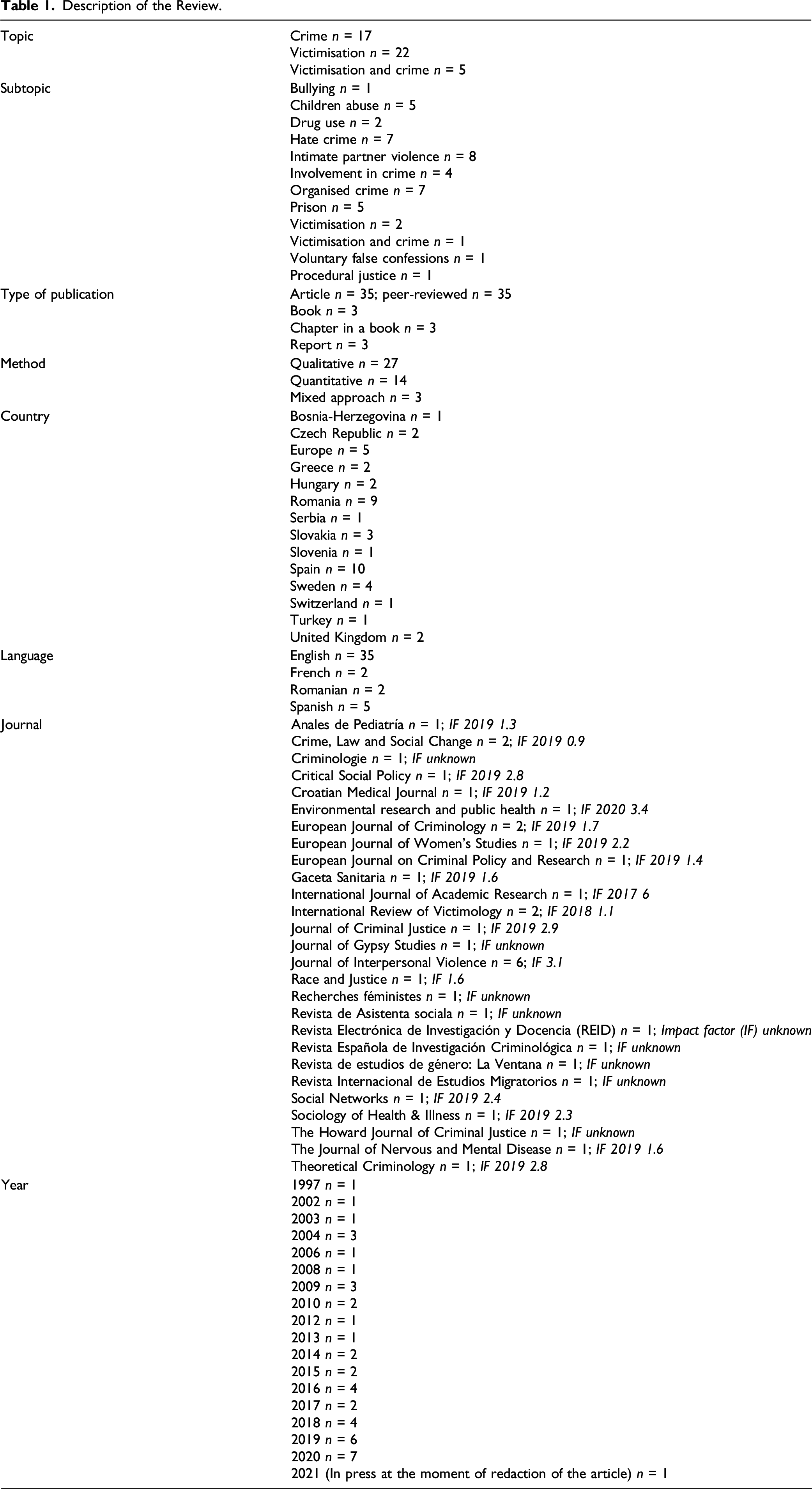
Description of the Review.
Characteristics of the Publications Reviewed
Table 1 illustrates the characteristics of the publications reviewed (1997–2020), which focused firstly on victimisation, secondly on crime and less on both phenomena studied together. The topics addressed most often were intimate partner violence (IPV) among Roma couples, hate crime suffered by the Romanies and organised crime within these groups. The publications were largely peer-reviewed articles that in general followed a qualitative method at the European level. A first clarification that must be made about the scientific study of the Roma is that the greatest methodological challenge for quantitative studies is attributable to the lack of a public register of Roma individuals. In that sense, the Roma people may self-identify (as in the 2011 census of Romania, for instance; see European Union Agency for Fundamental Rights, 2017) or be identified roughly by other organisations (as the Fondation Secretariado Gitano in Spain; see European Union Agency for Fundamental Rights, 2017); however, these figures are thought to be underestimations of the number of Roma in these countries. Moreover, it appears that because of the strong stigma that the Roma suffer (e.g. see Creţan & O’brien, 2019), some avoid mentioning their ethnic background because of fear of prejudice and discrimination.
For transparency reasons, Table 1 also specifies the journals in which the papers were published, as well as their year of publication. As the reader may observe, among the 35 articles published in peer-reviewed journals, 27 were published in rather prestigious journals with an Impact Factor (IF) approximately or greater than 1. Only a few articles were published in journals without an IF. Nonetheless, this does not necessarily mean that these articles are less valuable because most of these journals are in a language other than English and thus may be cited less frequently because an international audience is more likely to reference the English-written articles.
Reporting
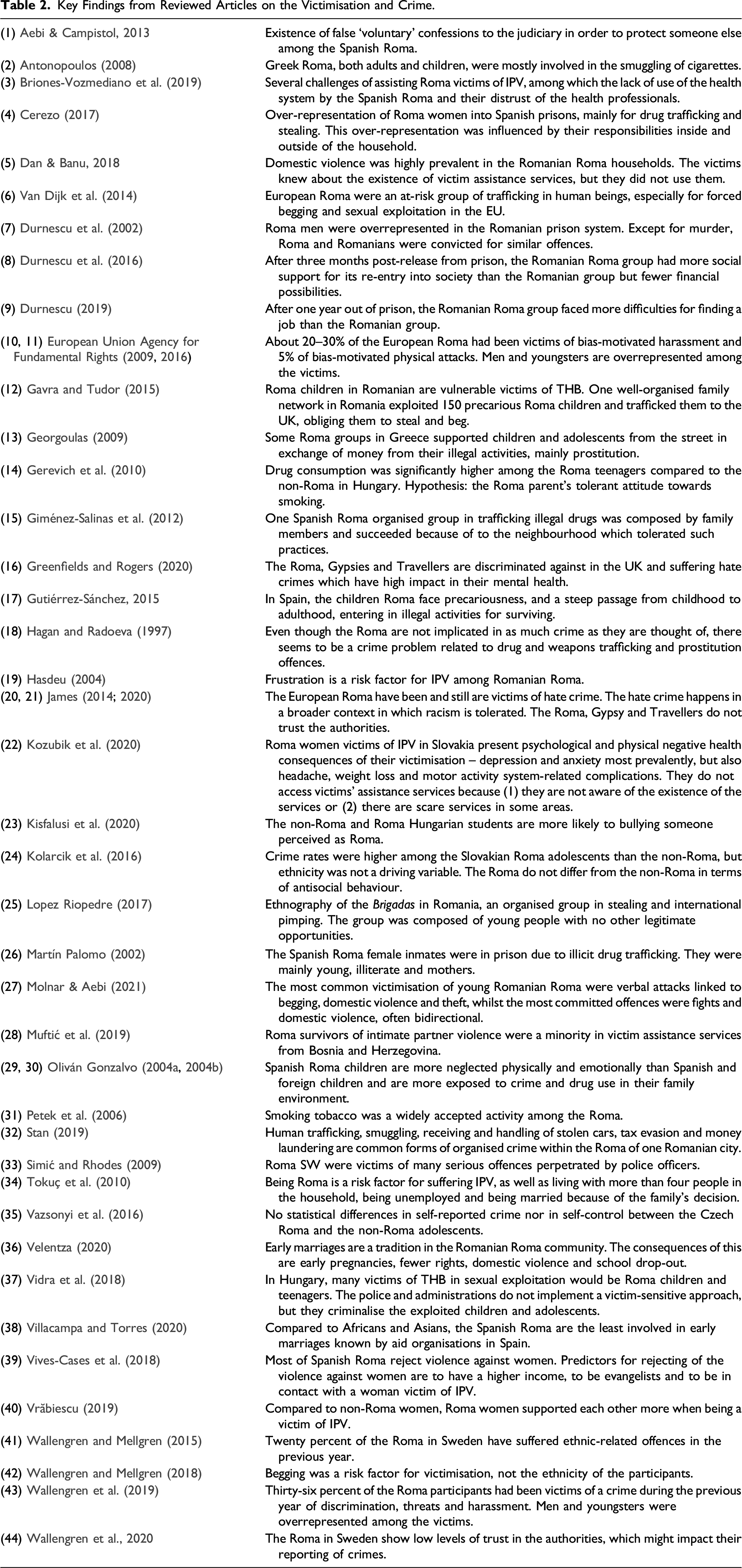
Key Findings from Reviewed Articles on the Victimisation and Crime.
Results
Victimisation of the Roma and their Use of Victims’ Assistance Services
Hate Crimes
Researchers have highlighted the ethnicity-related victimisation that the Roma have suffered, and continue to suffer, in Europe (European Union Agency for Fundamental Rights, 2017, 2016; James, 2014; 2020). This phenomenon has been studied as well with local samples in Sweden (Wallengren & Mellgren, 2015), Switzerland Molnar & Aebi (2021) and the UK (Greenfields & Rogers, 2020).
James (2014) reviewed the bias victimisation that European Roma, Gypsies and Travellers suffered throughout history until the present and described examples of the violence with which the Roma have been confronted in Europe. Further empirical studies have shown that the prevalence of these phenomena continues. In that respect as well, the European Union Agency for Fundamental Rights (2009, 2016) conducted the EU Minorities and Discrimination Survey (EU-MIDIS). Its 2016 version (N = 25,525), conducted in 28 EU member countries found that 30% of the European Roma reported having suffered ethnic-based harassment during the 12 months before the survey, among whom 39% had experienced it six times or more. The harassment was reported to be manifested as offensive gestures, inappropriate staring, insults or threatening comments. Specifically, 29% of Roma women and 31% of Roma men reported those experiences. With respect to more serious forms of violence, such as physical attacks in the previous 12 months, 3% of Roma women and 5% of Roma men reported having endured such acts. Among the respondents aged 16–24 and those 25–44 years, 5% reported having been victims of physical attacks because of their ethnic background, whilst 3% of those aged 45–59 and 2% of those over 60 reported such kinds of events. Therefore, Roma men and adolescents were overrepresented among the victims of ethnic-motivated offences.
A similar prevalence was found in Switzerland, although in this case, lifetime prevalence, in which 9 of 27 Roma (33%) declared that they have been victims of ethnicity-motivated offences, largely insults during childhood about their supposed dirtiness (Molnar & Aebi, 2021). Wallengren and Mellgren (2015) also explored the ethnicity-based victimisation of Eastern-European Roma (N = 121) in Sweden, but found less previous-year-prevalence than in EU-MIDIS. In their study, 20% of the participants suffered ethnic-related offences in the previous year. Further, another study by Wallengren and Mellgren (2018) contributed greater nuances to the hate-crime victimisation of Roma. They used thematic analysis to study the exposure to crime and the consequences of victimisation of 28 beggars (of whom 23 were Romanian Roma). Their results suggested that the main causal factor for the victimisation was the act of begging and not the participants’ ethnicity. In the same country, using survey data (N = 610) and interviews (N = 30), Wallengren et al. (2019) found that 36% of the Roma participants had been victims of a crime during the previous year. The offences most respondents reported were discrimination and threats (30%) and harassment, either verbal (25%) or on the internet (12%). The authors also found that men and youngsters from 16 to 29 years old were overrepresented among the victims. Analysing the data through logistic regression, the authors found that visibility was a significant risk factor in bias victimisation.
However, a much higher prevalence rate of hate crimes against the Roma, Traveller and Gypsy communities was found in the UK. Greenfields and Rogers (2020) pointed out that although they are protected legally against discrimination, 77% had been victims of hate speech or a hate crime. The evidence available suggested that the exposure to these incidents reduced their wellbeing and mental health. It also appears that members of these groups had little knowledge of any victim assistance services, a lack of information exacerbated by their poor access to IT services. In the British context, James (2020), who proposed a critical hate studies perspective, argued that the hate crimes against the Roma occur in a broader context of permission and tolerance of systemic racism, which thereby increases Roma’s institutional distrust and lack of protection when they are victims of a hate crime or of an offence in general.
Simić and Rhodes (2009), who studied the victimisation of 24 sex workers (SW) in Serbia, among whom 15 were Roma, highlighted another possible type of hate crime. They found that the SW were victims of physical assault, threats, arbitrary arrests and sexual abuse on the part of the police. Moreover, after they had been a victim of a crime, when they went to the police station to file a complaint, some participants were told to go home. Nonetheless, it remains unclear whether the police assaulted the participants because they were SW, Roma, both or for another reason.
Domestic Violence
Scholarship has addressed Roma children’s maltreatment (Oliván-Gonzalvo, 2004a, 2004b; Velentza, 2020) as well as IPV (Dan & Banu, 2018; Hasdeu, 2004; Kozubik et al., 2020; Tokuç et al., 2010; Vrăbiescu, 2019). Further, Dan & Banu, 2018 addressed the violence that Roma women experienced from other family members, such as their fathers. In addition, Muftić et al. (2019) and Briones-Vozmediano et al. (2019) studied the use of victim assistance services of Roma women victims of IPV, while Kozubik et al. (2020) addressed the physical and mental health consequences for Roma women victims of IPV. These studies were conducted in Bosnia-Herzegovina, Slovakia, Spain, Romania and Turkey. In summary, Roma children and women were found to be more prevalent victims of domestic violence when compared to general population (Oliván-Gonzalvo, 2004a, 2004b; Velentza, 2020; Villacampa & Torres, 2020; Tokuç et al. 2010). The phenomenon of early marriages was highlighted particularly as a cause of further problems in adulthood, IPV included. Other factors, such as frustration, jealousy and financial problems, were also attributed as causes of IPV (Dan & Banu, 2018; Hasdeu, 2004). Ironically, Roma communities appear to rather oppose violence against women (Dan & Banu, 2018; Vives-Cases et al., 2018), although Kozubik et al. (2020) found that prevailing gender stereotypes were a precondition in all IPV cases studied (N = 20). Further, the Roma women victims of IPV do not use victim assistance services often (Briones-Vozmediano et al., 2019; Muftić et al., 2019), although they suffer from psychological problems, such as anxiety and depression, and other health problems as a consequence of their victimisation (Kozubik et al., 2020).
OlivánGonzalvo (2004a, 2004b) compared Spanish Roma children (n = 83) to foreign children (n = 105) in Spanish protection centres in detail. His results suggested that Spanish Roma children were statistically significantly more neglected physically and emotionally than foreign children. Moreover, compared to foreign children, Spanish Roma infants were at a higher risk of being exposed to crime or drug use and abuse in their family environment. Nonetheless, Gerevich et al. (2010) criticised his methods, although they did not invalidate the findings. Velentza (2020) studied forced early marriages in some traditional Roma communities in Romania. Interviewing Roma, NGOs, scholars and civil society, among others, the author concluded that early marriages are a tradition in the Romanian Roma community and are viewed as a way to protect young girls from foreigners and preserve their purity. Instead, the subsequent consequences of early marriages against the child’s consent were early pregnancies, fewer rights, marginalisation, domestic violence and school drop-out. However, the author did not provide information on the size of the sample studied nor the prevalence of these phenomena. In Spain, Villacampa and Torres (2020) studied early marriages among the Roma by surveying 150 aid organisations. The authors found that these organisations reported that they had supported 57 such individuals, originally from African and Asian countries (93%). The Spanish Roma were also among the victims, but in a lesser proportion (7%) compared to the other groups and they were married in Spain and not abroad, as with victims of other nationalities.
Tokuç et al. (2010) studied the prevalence and risk factors of IPV against married women (N = 288) in Turkey. According to their findings, 34% of the sample reported being victims of physical IPV during the previous year and 93% of psychological IPV during the previous year. The risk factors for physical IPV detected were (1) being Roma, (2) living with more than four people in the household, (3) being unemployed and (4) being forcibly married by one’s family. Although the authors argued that the sample (N = 288) is representative, it is still small, and therefore, these results need to be interpreted with caution. Further, Hasdeu (2004) conducted a 2-year ethnography with Romanian Roma and underscored the role of frustration as a risk factor in IPV but did not specify the extent of the phenomenon. In addition, Dan & Banu, 2018 addressed domestic violence against Romanian Roma women and found a rather high level of such violence in these families. Among the sample, 42% of the women were shouted at and insulted by their husband, father or someone else in their family, 38.5% were beaten by their husband or family, 29% were injured, 22.5% were forbidden to meet with relatives or friends and 21.5% had their money taken from them. Moreover, a number of the participants, although not the majority, normalised some of the violent behaviours: for example, whilst 97.8% thought it was serious to be beaten by one’s partner, 81.7% thought that it was not a grave problem if they were not allowed to go outside the household. The respondents argued that the family’s poor situation, the perpetrator’s low education, angry temperament, consumption of drugs or alcohol and his jealousy, as well as arguments within the family, were the main explanatory factors of IPV. Although the level of knowledge of victim assistance services was satisfactory, these victims did not contact the authorities. Similarly, using data from the Spanish National Health Survey of the Roma Population of 2014 (N = 1167), Vives-Cases et al. (2018) found that 71% of the Roma respondents rejected violence against women. They found that the opposition to violence was higher among high income people, evangelicals and among those who had been in contact with a maltreated woman.
Further, the Roma were found to distrust victim assistance services and accordingly, did not use them. In Bosnia-Herzegovina, Muftić et al. (2019) studied 433 services that provided help to domestic violence survivors. Their findings revealed that, on average, shelters had assisted 64 survivors in the previous year, typically married women with minor children. However, Roma survivors were a minority (11.5%) in shelter services. Briones-Vozmediano et al. (2019) analysed semi-structured interviews (N = 28) to identify the challenges that Spanish health personnel and Roma organisations faced in detecting cases of IPV among the Spanish Roma women. The primary challenge was that both the health personnel and organisations perceived that this phenomenon is a private problem among the Romanies. Second, the Roma did not use the primary health system for prevention to any great extent and distrusted the professionals. In fact, health professionals are obliged by law to report cases of IPV to the police, a factor that decreased victims’ willingness to disclose their victimisation. On the other hand, facilitators in detecting IPV were trust of the personnel and ethnic heterogeneity in the services. Using a mixed-method approach, Wallengren et al., 2020 also found that the Roma’s unwillingness to report victimisation may be related to their low trust in the administration.
The consequences of IPV are highly adverse, both physically and psychologically. In that respect, Kozubik et al. (2020) conducted interviews with 20 Roma women from different backgrounds in Slovakia (45% from the general population, 40% from crisis centres and shelters and 15% from Roma settlements). Among the sample, most respondents (75%) reported psychological problems as consequences of their victimisation and physical issues such as headaches (25%), weight loss (10%) and motor-activity system-related complications (5%). Kozubik et al. (2020) also highlighted that the Roma women were unaware of the assistance programmes available, but also that there was a substantial lack of such services in some regions.
Trafficking in Human Beings
With respect to trafficking in human beings (THB) as a means of exploitation, Van Dijk et al. (2014) collected data from 24 countries of the CoE. The Roma were found to be a group at risk of forced begging and sexual exploitation in several European Union countries, and this phenomenon was increasing in prevalence in countries such as Bulgaria, Hungary and Croatia. In addition, selling their new-borns was a new form of THB among the Roma in Bulgaria. Specifically, Vidra et al. (2018) highlighted this phenomenon in Hungary, particularly among children exploited in prostitution. Studying policy analysis, institutional interviews and through community fieldwork, they found that most of the THB victims were Roma. These scholars criticised the state for not intervening and for lacking a victim-sensitive approach. For example, they found that rather than protecting the children in prostitution, the police criminalised them by applying sanctions for petty crime. Gavra and Tudor (2015) analysed judicial resolutions over seven years in Romania and addressed the exploitation of 150 Romanian Roma children whom one criminal network in a Romanian city sent to the UK to beg and steal. The authors identified the high levels of poverty, lack of long-term jobs, school drop-out, lack of access to education or health services and poor housing or homelessness as the primary risk factors for THB. They found that the wealthiest members of their community recruited Roma children from poor families and promised money to the children’s families that never was paid. Thus, the network was composed of people of Roma ethnicity who had family ties with clear tasks of recruitment, transportation and transfer, as well as with housing, exploitation, collection and transfer of the money to the group’s internal branch.
Delinquency and Offending Among (Some) Roma People
Youth Delinquency
This subject has received special attention by scholars, and researchers have focused on drug consumption and petty crime, as well as the young Roma’s self-control. The studies took place in the Czech Republic, Hungary, Slovakia, Slovenia, Spain and Switzerland. Several researchers have compared the Roma’s crime rates, self-control or drug use to samples of non-Roma, and carried out statistical analyses to compare the groups. Grosso modo, it was found that neither delinquency nor self-control differed from the non-Roma groups (Kolarcik et al., 2016; Vazsonyi et al., 2016), although their drug use was higher (Gerevich et al., 2010). Other scholars have added qualitative nuances to the quantitative findings by studying the reasons for delinquency that we address below (Gutiérrez-Sánchez, 2015; Molnar & Aebi, 2021; Petek et al., 2006).
In Slovakia, Kolarcik et al. (2016) studied the rates of aggression and crime among Roma adolescents in segregated Slovakian settlements (N = 330) and compared them to those of non-Roma adolescents elsewhere (N = 722). While crime rates were higher among the Roma sample, the authors identified social desirability as the determining variable, not ethnicity. Using linear regression, they found that social desirability diminished the ethnic differences in crime, increased the differences in hostility and nullified the differences in physical aggression. According to their findings, the parents’ educational level did not influence the associations among the variables substantially. The authors concluded that the Roma do not differ from their non-Roma peers in terms of antisocial behaviour. In a similar vein, Vazsonyi et al. (2016) tested Gottfredson and Hirschi’s (1990) Self-Control Theory among Roma youth in the Czech Republic. These authors found no statistically significant differences in either self-reported crime or in self-control between the Roma (n = 239) and the Czech youth (n = 130). They found that the socioeconomic level was statistically significantly lower among the Roma, whilst their parents’ monitoring was higher than among Czech youth. In Switzerland, Molnar & Aebi (2021) found that the offences that most young Romanian Roma respondents reported were fights (70%) and IPV (24%). According to the participants, the reasons for IPV were jealousy, external anger and refusal to accept a girlfriend breaking up with them. Using a qualitative approach, Gutiérrez-Sánchez, 2015 conducted a 3-year study in a Roma settlement in Madrid (Spain) and found that the Roma children were in highly deprived situations because they were required to grow up too fast. Consequently, they ended by dropping out of school, remained illiterate and stole to survive. Moreover, 13-year-old girls were expected to marry, which accentuated even more their early passage from childhood to adulthood. Further, the author highlighted that despite social organisations’ interventions since 2001, neither the quality of life nor the criminogenic factors have been alleviated effectively.
In Hungary, Gerevich et al. (2010) compared self-reported rates of smoking, alcohol intoxication and drug use among Roma (n = 225) and non-Roma adolescents (n = 182). They found that drug consumption was significantly higher among both Roma boys and girls and hypothesised that this was the result of Roma’s parents’ tolerant attitude towards drug use, particularly tobacco. This finding is consistent with that of Petek et al. (2006) based upon focus groups in Slovenia (N = 12), in which it was found that smoking tobacco was an activity accepted widely among Roma individuals and seen as a part of their cultural identity. The Roma were often unwilling to acknowledge the harmful effects of tobacco consumption on health and blamed illnesses such as lung cancer on fate.
Organised Crime
Organised crime among Romani individuals has also received some scholarly attention in Greece, the former Czechoslovakia, Romania and Spain. Nevertheless, the results of this research are more fragmented, likely because of the covert nature of organised criminal networks and the methodological challenges of carrying out research in this field. The principal findings are that drug trafficking is prevalent in some Roma groups or families and has the strong support of their community (Giménez-Salinas et al., 2012; Hagan & Radoeva, 1997; Stan, 2019). Although explored less, other topics include the THB networks (addressed above, see Gavra & Tudor, 2015) and Roma adults’ sexual exploitation or pimping of teenagers (Georgoulas, 2009; Lopez Riopedre, 2017).
Twenty years ago, Hagan and Radoeva (1997) argued that despite Czechoslovakian’s television estimates of the Roma’s disproportionate criminality, the Roma were not implicated in more than 7–11% of the crime in the country during the 1990s. Nonetheless, the authors also highlighted that there appeared to be a crime problem in relation to the economic and social challenges that the Roma faced, such as drugs and weapons trafficking, as well as prostitution offences. However, the authors did not provide further evidence. With respect to drug trafficking, Giménez-Salinas et al. (2012) studied Spanish police files for four investigations on criminal organisations. Using social network analysis, they found that a Spanish Roma family that was trafficking illegal drugs ruled one of these groups. The authors highlighted that this organisation succeeded in part because the community, which was composed of Roma individuals as well, tolerated drug trafficking. Through observations and interviews in Romania, Stan (2019) stressed that within the Romanian Roma community, THB, smuggling, receiving and handling stolen cars, tax evasion and money laundering were common forms of organised crime. However, the publication did not specify the number of participants interviewed or the prevalence or incidence of the phenomena described.
In Greece, Antonopoulos (2008) used official police and justice reports, as well as mass media from 1998 to 2006 to analyse cigarette smuggling. According to the author, those involved in selling smuggled cigarettes on the street were largely Greek Roma, both adults and children. In the same country, Georgoulas (2009) discussed the situation of the so-called street-light boys of 5–15 years who were exploited by others. These boys sold small items or even drugs, begged in the street or prostituted themselves. The author argued that sometimes these children and adolescents grew up close to the Roma, who would protect them in exchange for money – a highly lucrative business when the teenager was implicated in prostitution. However, the extent of the phenomenon remains unknown because both papers lack quantitative data analysis. In Spain and Romania, Lopez Riopedre (2017) conducted a socio-ethnography of the so-called Brigadas, an organised group of Roma youngsters who commit both property crime and international pimping. These groups consisted of young people from deprived neighbourhoods who would not have better legitimate opportunities in their lives. Interestingly, the researcher highlighted these groups’ lack of use of violence except for intimidating the victims of their robberies. He pointed out also the moral ambiguity of the pimp – whether a man or woman – who would have an emotional bond with the prostitute and would count with her ‘consent’ for pimping.
Roma’s Implication in the Criminal Justice System
This subject has been studied as well in Romania and Spain, from their prosecution to conviction and release from prison. In general, scholars agree that both Roma men and women are overrepresented among prison inmates (Cerezo, 2017; Durnescu et al., 2002). Durnescu et al. (2002) estimated the number of Roma men in the Romanian prison system and identified their socio-cultural characteristics and criminality-related variables with the intention to develop a better crime-preventive probation system in the country. The researchers selected 409 individuals randomly, 80 of whom were Roma. Their findings highlighted that the Roma are overrepresented in the Romanian prison system, as 17% of the adult inmate population were Roma and 40% were minors versus the 10% of Roma in Romanian society. The Roma group lived much more precarious lives than did the Romanians, in which 23% of them had what the authors referred to as a gypsy job, such as breeding horses, the tinker trade, processing precious metals, fiddlers, etc., which frequently provided only a low income. They also found that a higher percentage of Roma had larger families than the Romanians and that the parents of the Roma inmates were poorer and less educated than those of the Romanians. With respect to criminality, 60% of the Roma were serving sentences for a second conviction, in contrast to 60% of the Romanians who were in prison for the first time. Further, the Roma received longer prison sentences for such offences as theft, robbery, fraud, rape, murder and beatings that caused death. According to the authors, this distribution of offences did not differ greatly from that of the Romanians, except for murder, which constituted 15% of the Romanians’ convictions, whilst 20% of the Roma’s convictions were attributable to murder.
Cerezo (2017) highlighted the high percentage of Roma women in Spanish prisons – 25% of the inmate population in 2001 – whilst the Roma represented only 1.4% of the Spanish population. The author argued that these Roma women have many family responsibilities from an early age, both with respect to marriage and motherhood, but also with contributing income to the household via the drug trade for economic survival. Further, they also committed property crimes in which they took advantage of their victims’ inattention to steal from them. In the same country, Martín Palomo (2002) analysed the status of Spanish Roma women in 12 prisons (the sample size was not specified), and found that Roma inmates were primarily young, 60% were illiterate, 87% had children and 45% were, or had been, drug users. Much of the sample was in prison because of illicit drug trafficking. Aebi & Campistol, 2013 contributed to this topic with nuances regarding the phenomenon of false voluntary confessions to the judiciary. Employing a press analysis, the scholars hypothesised that these false confessions could explain part of the over-representation of Roma women in Spanish prisons. The authors argued that some of the Spanish Roma may self-incriminate to protect someone in their family. However, Aebi & Campistol, 2013 stressed the need for further study of this phenomenon and its circumstances.
Durnescu et al. (2016) studied the manner in which Romanian and Roma former inmates experienced their free life three months after their prison release. They found that the Roma’s families were more invested and supportive in their re-entry, whilst Romanians lacked social support and envisaged their re-entry as a lonely path. Despite their high social support, Roma’s economic resources were found to be less than those of the Romanians. In addition, Durnescu (2019) analysed the role of employment in the desistance process of 58 ex-inmates, 28 of whom were Roma. He followed up on the participants for one year after their release from prison and found that there were essential differences between the Roma and non-Roma former inmates. The Roma’s livelihood was more precarious compared to the other groups and they had fewer resources to obtain legitimate employment.
The Integrative Study of Victimisation and Delinquency
Although many authors have focused on victimisation or offending alone, two authors studied both phenomena together. This is justified because victimisation and offending have been found to be related (see the review of Jennings et al., 2012). Kisfalusi et al. (2020) studied the associations between self-reported and victim-reported bullying among non-Roma and Roma (N = 347) in Hungary, with a special focus on two dimensions of ethnicity: self-identification and ethnic perceptions. According to their results, both non-Roma and Roma students were more likely to report bullying against Roma-perceived peers. Moreover, students from both groups were more likely to report that they were perpetrators rather than victims of bullying. However, these authors did not find a similar association when they analysed victimisation related to being Roma. Therefore, they suggested that the victims report less bullying based upon ethnicity because they are unaware of the bully’s motivations. Further, Molnar & Aebi (2021) studied the victimisation and delinquency of young Romanian Roma through a mixed approach study which combined 130 hours of participant observation and 27 face-to-face questionnaires with Romanian Roma. Their findings showed that the most common forms of victimisation were verbal attacks associated with begging (as in Wallengren & Mellgren, 2018), domestic violence and theft, whilst the offences committed most often were fights and domestic violence, often bidirectional. Delinquency and victimisation appeared to be associated, in that those who committed more offences were those who also suffered more crimes as a victim, even if the range of victimisations suffered was more diverse than that of the offences committed.
Key Findings
Table 2 summarises the key findings of the 44 publications in alphabetical order.
Discussion
This paper reports findings about the victimisation and offending of Roma individuals and groups in Europe from 1997 until 2020. Seven findings emerged from the 44 papers included. First, Roma people are victims of hate crimes related to their ethnicity, but also to other factors such as visibility, for example. Second, Roma children and women are more prevalent victims of domestic violence, although most of the Roma people reject violence against women in the Roma communities. However, Roma victims of IPV did not use victim assistance services because of lack of trust in the authorities. Third, in some Romani communities in Romania, the phenomenon of early forced marriages still exists and has many negative consequences in adulthood. Fourth, in relation to offending, it was found that the Roma’s youth delinquency does not differ statistically from that of the non-Roma, although Roma adolescents face significantly more deprivation. Fifth, organised crime among the Roma has the particularity of being supported and hidden by their community. Sixth, the Roma are overrepresented in the prison population and face many structural and individual difficulties in re-entering society once released from detention. Last, studies of both victimisation and crime are scarce, but could be useful to capture the interaction between offending and victimisation in cases such as bullying, but also IPV or even THB.
Strengths and Limitations
Vis-à-vis the strengths of our review, it is worth mentioning that it is diverse with respect to the four languages included, countries studied, methodologies applied and the approaches used (see Table 1). For example, several scholars have studied the Roma via interviews, observations or questionnaires, whilst others have relied on the knowledge available in secondary sources, such as police records or academic literature. This renders the review rich by adding many nuances and provides the English readership with a broad picture of the European Roma’s victimisation and offending. In addition, many of the articles included have been published in highly reputable journals. Further, in our view, the combination of peer-reviewed articles with grey literature (reports, theses, etc.) was appropriate, as much information would have been lost about such an understudied topic.
However, although it was intended to apply a rather high level of systematicity, following Ferrari’s (2015) recommendations, our review remains at the level of a narrative review because of the understudied nature of our subject, and because some publications were not indexed in Google Scholar or Web of Science, and we needed to consult Google, we were obliged to follow an iterative method. Therefore, because of the inability to apply a much more systematic and rigorous method, it is plausible that, despite our efforts, we may have fallen into selection bias. Further, the main challenge with respect to the methodologies applied in the studies reviewed is their lack of representativeness, except for the EU-MIDIS study, which was designed to construct a representative sample of the Roma in Europe. Nonetheless, even the EU-MIDIS faced many challenges in doing so (see European Union Agency for Fundamental Rights, 2017). As explained in previous sections, the greatest methodological challenge is the lack of a public register of Roma citizens. In that sense, they may self-identify or others may identify them generally as Roma, but these numbers are underestimations. An additional difficulty is that in several cases, the authors did not specify the extent of the phenomenon observed, and therefore, the readership cannot determine whether it was a general rule or an exception among the groups studied.
Implications for Research and Practice and Recommendations
Implications for Research and Practice.
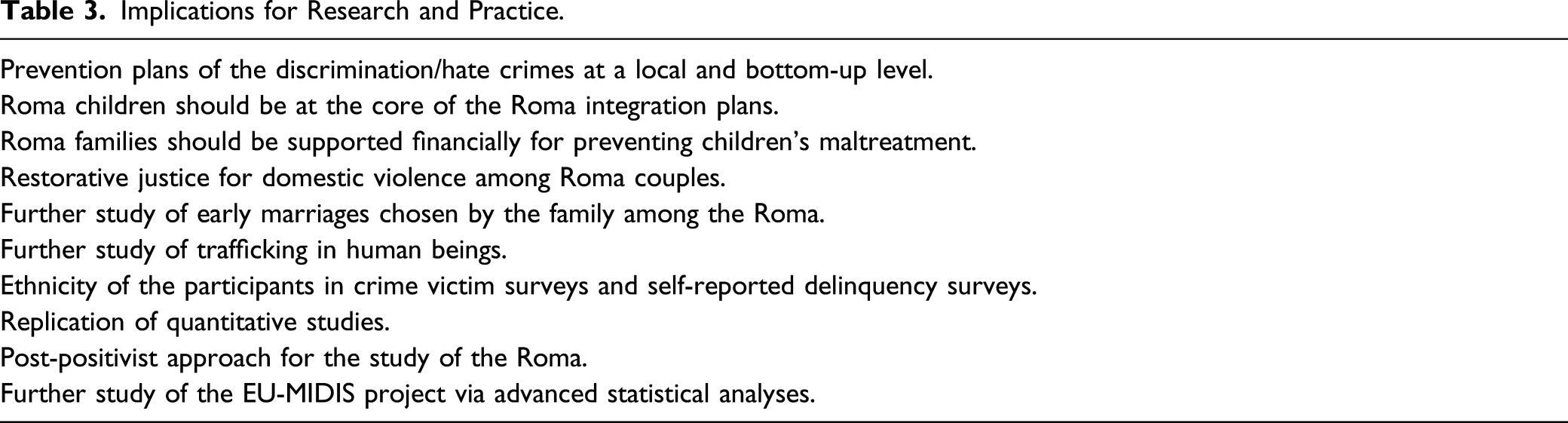
With respect to the Roma’s victimisation, scholars have highlighted the ethnicity-based victimisation that the Roma suffer in different contexts. However, Wallengren and Mellgren (2018) drew some nuances regarding the hate crimes the Roma have endured, in that the predictor of victimisation was not the ethnicity, but the visibility of the group studied. This finding is interesting, but deserves further research and replication in other contexts.
A particularly challenging domain is the violence against children, including offences such as THB. First, we believe that children should be at the core of any Roma inclusion programme and their economic deprivation and attendance in school should be addressed, not only for criminological reasons but to adhere to the Convention on the Rights of the Child (‘United Nations Treaty Collection’, 1990). In that sense, Roma families should be supported so that they have sufficient financial capital not to be obliged to put their offspring to work or send them abroad. The early marriages among the Roma community, although a topic discussed socially, remain largely unknown by researchers and therefore, they should be studied further, as well as the specificities of the THB among the Roma communities.
A paradoxical result is the rather high prevalence of IPV among the Roma groups, despite their generally low acceptance of violence towards women. This divergence should be addressed further because there may be other influencing factors in the IPV among Roma couples. Moreover, the lack of trust in victim assistance services and the police is something that needs to be analysed to identify other resources that Roma women victims of IPV could use (see Gaarder, 2015). Given the strong social attachment within Roma groups, restorative justice may be useful in these contexts. Further, the study of both the Roma’s crime and victimisation would offer an integrative vision of the challenges this specific community faces. In the Romani context, both Kisfalusi et al. (2020) and (Molnar & Aebi, 2021) have highlighted that there was a bidirectionality in the participants’ victimisation and delinquency or crime.
Although qualitative research is essential to obtain an understanding of the contexts, vulnerabilities and needs of the people in a specific context, quantitative research is still needed to generalise the data to broader contexts, as well as to replicate the former studies, for example, those of Kisfalusi et al. (2020), Kolarcik et al. (2016), Oliván Gonzalvo (2004a, 2004b), Tokuç et al. (2010) and Vazsonyi et al. (2016). We believe that for both the study of offending and victimisation among the Roma, and most importantly, its comparison with the general population, a pragmatic solution would be to include a question about the participants’ ethnicity in the crime victims’ surveys as well as in the self-reported delinquency studies. Clearly, the number of Roma participants would still be underestimated, but the data the Romani participants provided would be a valuable source of knowledge in the design of policies and would stimulate further research. Analysing the crime and victimisation of a group and comparing it with the general population, which is necessary in collecting and interpreting the data, may be useful in two respects. First, it could provide evidence for ways to reduce the stereotyping related to crime that the Roma have suffered through their history. Second, if evidence is found that indicates special needs for criminological intervention, this would allow evidence-based strategies to be implemented that could improve the communities’ wellbeing and the social inclusion of their most vulnerable members.
Obviously, these studies would need to be complemented with other research that approaches the difficult-to-reach populations among the Roma, for example, those who do not attend school or do not have a fixed address. Methodologies such as the random route EU-MIDIS used seem promising. In addition, a mixed-method approach (Maruna, 2010) would allow quantitative data to be collected to observe the group while the figures could be contextualised via participant observations and/or interviews. It is undeniable that the criminological study of sensitive populations like the Roma and topics as crime and victimisation raise methodological and ethical challenges (see Molnar & Aebi, 2021; Wallengren & Mellgren, 2015), but perhaps a post-positivist methodology (Phillips & Burbules, 2000) would allow the observation of the reality and at the same time, help the research develop reflexivity. Post-positivism, also referred to as post-empiricism, is a philosophical and theoretical position and framework that is intended to amend the critiques of positivism and states that researchers’ theories, hypotheses, backgrounds and values can influence the research. Therefore, to minimise biases, post-positivism proposes to detect the possible sources of bias and control them to the extent possible. In that respect, as researchers, it is imperative to be critical of ourselves and develop an introspective reflection of our own beliefs, attitudes and emotions (Emerson et al., 2011). The highest ethical standards must be respected as well to avoid the over-stigmatisation of the Roma community and its over-victimisation when recalling traumatic events. Further, precautions must be taken when interpreting the data. Researchers must be aware of their methodology’s limitations in collecting and analysing the data, and their research’s external validity (generalisation, see Aebi, 2006).
Last, further advanced statistical analysis of the databases the European Union Agency for Fundamental Rights (2009, 2017) provided b in the EU-MIDIS I and II projects is needed. These databases have great potential, possess a large number of observations and variables, and could be of interest in the study of factors in Roma’s risk and victimisation.
Footnotes
Acknowledgements
I thank Dr. Conte and the three anonymous reviewers for their suggestions, which significantly improved the quality of the manuscript. As well, many thanks to Marcelo F. Aebi, Ionuț Costică, Korbinian Baumgärtl and Cristina del-Real for their helpful comments and advice.
Declaration of Conflicting Interests
The author(s) declared no potential conflicts of interest with respect to the research, authorship and/or publication of this article.
Funding
The author(s) received no financial support for the research, authorship and/or publication of this article.
