



Abstract
On any given day, almost 11 million people globally are deprived of their liberty. In 2020, the global female population was estimated to be 741,000, an increase of 105,000 since 2010. In order to investigate progress in the adoption of the Bangkok Rules since 2010, we conducted a legal realist assessment based on a global scoping exercise of empirical research and United Nations (UN) reporting, using detailed MESH terms across university and UN databases. We found evidences in 91 documents which directly relate to violations of the Bangkok Rules in 55 countries. By developing a realist account, we document the precarious situation of incarcerated women and continued evidence of systemic failures to protect them from custodial violence and other gender-sensitive human rights breaches worldwide. Despite prison violence constituting a complex and multifaceted phenomenon, very little research (from the United States, Canada, Brazil, Mexico, and Australia) has been conducted on custodial violence against women since 2010. Although standards of detention itself is a focus of UN universal periodic review, special procedures (violence against women) and concluding observations by the UN committees, very few explicitly mentioned women, and the implications of violence against them while incarcerated. We highlight three central aspects that hinder the full implementation of the Bangkok Rules; the past decade of a continued invisible nature of women as prisoners in the system; the continued legitimization, normalization, and trivialization of violence under the pretext of security within their daily lives; and the unawareness and disregard of international (Bangkok and others) rules.
Background
On any given day, almost 11 million people globally are detained in prisons or other closed settings (Penal Reform International, 2020a). In 2020, the global female population was estimated to be 741,000 and increasing (Penal Reform International, 2020a) with a growth of 105,000 observed in the past decade, particularly evident in Asia (an increase of 50%), Central and South America (an increase of 19%), and Africa (an increase of 24%) (Lenihan, 2020; Penal Reform International, 2020a). Women in custodial settings are a minority and generally imprisoned for less severe, nonviolent crimes, often heavily underpinned by poverty (“crimes of survival”; Penal Reform International, 2020a, 2021a). Their profiles, histories, and pathways into crime and the criminal justice system are distinct from that of men. Many are from racial or ethnic minority backgrounds; they are disproportionately affected by lower socioeconomic status, trauma, histories of interpersonal violence (child, sexual, intimate partner, physical, and emotional), mental illness; and suffer continued exposure to custodial violence from staff or fellow prisoners (Ervin et al., 2020; Jones, 2020; Karlsson & Zielinski, 2020; Lenihan, 2020; Lynch et al., 2012; Penal Reform International, 2017a, 2020a, 2021a; Tripodi & Pettus-Davis, 2013; United Nations [UN] Office on Drugs and Crime, 2008; Wolff et al., 2007). Identified vulnerable groups include those affected by trauma, trafficking and sexual abuse victims, women who use drugs, sexual minorities, young girls, and those with complex comorbid psychiatric and learning disabilities (Bronson et al., 2017; Meyer et al., 2017; Penal Reform International, 2020a; Tripodi & Pettus-Davis, 2013; UN Office of Drug and Crime, 2008). Within the male dominated criminal justice system, women’s gendered and unique health needs are often neglected and ill-resourced, particularly regarding their sexual and reproductive health, mental health, and the treatment of drug dependence (Gadama et al., 2020; Nakitanda et al., 2020; Penal Reform International, 2020a; UN Office on Drugs and Crime, 2008).
The UN Rules for the Treatment of Women Prisoners and Non-Custodial Measures for Women Offenders (Bangkok Rules; UN Secretariat, 2010) were adopted by the UN General Assembly on 21 December, 2010. They were developed to support and complement, as appropriate, the 1955 Standard Minimum Rules for the Treatment of Prisoners (UN, 1955), the 1991 UN Basic Principles for the Treatment of Prisoners (UN General Assembly, 1991a), the 1991 UN Standard Minimum Rules for Non-Custodial Measures (Tokyo Rules; UN General Assembly, 1991b), and the updated 2016 UN Standard Minimum Rules for the Treatment of Prisoners (Nelson Mandela Rules; UN General Assembly, 2016). While the Mandela Rules do not specifically refer to women (with Rule 7 referring to self-perceived gender identity), the Bangkok Rules as soft law principles lay the foundation for intensified efforts to support women deprived of their liberty (Barbaret et al., 2017; Huber, 2016; Penal Reform International, 2020b). Although essentially underpinned by inherent tensions in human rights for women, “protection versus protectionism” (Berzano, n.d.), they are insufficiently broad regarding gender diversity by adopting a cis-normative stance and excluding transwomen who are at high risk of exposure to sexual violence when detained with males and potential perpetrators of violence against women when placed alongside females (UN Human Rights Office of the High Commissioner, 2016; Van Hout & Crowley, 2021).
Since adoption of the Bangkok Rules in 2010, the criminal justice system and its institutions remain largely designed for the dominant male population, and the Bangkok Rules are largely implemented in a piecemeal manner, despite observed global increase of women in prison (Lenihan, 2020; Penal Reform International, 2020a). The UN Committee on the Elimination of Discrimination Against Women (CEDAW) has established that discrimination against women encompasses ill treatment that affects women disproportionately, including detention conditions that do not respond to the specific needs of women (referring to the Bangkok Rules). The 2015 UN Subcommittee on Prevention of Torture and other Cruel, Inhuman or Degrading Treatment or Punishment (2015) has described concern regarding the situation of women in detention: the use of sexual violence as torture, including against transgender persons; lack of adequate attention to their right to health care, including sexual and reproductive health rights; the precarious situation of pregnant women and their children living with them; noncompliance with the rule of separation of women and men; shortage of women custody staff; the practice of invasive searches, including in intimate parts of the body, and the use of public nudity; discrimination in access to work, education, and recreational activities; limitations on contact with relatives, including visits by intimates and contact with their children, as a form of punishment.
The prison system and its authorities have a general obligation to protect prisoners against any type of violence, including excessive use of force (Penal Reform International, 2020c). GBVAW is defined by the UN Declaration on the Elimination of Violence Against Women as: violence that is directed against a woman because she is a woman or that affects women disproportionately. It includes acts that inflict physical, mental, or sexual harm or suffering, threats of such acts, coercion, and other deprivations of liberty. (Office of the UN High Commissioner for Human Rights [OHCHR], n.d.)
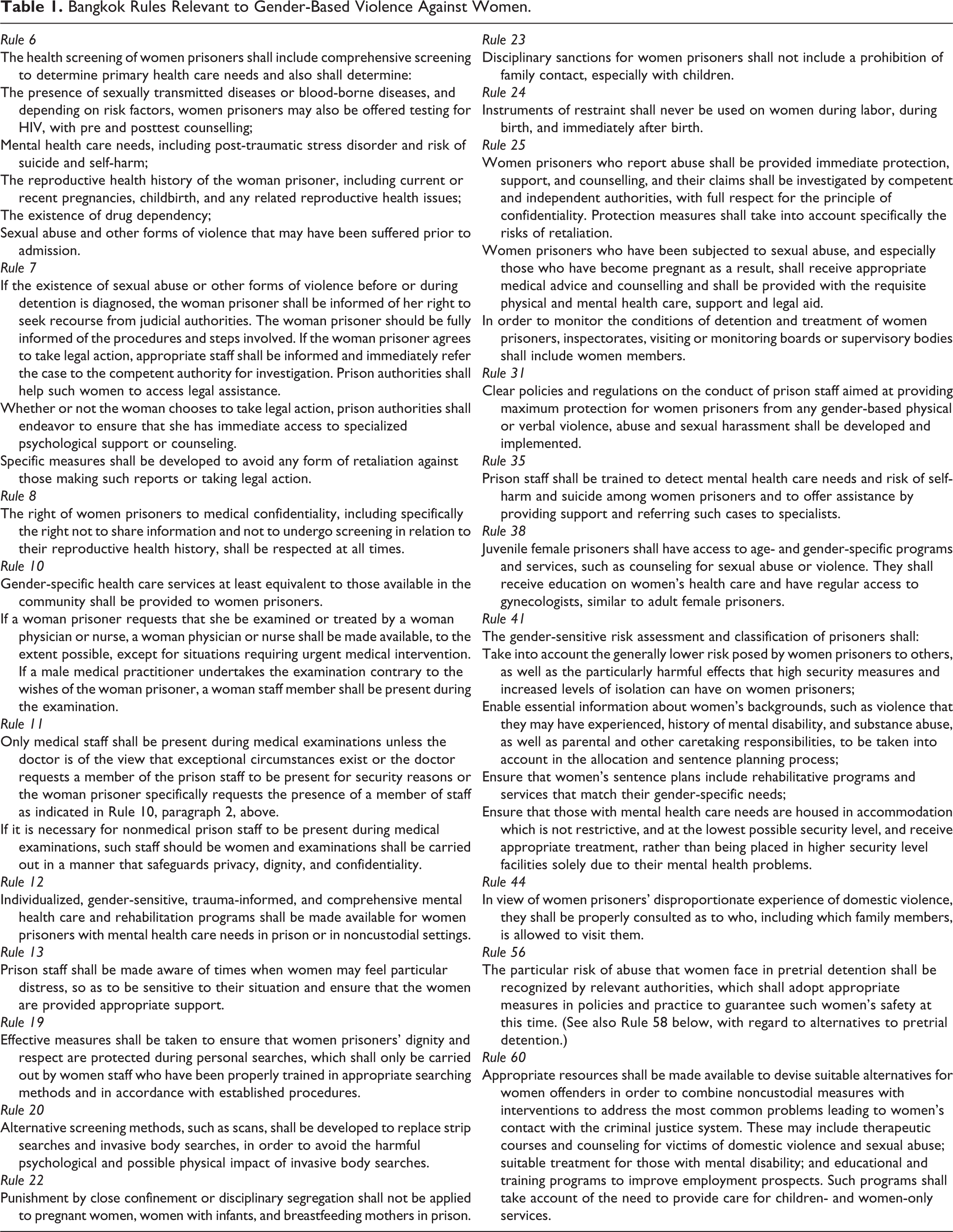
The identified threat of ongoing exposure to physical and sexual violence of women by fellow inmates and/or prison staff in custodial settings has continued since 2010 (Penal Reform International, 2021b). Hence, in order to investigate global progress in the adoption of the Bangkok Rules since 2010, with view on documenting and assessing the situation of women in prison, the elimination of custodial violence itself and responses to support those women affected, we conducted a legal realist assessment (Leiter, 2015) based on a global scoping review of extant published literature (empirical, humanitarian, and UN Committee reporting). First, we identified all rules of the Bangkok Rules which are directly related to violence. See Table 1.
Bangkok Rules Relevant to Gender-Based Violence Against Women.
We subsequently searched for literature using university databases and scrutinized the OHCHR system for all published domestic reporting to the UN and the UN Committee Against Torture (CAT) and CEDAW observations at the global level since 2010. 101 UN CAT reports and 158 CEDAW reports were scrutinized, with human rights violations pertinent to the identified Bangkok Rules found in 15 UN CAT, 32 UN CEDAW, and 21 other domestic and UN Human Rights Council reports. Third, the academic literature was examined, and we found 23 relevant records where breaches of the Bangkok Rules were evident. In total, 91 documents related directly to violations of the Bangkok Rules in 55 countries. Despite prison violence constituting a complex and multifaceted phenomenon, very little academic research (mostly from the United States, Canada, Brazil, Mexico, and Australia) has been conducted on GBVAW in custodial settings since 2010, with the bulk of the evidence centering on Special Rapporteur and UN (CAT; Human Rights Council, and CEDAW) country-level reporting. Although standards of detention itself is a focus of UN periodic reports, very few explicitly mentioned women, and the implications of violence against them while incarcerated. See Table 2.
Critical Findings.
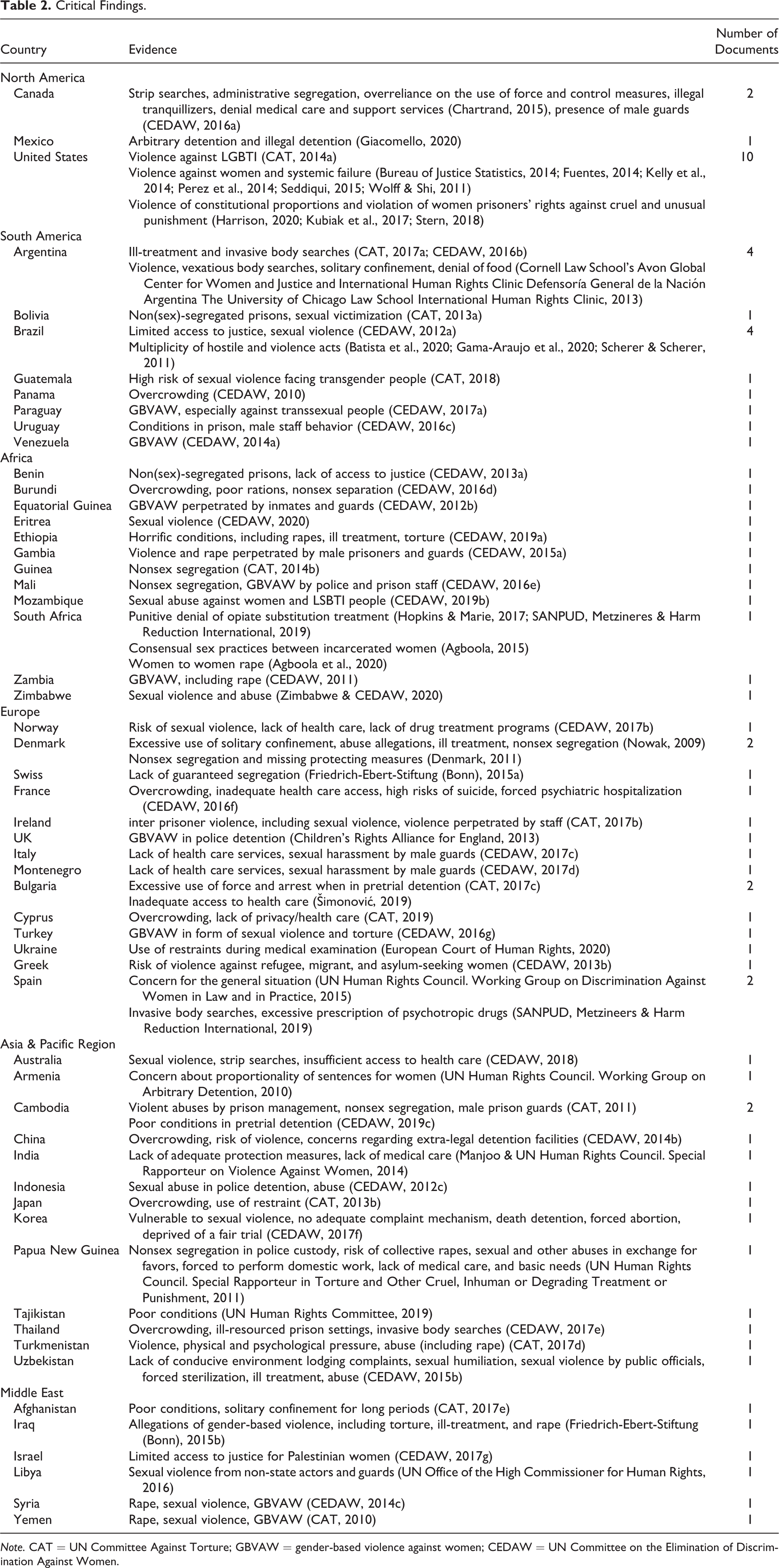
Note. CAT = UN Committee Against Torture; GBVAW = gender-based violence against women; CEDAW = UN Committee on the Elimination of Discrimination Against Women.
Adopting the Bangkok Rules and Progress in Tackling GBVAW in Prisons
Empirical studies from the United Kingdom (UK) and the United States reveal that the female prison environment continues to be as emotionally suppressive, conflict-laden, and violent as in male settings, particularly relating to fighting and physical assaults, with inmate-on-inmate violence comparable across male and female facilities, including sexual assaults, transactional sex in return for protection, privilege or basic necessities, and intimate partner violence between prisoners (Ervin et al., 2020; Kottler et al., 2018; Laws, 2019; Thomson et al., 2019). At the global level, women from sexual minorities (included transwomen) continue to be particularly at risk of sexual abuse including rape (Amnesty International USA, 2011; Human Rights Watch, 2018; Van Hout & Crowley, 2021).
In North America, in 2014, the UN CAT reports on violence against LGBTI people which included transwomen in US prisons (CAT, 2014a). Despite the 2003 Prison Rape Elimination Act and the National Standards to Prevent, Detect and Respond to Prison Rape which came into effect in the United States in 2012, academic literature since 2010 highlights systemic failures to protect women and provides continued evidence for official and inmate-perpetrated violence against women (often abusive sexual context but including rape) in prisons (Bureau of Justice Statistics, 2014; Fuentes, 2014; Kelly et al., 2014; Perez et al., 2014; Seddiqui, 2015; Wolff & Shi, 2011). Three US sources report on violence of constitutional proportions and violation of women prisoners’ (including transwomen) rights against cruel and unusual punishment, including a deluge of rape cases, the majority perpetrated by male guards since 2010 (Harrison, 2020; Kubiak et al., 2017; Stern, 2018). In other closed settings in the United States, recent media outputs report on mass hysterectomies carried out on migrants in immigration detention centers and with those women pleading for help on social media being detained in solitary confinement for several days (Andrews & Hackman, 2020; Bryant, 2020; Ghandakly & Fabi, 2021; Lenzer, 2020). Penal Reform International reports on arbitrary detention and illegal detention methods in 2020, including compulsory drug treatment centers where women are detained in Mexico (Giacomello, 2020). Elsewhere, in Canada, one article reports that violent aspects of prison life continue to affect women, in the form of strip searches, administrative segregation, often for long periods, overreliance on the use of force and control measures, restraints with devices such as with “the wrap” or duct tape, and forcible and illegal injection with tranquilizers, denial of medical care and support services (Chartrand, 2015). The 2016 CEDAW report on Canada criticizes the presence of male guards in female prisons in Canada (CEDAW, 2016a).
In Central and South America, the CEDAW report of Brazil in 2012 reports limited access to justice and sexual violence against women in detention (CEDAW, 2012a). Three empirical studies in Brazil observe the presence of continued power dynamics in female prisons, viewed as sites of exclusion characterized by a multiplicity of hostile and violence acts (Batista et al., 2020; Gama-Araujo et al., 2020; Scherer & Scherer, 2011). The UN CAT reports on femicide and GBVAW in detention in Argentina in 2017 (CAT, 2017a), and the CEDAW reports on ill treatments and invasive body searches of women in detention in 2016 (CEDAW, 2016b). There are reports by the Inter-American Commission on Human Rights and the UN Human Rights Committee of prison policies in Argentina which group the “worst” behaved women together in prisons, with reports of violence, vexatious body searches, solitary confinement, and denial of food (Cornell Law School, Defensoría General de la Nación University of Chicago Law School, 2013; UN Human Rights Committee, 2016). The UN CAT 2013 refers to non(sex)-segregated prisons and the sexual victimization of women in Bolivian detention settings (CAT, 2013a), and the high risk of sexual violence facing trans-people in male prisons in Guatemala in 2018 (CAT, 2018). In Panama, the CEDAW (2010) reports on overcrowding and violence in female prisons. The 2017 report on Paraguay documents GBVAW and especially the sexual abuse of transsexual people in detention settings (CEDAW, 2017a). The CEDAW is concerned about the conditions experienced by women in prison, particularly regarding behavior of male staff in Uruguay in 2016 (CEDAW, 2016c). In Venezuela, the 2014 CEDAW reports on GBVAW in female prisons (CEDAW, 2014a).
In Africa, the African Commission’s Special Rapporteur on Prisons and Conditions of Detention in Africa in 2012 notes no special reference to women’s issues are made and documents the unmet needs of women in the prison setting, risks of exposure to sexual abuse by prison guards, and that the Kampala Declaration ignores the plight of pregnant women (Special Rapporteur on Prisons and Conditions of Detention in Africa, 2012). A 2019 sub Saharan regional assessment highlights the continued vulnerabilities of women prisoners and their experiences of GBVAW, including rape by guards and fellow prisoners (South Africa, Malawi, Zambia, and Nigeria; Van Hout & Mhlanga-Gunda, 2018). Two studies report on invasive searches and the denial of opiate substitution treatment (OST) for incarcerated women who use drugs in South Africa, despite the Special Rapporteur taking note that punitive denial of OST causing withdrawal (known as “arosto” in South Africa) constitutes inhumane and degrading punishment (Hopkins & Marie, 2017; SANPUD, Metzineres & Harm Reduction International, 2019). Studies by Agboola (and colleagues) report on consensual sex practices between incarcerated women (Agboola, 2015) and continued women to women rape in South African prisons (Agboola et al., 2020). The CEDAW 2013 report on Benin documents non(sex)-segregated prisons and the lack of access to justice for female prisoners (CEDAW, 2013a). In Burundi, the 2016 UN CEDAW reported on overcrowding, poor rations, and no sex separation in prisons (CEDAW, 2016d). The CEDAW also reports women being victims of GBVAW by other inmates and guards in Equatorial Guinea in 2012 (CEDAW, 2012b) and exposure of women prisoners to sexual violence in Eritrea in 2020 (CEDAW, 2020). In Ethiopia, the 2019 CEDAW documents on conditions for women in detention settings which include ill treatment, rape, and torture (CEDAW, 2019a). The 2015 CEDAW report on Gambia documents violence and rape perpetrated against women by male prisoners and guards (CEDAW, 2015a). The 2014 UN CAT reports that male and female prisoners are not segregated in prisons in Guinea (CAT, 2014b). The CEDAW also reports on this lack of segregation of the sexes in Mali, and on GBVAW by police and prison staff in Mali in 2016 (CEDAW, 2016e). The 2019 CEDAW report on Mozambique documents sexual abuse against women and LGBTI people in detention (CEDAW, 2019b). In Zambia, the 2011 CEDAW reports on GBVAW, including rape against imprisoned women (CEDAW, 2011), and in Zimbabwe in 2020, the CEDAW documents sexual violence and abuse against women prisoners (Zimbabwe & CEDAW, 2020).
In Europe, the 2017 UN CCEDAW report on Norway takes note of the continued risk of exposure of women in prison to sexual violence and the lack of health care and drug treatment programs for women (CEDAW, 2017b). Building on a report in 2009, by the Special Rapporteur noting excessive use of solitary confinement in Denmark, allegations of women on women abuses, ill treatment of women in custody by males, and the approach not to segregate men and women in prisons (Nowak, 2009), a later investigation concludes in 2011 that given the mixed gender approach in Danish prisons there are continued needs for adequate protection measures (Denmark, 2011). The UN CAT documents the lack of guarantees of segregation in Swiss prisons (Friedrich-Ebert-Stiftung (Bonn), 2015a). In France, the UN CEDAW 2016 reports that female prisons are overcrowded, with inadequate access to health care and with high risk of suicide and forced psychiatric hospitalization (CEDAW, 2016f) The 2017 UN CAT report documents increased interprisoner violence, including sexual violence among female prisoners, and violent assault of staff in Ireland (CAT, 2017b). GBVAW in police detention was also observed in the UK (Children’s Rights Alliance for England, 2013). In Italy (CEDAW, 2017c) and in Montenegro (CEDAW, 2017d) in 2017, CEDAW comments on the lack of access to health services (including OST) and reports of sexual harassment by male guards for women in detention. The 2017 UN CAT reports on the excessive use of force by police against women on arrest and when in pre-trial detention in Bulgaria (CAT, 2017c). Further, in 2019 the Special Rapporteur on Violence against Women reports on inadequate access to gender-specific medical care for women in Bulgarian prisons (Šimonović, 2019). The 2019 UN CAT report on Cyprus describes overcrowding and lack of privacy/health concerns in women’s prisons (CAT, 2019). The UN CEDAW in 2016 documents GBVAW in the form of sexual violence and torture in Turkish prisons (CEDAW, 2016g). In 2016, there was one case against the Ukraine at the European Court of Human Rights regarding the use of restraints of women during medical examination in 2016 (see Korneykova and Korneykov v. Ukraine; European Court of Human Rights, 2020). The UN CEDAW reports on conditions and potential risks for exposure to violence experienced by refugee, migrant and asylum seeking women held in Greek reception centers (CEDAW, 2013b). Two 2020 regional European reviews reveal GBVAW in immigration detention settings (Lungu Byrne et al., 2020; Van Hout et al., 2020), with sources from Spanish prisons and Swedish/UK pre-removal settings referring to the denial of medical and mental health care; verbal abuse, random checks by male guards and lack of privacy reported by women (Arshad et al., 2018; Puthoopparambil et al., 2015; Ruiz-Garcia & Castillo-Algarra, 2014; Smith, 2017). The 2015 Report of the Working Group on the issue of discrimination against women in law and in practice on Spain refers to the situation of women in prison (UN Human Rights Council Working Group on Discrimination Against Women in Law and in Practice, 2015). Invasive searches are reported in female prisons in Spain alongside excessive prescription of psychotropic drugs as control measure by authorities (SANPUD, Metzineres & Harm Reduction International, 2019). In Central Asia, the 2010 Working Group on Arbitrary Detention documents its concern on proportionality of sentences for women in Armenia (UN Human Rights Council Working Group on Arbitrary Detention, 2010). Poor conditions are reported in Tajikistan female prisons (UN Human Rights Committee, 2019). In 2017, the UN CAT documents violence, physical and psychological pressures, and abuse (including rape) against women in prison in Turkmenistan (CAT, 2017d). The UN CEDAW reports in 2015 on concerning conditions for women in detention in Uzbekistan and the lack of conducive environment for lodging complaints about their treatment, underpinned by the intersectionality of discrimination, sexual humiliation, threats of sexual violence by public officials when in custody, forced sterilization, ill treatment and abuse of women human rights defenders in detention (CEDAW, 2015b).
Australia reports comparable rates of violence against male and female prisoners (Schneider et al., 2011) but with a continued process to adapt male policies and programs in prisons (Easteal et al., 2015) and a significant reduction in strip searching of women since 2014 (Wachirs et al., 2014). However, the UN CAT reports on sexual violence perpetrated by male prison officers and practices of strip searches, as well as high rates of mental health disorders and insufficient access to care in Australian prisons in 2018 (CEDAW, 2018). In 2017, in Thailand, the CEDAW committee documents the overcrowded and ill-resourced prison settings for women and the practice of invasive body searches conducted on women in prison (CEDAW, 2017e). The UN CAT report on Cambodia, in 2011, reports on violent abuses by prison management committees, the housing of male and female detainees together, and the use of male prison guards to guard female detainees due to limited staff (CAT, 2011) and in 2019 documents very poor congested conditions for women, including the detention of women in pre-trial detention mixed with convicted offenders (CEDAW, 2019c). The 2012 CEDAW report on Indonesia notes a concerning lack of protection to women in custody, reports of sexual abuse of women in police detention, and challenges in the disclosure by women of such abuses (CEDAW, 2012c). The Special Rapporteur on torture reports substandard conditions and abuses against detained women in Papua New Guinea in 2011. The report describes how women are often not separated from men in police custody, not protected from male inmates (at risk of collective rapes); are in danger of sexual and other abuses in exchange for favors or release from police custody, forced to perform domestic work for officers, including the collecting of male detainees bags and bottles filled with urine and excrement; and with severe lack of access to medical care and basic needs (UN Human Rights Council Special Rapporteur on Torture and Other Cruel, Inhuman or Degrading Treatment or Punishment, 2011). In South Asia, the 2014 Special Rapporteur on Violence Against Women notes a significant lack of adequate protection measures to ensure safety of female inmates, including from gender-related killings, and lack of access to essential medical care in India (Manjoo & UN Human Rights Council Special Rapporteur on Violence Against Women, 2014). In East Asia, the 2014 CEDAW report on China documents the increase of women in detention, overcrowding contributing to risk of violence, and presence of extra-legal detention facilities (“black jails”; CEDAW, 2014b). In Korea, the 2017 CEDAW report documents the grave situation of women in detention, who are particularly vulnerable to sexual violence, including rape by State officials; the absence of adequate, independent, and confidential complaint mechanisms; the detention of repatriated women on the criminal charge of “illegal border crossing” and who are “in addition to suffering sexual violence, are at risk of death in detention, subjected to forced abortions and deprived of their right to a fair trial” (CEDAW, 2017f) . In 2013, the UN CAT reports on overcrowding in Japanese women’s prisons and the use of restraints (Type II handcuffs and strait jackets) (CAT, 2013b).
With regard to the Middle East, the UN CAT documents allegations of gender-based violence, including torture, ill treatment and rape, against women in detention in Iraq in 2015 (Friedrich-Ebert-Stiftung (Bonn), 2015b). There are reports about rape, sexual abuse, and GBVAW in female prisons in Yemen in 2010 (CAT, 2010) and in Syria from non-state-armed groups as well as from forces of the government in 2014 (CEDAW, 2014c). In Libya, the OHCHR reports about sexual violence against women in detention from guards as well as from non-state actors in 2016 (UN OHCHR, 2016). In 2017, the CEDAW reports on the limited access to justice for Palestinian women in detention in Israel (CEDAW, 2017g). The UN CAT documents poor conditions in female prisons and the use of solitary confinement for long periods in prisons in Afghanistan in 2017 (CAT, 2017e).
Conclusive Remarks
Although it is beyond the scope of this global legal realist assessment to engage in a very detailed country-level review, we wish to highlight the continued breaches of the Bangkok Rules at the global level as they pertain to the conditions of women in detention since adoption, particularly the prevention of and protection from custodial violence when deprived of their liberty. Gender inequity and inequality is pervasive. Although custodial violence in essence violates the internationally recognized prohibition on cruel, inhuman or degrading treatment or punishment, it remains a largely hidden and sensitive topic for both genders when deprived of liberty, with insufficient surveillance of the issue, coercion threatening disclosure (particularly for women), very low rates of perpetrator accountability, and scant prevalence data available at the global level (Amnesty International USA, 2011).
We document the precarious situation of women in prisons, and continued evidence of systemic failures to protect them from custodial GBVAW and other gender-sensitive human rights breaches worldwide, and take note of the dearth of information in many countries worldwide. We highlight three central aspects that hinder the full implementation of the Bangkok Rules: the past decade of continued invisible nature of women as prisoners in the system; the continued legitimization, normalization, trivialization of violence under the pretext of security within their daily lives; the unawareness and disregard of international (Bangkok) rules; and the task to organize different modes of incarceration environment for (female) prisoners who committed nonviolent crimes. Human rights violations encountered by women in the criminal justice and penal systems continue worldwide. Many countries have not fully adopted the Bangkok and Tokyo Rules, leading to congestion and overcrowding in female prisons, lack of protection against violence, particularly when housed in nonsegregated prisons, either perpetrated by officials or by fellow inmates (of both genders), use of psychotropic and physical restraints, arbitrary detention and solitary confinement, and the lack of full access to gender specific medical care, trauma-informed and trauma-responsive mental health supports, and drug treatment (for instance, OST). Inadvertently, our realist account highlights the continued lack of resourcing of female prisons, lack of implementation of noncustodial sentencing for minor and nonviolent offenses, lack of consideration of GBVAW, exploitation and trauma-related pathways into crime (largely poverty or drug-related), and overall lack of oversight in disclosure and penal complaint mechanisms where GBVAW is perpetrated in the closed setting.
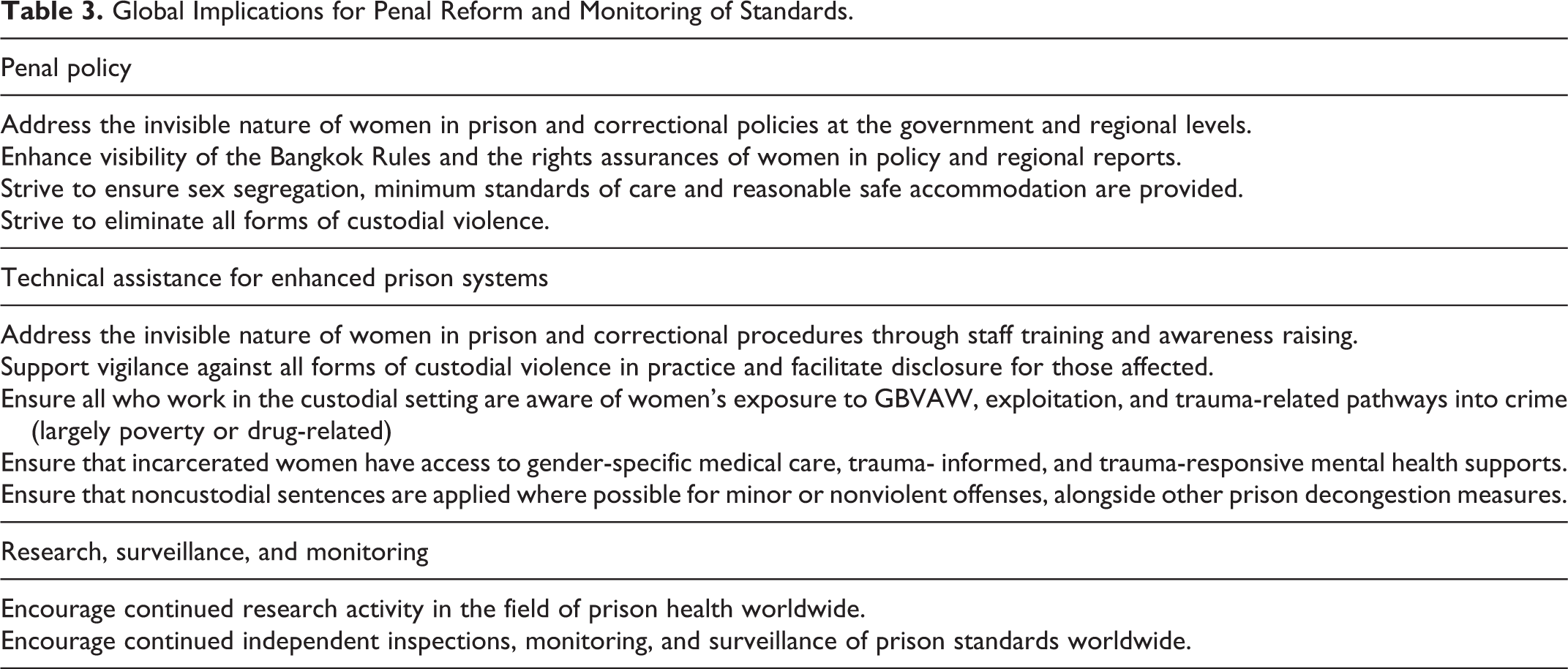
These insights give a well-founded basis for relevant UN agencies (UN Women, UN Office of Drug and Crime, UN Development Program, UNAIDS, and others) and the World Health Organization to provide technical assistance and promote further improvements and penal reforms worldwide. Moreover, this gives a substantiated starting point for human rights organizations such as Amnesty International, the Howard League for Penal Reform, Penal Reform International, and Harm Reduction International to appoint targeted and fitting actions to reduce GBVAW in custodial settings. See Table 3.
Global Implications for Penal Reform and Monitoring of Standards.
Further, we wish to underscore how this neglect not only constitutes grave human rights abuses but also fuels self-harm, suicide, psychiatric disorders and deaths, and the spread of disease (HIV, Hepatitis C) bridging between prisons and communities. Addressing disease hinges on prison system approached and parameters to address physical and sexual violence in prisons, trauma-related mental health issues, and unsafe injecting of drugs. UN reporting continues to highlight such issues globally where women are discriminated and treated in an unequal manner, alongside the dearth of academic research and access of research teams into prisons (Mhlanga-Gunda et al., 2019). It is further lamentable that despite global prison release schemes during COVID-19 that women including those convicted on minor, nonviolent or drug offenses have been largely overlooked, thereby exposing them to continued violence, trauma, and harm (Penal Reform International, 2020d; Van Hout, 2020).
Footnotes
Declaration of Conflicting Interests
The author(s) declared no potential conflicts of interest with respect to the research, authorship, and/or publication of this article.
Funding
The author(s) received no financial support for the research, authorship, and/or publication of this article.
