



Abstract
Child maltreatment has many well-documented lasting effects on children. Among its consequences, it affects children’s recognition of emotions. More and more studies are recognizing the lasting effect that a history of maltreatment can have on emotion recognition. A systematic literature review was conducted to better understand this relationship. The Preferred Reporting Items for Systematic Reviews and Meta-Analyses (PRISMA) protocol was used and four databases were searched, MEDLINE/PubMed, PsycINFO, EMBASE, and FRANCIS, using three cross-referenced key words: child abuse, emotion recognition, and adults. The search process identified 23 studies that met the inclusion criteria. The review highlights the wide variety of measures used to assess child maltreatment as well as the different protocols used to measure emotion recognition. The results indicate that adults with a history of childhood maltreatment show a differentiated reaction to happiness, anger, and fear. Happiness is less detected, whereas negative emotions are recognized more rapidly and at a lower intensity compared to adults not exposed to such traumatic events. Emotion recognition is also related to greater brain activation for the maltreated group. However, the results are less consistent for adults who also have a diagnosis of mental health problems. The systematic review found that maltreatment affects the perception of emotions expressed on both adult and child faces. However, more research is needed to better understand how a history of maltreatment is related to adults’ perception of children’s emotions.
The intergenerational cycle of maltreatment is a complex phenomenon. Maltreated children are twice as likely to grow up in families where their mothers have been maltreated during childhood (Bartlett et al., 2017). According to an umbrella review of meta-analyses, the factor with the largest predictive effect size for child maltreatment is having a parent with a history of maltreatment (van IJzendoorn et al., 2020). However, there appears to be considerable variation in the intergenerational trajectory of maltreatment. A scoping review by Madigan et al. (2019) found that prevalence rates of intergenerational transmission range from 7% to 88%. Furthermore, the relationship between the form of maltreatment to which a parent was exposed as a child and the form that they may perpetuate is not necessarily direct. A history of maltreatment increases, by the same odds, the risk of homotypical (e.g., abuse to abuse) and hetereotypical (e.g., abuse to neglect) intergenerational transmission. Using a multigenerational multi-informant approach, Buisman et al. (2020) found that transmission appears to be more systematic for abuse than for neglect.
Many factors could contribute to the intergenerational transmission of maltreatment. A recent meta-analysis established that once they become parents, adults with a history of child maltreatment demonstrate more negative parenting and a lower quality in the parent–child relationship than adults without such past experiences (Savage et al., 2019). Similarly, a systematic review by Greene et al. (2020) found that parents with a history of maltreatment make greater usage of negative parenting practices and show a diminished propensity to use positive ones. These characteristics refer to sensitive parenting behavior. Ainsworth (1979) defined sensitivity by dividing it into three components, namely, the parents’ ability to (1) perceive their child signals, (2) interpret them properly, and (3) respond in an appropriate and quick manner. Few studies have examined the relationship between a history of maltreatment and the first component of Ainsworth’s model, namely how parents perceive the emotions displayed by children.
Studies investigating the effect of maltreatment on emotional development have primarily examined children’s perceptual abilities. In a series of experiments published in the early 2000s, Pollak and his colleagues demonstrated that maltreated children can identify anger and fear with less sensory information than nonmaltreated children. Numerous studies have followed to better understand this phenomenon. These studies have revealed the complexity of the effect of maltreatment on children’s perception of emotions. For instance, physical abuse is the form of maltreatment that has shown the most consistent results across studies. Children who have experienced this form of abuse tend to show hypersensitivity to anger and fear. They require less perceptual information to recognize facial expressions of anger compared to nonabused children (Pollak & Sinha, 2002) and show more attentional biases and shorter reaction times to both emotions (Assed et al., 2020; da Silva Ferreira et al., 2014; Harms et al., 2019; Masten et al., 2008). While this hypervigilance to fear and anger may help abused children assess their environment and adapt their behaviors in order to prevent further abuse, it may be inappropriate in nonthreatening contexts (Assed et al., 2020; Pollak, 2008).
A recent meta-analysis concluded that children exposed to neglect also have differentiated emotion recognition skills, evidenced by shorter reaction times when asked to identify negative expressions (Assed et al., 2020). They demonstrate a lower understanding of the negative emotions of anger and sadness (Shipman et al., 2005). For instance, they show a tendency to confuse all negative emotions with sadness (Pollak et al., 2000). Researchers suggest that growing up in less stimulating environments may impair children’s ability to recognize the emotional facial expressions of others (Pollak et al., 2000).
It is important to understand how childhood maltreatment can affect emotional recognition in adulthood. A growing number of studies are being conducted to verify the effect of childhood maltreatment on adults’ perception of emotions. In addition, recent techniques used to understand emotion recognition may offer new insights on the long-term effects of childhood maltreatment. These advances in the field warrant a review to examine the effects specifically associated with childhood maltreatment, examining whether different methodologies provide new insights, and whether perceptual abilities differ in relation to adult vs. child face stimuli.
Objective
The main objective is to explore the link between a history of childhood maltreatment and adults’ perception of emotions. To do so, a systematic review of research published on the topic was conducted. To our knowledge, this is the first systematic review to examine this relationship among adult subjects specifically. Particular attention was given to reviewing studies conducted with adult victims of childhood maltreatment, which is a specific form of early adverse experience (Atzl et al., 2019; Mersky et al., 2017). A distinction was also made between responses to emotions expressed on adult and child faces.
Method
Search Strategy
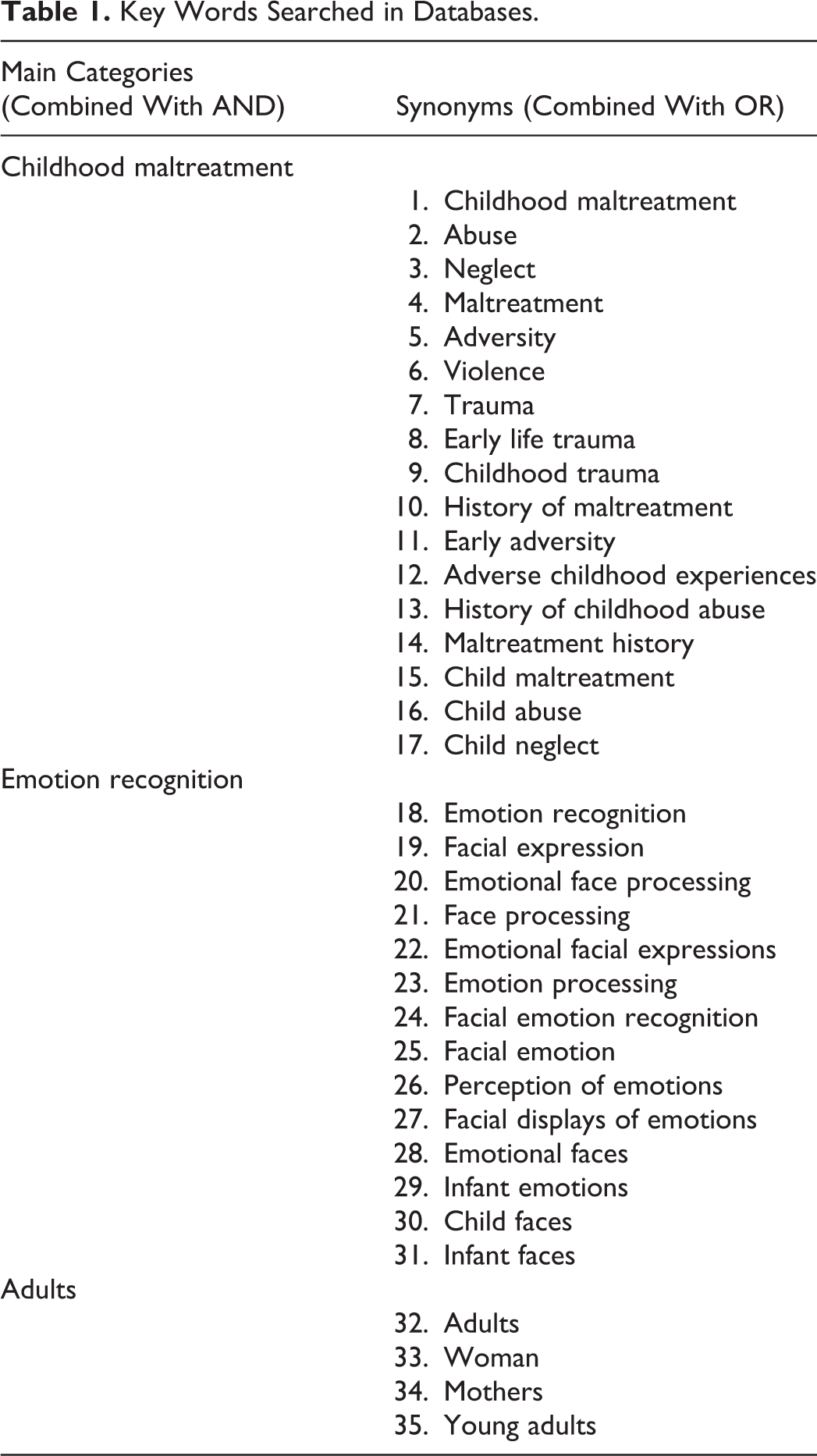
A systematic review of the literature was conducted according to the PRISMA protocol (Moher et al., 2015). Three cross-reference key words (childhood maltreatment, emotion recognition, and adults) were searched in four databases: MEDLINE/PubMed, PsycINFO, EMBASE, and FRANCIS. All related terms for each of the three categories of interest were identified and verified by two independent judges. Agreements were included in the search. A full list of key words used is shown in Table 1. The search returned a total of 372 articles.
Key Words Searched in Databases.
Study Selection
Research findings were reviewed in three stages. First, duplicates were removed, leading to a total of 285 articles. Second, an initial selection of articles was conducted based on titles and abstracts. Two reviewers independently assessed the eligibility of these articles for use in the current paper. Of the 285 articles, 44 were retained based on title and abstract screening (see Figure 1 for PRISMA diagram). Excluded publications included non-English papers (n = 2), books (n = 2), thesis papers (n = 12), conference papers (n = 24), and articles unrelated to the current study’s research question (n = 201), such as studies examining the link between maltreatment and emotion processing in children and/or teenagers. Discrepancies (13 of 285 articles) were discussed until a consensus was reached (K = 0.80). The remaining 44 articles were subjected to in-depth evaluation by both independent reviewers to verify that they met predefined inclusion criteria: (a) peer-reviewed papers published in 2019 or before, (b) empirical studies and literature reviews focused on the facial emotion processing of child and/or adult stimuli, and (c) inclusion of a sample comprised of adults with a history of childhood maltreatment. Both auto-revealed and substantiated cases of maltreatment were accepted. Maltreatment experiences consisted of at least one form of abuse and/or neglect. We excluded studies that assessed the broader concept of early stress, such as experiencing bullying, the death of a parent or an illness. Disagreements (6 of 44 articles) were resolved through discussion and consensus was reached in all cases.
Among the 44 studies assessed for eligibility, 21 were excluded in total, due to unavailability (n = 1), absence of a task with emotions or use of nonfacial stimuli (n = 5), wrong population (e.g., veterans, maltreating parents; n = 4), and measure of early stress unrelated to abuse or neglect (n = 7). Moreover, three reviews of the literature were excluded. One did not find any studies on maltreatment and emotional processing in adults (Hart & Rubia, 2012); the two other reviews examined the link between childhood maltreatment and psychopathology (Jaffee, 2017; Teicher & Samson, 2016). Finally, a meta-analysis (Hein & Monk, 2017) was excluded given the variability of the studies in terms of participants and measurements. This search process yielded 23 studies that met inclusion criteria (K = 0.72). One additional article (i.e., English et al., 2018) was identified through manual search by both reviewers, leading to a total of 24 studies for the review (see Figure 1).
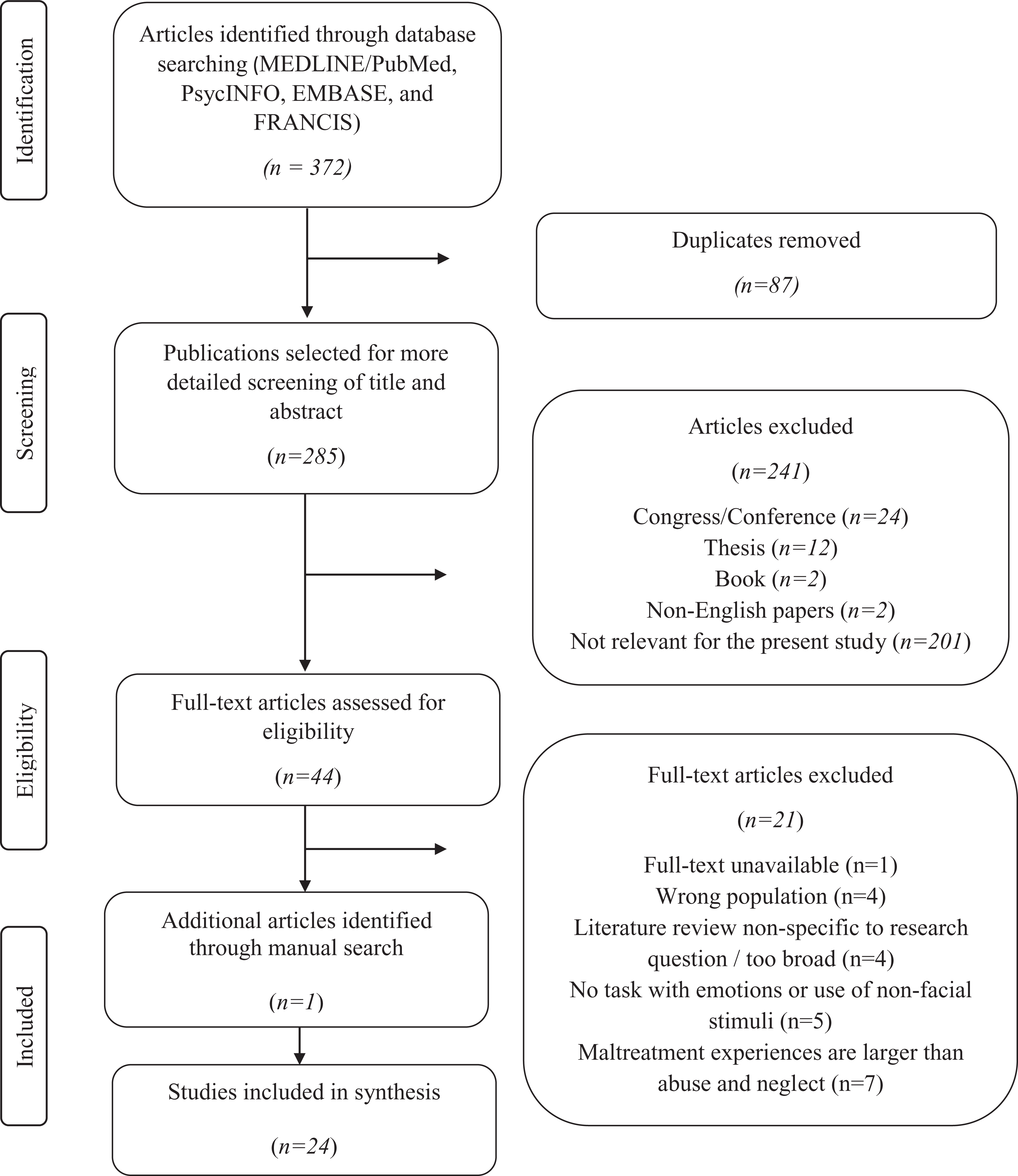
PRISMA diagram for systematic review.
Data Extraction
Data were extracted to a standardized data collection Excel sheet by the author responsible for the study selection and verified by one of the other authors. This covered research objectives, details about participants, measures, analyses, relevant findings, and study limitations (see Table 2 for a brief description of the articles included in synthesis).
Measures and Tasks Used in Studies Included in Synthesis.
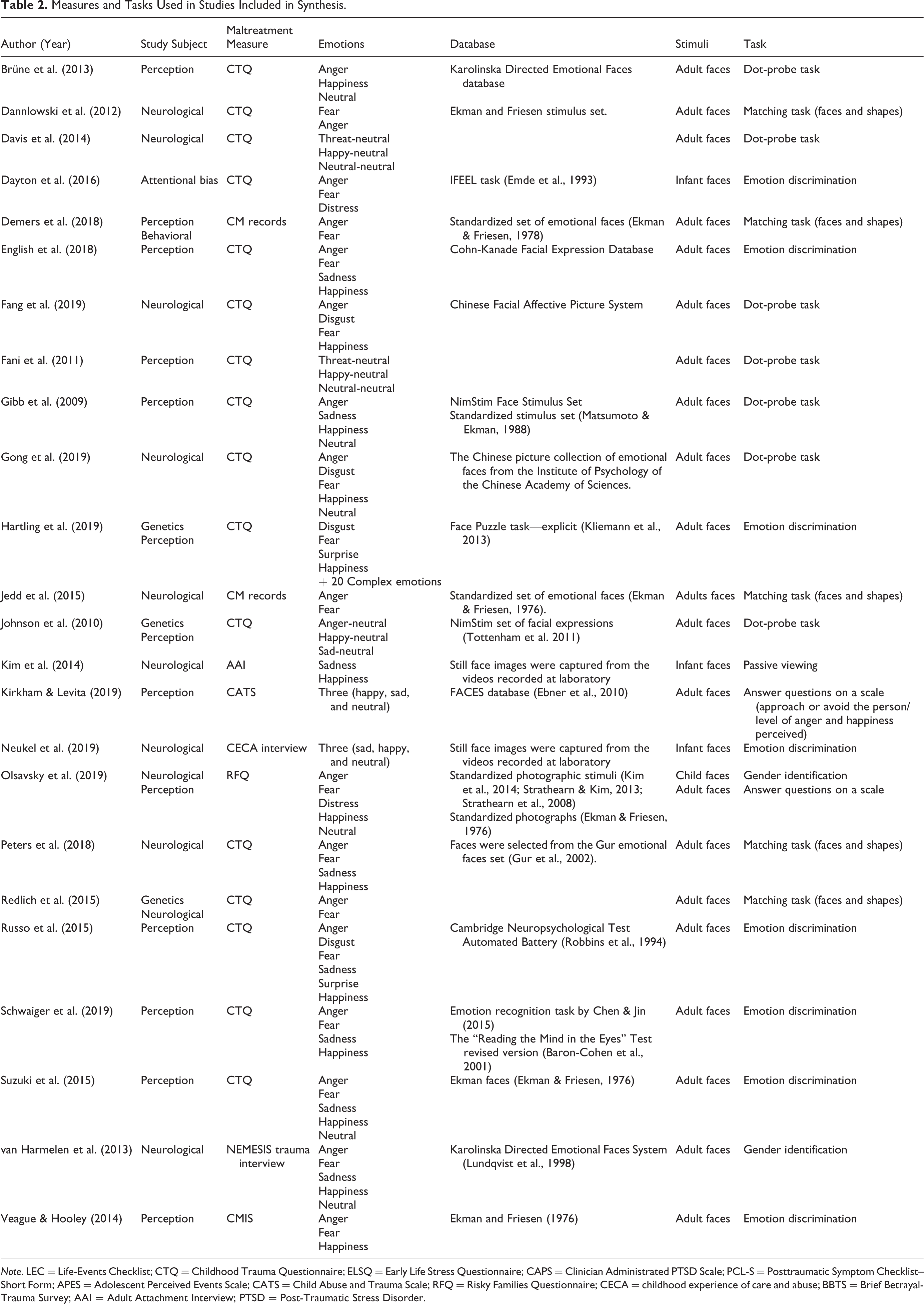
Note. LEC = Life-Events Checklist; CTQ = Childhood Trauma Questionnaire; ELSQ = Early Life Stress Questionnaire; CAPS = Clinician Administrated PTSD Scale; PCL-S = Posttraumatic Symptom Checklist–Short Form; APES = Adolescent Perceived Events Scale; CATS = Child Abuse and Trauma Scale; RFQ = Risky Families Questionnaire; CECA = childhood experience of care and abuse; BBTS = Brief Betrayal-Trauma Survey; AAI = Adult Attachment Interview; PTSD = Post-Traumatic Stress Disorder.
Results
Description of Study and Subjects’ Characteristics
All studies included in our systematic review were empirical studies. Among the 24 studies selected, almost half (11 of 24, 46%) examined associations between childhood maltreatment and adults’ responses to emotions, namely their attentional or interpretation biases or their abilities to discriminate between emotions. Ten articles (42%) described research documenting how childhood maltreatment affects adults’ brain response to facial emotional expressions of emotion. Finally, three studies (12%) examined the relationship between genetic factors and early adversity on emotion processing.
Study samples ranged from 26 to 395 participants. Approximately 21% of studies (5 of 24 had samples of 50 or fewer people, eight publications (33%) had between 51 and 100 participants, 11 studies (46%) had more than 100 participants. Six of the 24 (25%) studies were conducted with samples of predominantly male adults. A few publications were conducted with samples of parents (4 of 24, 17%) or undergraduate students (4 of 24, 17%). Finally, 50% of articles (12 of 24) included in our review compared adults with a history of childhood maltreatment to adults without such a history.
Participants’ mean age ranged between 18 and 52 years old. Only 12% of studies (3 of 24) had participants between the ages of 18 and 20 years. Most samples reported a mean age between either 20 and 30 years old (8 of 24, 33%) or 30 and 45 years old (9 of 24, 37%). Three publications (12%) were conducted with participants over 45 years old, and one (4%) simply indicated that participants ranged between 18 and 68 years old. Only 13 studies (54%) reported information about the ethnic background of their participants. Of these, six of the samples (25%) were predominantly White, Caucasian, or from European descent, while seven (29%) were predominantly African, Asian, Hispanic, Black, or Multiracial. Five studies (21%) were conducted with participants of low-socioeconomic status.
Among the 24 studies, five (21%) screened participants for current or past mental illness problems and excluded those who met this criterion. Other studies (8 of 24, 33%) examined the combined effect of childhood maltreatment and mental illness (two borderline personality disorder, one bipolar disorder, two depression, one schizotypy, and two other psychopathology) on emotion processing. Eleven (46%) studies did not report information about participants’ mental health.
Maltreatment
Two thirds of the studies (16 of 24, 67%) in our systematic review used the Childhood Trauma Questionnaire (Bernstein et al., 2003) which measures five types of maltreatment experiences. Three types are related to abuse, namely, physical, sexual, and emotional abuse, whereas the two others are forms of neglect, physical and emotional. In their study, van Harmelen et al. (2013) used the NEMESIS interview (De Graff et al., 2002) to measure the same dimensions, apart from physical neglect, which is not documented. Veague & Hooley (2014) also used an interview protocol composed of 11 questions tapping on physical, sexual, and emotional abuse as well as witnessing domestic violence. Neukel and colleagues (2019) administered the Childhood Experience of Care and Abuse Interview (CECA; Bifulco et al., 1994) to participants to assess childhood abuse experiences (physical and/or sexual). Two studies relied on child protection reports as indicators of child maltreatment (Demers et al., 2018; Jedd et al., 2015). One study used the Child Abuse and Trauma Scale (CATS; Sanders & Becker-Lausen, 1995) which measures physical and emotional abuse and neglect (Kirkham & Levita, 2019). Olsavsky et al. (2019) used three different questions, one for emotional abuse (being verbally insulted or threatened), one for physical abuse (being pushed, grabbed, slapped, or shoved), and one concerning the exposure to domestic violence. Finally, Kim et al. (2014) used the Adult Attachment Interview (AAI; George et al., 1996) to screen for adults with unresolved traumas, such as experiences of loss and/or abuse.
Stimuli
Adults or child faces
Most studies investigating the link between childhood maltreatment and emotion recognition have exposed participants to adult faces. Among the 24 studies included in our review, only four used child faces as stimuli. Within these four studies, two different types of stimuli were used. On one hand, participants were exposed to a set of pictures representing different expressions of emotion performed by children in laboratory settings (Dayton et al., 2016; Olsavsky et al., 2019). On the other hand, mothers were exposed to pictures of their own child. These pictures were extracted from videos of their child by independent judges who assigned each one to a specific emotion category, namely, happy, sad, or neutral (Kim et al., 2014; Neukel et al., 2019).
Emotions
Face database
Most studies used a validated face database depicting different emotions. Ekman and Friesen’s (1976) database of adult faces was used in some studies, either as is (e.g., Dannlowski et al., 2012; Demers et al., 2018) or to create morphed emotions (e.g., Suzuki et al., 2015). Other standardized validated databases were also used, such as FACES (e.g., Kirkham & Levita, 2019), which presents a set of faces showing different emotions created by Ebner et al. (2010). Certain studies used the Cambridge Neuropsychological Test Automated Battery (Robbins et al., 1994), a computer-generated paradigm for the recognition of six basic facial emotional expressions (Russo et al., 2015). The Karolinska Directed Emotional Face database developed by Lundqvist et al. (1998) was also used in van Harmelen et al. (2013). Few research studies (Demers et al., 2018; Jedd et al., 2015; Peters et al., 2018) also focused on an emotion-matching task proposed by Hariri and colleagues (2000) which uses the Gur emotional faces set (Gur et al., 2002). A series of studies was realized using the Dote-probe task from Mogg and Bradley (1999) which is a database of happy and sad faces (Brüne et al., 2013; Davis et al., 2014; Fani et al., 2011). In English et al. (2018), images were obtained from the Cohn–Kanade Facial Expression Database (Kanade et al., 2000), a sample of video sequences created by Pollak et al. (2009), where actors portray different emotions ranging from neutral to apex. Ten images per emotion were taken to reflect different levels of intensity. Hartling et al. (2019) used videos instead of pictures. They exposed participants to 24 short video clips of positive and negative emotions portrayed by 15 professional actors. Finally, for tasks with infant faces, Dayton et al. (2016) used the Infant Facial Expressions of Emotion from Looking at Pictures (IFEEL) task (Emde et al., 1993) in which the participant is exposed to infant faces, many depicting ambiguous emotional expressions. Olsavsky et al. (2019) and Kim et al. (2014) used a task composed of 10 infant faces depicting happy, neutral, and distressed faces. The task was first used in Strathearn et al. (2008). Neukel et al. (2019) created their own database of happy, sad, and neutral emotion pictures from videos of participants’ school-aged children.
Number of emotions
Some researchers exposed participants to Ekman and Friesen’s (1976) set of six basic emotions, namely, happiness, anger, disgust, fear, sadness, and surprise (Russo et al., 2015), whereas other studies focused on specific emotions. Many studies exposed participants to one positive and one negative emotion, such as happiness and anger (Kirkham & Levita., 2019; Neukel et al., 2019), happiness and fear/threat (Davis et al., 2014; Fani et al., 2011; Olsavsky et al., 2019), or happiness and sadness (Kim et al., 2014). In other studies, participants viewed anger and fear, two negative emotions (Dannlowski et al., 2012; Demers et al., 2018; Jedd et al., 2015; Redlich et al., 2015). Certain researchers presented these two negative emotions as well as happiness (Johnson et al., 2010; Olsavsky et al., 2019; Veague et al., 2014). Many studies included four emotions, although the emotions chosen varied across protocols. In Fang et al.’s (2019) and Gong et al.’s (2019) experiments, participants were exposed to faces of happiness, anger, fear, and disgust in addition to neutral faces. English et al. (2018), Peters et al. (2018), Schwaiger et al. (2019), Suzuki et al. (2015), and van Harmelen et al. (2013) also presented the four emotions in addition to neutral stimuli but incorporated sadness in their database instead of disgust.
Very few researchers exposed participants to more complex emotions. One exception is Hartling et al. (2019) who, using short videos of actors, exposed their participants to four basic and 20 complex emotions (e.g., interested, amused, aggrieved, troubled, jealous). Another study used the Read the Mind in the Eyes protocol developed by Baron-Cohen et al. (2001) where only the eyes are shown to participants who must choose among basic and more complex emotions (Schwaiger et al., 2019).
Transformation of stimuli
Most studies presented the emotions to participants without editing the images. However, a few studies used techniques to modify the images and to provide participants with a gradual display of emotions. The morphing technique allows to measure how the emotion is perceived when it is not presented at apex, that is, where a ceiling effect in performance occurs in many populations (Young et al., 1997). With morphing, two emotions of different percentages are combined, resulting in a single image. Some studies used a combination of one emotion with a neutral expression in order to create an array of intensity (Gibb et al., 2009; Russo et al., 2015), whereas other studies morphed two different emotions, with both emotions varying in intensity (Schwaiger et al., 2019; Suzuki et al., 2015; Veague & Hooley, 2014).
Task
Emotion recognition
Part of the studies used experimental designs where participants were asked to identify the emotion presented. Schwaiger et al. (2019) used a task that required participants to respond as quickly and as accurately as possible to identify the basic emotions displayed on adult faces, with each emotion being gradually increased in intensity. Others asked participants to identify the dominant emotion presented on morphed facial expressions, regardless of response time (English et al., 2018; Gibb et al., 2009; Russo et al., 2015; Schwaiger et al., 2019; Suzuki et al., 2015; Veague & Hooley, 2014). In their study, Kirkham and Levita (2019) asked participants to rate the intensity of happiness and anger on two separate scales ranging from 0 to 100%.
Attentional bias
The most common protocol used to evaluate attentional biases toward emotions is the dot-probe task. During this task, a picture of both an emotional and a neutral face are displayed on the right and left sides of a screen for a short period of time (e.g., 800 ms), followed by a dot appearing on either side. Participants must indicate the location of the dot. An attentional bias toward the emotional face will result in faster responses when the dot is located on the same side as the emotional face. This protocol has been used in numerous research studies examining attentional biases in participants with and without a history of maltreatment (Brüne et al., 2013; Davis et al., 2014; Fani et al., 2011; Gibb et al., 2009; Johnson et al., 2010). Recent studies have also combined this protocol with brain imagery (Fang et al., 2019; Gong et al., 2019).
Viewing of facial emotions during brain recording
Many studies have investigated brain activity during emotion processing. Among these studies, some used passive viewing in which participants were exposed to faces without being asked to perform any task (van Harmelen et al., 2013). In other protocols, brain recording occurred while participants performed a memory-matching task. Participants’ accuracy in matching faces was compared to their performance in matching simple geometric shapes (Dannlowski et al., 2012; Demers et al., 2018; Jedd et al., 2015; Peters et al., 2018; Redlich et al., 2015).
Effect of a History of Childhood Maltreatment on Emotion Recognition
Maltreatment and happiness
In their study on emotion recognition, Veague et al. (2014) concluded that a history of abuse predicted difficulties in recognizing happiness as opposed to fear and anger. Studies on attentional biases show contradictions. Fani et al. (2011) found that a history of childhood abuse was related to attentional biases toward happy faces compared to neutral faces. In Davis et al. (2014), childhood abuse was not related to an attention bias toward happiness nor threat. However, participants who had both a history of severe abuse and attachment anxiety had an attentional bias away from happy faces compared to neutral faces.
Maltreatment and anger
Many studies have demonstrated a relationship between a history of childhood maltreatment and the recognition of anger. Gibb et al. (2009) found that individuals with a history of childhood abuse could recognize anger when presented at a lower level of intensity. No difference was found for happiness and sadness. They also found that individuals with a history of childhood abuse display a greater attentional bias toward anger. In a study by Kirkham and Levita (2019), participants with a history of maltreatment and no mental illness reported they would be less likely to avoid a person with an angry face. Finally, in another study, while accuracy in recognizing angry and fear was similar for participants with and without a history of childhood maltreatment, it increased following oxytocin administration but only for the maltreated group (Schwaiger et al., 2019).
The relationship between childhood maltreatment and the recognition of anger seems to go in the opposite direction when participants with childhood maltreatment experiences have mental disorders. In a clinical sample of participants with bipolar personality disorder (BPD), Russo et al. (2015) found that participants who reported experiencing physical abuse, emotional neglect, or physical neglect were less accurate in recognizing anger than those without such childhood experiences. In a similar sample, Brüne et al. (2013) found that participants with BPD and a history of childhood maltreatment were more likely to show attentional avoidance to expressions of anger, devoting less attention to anger than to neutral stimuli. However, Johnson et al. (2010) revealed that the attentional avoidance to angry faces in women reporting childhood maltreatment was specific to carriers of a short allele in the 5-HTTLPR gene, rather than to major depression or anxiety disorder. In a similar study, Hartling et al. (2019) found that participants with a history of maltreatment and a more stress-responsive genetic profile were less accurate in recognizing emotions in general.
Maltreatment and fear
English et al. (2018) submitted participants to emotional faces while under low and high cognitive load in order to distinguish between strategic and automatic processing. They found that participants with a history of emotional maltreatment recognized fear more quickly when processing emotions under high cognitive load, which suggests an enhanced alertness to threat signals. On the other hand, Suzuki et al. (2015) found that adults with a history of maltreatment made significantly more errors in recognizing fear than anger. Looking at the interaction between childhood maltreatment and mental disorders, these authors also found that depressed adults with a history of maltreatment demonstrated an increased bias toward fear compared to adults with a history of maltreatment but no depression.
Maltreatment and brain activation
Childhood maltreatment is also related to specific brain activation when participants are exposed to facial expressions of emotion as demonstrated in EEG studies. Fang et al. (2019) found larger N170 amplitudes for participants with a history of childhood maltreatment when they performed a dot-probe task with angry, fearful, and happy faces. Although not significant, the maltreated group also showed better accuracy and shorter reaction times in recognizing the emotions. The authors conclude that adults with a history of childhood maltreatment show a hypervigilance to the measured emotions. Using a similar protocol to compare participants with high and low negative schizotypy, Gong et al. (2019) found no main group difference for participants with and without a history of maltreatment on the amplitudes of N170 and P100.
Other research used functional magnetic resonance imaging (fMRI) to examine brain activation when participants were exposed to facial emotions. Demers et al. (2018) found that, among participants who experienced childhood maltreatment, facial emotions elicited greater amygdala-based connectivity within the dorsomedial- and right-dorsolateral prefrontal cortex, structures related to stress response, and differences in the hippocampus–amygdala connectivity, a circuit linked to the representation of emotional significance. An enhanced amygdala responsiveness in adults with a history of maltreatment has also been demonstrated in relation to anger and fear (Jedd et al., 2015; van Harmelen et al., 2013) and to threat (Dannlowski et al., 2012). Peters et al. (2018) found that participants with a combined history of maltreatment and internalizing psychopathology had increased corticolimbic reactivity to fearful facial expressions and greater activation of somatosensory areas during fear and anger processing. Finally, studies have shown that the interaction between maltreatment and amygdala reactivity to angry and fearful faces is specific to certain genotypes (Redlich et al., 2015).
Results With Exposure to Children’s Faces
In a study by Dayton et al. (2016), participants were exposed to pictures from the IFEEL database of 1-year-old infants depicting ambiguous facial expressions. Mothers who reported having experienced childhood maltreatment and intimate partner conflict tended to interpret ambiguous infant facial expressions more negatively than other mothers did. Olsavsky et al. (2019) found that mothers with a history of maltreatment showed a blunted bilateral amygdala reactivity to infant emotions, with no differential reactivity to positive, neutral, and negative emotions. This effect occurred only with infant faces, not adult faces. Moreover, for maltreated mothers, a more elevated amygdala response to children’s emotions was related to more sensitive behaviors during a mother–child interaction, whereas the nonmaltreated mothers showed a reversed relation.
Other studies have compared mothers’ reactions to their own child’s emotions with those of unknown children. In Neukel et al. (2019), mothers with and without a history of maltreatment reacted differently to their child’s expressions of happiness. Mothers with a history of maltreatment demonstrated elevated brain activation to their child’s happy faces, which was not the case for other mothers. The authors interpreted the reaction of mothers with a history of maltreatment as greater mentalization and less spontaneous empathic reactions to their child’s positive emotions. Similarly, Kim et al. (2014) found that mothers with history of maltreatment did not show differential responses to their own child’s happy versus sad faces, whereas mothers without a history of maltreatment showed greater amygdala responsiveness to their own child’s sad faces. Table 3 presents a summary of these findings.
Effects of Childhood Maltreatment on Emotional Processing in Adults.
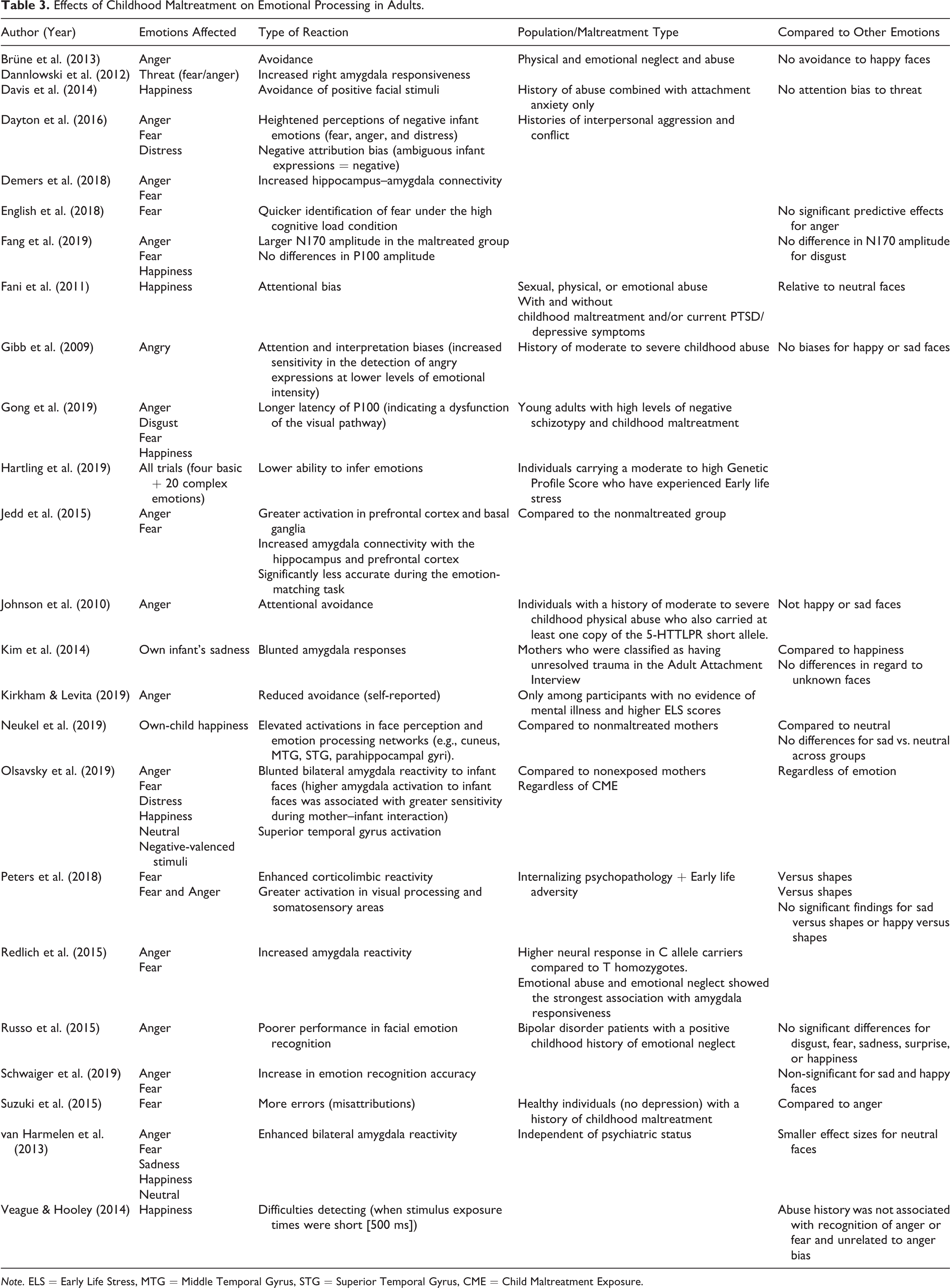
Note. ELS = Early Life Stress, MTG = Middle Temporal Gyrus, STG = Superior Temporal Gyrus, CME = Child Maltreatment Exposure.
Discussion
A growing number of studies have examined how adults with a history of maltreatment react to emotions. The main conclusion is that the experience of childhood maltreatment does alter the perception of emotions in adults. Despite the wide variety of methodologies employed to measure child maltreatment, as well as the different protocols used to measure perceptual abilities related to emotion recognition, most of the studies reviewed found a difference between adults who were exposed to maltreatment during childhood and those who were not (see Table 4 for a brief resume of the study).
Summary of Critical Findings.

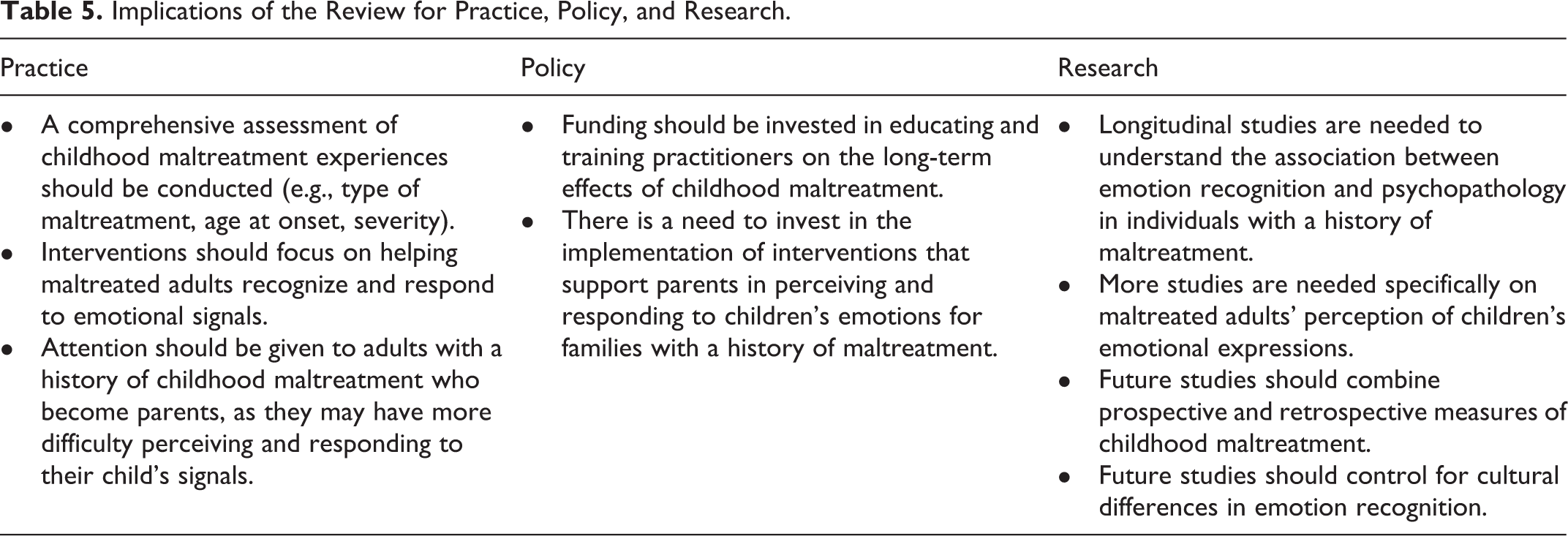
Implications of the Review for Practice, Policy, and Research.
Anger and fear are the emotions that have been included in the largest number of studies. Maltreatment experiences are related to an increased recognition of these emotions (English et al., 2018, for fear; Gibb et al., 2009, for anger). These emotions also elicit greater brain activation in adults with a history of maltreatment, particularly in the amygdala region (Jedd et al., 2015; Redlich et al., 2015; van Harmelen et al., 2013). However, for both emotions, when childhood maltreatment is combined with a mental disorder, recognition seems to be decreased and participants show greater avoidance to the emotional stimuli (Brüne et al., 2013; Kirkham & Levita, 2019; Suzuki et al., 2015).
As for positive emotions, participants with a history of maltreatment seem to have more difficulty recognizing happiness (Veague et al., 2014). They also demonstrate more attentional-biases toward this emotion (Fani et al., 2011). However, when they also have a psychopathology, they show attentional biases away from happiness (Davis et al., 2014).
To date, psychopathology is one of the most studied potential mechanisms linking childhood maltreatment and emotion recognition in adulthood. For instance, Maoz et al. (2016) found that people with social anxiety disorder have faster reaction times when looking at anger and slower reactions times for happiness. Participants with social anxiety disorder also show a tendency to misinterpret neutral expressions of emotion as anger (Peschard & Philippot, 2017). Lower performance rates in detecting emotions have also been observed in people with psychopathy and antisocial traits (Iria & Barbosa, 2009; Pham & Philippot, 2010). Similarly, difficulties and negative misattribution errors in emotion recognition have been reported in people with borderline personality disorder (Nicol et al., 2014; Veague & Hooley, 2014).
When looking at the high proportion of studies connecting a history of childhood maltreatment, emotion recognition, and mental disorders, one might be tempted to conclude that the particularities in emotion recognition relates more to psychopathology than to maltreatment. However, considering that many children exposed to maltreatment are known to have impaired emotion recognition in childhood (Assed et al., 2020; Harms et al., 2019), it is likely that in this population, the deficit in emotion recognition contributes to psychopathology rather than the other way around. In any case, longitudinal studies are needed to better understand the trajectory of this co-occurrence.
Moreover, some studies included in the systematic review have established a link between maltreatment experiences and emotion recognition, but only for adults with a particular genetic profile (Hartling et al., 2019; Johnson et al., 2010; Redlich et al., 2015). A genetic contribution to emotion recognition was also found in research with other populations. A study with twins found that similarities in emotion recognition among twins could mostly be attributed to genetic factors (Rappaport et al., 2018). Therefore, epigenetics could explain multiple complex developmental pathways that predict the emotional recognition abilities of individuals exposed to maltreatment during childhood. For example, St-Laurent et al. (2019) found that the continuity of maltreatment across generations is predicted by the level of stressors in the family ecology, pleading in favor of a diathesis-stress model in which adverse experiences lead to further maltreatment only in certain stressful contexts.
A recent meta-analysis by Saarinen et al. (2021) examined the effects of early adversity, defined as important stressors encountered before the age of 18 years, on emotion recognition. The meta-analysis combined results from studies conducted with children and adults, with the average age of participants being of approximately 10 years for the behavioral studies, and 20 years for the fMRI studies. The results from the behavioral studies cannot be compared to the results of the current systematic review since most participants in the meta-analysis were children. The fMRI results from children and adult participants indicate higher brain activation, but only for sad faces, independent of mental disorders. This is different from the results of the current systematic review where anger and fear were found to elicit brain activation. This distinction could be explained by different factors. First, the response to emotions in children and adults may differ, and until we have a better understanding of the evolution of emotion recognition following a history of maltreatment, considering the two groups separately may offer different insights. Second, Sareeine et al.’s study looked at early adversity contrary to the current study that focuses specifically on child maltreatment. Researchers emphasize the difference between child maltreatment and other early adversities both conceptually (Mersky et al., 2017) and in terms of their consequences on child development (Atzl et al., 2019). Finally, of the 23 studies examined in the current systematic review, only 11 included sadness. More studies examining this emotion in maltreated adults may be necessary.
Most studies have been conducted using adult faces as stimuli. However, the few studies that have used infant faces have also shown a difference between adults with and without childhood maltreatment experiences. Dayton et al. (2016) reported a negative misattribution of ambiguous infant expressions in mothers reporting maltreatment experiences as well as intimate partner conflict. Cerebral imagery also shows differential brain activation in mothers with and without past experiences of maltreatment (Kim et al., 2014; Neukel et al., 2019). Results from these studies may contribute to explain the link between childhood trauma and lower parental sensitivity. While childhood maltreatment has been associated with parenting difficulties (see Savage et al., 2019, for a review), the underlying mechanisms that explain why there is continuity in the intergenerational transmission of maltreatment in some cases, and discontinuity in others, are still poorly understood. A recent study demonstrates that emotion recognition was differentially associated with maternal sensitivity in mothers with and without a history of childhood maltreatment (Bérubé et al., 2020). Mothers who had experienced severe maltreatment and who were better at recognizing emotions expressed on child faces demonstrated less sensitive behaviors when interacting with their own child. For mothers with traumatic childhood experiences, being exposed to emotional signals may trigger trauma-related reactions and lead to difficulties in parenting. Such processes may play a role in perpetuating the intergenerational cycle of maltreatment.
The results of this systematic review of the literature are difficult to interpret because of the variability in the measurement of maltreatment and the diversity of tasks used to measure emotion recognition. For instance, some studies have included a sample of maltreated children referred to child protection services, while others obtained retrospective reports of maltreatment from participants. A growing number of studies show that maltreatment based on self-reports and what is referred to as an objective measure, such as child protection services (CPS) reports, do not target the same population. In a study by Najman et al. (2020), children were followed over a 30-year period. Very low concordance was found with only 17% of adults reporting maltreatment having a CPS file. Of all children referred to CPS over time, 60% did not indicate a history of severe maltreatment on self-report measures. Similarly, in a meta-analysis, Baldwin et al. (2019) concluded that approximately half of adults with a prospective observation of child maltreatment (such as CPS reports) will retrospectively report child maltreatment, and half of adults who self-report child maltreatment will have been reported to CPS as children. Danese and Widom (2020) found a difference in the psychopathological consequences of maltreatment between the two groups. Self-reports of maltreatment were associated with a higher risk of mental health problems, whether they were substantiated by CPS data or not. Conversely, CPS data, if not combined with a self-report of maltreatment, have little predictive value.
Moreover, most of the studies we examined either combined the different forms of maltreatment in a general concept or examined some specific forms but not others. Studies with children have demonstrated that different forms of maltreatment are related to differences in the perception of emotions. A study by Turgeon et al. (2020) established that adults who reported having experienced childhood physical abuse were less able to recognize the emotional expressions of fear and sadness displayed on child faces. Furthermore, childhood experiences of emotional and sexual abuse were associated with difficulties in recognizing anger. Finally, physical neglect was related to difficulties in recognizing happiness, whereas emotional neglect was associated with higher accuracy scores in recognizing anger. These results suggest that different types of maltreatment may lead to different consequences in adults. More studies are needed to validate this knowledge.
Limitations and Future Directions
While this systematic review makes significant contributions to understanding the link between childhood maltreatment and emotional processing in adulthood, findings should be interpreted in light of the following limitations. First, quality assessment of studies was not documented using a systematic tool. However, only studies with a rigorous methodology and published in a peer-reviewed journal were considered in the synthesis, and interrater agreement was assessed at each step of the review.
Second, it would have been interesting to transform the current systematic review into a meta-analysis study. To perform the calculations required for a meta-analysis, authors usually set a threshold of a minimum of three articles on the same data type (Saarinen et al., 2021). The current review describes the results of studies with particular attention to the specific populations that were studied and the methodologies used. In fact, data regarding adults are separated from data regarding children. A history of childhood maltreatment is also acknowledged as a specific form of early childhood adversity and only data pertaining to this form of trauma were examined. Finally, the different tasks used to measure emotion recognition are considered separately. By doing so, many clusters did not meet the minimum criterion required to calculate scores in a meta-analysis. Thus, instead of presenting calculations for certain specific combinations of methodology/population/trauma, this article favors a descriptive approach that considers all parameters.
Third, results were not interpreted in light of sociodemographic data, such as gender, age, or ethnicity. As for ethnicity, two studies conducted with a similar population (i.e., predominantly African American adults, female, with a low socioeconomic status) exposed participants to the same emotion recognition task and found conflicting results. While Fani et al. (2011) found an attentional bias toward happiness, Davis et al. (2014) reported avoidance of positive facial stimuli (i.e., happiness). The differences in these studies may be explained by the ethnicity of the presented emotional stimuli. Davis et al. (2014) exposed participants to both African American and Caucasian models, whereas Fani et al. (2011) mainly exposed participants to Caucasian models. Results from a meta-analysis examining the effect of culture on emotion recognition reveal an in-group advantage, indicating that emotions are best recognized when they are expressed and perceived by the same ethnic group (Elfenbein & Ambady, 2002). This factor was not controlled for in most of the studies we examined. Future research should consider this factor as its effect on emotion recognition is now better documented.
Finally, the samples included in the review do not fully represent diversity in terms of socioeconomic status, ethnicity, gender identity, age, and culture. This limitation must be considered when interpreting the results. Future studies examining the association between childhood maltreatment and emotion recognition should be conducted with diverse samples and all studies should include information about participants’ sociodemographic characteristics.
Conclusion
Results from this study indicate that childhood experiences of maltreatment influence adults’ ability to recognize and discriminate between emotions expressed on both adult and child faces. Additional studies are needed to understand the mechanisms underlying this relationship (e.g., type of maltreatment, age at onset, severity/chronicity). This knowledge is crucial to better support adults with a history of maltreatment and help these parents recognize their child’s signals and needs. This understanding could ultimately help reduce the intergenerational cycle of maltreatment.
Footnotes
Declaration of Conflicting Interests
The author(s) declared no potential conflicts of interest with respect to the research, authorship, and/or publication of this article.
Funding
The author(s) disclosed receipt of the following financial support for the research, authorship, and/or publication of this article: This work was supported by the Social Sciences and Humanities Research Council of Canada (grant number 430-2016-00521). This work also received the support of the Centre de recherche universitaire pour les jeunes enfants et leur famille (grant number 7053088—CRUJeF).
