



Abstract
Background
To counter the effects of radicalization, we should first understand the persuasion mechanisms used by fundamentalist organizations to reach and engage with potential candidates to religious radicalization, particularly in Western societies.
Focus of the Article
The paper analyzes ISIS and Al-Qeada (AQ) propaganda as grotesque transparency strategy, with particular attention to the so-called “Islamic State.”
Research Questions
The main research question guiding this case study is: how the “grotesque transparency” strategy is articulated in the context of radicalization propaganda by Islamist terrorist organizations? The secondary research question is: how the understanding of the “grotesque transparency” strategy could inform social marketing and policy initiatives to counter the effects of such propaganda?
Importance to the Social Marketing Field
The novelty of grotesque transparency in the context of digital networks lies in the ease with which potentially everyone can be a propagandist, transforming the strategic prescriptions of the organized terrorist into an individual “creative” tactic or action. In this context of media fragmentation, the notion of social marketing as mainly a strategic endeavor to favor general change of attitudes and behaviors may be reconsidered as a more dialogic and individualized interaction to understand the expectations, needs and ideas of the “tribal groups.”
Methods
By applying the “aquarium metaphor”, the author describes the narrative of such radical groups, including the visual elements that are key in the case of grotesque transparency in the digital media ecosystem.
Results
The visually grotesque gives meaning to events in a world of excess, fragmentation, and disenchantment. The language of the ocular reduces ambiguity, privileges the concrete, and facilitates moral judgments. It has become a way of “knowing” based on emotion.
Recommendations for Practice
Social marketing experts and officers might reconsider the very notion of strategy when trying to counter the effects of grotesque transparency radical propaganda among certain groups of the population, moving beyond the more traditional approach of control-command to a more open and interactive process to engage in a dialogue and connect with individuals, their families and peers through strategizing.
Limitations
The analysis presented here of the Islamist terrorist propaganda is based on a literature review and some empirical research. The question of reception and tactical appropriation by some groups remains an important area to be explored in future research.
Introduction
The main premise of this paper is that in order to counter the effects of radicalization, we need first understand the persuasion mechanisms used by fundamentalist organizations to reach and engage with potential candidates to religious or political radicalization, particularly in Western societies. I propose to analyze theses mechanisms from the point of view of “grotesque transparency” (Nahon-Serfaty, 2019). This perspective looks at “grotesque transparency” as a strategy used by fundamentalist organizations focused on conveying a disruptive aesthetic to produce a strong sensorial-affective experience, introducing at the same time a problematic ethic representing a rupture with moral and religious principles. The main strength of such strategy is based on its perceived realism, thus its authenticity, and its sensorial impact that is connected with a set of beliefs and behaviours.
In this case study, I will show how Islamist groups’ strategy not only focused on transparently conveying terror but on the diffusion of their values and what they consider to be virtuous aims. In this paper I analyze ISIS and Al-Qeada (AQ) propaganda as grotesque transparency strategy, with particular attention to the so-called “Islamic State” which developed a more sophisticated communicational apparatus intended to recruit combatants (Bole & Kallmyer, 2016; El-Badawy et al., 2015) and generate sympathy to their cause (Farwell 2014). As pointed out by El-Badawy, Comeford and Welby (2015, p. 5), the dominant themes in the Salafi-jihadist organizations’ propaganda are the values of honour and solidarity, the objective of destroying the enemy, the nobility of jihad, and a strong group identity based on the ummah, the worldwide Islamic community. I also look in this paper into their branding or “value proposition,” the way they engage with their “potential clients” by appealing to key psychosocial drivers, and the deterritorialization of their marketing platforms (the “place” in social marketing four Ps (Kotler, Roberto & Lee, 2002)) by making radicalization a globalized venture. I close the paper by discussing some of the social marketing implications of the “grotesque transparency” approach in the current digital communication ecosystem, explain its limitations, and consider some future research venues based on this approach.
Before moving forward, it’s important to make some clarifications. First, this paper is about one form of religious radicalization called Islamism, and particularly the terrorist expressions of this radicalization. This does not imply that Islam as a religion and the vast majority of those practicing this religion are fundamentalist or radicals. Second, radicalization and fundamentalism can be observed in other religions, including Christianity, Judaism and Hinduism (Rosenfeld, 2010; Swami, 2010). And finally, radicalization is not exclusively a religious phenomenon. It has manifested in other types of ideologies, both on the extreme right and the extreme left, as we have seen recently in the United States (Hennessy-Fiske, 2021) and Canada (Ling, 2022). But, in the context of social media and digital communications, both the religious and ideological manifestations of fundamentalism use a disruptive “aesthetics” through images to convey their ideas, values and capture the attention of the public.
The main motivation for doing this research about propaganda and radicalization is inspired by my own experience dealing with authoritarianism as a journalist and human rights activist. I have studied the strategic use of the transparently grotesque in other contexts when the dissolution of democratic institutions and guarantees has translated in the persecution and imprisonment of opposition figures, and wide violations of human rights, including the assassination of citizens by the regime. To counter the effects of propaganda and radicalization, scholars need to understand and deconstruct its communication and branding stratagems and educate the public about their emotions and beliefs are manipulated by terrorist groups and authoritarian regimes.
Grotesque Transparency
Grotesque transparency conveys a paradox in the terms, since the shocking impact of the horrific, disgusting, ugly, or deformed often blurs the issue at hand and produces opacity, which is the opposite of being transparent. The transparently grotesque has been used as a strategy in different public communication manifestations and social marketing because it is considered highly effective, as in the case of the apparel brands such as Benetton or Nolita (e.g., to promote awareness of HIV-AIDS and anorexia nervosa) (Barela, 2003; Bruell, 2007), public health campaigns (e.g. to reduce the use of tobacco) (Environics Research Group Limited, 2008), or political communication (e.g. Hugo Chávez propaganda performances) (Nahon-Serfaty, 2016).
The transparently grotesque (as with other forms of transparency in general) is always mediated, thus always presented through the filter of a medium. For that reason, I consider the grotesque as esperpento, a literary and theatrical notion introduced by the Spanish writer Valle-Inclán (1981). The esperpento is a theatrical genre that makes a contrast between the classical hero, who represents the norm of the beautiful and the truthful, and his/her grotesque representation that is accessible to the public through the deformative mediation of what Valle-Inclán (1981) calls the “concave mirrors.” This aesthetics of the esperpento produces a tension between the “norm” of the “civilized word” and an “alternate” norm––the one derived from the mathematics of the concave mirrors––where another kind of reflexivity or “aesthetical reflexivity” is possible (Lash, 1995, 1999) as a way to criticize and question institutions, morality and values.
A theory of grotesque transparency approaches the esperpento according to Bakhtin’s (1984, p. 19) definition of “grotesque realism”: a form of degradation, “that is, the lowering of all that is high, spiritual, ideal, abstract: it is a transfer to the material level, to the sphere of earth and body in their indissoluble unity […].”
The transparently grotesque becomes strategic when it is used as the main visual driver to shape human beliefs, attitudes and behaviours, and therefore produce political, social, economic, or cultural outcomes (e.g., affiliation to a political movement or ideology, or take an action). The aesthetic appeal of the grotesque resides in the “deformed, fantastic, ugly” (Schevill, 1977, p. 2, italics in the original) as “[…] an attempt to invoke and subdue the demonic aspects of the world” (Kayser, 1966, p. 188). The grotesque as an aesthetic category is historically situated, and therefore evolves and changes according to the tastes and moral judgments of the day (Eco, 2007). The strategic use of the grotesque corresponds then to a certain contextualized sense of taste (or distaste) and values, as I am going to discuss later in the Islamist terrorist case study.
The transparently grotesque, then, is a visual communication that is both a manipulation of emotional and perceptual forces (strategy), and the “creative” public reception (tactics) that is related to the action that it contributes to producing (e.g., to engage in terrorist actions). In that regard, the strategically grotesque is a manifestation of “ocular politics” (Green, 2010), where the locus has been displaced from the voice – as discursive or rhetorical expression – to the eye (i.e., seeing through digital media). Individuals nowadays access to current affairs by watching others engaged in different kinds of representations or, more precisely, in social performances (Alexander, 2004), through the “politics of spectatorship” (Green, 2010, p. 5). But instead of being a fully alienating system as in Debord’s (1992) spectacle society, the politics of spectatorship could be, under certain conditions, an alternate or tactical route for participation in the public sphere, as part of social performance understood as drama that “is fundamental to the search for meaning and solidarity in a post-ritual world […]” (Alexander, 2014, p. 9–10). In Goffman’s (1956) terms, through these visual representations the performer and the public accept theatrical convention and consent to being immersed in the “real reality” of engaging in a dynamic of seduction and deception (Cooper, 1993).
From the perspective of an aesthetic of action (Gherardi & Strati, 2017; Strati, 1996), grotesque transparency is a way to disclose a certain kind of knowledge and showcasing values, linking the experience of shock or disruption with the very impression of having access to a reality and the “facts.”
This impression of grotesque transparency is mainly created through the esperpentic mediation (i.e., “concave mirrors”) of digital networks (Meijer, 2009, p. 256). It also serves as an ideological construct (Libaert, 2003, p. 47) in line with organizational interests. In the case of the strategic use of the visually grotesque, the transparency emphasizes the deformative representations as a “truthful reflection” of a given reality. In other words, the declared intention by the communicator of being fully and disgustingly transparent defines his/her aim of “being real” to challenge established formalities and placing the emphasis on authenticity (Alexander, 2004). This is done under the premise of total disclosure, in an environment of exuberant communication that may lead to a paradoxical opacity as a consequence (Lash, 2002). This strategy can be assimilated to the paradox of the “tyranny of light” (Tsoukas, 1997), used originally to describe the blinding effect of excessive data. In this case, it can be linked to the ocular or performative excesses of the aesthetics of provocation.
These visual excesses are linked to an emotional or affective way of consuming political information and understanding current affairs (Citton, 2008; Latour & Lépinay, 2009; Martin-Juchat, 2014). These affective factors are even more powerful when the audience believes that is observing a performance that could be assimilated with the psychological notion of “emotional transparency” that overestimates “the extent to which others can read one’s internal states [...]” (Gilovich, Husted Mesvec & Savitski, 1998, p. 332). This impression of authenticity is paradoxically reinforced by the “exaggeration or magnification of certain traits of a given reality” as a way to covey a “critical realism” (Oliva, 1978, p. 59, our translation). The esperpento, as grotesque representation, portrays a daily reality that becomes, through deformation, strange and unreal: “[…] the spectator suddenly finds himself in front of a familiar world that surprises and shocks him […]” (Campanella, 1980, p. 43, our translation). The ambiguity of grotesque transparency derives from the esperpento’s quality of “tragedy that is not tragedy” (Valle-Inclán, 1981, p. 105), easily navigating from one genre to another, from the dramatic to the comedic and vice versa, from the shocking to the appealing.
Virtual Communities and the Economy of Emotions
The ability that anyone nowadays has to record, capture, edit, modify, broadcast and comment visual images of so-called “real events” is a constitutive process of the digital communication ecosystem. Many of our perceptions, opinions, ideas and “knowledge” (what we think we know) are the result of this economy of emotions prompted by these visual images. By the economy of emotions, we mean the way our affects are triggered, strategically organized and tactically conveyed, sometimes producing contradictions and expressing outrage (Sandman, 2012), some other times facilitating the emergence of consensual views (Citton, 2008; Lordon, 2013). In other words, it can be characterized as the economy of the “passionate interests” that debate, collide and agree in the digital public sphere (Latour & Lépinay, 2009).
This economy of emotions is very much associated with what Goldhaber (1997, n.p.) called the “economy of attention in the net,” being attention a “intrinsically scarce resource.” The exponential increasing number of users of the net and the multimedia capabilities of these platforms are making “the Web [note: we can say today the same for all the digital communication platforms] a better and better means of transmitting and circulating attention, a circulation that is essential for a full-fledged economy to emerge…” (Goldhaber, 1997, n.p.) If we consider the competition among corporate players, social actors, individuals and governments to get the attention of the public in a highly fragmented media environment, we can say that the appeal to emotions is one of the structuring factors of the economy of attention, which is by extension an economy of affects. This corresponds to the relatively recent interest on how subjectivity, including our ability to tell and process stories, is fashioning our economic and consumption behaviours in the era of digital communication (Shiller, 2019). It is also linked to the research agenda of evolutionary psychology applied to explaining learning, motivation, decision-making perceptions, attitudes and emotions in the marketplace from a Darwinian point of view (Saad, 2007, 2020).
At a very primary level, humans react to what they see. The shock, repulsion, and even incredulity are the affective expressions that they elaborate afterward to convey their agreement or disagreement with the aesthetic/sensible (in relation to the senses) visual image. This emotional reaction is an intrinsic part of their cognitive processing. Emotion and reason are part of a continuum that are closely intertwined (Damasio, 2018), and not opposite categories as proposed by the Cartesian way of thinking. Therefore, the main research question guiding this case study is: how the “grotesque transparency” strategy is articulated in the context of radicalization propaganda by Islamist terrorist organizations? The secondary research question is: how the understanding of the “grotesque transparency” strategy could inform social marketing and policy initiatives to counter the effects of such propaganda?
Methodological Approach
The theory of grotesque transparency can be accurately described using the metaphor of the aquarium (see Figure 1) based on strong conceptual (Lord, 2006; Lupton, 2015; Oliver, 2004) and empirical foundations (Sontag, 2004; Zaretsky, 2017). The spectators looking at the fish tank believe they are seeing the underwater world as it is (i.e., an “authentic” representation of nature). Nevertheless, performed transparency is achieved through the mediation of the glass and the water, both having a deformative effect on the representation and images accessible to the public. Most importantly, the transparency that discloses the underwater world to its audience is the result of a mise-en-scène: a well-arranged setting where rocks, plants, and animals are part of a manufactured reality that pretends to be authentic. The aquarium metaphor as transparent mise-en-scène.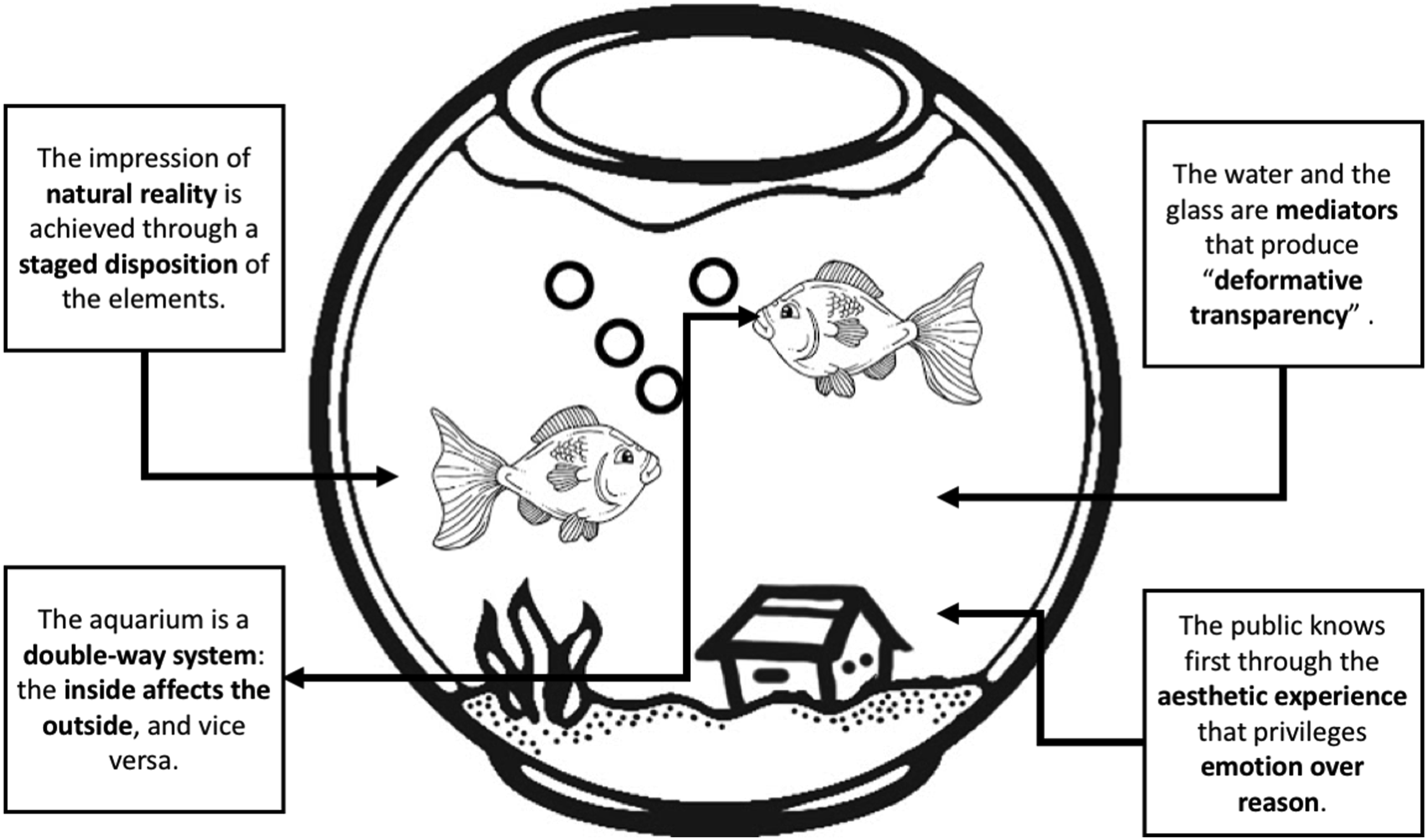
It is important to highlight that our methodological approach serves to describe and understand the narrative of such radical groups, as already done by other authors (Braddock, 2015), but adding to this the visual elements that are key in the case of grotesque transparency in the digital media ecosystem (Fisher & Prucha, 2019).
I can summarize now the four analytical and interpretative keys derived from the aquarium metaphor: 1. It describes the visually grotesque strategy that pretends to be an authentic and truthful representation of a disturbing event usually associated with the degradation and mutilation of a body in order to achieve objectives (e.g., inform attitudes or incite behaviours). It’s the so-called “reality” of the transparently grotesque that potentiates its persuasive and viral impact. 2. It considers the mediation factors playing a role in the reception of the transparently grotesque strategy, through the deformative effects of the medium (mainly, digital platforms), and other socio-cultural and religious elements intervening in the tactical appropriation of the messages and images, and their outcomes (e.g., affiliation, mobilization, attacks). 3. It ponders how the public elaborates the “truth” (as pretended knowledge of the facts or a given reality) based on the aesthetic and sensible experience of the grotesque visual representation. In classical terms, it looks at the logos as being accessible through the pathos, or cognition as mediated through emotion, and then shaping ideological mindsets and eventually inspiring actions, including violent ones. 4. It examines the two-way system formed by the inside and the outside of the “aquarium” to show how both sides interact in a dialectic way of influence and adaptation to the dynamics of the interactive media ecosystem. Branding and communication strategies evolve in a context of constant exchange between organizations and the public as an adaptive modality to emerging circumstances in the political, military, social and media ecological landscapes.
Case Study: Terrorist Propaganda
ISIS and Al-Qaeda (AQ) propaganda activities are representative of the Islamist terrorism strategy looking to instill fear in what they consider the enemy, either the “near enemy” (e.g., Shia Muslims or apostate regimes in the Middle East) or the “far enemy” (e.g., the U.S., the “Great Satan,” or the French described as “spiteful and filthy”) (El-Badawy, Comeford & Welby, 2015, p. 26). Their ideology makes a topographical distinction between the sacred or holy territories of Islam (Dar-al-Islam) and the profane or unholy territories named the “Domain of War” (Dar-al-Harb). From a strategic communication point of view, this distinction justifies any action or message targeting enemies in the “Domain of War” that will eventually contribute to the expansion of the “Domain of Islam.”
However, it would be too simplistic to approach their propaganda strategy as the continuation of war by other means, paraphrasing von Clausewitz’s aphorism. Both ISIS and AQ have incorporated media, and particularly digital networks, as their sites for political action (Lynch, 2006). They understood that the actual and virtual wars they are fighting rely more on decentralized and diffused organizations, even while establishing a central command (e.g., the declared Caliphate of Iraq and Syria by ISIS) or trying (and failing) to maintain an organic unity as a hidden or “dark” organization, as observed with AQ by Bean and Buikema (2015).
These organizations’ strategies are not only focused on terror. They also function as a way to convey their values and what they consider to be virtuous aims, or in other words, their “value proposition.” As pointed out by El-Badawy, Comeford and Welby (2015, p. 5), the dominant themes in the Salafi-jihadist organizations’ propaganda are the values of honour and solidarity, the objective of destroying the enemy, the nobility of jihad, and a strong group identity based on the ummah, the worldwide Islamic community. Atran (2017, paragraph 25), who has extensively studied young militants in Europe, North Africa, and the Middle East, concluded that, “[…] when membership in a tight community combines with a commitment to transcendent values, the willingness to make costly sacrifices will rise. The idea is to encourage devoted action for the sake of absolute values that fuse community and purpose.”
The strategy of grotesque transparency is taking place in a context marked by the return of religion and the religious to the public sphere in Western societies, through the invocation of religious values and traditions by political actors (e.g., the evangelical right in the United States) or debates around religious accommodation and interfaith coexistence in multicultural societies (Bouchard & Taylor, 2008). In both cases, the “revenge of God” (la revanche de Dieu) in the words of French author Kepel (1991), has shaken the illusion of secularism in Western democracies pretending to limit religion to the private sphere (Linden, 2014). The public is confronted, indirectly or directly, with images of the sacred and the profane (i.e. the religious in its bipolar dimension) through the strategic diffusion, re-diffusion, and use of the transparently grotesque. These grotesque and esperpentic images are conveyed by militant groups are consumed by a public that sometimes prefers the bliss of what Roy (2008) has called the “saint ignorance” (la sainte ignorance), where shared emotions (i.e., the affective) overtake discursive knowledge that is often depicted as “secular vanity” (vanité séculière) (Roy, 2008, p. 253), without a proper understanding its doctrinal and cultural foundations.
To summarize the socio-religious context of our study I would say that the diffusion of the visually grotesque by Islamist terrorist organizations is the result of a strategic calculation. The terrorist hopes that the execution of a hostage or a massacre will have a significant impact due to the massive dissemination achieved by his/her criminal act. Its agenda of social polarization, intimidation, and fear may potentially advance and modify attitudes and behaviours, and reinforce others, such as radicalization.
First Level: Revealing the Strategy
In strategic terms, ISIS and AQ seek to increase their “social capital” (Heath & Waymer, 2014). As per Baines and O’Shaughnessy (2014, p. 182), referring to AQ’s propaganda strategy, these are not “mere self-referential expression of hatred” but a way to increase support: “[…] The idea of increasing the Umma (sic)––the worldwide nation of Muslims––is central to AQ theology.” How do grotesque images of hostages being beheaded contribute to gaining sympathizers or convincing young people to join ISIS or AQ? What is the psycho-sociological mechanism that explains how, despite the horror or because of it, someone decides to join a radical organization? To answer these questions, I explore both the inside and outside of the aquarium, following our interpretative metaphor of the transparently grotesque.
Many authors have taken note of ISIS’s sophisticated production and diffusion apparatus. Stern and Berger (2015, p. 155) observed that ISIS engages a network of users – called the mijtahidun (industrious) – to boost the organization’s reach and exposure online. Friis (2015, p. 729) argued that besides the brutality of the act portrayed, “[…] what has made beheading videos of particular concern in their embodiment of a manifest transformation of an image into a ‘weapon’ for agents engaged in warfare […]” Giroux (2006, p. 20) pointed to the spectacular nature of these actions as redefining space for a “new kind of cultural politics,” an idea that resonates with the controversial comment by composer Karlheinz Stockhausen that the events of 9/11 were “the greatest work of art imaginable for the whole cosmos” (as quoted by Castle, 2011, paragraph 4). Even if Stockhausen later apologized for his remarks – explaining that he was referring to “Lucifer’s greatest work of art” (as quoted by Castle, 2011, S4) – he revealed something about the spectacular nature of global propaganda. Stockhausen was conveying, to a certain degree, the same idea as Alexander (2006, p. 61), who noted that 9/11 and other terrorist attacks correspond to a “particular kind of political performance (that) […] aims not only to kill but in and through killing also aims to gesture a dramatic way […]”
The force of these communicative acts derives from their horrific concreteness, or their luciferin character according to Stockhausen (see Figure 2). This connects them with the more “tactile categories” (Giroux, 2006, p. 19), or bodily categories of death, fear, life, and survival in clear contrast with abstract ideals such truth, reason, or justice, in contrast with the post-modern notion of the hyperreal that tends to focus too much on the simulation and the idealistic (as almost platonic forms) (Baudrillard, 1994), and not the fundamental materiality of such communication. These categories correspond more to the bakhtian notion of the realistically grotesque. This confirms their “authenticity,” not only as a truthful performance or representation, but as the confirmation of the “authenticity” of those performing it (e.g., the terrorists as representatives of a supposedly authentic and original Islam) (Giroux, 2006, p. 33). ISIS′ escalating the grotesque: burning alive the Jordanian pilot Muath Safi Yousef Al-Kasasbeh (Image from Dabiq magazine).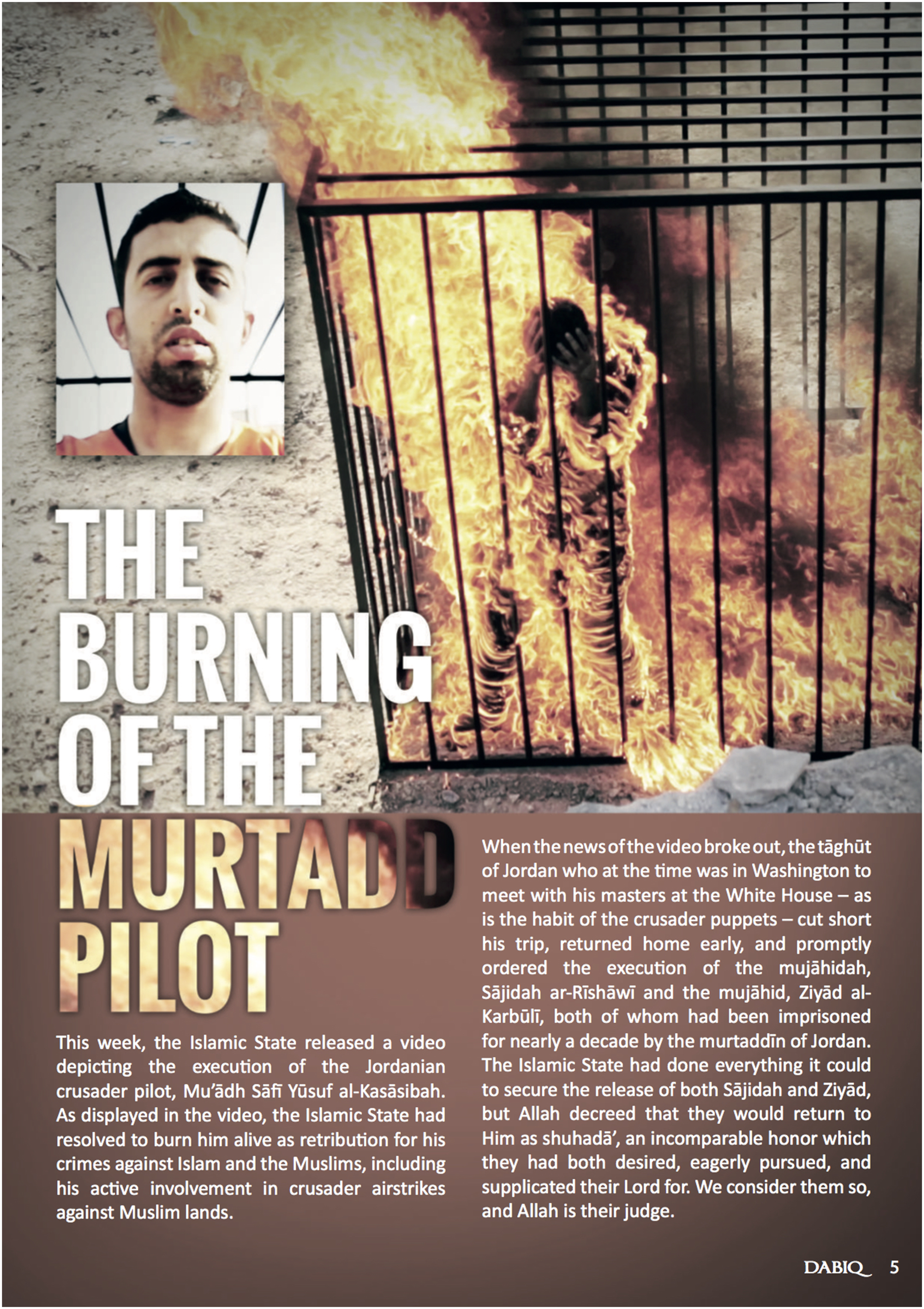
Second Level: Mediation
These horrific performances have multiple and even contradictory consequences. First, there is no unified global jihad (Tawil-Souri, 2012); there are multiple views on how to understand and justify the actions of different groups, particularly in relation to “near” and “far” enemies in Islamist terms. Second, these acts have geopolitical consequences. For example, they have contributed to reframing the conflicts in Iraq and Syria from a “humanitarian” and “sectarian” crisis to a “national security” issue requiring military and counterterrorism efforts (Friis, 2015, p. 737). Third, ISIS frequently personalizes its beheading videos to provoke an “affective connection” with public opinion. For example, this was done with the video of a soldier named Berg, where one of the hooded captors directly addressed the “mothers and wives of American soldiers” (as quoted by Heuston (2005, p. 65)).
Communication scholarship shows that mediation is as important as the medium. In the global public space, instances of mediation have multiplied. They transcend traditional groups of reference (i.e., family, friends, or the nation) and include transnational relations, networks, organizations, and ideologies (Martín-Barbero, 1993). Nowadays the mediation process is becoming “messier” because of its complex mix of social, economic and cultural factors (Couldry, Livingstone & Markham, 2009), and certainly under the influence of the growing intrusive role of digital communications in the life of people (Newport, 2019; Radianelina Hita, Kareklas & Pikleton, 2018).
The global cultural order, or “disorder,” is not exclusively emancipatory (pro-autonomy) or disciplinary (pro-control) but – as Appadurai (1996) defined it – a disjunctive, overlapped, and complex juxtaposition of various “landscapes” (ethnic, media, financial, technological, and ideological) that shape and are shaped by the imaginary. The various “non-traditional” mediation instances and mediators fill the gaps left by traditional institutions facing a credibility crisis and disaffection with liberal-democratic values and practices (Foa & Mounk, 2017). They do so, as in the case of ISIS, in a context where disfranchised individuals and communities are looking for “personal significance” (Kruglanski & Orehek, 2011) and where the emergence of a “tightening” political culture is more inclined to endorse intolerant behaviours (Gelfand et al., 2011). Viewing the grotesque images of a beheading or burning hostages alive, therefore, could be analyzed through the lenses of a “neo-orthodoxy” that at the same time questions modernity and the religious establishment (Kepel, 1991).
The multiplication of mediation instances, political (e.g., the triumph of the Iranian revolution), cultural (e.g., the revalorization of the image in Islamist propaganda), and even military (e.g., the victory against the soviet invader in Afghanistan), opened the door to the globalization of jihad and broke the borders between tradition and modernity. According to Roy (2008, p. 263, our translation), globalization “blew the link that connected the religious markers and the cultural markers.” This resulted in some religious rites or norms losing their original socio-cultural significance, creating “cultural oxymoron[s]” (Leon, 1998, p. 173) such as McDonald’s serving halal food or the use and abuse of grotesque representations of the sacrificed human body through technological means. In the religion and ideologies “global markets,” or Appadurai’s (1996) ideospaces, a competitive logic has prompted the emergence of “strategic syncretism” (Jaffrelot, 1992, p. 595) that allows for reinterpretation of identities and the eventual exportation of meaning to respond to the expectations and needs of those living in different political and social contexts.
Third Level: Tactical Appropriation by the Audiences
Through the different mediation instances (local and global ones), where radical views defy the normative and institutional frames of organized religion, the Internet has become the deterritorialized space (Mayer, 2008) to proselytize, “educate,” perform spiritual practices, and wage vicious sectarian wars (Palmer, 2014). This non-territorial virtual space helps project imaginary spaces (Roy, 2008) to a global community of believers (the ummah, according to Islam) or a global audience who are reachable and can act as a coherent and coordinated collective entity (e.g., as the crowd described by Canetti, 1960).
There is also a more intimate experience among those viewers who emotionally enjoy or ideologically justify these horrific videos. From the point of view of the so-called “pornography of violence,” this enjoyment comes from an “amoral (sic) gaze which perverts the empathetic and ethical space constitutive of death imagery” (Tait, 2008, p. 103). It is an enjoyment derived from a psychopathological mindset and an emotional agitation produced by the grotesque images’ “reality effect.” The ideological viewing experience, on the contrary, is nourished by a highly moralistic gaze about the authenticity of ISIS’s rhetoric and action, and a sense of justice that legitimizes the enemy’s disgrace (El-Badawy et al., 2015). The more ideologized audience participates in a dialectic of horror comparing televised scenes of “shock and awe” bombing in Baghdad by U.S. forces, Palestinians victims in Gaza, and the humiliation of Muslim prisoners in the Guantanamo or Abu Ghraib prisons, with what he or she considers acts of justice performed by the brave combatants of ISIS or AQ.
Viewing such horrific videos and images is not just an individual experience. The virtual digital ecosystem offers to these audiences, mostly those looking for confirmation of their ideological inclinations or affective needs, a space where “cheap speech” contributes to social polarization that can be translated into radicalization and violence (Hasen, 2017). In addition, there is evidence that online media tends to amplify the expression of moral outrage and its social consequences (Crockett, 2017).
In an era of virtual, non-territorial sectarianism, however, we have seen actual mobilization of some audiences towards specific territories, as in the case of young Westerners who convert to Islam and travel to Syria and Iraq to join ISIS. This shift from the “virtual” to the “real,” and the closely entwined relationship between them, confirms this paper’s argument that this strategy incites tactical or “creative” actions by groups and individuals. The persuasion process that leads to conversion happens both at the cognitive and emotional levels (i.e., “feeling the call from above”). This conversion eventually translates into the physical action of disrupting a territory (e.g., the terrorists who drove trucks into crowds in Nice, Barcelona, and New York) and destroying human bodies, that is actually more than a simple “simulation” à la Baudrillard. According to the Global Terrorism Index, ISIS (or ISIL) terrorist activities in the West, since its first attack in the Jewish Museum of Brussels in 2014, has produced fatal victims in France (with more than 250 deaths), followed by the United States, Belgium, the United Kingdom, Spain, Germany, Sweden, Australia, Austria and Finland (Institute for Economics & Peace, 2020).
Deradicalization Strategies
Western governments have launched campaigns to counter the recruitment efforts of radical Islamist organizations. These campaigns sometimes use grotesque transparency – recycling visual material from ISIS and other terrorist groups – to convey the horror caused by terrorists and denounce their lies, as the French government did with StopDjihadisme (Ziv, 2015). Other programs, such as the British government Prevent, look to effect “attitudinal and behavioural” change in local young Muslims who are potential recruitment targets for terrorist organizations through covert propaganda tactics (Cobain, 2016). Prevent in particular has created controversy; according to its critics, it has stigmatized and caused fear among Muslims in the U.K., and breached their rights to freedom of speech and protection of privacy (Graham, 2017). Other efforts in this area focus on helping former ISIS militants rejoin society, but the efficacy of these interventions (including the Canada Centre for Community Engagement and Prevention of Violence, which funds several different programs) is far from proven (Dyer, 2017).
The main criticism of anti- or de-radicalization initiatives is that they tend to simplify a complex issue and may fuel violent narratives or even discrimination against certain communities, particularly Islamophobia. Radicalization among young people and eventual allegiance to ISIS results from multiple factors, “[…] including social and economic inequality, political polarization, globalization, declining levels of trust in institutions, disaffection, belonging and identity crises, and discrimination” (Goñi, 2017, n.p.). These campaigns are also perceived as an additional source of polarization in societies already experiencing tensions caused by cultural differences, religious accommodation claims, and terrorist attacks (Bond, 2014). In addition, anti-radicalization programs that aim to prevent homegrown terrorism may, according to some critics, “[create] the potential for systemic human rights abuses” (Open Society Justice Initiative, 2016, p. 16).
Another prescription for achieving anti-/de-radicalization proposes to limit freedom of speech and propaganda in cyberspace, and to put the onus on so-called “Internet intermediaries” such as Facebook, Twitter, Google, and YouTube to tackle online terrorism and strike a balance between the right to express ideas publicly and their own social responsibility (Cohen-Almagor, 2017, p. 129).
In attempting to implement a counter-strategy against the transparently grotesque strategy of terrorist organizations, governments, NGOs, and corporations are faced with the challenges created by a fragmented public sphere; the conflicting rationales of protecting both human rights and public security; and most of all, the competitive views of different groups and communities looking to advance or protect their “passionate interests” (Latour & Lépinay, 2009). To add to this complexity, the explicit connection between these counter-strategies and the realm of the religious, the spiritual, and the sacred – or in other words, their aim to oppose or present alternative religious narratives – prompts cultural, political, ethical, and legal discussions in an already-crowded polyphonic communication ecosystem.
General Discussion
Theoretical Implications
Grotesque transparency embodies some of the characteristics of older propaganda: its focus on the affective and emotional drivers, its ability to synthesize complex issues in a visual image, and its disruptive nature. Its novelty lies in the ease with which potentially everyone can be a propagandist, transforming the strategic prescriptions of the organized terrorist into an individual “creative” tactic or action. In this context of media fragmentation and digital networks, the very notion of social marketing as mainly a strategic endeavour to favour general change of attitudes and behaviours may be reconsidered as a more dialogic and individualized interaction to understand the expectations, needs and ideas of the different “tribal groups” or micro-segments of the audience (Veroni, 2014).
The religious claims of ISIS or AQ’s transparently grotesque strategy points to the tension between what should be visible versus what should remain invisible, in a very prescriptive way. A tension that can also be seen as a contradiction of the sacred versus the profane (Eliade, 1957/2013). The sacred is a dimension that remains separate, distant or inaccessible; the profane represent “the sensible,” which is accessible to the eyes or even touch (Tessier & Prades, 1991). This study has revealed that any attempt to counter the effects of radicalization strategies may reinsert a notion of the sacred in the social marketing initiatives, including notions such as the respect of human life and dignity (see below about the practical applications).
The value of “authenticity” is what most populist politicians, terrorists, and some corporations emphasize. In a world in which the virtual (e.g. online) is perceived as inauthentic, false (e.g., “fake news”), and subject to manipulation, the illusion of transparency confirms the “truthful” nature of these shocking and disrupting visual images. The perceived authenticity of the event lies in the emotional connection or even disgust that users express, as researches in marketing and communication have shown (Illouz, 2017; Molleda, 2010).
The visually grotesque gives meaning to events in a world of excess, fragmentation, and disenchantment. The language of the ocular reduces ambiguity, privileges the concrete, and facilitates moral judgments. It has become a way of “knowing” based on emotion. Therefore, the emotional factor could be integrated in deradicalization efforts as a way to facilitate a reflexive appreciation of the consequences of radicalization.
The effect of transparency is also associated with the exposure of violence in different ways. Disclosure of the realistically grotesque can play a cathartic or purgatory-type role in what Girard (1972/2010, p. 386, our translation) called the intrinsic unity between the sacred and violence that “allows to organize all the elements of the sacred in an intelligible totality.” As I have shown in this paper, the sacred and the profane in grotesque transparency, from its disturbing obscurity in Girard’s (1972/2010) terms, require qualitative interpretive keys that could inform deeper social and cultural processes beyond just their functional quantification of how strategies based on visual excesses may affect attitudes and behaviours of religious radicalization.
Implications for Social Marketing
I can point now to some social marketing considerations raised by the grotesque transparency analysis of radicalization propaganda. Before doing that, I would like to highlight that these considerations contribute to better some of the weaknesses of previous anti-deradicalization or deradicalization strategies in various countries, as discussed earlier in this paper. One is that experts and officers may reconsider the way they approach the very notion of strategy when trying to counter the effects of grotesque transparency radical propaganda among certain groups of the population. They can move beyond the traditional perspective of social marketing as planned and calculated effort to influence the acceptability of social ideas (Kotler & Zaltman, 1971), based on a control-command approach (Mahoney, 2017), and even the very idea of strategy (Hallahan et al., 2007). In this regard, integrating the notion of “strategizing” to deradicalization initiatives provides an alternative perspective that proposes a more horizontal and open process that allows the emergence of an “organizational direction” (Ate & Thomas, 2016) instead of imposing one particular worldview. As stated by Ate and Thomas (2016, p. 175) “(…) crowdsourcing platforms can be used to increase participation in the strategizing process, generate a multitude of innovative ideas, and bring both internal and external stakeholders at all levels into an organization’s strategic conversation (…).”
Second, as a consequence of the “strategizing” turn (in contrast with a more rigid strategy), social marketers may consider adopting an open branding angle when creating platforms to counter religious or political radicalization, which means integrating what the public has to say and contribute to the creative and tactical enhancement and diffusion of the counter-propaganda brand (Veroni, 2014). The example of the truth®, the anti-tobacco campaign targeted to a young public in the USA, shows how brand equity can add value to social marketing initiatives (Evans et al., 2005) and how “brand appropriation” can lead to a more interactive relationship between the “clients” and the anti-radicalization initiative.
Third, a notion of the sacred (not necessarily in religious terms) might be conveyed in anti-radicalization and deradicalization strategies, particularly fundamental principles such as human dignity (Safranski, 1999) and the respect of individual autonomy (vs. group thinking). A value-based perspective could be put forward, since radicalization is not just a blind acceptation of a fundamentalist ideology, but a competing set of values in the context of what is sometimes perceived as a morally “degraded” society.
Fourth, visual communication should be a key element of anti-radicalization and deradicalization strategies, not as a mirror of the visually grotesque, bus as a way to instill cognitive and affective reflection of the concrete consequences of terrorist actions and crimes. Images can contribute to transition from the abstraction of radical ideas to the concrete consequences of radical actions, including the suffering and distress that they cause on real human beings.
Fifth, social mediation factors may be considered in the anti-radicalization and deradicalization social marketing initiatives, working with community members and promoting different tools and activities to critically read and interpret fundamentalist and extremist messages and images. Religious leaders, peers, family members, can be part of the conversation both in more personal and intimate level and in the broader public sphere.
And finally, authenticity may be showcased as a key value to maintain family, community and friendship relations, in contrast with the claimed “authenticity” of those leaders and groups that create an impression of being truthful through the manipulation of strong emotions, and breaking up these human connections. The contrast between the “authenticity” of violence and its consequences with the authenticity of fundamental human relations within the family and the community emphasize again the value-based approach of any counter-radicalization social marketing action.
Limitations and Research Venues
The most obvious limitation of this paper is that our analysis of the Islamist terrorist propaganda, with particular focus on ISIS and AQ, is based on a literature review and the results of previous empirical research. The question of reception and tactical appropriation by some groups remains an important area to be explored in future research by directly observing and interrogating consumers of this kind of content. It will also be important to apply the grotesque transparency framework to study other forms of fundamentalist propaganda, and the most recent wave of conspiracy theories circulating on the digital ecosystem during the Covid-19 pandemic.
Conclusion
The multiplication of visual images and the ability that any individual has to create, manipulate and broadcast them to the entire world, represent a significant transformation in the way we produce content, consume it, process knowledge and experience emotions. This requires a profound revision of notions such as strategy, transparency, and the very aesthetic canons that determine tastes, ideological affinities, and even inspire behaviours. By looking at these issues from the point of view of grotesque transparency strategy, and its aesthetic and religious anthropological features, this paper pretended to modestly contribute to the understanding of these important challenges for social marketing and public policy.
Footnotes
Declaration of Conflicting Interests
The author(s) declared no potential conflicts of interest with respect to the research, authorship, and/or publication of this article.
Funding
The author(s) received no financial support for the research, authorship, and/or publication of this article.
