



Abstract
Background
Government and private responses to the COVID-19 pandemic resulted in the generation and dissemination of personal data not previously available in the public sphere.
Focus of the Article
This “Notes from the Field” paper reflects on the implications of this surge of new data for the study and practice of social marketing. The paper examines how this phenomenon impacts on the following aspects of social marketing: (1) Setting of explicit social goals; (2) citizen orientation and focus; (3) value proposition delivery via the social marketing intervention mix; (4) theory-, insight-, data-, and evidence-informed audience segmentation; (5) competition/barrier and asset analysis; and (6) critical thinking, reflexivity, and being ethical.
Research Question
How are the government and private responses to the pandemic shaping the generation and use of personal data, and what are the implications of this eruption of data for the social marketing scholarly community?
Approach
The paper highlights how the pandemic resulted in significant changes in behavior of government and citizens alike, and how these changes, in turn, spurred the generation and dissemination of new personal data. Subsequently, we draw on the Core Social Marketing Concepts framework to explore how the aforementioned data explosion impacts on the six dimensions of this central framework.
Importance to the Social Marketing Field
The COVID-19 pandemic is more than a temporary public health event. Therefore, it is important to consider the lasting consequences that may stem from the pandemic-induced personal data explosion, for both consumers and social marketing scholars and practitioners.
Methods
This paper comments on a topical matter, and discusses its implications for the social marketing community.
Results
We find that the data explosion creates conflicting social marketing goals, and that inequalities in access to digital technology are increasingly impacting what voices are heard, and which concerns are prioritized. Moreover, new innovations may be enabled or needed, leading to the improvement of firms' ability to create value for individual citizens; the creation of new datasets—particularly among demographics that previously had a limited digital footprint—enhances the ability to segment markets and target social marketing activities. Furthermore, the pandemic-induced data explosion may lead to the identification of additional barriers to positive social behaviors that have emerged, diminished, or even disappeared during the pandemic; but researchers need to critically examine the consequences of the government and private behaviors at the macro, meso, and micro levels.
Recommendations for Research or Practice
We propose a research agenda for the social marketing community, consisting of 21 research questions.
Limitations
Our analysis focuses on the behavior of government and citizens in North America and Western Europe.
Introduction
To monitor and control the spread of infection during the COVID-19 pandemic, governments worldwide started collecting – and sharing – information about the movements, activities, and health status of their citizens. Meanwhile, isolated individuals increased online activities and voluntary self-disclosure. These trends made available a large pool of personal data not previously available in the public sphere.
Consumer data play a critical role in social marketing in general (Metzler & Coffey, 2018), and the management of pandemics, in particular (French, 2016). Because the concerns and interests of actors shape the use of consumer data (Cluley, 2020), this paper examines the following research question: “How are the government and private responses to the pandemic shaping the generation and use of personal data, and what are the implications of this eruption of data for the social marketing scholarly community?” Subsequently, the paper draws on the core social marketing concepts (ISMA, 2017) to outline implications of this eruption of data for the social marketing scholarly community.
Drivers
COVID-19 is a novel and highly infectious respiratory disease, which to date has caused more than 5.41 million deaths globally.
2
The pandemic has resulted in significant changes in behavior of government and citizens alike, which, in turn, has spurred the generation and dissemination of personal data, as discussed next and summarized in Figure 1. Data generation and dissemination resulting from responses to COVID-19.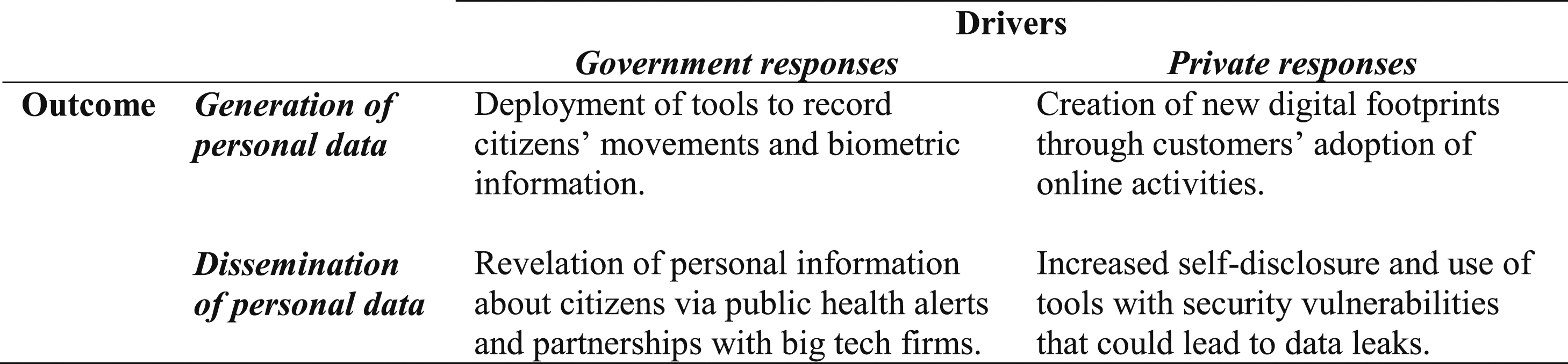
Government Responses
Data Generation. The spread of COVID-19 was accompanied by a sudden restriction in movement, in most countries. At first, the restrictions were voluntary—business travel slowed, meetings were postponed or moved online, and individuals in vulnerable groups stayed home. Shortly thereafter, as quarantines and stay-at-home directives were imposed by governments across the globe, citizens were abruptly forced online for access to essential goods and services. For example, telemedicine, whose adoption had previously remained far below expectations, became a key tool in triaging possible COVID-19 patients, as well as reducing other patients’ risk of exposure to the virus (Hollander and Carr, 2020). Moreover, to record citizens’ movements and biometric information, governments deployed a number of surveillance strategies. Some existing tools were repurposed to monitor citizens’ compliance with movement restrictions. For instance, Brough and Martin (2020) reported the use of traffic monitoring technology in India and of phone surveillance technology in Israel. In addition, various governments adopted contact tracing apps that increase the generalized and indiscriminate collection of electronic records about private individuals (Cox, 2020).
Data Dissemination. Not only did governments collect more data—they also released highly sensitive personal information. For instance, the UK revealed that the first British national had been diagnosed with COVID-19 in the seaside town of Brighton. This alert led to the publicizing of that person’s name, professional occupation, and recent travel itinerary, as well as the identification of individuals who had accompanied them on holiday (Boseley et al., 2020). Beyond public announcements about infected individuals, governments have developed partnerships with big tech firms, granting them access to personal data about healthy individuals (Fitzgerald & Crider, 2020).
Private Responses
Data Generation. While isolated at home, many individuals turned online for various work, education, and leisure activities. The sudden shift from offline to online activities enabled firms to gain access to data about previously inaccessible consumer segments. For example, grocers and delivery services noted a surge of app downloads and new sign-ups (Repko, 2020), while Zoom and other video conferencing platforms, traditionally associated with the business world, were widely adopted for schooling and socializing (Yuan, 2020). Moreover, the flurry of online activity led to the creation of new digital footprints as information that was not previously recorded was digitized—including online addiction recovery meetings (Bertoni, 2020) and streamed religious services. 3
Implications for Social Marketing
The COVID-19 pandemic is more than a temporary public health event. Therefore, it is important to consider the lasting consequences that may stem from the pandemic-induced personal data explosion, for both consumers and social marketing practitioners.
Social marketing refers to the use of marketing concepts to facilitate the achievement of social good, through the behaviors of individuals, communities, and society. To achieve these goals, social marketers need to consider the following six elements (ISMA, 2017): (1) Setting of explicit social goals; (2) citizen orientation and focus; (3) value proposition delivery via the social marketing intervention mix; (4) theory, insight, data, and evidence informed audience segmentation; (5) competition/barrier and asset analysis; and (6) critical thinking, reflexivity, and being ethical. We draw on this conceptualization to discuss the implications of the pandemic-induced data explosion for social marketing.
Social Marketing Goals
Social marketing programs aim to influence individual and collective behaviors. In order to develop explicit and measurable goals associated with the phenomenon that they are trying to influence, social marketers need to use relevant information that show them not only the barriers faced, but also how difficult it will be to change the targeted behavior (Hayden & Deng, 2012). The analysis of what datasets become available as a result of government and private action during the pandemic, and how they are used, can reveal the concerns and interests of relevant actors (Cluley, 2020).
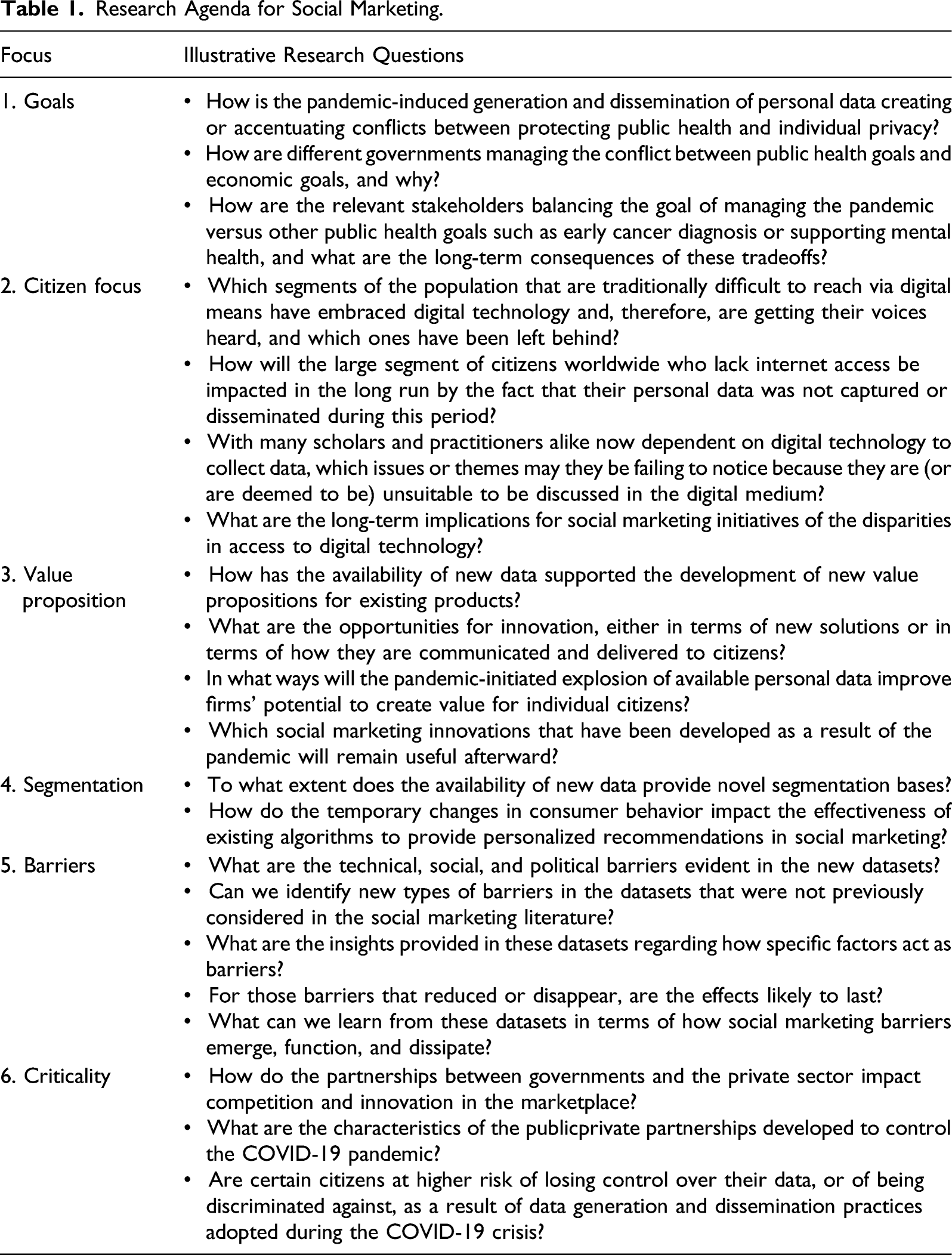
One implication of the data explosion is the creation of conflicting social marketing goals. For instance, the pandemic-induced generation and dissemination of personal data has created new conflicts between protecting public health and individual privacy (Mikkelsen et al., 2020). More data is available to combat social ills and public health challenges, but at a greater cost to the individuals whose data is used—and potentially greater backlash to the social marketers who use this data. Although governments have taken different approaches to managing these conflicts, their actions have often been met with widespread criticism. Given the long-term tradeoffs these conflicts present to relevant stakeholders, additional research is warranted to better understand the right balance to managing such conflicts.
Citizen Focus
Social marketing scholars and practitioners have a duty to engage with the beneficiaries of social initiatives. For that end, social marketers follow methodologies for identifying citizen needs and values, and including them in co-creation opportunities, which often rely on face-to-face interaction and community action (Wood & Fowlie, 2013). During the pandemic, this engagement is largely done via digital technology, whether because of social distancing requirements or because of the emphasis on surveillance strategies. However, the overreliance on digital technology to provide a broad range of services can harm the experiences of citizens without access to the technology (Ekpo et al., 2018).
In the wake of the pandemic-induced data explosion, inequalities in access to digital technology are increasingly impacting what voices are heard and which concerns are prioritized. For instance, while some segments of the population that are traditionally difficult to reach via digital means have embraced digital technology and are therefore being heard, others have been left behind. A large segment of citizens worldwide who lack internet access may be negatively impacted in the long run by the fact that their personal data was not captured or disseminated during this period, which can bias artificial intelligence algorithms (Huang & Rust, 2021). Such disparities in access to digital technology may have long-term implications for social marketing initiatives, and some initiatives may suffer from neglect as issues or themes that are deemed unsuitable to be discussed in the digital medium are ignored by scholars and practitioners who have become dependent on digital technology to collect data.
Value Proposition
Value propositions refer to how social marketing initiatives create value for citizens and are developed based on the insight available. Building on the market research, social marketers can develop offers that address citizens’ needs, and they can communicate and deliver their programs in ways that address citizens’ concerns and customs (Metzler & Coffey, 2018). As new segments started using digital technology or extended their use to new areas of their lives, new needs and preferences became evident (Yuan, 2020).
As a result of the pool of personal data made available during the pandemic, new innovations may be enabled or needed, leading to the improvement of firms’ ability to create value for individual citizens. For example, the availability of new data has supported the development of new value propositions for certain existing products, such as Zoom. Other opportunities may exist for innovation, in terms of new solutions as well as in terms of how they are communicated and delivered to citizens. For example, Disney created several family singalongs consisting of musical performances from select Disney films; these specials included public service announcements that raised awareness for social causes such as Feeding America. By combining viewer demographic data with donation behavior, social marketing insights may lead to similar innovations to promote general health and consumer well-being that could remain useful after the pandemic.
Segmentation
Clustering the market into segments with similar characteristics and needs supports the development of social marketing initiatives. In particular, it is necessary to develop granular segmentation, which enables effective targeting of social marketing programs (French, 2016). Algorithmic decision-making systems and artificial intelligence are increasingly used for segmentation purposes, but they require large and timely datasets (Constantiou & Kallinikos, 2015).
The creation of new datasets—particularly among demographics that previously had a limited digital footprint—enhances the ability to segment markets and target social marketing activities. For instance, the availability of new data that was previously available only in offline channels (e.g., alcoholics anonymous meetings) may provide novel segmentation bases. And even the temporary changes in consumer behavior during the pandemic may impact the effectiveness of existing algorithms to provide personalized recommendations in social marketing.
Barriers
Social marketing scholars also need to identify the actors and factors that can hinder the adoption of positive social behaviors, so that strategies can be developed to reduce their influence. These barriers can be of a technical, social, or political nature (Hayden & Deng, 2012). In the context of the COVID-19 pandemic, a range of factors has impacted the adoption of desired public health behaviors, including feelings of isolation, caring responsibilities, type of job, group membership, and skepticism toward official messaging (Lee, 2020). At the same time, long-standing barriers dissipated, as in the case of telemedicine (Hollander & Carr, 2020). Widespread distrust in the public sector regarding the potential misuse of personal data may also interfere with social marketers’ efforts to influence prosocial behaviors.
The pandemic-induced data explosion may lead to the identification of additional barriers to positive social behavior that have emerged, diminished, or even disappeared during the pandemic. Additional research may be needed to determine how lasting these effects will be, as well as to gain insights into the processes by which social marketing barriers emerge, function, and dissipate.
Criticality
Finally, social marketers need to ensure that initiatives are cost effective, culturally acceptable and relevant, and ethical. Health issues are one of the most important challenges facing humanity and the social marketing community (Kassirer at al., 2019), which may result in governments partnering with technology firms, in order to benefit from the latter’s analytical resources and expertise (Cox, 2020). The privileged access to citizen data by companies which already have significant market power can have significant detrimental effects on markets, organizations, and individuals (Blose et al., 2020).
Researchers need to critically examine the consequences of the government and private behaviors at the macro, meso, and micro levels. For instance, new partnerships between governments and the private sector were formed to control the COVID-19 pandemic that have the potential to impact competition and innovation in the marketplace. As a result of these public-private partnerships, certain citizens may be at higher risk of losing control over their data, or of being discriminated against, because of data generation and dissemination practices adopted during the COVID-19 crisis.
Research Agenda for Social Marketing.
Conclusion
The increased generation and dissemination of personal data resulting from government and individual responses to the COVID-19 pandemic has important implications for both markets and individuals. While access to this data presents an opportunity for social marketers, it is not unique or exclusive to social marketers. Indeed, to the extent that commercial marketers’ goals are misaligned with consumer welfare, their use of this data to promote marketing of unhealthy consumption (e.g., tobacco) may counter social marketing initiatives. We hope that the insights discussed in this article will inspire social marketing scholars to further explore the lasting consequences of the pandemic-induced explosion of personal data.
Footnotes
Declaration of Conflicting Interests
The authors declared no potential conflicts of interest with respect to the research, authorship, and/or publication of this article.
Funding
The authors received no financial support for the research, authorship, and/or publication of this article.
Note
This commentary went through double-anonymized peer review.
