




Abstract
The often-forgotten dimension of public infrastructure finance is the difficulty of maintaining a proper level of infrastructure in good condition. Given that increasing responsibilities for public infrastructure investment have been decentralized worldwide, this study investigates the impact of fiscal and political decentralization on infrastructure maintenance expenditures using a panel cross-country analysis from 1995 to 2020. To address the endogeneity concerns and estimate the causal impact of fiscal decentralization (revenue and expenditure decentralization), this research uses the Geographic Fragmentation Index and country size as two valid instrumental variables for fiscal decentralization. Our main results confirm that fiscal and political decentralization measures are found to increase public spending on road maintenance. The findings are robust to alternative model specifications and different measures of fiscal and political decentralization.
Introduction
Routine maintenance is vital to ensure the function and safety of infrastructure assets. Studies have shown that delayed maintenance results in faster deterioration of capital assets (e.g., Chen, 2017), causes travel delays (Bock & Blemings, 2024), increases traffic fatalities (Nguyen-Hoang & Yeung, 2014), and incurs greater costs of infrastructure rebuilding (e.g., Dornan, 2002; Kim, 2022). In practice, the maintenance of existing public infrastructure has often been neglected in favor of building new infrastructure in both developed and developing countries (Rioja, 2003).
Why do governments underinvest in infrastructure maintenance? A few studies have found that fiscal stress (Bumgarner et al., 1991; Chen, 2016), political institutions (Bock & Blemings, 2024; Kim, 2022), and infrastructure accounting methods (Kim et al., 2018) are statistically significant determinants of public infrastructure maintenance expenditures. Does increased government decentralization worldwide affect the proper maintenance of public infrastructure? Across the globe, there has been a great decentralization movement in the public infrastructure field (Frank & Martinez-Vazquez, 2016). Currently, subnational governments play an important and growing role in the provision of public infrastructure services. According to Frank and Martinez-Vazquez (2016), in the Organization for Economic Co-operation and Development (OECD) countries and subnational governments account for an average of 63% of public fixed capital formation and about 40% in developing countries. Although there are many empirical studies on the effects of decentralized governance on infrastructure quality and investment, there is a paucity of cross-country research that links fiscal decentralization and public infrastructure maintenance expenditures (Martínez-Vázquez et al., 2017).
To fill the research gap, this study examines the role of decentralized governance in ameliorating or deepening the universally observed problems related to inadequate levels of infrastructure maintenance. We first build a simplified theoretical framework to explain how decentralization may affect infrastructure maintenance. On the positive side, the devolution of decision-making powers from central governments to subnational governments is expected to have a positive effect on infrastructure maintenance because it not only allows governments to better adapt to local infrastructure preferences but also brings more direct accountability mechanisms to residents and firms. In addition, fiscal competition can generate additional incentives for subnational governments to raise infrastructure maintenance spending to attract new residents and businesses (Keen & Marchand, 1997). On the negative side, decentralized governance may face challenges related to multi-level infrastructure coordination, weak subnational infrastructure planning and management capacity, and constrained subnational financial resources. Next, we employ a large panel data set of countries to test the role of decentralized governance (fiscal and political decentralization) on the level of public road infrastructure maintenance after controlling for other institutional variables that may be expected to play a role based on the existing literature on this subject. Our main finding is that overall fiscal or political decentralization largely increases road infrastructure maintenance expenditures. These key results are robust to different specifications of the main explanatory variables and alternate estimation methods.
The rest of the paper is organized as follows. Section “Review of Relevant Literature” provides a literature review of decentralization and infrastructure as well as the general determinants of infrastructure investment and performance. Section “A Simplified Theoretical Framework” develops a simple theoretical framework. Section “Empirical Analysis: Data and Variables” discusses the data, variables, and research methods. We present the main empirical results in section “Empirical Methodology: Panel IV Estimation” and robustness checks in section “Empirical Results”. The final section concludes with discussion and policy implications.
Review of Relevant Literature
Previous Studies on Infrastructure Maintenance
A well-developed and carefully maintained public infrastructure system is of critical importance to ensure that the economy can function effectively. There is a growing number of academic studies that examine the macroeconomic effect of infrastructure maintenance expenditures. Rioja (2003) argues that the maintenance of existing public infrastructure has often been neglected in support of building new infrastructure in developing countries. Rioja (2003) develops a dynamic general equilibrium model that examines the reasons and effects of such neglect. Based on the quantitative modeling of seven Latin American countries, Rioja (2003) concludes that reallocating funds from new infrastructure to maintenance can have positive effects on nations’ gross domestic product (GDP). Kalaitzidakis and Kalyvitis (2005) use the Canadian nationwide data set to test the economic growth impact of new public investment along with maintenance expenditures in public capital. The authors posit that public maintenance spending is a critical determinant of long-run economic growth, whose economic impact should be analyzed in conjunction with that of expenditures in new capital formation.
In the context of U.S. subnational governments, Kalyvitis and Vella (2015) evaluate the productivity of water and transportation infrastructure operation and maintenance (O&M) expenditures by state and local governments in the 48 contiguous U.S. states during the period 1978 to 2000. The authors find that a 1% increase in state O&M spending corresponds to a statistically significant increase in state economic outputs ranging from 0.37% (Missouri) to 0.46% (Michigan). Besides the research focus on the growth effect, Gibson and Rioja (2017) explore the role of maintenance expenditures on the distribution of wealth in a heterogeneous agents’ model in the context of Mexico. The authors confirm more allocation on public maintenance spending reduces wealth inequality (the Gini index) and improves the distribution of wealth. Rather than analyzing the economic role of infrastructure maintenance, a most recent study by Huet-Vaughn (2019) investigates the impact of public road maintenance spending on voting behavior using a quasi-experimental design and the distribution of American Recovery and Reinvestment Act road projects in New Jersey. The author finds that Democrat-approved, federally funded highway maintenance expenditures increase local presidential vote shares for the Democratic Party (Huet-Vaughn, 2019).
Compared with the abundant research on the determinants of infrastructure investment and quality (e.g., Grigoli & Mills, 2014; Gupta et al., 2016; Keefe & Knack, 2007; Tanzi & Davoodi, 1997; Vergne, 2009; Wijsman & Crombez, 2021), the factors affecting infrastructure maintenance have received less attention in the literature. Several authors model the optional allocation of infrastructure spending between new capital formation and maintenance and contend that the optimal maintenance spending hinges on various model parameters, including depreciation rates (Agénor, 2009; Rioja, 2003) and congestion rates (Dioikitopoulos & Kalyvitis, 2008). Blazey et al. (2020) point out the four reasons why infrastructure maintenance has often been neglected: political economy reasons (infrastructure maintenance expenditures are not politically favored—there are no ribbon cuttings for pothole repairs), fiscal reasons (maintenance expenditures are often viewed as discretionary spending and can be easily cut during periods of fiscal stress), institutional reasons (separate agencies prepare capital investment and maintenance without an integrated medium-term perspective), and capacity reasons (lack of up-to-date information on assessing the condition of capital assets and maintenance needs and weak capacity in life-cycle asset management) (pp. 265–266). Empirically, a few studies have investigated the determinants of state and local government spending on infrastructure maintenance. At the local government level, Bumgarner et al. (1991), using a cross-sectional expenditure dataset collected from 42 city budgets from 1978 to 1979, find that fiscally distressed cities engage in significantly lower capital and maintenance expenditures relative to expenditures on non-capital expenditures. Walden and Eryuruk (2012) examine county highway capital and maintenance spending in North Carolina during the period 1990 to 2005 and compare three models of public spending: the median voter model, the special interest model, and the political model. They find that the employment market condition and the county’s relative vote in the most recent election for the state’s dominant political party are the strong determinants of county highway capital spending. County highway maintenance spending is found to be positively affected by median household income, vehicles per capita, and road size, while they found no evidence of political influence factors. Most recently, Bock and Blemings (2024) analyzed how local political incentives affect local road maintenance based on completed road maintenance projects in the City of Pittsburg, Pennsylvania, from 2009 to 2017. Based on a difference-in-differences method that leverages exogenous timing of mayoral election, the authors find the timing of road maintenance is shifted according to the political similarity of areas in mayoral election years.
At the state government level, Chen (2016) examines how the deteriorating fiscal conditions of state governments affect state highway capital and maintenance spending. Based on a panel data analysis of 48 states in the U.S., from 1999 to 2009, his empirical findings give support to the fiscal stress hypothesis that state highway maintenance spending is negatively affected by the lagged values of state fiscal stress. Kim et al. (2018) contend that the implementation of the Government Accounting Standard Board Statement No. 34 improved state highway quality by raising state highway maintenance expenditures, and the states using the modified approach had a larger effect on road maintenance spending compared to the states using depreciation accounting. Kim (2022) employs a panel data analysis covering 47 states from 1995 to 2009 to investigate the effects of politics on state highway routine maintenance spending. The author confirms that political election incentives and divided governments are the key factors delaying state highway routine maintenance spending.
Previous Studies on Fiscal Decentralization and Infrastructure Finance
There is a limited number of empirical studies on the effects of decentralization on infrastructure investment, composition, and performance (Martínez-Vázquez et al., 2017). Most of the existing empirical studies on the effect of fiscal decentralization on infrastructure have focused on a cross-country setting. In 1994, the World Bank released the World Development Report 1994—Infrastructure for Development. The main messages of this report were that infrastructure provides public goods of a localized nature, and decentralization offers a good opportunity to improve the provision of infrastructure. Based on a review of infrastructure development in 42 developing countries, that report found that decentralized road maintenance leads to lower backlogs and costs, and better road conditions. Similarly, decentralized governance results in better performance and maintenance in the water and sanitation sectors than would be the case in more centralized settings (Word Bank, 1994). Estache and Sinha (1995) explore the impact of fiscal decentralization on per capita infrastructure expenditures from 1970 to 1992 using a panel of two samples of countries (10 industrialized and 10 developing countries). These authors find that decentralization matters, increasing total and subnational expenditures on infrastructure services in both developed and developing countries. Estache and Sinha (1995) further compare the findings between developed and developing countries and conclude that an increase in the degree of decentralization results in larger increases in infrastructure expenditure in developing countries than in industrialized countries. Kappeler and Välilä (2008) investigate the role of fiscal decentralization on the composition of public investment in a panel of 10 EU countries during the period 1990 to 2005. Their results suggest that fiscal decentralization increases economically productive public investment (infrastructure) and reduces economically less productive investment (recreational facilities).
More recently, Viñuela (2015) utilized an expanded cross-country sample of 87 developed and developing countries from 1990 to 2010 to analyze the effect of fiscal decentralization on the quantity and quality of public infrastructure. The author concludes that fiscal decentralization is positively associated with the quality of infrastructure but is negatively associated with aggregate levels of fixed capital formation. Viñuela (2015) suggests that lower levels of capital investment may be reflective of efficiency gains or due to the potentially insufficient access to financing and stable infrastructure funding sources for subnational governments. Kappeler et al. (2013) examine the effect of revenue decentralization on regional infrastructure investment using panel data covering 20 European countries over the period 1990 to 2009. The authors find regional infrastructure investment generally increases with decentralization, and that this impact decreases with the level of (capital) transfer dependence by subnational governments.
Several studies have focused on examining the effect of fiscal decentralization on infrastructure in specific countries. Faguet (2004) examines whether decentralization increases the responsiveness of public investment to local needs using a unique database from Bolivia. The author finds that decentralization significantly changed public investment patterns in Bolivia. In particular, decentralization led to higher investment in human capital and social services because the poorest regions of the country chose projects according to their greatest needs. Esteller Moré and Solé Ollé (2005) use a unique Spanish database to explore the effect of decentralization reforms on road and educational infrastructure investment and capital stock. They find that road and educational investments made by subnational governments in Spain are much more sensitive to changes in output, users, and costs than those investments made by the central government. Escaleras and Calcagno (2018) analyze the role of fiscal decentralization on the quality of highway infrastructure in the U.S. 50 states. Based on generalized linear model estimation on state data from 1992 to 2012, the authors find evidence that fiscal decentralization improves the quality of state highways and bridges.
In summary, despite the plentiful evidence in the related literature, previous studies are generally limited in at least three respects: (1) the literature on infrastructure finance has largely neglected the analysis of public expenditure in infrastructure maintenance. To the best of our knowledge, to date, there is a lack of an empirical analysis of the determinants of infrastructure maintenance at the country level, (2) evidence for the effect of both fiscal and political decentralization on infrastructure maintenance is scarce, and (3) potential endogeneity problems are prevalent in existing studies. This research addresses these limitations by applying instrumental variable (IV) estimation and system GMM to a longitudinal data set of cross-countries to scrutinize the effect of fiscal and political decentralization on infrastructure maintenance.
A Simplified Theoretical Framework
In this section, we build a simplified theoretical framework to explain how decentralization may affect infrastructure maintenance. 1 In general, decentralization means the devolution of decision-making powers (e.g., political, fiscal, and administrative) from central governments to subnational governments (Martínez-Vázquez et al., 2017, p. 1096). Oates’ (1972) classical decentralization theorem states that in the presence of heterogeneous preferences and needs across jurisdictions and localities, the provision of public services in a decentralized governance structure will generally increase citizen welfare and improve public service performance (barring large economies of scale and externalities).
Following the logic of Oates’ decentralization theory, decentralized governance offers significant advantages for improved infrastructure maintenance. First, decentralization moves infrastructure maintenance decision-making and project implementation closer to localities and enhances the ability of governments to reflect and match local infrastructure maintenance needs. Central governments are typically far away from localities. The centralized decision on infrastructure maintenance may not allow for variations in local infrastructure preferences. By contrast, local governments are closer to citizens. Local government officials possess information advantages about the usage, depreciation, needs, and condition of local infrastructure. Hence, local governments have more knowledge and flexibility in accommodating citizens’ preferences for routine infrastructure maintenance and repair (Viñuela, 2015). Second, decentralization improves the incentive of local government officials to adequately maintain public infrastructure in good condition. When the infrastructure responsibilities are more localized, local governments have strong incentives for efficiently operating and maintaining infrastructure. This is because infrastructure maintenance decisions will be closer to those who benefit more from improved infrastructure quality (Fox & Murray, 2016). Furthermore, as Tiebout (1956) contends, citizens can vote with their feet and sort themselves into taste-homogeneous jurisdictions where their preferences are maximized. From this theoretical perspective, greater fiscal autonomy in subnational governments fosters competition among jurisdictions to attract citizens and business investors. A carefully maintained public infrastructure system is of critical importance to ensure economic growth and quality of life. Therefore, inter-jurisdictional competition can increase the responsiveness of local governments to maintain proper levels of infrastructure (Keen & Marchand, 1997). Third, decentralization facilitates citizen participation and monitoring of infrastructure maintenance and ensures greater direct accountability mechanisms enjoyed by subnational governments. In reality, infrastructure maintenance funding is determined through the political process in competition with other public service demands. Decentralized governance can strengthen accountability in infrastructure maintenance by involving local communities and citizens in monitoring infrastructure conditions and ensuring funding for routine maintenance is not neglected.
Despite the stated benefits of decentralization for maintaining infrastructure, there are also challenges of decentralized governance facing the provision of infrastructure. First, decentralized governments may pursue the tactic of implementing low maintenance in the hope that central governments will intervene and replace obsolete infrastructure. For example, local infrastructure financed by the central governments with capital grants and other means may not be properly maintained by subnational governments because local governments do not take ownership of centrally financed projects or gamble that the deteriorated, improperly maintained infrastructure will be eventually replaced with central government funds. Subnational governments also may be more prone than central governments to underestimate and underbudget infrastructure maintenance expenditure needs. And generally, they are more exposed to budgetary pressures because of their lower ability to borrow and generate increased tax revenues. Second, infrastructure maintenance may generate spillovers to other geographical areas and jurisdictions. Decentralized governance for infrastructure maintenance requires coordination and cooperation across levels of government. However, in the absence of sound vertical and horizontal coordination across levels of government, decentralization may exacerbate coordination failures and discourage the prioritization of routine infrastructure maintenance needs (Viñuela, 2015). Third, across countries, it is a common practice to decentralize infrastructure maintenance responsibility to subnational governments without the corresponding funding support from the central governments. Subnational governments, especially in developing countries, may lack the financial resources and asset management capacity to properly maintain infrastructure (Pierskalla & Sacks, 2018). In addition, local policymakers may have little incentive to allocate sufficient funding toward infrastructure maintenance because the negative consequences of deferred maintenance are not immediately visible to the public (Chen, 2016; Fox & Murray, 2016). Last, infrastructure maintenance expenditure represents an opportunity for rent extraction through the maintenance contracting process (Fox & Murray, 2016). In the presence of weak government institutions, decentralization may increase opportunities for corruption and divert infrastructure maintenance funding to other uses (creating waste and inefficiencies).
In sum, following the two contrasting lines of argument, in this paper, we hypothesize that the positive efficiency gains and benefits of decentralization are large enough to offset the negative effects of decentralization, especially in developed countries with sounder institutional development. Therefore, our basic research hypothesis is that greater subnational fiscal and political autonomy is expected to enhance the proper maintenance of public infrastructure due to the main advantages of proximity, better information about infrastructure conditions and needs, and closer accountability mechanisms in maintaining infrastructure in good shape. We further provide empirical evidence in support of this hypothesis in the following sections.
Empirical Analysis: Data and Variables
In this section, we present a quantitative analysis to test our research hypothesis. For such purpose, we investigate whether the level of fiscal decentralization of a country is a significant explanatory variable of public infrastructure maintenance expenditure after controlling for the country’s different economic, sociodemographic, institutional, and fiscal features.
Dependent Variables—Road Maintenance Expenditures
We construct a comprehensive panel (time-series and cross-country) of 42 countries from 1995 to 2020. Appendix Table 1 provides the list of countries. The actual sample used in our model estimations varies depending on the specification and variables used due to differing data availability. Infrastructure maintenance outlay consists of expenditures associated with infrastructure systems preservation, rehabilitation, and restoration. It differs from capital outlay, which includes expenditures associated with infrastructure improvements and construction. Infrastructure capital and maintenance expenditures are different types of expenditure categories and usually receive different levels of public visibility and attention (Walden & Eryuruk, 2012).
Comparable data on public infrastructure maintenance are still not available for many countries, or in many cases, there is only information for transportation infrastructure for a limited number of years. For those reasons, we use the Transport Statistics database from the International Transport Forum (ITF). ITF is an inter-governmental organization within the OECD. It acts as a think tank for OECD transport policy issues. ITF defines road infrastructure maintenance expenditures as government spending on the preservation of the existing road network and road infrastructure investment expenditures as government spending on new road construction and the improvement of the existing road network. Road maintenance spending data for individual countries are consistently collected over time from Ministries of Transport and national statistical offices. Based on the ITF’s Transport Statistics database, this research uses two dependent variables to measure road infrastructure maintenance: road maintenance expenditure real per capita and the share of road maintenance expenditure in total road expenditure.
Key Explanatory Variables—Fiscal and Political Decentralization
Our main explanatory variables are the aggregate measures of fiscal decentralization. Following previous studies (e.g., Shrestha et al., 2023; Viñuela, 2015), the degree of fiscal decentralization is measured by revenue decentralization and expenditure decentralization. Revenue decentralization captures the share of revenue of subnational governments (local and regional) as a share of general government revenue. Similarly, expenditure decentralization captures the share of expenditure of subnational governments (local and regional) as a share of general government expenditure. The data source for revenue and expenditure decentralization measures comes from the International Monetary Fund (IMF)’s Government Finance Statistics (GFS). It is worth noting that the GFS data on our revenue and expenditure decentralization measures are not without limitations. The key weakness of these measures is the failure to account for the multiple dimensions of decentralization, especially the level of autonomy exercised by subnational governments (Martínez-Vázquez et al., 2017). Despite this key limitation, the IMF’s GFS data source has the significant advantage of allowing a comparison of subnational government expenditures and revenues for a sample of industrialized and developing countries.
In light of the above considerations, we also utilize the regional authority index (RAI) as an alternative fiscal decentralization measure. The RAI measures were developed by Hooghe et al. (2016) to capture the authority of regional governments to exercise explicit rules that are not necessarily written in constitutions and other legislation. RAI is composed of two core elements—self-rule and shared rule. Self-rule captures the capacity of regional governments to function autonomously under their jurisdictions. It assesses the five different institutional dimensions: institutional depth, policy scope, fiscal autonomy, borrowing autonomy, and representation. Meanwhile, shared rule measures the co-dependence of regional governments to shape national policies. It captures the influence of subnational governments have over central governments’ decision-making and consists of four components: normal legislation, executive control, fiscal control, and constitutional reform (Hooghe et al., 2016).
There are many dimensions to decentralization, and the fiscal aspect is only one of them. Following Hankla et al. (2019), the political decentralization variable is measured as a dummy variable to capture whether countries hold independent local elections. This variable captures the strength of accountability of subnational officials to their residents.
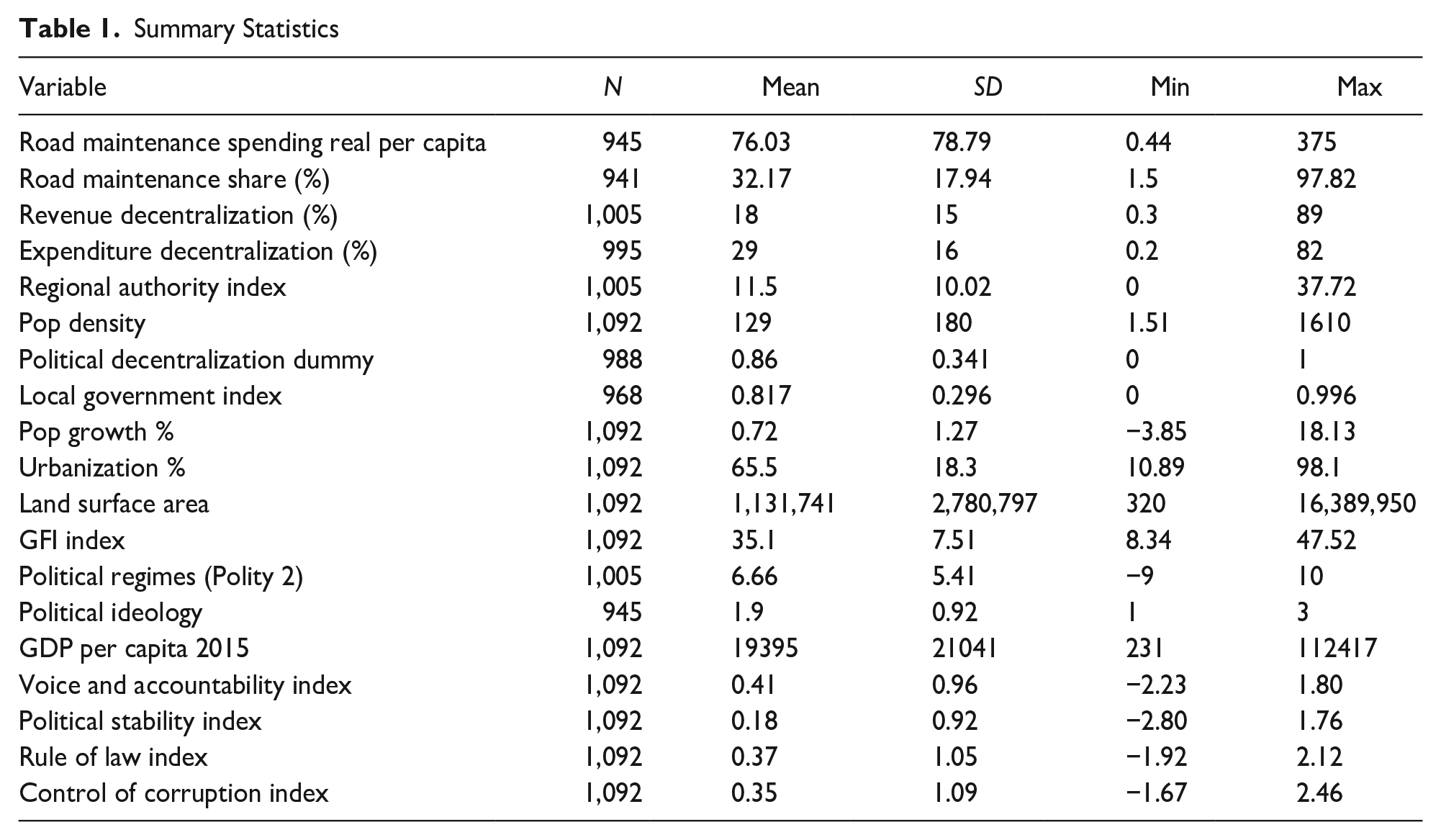
Figure 1 plots the distributions of road infrastructure maintenance and fiscal decentralization variables across countries. As seen in Figure 1, road infrastructure maintenance variables vary widely across countries. The share of road maintenance spending in total road spending ranges from 1.5% (Azerbaijan in 2010) to 97.82% (Latvia in 1998), with a mean value of 32.17%. Similarly, the size of road maintenance spending in real per capita ranges from $0.44 (Turkey in 1995) to $375 (Norway in 2005), with an average value of $76. Regarding our fiscal decentralization measures, revenue decentralization ranges from 0.3% (Afghanistan in 2014) to 89% (United Arab Emirates in 2013), with an average of 18%. Expenditure decentralization ranges from 0.2% (Afghanistan in 2014) to 82% (United Arab Emirates in 2013), with an average of 29%. Figure 2 presents the scatterplots between fiscal decentralization and road infrastructure maintenance across our sample.
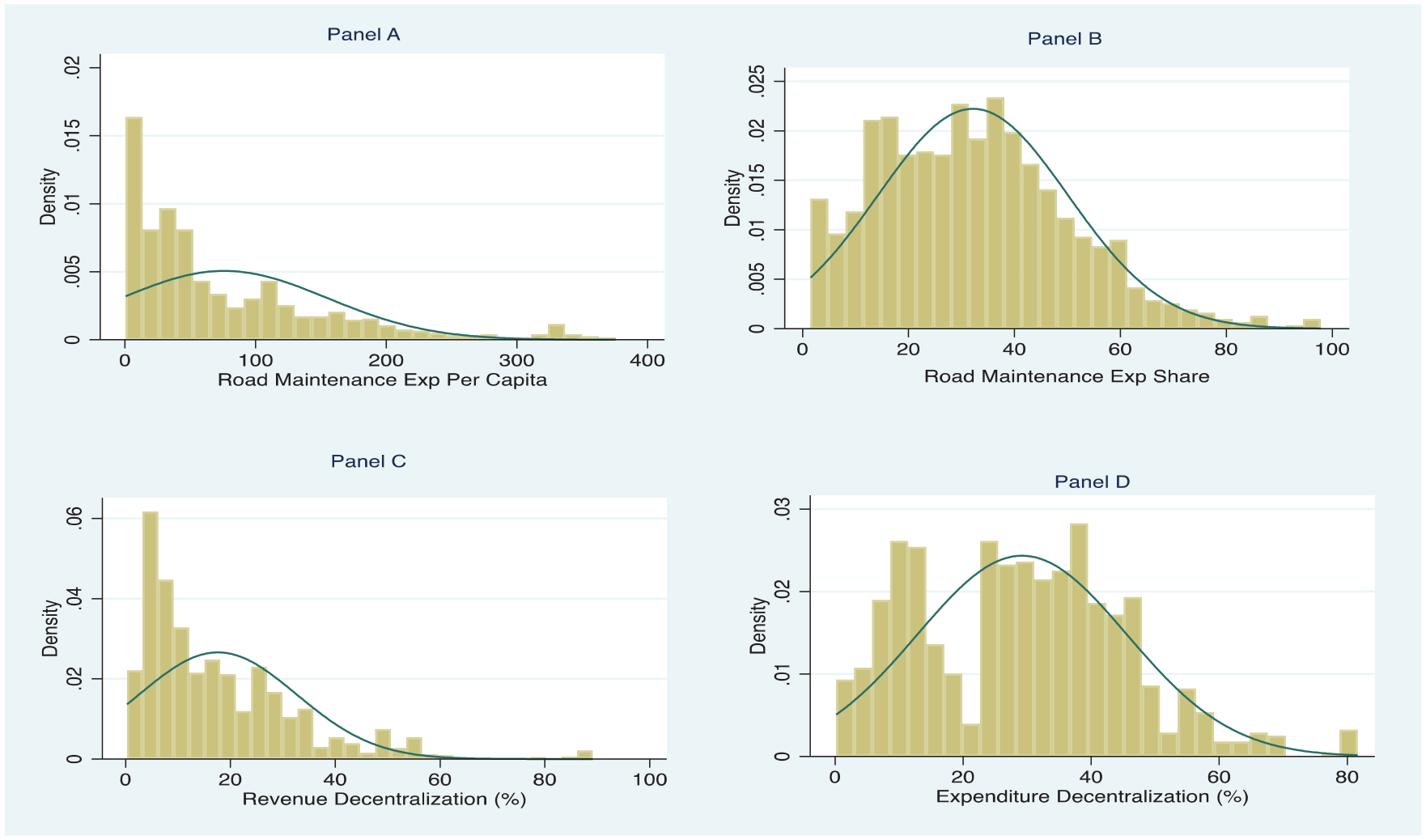
Distribution of Road Maintenance Expenditures and Fiscal Decentralization Measures
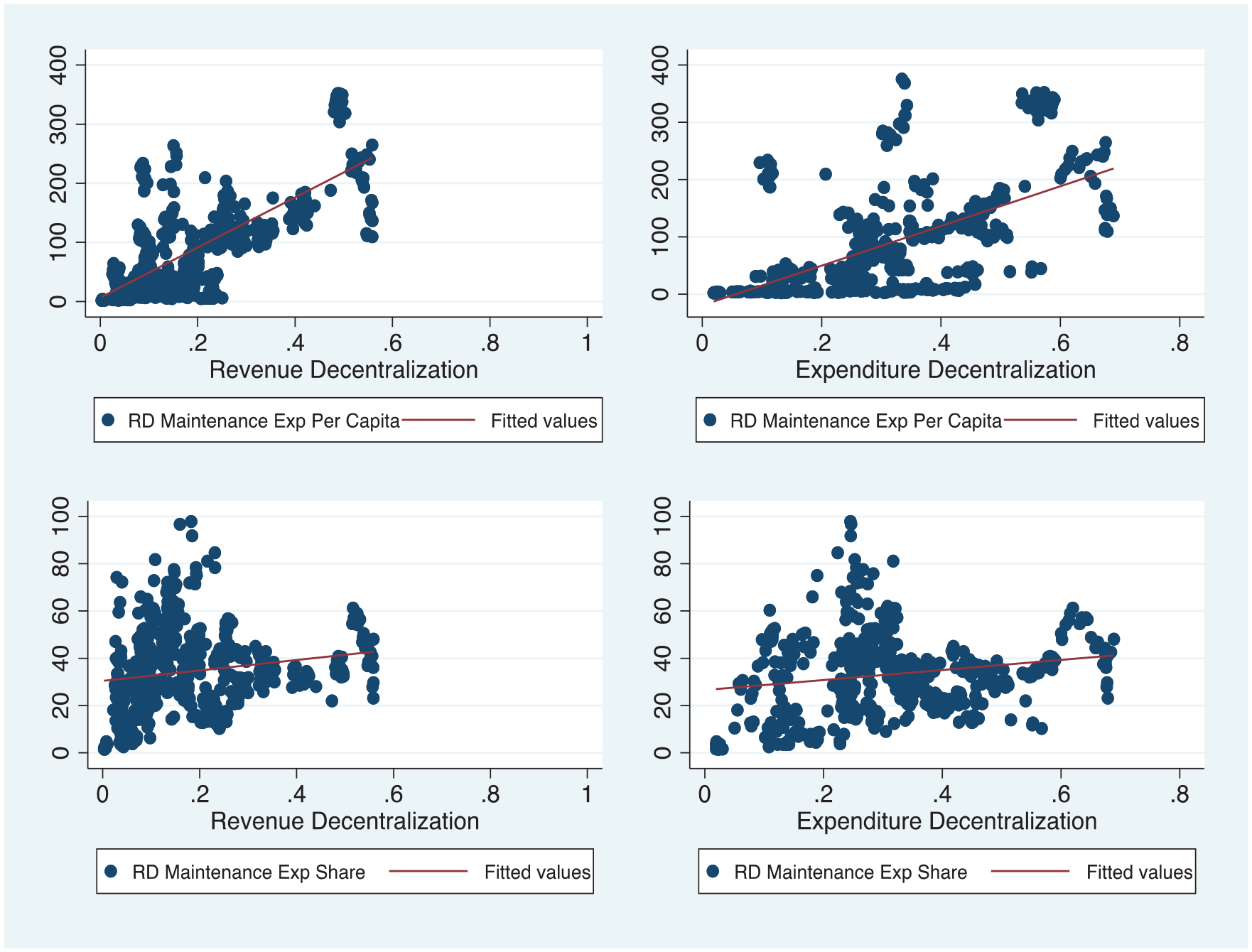
Scatterplots Between Fiscal Decentralization and Road Infrastructure Maintenance
Control Variables
We control for a set of additional covariates that are expected to also affect the provision of infrastructure services and maintenance expenditures. The political controls include political regime and political ideology. We use the Polity-IV data to measure the presence of democracy or autocracy. It ranges from −10 (autocracy) to +10 (democracy). Political ideology matters in infrastructure decision-making since the previous literature generally has found that infrastructure investments are higher under left-leaning administrations (e.g., Gupta et al., 2016). To measure government political ideology, we employ the largest government party orientation (1 = Right, 2 = Center, 3 = Left) from the Database of Political Institutions (DPIs). DPI provides annual information about the party composition and political orientation of governments in 177 countries over the 1975 to 2020 period.
Several past studies also provide strong evidence for social and economic development as a major factor in infrastructure development. To account for the effect of economic development, we use annual real GDP per capita. The covariates also contain three demographic controls—urbanization, population density, and population growth. Rapid urbanization, population growth, and higher population density are expected to increase demands for infrastructure services. The extant infrastructure literature also suggests that beyond the level of decentralization, the overall level of institutional quality and degree of accountability matter in infrastructure decision-making. Thus, we use voice and accountability, control of corruption, rule of law, and political stability index from the Worldwide Governance Indicators.
Empirical Methodology: Panel IV Estimation
There is an important concern in empirical modeling that fiscal decentralization measures might be subject to endogeneity (e.g., Martínez-Vázquez et al., 2017). The endogeneity concern could arise because of the simultaneous effects of omitted variables on both fiscal decentralization and our endogenous variables. For example, an increase in infrastructure maintenance expenditure could result in a government response for fiscal decentralizing further as subnational governments could better match the infrastructure needs. Following the most recent study (Canavire-Bacarreza et al., 2020), this research uses a panel IV estimation (Two-Stage Least Squares) as the main empirical strategy to address the endogeneity concern between fiscal decentralization and infrastructure maintenance. Specifically, the estimation of the impact of fiscal decentralization on public infrastructure maintenance expenditure is done in two stages:
First stage:

Second stage:

where
This research utilizes two different instrument variables for fiscal decentralization. The first IV is the “GFI,” which was developed index by Canavire-Bacarreza et al. (2017). The GFI measures the weighted probability that two randomly chosen individuals do not live in similar altitude zones with the weight matrix derived from the average distance between altitudes. It is calculated as follows:

where
Summary Statistics
Empirical Results
Baseline Results of Fiscal and Political Decentralization
As it was argued above, road maintenance expenditures are distinct from road capital spending, and they are a critical link in the provision of public infrastructure services. Table 2 provides the empirical results for the linkage between fiscal decentralization and road maintenance activities. 3 Recall that the road sector is the only public infrastructure sector in which maintenance expenditure data are consistently available across countries. The estimates show the baseline panel IV results. The key independent variable in Models 1 and 2 is revenue decentralization. Models 3 and 4 use expenditure decentralization as the key independent variable. Across all four models, revenue and expenditure decentralization measures display positive coefficients, but our fiscal decentralization variables are only statistically significant in the models of the level of road maintenance expenditure. None of them are statistically significant in the models of the share of road maintenance expenditures. In Mode 1, the variable of revenue decentralization displays a coefficient of 1.582 at the 5% significance level. This indicates that, all else equal, a one-point increase in the share of revenue implemented by the subnational level is associated with an increase of 6.56% change in the size of real per capita road maintenance spending. 4 In a similar vein, the variable of expenditure decentralization displays a coefficient of 1.818 at the 1% significance level. This indicates that, all else equal, a one-point increase in the share of expenditure implemented by the subnational level is associated with an increase of 9.22% change in the size of real per capita road maintenance spending. These estimated effect sizes are economically significant. 5
Fiscal Decentralization and Road Maintenance Expenditures (Country Surface Land Area and GFI as IVs)
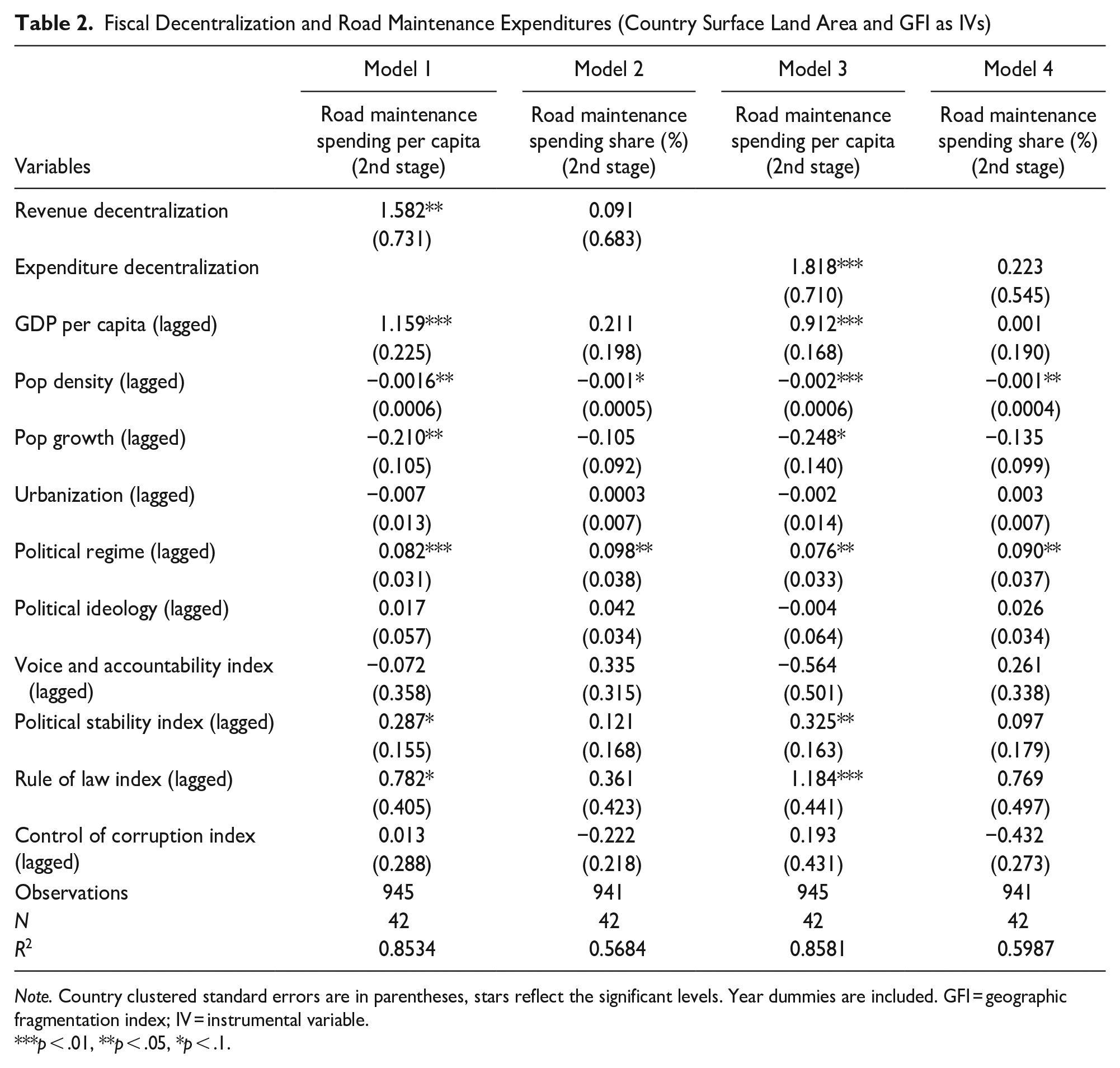
Note. Country clustered standard errors are in parentheses, stars reflect the significant levels. Year dummies are included. GFI = geographic fragmentation index; IV = instrumental variable.
p < .01, **p < .05, *p < .1.
A couple of our control variables are statistically significant in the models of road maintenance. Countries with a higher level of real GDP per capita and democratic regimes experience larger levels of road maintenance spending. At the same time, countries with democratic regimes and stronger institutional quality (voice and accountability index and political stability) are found to increase the size of road maintenance spending. By contrast, population density is found to reduce the share and level of road maintenance spending, and higher population growth is associated with fewer road maintenance expenditures. This may be because higher population density and large population growth stimulate more demand for road capital spending with less focus on maintenance.
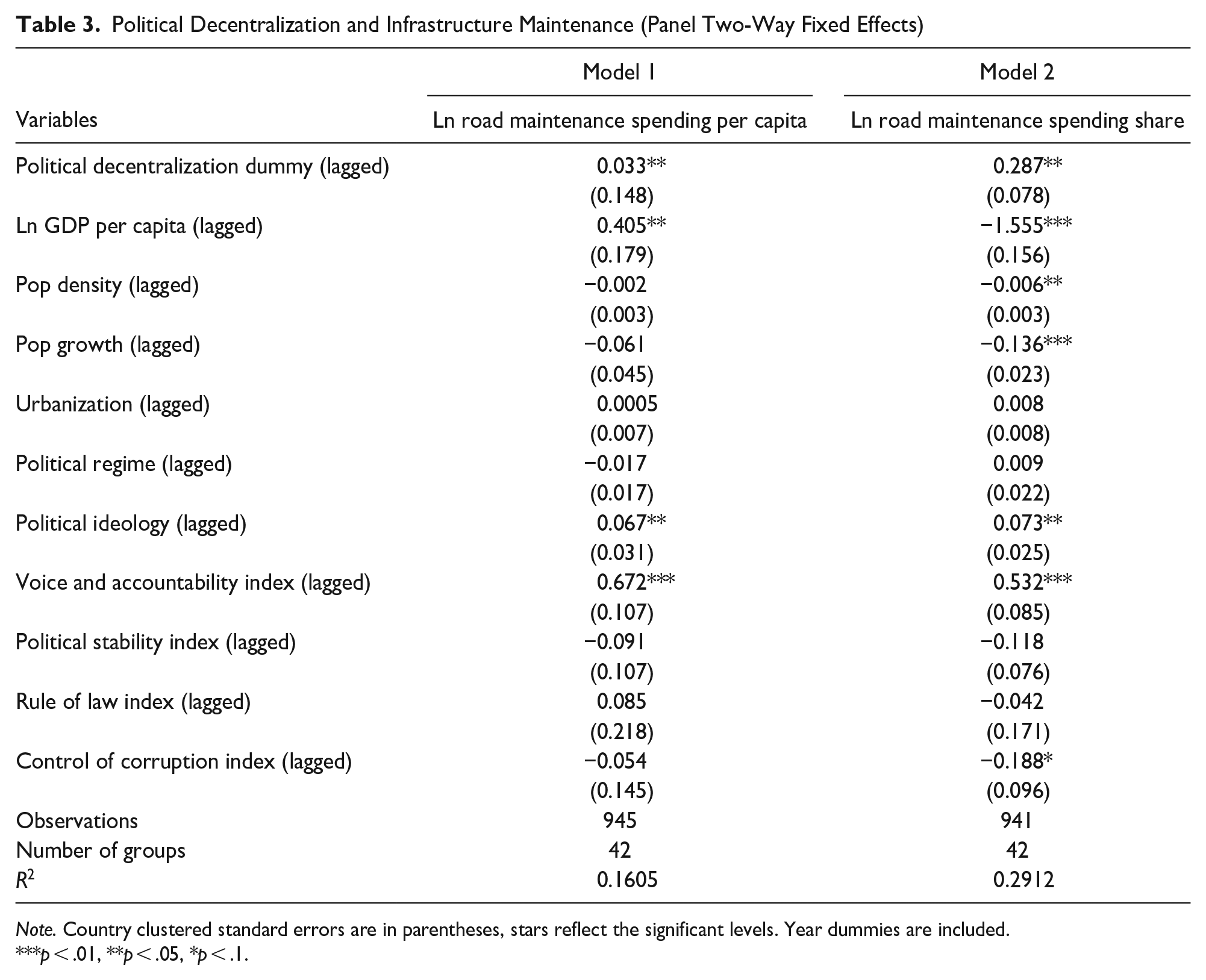
We turn to our political decentralization measures. Table 3 provides the empirical results for the linkage between political decentralization and road maintenance activities. Recall that our political decentralization variable is measured as a dummy variable to capture whether countries hold independent local elections based on Hankla et al. (2019). In comparison with fiscal decentration, there is less endogeneity concern for political decentralization. We use 1-year-lagged political decentralization variable in our model to address potential endogeneity between political decentralization and infrastructure maintenance. The use of lagged explanatory variables to mitigate the potential issue of simultaneity and reverse causation is a common practice in applied econometrics (e.g., Islam, 2018; Reed, 2015). Further, we utilize a Granger causality test to identify the direction of causality between political decentration and infrastructure maintenance. The results suggest causality runs one way from our political decentralization variable to infrastructure maintenance but not the other way around.
Political Decentralization and Infrastructure Maintenance (Panel Two-Way Fixed Effects)
Note. Country clustered standard errors are in parentheses, stars reflect the significant levels. Year dummies are included.
p < .01, **p < .05, *p < .1.
It is interesting to note political decentralization variable shows a positive and statistical sign in both models. It means that compared with democratically centralized countries, political decentralization is associated with increased sizes and shares of road maintenance expenditures. Several control variables show a statistical coefficient. Countries with higher levels of real GDP per capita and voice and stability index are associated with larger levels of road maintenance spending. By contrast, economic development, population density, and growth are found to reduce the share and level of road maintenance spending.
Robustness Checks
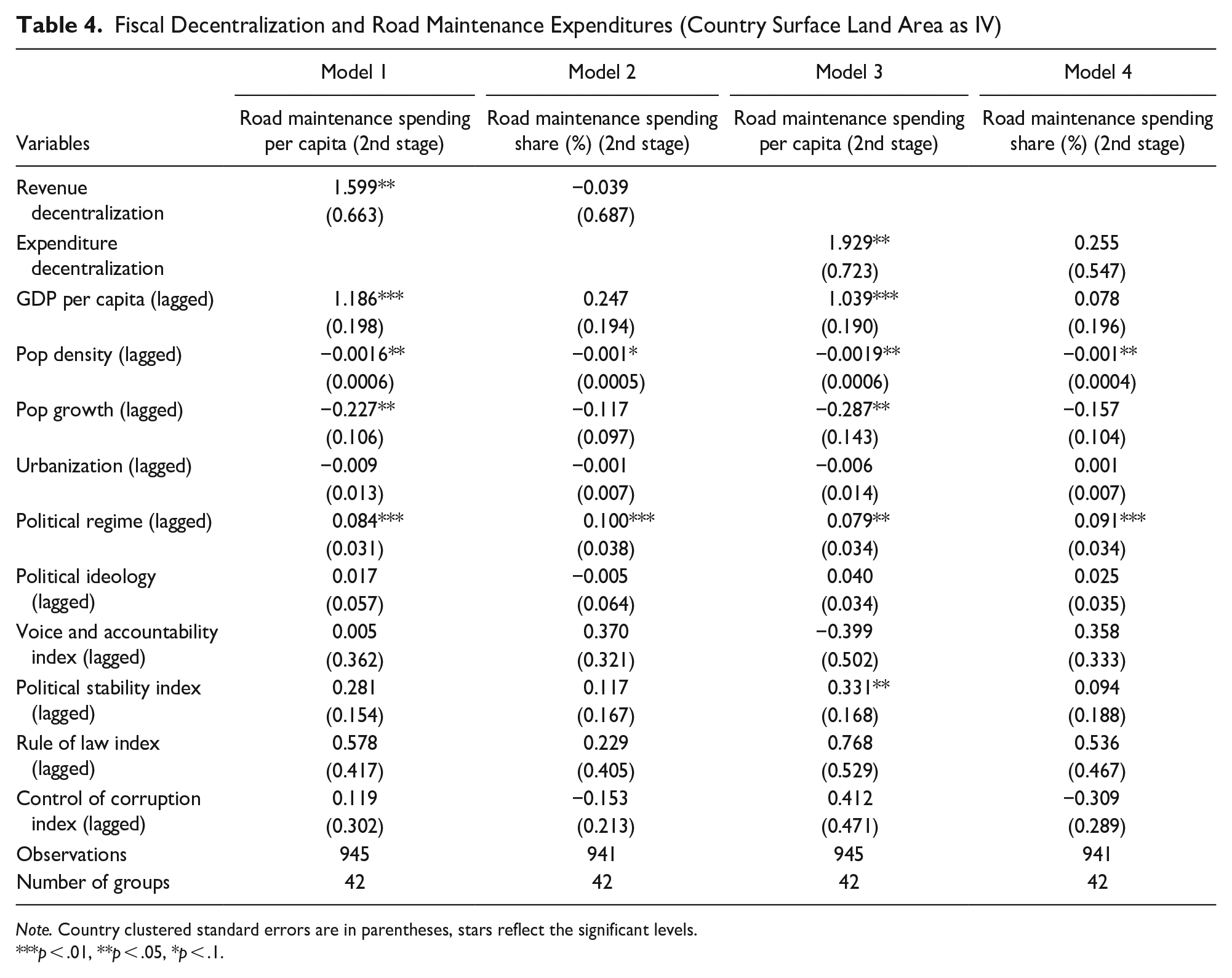
We conducted a series of robustness checks for our main baseline results. First, while there is no evidence in the literature on the direct effect of the GFI on road infrastructure maintenance expenditures, GFI might have a direct effect on the cost of road maintenance activities and thus not meet the exclusion restriction condition. To address this potential concern, we dropped GFI and only used the country surface area as the IV. The results in Table 4 are consistent with the main findings. Both revenue and expenditure decentralization variables display a positive and statistically significant sign in the models of the size of road infrastructure spending.
Fiscal Decentralization and Road Maintenance Expenditures (Country Surface Land Area as IV)
Note. Country clustered standard errors are in parentheses, stars reflect the significant levels.
p < .01, **p < .05, *p < .1.
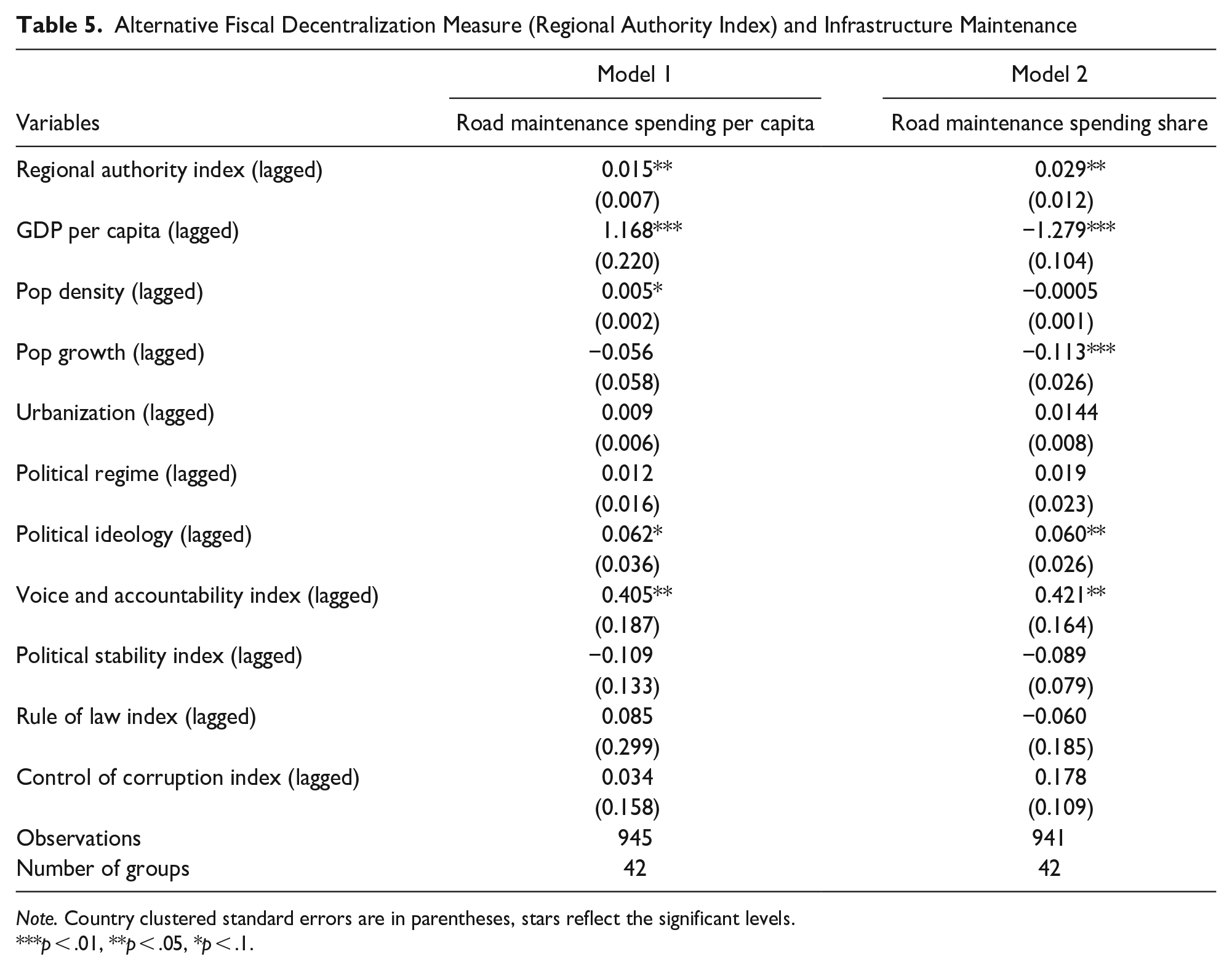
Second, there are alternative ways to measure fiscal decentralization. Instead of using revenue and expenditure decentralization indicators, we use—the RAI, which is an alternative measure commonly employed in the decentralization literature. Table 5 shows the empirical results using RAI as our alternative fiscal decentralization measure. It is interesting to note that the variable of RAI displays a positive and statistically significant coefficient sign in both Model 1 of road maintenance expenditure size (the coefficient is 0.015 at the 5% significance level) and Model 2 of road maintenance expenditure shares in total road spending (0.029 at the 5% significance level). In sum, the overall results for using RAI confirm that fiscal decentralization boosts government spending on road maintenance in both, size (real per capita) and shares (percentage in total road spending).
Alternative Fiscal Decentralization Measure (Regional Authority Index) and Infrastructure Maintenance
Note. Country clustered standard errors are in parentheses, stars reflect the significant levels.
p < .01, **p < .05, *p < .1.
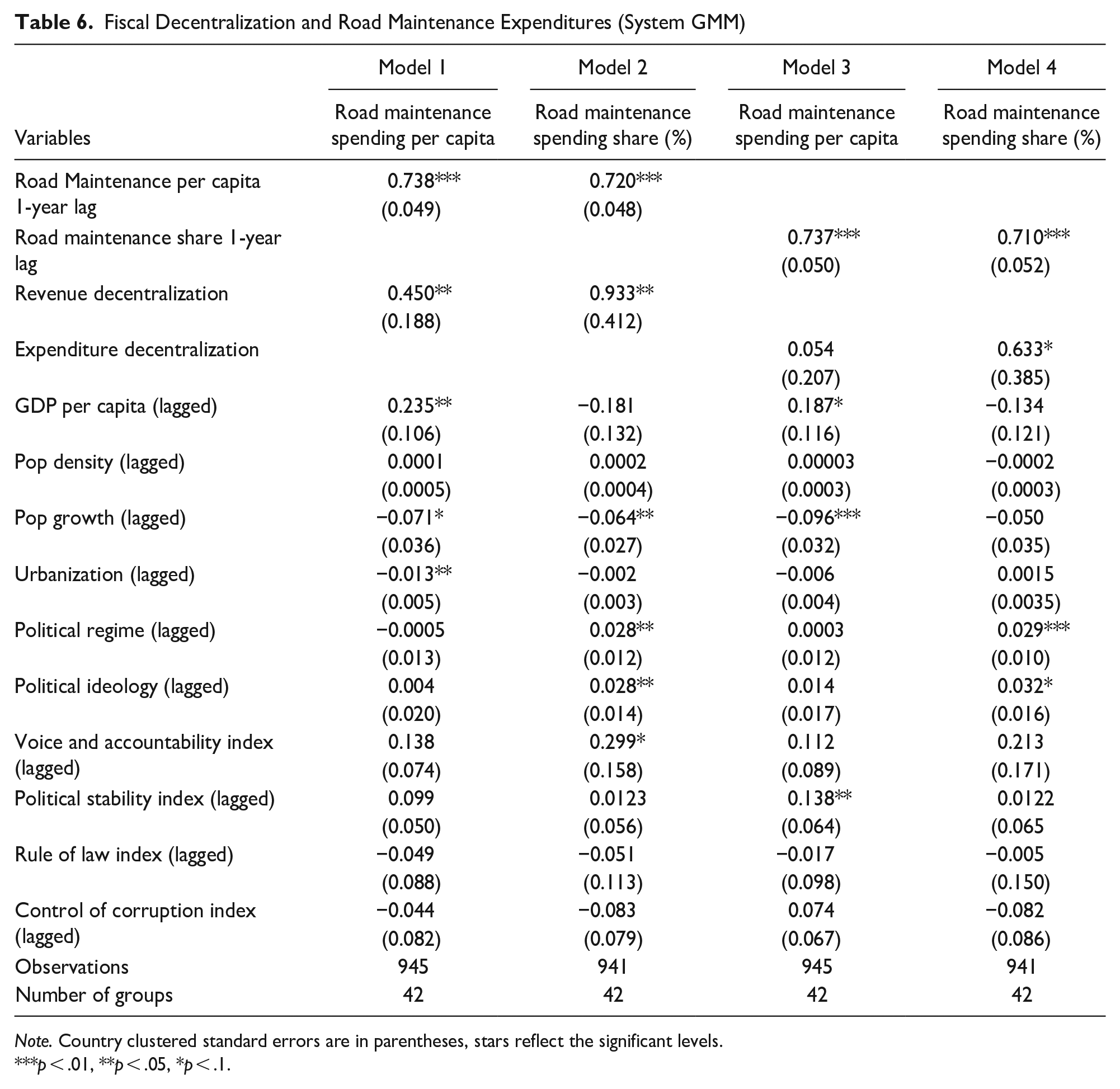
Third, as an alternative to the IV method, we use system GMM for panel data. Table 6 reports the estimation results using a dynamic panel model (system GMM). Across all four models, we find that the lagged (one period) infrastructure maintenance dependent variable is positive and statistically significant in each model. This suggests that current infrastructure maintenance expenditure is affected by last year’s infrastructure maintenance spending. In comparison with the main specification, the variable of revenue decentralization displays a consistently positive coefficient in the model of the size of road maintenance spending, although the variable of expenditure decentralization loses its significance in Model 3. It is interesting to note that the positive coefficients of revenue decentralization and expenditure decentralization become statistically significant in the models of the share of road maintenance spending (Models 2 and 4).
Fiscal Decentralization and Road Maintenance Expenditures (System GMM)
Note. Country clustered standard errors are in parentheses, stars reflect the significant levels.
p < .01, **p < .05, *p < .1.
Fourth, we use alternative measures of political decentralization. Following Shrestha et al. (2023), we use the local government index from the V-Dem dataset as an alternative political decentralization measure. The local government index captures the extent to which elected local governments can operate without political interference from upper-level governments. The lowest score of the local government index means countries have no elected local governments. By contrast, a higher score on the local government index indicates a higher degree of autonomy in elected local governments. Table 7 presents the results of using alternative political decentralization measures. As expected, it is found that a higher value of the local government index is consistently associated with a larger size and a higher share of maintenance in total road expenditures.
Alternative Political Decentralization Measure and Infrastructure Maintenance
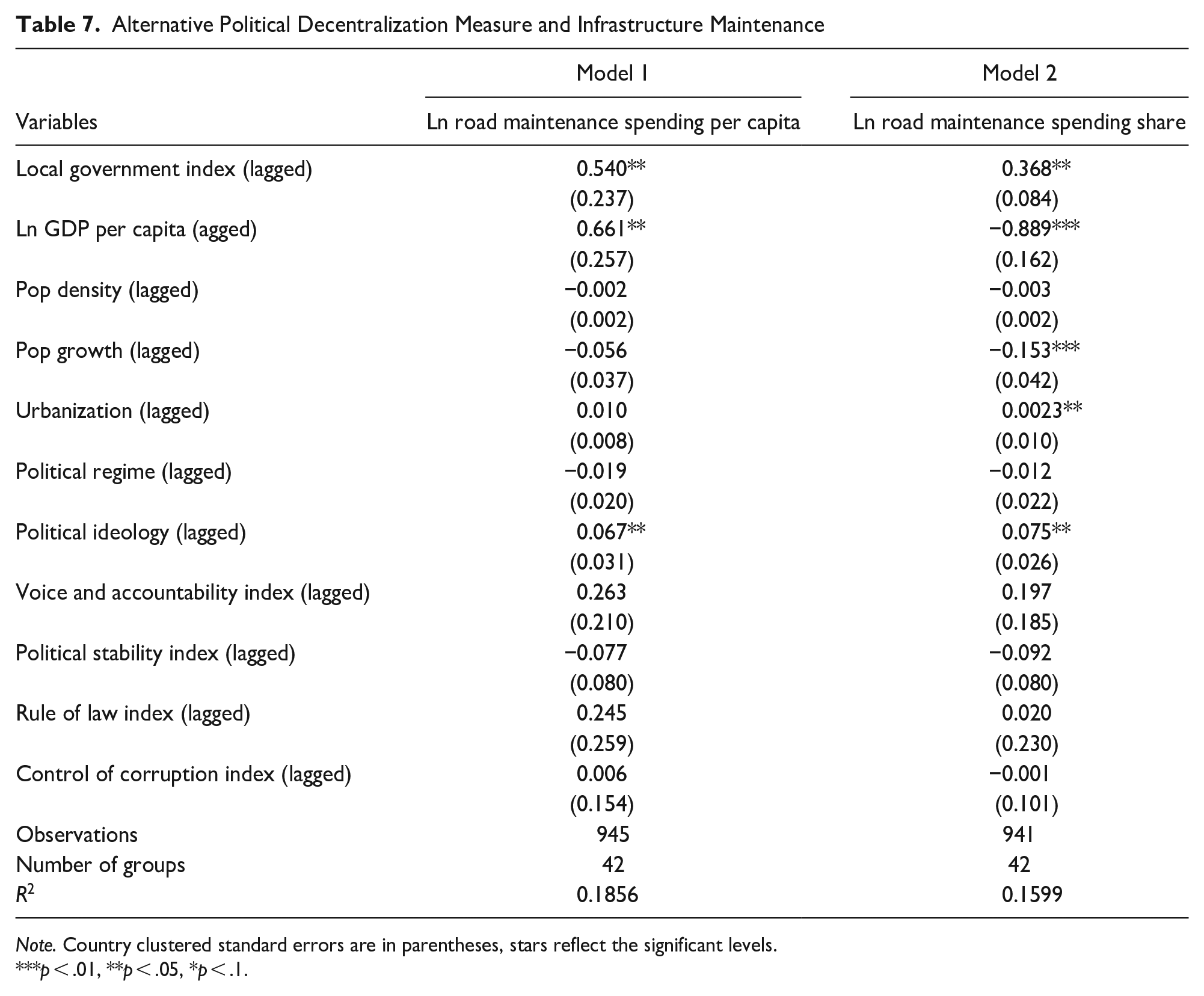
Note. Country clustered standard errors are in parentheses, stars reflect the significant levels.
p < .01, **p < .05, *p < .1.
Conclusions and Policy Implications
Adequately maintaining existing public infrastructure is one of the most challenging dimensions of public financial management at all levels of government and across countries, both developed and developing. The last 2 decades have witnessed a bourgeoning of the literature examining the impact of fiscal decentralization on a wider array of fiscal and economic issues. However, to the best of our knowledge, to date, no studies have investigated the relationship between decentralized governance and infrastructure maintenance.
This research aims at empirically testing the impact of fiscal and political decentration on the level and share of road infrastructure maintenance across a large sample of developed and developing countries from 1995 to 2020. To address the endogeneity issue stemming from reverse causality and unobserved factors that have plagued numerous previous decentralization studies, in this paper, we address the problem by using IV estimation, with country size and the GFI index as two IVs for fiscal decentralization. Our main results confirm that revenue and expenditure decentralization strongly increase the levels of public spending on road maintenance. In addition, democratically decentralized countries are found to have larger shares and sizes of road maintenance spending. Our main findings are robust to alternative model specifications and different measures of fiscal and political decentralization.
There are limitations to this research. First, our study only examines government maintenance spending on roads because maintenance expenditure data are generally not available for other types of infrastructure, such as transit and airports. Therefore, our findings may not be generalized to other public infrastructure assets. Second, our study sample is limited to 42 countries from the ITF. Most of these 42 countries are in Europe and high or middle-income countries. In this sense, our results may not be generalized to low-income countries with different institutional and socioeconomic contexts.
Despite these limitations, this study contributes to the field of public finance scholarship in three important ways. First, to the best of our knowledge, this study represents one of the first academic attempts to test the role of decentralized governance in infrastructure maintenance. In the extant literature, while a large volume of research exists that investigates the association between fiscal decentralization and various public service outcomes, empirical studies that link government decentralization and infrastructure maintenance are still rare. In theory, the existing empirical literature largely agrees on the beneficial impact of fiscal decentralization on local public infrastructure. However, important doubts have lingered regarding the potential negative effects of decentralized governance on maintenance spending. The significance of this paper is to show empirically that decentralized governance also has a beneficial effect on infrastructure maintenance spending.
Second, this research makes key contributions to the field of infrastructure finance. Compared with the abundant research on the determinants of infrastructure investment and quality, infrastructure maintenance has received less attention in the academic literature. This study provides empirical evidence that fiscal and political decentralizations matter for public spending on infrastructure maintenance and complements the literature on capital infrastructure and decentralized governance by examining the decentralization-infrastructure maintenance link.
Third, proper maintenance activities are essential to ensure that infrastructure continues to function safely and efficiently. Unfortunately, significant underspending in infrastructure maintenance is a very common issue across countries. Our findings consistently show decentralization plays a significant role in maintaining public infrastructure. To improve infrastructure maintenance, policymakers may consider the beneficial impact of increasing the fiscal and political autonomy of decentralized governments, granting more authority in self-rule and shared rule exercised by subnational governments within their countries.
There are several avenues for future research. It would be intriguing to explore the effects of decentralized governance on government maintenance for other types of infrastructure assets at different levels of government. Second, future research may consider the heterogeneous effect of decentralization when infrastructure maintenance data on developing countries are available. Third, it would also be interesting to investigate the role of different institutions in moderating the effects of decentralized governance on infrastructure maintenance.
Footnotes
Appendix
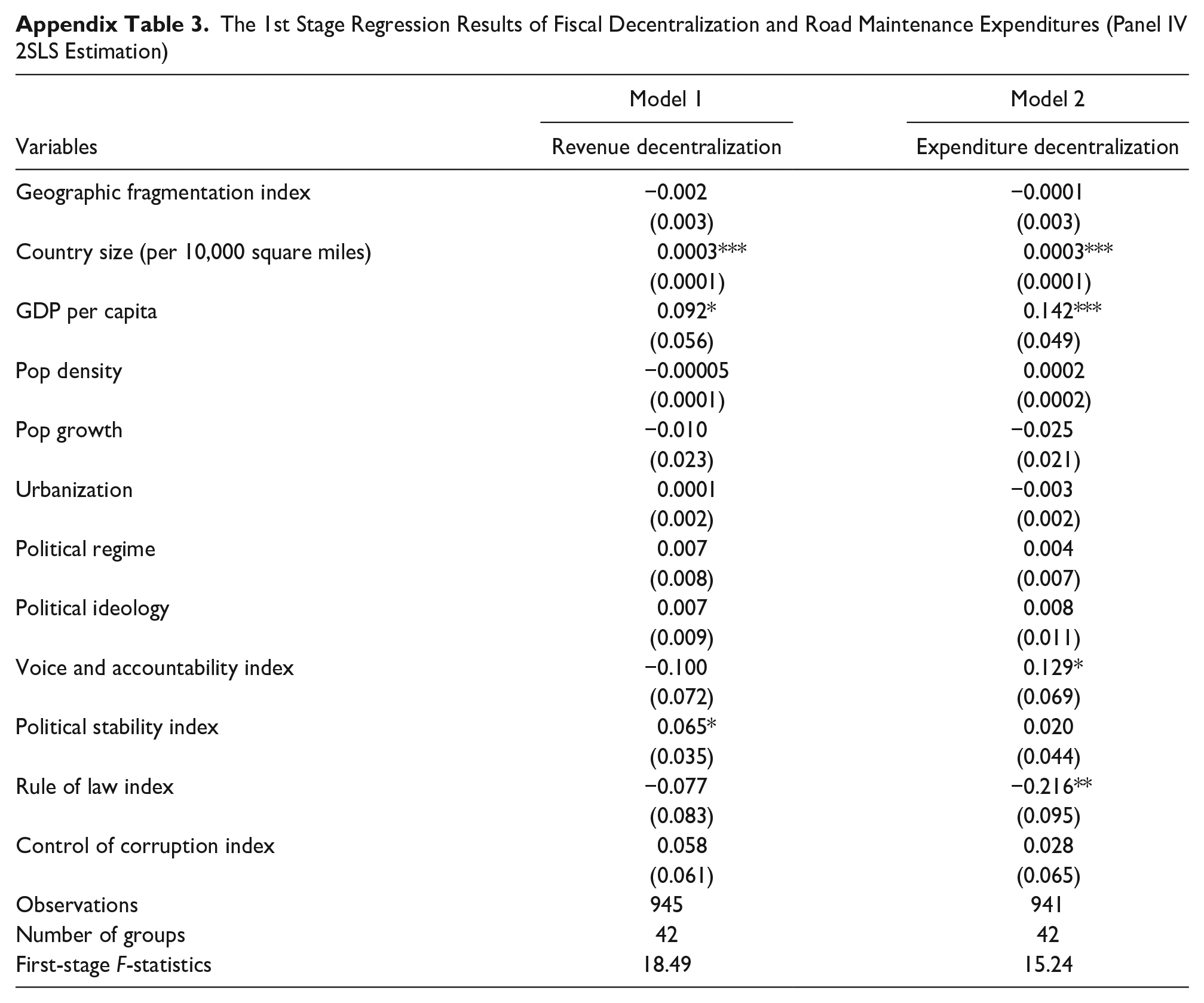
The 1st Stage Regression Results of Fiscal Decentralization and Road Maintenance Expenditures (Panel IV 2SLS Estimation)
| Variables | Model 1 |
Model 2 |
|---|---|---|
| Revenue decentralization | Expenditure decentralization | |
| Geographic fragmentation index | −0.002 | −0.0001 |
| (0.003) | (0.003) | |
| Country size (per 10,000 square miles) | 0.0003*** | 0.0003*** |
| (0.0001) | (0.0001) | |
| GDP per capita | 0.092* | 0.142*** |
| (0.056) | (0.049) | |
| Pop density | −0.00005 | 0.0002 |
| (0.0001) | (0.0002) | |
| Pop growth | −0.010 | −0.025 |
| (0.023) | (0.021) | |
| Urbanization | 0.0001 | −0.003 |
| (0.002) | (0.002) | |
| Political regime | 0.007 | 0.004 |
| (0.008) | (0.007) | |
| Political ideology | 0.007 | 0.008 |
| (0.009) | (0.011) | |
| Voice and accountability index | −0.100 | 0.129* |
| (0.072) | (0.069) | |
| Political stability index | 0.065* | 0.020 |
| (0.035) | (0.044) | |
| Rule of law index | −0.077 | −0.216** |
| (0.083) | (0.095) | |
| Control of corruption index | 0.058 | 0.028 |
| (0.061) | (0.065) | |
| Observations | 945 | 941 |
| Number of groups | 42 | 42 |
| First-stage F-statistics | 18.49 | 15.24 |
Acknowledgements
We would like to thank the two anonymous referees for very constructive comments.
Correction (November 2025):
The authors would like to alert readers to the following changes in their article: The following Disclosure Statement has been added:
Can Chen is a member of the Editorial Board of Public Finance and Management. The author did not take part in the peer review or decision-making process for this submission and has no further conflicts to declare. Jorge Martinez-Vazquez has no conflicts of interest to declare.
Declaration of Conflicting Interests
The author(s) declared no potential conflicts of interest with respect to the research, authorship, and/or publication of this article.
Funding
The author(s) received no financial support for the research, authorship, and/or publication of this article.
Disclosure Statement
Can Chen is a member of the Editorial Board of Public Finance and Management. The author did not take part in the peer review or decision-making process for this submission and has no further conflicts to declare. Jorge Martinez-Vazquez has no conflicts of interest to declare.