




Abstract
Aims:
Intracranial aneurysm (IA) is a critical cerebrovascular disorder strongly linked to phenotypic switching and apoptosis of vascular smooth muscle cells (VSMCs). This study aimed to investigate the role of circGNAQ in IA development and elucidate its underlying molecular mechanisms.
Results:
Reverse transcription-quantitative polymerase chain reaction and fluorescence in situ hybridization revealed significant upregulation of circGNAQ in IA tissues, predominantly localized within VSMCs. In vitro, circGNAQ knockdown attenuated hydrogen peroxide-induced VSMC phenotypic switching and apoptosis, whereas circGNAQ overexpression aggravated these pathological processes. RNA pull-down and mass spectrometry demonstrated that circGNAQ specifically binds to serine/arginine-rich splicing factor 1 (SRSF1), promoting its ubiquitination and degradation, thereby destabilizing SRSF1. Cotransfection assays confirmed that SRSF1 functions as a downstream mediator of circGNAQ in regulating VSMC phenotypic switching and apoptosis. In vivo, circGNAQ knockdown significantly suppressed IA formation in a murine model by inhibiting VSMC phenotypic switching and apoptosis.
Innovation and Conclusion:
This study identifies circGNAQ as a novel regulator of VSMC phenotypic switching and apoptosis through targeting SRSF1. The findings highlight circGNAQ as a potential therapeutic target for preventing and treating IA. Antioxid. Redox Signal. 44, 24–40.
This is a visual representation of the abstract.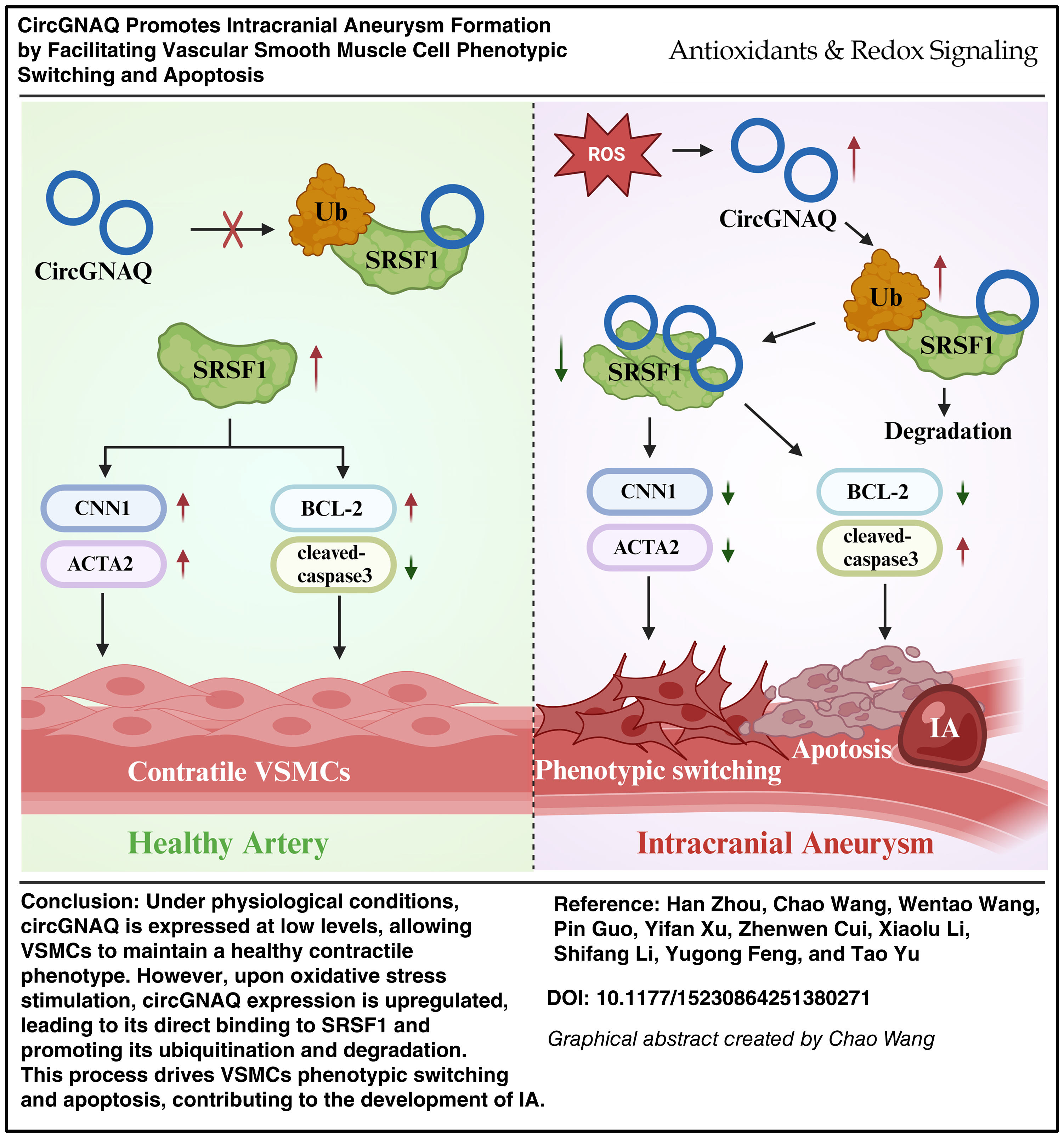
Get full access to this article
View all access options for this article.
References
Supplementary Material
Please find the following supplemental material available below.
For Open Access articles published under a Creative Commons License, all supplemental material carries the same license as the article it is associated with.
For non-Open Access articles published, all supplemental material carries a non-exclusive license, and permission requests for re-use of supplemental material or any part of supplemental material shall be sent directly to the copyright owner as specified in the copyright notice associated with the article.
