



Abstract
Iconic images are those that rise to the forefront of our collective, visual public consciousness to become the defining, enduring image of an event: a naked Vietnamese girl screaming out in pain following a napalm attack, U.S. Marines raising the American flag at Iwo Jima, and a German dirigible engulfed in flames and falling to the ground. Iconic images have a discursive value that helps citizens navigate and understand the political and social contexts of complex events. Traditionally, news photographs became iconic largely through their prominent placement on the front pages of elite newspapers across the globe. But, undeniably, in the age of digital news, mobile phones/tablets, and social media, the media component has changed the equation for the formation of iconic imagery and collective visual consciousness. With the speed, ease of access, and abundance of information sources available in the current age, a volume of images can now represent a significant (or not so significant) event. This monograph traces the development of iconic image literature and then proposes a model termed the “influence-network model of the photojournalistic icon,” which predicts how photographs of events become iconic (or not).
In the course of modern human history, trillions of images have been captured and shared. Yet, it is the rare image that rises to the forefront of our collective, visual public consciousness and becomes the defining, enduring image of an event: a naked Vietnamese girl screaming out in pain following a napalm attack, U.S. Marines raising the American flag at Iwo Jima, and a German dirigible engulfed in flames and falling to the ground. Scholars, journalists, and the public call these defining images “iconic.” Hariman and Lucaites (2007) define photojournalistic icons as photographic images appearing in print, electronic, or digital media that are widely recognized and remembered, are understood to be representations of historically significant events, active strong emotional identification or response, and are reproduced across a range of media, genres, or topics. (p. 27)
These iconic images are prominent quantitatively (in a number of occurrences across many sites over time) and in their location within the news stream (front page of the newspaper, lead of the newscast). More to the point, they are metonymic—such that one thing stands for something else, to recall larger historical events (Perlmutter, 1994). These are tropes that stand in for World War II, “Black Power” protests against racism at the 1968 Olympics, the 1989 Tiananmen protests and crackdown in Beijing, Black Lives Matters protests, and so on. Regarding the intellectual value of iconic images, Hariman and Lucaites (2007) argue that iconic photographs are a “leading artifact of public culture” (p. 26.) Iconic images, then, are part of our public culture that “have developed historically through the use of modern communicative media to define the relationship between the citizen and the state” (Hariman & Lucaites, 2007, p. 26). Given this discursive value of iconic images, these select images hold tremendous value in helping citizens navigate and understand the political and social contexts of complex events.
Traditionally, news photographs became iconic largely through their prominent placement on the front pages of elite newspapers (here, defined as the highest quality outlets among all legacy news outlets) across the globe. Nicole Fruge, San Francisco Chronicle Deputy Director of Photography, explains, When you think of the Hindenburg disaster, when you think of that picture, you think of the front page that that picture was on . . . and it plays together as this complete, finished thought, which is really amazing and wonderful. (Personal communication, February 6, 2013)
Audiences then see those same images on the evening news broadcast, and these elite media placements of imagery in print and broadcast influenced each other in time and space to solidify select images as iconic. Indeed, what we regard as the iconic image’s “Golden Era” was characterized by the top-down control of elite media creation through image selection, editing, distribution, and commentary.
But this Golden Era has come to an end. The new era of iconic imagery is less hierarchical and more chaotic. Indeed, the production and consumption of news imagery—and especially the formation of iconic imagery—has been markedly changed by emerging technologies, the shift to digital journalism, and the rise and reach of social media and mobile phones/tablets. With the speed, ease of access, and abundance of information sources available in the current age, a volume of images can now represent a significant (or not so significant) event. Photographer Phil Toledano explains, The power of the single image has diminished. What’s more powerful are Twitter, Instagram and Facebook. The constant, relentless tsunami of images showing up in your virtual living room. That’s more personal, and more potent, than a solitary photograph on the front page of a newspaper. (Quoted in Estrin, 2015)
While the elite news media (legacy newspapers, 24-hr cable news, and network evening news broadcasts) can still create defining images, audiences also have unlimited opportunities to create, seek out, receive, and share/repost imagery via digital news, mobile phones/tablets, and social media. Take one notable example: the “Miracle on the Hudson” iPhone photo that a citizen took and then tweeted was soon retweeted by a spiral of thousands of other people before it actually entered the elite news stream. The Los Angeles Times called it “among the most striking instances yet of instant citizen reporting” (Sarno, 2009). Elite news affirmed the image as important by putting it above the fold and at the lead of newscasts. This amplified its reach to an even larger audience: The image was shown on thousands of newscasts, front pages, and covers and then later in documentaries. Individuals unaffiliated with any news or government organization, however, initiated and then carried out the process of making the image iconic.
To be clear, the old and new eras are not necessarily divided by a clean break or transition point. No starting date can be identified for the new era because, of course, many aspects and entities of industrial news remain in operation, albeit in both diminished and transformed configurations. But, undeniably, in the age of digital news, mobile phones/tablets, and social media, the “media component” has changed the equation for the formation of iconic imagery and collective visual consciousness. The role of the elite media in iconic image formation has been altered through the democratization of news creation and distribution. As such, the understanding of iconic image formation necessitates a theoretical reconsideration (Dahmen & Miller, 2012; Dahmen & Morrison, 2016). Moreover, most scholarship on iconic images pre-dates significant developments in technology and news delivery that has shaped how famous images are born and what lives they lead post-publication, both offline and online.
Rather, in the second decade of the 21st century, the many different levels of the reciprocal nature of media (e.g., interpersonal, social, mass propaganda) between the different stakeholders (such as large corporations, factions in government, individuals, and activist groups) may cooperate (or conflict) to create media content, to distribute it, to assign meanings to its interpretation, and then to seek audiences. Crucially, and differently from the industrial-professional era, those audiences now can, if they wish, share, repost, or recast (in a meme) the image with their own commentary.
This last component, retransmission via social media, is a mechanical break from the past, but not necessarily a cognitive one. Audiences have always exercised power as interpreters before they had actual physical access to media production; messages sent were not always the ones received even in the industrial-professional era. As said, preexisting beliefs, attitudes, ideas, concepts, and prejudices govern what we take pictures (icons or otherwise) to mean (rather as social psychology would predict from research on cognitive biases). Perlmutter’s (1998) axiom for this is: “believing is seeing,” and it is true that, as humans, we are much more likely to take what we purport to see as a reinforcement of what we already believe than to allow it to challenge our worldview. Smartphones with cameras, texting, Twitter, Instagram, and Facebook have added nuances to such a condition, but nothing has effectively overturned this finding just yet.
Thus, we begin this monograph by tracing the development of iconic image literature and theory. This forms the basis for our argument that the current theoretical predictions of iconic image formation warrant reconsideration, given the advent of new media technologies, digital news, social media, and mobile phones/tablets and the significant effects of these technologies on image production, dissemination, consumption, and the subsequent ascription of meaning. We then propose a model that we term the “influence-network model of the photojournalistic icon.” This model of how photographs of events become iconic (or not) involves four central and related stages: creation, distribution, acceleration, and formation (see Figure 1). The model includes patterns and rules that sometimes predict when, how, or which images will be powerful, especially in the age of digital news, mobile phones/tablets, and social media. Our theory is grounded in historical analysis: We outline the sequence of events to chart the pathways of power and influence from one decision to the next in the process of iconic image formation.
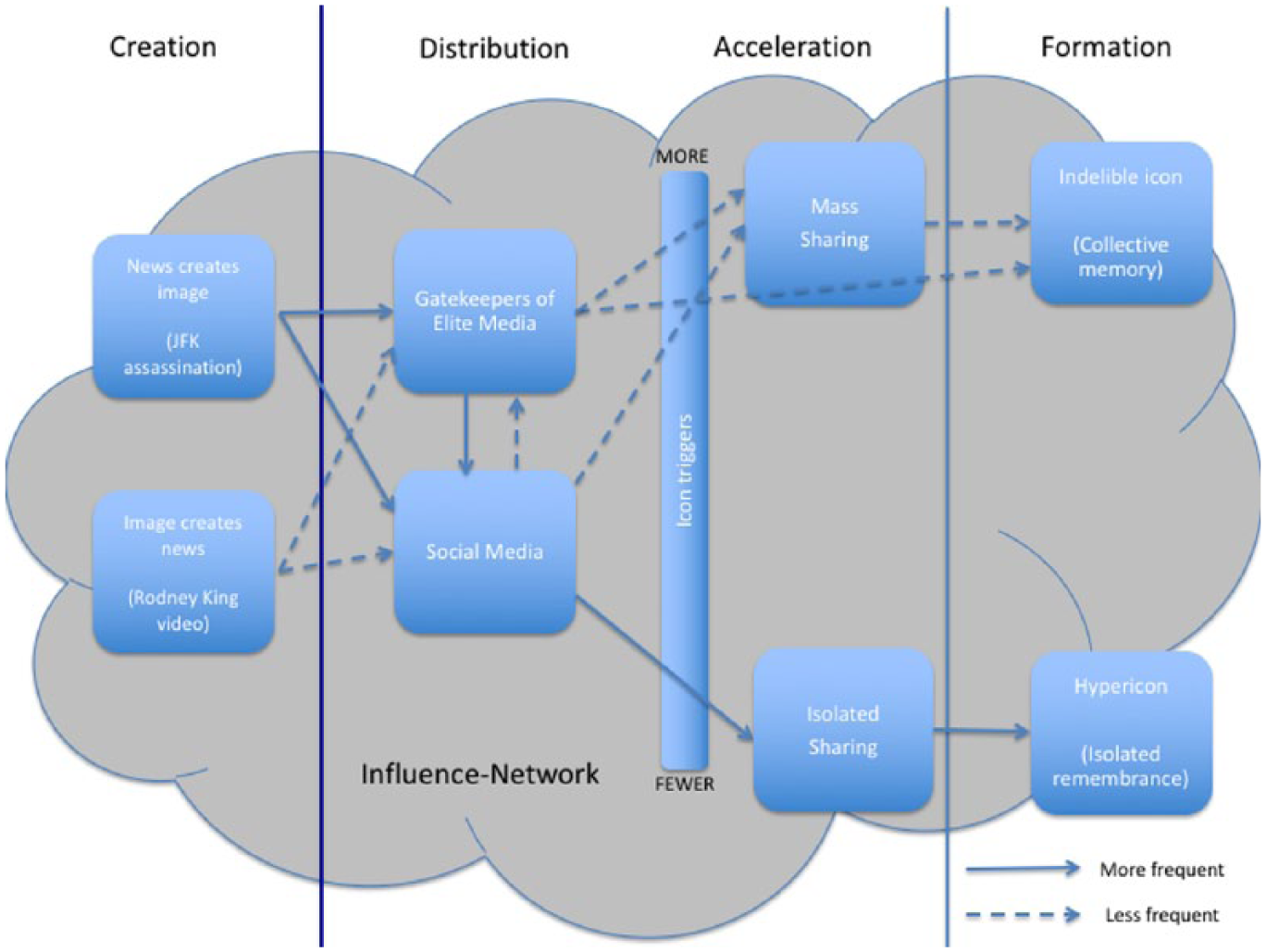
The influence-network model of the photojournalistic icon.
After outlining the theory, we examine three contemporary case studies, tracing their origin, history, and rise to iconic image status within the framework of our influence-network model. Volumes have been written on indelible iconic images of the 1960s, 1970s, and 1980s. Therefore, and given our theoretical premise, we examine three iconic images from relatively recent years (2009-2016). In the concluding section of our monograph, we outline some speculative predictions about the development of iconic images within the evolution of our model. A brief introduction to our three contemporary case studies follows:
Miracle on the Hudson. The iPhone photo (see Figure 2) taken on January 15, 2009, of the so-called “Miracle on the Hudson,” after a pilot successfully landed a malfunctioning passenger plane on a river, was among the first images of the incident to circulate the world and “one of the first and best examples of citizen journalism going viral on Twitter” (Zdanowicz, 2014). Through the dirty lens of his phone, a 23-year-old man on a commuter ferry captured the airplane floating in water with passengers standing on the right wing. He uploaded the photo to Twitter and put his phone away. This artifact of “eyewitness news” (France, 2009) demonstrates the marked shift of the production of famous news images from elite media institutions to citizens equipped with cameras at the location of a breaking news event. The image thus became iconic, representing the modern, citizen-created iconic image.
The Boy on the Beach. On September 2, 2015, 3-year-old Alan 1 Kurdi’s body washed up on the shore of a Turkish beach after he, his mother, his 5-year-old brother, and others drowned while fleeing from Syria to Greece. An arresting photograph showed the body of the little boy clad in a red T-shirt, blue shorts, and shoes lying face-down in the surf on a Turkish beach; his head was slightly turned to the left, as if he were sleeping (see Figure 3). Within hours of photojournalist Nilufer Demir taking the photo for the Turkish Dogan News Agency, which published it, the image spread globally through social media (Mackey, 2015), reaching 20 million people through Twitter (Goriunova, 2015). Many more millions saw it on the front pages of newspapers the next day. Afterward, government restrictions on accepting refugees were loosened (“Migrant Crisis,” 2015), and private donations to organizations like the Red Cross spiked dramatically (Slovic, Västfjäll, Erlandsson, & Gregory, 2017). The humanitarian response was short-lived. But, demonstrating the image’s importance, the photo has since been used and adapted by political and civic actors—from senators, to activists, to pundits, and protestors—to advocate their cause.
Unrest in Baton Rouge. During the summer of 2016, race-related violence generated immediate attention from both journalists and the public: Alton Sterling and Philando Castile were shot and killed by police officers, and eight police officers were shot and killed in Dallas and Baton Rouge. Numerous demonstrations across the country erupted, with each receiving news media attention. One image that rose to the forefront was that of Ieshia Evans, a lone African American woman, seemingly peaceful and strikingly poised, being approached by two police officers dressed in riot gear in Baton Rouge, Louisiana (see Figure 4). Journalists across the globe described the image, taken by Jonathan Bachman for Reuters, as a “powerful symbol” (Miller, 2016) and “impossible to forget” (Appelbaum, 2016). The photo was quickly hailed as “iconic” (Cole, 2016; Mack, 2016). It was compared with such well-known images as a lone man facing oncoming tanks at Tiananmen Square in 1989 and a high school student being attacked by police dogs in Birmingham, Alabama, in 1963 (Appelbaum, 2016). The meaning of the photo became instantly contested on social media, however, and interpretations were fractured along lines of race, locality, and political affiliation.

Miracle on the Hudson, January 15, 2009.
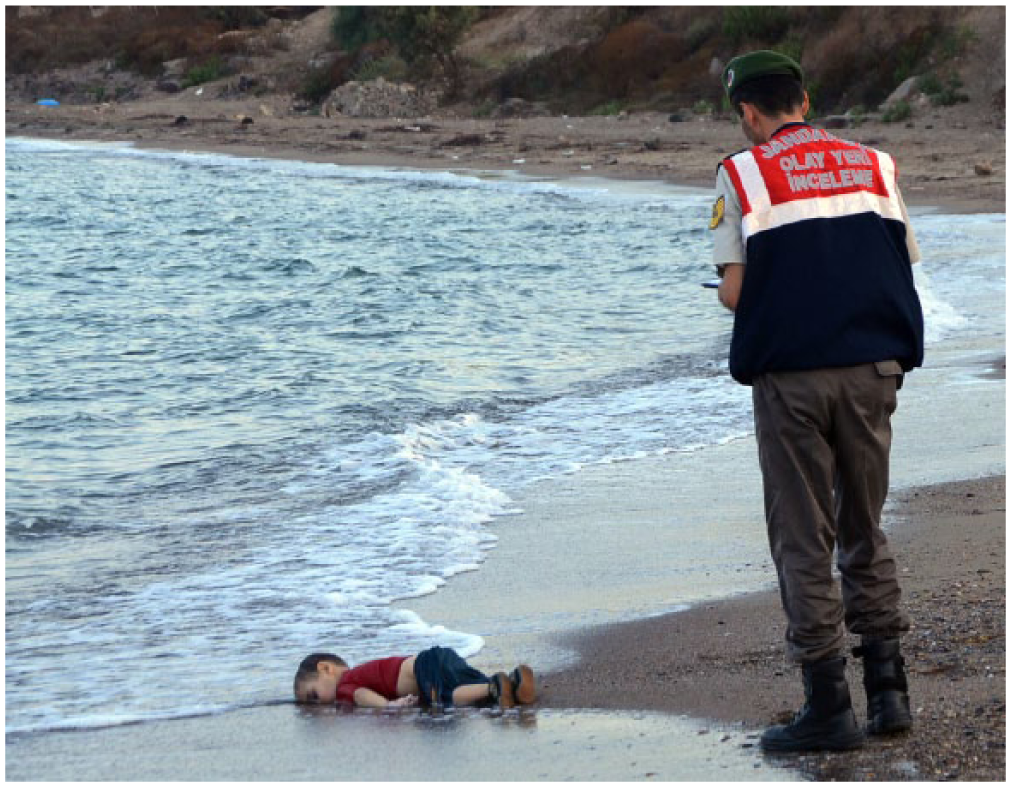
Death of Alan Kurdi, 2015.
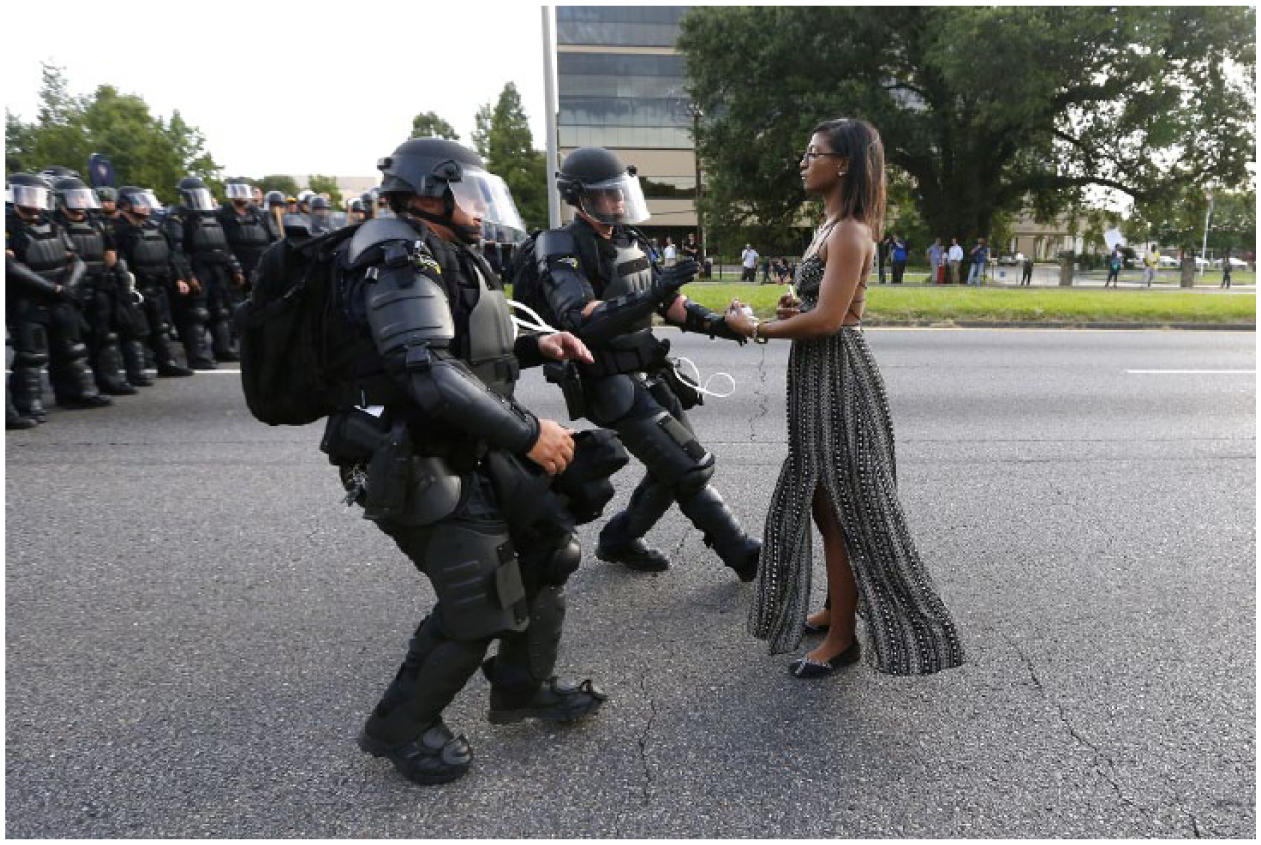
Protestor and police, Baton Rouge, Louisiana, 2016.
Although from different news events and moments in time, the three contemporary images, we argue, share a similar trajectory to prominence. With speeded-up creation, distribution, acceleration, and formation—the four phases of our proposed influence-network model—they became so-called instant icons among the connected publics and media outlets.
To begin, we review the relevant literature to illustrate how this process of iconic image formation has evolved over time, often propelled by technological advances.
Literature Review
News Photographs as Icons
The word icon comes from the Greek word eikon and translates into “likeness” or “picture.” Within that definition, icons have served various functions across time and space, from being sources of meaning to being objects of religious veneration. Ancient Greeks used icons to commemorate brave leaders and other people of note (Brink, 2000), for example, as did the early followers of Jesus. Icons have also played a central role in Orthodox Christianity, being ascribed the function of representing truth: What they captured was deemed authentic and real, as if storing an objective moment of reality (Brink, 2000). “To the Orthodox believer, icons are considered to be a mirror or portal into the holy” (Museum of Russian Icons, 2017), sealing their status as sacred objects. Typically displaying Jesus, his mother, and Christian saints, such icons have often been admired almost as much as the characters they depict (Museum of Russian Icons, 2017).
Similar to the religious images, some news photographs have been called “secular icons” (Brink, 2000) because of their lasting relevance, revered content, and perceived ability to capture reality and to evoke deep emotional responses. They symbolically collapse (or even simplify) ideas, historical events, and sentiments to an exemplary form, thus becoming metonyms that stand in for larger, more complex phenomena (Brink, 2000). Bennett and Lawrence (1995) define a news icon as a “powerful condensational image, arising out of a news event that evokes primary cultural themes [as well as] contradictions and tensions” (p. 22). They also allow countercultural and subversive readings that challenge dominant interpretations and prevailing narratives in the media and society (Hariman & Lucaites, 2007; Robinson, 2001). Here, we wish to extend the argument that the “complicated” nature of news icons comes from human cognition. On one hand, popular commentary takes the meanings and symbolism of the news icon to be natural when the “meaning” (conflating the aesthetic, condensational and political) is “obvious”; on the other hand, the closer you study any particular icon, the more imposed, artificial, and even industrial are the ways in which meanings and symbols are made of them. The process is more mythologizing than reporting.
The fact that a popular “image” can be symbolic, stand for something (e.g., a place, event, idea, feeling, political stance), is uncontroversial in the study of history, entertainment media, and politics (Perlmutter, 1994). We use the term “generic news icon” to refer to icons who fall into repeated iterations or genres, where people may recall the type but not necessarily (or in addition to) one special instance of it: starving child in Africa, protester being beaten by police, political leaders shaking hands. Similarly, Propp (1968) created a morphology of Russian folktales, identifying a limited number of repeated characters, situations, plots, and symbols among them. Similar compendiums have been made of movie genres, such as the classic Hollywood Western (Wright, 1977). Liebes and Katz (1988), in their studies of the reception of the original “Dallas” television show in Israel, found recurrent cross-cultural sets of visually enacted narrative themes, such as “conflict between father and son”; these recur again and again. In politics, scholars have long recognized that the nonverbal language of visual cues may be considered extra-analytical, that is, as constituting a protolanguage capable of communicating subtle cues about, for example, a leader’s personal attributes, including, most obviously, the attribute of leadership itself (Edelman, 1964; Graber, 1981; Nimmo, 1974).
Murray Edelman (1964), the American political scientist known for his research on symbolic politics and political psychology, in particular, documented how recurring, shorthand images, such the American Flag (“Old Glory”), were deployed as part of the rituals and myths of political life, most obviously in persuasive election messages, such as television commercials. Edelman (1964) argues, The meanings, however, [of political symbols] are not in the symbols. They are in society and therefore [people]. Political symbols bring out in concentrated form those particular meanings and emotions which the members of a group create and reinforce in each other. (p. 11)
We likewise assume that the meanings and myths of news icons are not naturally resident in the icons themselves but in what we say about them and how we use them.
Visual communication scholars generally agree that no single theory entirely or definitively maps out or predicts how famous images rise to the rank of icons from among the trillions of pictures that circulate throughout news and popular culture. But known images—those singular famous images we call “super” icons (Perlmutter, 1998)—share certain characteristics that propel them to an almost instantaneous fame. They typically capture an important moment in history and/or an important person and become familiar to audiences because of their heightened frequency of exposure and transposability across media. In other words, the life of an iconic image continues past its original publication (Dahmen & Morrison, 2016; Hariman & Lucaites, 2007; Mielczarek & Perlmutter, 2014; Mitchell, 2011). An iconic image is recirculated across media, jumping from the front pages of newspapers, television screens, and textbooks onto T-shirts, posters, and Internet memes, securing widespread prominence and celebrity. And, as mentioned in the introduction, iconic images operate efficiently as metonyms that crystallize larger events, sentiments, and phenomena.
Iconic images may share certain visual qualities, although there is no list of “must-have” elements that automatically upgrade a picture to an icon. One major shared visual quality is the “decisive moment”—in the words of Henri Cartier-Bresson—of a scene, when the lighting, angle of the shot, positioning of the subjects, and their bodily expressions align “just right” to produce a compelling composition that often elicits admiration and sparks conversations among audience members, although it is not an objective (or reliable) measure of the image’s greatness (Perlmutter, 1998). In scores of images, that decisive moment comes through juxtaposition or tension, visibly pitting conflicting elements against one another to reveal “some insight into the human character against the backdrop of historical events” (Perlmutter, 1998, p. 18).
Because of their fame, prominence, and cultural resonance, such secular icons undergo a process of canonization (Brink, 2000; Kemp, 2012), during which their status as defining images gets established over time (Mortensen, 2016). They “survive the conclusions of the stories in which they first appear, reappearing—as definitional cues, historical markers, and plot thickeners” (Bennett & Lawrence, 1995, p. 22)—as they enter mainstream culture and travel beyond it. Through reproduction, consumption, and recirculation over time, these famous images build up even more cultural significance, embedding themselves (and being embedded) within collective memories of a society and serving as signposts that guide interpretations of what happened (Borchard, Mullen, & Bates, 2013; Hariman & Lucaites, 2007; Zelizer, 2004). Such cultural cachet only amplifies the iconic photograph’s recognition, celebrity, and fame, fueling its continuous cultural circulation and temporal endurance (Hariman & Lucaites, 2007; Mortensen, 2016; Perlmutter & Dahmen, 2008; Zelizer, 2004).
Icons and Context
Perlmutter (1998) divides photojournalistic icons into two broad categories: generic and discrete. The news media deploy a generic iconic image to illustrate a commonplace, recurring situation. For example, an African child with a distended stomach and emaciated body is a generic iconic image of the broad phenomenon of starvation in Africa. But that same image may also be used to cover a specific instance of famine in Africa. A discrete iconic image is connected to a specific event that usually becomes the defining single image of that occasion or that historical time. Examples from across time and place abound, from the 1936 Dorothea Lange picture of a migrant mother and her children, which has come to symbolize the Great Depression, to the 1945 Iwo Jima flag raising on Mount Suribachi, which has come to encapsulate the Pacific Theatre in World War II for Americans, to name just two.
No iconic image—or any photograph for that matter—circulates and produces meaning in a cultural and cognitive vacuum. Captions, accompanying news stories, media commentary, and framing (as well as the viewers’ own experiences, value systems, and perceptions) influence interpretation (Berkowitz & Rogers, 1986; Craig, 1999; Dundes, 2004; Perlmutter & Wagner, 2004; Pfau et al., 2006). No wonder that readings of a single image vary widely among members of the public, who are influenced not only by what they see in the picture but also by what they were told and what they had seen in the past (Mielczarek & Perlmutter, 2014). In addition, each news photograph works on several levels, from literal and symbolic to personal, cultural, and timeless.
In drastic terms, photos may mean different things to different people—shockingly so—as was the case with the 2004 Abu Ghraib images that surfaced after a concerned soldier reported them up the chain of command (Gilmore, 2006). In one of the more infamous images, Lynndie England, a U.S. Army Reserve soldier, poses for the camera with a smirk and a cigarette in her mouth while pointing in a gun-holding gesture at the genitals of naked Iraqi detainees standing in front of her. For England and her friends, the images were reportedly merely frivolous pictures of “fun” on the job (L. Parker, 2004). However, for many in the United States—military, journalists, commentators, and the public—these photographs were photographic evidence of American-sanctioned prison abuse and torture; these images were subsequently used in investigations, prosecutions, and convictions (Gilmore, 2006; cf. Najjar, 2011), demonstrating their documentary functions. Dahlia Lithwick (2006), who covers the law and courts for Slate, wrote, The images were a searing reproach to virtually any American with a soul and a conscience. With a handful of sick exceptions, people who could agree on nothing else could agree that this was an unacceptable way to treat prisoners—regardless of who they were, what they were accused of, or where they were being held. (n.p.)
The immediate cultural and legal impact was noticeable: The photographs exposed illegal and unethical acts within the U.S. military, sparked heated debates among politicians and the intelligence community about legality of certain interrogation techniques, and shocked scores of Americans—and others around the world (Drash, 2009; Lithwick, 2006). Over time, however, the impact diminished (Lithwick, 2006; Mirzoeff, 2006). The hope expressed by politicians, media pundits, and the public that exposure to the images would move people to correct systemic problems around interrogation techniques in U.S. military faded; the images generated little change (Bierman, 2015; Lithwick, 2006). Eleven low-level U.S. soldiers, for example, were charged and convicted of abuse and related charges, largely absolving the military leaders of any responsibility. Despite the initial outrage generated by the images, more than 10 years later, “the calls for accountability have faded” (Bierman, 2015, n.p.).
Nonetheless, iconic photographs, some have argued, can simultaneously reveal and conceal, depending on the context of their viewing and the readings of their content (Brink, 2000; Zelizer, 2010). Iconic Nazi concentration camp images, for example, that display emaciated bodies and piles of corpses illustrate this paradox. They reveal (in that they are thought to show the horror of the Holocaust directly, nearly assaulting the viewer with death). Because of what they show, they function as documentary evidence that proves what “really” happened behind the walls of the Nazi death camps during World War II (Brink, 2000). And yet those same icons also conceal from the viewer the trauma because they show its aftermath instead of the actual acts of violence (Brink, 2000). They veil the direct horror by deploying the “about to die” and post-death moments (Zelizer, 2010) as visual signifiers of the hidden act of extermination. Depending on the context in which they are analyzed, they can produce myriad symbolic meanings riddled with contradictions (Bennett & Lawrence, 1995).
The crucial point, thus, is that the most important—and often overlooked—context of assessing an iconic image is the prejudices of the audience; as always, believing is seeing. People can look at any image and make what they want to make of it. Elite commentators are on very shaky psychological ground when they claim that any picture “naturally” provokes a discrete reaction. A picture can be “fun” to one person and “searing” to another. As Perlmutter (1998) concluded about holocaust imagery, . . . no picture is naturally the subject of outrage, in the same way that no image is a natural metonym. Outrage is a quality that stems from human cultural perspective. Many readers may object here, claiming that certain images—a child crying in hunger, or a man being beaten by the police, or civilians being bayoneted—are somehow universals, that all those who witness them will feel empathy and concern. While no action may result from this pity, at the least it will produce upset or outrage. This, however, is not always the case. Too many images that vocal elites in one culture have deemed objects of outrage have been interpreted wholly differently by others. We need look no further for examples than the photographs and films of the destruction of European Jews by the Nazis. These were produced as documents or souvenir shapshots by the perpetrators of the Holocaust. One man’s icon of outrage is another man’s trophy photo; yet, the picture does not change, only the prejudices of the beholder. (p. 30)
Iconic Images and “Powers” of Signification
Perhaps most important, iconic images are commonly alleged to have extraordinary powers to mobilize national opinion, start or stop wars, or at least capture “decisive moments” in history. Some evidence suggests that photographs can sway public opinion and move audiences (and governments) to action. Some visual communication scholars and photojournalists have ascribed almost catalytic powers to famous news images, linking them to specific political and policy outcomes, sometimes suggesting a causal relationship. Icons, they claim, can influence policy, end conflicts and humanitarian crises, and spark social movements (Hariman & Lucaites, 2007; Harold & DeLuca, 2005; Yang, 2011).
One photograph with such transformational abilities, Harold and DeLuca (2005) have argued, was the 1955 graphic, open-casket photo of the mutilated face of Emmett Till, the Chicago youth who was lynched by two White men in Mississippi after being accused of flirting with a White woman. Harold and Deluca (2005) argue that the image of Till served as a “political catalyst” in mobilizing Americans to action in the Civil Rights Movement. To its viewers, the picture, which circulated widely through the black press in the mid-to-late 1950s, documented the violence of racism in the South. The photograph turned its audience into a witness of lynching by revealing the shocking image of a brutalized corpse of a child (Harold & DeLuca, 2005). Because of its violence and its display of a body, Harold and DeLuca (2005) say, the image produced “rhetorical and political force” (p. 259), which, in turn, resulted in “tangible social and political effects” (p. 264), referring to the momentum behind the Civil Rights Movement. Indeed, as discussed above, some scholars maintain that images hold power to sway public opinion and to move us to action.
Journalists also frequently assume this kind and intensity of impact. As an example, following the publication and spread of the photo of Alan Kurdi’s body washed up on the shore of a Turkish beach, The Wall Street Journal claimed that the Kurdi photo was among those that was able to “change history” (Pensiero, 2015). Similarly, The Guardian suggested that the Kurdi photo was one that “shook the world” (Khaleeli, 2015). Images from the Great Depression and the Civil Rights Movement were also ascribed this power by The Wall Street Journal and The Guardian (Khaleeli, 2015; Pensiero, 2015). More broadly, the end of each calendar year brings lists of the “most influential photos of the year”; Time Magazine even recently included a feature on the 100 “Most Influential Images of All Time” (100photos, 2018).
But not all scholars agree that photos hold this type of influence or power. W. Joseph Campbell (2017), a journalism professor at American University, for example, argues that it was a “myth” that the iconic photo of a girl severely burned by napalm swayed public opinion and hastened the end of the Vietnam War. Furthermore, these frequently occurring journalistic lists of so-called “powerful images” are given this ascription without empirical evidence. Indeed, many famous pictures, including some we discuss in detail in this monograph, have attracted the attention of the world (at least the news world); they may have a telescoping and mnemonic power in that they are still used today as visual summaries of historical events. But that does not guarantee that they have the power to change government policy or to sway public opinion. To a large degree, some images deemed iconic are simply famous for being famous.
Other scholars of visual communication subscribe to a considerably less prescribed theorization of iconic news photographs and their impact on the audience (Domke, Perlmutter, & Spratt, 2002; Smith-Rodden & Ash, 2012). The powers of iconic images do not simply lie within the images in and of themselves (Hariman & Lucaites, 2007; Mielczarek & Perlmutter, 2014; Pfau et al., 2006). Instead, the bulk of those powers is manufactured by the news media, political pundits, government officials, activists, and commentators. In other words, the powers do not come directly from the images but rather from the political and cultural contexts surrounding those images. Those groups define such powers by framing the big images in specific terms and insisting on their role—ascribing that role, in fact—as sole determinants of situational outcomes without much evidentiary support for such claims (Perlmutter, 1998; Smith-Rodden & Ash, 2012). Their meanings—as aids to understanding news and history—are not fixed at the moment of the event they capture; rather, these evolve over time into a historical legacy of interpretations.
Again, for example, the Emmett Till image may have galvanized activists within the Civil Rights Movement and gained sympathizers nationally—especially in the North in the national news media—but nothing suggests that it changed hearts and minds in ordinary White southerners who were already firmly rooted in the ideology of segregation or in the legislators representing them. To be clear, we are not saying that Civil Rights images showing such horrors as the beating and setting dogs upon 1960s and 1970s Freedom Marchers had no effects. Rather, descriptions of the “power” and “effects” of news icons tend to be overly general, imprecise, and not backed up by actual evidence. An image may have an effect in one dimension (policy-maker decisions, legislation, legal rulings) but track little change in another dimension (public opinion). Furthermore, audiences are not homogeneous; local politics, culture, and prejudices matter as filters of reception—as we will see with the third case study discussed later in this monograph. In the case of the Civil Rights Movement, on one hand, significant Civil Rights legislation, rulings, and initiatives were passed throughout the 1960s. Simultaneously, on the other hand, in the Southern U.S. states, such as Alabama, “anti” Civil Rights candidates consistently won elections. Indeed, staunchly segregationist George Wallace won the 1972 Democratic presidential primaries in Michigan and Maryland. One man’s oppressed Civil Rights workers unjustly beaten was (and apparently still is) another man’s “outside agitators” getting their deserved comeuppance. The two conditions must be investigated individually, not lumped together into the deterministic and unscientific rhetoric of the “powerful image.”
Some photographers, visual communication scholars, and members of the public suggest that iconic images have the power to both perpetuate and subvert ideology; they also have the power to model civic behavior (Bennett & Lawrence, 1995; Hariman & Lucaites, 2003, 2007; Harold & DeLuca, 2005; Solaroli, 2011; Yang, 2011; Zelizer, 2004), thus acting as teaching tools for the generations of those exposed to the pictures. Hariman and Lucaites (2007) argue that Iconic news photographs . . . orient the individual within a context of collective identity obligation, and power . . . Photojournalism might be the perfect ideological practice: while it seems to present objects as they are in the world, it places those objects within a system of social relationships and constitutes the viewer as a subject within that system. (pp. 1-2)
Joe Rosenthal’s iconic (and Pulitzer Prize–winning) photograph of the 1945 flag raising on Iwo Jima is a case in point. Rosenthal’s image has come to encapsulate what American sacrifice and contribution to the war effort looked like (Hariman & Lucaites, 2003, 2007): a group of American men working together for the greater good of humanity. The news image, distributed by Associated Press (AP) less than 18 hr after Rosenthal shot it, has served to model these particular conceptualizations of citizenship and patriotism, thus playing an active role in shaping American civic identity and behavior over the years and the collective memory of World War II. The fact that none of the faces of the men in the photo are visible allowed the group to become a metonym of “all our boys at the front” and “all Americans sacrificing together.” Such iconic photographs as Rosenthal’s can transform “the banal and the disruptive alike into moments of visual eloquence” and thereby create “an idealism essential for democratic continuity” (Hariman & Lucaites, 2007, p. 3).
As much as iconic images may promote and solidify such collective sentiments and identities, they may also challenge them (Bennett & Lawrence, 1995; Hariman & Lucaites, 2007; Solaroli, 2011; Zelizer, 2004, 2010), becoming sites of contentious political and ideological debates. In fact, they often invite alternative interpretations of the dominant narratives that surround them. This happened with the iconic 1972 Vietnam War image showing a naked and severely injured girl and other children running toward the camera after their village had been bombed with napalm. At the time, the AP photographer Nick Ut’s photo cemented (for some Americans) the Administration’s argument for an urgent and needed intervention in Vietnam to stop the spread of Communism (Hariman & Lucaites, 2007). The photo also justified (for some) the American involvement in fighting the enemy and (possibly) saving villages of children from harm. The soldiers who casually walk behind the running children in Ut’s photograph are not American, although scores of viewers have assumed so over the years (Hariman & Lucaites, 2007). As such, this interpretation of the image as justification for American involvement is based on a faulty premise. Furthermore—a point often left out of much commentary about this iconic photograph—the incident pictured occurred after the United States began withdrawing its land forces from Vietnam. For others, however, the Pulitzer Prize–winning picture sparked oppositional readings regarding the shaping of understanding of the war and their country’s role in the conflict (Hariman & Lucaites, 2007). It forced some to confront the morality of the war and to ponder American culpability, even if American military was not directly responsible for the incident. For some others, the image came to symbolize the plight of children as casualties of war, shifting the conversation from ideology to humanitarian action (Hariman & Lucaites, 2007). In sum, the “power” of iconic imagery is not one unified force covering all eventualities. Rather, an iconic image can have different kinds of powers that may or may not coincide in the interpretation of that image or how that image is employed.
Erosion of the Iconic Image in the Digital Era
As previously discussed, the number of images taken in recent years has skyrocketed because of digital technology (such as smartphones with built-in cameras) and mobile communication that allow for online sharing and constant circulation of images (Hand, 2012). One industry source estimated that 1.2 trillion digital photos were taken in 2017 (Cakebread, 2017), compared with 3 billion in 1960, 25 billion in 1980, 86 billion in 2000, and 380 billion in the mid-2000s (Schwarz, 2012). Regarding the enormity of the number of images taken, Rubenstein and Sluis (2008) write, “the value of a single photograph is being diminished and replaced by the notion of a stream of data in which both images and their significances are in a state of flux” (p. 22). With such an enormous influx of images uploaded and circulated among traditional and nontraditional media outlets, the “Golden Era” of the iconic image has come to an end (Dahmen & Miller, 2012). The providence of contemporary news icons has also changed: It no longer traces back exclusively—as it has for decades—to the professional institution of legacy media, thus making the production of present-day photography, including icons, more democratic and widespread (Borenstein, 2009; Hristova, 2014; Mortensen, 2016). The “news media” are no longer a tiny band of elites.
Today, with the proliferation of social networking sites, blogs, digital cameras, and smartphones, Internet users can circumvent mainstream media institutions to produce and share “their vernacular creations to Internet audiences” (Howard, 2008, p. 491), including iconic photographs. As a consequence, in the digital era, less and less often does a singular image define an event (Dahmen & Miller, 2012). Instead, series of photos and videos now capture the themes and motifs of news events (i.e., instead of only decisive moments; Dahmen & Miller, 2012). They are shot by professional photojournalists and their amateur counterparts alike, all competing for the attention of the members of the public. Such was the case with Hurricane Katrina, when no single photo emerged as the tragedy’s defining image (Dahmen & Miller, 2012). Research on viewers showed, instead, that viewers identified several iconic news images—some taken by professionals and some by citizens—that they said encapsulated the disaster through several themes, most notably roof rescues (Dahmen, Miller, & Morris, 2018).
The “Speeded-Up Icon” and Internet Derivatives
The singular famous images that do come online in the digital age share the mentioned characteristics of the traditional news icons from the pre-Internet era. But their path to fame and their enduring cultural resonance differ. These “hypericons” (Perlmutter, 2006) are the speeded-up famous images that are rapidly consumed online by a networked global audience. The fame of hypericons stems largely from the furious—oftentimes viral—circulation online that turns them into highly visible and prominent “instant news icons” (Mortensen, 2016, p. 409). These particular images are “more transient than traditional icons and are mobilized by impromptu publics, which have affect as their driving force” (Mortensen, 2016, p. 410). In the era of instantaneous mass self-communication (Castells, 2009), when news and images flow across platforms outside and within the traditional mass media structures, instant iconicity—often proclaimed as “iconic” within hours of the photograph’s public debut—is manufactured spontaneously by connected publics across the world who disseminate and mobilize a particular image, appointing it the visual frame of reference for a news event by the sheer intensity of dissemination alone.
As such, the contemporary instant news icons of the social media era are unlikely to linger in the public consciousness for as long as their traditional predecessors (Mortensen, 2016; Perlmutter, 2006). In our network-influence model of iconicity, we will argue that the fame of these hypericons is fleeting, and therefore, hypericons do not persist as enduring iconic images in the visual collective memory. In the social media era, in which the production, circulation, and consumption of images are prolific and ongoing, the competition for iconic status is intense. In such a fast-paced production environment, the icon’s “replacement rate is even more important, since the hypericon does not have time to establish itself through long-term repetition because other quasi icons replace it quickly” (Perlmutter, 2006, p. 60). As a consequence, contemporary photojournalistic icons may be more ephemeral than ever; they quickly make a strong—but not necessarily a lasting—impression on the viewers (Mortensen, 2016; Perlmutter, 2006).
As part of the “transcontextual circulation” (Solaroli, 2011, p. 247) in digital culture, images often serve as fodder for the impromptu networked public to reframe the dominant news narratives about the events they capture through, for example, memetic reappropriation. The Alan Kurdi photograph analyzed later in this monograph serves as a case in point. As the image spread through social media (primarily Twitter) hours after its original publication on a Turkish news site, about 17% of the shared images from the news event appropriated the iconic image in cartoons, memes, and other formats (Vis & Goriunova, 2015). Photojournalistic icons get their multiple lives online when they become Internet memes: images that share common elements of content, form, and stance and use the original image as a template to create new meaning (Hristova, 2013, 2014; Milner, 2013; Shifman, 2014a, 2014b). These images can serve as “memetic photos” (Shifman, 2014b, p. 89), images that invite memetic creativity for a variety of reasons: They may display a visual incongruence that begs for resolution or repetition in other contexts, they may freeze an unfinished action or a tense moment that provokes creative responses, or they may display an absurd situation or a funny facial expression that gets reappropriated in other compositions that already have existing content (Shifman, 2014a, 2014b). The result is a collection of Internet memes that use parts of the iconic image to create new rhetorical statements with personalized touches about whatever the image captured.
“Reaction Photoshops” (Shifman, 2014b) are one popular genre of Internet memes whose memetic creativity involves manipulating an image to produce reactions to it. They often mash up famous images with other content, inserting part of the iconic image into other contexts or inserting various characters into an iconic scene, repeating some elements of the original throughout the series of iterations. Scores of examples abound, including the memes of the pepper-spraying cop that were manipulated interpretations of the iconic image of a University of California-Davis police officer seen pepper-spraying student protesters during the 2011 Occupy Wall Street movement. Countless memes surfaced on social media just hours after the original image was posted online, inserting the spraying officer into various contexts, including other known historical moments captured through images and paintings, including Nick Ut’s Vietnam War photo, Picasso’s Guernica, and Da Vinci’s The Last Supper. Similarly, the Syrian boy’s dead body from the iconic 2015 news photograph was placed in a bed, on a blanket, in the middle of the European Union’s parliament, and at the feet of Arab leaders, to name a few. These new kinds of interactions between photojournalistic icons and various kinds of publics in the era of digital news, mobile phones/tablets, and social media remain understudied.
Summary
The portrait of iconic images that emerges from the above scholarship presents them as prominent artifacts of public culture that have functioned as building blocks of history for about two centuries. They have been ascribed powers to evoke emotions, change opinions, and policies—and even end wars. Some of that perceived power stems from their striking composition and content and some gets transposed over them by journalists, politicians, and the public. Although, as noted, photojournalistic icons continue to contribute to the meaning production in contemporary digital culture, their pathway to stardom has been changing, mirroring advances in technology. With this literature framework, we now account for those transformations and turn to the propositions for an updated model of iconic imagery.
Propositions for the Influence-Network Model of the Photojournalistic Icon
We argue that the process (which we will call a model) for iconic image formation has not changed; rather, technological advancements have allowed for new ways in which this model fulfills itself. Regardless of time period, for an image to become iconic requires some sort of influence through a network. In the Golden Age, if the New York Times ran an image above the fold on the front page (e.g., Man Standing Against the Tanks Near Tiananmen), this increased the likelihood that other news outlets (print, broadcast, and cable) would then run—or were already running—the same image, thus illustrating influence of the elite media network.
But in the modern era, news producers and audiences are potentially one and the same, thus influencing one another and creating and connecting networks beyond the elite media. As already seen in the image of the airplane landing on the Hudson—and also in images of the 2004 Asian tsunami and the 2005 London underground bombings—the new first draft of history can be taken and posted by nonjournalists, with industrial news venues being influenced and then publishing, airing, posting, and sharing the images. Certainly, networks enjoy different amounts of strength based on the size and influence of followers and supporters. The number of subscribers or followers on a Twitter feed, for example, could be a measure of network strength. And certainly, networks have hierarchies. All Twitter accounts can be said to be equal in terms of their space and function, but some accounts can be said to boast more strength based on their influence through followers. Network size helps to determine speed and spread of content.
The influence-network model of how particular photographs become iconic (or not) involves four central and related stages: creation, distribution, acceleration, and formation (again, see Figure 1). We now consider these four central stages of the influence-network model of the photojournalistic icon, which include patterns and rules that sometimes may predict when or how or which images become iconic in the age of digital news, mobile phones/tablets, and social media.
Creation
Stage 1 is the initial creation of the image. Image creation can be considered neatly by adapting Harold Lasswell’s (1948) famous statement of communication: The image is captured by whom, in what context, and for what purpose? We argue that (a) news creates images that come to be iconic and (b) images create news that leads to the image being regarded as iconic. To illustrate, John F. Kennedy’s (JFK) assassination in November 1963 was—without question—a significant news event. It was within the context of the weight of that major news that a photograph of a young son saluting his father’s coffin became an iconic image. Conversely, the brutal police beating of Rodney King in 1991 in Los Angeles would not likely have become the significant news story that it was without the image of the beating to drive the weight of the news, and the subsequent trial and riots. Process 1—in which the news creates the image that becomes iconic—is more common.
Also regarding creation, we must again take notice of the effects of citizen-created content for visual reporting; the “who” is not exclusively restricted to recognized journalists. A citizen named George Holliday just happened to observe and capture on his Sony Handycam the beating of Rodney King by four Los Angeles Police Department (LAPD) officers; the raw footage of the event was later broadcast on national television. Twenty-five years later, because of technological innovation, nearly everyone has a smartphone that takes pictures and video. In breaking news events, everyday citizens are now on the scene to capture breaking news images. Called a “pivotal moment in the history of journalism,” images of the reporting of the London bombings in July 2005 largely came from citizen-created content (Allan, 2015; Cooper, 2015). Less than 1 year later, CNN launched iReport (https://www.cnn.com/specials/opinions/cnnireport), a feature that allows citizens to easily share captured photos and videos with the news network. According to the CNN description, “iReport invites you [citizens] to take part in the news with CNN. Your voice, together with other iReporters, helps shape what CNN covers and how” (“CNN iReport FAQ,” 2018, n.p.). In the modern era, any photograph taken by anyone could potentially become iconic.
Distribution
Traditionally, news photographs became iconic in large part through their prominent placement on the front pages of elite newspapers across the globe. As referenced in the introduction of this article, but worth repeating, Nicole Fruge (2013), San Francisco Chronicle Deputy Director of Photography, explains, When you think of the Hindenburg disaster, when you think of that picture, you think of the front page that that picture was on . . . and it plays together as this complete, finished thought, which is really amazing and wonderful. (Personal communication, February 6, 2013)
Audiences then saw those same images—in both still and moving forms—on the evening news broadcast. These elite media placements of imagery in print and broadcast influenced each other in time and space to solidify select images as icons. Moreover, elite media networks were established, and through prominent placement and frequency of repetition, icons were industrially created and industrially defined.
Of course, not all photographs that have appeared (or will appear) on front pages and on elite media news broadcasts become iconic. Rather, gatekeeping by news editors—through the selection and placement of photographs—had long been one critical component in the formation of iconic imagery (McCombs, 2004). Indeed, replication across media and time has been one of the key indicators of photographic iconicity (Hariman & Lucaites, 2007; Perlmutter, 1998).
What is the effect of the shift away from print news and toward a digital news environment, however, on this traditional tenet of iconicity? While lead news images certainly exist in a digital media environment, they are no longer “fixed” in a medium in the same way that they were once fixed in print. In print, news images are “fixed” (i.e., printed or solidified) in time and space on the cover of a news magazine or on the front page of a newspaper. As part of our model, we consider the term “fixedness,” in part as a nod to fixedness in a dark room, but also due to changes in the medium itself. In a digital environment, news images rapidly come and go across a digital news site or a social media feed, and thus, their time in our immediate digital radar is fleeting. While digital images are theoretically forever available in digital space, the digital image is rarely “fixed” in its form and meaning because of easy and prevalent manipulation (memes, for example) or just the sheer ability to spread online enabled by unlimited channels and networks with varying levels of influence.
In a digital news, mobile phones/tablets, and social media environment, while images are still replicated across media and time, our understanding and experience of “media and time” and the distribution of images have been greatly shifted and probably shortened. Relatedly, with the rise of smartphones and social media, fast data transmission speeds, and high-data capacities of technologies owned by individuals, both elite and citizen-captured images can spread rapidly via social media. We no longer need the front page or broadcast/cable media to distribute and bring photos into our living rooms. Rather than turning to a handful of elite newspapers or evening news broadcasts—which still have the ability to create iconic images—audiences now have unlimited opportunities to share, seek out, and receive imagery via digital news, mobile phones/tablets, and social media.
What is more, many news media outlets solicit user-generated content “from the scene,” often relying on it to supplement their own reporting. CNN iReport, which crowd-sources viewer content through social media, is again an example of this common practice (Lobato, Thoms, & Hunter, 2011; Thurman, 2008). Often characterized as technological laggards (Thurman, 2008), mainstream news media have been moving away from merely providing news and information to their audiences to now inviting citizens to contribute their content to the professional sites (Lobato et al., 2011; Thurman, 2008). So-called mainstream media, thus, no longer curate only themselves; they also curate content from citizens.
As an additional caveat of the distribution of images, images no longer solely exist on the pages of the news media and history books. Images can now “live” in a digital space: In an online environment, and at any time and place, one can easily search for and locate an image. In other words, images can resurface at any time—and, perhaps more relevantly, they can resurface as “important” in the course of a news story. Consider, as an example, the now infamous photograph of then President Bill Clinton hugging an intern in the middle of a crowd of onlookers. The photo, taken at a Democratic fundraiser in October 1996, perhaps innocuous in its own right, later become marked evidence—and largely important in its own right—in 1998 when the sexual relationship between Clinton and the intern was revealed. The photo took on iconic status well after it was taken.
In addition to easily locating original images, digital space and “living” images now allow for the mass distribution of appropriations of images. As an example, a quick Google search of “situation room 2011” will locate the iconic image taken by Pete Souza (the former Chief Official White House Photographer for Presidents Ronald Reagan and Barack Obama and the former director of the White House Photography Office) of President Obama and his national security team waiting in suspended disbelief for Osama bin Laden to be killed. Historical record notwithstanding, the Google search will locate countless appropriations of the image, from Obama and his team dressed as superheroes to other caricatures of the group. Several questions arise: Do audiences know the original image? Or do they only know the appropriations of the image? And how, then, do those appropriations affect the historical significance of that original moment?
Acceleration
The distribution of an image is directly tied to the third stage, which is the acceleration at which an image spreads and becomes known. Iconic “triggers” (which we are defining as catalysts for the dispersion of an image) determine the rate at which an image spreads and becomes known. We posit that the more triggers an image holds, the more frequently it will be shared via the gatekeepers of elite media and then citizens of social media (or vice versa). The more triggers, the more likely the image to experience mass sharing. The fewer the triggers, the more likely the image to experience isolated sharing. In the age of digital news, mobile phones/tablets, and social media, for an image to become resilient (and to be mass shared) is more challenging given an overabundance of images taken—again, some estimates suggest that 1.2 trillion images were taken in 2017 (Cakebread, 2017). However, for those select few images that experience mass sharing, their ubiquity becomes even more pronounced. Through mobile phones/tablets and social media, the mass sharing of images precipitates even greater fame for the image because so many people are sharing it, and each act of sharing leads to an additional digital artifact. The remainder of the images is likely to be more ephemeral precisely because of the onslaught of production, hard competition, and shortened time of exposure (Perlmutter, 2006).
The presence of trigger—not necessarily in reality but in ascription or perception of its presence—can enhance (or diminish) the chances of an image being accorded iconic status. It is also critical to understand that these triggers are not mutually exclusive: Iconic imagery can and will exemplify the intersection of triggers, thus further contributing to the potential for that image to experience mass sharing. The following factors, expanded from Perlmutter (1998), can act as triggers:
Importance of events. The question of “what is news” is certainly longstanding within journalism practice and one that we will not debate here. Rather, we reference seminal research on the taxonomy of news values as predictive of the journalistic determination of what is and is not newsworthy (Galtung & Ruge, 1965). Events that are deemed important—typically those that involve conflict, magnitude, impact, and/or prominence—are likely to be heavily covered by the news media (and increasingly by citizens). As such, this increases the likelihood of iconic images associated with the important event: the flag raising by the three firefighters at the 9/11 site, the fireman carrying the dead child out of the Oklahoma City federal building wreckage, and a young son saluting his father’s coffin.
Timeliness. A basic news value is that information should be new. A photograph produced concurrently with a breaking news event so that it can be plugged into a newshole to illustrate that event has an advantage in getting early attention. Hungarian war photographer and photojournalist Robert Capa’s blurry images of the D-Day landings were more likely to emerge among the icons of the event than much clearer images taken weeks later. And, in the age of 24-hr news and reality television, timeliness is even more fleeting. As noted before, the photo/videographer at the scene is increasingly more likely to be a nonprofessional citizen with a smartphone than a professional employed by industrial media who arrived on the scene 10 min later. Timeliness, however, is not always a prerequisite for an image to become important in the news and public conversation—recall the earlier discussion of the resurfacing of the photo of then President Bill Clinton hugging Monica Lewinsky.
Historical or event metonymy. Almost all the iconic images of the Golden Era of the 20th century are used historically, to represent historic events, even great and sweeping ones that took place over long periods. History textbooks often regularly use a single image if it is consensually taken as a metonym (Perlmutter, 1997). As one example, the image of a little boy with his hands up in the Warsaw ghetto is often employed to stand for the World War II Holocaust of Europeans Jews (Berger, 2010). To take another example, the Migrant Mother photo has come to represent the Great Depression (Hariman & Lucaites, 2007); Dorothea Lange’s 1936 photo of a destitute farm woman has even been called “the iconic photo” of the sustained period (Phelan, 2014).
Prominence/Frequency. Historically, prominence and frequency were standalone triggers. Iconic images were most likely to be placed in positions of prominence in the news media: “above the fold” on the front page of the newspaper, the cover of the news magazine, or lead of the television newscast. These prominent placements helped the icons gain attention, as did frequency, that is, the repetition of iconic images across place and time. But in the age of digital news, mobile phones/tablets, and social media, frequency becomes prominence. Images can certainly still exist above the fold and at the top of the newscast. In a social media environment, however, prominence (as we have traditionally identified it based on size and placement above the fold; cover of Time magazine, etc.) changes: Every YouTube video is the same size; every social media image is roughly the same size. In addition to front pages and leading broadcast images, icons appear online in various places at the same time, surfacing on Twitter (and trending) and on Facebook news feeds, on news websites, and the like. Prominence is now much more platform-specific and cross-pollinated. The measure of prominence is the degree of trending online. Regarding frequency, photo icons are ascribed with power by their ubiquity: They are seen more often, appearing in print, television, and the Internet, and in the age of social media, they rapidly spread across our social channels. In the modern era, they also are more likely to be passed on for comment by social media and even to become captioned memes. Their iterations often cross many genres with modes of publication as well, from news programs to history to documentaries to textbooks to appearances in popular culture. In a social media world, frequency (measured in terms of likes, shares, upvotes, reposts, favorites, and comments) is the real value; thus, frequent images become prominent images.
Fame of subjects. Some iconic images gain importance and prominence and are replicated partly because of who is depicted. The image of the dying Robert Kennedy, or JFK speaking in Berlin before hundreds of thousands, or Jimmy Carter, Menachem Begin, and Anwar Sadat signing a peace treaty would be unlikely to be iconic if their subjects had been ordinary, unknown people. At the same time, fame can be thrust upon someone at a particular moment. Whether it is the man standing against the tanks near Tiananmen or a naked girl running away after being injured by napalm during the Vietnam War, ordinary people can become famous because they are the subjects of an iconic image. Iconic images also can lead to the fame (however fleeting) of previously unknown individuals. In the case of the 2013 Boston Marathon bombing, the photo of a man in a cowboy hat heroically helping a victim became a key image, garnering national attention and thrusting the two people at the center of the image into the media spotlight (Dahmen, 2016; Dahmen & Morrison, 2016).
Celebrity. Iconic images themselves are famous, and fame—as the 20th century demonstrated and the Internet age sustained—is a viral phenomenon. These days people are famous for being famous. (Reality show contestants are described by the same word—stars—that was previously reserved for acclaimed actors such as Meryl Streep and Cary Grant.) Some argue that despite having no previous political experience, Donald Trump was elected President of the United States in large part because of his “star” status, subsequently making him the first “TV Reality show” president (Cassidy, 2017).
Secular authority. Political, academic, and journalistic elites have always played a crucial role in influencing the potential iconic status of an image. This type of authority is seen when a prominent individual points out a particular image and says, in effect, “This is important; everyone pay attention.” When President George H.W. Bush referred to the Tiananmen image and stated, “We all stand with that man,” the press and the public were unlikely to ignore that image (Perlmutter, 1999). President Bush (1990) later cited pictures of starvation in Somalia as something that we “cannot let stand” and used them as justifications for U.S. intervention. Similarly, and more recently, President Donald Trump deemed the photos from the spring 2017 sarin gas attacks in Syria “horrible” and “awful” enough (A. Parker, Nakamura, & Lamothe, 2017) to warrant military action from the United States; the implication was that his rallying cry of the importance of the images helped to gain generally widespread support for the military intervention, as fleeting and ineffective as it was (Hughes, 2017). To be clear, secular authority—as with any of the triggers—does not solely dictate that an image is or will become iconic. For example, audiences paid attention to the sarin gas attack photos, in part, because President Trump said they were important; but this alone was not enough to dictate that the images became iconic.
Cultural resonance. Iconic images can invoke (a) tropes or previous images that may be common as a cultural reference across time and space, or (b) specific references within certain cultures. The man standing against the tanks near Tiananmen, for example, was variously likened to the Biblical story of David versus Goliath and the legendary Horatius, the Roman army officer who famously defended bridge from an invading army in the late 6th century BC. Most (if not all) iconic images embody the human experience. The vast majority of iconic images have people as the central element. Granted, some iconic images do not show people (the whole earth, crumbling twin towers on 9/11), but even in those without individuals, the connection to the shared human experience of life and death is strongly implied in those images. In other words, an arbitrary image of a shoe or building, for example, will not become iconic without a direct connection to human experience (and then the object must be emblematic of that event, such as the smoke plume from the Challenger explosion). Moreover, embodied in icons is a uniqueness–universality dichotomy. However, they are situational: Iconic photographs of the Boston Marathon bombing, the airplane landing in the Hudson River, and the dead Syrian boy on a beach are all tied to specific news events as discrete iconic images (Perlmutter, 1998). But they are also universal (or generic) as they tap in to universal themes, transcending the specific to signify the general: survival, triumph, and failure (respectively).
Transposability. Icons are often analogous to what George Orwell, in his famous 1946 essay, “Politics and the English Language,” called dead metaphors, which no longer evoke any visual image and therefore is now merely ordinary words. George Orwell distinguished those from metaphors invented by poets who assist thought by evoking a visual image. Like dead metaphors, icons have “meaning,” but their origins have been lost (e.g., “red herring”). In some cases, the images are made into historical monuments (e.g., the United States Marine Corps War Memorial and the 1968 Black Power Salute statue at the National Museum of African American History and Culture). They are parodied on late night television and then appropriated and used in mass-reproduction on coffee mugs, mouse pads, dorm room posters, and now even smartphone cases. As referred to earlier, they can live forever as well as “Reaction Photoshops,” plugged into Internet commentary, perhaps in reference to a new icon. We know them because their frequency, both in originality and in appropriation, is ubiquitous. Today, the main transposer of an image taken at one time, in one setting within one context and then applied to another (with an inside-the-image caption), is the Internet/social media meme (Procházka, 2014).
Aesthetics and striking composition. An irony that is often observed about iconic images is that many of them are not quality images, at least by the standards of Photojournalism 101 classrooms. The Raising the Flag on Iwo Jima photo does not follow the standard dictum to show the faces of the subjects. Man Standing against the Tanks near Tiananmen is almost out of focus due to the extreme distance, because all the iterations of the photo were taken by photographers trapped in a nearby hotel. In Woman Screaming over Dying Young Man at Kent State, undoctored versions include a pole that looks to be protruding from the subject’s head. On the contrary, many famous photos show decisive moments. If the photograph had been delayed—for example, being taken few minutes later or before the event (e.g., a flag raising, a street execution, or a shot fired in assassination)—the moment would have changed and the iconic image may not exist. Furthermore, volumes in their own right could be written about each “indelible” image’s aesthetic properties, from clashing vectors of movement to color composition and the mise-en-scène of objects included. Of course, “great” images tend to be the focus of a great deal of attention; thus, aesthetic properties are discovered post hoc to explain their greatness.
Profit/Economic value. The economic value of a news icon is a largely unexplored area within scholarship. Revenue primarily originates from academics, school textbook publishers, advertisers, documentarians, and others who pay for the rights to use an image and often are willing to purchase a printable high-resolution copy of the still print, film, or video. The actual cost of rights is highly variable, due to many circumstances and contingencies. For example, the AP is the copyright holder for Eddie Adams’s Saigon Execution 1968 picture and sometimes charges US$250 for rights to reproduce the image in an academic book of less than 2,500 print run copies. Often, however, copyright holders will negotiate with would-be users based on the number of individual purchases a potential user wishes to make and even the user’s particular affiliation, such as a university versus a news organization. A waiver for part of a fee for an educational project may be granted, but a charge could me much higher for commercial use. A news icon in the stratospheric level of some of the classic famous images discussed here, like the Saigon Execution 1968, thus, can earn hundreds of thousands, even millions, of dollars of revenue for the copyright holder.
Notably, the copyright holder often is not the photographer. Eddie Adams, for instance, shot his images under a “work for hire” contract for the AP. At least initially, he earned nothing from sales of the images, although, as one of his editors at the time recalled, Adams was allowed to print individual copies, sign them, and then sell them as an objet d’art, explains Hal Buell, renown longtime AP photo editor (Buell, personal communication, January 17, 2018). Indeed, the prestige of being the person who photographed an icon has an economic value aside from fees. Icon photographers are more likely to find future employment, be paid to give lectures and lessons, and win awards that carry some cash value. So, they can benefit economically indirectly, if not always directly. The expense of purchasing icon copyrights can affect history itself—or at least our vision of it. The award-winning Public Broadcasting System 1990 two-part documentary Eyes on the Prize about the history of the Civil Rights Movement could not be rebroadcast on television for many years because the use agreement for the images of Martin Luther King, Jr. expired and the costs for repurchase were very high (Brown & Harris, 2005, p. C01). Eyes on the Prize was eventually rebroadcast, but only with a grant of US$600,000 from the Ford Foundation (Dean, 2005). The second part that focuses on King’s story is still not available for purchase, even by universities and colleges. In any case, the economic value of an icon is its least publicly explored component but is certainly one that mainstream media organizations have always recognized as being a power of a celebrated image.
Shocking/Graphic content. One of the longest running ethical debates in visual journalism is the extent to which news media should run or use graphic images. Research has shown that when audiences feel emotionally connected with news events, they are more likely to change their views or take action (Maier, Slovic, & Mayorga, 2017). To publish violent or graphic imagery is often the way to truthfully and entirely convey a story to the public, without filtering the nature of that story before publication. Regarding graphic war imagery, Susan Sontag (2003) writes, “Look, the photographs say, this is what it’s like. This is what war does . . . War tears, rends. War rips open, eviscerates. War scorches. War dismembers. War ruins” (p. 9). On the contrary is the potential impact of those images on viewers and the effects on victims’ family and friends. The rights of the suffering subject, who may have paid the ultimate price of these graphic or violent events, also bears consideration. Photographs of violence and bloodshed can certainly serve as conduits for this emotional connection. Their realism resonates, and they are able to create a visceral effect that can arouse a range of emotions: sorrow, disgust, shock, and anger. The ethical debate notwithstanding, iconic images frequently show graphic or shocking content—often connected directly to death. Whether graphic (as in the case of the Saigon execution), implied (as in Falling Man), or evidentiary (the smoke plume from Challenger), these visual signifiers of the “about to die” moment (Zelizer, 2010, p. x) force us to confront human mortality and raise the inevitable questions that we all face about our own unknown, yet unavoidable, moment of death. In these images, that moment is known for these humans and, thus, often implied for the viewer. We cannot shake or forget seeing such images, which contributes to the formation of these graphic or shocking images as iconic. Adding to this process in the digital, mobile phones/tablets, and social media era is the “I was there” quality of some of the photos supplied by eyewitnesses (Mortensen, 2011) who operate outside the traditional media structures.
The photographers’ proximity to death (or near-death in some cases) puts the viewers in the midst of action, almost as co-participants or as co-witnesses of the event. Such was the case with the image of the “miracle on the Hudson” landing, for example, when the metonymic image of the near-death emergency water landing was captured by a passer-by who happened to be near the scene and owned a mobile phone with a camera. This is not to say that the “being there” quality of many iconic images only comes from noninstitutional sources (as that was certainly not the case with the Iwo Jima flag raising or the Tank Man photograph from Tiananmen Square, to name just two examples). Rather, the digital era of ubiquitous photography seems to have created a new category of a photographer—the eyewitness—who has become a “powerful media protagonist” (Mortensen, 2011, p. 72) with his or her own agenda and his or her visual version of what happened and how it should be interpreted.
Formation
Iconic images do not arise organically; they are constructed. The more triggers an images has, the more prone that image will be to spread. Triggers increase the fame and longevity of an image. The more triggers an image has, the more likely the image is to experience mass sharing and become an enduring icon. If an image has only a few triggers, it is less likely to endure; thus, this image may become an iconic image of the moment, the fleeting hypericon. In the age of digital news, mobile phones/tablets, and social media, it is more challenging than ever for an image to become resilient (and therefore experience mass sharing) given the overabundance of image sharing, making it harder for one particular image to surface more than the others. For those select few images that do successfully experience mass sharing, however, their ubiquity becomes even more pronounced. A leading artifact of digital news, mobile phones/tablets, and social media is that mass sharing of images precipitates even greater infamy for the image because everyone is sharing them and each share leads to an additional digital artifact.
With the development of the influence-network model of the photojournalistic icon, we now examine three cases. The premise of this section is to consider the model in practice through an in-depth examination of the creation, distribution/acceleration, and formation of three modern iconic images. Again, given our theoretical premise—that the role of the elite media in iconic image formation has been altered through the democratization of news creation and distribution—we examine three iconic images from the age of digital news, mobile phones/tablets, and social media. These three cases were selected for key reasons: They were taken and rose to prominence in this new age of iconic imagery, they depicted a range of types of news events, they represented both international and domestic events, they reflected images captured by both elite news media and citizens, and they represent various trajectories on their paths to iconic status via the influence-network model of the photojournalistic icon.
Case 1. Miracle on the Hudson
Creation
After taking and distributing one image, Janis Krums went—in a span of 30 min—from being an obscure Florida businessman to a celebrated citizen journalist giving interviews on live television as a witness to a breaking news story (Langer, 2014). His January 15, 2009, photo captured the U.S. Airways plane, headed for Charlotte, NC, after Captain Chesley “Sully” Sullenberger safely landed it on the Hudson River with 115 passengers on board. Krums had been on a nearby commuter ferry destined across the river for New Jersey. When the ferry was diverted to help survivors to safety, he had his chance to take the photograph (Zdanowicz, 2014). He immediately uploaded the dramatic image to Twitter (Zdanowicz, 2014) with his now-famous caption reading, “There’s a plane in the Hudson. I’m on the ferry going to pick up the people. Crazy.”
With mobile and digital technology on hand, Krums happened to be on that ferry moments after the miraculous landing, so he was able to act as a witness to the noteworthy event. He posted the photograph on the popular social media platform, he later recalled, “because I thought, ‘That’s pretty newsworthy’ and I wanted to share it with the people who follow me on Twitter” (France, 2009). Although he was not a professional journalist, Krums’s instinct to capture and then to report the news illustrates a clear institutional shift in the process of icon creation in the digital era: The exclusive role of traditional gatekeepers in producing and disseminating photojournalistic icons has been effectively eroded with the advent of Internet and citizen journalism (Murthy, 2011). This photograph originated outside the structure of iconic image production that was well established in pre-digital times, thus signaling that the mainstream media was losing its grip on determining which images would define “news” and what those images may mean.
The “who” of iconic image creation, then, has expanded to include nonprofessional bystanders, like Krums, whose work performs journalistic functions in contemporary society and effectively changes the professional practice of news gathering and iconic image production. This shift may have implications for the historical levels of authority and influence of media elites to define meaning via icons in digital participatory culture (Allan, 2013; Borenstein, 2009; Hand, 2012; Papadopoulos & Pantti, 2011). As the elite news media are no longer exclusively in charge of the process, the door is gradually opening for myriad versions and interpretations of what happens in the world. As this case shows, regular people with smartphones have become the occasional co-creators of iconicity—and meaning—in the social media environment, eroding the primacy of legacy media in that process.
It is important to acknowledge the rather complicated and reciprocal dynamic between citizen and institutional journalism, because although the “Miracle on the Hudson” picture originated as a noninstitutional image, it was instantly swallowed by institutional journalism, becoming a part of the well-oiled machine that, in part, contributed to its importance through mass exposure. The iconic image certainly made its rounds on Twitter (and to a lesser extent on other social media platforms), gaining fame, attention, and prominence, but it undoubtedly owes some of its notoriety to its distribution through the more traditional mass media channels as well.
Twitter scooped the traditional media outlets by about 15 min with “Miracle on the Hudson” (Beaumont, 2009), and the fact of its initial ownership of this breaking news story sparked discussions among journalists, media pundits, and scholars about the changing role of regular people and professional journalists in the process of gathering and distributing news: Traditional media outlets are hard-pressed to have people on the ground picking up stories this quickly. Twitter, on the other hand, has at its disposal a virtual army of citizen journalists ready to tweet at a moment’s notice from their mobile phones or mobile devices. (Murthy, 2011)
The “Miracle on the Hudson” image also, however, speaks to the changing role of social media platforms in both news and iconic image production. “What used to be just a virtual gathering place to communicate pet peeves or plans for the weekend has evolved into a go-to for eyewitness news—sometimes even before mainstream media has had time to crack the story” (France, 2009). In this particular case, Twitter preempted the newspaper front pages and television screens that used to be the sole incubators for photojournalistic icons. It launched the “Miracle on the Hudson” picture on its path to iconicity by serving as a multidirectional networked platform that replicated the image with veracity as the news of the plane landing was still developing. It made Krums’s image instantaneously relevant, elucidating the acceleration of not only distribution but also fame in this environment of digital news, mobile phones/tablets, and social media. Although Krums’s tweet and the photograph were among the first to hit the social networking site, however, someone else had actually broken the news a few minutes before (Beaumont, 2009). Twitter user Jim Hanraham’s post 4 min after the water landing is regarded as the first recorded tweet documenting the event: “I just watched a plane crash into the Hudson riv [sic] in manhattan” (Beaumont, 2009).
Hanraham remains obscure compared with Krums because he did not take a photo. Given the context and the timing of the icon image’s birth, it was the photo that gave the initial weight to the news, which, in turn, led to the image’s iconic status via diffusion and formation, the two processes of iconicity that we explore next. Until citizen journalists like Krums tweeted their pictures and updates about the accident, the “Miracle on the Hudson” did not exist as a news story or an image in the public consciousness. Another reason for Hanraham’s anonymity may be the wording of his text. By referencing the event as a plane crash, he told only a part of the story. The bigger news, perhaps, was the fact that the plane landed in the river, not crashed—a rare and even miraculous feat. Given Hanraham’s proximity to the event, he may not have recognized it as such.
Once the pictorial and written accounts started to circulate via social media platforms, the news snowballed from individual updates and images to mainstream media coverage, on-camera interviews, and a more heightened social media circulation, spreading information and the famous image globally in a self-perpetuating cycle of iconic distribution, acceleration, and formation with both the elite and the non-elite media fueling the process. This self-feeding loop ended up generating even more fame, exposure, celebrity, and prominence for Krums’s photo, and thus elevating it to the status of the dominant image at the time, the one that encapsulated the unfolding drama of flight 1549’s dramatic fate. However, it should be remembered that the image also functioned as an individual visual account taken by one of a number of bystanders who recorded the news on their phones and posted similar visual accounts on social media, particularly Twitter and Flickr. Krums’s picture just happened to be among the first to spread through the networked channels of the Internet, beating the others to fame.
Distribution and Acceleration
Krums initially shared his photo with his 170 Twitter followers; they subsequently retweeted it to others, and so on, carrying the famous picture in multiple directions (Zdanowicz, 2014). The image also surfaced on Flickr alongside other pictures from witnesses and the mainstream media, as well as appearing on Tumblr and Reddit, two popular social networking sites known for hosting visual content. Posted originally via the application TwitPic, which allows users to attach images to their posts, the picture became so popular that the traffic volume it generated that day crashed the site (Beaumont, 2009). This rapid spread emphasizes the capabilities of social networking platforms to initiate and perpetuate a picture’s journey to fame, visibility, and recognition in public culture outside the traditional media that once solely defined and delivered icons to their readers. Six years after the incident, Krums marveled at the acceleration and intense diffusion of his picture through the Internet, telling a reporter, “it was incredible to see the power of Twitter and how news can spread around the world in a matter of minutes” (Zdanowicz, 2014). Days after the picture spread through social and mainstream media, Krums remarked on his blog, “It is incredible that anyone at any point can have such an impact by simply posting a picture online. Anyone with a camera phone can report breaking news” (Krums, 2009).
As it traversed cyberspace and was replicated across newspapers, television, and news websites, “the Miracle on the Hudson” iconic image was not fixed in the single medium of newspapers, as pre-digital era icons used to be. Although it was born on a social media network, the iconic image quickly jumped to other platforms, landing in television broadcasts and in newspaper accounts, reversing the old and familiar order of iconic image production of the print days. This traveling through popular culture through various channels illustrates a destabilization of the “fixedness” of a contemporary iconic image in a single medium, suggesting, once again, the eroding primacy of legacy print media as the one default pathway to iconicity.
Acceleration online and offline
Within half an hour of posting, Krums spoke with MSNBC and CNN, amplifying the photograph’s fame on the national stage. His first live interview on television was later that night on The Rachel Maddow Show on MSNBC: Krums talked about what he saw, how the rescue operation proceeded, and how his photo captured the seriousness of what happened. As Krums recounted the ordeal of the plane’s passengers, his Twitter picture flashed on the screen. Maddow called it “one of the most dramatic photos that we have seen all day” (“The Rachel Maddow Show,” 2009), and it was framed as the single dominant image that summarized the event for the audience. The next day, Krums made the rounds on Good Morning America on ABC and was introduced as the “author of the iconic scene that so many of us are talking about this morning” (Krums, 2011). Several minutes later, the famous image appeared on the screen as Krums retold its genesis, garnering the attention of an audience of more than 4 million (Project for Excellence in Journalism, 2010). In less than 24 hr since posting, the image had already been branded as an icon, illustrating the picture’s accelerated path to fame and recognition in digital culture. Krums also contributed to several other national and local TV and radio stations, including 20/20 and Inside Edition, and gave interviews to local and international newspapers (Krums, 2009). During that time, the picture experienced a sort of media cross-pollination by getting recirculated and reposted online and offline within and outside the mainstream media.
Unlike in the pre-digital era, however, when iconic images lingered in public culture and consciousness over time accruing celebrity and building up their cultural stature, the contemporary famous images are “speeded-up icons” (Perlmutter, 2006, p. 51); these not only reach fame quickly via intense circulation but also fade quickly, pushed out by other photographs also competing for attention and recognition. Such seems to have been the case with the “Miracle on the Hudson” image. Two days after Krums’s image became an instant media sensation, he wrote in a blog post that “everything kind of died down at this point” (Krums, 2009). The news media—and presumably the public—had moved on by then to interviews with the hero pilot, who himself retold the story of the ordeal. But the image did not vanish permanently from the social memory of the event; icons do not disappear after their initial publication (Hariman & Lucaites, 2007; Mitchell, 2011; Perlmutter, 1998). They tend to lead rich lives online and offline, resurfacing through commemorative journalism and appearing in textbooks, on mugs, T-shirts, and even as Internet memes. Although Krums’s picture did not have a second life as a meme, a reverse Google Image search revealed that the picture has occasionally been resurrected since its original publication on other personal blogs and in mainstream anniversary news coverage. Krums himself has reposted it on Twitter on the event’s anniversaries.
Not surprisingly, the key words “Miracle on the Hudson” were among the top Google searches in January 2009, according to a Google Trends analysis. However, by March 2009, they had plummeted to almost zero and have stayed consistently low since then. Internet users resurrected the search terms in September 2016 after the movie Sully (with Tom Hanks playing the heroic pilot) was released in theaters.
Triggers
As mentioned, certain elements of a picture’s content, form, and cultural influence can propel it to iconic image status. “Miracle on the Hudson” exhibited most of the triggers that we propose to add to the theory of iconicity. Krums’s image captured the essence of the event as newsworthy: a dramatic airplane landing as traumatized passengers wobble on a floating fuselage in the middle of a river. Timeliness, importance, and immediacy were the triggers that pushed this image toward fame. Because of its “being there” quality as a real-time witness—the smudges on Krums’s lens add a dramatic element—and the immediacy with which it entered the photostream, the image gained instant prominence and exposure. Although the iconic image did not include the pilot responsible for the miracle, it indirectly tapped into the theme of a singular hero-rescuer by showing the outcome of his action, adding to its authority and its fame.
Case 2. The Boy on the Beach
Creation
Since 2011, the brutal regime of Bashar al Assad against the Syrian people has taken an estimated 500,000 lives, some 200,000 of them civilians. By the end of Summer 2015, audiences and governments had been exposed to numerous images of the deceased—including images of children—from Syria. Images recounted the brutal murders in Syria, as well as the many deaths of refugees trying to flee the war. But in early September 2015, an image emerged that seemed to sway public opinion and even to move governments to action—but only temporarily.
No doubt the picture was arresting: the body of a lifeless little boy clad in a red T-shirt, blue shorts, and shoes lying face-down in the surf on a Turkish beach. His head was slightly turned to the left, as if he were sleeping, the waves lapping his face. Three-year-old Alan Kurdi had washed up on the Turkish shore near a resort town after he, his mother, his 5-year-old brother, and several others all drowned while fleeing from Syria to Greece. The boy’s father, Abdullah Kurdi, survived. Mr. Kurdi had secured passage from smugglers for his family to travel across the eastern Mediterranean Sea from Turkey to Greece (Barnard & Shoumali, 2015). Shortly after departing from a beach in Bodrum, Turkey, the flimsy raft flipped in the waves. Despite Mr. Kurdi’s best efforts to save his two sons, both boys drowned (Barnard & Shoumali, 2015). Alan Kurdi’s lifeless body washed up on the beach on the morning of September 2, 2015. Nilufer Demir photographed the harrowing images of Kurdi’s body, as well as the subsequent image of a Turkish gendarme removing Kurdi’s body from the beach. In a later interview, Demir described the scene on the beach as a “children’s graveyard” (Walsh, 2015).
Initially, the images resonated with audiences and world leaders, becoming a seeming catalyst for action; donations to charitable organizations spiked (Raab & Parvini, 2015). Germany and Austria, for example, opened their borders to crossing migrants (Migrant crisis, 2015), while Pope Francis urged Catholic churches to host refugees (Hutcherson, Gray, & Pleitgen, 2015). However, these emotional and political reactions were short-lived. The European Journalism Observatory (2015) found that following the mass publication of the images, European media showed a “surge in sympathetic coverage” of the refugee crisis; however, the surge was short-lived, rather than a “long term shift” in media coverage (n.p.). Reporting on that same study for National Public Radio’s “On the Media,” Brooke Gladstone (2015) suggested that the photo “signaled merely a blip of public and media empathy.” She added, “We all cried when we saw this photo. Then we forgot.” With bombings continuing across Syria and refugees fleeing to escape the war zone, the death toll continued to mount. In short, the image did not deliver what those who initially publicized it wanted: a solution: The circulation of Alan’s photo in various media stimulated awareness of the problem and dangers of refugee migration from Syria; it did not, of course, solve these. Twitter and Facebook proved as inefficient, and as inadequate, as older media such as newspapers and news magazines in promoting more incisive and humane policies towards refugees and immigrants fleeting armed conflict in Syria, the Middle East and Africa. Since September 2015, many Alans have followed. (Fehrenbach & Rodogno, 2015, pp. 1152-1153)
In considering iconic image creation, we continue to look to Lasswell’s (1948) theory of communication; having already discussed image capture and context, now we consider image purpose. As previously mentioned, Alan Kurdi’s image was circulated well into the Syrian conflict. Estimates suggest that by late summer 2015, more than 10,000 children had already died—averaging about seven a day (Sly, 2015). In the case of Alan Kurdi, the image was taken in the context of ongoing news. Thus, here, the news created the image that then became iconic.
But there was something about Alan’s image that accomplished what the rising death toll—and previous images of dead children—had not done: It seemingly “woke the world to the plight of refugees” and created empathy (Slovic & Dahmen, 2016). Thus, in the case of the Alan Kurdi image, the stronger relationship was that the image created the news that then created the icon. Indeed, it was to some degree a simultaneous relationship—as was the case of “Miracle on the Hudson”—in which these two processes co-occurred, thereby perpetuating one another. This inability sometimes to determine which came first seems not unusual in the social media era, when pictures sometimes spread faster than news. Regarding the labeling of this image as an “icon,” one columnist asked, In this cacophony of wanton cruelty, what is an “icon”? What can an “icon” mean, or do, or be? The same media that brings us this “icon” today has the attention span of a schizophrenic baboon, and by tomorrow this “icon” will be forgotten for another. (Syed, 2016, n.p.)
Indeed, this apropos statement neatly justifies our explanation of the evolution of iconicity.
Distribution and Acceleration
Within hours of the publication of the images by the Turkish Dogan News Agency, the pictures spread globally through social media, often carrying the hashtag #KiyiyaVuranInsanlik, which translates to “humanity washed ashore” (Dogan News Agency, 2015; King & Johnson, 2015; Mackey, 2015). As described by The New York Times, the images rocketed across the globe (Barnard & Shoumali, 2015). Within hours of its online release, the photo had reached 20 million people through Twitter (Vis & Goriunova, 2015). The following day, newspapers across the globe published the images on their front pages, typically featuring the two that became famous: Alan’s body lying in the surf and his corpse cradled by a Turkish gendarme.
Indeed, the images of Alan Kurdi had a wide distribution and a rapid rate of acceleration, going viral on social media, particularly Twitter, within some 5 hr of its online publication by Dogan News Agency (Vis & Goriunova, 2015). Less than 2 hr after Dogan posted the story, Kurdi’s pictures hit Twitter via the posts of a Turkish journalist and activist, generating retweets and additional reporting by more news outlets in Turkey (Vis & Goriunova, 2015). Within 3 hr, the pictures diffused through the Middle East, circulating through Lebanon, Gaza, and Syria. About an hour later, a Human Rights Watch official in Geneva retweeted Alan’s images, which then got picked up by Twitter users in the United Kingdom, the United States, Australia and Malaysia. Within 5 hr of the initial Dogan post, the pictures reached about half a million people on Twitter in 100 countries (Vis & Goriunova, 2015). The British newspaper The Daily Mail, which at the time was Britain’s most read newspaper, became one of the news outlet to publish Alan’s story, triggering a new wave of news reporting by legacy media, contributing to the viral circulation of the story and the images (Ponsford, 2015; Vis & Goriunova, 2015).
The image exhibited most of the triggers in our theoretical framework of iconicity (importance of the event, timeliness, event metonymy, frequency of exposure, cultural resonance, and shocking content), pushing the picture up the iconicity ladder to help form it as a speeded-up iconic image of that particular news event. Certainly, the Syrian conflict and refugee crisis was (and still is at the time of this writing) a timely and global news event. The image marked Alan’s death and his body’s resting place on a Turkish beach. Its powers also stemmed from the decisive moment of death that it captured, tapping into the universal theme of children’s innocence that resonated with audiences throughout the world and reverberated through the hashtag.
As difficult as it may be to acknowledge given the tragedy depicted in the photo, the image was no doubt striking in its aesthetics and composition, as was noted in many media outlets, whose commentators often cited such characteristics as captured in the image as his round cheeks, red T-shirt, and tiny sneakers. And, in large part, it was the aesthetics of the image that resonated with audiences. Charles Homans (2015) in The New York Times wrote, For me, it was the shoes. Aylan appeared in my Twitter feed early yesterday afternoon, and I spent the rest of the day wrecked by his image. More than once I found myself staring out the window, thinking about the boy on the beach. I have a young son, a couple of years younger than Aylan but close enough to him in size that every detail of the photo—down to the angle of repose that, as more than one artist noticed, so precisely echoes that of an exhausted child asleep in his crib—was terribly familiar.
In this sense, the trigger was cultural resonance. Strangers recognized and saw their own children in Alan’s corpse—he could be anyone’s son or brother—and so it is the ordinariness of the body that makes it extraordinary. It is so relatable that it becomes a common denominator for all people, as they can imagine themselves as his parents, grandparents, neighbors, and teachers. In his commonality, the boy becomes universal, and thus the shared cultural resonance. As Peter Bouckaert, the Human Rights Watch official who retweeted Alan’s image, recalled, the picture felt familiar (Bouckaert, 2015): What struck me the most were his little sneakers, certainly lovingly put on by his parents that morning as they dressed him for their dangerous journey. One of my favorite moments of the morning is dressing my kids and helping them put on their shoes. They always seem to manage to put something on backwards, to our mutual amusement. Staring at the image, I couldn’t help imagine that it was one of my own sons lying there drowned on the beach.
The image’s rise to fame and celebrity was nearly instantaneous, earning swift prominence and high visibility across myriad media platforms. Regarding prominence/frequency, the images of Alan appeared across both legacy (print and broadcast) media and digital news/social media. The images of Alan took on a fame of their own, becoming a sustained viral phenomenon. Secular sources were quick to identify Demir’s images as important. The Guardian, for example, called it an image that “shook the world” (Khaleeli, 2015), while The Wall Street Journal counted it among those photos that “changed history” (Pensiero, 2015).
Almost immediately, the harrowing image of the drowned boy on the beach became transposed and memeized in the form of political cartoons, art works, and the like. Just a day after the boy’s death, BuzzFeed featured a compilation of political cartoons featuring the boy’s body on the beach from across the globe (Broderick, 2015). Although the original image was quickly turned into memes, it has been argued that most were created from the “cesspits of the Internet” for purely “shock” value rather than advocating for any sort of intervention or emotional connectedness, thus calling into question the ability of transposability to sustain the icon’s fame while diminishing its “power” (Parkhill, 2015).
The image also became an almost instantaneous metonym for childhood victims of war and mass suffering. It was compared with Nick Ut’s Vietnam War iconic image of a young girl badly burned by napalm (Homans, 2015). The image became metonymic because, as one headline announced, it “show[ed] tragic plight of refugees” (Smith, 2015), summing up the experience of a collective. Alan Kurdi became the face of the migrant crisis brought on by a massive exodus of thousands of refugees from war-torn parts of the Middle East and Africa in search of a better life in Europe. New media professionals and pundits ascribed it powers to move hearts and ignite action, and it was likened to a “political bombshell” (Barnard & Shoumali, 2015) that “has forced Western nations to confront the consequence of a collective failure to help migrants” (Barnard & Shoumali, 2015).
Despite possessing a number of iconic image triggers, the image might have disappeared. Yet, because it embodied shared cultural resonance, it has resurfaced over and over again, most notably almost a year later when another image from Syria seemingly galvanized the public. Alan Kurdi’s image reemerged in the context of being compared with another haunting image to emerge from Syria: that of a 5-year-old Syrian boy who was pulled from the rubble after an airstrike in Aleppo. Through the dirt and blood and his state of shock, Omran Daqneesh stared at us, and he was impossible to ignore; the connection to Alan was immediate. And it once again resurfaced in April 2017 following the capture and spread of the jarring images of children from the sarin gas attack in Syria. The newest images from Syria reinforce the image of Alan in our collective visual consciousness.
Case 3. Unrest in Baton Rouge
Creation
In 2016, two separate incidents generated intense discourse about police brutality against African Americans, especially against African American young men. The ongoing discourse had been a large focus of the media and public agenda since the summer of 2014 when Michael Brown, an African American teenager, was shot and killed by a White police officer in Ferguson, Missouri. On July 5, 2016, Alton B. Sterling, a 37-year-old African American man, was shot and killed by police officers in Baton Rouge, Louisiana. This shooting marked the 559th person killed by police in the United States in the year 2016 alone (https://www.theguardian.com/us-news/ng-interactive/2015/jun/01/the-counted-police-killings-us-database#). The controversial incident was captured on video, resulting in the incident receiving massive media and public attention, as well as leading to protests throughout the city of Baton Rouge.
The protest image that rose to the forefront showed Ieshia Evans, a lone African American woman, seemingly peaceful and strikingly poised in a billowing dress, being approached by two Baton Rouge, Louisiana, police officers wearing riot gear. Evans was subsequently arrested—one of the more than 100 protesters arrested in Baton Rouge (Chan, 2016). Jonathan Bachman of Reuters was on the scene on July 9, 2016, to capture the moment in a photo. Bachman later described for The Atlantic how a group of demonstrators blocked the highway that runs in front of Baton Rouge Police headquarters: So law enforcement came out, consisting of several departments within Louisiana . . . they had come out in riot gear to clear the protestors off to the side of the road. In that attempt, they arrested three to four people as some of the demonstrators confronted the line that the police had created, but for the most part they were able to move everyone off to the side of the road. I had my attention on people confronting the police on the side of the road . . . I had turned to look over my right shoulder, I think that I had heard this women say something about she was going to be arrested, and I saw this woman, and she was standing in the first lane in that road. It happened quickly, but I could tell that she wasn’t going to move, and it seemed like she was making her stand. To me it seemed like: “You’re going to have to come and get me.” And I just thought it seemed like this was a good place to get in position and make an image, just because she was there in her dress and you have two police officers in full riot gear. It wasn’t very violent. She didn’t say anything. She didn’t resist, and the police didn’t drag her off. It’s representative of the peaceful demonstrations that have been going on down here. I understand that officers have been hurt in other cities, but down here it’s remained peaceful. (As quoted in Appelbaum, 2016)
The photographer documented the protests for the purpose of informing larger audiences and for the purpose of historical record. Ieshia Evans appears as a heroic protestor in the face of injustice, and the image functions as a vital marker for Black Lives Matter (Cole, 2016). While many hailed Evans as “heroic” and the image as “powerful,” those closest to the event had starkly different responses to the image. Social media posts from some in or near Baton Rouge revealed a different narrative of the image. Here, for example, are two individual Facebook comments: It may be a powerful image, but to those of us who live here in Baton Rouge it represents the demonstrators & protesters who came here from out of town to stir up trouble, make headlines and further divide our city and country. They do not represent the people of Baton Rouge, who have been peaceful and respectful in their protests.
And a second poster wrote, It is a powerful image but the image does not reflect the truth behind the image. Protesters gathered on the corners adjacent to the police headquarters . . . . Barricades were set up to prevent demonstrators from over running police headquarters campus. Police lined up with their backs to the barricades. In this location there is limited open space for demonstrators to occupy and many lined up face to face with police challenging and taunting them trying to provoke a reaction. Police were tasked with keeping Airline Highway open to traffic. This woman was in the road hoping to create just such an image for circulation on social media.
These two individual postings represent the ability afforded by social media for individuals to reject the media-selected images (Dahmen & Morrison, 2016)—or in this case, the media-fed narrative of the image—in favor of an individually experienced narrative that could now be spread and corroborated online. But, indeed, these two Baton Rouge social media voices pale in comparison with the power of the media elite to name an image as “powerful.” A consensus of images is not necessarily consensual. This particular image involves an elite media consensus without public consensus from those closest to the event.
Distribution and Acceleration
News outlets across the globe published the image, calling it a “powerful symbol” (Miller, 2016) and “impossible to forget” (Appelbaum, 2016). Audiences seemingly accepted journalists’ assessment of the photo. One Facebook commenter called the image a “legendary picture” that “will be in history and art books from this time” (“Baton Rouge killing,” 2016). Regarding iconic image triggers, the image documented in a timely manner the state of political unrest and demonstrations across the country spurring from high-profile cases of police brutality against African Americans. The image frequently appeared in print and in digital news and social media feeds across the county, elevating it to prominence.
The photo was quickly hailed as “iconic” (Cole, 2016; Mack, 2016). It was compared with such well-known images as a lone man facing oncoming tanks at Tiananmen Square in 1989 and police dogs attacking a high school in Birmingham, Alabama, in 1963 (Appelbaum, 2016). These continued media references to other iconic images clearly and authoritatively illustrated the image’s ability to serve as a marker of cultural resonance. Comparing the image with that of Tiananmen clearly invoked the reference to David versus Goliath, or in this case, one lone protestor defying an assumed authoritarian and violent regime. A former AP photo editor and photographer suggested, “Like the Tank man image of Tiananmen Square a generation ago, this image shows singular defiance to the authorities perceived as unjust” (in Murabayashi, 2016, n.p.). Furthermore, the aesthetics of the photograph help to reinforce the cultural resonance of the image. A former photo editor for Reuters explains, The body language says it all. They are combatants. She is femininity. They are prepared for brutality. She embodies serenity. She stands tall, dignified, composed and at peace, facing what could have been, but thankfully was not, a very physical encounter. She embodies the peaceful resistance of Dr. Martin Luther King and Mahatma Gandhi; she bears the stylish grace of a Raphael painting or a statue by Michelangelo. (In Murabayashi, 2016, n.p.)
Formation
Without question, Bachman’s image is striking, clearly documenting an historically significant moment while alluding to primordial themes. But more than anything else, we argue that it has been the secular authority of the media itself—in the instantaneous and dogmatic labeling of the image as “iconic”—that propelled it to the described state of elite image status. In effect, the image became “iconic” because media elites labeled it as such.
A final point regarding the formation of Bachman’s image as iconic: the additional fame afforded to an image after it becomes an award winner. Regarding the longevity of images—and referencing the image of the drowned Syrian boy in particular—Panzer explains (in Warren, 2015), “I guess we have to wait for the journalism awards for 2015 to find out where the picture lands in the history of photojournalism” (n.p.). Panzer’s quote, as seemingly harsh as it may be, reinforces an understanding among journalists and photographers that prestigious photojournalism awards contribute to the longevity of imagery. Subsequently, Bachman’s photo from Baton Rouge has won numerous esteemed awards, including being a Pulitzer Prize finalist and a winner in the category of “contemporary issues” from World Press Photo.
Rather than being a true iconic image, however, we predict that Bachman’s photo from Baton Rouge is a “hypericon,” a one-time wonder that lodged itself into social memory but only temporarily, outdone by other pictures that distracted from it when they came online. This photo and other subsequent famous pictures that grab public attention become rushed icons in the digital world full of competition and rapid circulation. Unlike Adams’s picture from Vietnam, which has lingered in the collective memory for more than four decades, the protester hypericon most likely will not. The reason is that journalists and public attention have moved on to the next crisis. So, while this photo is undoubtedly important and emotional and carries great value—and it may indeed be the “defining photograph” of this event—we argue that it is unlikely to be an enduring icon.
The Future
Millions of news images (still and moving) have been created in the past 150 years of news production, and now billions of user-generated images enter the global image stream. The relative few that have become the fabled “icons” of photojournalism have been popularly ascribed with extraordinary powers to mobilize national opinion, start or stop wars, or at least capture “decisive moments” in history. As most of the photojournalistic iconic image era occurred when news was a wholly industrial (via print and then broadcast and cable) enterprise, media gatekeeping has been a critical component of the process of iconic image creation, distribution, and maintenance. Traditionally, news photographs became iconic, in large part, through their purposive, industrially defined, and prominent placement on elite newspaper front pages and their lead position in broadcast/cable news across the globe.
But the rapid move away from print news and toward a digital/Internet/social news environment has brought a demonstrable effect on the actual formation of iconic imagery. We argue that it is both a changed reality of news delivery formats and the democratization of news production and dissemination via social media that necessitate the revisiting of our theoretical understanding of the formation of iconic imagery. Although contemporary news icons still follow most of the theorized pre-digital pathways to stardom, they do so in an accelerated manner and through new gateways given the instantaneous and networked nature of the Internet.
We conclude this monograph with some speculative predictions about the development of photographic icons within the evolution of our influence-network model, arguing that several trends are predictable.
First, an image will continue to be democratically sourced but will depend upon reciprocal networks for its actual fame. So, while there is no prospect that social media will disappear and the closed industrial system will return, there will still be a greater likelihood for one particular source—someone with many followers, for example—to assist an iconic image in gaining widespread attention. While the first draft of journalism, and thus the first draft of history, will most commonly continue to start from a personal cell phone or other device owned by an individual, the news industries, governments, and other organizations with commercial or political agendas will never become inconsequential in iconic image creation or maintenance. A blended individual–social–mass–industrial–governmental system will continue.
Second, beyond the circumstance of humans as capturers of images is the increased likelihood of “creatorless icons” via automatic technologies such as drones, security cameras, bodycams, dashcams, or whatever autonomous picture-taking technologies arise next. Human volition will still play a role (e.g., launching the drone with a camera, setting a camera to photograph a certain area, deciding to wear a camera). In future, we can imagine cameras roaming among us with no “owner,” taking images and then automatically posting them to online venues. An algorithm in the camera’s programming may decide that an image that has been captured in this way has iconic properties and then may post the image with priority; other bots scanning for icons may have algorithms that share the drone’s “iconic image value” and thus may be more likely to pass it onward. All this could occur without people being involved; the network may include AI with influence among machines. “Robo-icons,” thus, are not far away.
Third, the designator “icon” will be stretched as the global news and social media system hungers for instant new content. This may bring about an eruption of images and videos that gain notoriety, but, in many cases, these will be very quickly replaced by the next outrageous moment captured on still or video. The iconicity of images, that is, will continue to be assigned by news media without necessarily being properly demarcated. Researchers might legitimately claim that the hypericons of Andy Warhol’s “fifteen minutes” may not be icons in any true sense at all.
Fourth, a mash-up effect about the types of content of icons will grow. The familiar “hard” news iconic image (e.g., Saigon execution, drowned Syrian boy) will coexist in the same public space as the “soft” icons of funny gifs and amusing church signs. In fact, similar to the trends previously mentioned, the resulting concern will be icons that portray horrific events being measured quantitatively and in terms of world attention span that is drowned out in number of views and impact in the flooding stream of “iconic” images.
Fifth, as we have shown, serious questions have always arisen regarding the captioning of icons and what they actually represent. No picture truly speaks for itself. But as “Photoshopping” technology becomes more sophisticated, simpler to use, and instantly accessible via mobile picture-capturing devices and apps, we can foresee the rise of actual pseudo-icons—that is, images partly or wholly faked or concocted with the intent of creating outrage in support of a cause.
In addition, we predict an increase in what might be called the “meme-ization” of icons. Right now, simple software exists that enables any e-device user to take an existing image and add captions overprinted on the picture, thus instantaneously creating a visual meme. Because of their familiarity to the public, icons will be greatly subjected to this process. Purely in terms of appearance, an iconic image may have second and third lives if a particular meme becomes popular after frequency of the original icon’s presence in the news has lessened. And, as always, nothing guarantees that subsequent interpretative generations or groups will even recall the context or “meaning” of the original iteration of icon.
Next, we foresee the acceleration of a trend that is parallel to the polarization of political climates and disputations over contentious issues. “Democratized” networks of affiliated people with similar political prejudices allow the rapid deployment of counter icons as well as tactics of countering icons. Ready examples of this phenomenon proliferated during the controversy of U.S. government separations of “migrant children” from their parents in the early summer of 2018. Those in the mainstream media as well as in the social media realm who opposed the policy used photos and videos to illustrate the suffering of the affected families. Almost immediately, other media, such as Fox News and conservative and pro-Trump policy websites and social media sites deployed images—often in the form of memes—to counter the opposition. For example, the latter showed pictures of American citizens who had been killed by “illegal aliens”—trying to gestate a counter icon. Alternatively, they posted images purporting to be of aborted fetuses, trying to make the point that liberals are selective in their concern for “children.” The divergent reciprocal networks of social media likely will produce similar icon versus icon battles about any controversial issue.
Finally, Virtual Reality (VR) and Augmented Reality technologies now can make the user experience for icons truly personal. For example, in spring 2018, Amnesty International UK and a San Francisco advertising agency created a new VR campaign to increase awareness about war crimes committed by the Syrian government against civilian populations (Nudd, 2018). The self-guided VR tour available via a website allows audiences to experience the devastation in Aleppo and elsewhere. We can imagine new technologies helping anyone not only to create or share an icon but eventually to experience living within it.
Conclusion
Indeed, iconic images represent collective memory of significant—and now even not so significant—events. And due to changes in technology and distribution networks, a volume of images—images selected by citizens and not solely media elites—can now represent events. Anyone with a smartphone can now contribute to the process, sharing photographs from news events in the digital public sphere and creating a grassroots momentum toward their celebrity, fame, and prominence. And this critical shift is precisely what happened with the “Miracle on the Hudson” photo, taken by a bystander who tweeted the first picture of the near-tragedy to the world, turning a blurry image into an international sensation.
Yet, the bulk of academic understanding of iconic images pre-dates these significant developments. Our “influence-network model of the photojournalistic icon” (with its four central and related stages involving creation, distribution, acceleration, and formation) proposes patterns and rules in the age of digital news and social media that can potentially predict the likelihood of an image to become iconic. We have traced the path of three modern iconic images through this model. But, as the three contemporary case studies demonstrate, the longevity of such iconic images is relatively short, only to be overtaken by other remarkable photographs that come online. What we may be experiencing in the digital era of an iconic image is a trade-off through the iconic image creation process, one that goes from the few metonymic single shots that have lingered in the cultural consciousness for generations to many overnight sensations that fade with time.
In the pre-digital era, iconic photographs were scarce. They were created by the mainstream media elites who manufactured their greatness through commentary, ongoing recirculation, and ascribed powers to change the world. They endured for decades as placeholders for major historical events, as seen with the Iwo Jima flag raising or the Tank Man photograph from Tiananmen Square. In the digital age, that “iconic” designation has been bandied about in mainstream media and on social networking sites, both of which brand images that barely saw the day of light, as was the case with the unrest in Baton Rouge photo. Thanks to the countless ways of distribution and recirculation, those overnight iconic images typically gain immense and instantaneous popularity, cross-pollinating media platforms—only to disappear in the next news cycle. Perhaps the new iconic images are greater in numbers but lesser in their staying power, always competing—and often losing—with the next famous image that hits the photostream.
It is certainly not our intention to negate the defining powers of contemporary news icons, especially given that not enough time has passed since their genesis to make any such comparisons, assessments, or pronouncements at present. Rather, this updated model of iconic image formation provokes us to ponder the cultural work that photographs tapped as iconic perform in digital culture as a result of changes to their production, distribution, and uses that the influence-network model of the photojournalistic icon addresses. We concluded with predictions for the future, trying to take into account two simultaneous conditions. First, the technology, methods, and venues of icon production, selection, distribution, reaction, and contestation will continue to evolve. We will physically “look” at iconic images differently a hundred years from now. Yet, second, the human inclination to fit sensory data, even the iconic image, into our preexisting prejudices will probably not lessen. Believing will be seeing in the future as much as it has been in the past.
Footnotes
Acknowledgements
David D. Perlmutter thanks Mr. Santiago Arias, his research assistant, for help with the research on historical news icons and Dr. Richard Nelson for reviewing his contributions to the monograph.
Declaration of Conflicting Interests
The author(s) declared no potential conflicts of interest with respect to the research, authorship, and/or publication of this article.
Funding
The author(s) received no financial support for the research, authorship, and/or publication of this article.