



Abstract
This study examined news images and captions published by The Associated Press (N = 7,455) between 2018 and 2022 to ascertain whether names were more frequently included for certain groups of people. The analysis found that people depicted in the Global North are named far more frequently than in the Global South, and that sports, entertainment, and political images include names more often than news and feature images. These pervasive patterns suggest naming has a discursive function that constructs an Other by excluding familial and cultural connotations inherent in names, forming a hierarchy through opposition, and extending social prominence for certain groups.
Reporting people’s names in news texts is one of the most ubiquitous journalistic practices and basic components of news. The full name of a person often satisfies the first of the familiar “five Ws” of event-based journalism—Who?—and audiences expect to know the identity of the subject and source of news. Aside from cases involving perpetrators and victims of crimes (Black, 1995), stories featuring minors (L. M. Jones et al., 2010), or anonymous sources (Duffy, 2014; Martin-Kratzer & Thorson, 2007; Sternadori & Thorson, 2009), text-based journalism cannot function without the inclusion of names. Yet, when it comes to visual journalism—especially news photographs—names in the accompanying captions are not a precondition to the creation and dissemination of images. News images are consistently published without the names of identifiable people, and this daily routine is rarely problematized by journalism scholars.
The implications of naming in news texts reach far beyond the impact on the individual being named. As scholars in the field of semiotics, linguistics, and onomastics posit, naming can bring material objects into existence within the symbolic order or make them “psychosocially salient” (van Langendonck & van de Velde, 2016, p. 18). This includes turning people into symbolic subjects of discourse. Naming is used in human communication to signify distinction and sameness (Aldrin, 2016), and to designate worthy referents (Ainiala, 2016). These discursive functions invisibly permeate the process of naming in news images and can signify value or importance of an individual. The act of naming, therefore, becomes a shorthand code for differentiating between people who are worthy of personhood (a human identity within a cultural context) and those who are viewed simply as bodies, illustrations, props, or stand-ins for a story unfolding. When this inclusion and exclusion of names follows definable patterns based on axes of social difference, it can function hegemonically to signify who is part of an in-group worthy of identification and who is part of an out-group, or other.
To this end, this study asks: Who gets named in news images, and under what conditions? To answer that question, the authors employed a quantitative content analysis to examine if naming routines in the captions of news images (N = 7455) published by The Associated Press (AP) follow discernable patterns. This study is designed primarily to describe the variation of naming with respect to aspects of social difference, such as a depicted person’s ethnicity, as well as the specifics of a story, such as the news category. This study also seeks to examine pragmatic considerations and mediating variables of naming routines, such as the influence of the number of people in an image and the identifiability of a person’s face. These critical and pragmatic inquiries help fill a fundamental gap in the literature of visual journalism studies and can help illuminate how the routines of naming function discursively to construct social difference.
Literature Review
Naming, Identity, and Social Difference
The act of naming objects, places, and people is a fundamental process of communication, most often studied in the field of onomastics (Hough, 2016). Although many onomastic scholars explore the linguistic origins and similarities of family names, socio-onomastics focus on the historical and cultural contexts of naming and how they are used in social life (Ainiala, 2016). Naming in communication foremost identifies referents to distinguish objects and people from one another (Aldrin, 2016). Simultaneously, names in social life are structured linguistically to connect and group certain types of objects and people together, such as personal and family names, which can reify human bonds as well as create social divisions (Charmaz, 2006). Naming, therefore, brings material objects into discursive existence (Algeo & Algeo, 2000), and positions them within a matrix of symbolic relations. As such, appellation, or the act of naming, is an exercise of power in our communication processes. Assigning a name can also assign a social position based on linguistic or cultural connotations, and as many post-colonial studies scholars have asserted, this can be used for control, regulation, and violence (Uluocha, 2015; Wanjiru & Matsubara, 2017).
Most important to this study is how personal and family names correspond to the establishment of identity. Aldrin (2016) asserted that “naming is always a question of assigning identity” (p. 382), and as Moraru (2000) briefly sketched in certain contexts like the Yugoslav wars, names are identities. In less extreme cases, Bodenhorn and Vom Bruck (2006) noted that names are a recognition of personhood, defined as our “conceptions of what persons are and how we should understand and act toward them” (Rose, 1998, p. 11). White et al. (2021) stated that the recognition of someone’s “complex personhood” is “arguably the most powerful way to express the value of someone’s life” (p. 336). Complex personhood refers to close and extended social relationships, such as key family and community roles. Although names alone cannot be equated to a complex personhood, they work toward enabling that construction. By replacing a description of “a man” with that man’s personal name, the narrative being communicated moves from the abstract into the concrete. Audiences can develop symbolic and, perhaps, even interpersonal relationships with the person that now has a personal identity and exists within a web of human relations.
Identity, as a concept, extends beyond the use of personal names and refers broadly to how an individual or group defines itself and/or is characterized or defined by others. Examining identity is vital to understanding how structures of society are developed and maintained through communication practices. Many postmodern theorists have rejected a single, unified identity (Barker & Jane, 2016), and instead see identity as fluid and fractured, evolving and reforming in specific contexts and for specific purposes. Identities can be based on many factors, including race, ethnicity, gender, shared languages, nationality, occupation, and even interests or proclivities. Although a person or group has the power to construct their own specific identities in what Giddens (1991) called a self-identity project, cultural theorists contend it can never be accomplished in a vacuum apart from the cultural resources and structural contexts in which they exist (Lamont, 2001). Even more, self-identities held by the individual can be contradictory (Grossberg, 1996) and do not necessarily parallel the social identities and categories of personhood developed, negotiated, and even forced upon people in specific cultural contexts. Social identities are created through social activity (Hopkins & Reicher, 2011), and communication processes (Hecht, 1993) like news can construct, augment, revoke, or even withhold identities.
Stuart Hall (1990) argued that the process of social identity creation is an exercise of power and that there are people and groups who have the authority to define and give an identity to others. Among entities that possess this power, news organizations are among the most significant as they claim an epistemic authority (Carlson, 2015) and are socially positioned to transmit “truthful” (Hermida, 2015) and unbiased accounts of the social world. This epistemic authority, coupled with massive audiences, positions news texts as a significant battleground over how social identity is constructed, promoted, and maintained. This is traditionally the domain of cultural studies scholars who have often looked at the ways news texts develop and define social identities from intersecting dimensions including race (Entman & Rojecki, 2000), ethnicity (Chavez, 2013), sexuality (Alwood, 1996), or other constructed political categories such as migrant and refugee (Chouliaraki & Zaborowski, 2017). When personal names are replaced with linguistic signifiers of social identities, a “collectivization” (Chouliaraki & Zaborowski, 2017) of referents can occur, which can lead to distortions, stereotypes, and dehumanization.
As Lamont (2001) asserts, the construction of identities is also the formation of boundaries. The reporting of personal names does not just create an in-group identity or an “us” that corresponds to the positionality of a journalist or the target audience of a news organization, the absence of personal names can also produce an out-group of “them.” Scholars have described this phenomenon generally as “othering,” a process by which people discursively differentiate themselves from others in a way that subjugates one to a position of lower status. The concept of the “other” is one that scholars such as Hall (1990), Edward Said (1979), Teun Van Dijk (1995), and bell hooks (1992), among many others, have grappled with, especially as it relates to how representation practices can contribute to this process of othering. In the context of journalism, Chouliaraki and Zaborowski (2017) have called this journalistic bordering, a performative action that creates symbolic conditions through which audiences come to understand others and defines how they should relate to them (Chouliaraki, 2017). Othering and bordering often arise from ethnocentrism (Van Dijk, 1995), or a cultural center of gravity from which representations are constructed. The othering process can come in many forms, such as tropes (Celeste, 2011) or symbolic annihilation (Yücel, 2021), and takes place in a variety of communication contexts, both interpersonal and mediated. Edward Said (1979) argued this othering has occurred on a cultural level in the way the West represented and discursively portrayed the Middle and Near East through “orientalism.” Orientalism, especially in Said’s view, refers to the way the Western world views the Eastern world through negative stereotypes that imagine and construct the “Orient” as uncivilized, underdeveloped, and exotic, requiring Western intervention (Said, 1979). In this way, Orientalism others the Eastern World and functions to maintain Western hegemony and European culture.
The practice of naming can also create divisions through the signification of an active subject akin to the Cartesian subject—a rational, conscious individual (Barker & Jane, 2016)—as opposed to a passive mode of existence. Including a name in a news product recognizes the personhood of an individual (Bodenhorn & Vom Bruck, 2006) and communicates the cultural connotations carried within names such as personal, cultural, and genealogical histories—which all can signify action and agency. The opposite—replacing names with social identities (demonyms, ethnicities, genders, occupations)—binds the individual to the structural realities formed solely from a discursive understanding of that group. The individual is reduced and flattened into a homogenized category. In the fast-paced practice of news production, the implications of naming individuals are not always analyzed and explored, and heuristics must be developed through organizational policy and institutional routines.
Naming and Journalism Studies
Journalism studies have long studied the way names, monikers, and referents linguistically and symbolically frame issues, events, and actions (Cuklanz, 2020; Guzman, 2016; Ismail et al., 2018; T. M.Jones & Sheets, 2009; Nilsen, 2009). Framing research has shown that the labels of events, policies, issues, or actions are key factors in the transmission of the latent prevailing assumptions and organizing principles, such as the “War on Terror” (Reese, 2009; Reese & Lewis, 2009), “Arab Spring” (Ismail et al., 2018), or European “migration crisis” (Chouliaraki et al., 2017). When it comes to personal and family names, journalism studies scholars have predominantly focused on privacy, legal, and ethical concerns of events involving minors (Davis, 2000; L. M.Jones et al., 2010), victims of crimes (Stone & Socia, 2019; Thayer & Pasternack, 1994), sex abuses (Black, 1995; Riski & Grusin, 2003), and anonymous sources (Blankenburg, 1992; Martin-Kratzer & Thorson, 2007; Stenvall, 2008; Sternadori & Thorson, 2009). These studies echo the concerns of practitioners and media watchdogs who question the ways that crime, especially sexual violence, and cases involving minors is reported (Duara, 2014; Funt, 2015). The way that news disseminates, popularizes, and legitimizes names have been recently studied in the naming of transgender individuals (Capuzza, 2016) and the harm caused by deadnaming (Osborn, 2022) and misidentification (Li, 2019). A common thread is how these studies are focused on the effects and consequences to the individual named, and others that are within the specific social category. Putting framing studies in conversation with cultural studies of social identity enables an exploration of how names promote knowledge about the social world on a broader level.
There are other areas of journalism studies that can help explain why certain people may be named more often, regardless of certain social categories. Many scholars have focused on the idea of news values, and one specific news value in particular, prominence, could provide some explanation of naming practices. Caple and Knox (2015) defined news values as “criteria/principles that are applied by news workers in order to select events or stories as news or to choose the structure and order of reporting” (p. 136). Prominence, as a news value, was identified in Galtung and Ruge’s (1965) seminal study that included the “reference to elite people.” Harcup and O’Neill (2017) asserted the continued relevance of these values and listed “the power elite” and “celebrity” as the top news values (p. 1471). Caple and Bednarek (2016) found ample evidence of “eliteness” as an enduring news value alternatively labeled as “Celebrity, Elite-centered, Elites, Eliteness, the Power Elite, Power, Prominence, Status and Worth” (p. 6). Parks (2019) noted that prominence as a news value was present in journalism textbooks in 1911 and continues to be listed in recent textbooks (p. 797). This affirms the commonsense understanding that previous popularity is intricately connected to newsworthiness, and the actions of certain individuals are ascribed more value than others. Some scholars even use the frequency of naming in news as an indicator of fame (van de Rijt et al., 2013). This newsworthiness of a person prior to publication subsequently affects who is to be named, and naming extends this newsworthiness and social value. The practice of naming is thus a performative bordering action; it does not just affirm or create the status of an elite or prominent person, but also affirms or constructs the lack of status in other individuals.
News Image and Captions
Captioning is part of the “basic unit” (Hicks, 1952) of photojournalistic practice, and leading photojournalistic textbooks, such as Ken Kobré’s (2017) Photojournalism: An Ethical Approach, argue that images and words work better together. Kobré asserted that “an image that can stand alone is rare” (Kobré, 2017, p. 175). News images, which purport to provide information about news events (Newton, 2009) are almost always accompanied by a caption that will both restate what is in an image and expand or situate the image in a context that cannot easily be interpreted from denoted objects in the frame (Caple & Knox, 2015). Unlike other visual practices, news images abhor ambiguity, which has been posited as one of the essential factors of news (Galtung & Ruge, 1965).
Amid calls for a “sharper focus on context” (D’Angelo et al., 2019, p. 22), some visual framing studies have looked at the textual framing of captions (Fernández & Lirola, 2012; Wilkes, 2016), or captions and images together (Cheregi & Adi, 2015; Fahmy et al., 2007; Ojala et al., 2017) but few scholars have focused explicitly on naming practices in captions. Proper names in every caption have been presupposed in the newspaper era (Becker, 1995, p. 10; Edwards et al., 2003), but recent scholarship has contradicted this notion. Horsti (2016) suggested that the exclusion of names in images and captions that depict migrating people serves to dehumanize them, which was also suggested by Cooper et al. (2017). Chouliaraki and Zaborowski (2017) have included names as a variable when looking at news articles, which suggests that naming people should not be taken for granted. Photography is inherently a process of objectification and names can help mitigate that objectification by supplying an identity that trends toward a subjectivity.
While naming processes do need to be understood within the pragmatic realities and routines of news work, there is a lack of standardized and readily available guidelines. National Public Radio (NPR) has published its guidelines for captioning images, but it speaks to identification only in relation to the ethics of naming minors and victims of crime (National Public Radio [NPR], 2019). The Poynter Institute gives the broad guideline to identify the “main people in the photograph” (Krueger, 2017), but does not elaborate further. The Society of Professional Journalists’ code of ethics states to “identify sources clearly” (Society of Professional Journalists, 2014), and preaches caution for publishing identifying information in certain contexts but does not mention photographs or captions. This lack of standardization enables many newsrooms to develop their own routines for naming in captions, but the most common starting point is the Associated Press Stylebook, or AP Style, as it’s commonly called.
AP Style is often considered the standard of journalistic writing (Vultee, 2012) and is the most often taught style in journalism education (Littlefield, 2022). Historically, there was a section on photo captions in the print edition of the AP Stylebook (Angione, 1977) but this was removed in 2018 (“Ask the Editor,” 2018). There have been many versions of photo caption guidelines, but few details about personal names in captions. The first edition of the modern AP Stylebook in 1953 simply states, “First names, titles, identifications are basic. Nicknames should be avoided” (Winkler, 1953). The 1977 stylebook has a list of “Ten Tests of Good Caption” (Angione, 1977, p. 265). The section on the caption content poses the questions, “Does it identify, fully and clearly? and Does it have the names spelled correctly, with the proper name on the right person” (p. 265). Yet on the very next page, a sample caption identifies people solely as “Subway Riders (Angione, 1977, p. 266). The now-absent “Photo Caption” section from the AP Stylebook outlines a “simple formula” that includes “who is in the photograph and what is going on within the photo,” the location where the image was made, and the date the photo was made (Minthorn et al., 2015, p. 503). These “mandatory” elements were required in the first sentence of the caption, followed by an optional second sentence to “give context to the news event or describe why the photo is significant” (Minthorn et al., 2015, p. 503).
The relatively recent removal of photo caption guidelines did not go unnoticed. In the AP Stylebook’s online blog, a section on caption writing was included by AP editors at the request of an individual (“Ask the Editor,” 2018). The complete entry on naming is as follows: Names should be listed in order, left to right, unless it is impossible for the caption to read normally otherwise. With multiple people identified within the caption, enough representations to placement are necessary so there is no confusion as to each subject’s identity (para. 10).
These guidelines are focused more on the style of identification and do not give guidelines about naming and under what circumstances names should not be included. AP Style is not solely a guide for formatting text or a reference for grammar and punctuation, it has a way of shaping discourse by approving and disapproving ways of speaking about people and places (Bien-Aimé, 2016; Vultee, 2012). Additional entries on naming in the most recent AP Stylebook only refer to noms-de-guerre, anonymous sources, or name changes (The Associated Press, 2022), and do not mention photographs. The popularity of AP Style and the lack of clear guidelines for naming in photo captions makes AP’s own photo captions a premiere site of study.
In sum, naming is one way of communicating and constructing identities in news products, and it has the potential to signal prominence or value of a person to audiences. The examination of naming patterns will help scholars and practitioners understand the discursive function of naming in news products. Since naming every person in a news photograph is not always possible, this study will first seek to identify how mediating variables, such as how the number of people in a frame and the identifiability of a person’s face, affect naming. The authors propose the following research questions to address this gap in the literature of news work and photojournalism.
Research Questions
Method
This study first employed a quantitative content analysis to examine the conventions of naming in news images’ captions for one constructed month for each year between 2018 and 2022 of photographs (N = 7,455) published by The AP. Content analysis is a method endemic to communication studies (Krippendorff, 1989) and is especially suited for identifying patterns in news coverage. This study used single images and their embedded captions as the unit of analysis. The AP was chosen because it is one of the largest wire services in the world and the AP Stylebook is commonly viewed as the accepted standard of journalistic practice. Wire service images are widely distributed news images that can be published by any contributing or subscribing news outlet. Many visual studies have focused on wire services (Bowe et al., 2019; Fahmy, 2004; Fahmy et al., 2007; Fahmy & Neumann, 2012) which have been called the wholesale suppliers of news (McQuail, 2005). The images sampled for the constructed months possessed the label “APTOPIX,” which is a designation by AP photo editors indicating the best images of the day (Lough, 2018).
Each constructed month was formed by creating a constructed week from each season (January-March, April-June, July-September, October-December) from each year sampled. This method allows for the sample to reflect the changing news cycles (Long et al., 2005). The authors used a random number generator to choose days of the week from each season, as proposed by Long et al. (2005). The 20 total constructed weeks are far above the minimum threshold suggested by Luke et al. (2011). The 5-year time period was selected to enable a longitudinal sample of photos and additionally, this time period (2018-2022) witnessed many important political and social moments, most notably the COVID-19 pandemic. Images were downloaded from https://newsroom.ap.org using Google Chrome’s image downloader, and a total of 7,455 images, all “APTOPIX,” were selected for this sample after duplicates and images without people were removed.
After the sample was compiled, each image and its embedded caption within the images’ metadata were coded for five categorical variables to detect if naming conventions followed any discernible patterns. The five variables are as follows:
The number of people depicted in the frame (1, 2, 3, or 4+).
Was a face identifiable in the frame? (Yes/No).
Was a person in the photograph named? (Yes/No).
The geographic region of where the image was taken (United States/Canada, Europe, Latin America, Africa, Middle East, Asia, Oceania).
The news category of the image (News, Feature, Sports, Entertainment, Politics).
The variables were developed through the literature on social difference (geographic region), identity (face, name), and with consideration to the logistics of obtaining names of depicted persons (number of people). The news category variable was developed in a pilot study (N = 1,475) after finding that naming patterns changed with the news category of the image. Intercoder reliability was assessed in a pilot study of 1 month of AP images from September 2021, N = 1,475, through a 10% sample (147 images), and the coders achieved a Cronbach’s Kappa of .792 for the number of people depicted in the frame, .72 for identifiable faces, .91 for named in captions, .846 for the geographic region of the image, and .915 for the news category of the image. All images in this study’s sample were coded by one author, so an intracoder reliability was assessed in a 10% sample (755 images) 1 week after the original coding, as suggested by Bell (2011). A Cronbach’s Kappa was achieved of .851 for the number of people depicted in the frame, .847 for identifiable faces, .932 for names in captions, .993 for the geographic region of the image, and .903 for the news category of the image.
After the quantitative analysis was concluded, a post hoc qualitative content analysis was employed to examine precisely how unnamed people were identified. The goal of this qualitative analysis was to describe what demonyms, general descriptors, or monikers were used to identify people and how these might change across geographic regions. This analysis used the concept of discursive ethnocentrism as conceptualized by Van Dijk (1989), as an analytical frame to conceptualize disparate patterns and conventions of naming. The images were first divided by news category (News, N = 2,538; Feature, N = 548; Sports, N = 3564; Entertainment, N = 238; Politics, N = 684) to compare similar image types. Every image and caption were then analyzed, and a list of identifiers was compiled for each geographic region. The lists were then compared, and pervasive patterns of identification and differences were illuminated.
Results
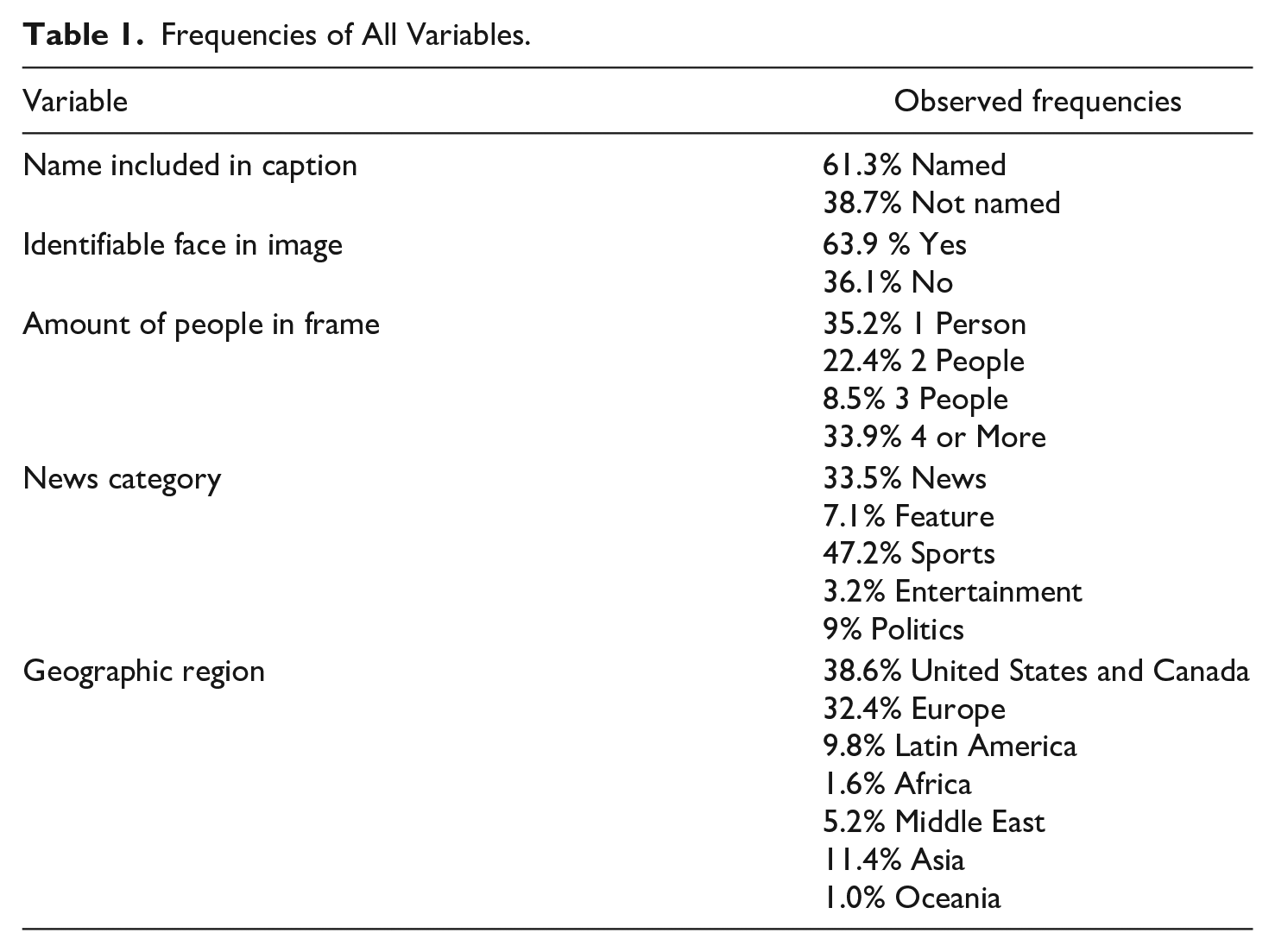
The analysis consisted of 7,455 “APTOPIX” images downloaded from the AP image bank. A general description of the data can be found in the frequency table (Table 1). In this sample, the majority of images included a name (61.3%) and depicted an identifiable face (63.9%). Images were more likely to include one person (35.2%). The most common news category was sports (47.2%), and the most common geographic origin of the images was the region that included the United States and Canada (38.6%).
Frequencies of All Variables.
Practical Concerns: Identifiable Faces and Amount of People
Naming Routines and News Categories
Crosstabulation of Names and News Category.
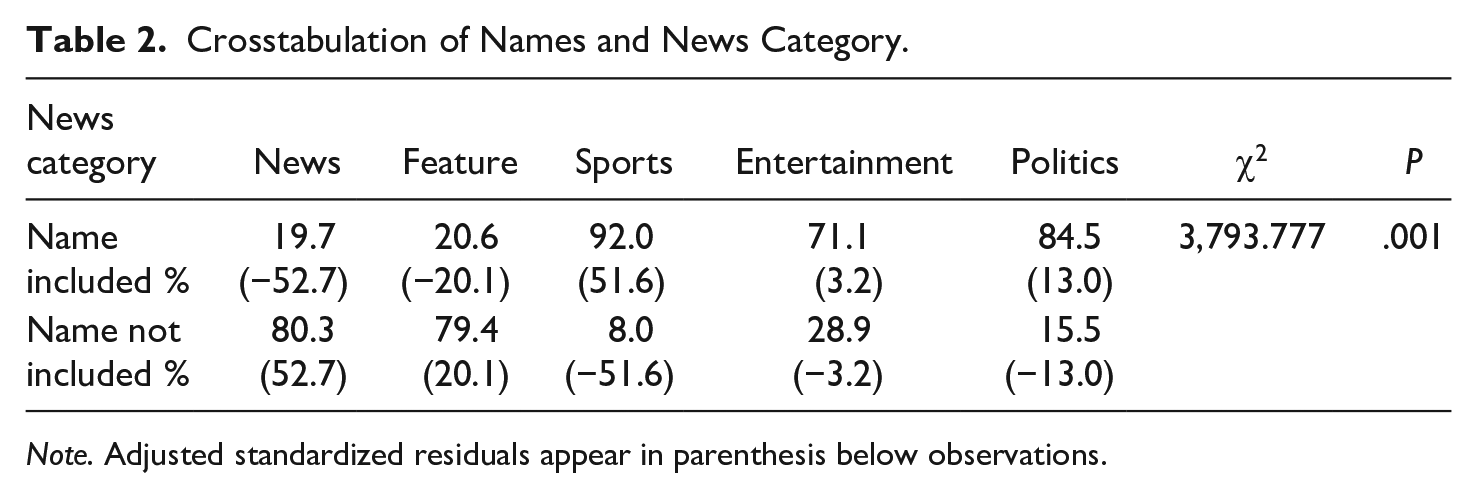
Note. Adjusted standardized residuals appear in parenthesis below observations.
Naming Routines and Geographic Regions
Crosstabulation of Names and Geographic Region.
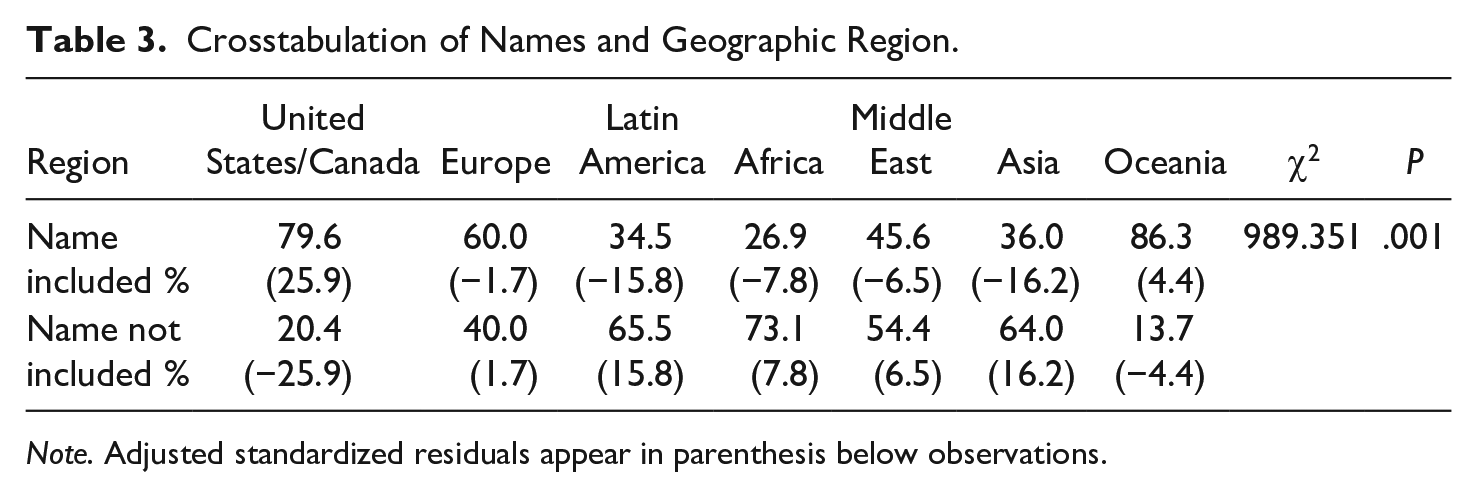
Note. Adjusted standardized residuals appear in parenthesis below observations.
To understand moderating variables, a chi-square analysis, χ2 (18, N = 7,445) = 285.178, p < .001, Cramer’s V, .112, compared the geographic region of images with the number of people depicted in the images. The results indicated a significant result, but the adjusted standardized residuals indicated that the United States/Canada and Oceania were significantly less likely to have images of four or more people than other geographic regions. This finding must be understood in the context of how sports images affected the results. The United States/Canada and Oceania categories had the largest number of sports images in the sample (59.7% and 84.9% respectively), which, as a news category, had the highest proportion of single-person images (34.3%). Most images from the Oceania category were from the Australian Open tennis tournament. Excluding Sports, χ2 (18, N = 3,986) = 68.929, p <.001, the Cramer’s V, .076, dropped, indicating a small effect size. This additional analysis indicates that the amount of people depicted in a frame does vary by region and news category, but that the effects on the overall analysis are small.
An additional chi-square analysis, χ2 (6, N = 7,445) = 212.199, p < .001, Cramer’s V, .168, compared geographic region by identifiable face. The adjusted standardized residuals indicated that Asia (−11.1) and Latin America (−7.1) had statistically fewer images with identifiable faces. The sports category was another contributing factor. Excluding Sports from the analysis, χ2 (6, N = 3986) = 99.730, p < .001, the Cramer’s V, .158, dropped. With sports excluded, the adjusted standardized residuals for Asia increased to −6.2, and Latin America increased to −4.2. This additional analysis indicates that identifiable faces are a moderating variable for images made in Asia and Latin America and has a medium effect size. It is likely that mask-wearing due to the COVID-19 pandemic directly contributed to this result, and Zhang (2021) and Fearnley and Wu (2022) posit that media organizations have often focused on mask-wearing in Asian countries as a type of orientalist discourse labeled “mask culture.”
Qualitative Analysis
To develop a more nuanced understanding of naming practices, the authors conducted a qualitative content analysis to identify any differences in the groups of people that are named, as well as what types of words are used in the place of names. The analysis was structured by Van Dijk’s (1989) conceptualization of ethnocentrism, specifically how a cultural center of gravity influences the “syntactic formulation of underlying semantic representations” (p. 46). This qualitative analysis addresses
News
The most substantial differences in naming practices took place in the category of News, which included news events such as fires, natural disasters, crime, military conflict, protests, terrorism, COVID-19, migration, funerals, and planned news events like festivals. Of the 2,538 news images in this category, there was a stark difference between how unnamed people were identified in the United States versus in other countries and geographic regions. The largest differences had to do with ethnic identities, group affiliations, and occupations.
There were no U.S. news images that identified unnamed people as “United States Citizens,” “Americans” or any variation of a state demonym. In most instances, people were identified as “people” or singularly as a “man” or “woman” (all transgender and gender non-conforming people in the sample were named). This is most likely due to The AP’s position as a U.S.-based company that caters to a larger U.S. market. Although American people were identified as “people,” most news images from other geographic regions were qualified by an ethnic identifier. Common identifiers included: “Afghan boys,” “Afghan women,” “Indian children,” “Rohingya Refugees,” “Uyghurs,” “A Chinese Woman,” “Palestinians,” “Ukrainian Men,” “Central American Migrants,” “Venezuelan boy,” or “Chinese Paramilitary.” One image identified a man solely as “A Pakistani drug addict.” Most of these ethnic identifiers were found in images made in Latin America and Asia, and this was especially true of indigenous identifiers. Only one instance of a person identified as indigenous was named, while others were generally labeled as “an indigenous man” or specifically as a “Tenetehara Indigenous child,” “Guarani and Kaiowa Indigenous man,” “Munduruku Indigenous woman,” or the “Ethnic Entha community.”
Another important difference was how affiliations, especially faith-based affiliations, differed between U.S.- and non-U.S.-made images. There was no mention of faith-based affiliations in the United States in this sample, but images made in other geographic regions included identifiers such as the “Faithful,” “Devotees,” or “Pilgrims” often with the religious affiliations attached such as “Shiite Muslim women,” “A Muslim vendor,” “Ultra-Orthodox Jews,” “Christian orthodox nuns,” and “An Ethiopian Orthodox Christian.” Affiliations in the United States were most likely to be excluded in place of words such as “participants,” and “supporters” but a notable affiliation was for fringe nationalist movements, such as “Members of the Proud Boys.”
Non-U.S. news images had much more diversity and specificity when it came to identifying people by their occupation. Common identifiers included “workers,” “security officers,” “delivery drivers,” small-business owners,” “firefighters,” “medical workers,” volunteers,” “vendors,” “farmers,” “laborers,” “day laborers,” and “migrant daily wage laborers.” Images made in the United States had far fewer identifiers, due to the increase in names, but they also corresponded more to occupations in the public sector and included, “officials,” “investigators,” “police officers,” “firefighters,” and “election workers.” Children in the United States were most often identified as “students.”
Feature
Feature images included human interest stories of love, loss, and overcoming adversity, as well as more artful images such as landscapes and people enjoying recreational activities. The only substantial difference, besides people in the United States being named more often, was the continued use of ethnic identifiers. This sample included the identifiers, “an Indian girl,” “A Bangladeshi Hindi,” “Filipino Men,” “a Sri Lankan ragpicker,” “a young Syrian woman,” “a Bosnian Muslim Woman,” “a Turkish boy,” “a Nepalese elderly man,” Kashmiri women,” “Israelis,” “Muslim girls,” and variations of the same religious affiliations mentioned in the news category. There were no ethnic identifiers in U.S. images.
Sports
Sports was the most consistently named category across all geographic regions. Major sporting events took place over the 5-year timeframe of the sample, including the World Cup in Qatar, the 2020 Summer Olympics in Tokyo, the 2022 Winter Olympics in Beijing, and many more regional and national events. Names were included in nearly every image unless the athlete was in silhouette, or a team was identified collectively cheering or celebrating. Only three fans were named in the images and each of those images was made in the United States.
Entertainment
Entertainment included images made on red carpets and film premieres, fashion runways, and art exhibitions as well as some concerts with musicians. Invariably, every entertainer was named in the images. Most unnamed people in this news category were models, all labeled solely as “models” except for three celebrity models. When groups of people were depicted, they were labeled as “fans,” and one image listed a group of people as “crew members.”
Politics
Politics consisted of press conferences, public speeches, and scheduled campaign rallies. Any political protest images were included in the News category. The quantitative analysis revealed that this category was the only news category where images in the United States were less likely to include names. This is largely because coverage of the 2020 election included 75 images (over 10% of this category) of crowds celebrating President Joe Biden’s election, most without names. This sample also included many images of crowds from political rallies in the United States, unlike other countries and geographic regions.
Discussion
The findings from the content analyses reveal a clear difference between who is worthy of a name and who is not, divided along the lines of class status and ethnicity. These naming routines remained stable over the 5 years of the analysis and constitute a pervasive pattern of disparate discursive treatment. This difference in naming practices evidences a pervasive ethnocentrism and contributes to the construction of the Other in multiple ways: by excluding the audience’s ability to identify with subjects, creating a hierarchy through opposition, and extending the prominence of certain groups of people over others.
As onomastics scholars assert (Algeo & Algeo, 2000; Charmaz, 2006), names are more than legal identifiers, they invoke familial ties and cultural histories and bring people into symbolic existence. The findings indicate that people from the Global North are more often identified by names and thus discursively exist as unique, individualized, and active subjects for which audiences have increased opportunities to connect to the depicted persons. The consistent exclusion of names for people in the Global South suggests that they are treated as both representative and as fungible, or interchangeable. This fungibility can serve to devalue and dehumanize people, as it replaces unique individualism with generalized archetypes that call upon hegemonic discourses for decoding. This eliminates the possibilities of symbolically constructing personhood for an individual (Chouliaraki & Zaborowski, 2017), which itself is a step toward developing a “complex personhood” (White et al., 2021). Naming is thus not solely about newsworthiness but also about social value, as in who is valuable for audiences to know. The findings suggest that photojournalists develop different routines for different social groups, some of which journalists have more responsibility and accountability toward than others.
The clear difference in naming practices between the Global North and Global South also indicates a distinction, or categories that gain definition through opposition. Citing Derrida, Hall stated, “There are very few neutral oppositions,” there is a dominant group and “one which includes the other within its field of operations” (emphasis added, Hall, 1997, p. 225). The north/south opposition in this sample was not just defined by names, but also through the differences between how unnamed people were identified, especially in the news and feature categories. Even without names, similar sets of people are discursively constructed as different—one as the standard, generic, or obvious “people” and the other qualified as specific types of people. This difference can also be seen as a performative symbolic bordering (Chouliaraki & Zaborowski, 2017), composed of communicative strategies “which perform ethico-political effects of misrecognition and ex/inclusion” (p. 615). The sustained, routinized pattern of depicting people from the Global South by their demonyms and other linguistic qualifiers evidences a journalistic ethnocentrism that discursively constructs the other in a domestic American consciousness. The AP has journalists and offices in 100 countries (“Our Story: AP,” 2022), but as an American news agency, it caters primarily to a domestic American audience. The histories, connections, and social positions that are connoted by names are erased when replaced by group designations. As Hall (1990) stated, cultural identity is a matter of “becoming as well as being” (p. 225), and social difference is something actively produced, even in the typically small font size of photo captions. The unnamed people in the images become archetypal stand-ins, and a viewer’s interpretation is subsequently indexed to the previous discursive constructions of the social category.
The results also suggest that the prominence of a subject is affirmed and extended through the process of naming in news. Prominence is a capacious concept as it can refer to talent, power, importance, popularity, or even notoriety, but it is manifested discursively by citation and frequency. The more someone is written about, the more prominent they become. The Sports, entertainment, and politics news categories had the highest percentage of naming (92%, 71.1%, and 84% respectively), which substantiates the commonsense notion that a prominent person is newsworthy by their existence and not the activity they are engaging in. Many of the images of celebrities, athletes, and politicians in the sample that were labeled with the APTOPIX signifier did not possess dynamic graphic qualities or document events of great impact required of general news images to attain the status of best of that day. These images were designated as the most important of the day for the hundreds of news organizations that license images from The AP solely because of the status of the people depicted.
The news industry’s symbiotic relationship with powerful public figures that trade on visibility is more of a historical fact than a revelation (Herman & Chomsky, 1988; Mills, 1956; Shoemaker & Reese, 2013), but it serves to reveal the discursive function of naming and the potential harm to those that are relegated to an anonymous group or gendered identity. The inclusion of names in captions can communicate a class status, separating the powerful, elite, and wealthy from the rest. Thus, through a discursive understanding of the prominence news value (Caple & Bednarek, 2016), naming becomes a signifier of status, most often class status in international media, but can be reworked as community status in local media or group status in alternative or niche media publications. The sports, politics, and entertainment categories varied the least between geographic regions, revealing that wealth, notoriety, and status could overcome the othering of Global South residents of lower status.
It is not possible to obtain the name of every person in every situation, especially in dynamic scenes of conflict or when intimate social access is controlled through practices of embodied gatekeeping (Bock et al., 2016; Lough, 2019). It should also be noted that many captions that originally included a name when made available by The AP are often stripped in subsequent syndications of the same image to illustrate more general stories on the same news category (easily evidenced on AP’s image bank). Naming is a far more complex process that has little explicit transparency by news organizations, but the definable patterns at this node in the news production chain indicate different types of people are given different discursive treatments. This difference has symbolic and material consequences as news texts construct knowledge about the social world.
Conclusion and Limitations
The analyses revealed significant differences in naming practices regarding the geographic region and news category of the images syndicated by The AP. The findings suggest that naming has a discursive function to signal social difference along the axes of class and ethnicity. People depicted in images made in the Global South regions were named far less often than people in the Global North, symbolically constructing them as an Other in these news products that force audiences to call upon hegemonic narratives for decoding. In addition, people depicted in sports, entertainment, and politics images were named much more frequently than in news and feature images, elevating the identity of prominent individuals and public figures over other private citizens. One limitation of this study is the omission of a code for race, which is complicated by the international scope of the sample. This can perhaps be more fully explored in images bound to one country, to reveal any constructions of social difference within a specific historic and cultural milieu. Future studies could also explore how cultural norms and local journalistic routines influence naming protocols, conduct comparative analyses with other wire services or press agencies, or explore whether the author of the caption impacts the likelihood that someone is named. Despite these limitations, this study offers a foundation for further exploration into the naming practices and conventions of photojournalism.
Footnotes
Declaration of Conflicting Interests
The author(s) declared no potential conflicts of interest with respect to the research, authorship, and/or publication of this article.
Funding
The author(s) received no financial support for the research, authorship, and/or publication of this article.
