




Abstract
Previous research has given scant attention to the issue of multiple concurrent enrollments, which can hinder persistence when resulting in a study load exceeding full-time study. Heavy study loads can challenge students’ time management skills and disrupt their self-regulated learning processes. This register-based study analyzed the enrollment patterns of 778 undergraduate students taking full-time foreign language courses at a large urban Swedish university, of whom 26% were simultaneously enrolled in additional courses and had therefore an above-normal study load. These multiple enrollments significantly reduced the odds of course completion (by 57%). However, students’ ability to manage above-full-time study loads varied. The findings have implications for theory, policy, and practice, emphasizing the need to consider multiple enrollments as a risk factor for non-completion in persistence models. Several hypotheses regarding the pathways through which heavy study loads contribute to course non-completion are proposed and warrant further exploration in future research.
The aim of this article is to analyze the effect of multiple enrollments resulting in above-full-time study loads on students’ likelihood of completing their courses. Here, multiple enrollments refer to the concurrent registration in several courses during the same study period. This study is based on a quantitative analysis of the enrollment patterns of foreign language students at a Swedish university. Unlike in other countries, the Swedish post-secondary system permits multiple concurrent enrollments that may exceed the standard full-time study load. This possibility is guaranteed by government regulation (The Higher Education Ordinance [1993:100], 2023). While full-time studies comprise 60 credits per year, 1 students are allowed to enroll in courses totaling up to 90 credits per year (or 45 credits per semester), representing a 50% increase over the standard full-time load of 60 credits per year (or 30 credits per semester). Additionally, re-enrollments, which do not count toward the 90-credit limit, enable parallel enrollments that can far surpass full-time studies. This system offers students greater flexibility in their academic careers by enabling them to take courses in parallel and thus complete their studies more quickly, or to combine a study program with additional freestanding courses. 2 However, this opportunity also carries risks, such as overloading students beyond their capacity to cope, which is the issue addressed by the present study.
Although this study examines a Swedish-specific context, its findings remain relevant for an international audience, as it addresses fundamental issues in research on university student retention, such as time management and self-regulated learning. Since the amount of time and energy that students can invest in their academic experience is limited (Astin, 1999; Bakker & Mostert, 2024; Kyndt et al., 2014), enrollment in multiple courses with a total workload exceeding full-time study presents a notable challenge. Concurrent courses compete for students’ time, requiring them to make trade-offs in how they allocate study time across the various courses in which they are enrolled. Multiple enrollments may also hinder students’ ability to self-regulate their learning, further affecting course completion (Broadbent & Poon, 2015; Wolters & Brady, 2021).
This study addresses the following research questions.
How prevalent are multiple enrollments that surpass a full-time study load? To what extent do multiple enrollments exceeding a full-time study load predict course completion? Do multiple enrollments exert a greater impact on course completion than other entry variables? How does students’ capacity to manage above-full-time study loads induced by multiple enrollments vary?
Literature Review
This literature review examines previous research on entry variables—particularly gender, age, upper secondary school attainment, and prior academic experience—in relation to persistence and academic achievement. It also considers time management and self-regulated learning, which are central to understanding the challenges of multiple enrollments. The review begins by clarifying the concept of course completion and its relationship to related terms such as persistence and retention.
Course Completion
Course completion, the dependent variable in this study, is defined as fulfilling the requirements of a course (Delnoij et al., 2020). This concept is related to persistence, which has been described as “the process by which a student adopts and maintains a commitment to his or her studies throughout the university curriculum, regardless of the obstacles encountered” (Roland et al., 2015, my translation). While persistence describes a process, completion refers to the outcome of that process and results from an administrative decision made by an academic committee or faculty member. Another closely related concept is retention. The distinction between retention and persistence lies in perspective: retention reflects an institutional view, whereas persistence represents a student-centered perspective (Tinto, 2017).
Several studies have equated course completion and graduation with student success (Engel, 2021; Ifenthaler & Yau, 2020; Roland et al., 2015; Tinto, 2012). However, some researchers have argued that course or degree completion should be distinguished from the notion of success, as students may achieve their learning goals without completing a course or degree (Delnoij et al., 2020). Non-completers may also derive other benefits from attending academic institutions, such as acquiring useful skills, building social networks, securing employment (Cunninghame & Pitman, 2020), and experiencing affiliation, development, and autonomy (Tinto, 2017). Therefore, the present study primarily uses the term course completion, defined as the validation of all course credits within the nominal (i.e., officially prescribed) period of study.
University student retention is a complex issue and has been the subject of numerous theories (Aljohani, 2016; Burke, 2019; Seidman, 2022). However, it is possible to distinguish between two main types of models: educational and motivational models (Schmitz et al., 2010). Educational models emphasize the importance of the interaction between students and academic institutions (see, e.g., Tinto, 1993, 2012), while motivational models focus on individual student characteristics such as self-efficacy (Bandura, 1997) and student engagement (Astin, 1999; Kahu & Nelson, 2018; Trowler et al., 2022). Some theories combine motivational and educational approaches to provide a more comprehensive understanding of student retention (e.g., Braxton & Hirschy, 2005; Schmitz et al., 2010; Tinto, 2017, 2022).
The interactionalist model developed by Tinto (1993), which emphasizes the importance of students’ academic and social integration for academic success, has played a “near paradigmatic” role in student retention research over the past decades (Braxton, 1999; see also Barbera et al., 2020). Empirical studies in both North American and European contexts (e.g., Cabrera et al., 1992; Chrysikos et al., 2017; Schmitz et al., 2010) have demonstrated the model's usefulness in explaining the mechanisms of student retention. At the same time, Tinto's model accounts for only a modest proportion of the variance in student persistence outcomes (see in particular Chrysikos et al., 2017), underscoring the need for complementary perspectives. A further limitation is that the model is best suited to explaining retention among traditional North American residential college and university students and may therefore be less applicable in other contexts and for other student categories (see, e.g., Aljohani, 2016; Braxton & Hirschy, 2005). To address these limitations, Braxton and Hirschy (2005) proposed two complementary theories to better account for the diversity of the student population: one for residential colleges and universities, and another for commuter institutions. The latter—especially relevant to the present study, which was conducted in a commuter university—incorporates students’ entry characteristics (e.g., motivation, self-efficacy, and parental education level), external environmental factors (e.g., family and work obligations), and internal institutional factors (e.g., type of instruction or the institution's commitment to student success). These factors may directly influence student persistence or exert indirect effects through intermediate variables such as students’ commitment to the institution. However, the issue of heavy study loads associated with multiple enrollments, which may challenge students’ ability to effectively organize their study time and regulate their learning, is addressed neither in Braxton and Hirschy's (2005) models nor in the others discussed above and thus represents a gap in the research that the present study seeks to fill.
Time Management and Self-Regulated Learning
Time management is one of the main difficulties students face in their university studies, particularly during the first year (Brooker et al., 2017; van der Meer et al., 2010). When asked about the challenges of time management in their studies, students frequently highlight the difficulties of “keeping up with study” right from the outset and finding effective strategies for managing the heavy workload associated with university studies (van der Meer et al., 2010). In a meta-analysis of psychological correlates of academic performance, Richardson et al. (2012) found that time and study management was positively correlated with students’ grade point average (GPA), reporting an average weighted correlation (r+) of .22. Empirical evidence also suggests a direct correlation between the time students allocate to study and their academic performance (Brint & Cantwell, 2010; Stinebrickner & Stinebrickner, 2004).
Effective time management is a key skill within self-regulated learning (Wolters & Brady, 2021), which refers to the processes by which students manage their own efforts to acquire new knowledge or skills (Zimmerman, 1989). These self-regulatory processes encompass a range of strategies that can be organized into three successive phases (Zimmerman, 2002):
the forethought phase, which includes goal setting, learning planning, and self-motivation beliefs the performance phase, which involves processes such as self-control and self-monitoring the self-reflection phase, during which learners retrospectively analyze their performance.
Self-regulated learning processes can be taught and have been shown to correlate with student achievement. An important question to consider is whether the above-full-time study load associated with multiple concurrent course registrations may disrupt students’ self-regulatory processes and impair their capacity to engage in forethought, performance monitoring, and reflective analysis.
Entry Variables
Entry variables are known to explain a significant proportion of the variance in academic achievement, with past performance, admissions or intelligence test scores, and students’ socioeconomic backgrounds among the best predictors of student success (Dupont et al., 2015). This study compares the impact of multiple enrollments on course completion with that of other entry variables (see Research Question 3), including gender, age, upper secondary school attainment, and previous academic experience.
Gender
Female students tend to succeed in their university studies to a greater extent than their male counterparts and often outperform them (Dupont et al., 2015; Richardson et al., 2012; Thiele et al., 2016). However, previous research findings on gender differences in academic outcomes have been inconsistent, with some studies reporting no significant differences. Richardson et al. (2012) found a weak average weighted correlation (r+ = .09) between GPA and being female. Other studies have shown that the existence of gender differences in student outcomes depends on the set of control variables included in the analysis (see, e.g., St. John et al., 2001). Differences may also vary depending on how achievement is defined. For example, a large register-based study conducted in the Netherlands found that female students were less likely to graduate on time from Science, Technology, Engineering, and Mathematics (STEM) programs, where “on time” was operationalized as graduating within the nominal period of study plus 1 year. However, after ten years, male and female graduation rates were similar (Vooren et al., 2022). This variation in previous findings justifies the inclusion of gender as a factor in this study to explore its potential impact on course completion among Swedish foreign language students.
Age
The same reasoning applies to the age variable. The relationship between age and academic achievement is also inconsistent across previous studies (Dupont et al., 2015). A weak positive correlation (r+ = .08) has been reported between age and academic performance (Richardson et al., 2012). In an exploratory study of beginner-level French as a foreign language students (Engel, 2021), participants were divided into three age categories: 19–30 years, 31–60 years, and 61–85 years. The odds of completing the language course were 16 times higher for the oldest group compared to the youngest group, while no significant differences were found between the middle-aged and the youngest group. The higher rate of course completion among the oldest students was interpreted as the result of a mix of favorable sociodemographic, academic, and motivational factors, including employment status (retirement for many of them, allowing more time for study) and engagement in studies chosen out of strong personal interest.
Upper Secondary School Attainment and Previous Academic Experience
The upper secondary school GPA is one of the strongest predictors of university GPA, alongside scores obtained on university admission tests such as the ACT and SAT (Robbins et al., 2004; van Rooij et al., 2018). In Richardson et al. (2012), upper secondary school GPA showed a medium-sized positive correlation with university GPA (r + = .40). Given its established correlation with academic performance, upper secondary school GPA is included in this study as a potential predictor of course completion.
Cumulative university GPA has often been used in previous research as a measure of prior academic performance and has been shown to be positively associated with retention (see, e.g., Cochran et al., 2014). However, cumulative university GPA from previous semesters was not included in this study for the following reasons. First, some participants were enrolled in a university course for the first time. Second, cumulative GPA is not automatically calculated by the Swedish student management system from which the data were extracted, and computing it manually for all participants would have been a massive undertaking. Instead, previous academic experience was included as an independent variable in this study.
Previous academic experience reflects students’ familiarity with the demands and expectations of academic studies and may therefore influence their ability to manage coursework. Although prior research has shown mixed findings regarding its predictive value for student success (Bonin, 2020; Hall et al., 2012), including this variable allowed us to examine its impact on course completion relative to that of the above-full-time study loads induced by multiple enrollments, an aspect that has not been addressed in previous studies.
Hypotheses and Expected Results
Based on previous research, it is expected that among the entry variables examined in this study, age, upper secondary school GPA, and multiple enrollments will be associated with course completion, while other characteristics, such as gender and previous academic experience, will have a negligible or no impact. It is also hypothesized that the above-full-time study load resulting from multiple enrollments will have a significant negative effect on course completion.
Methods
Research Design
This study is based on a register survey, utilizing data retrieved from an enrollment management system (Ladok) and an admissions management system (the NyA web), both of which are national databases used by Swedish universities and university colleges. Ladok was used to identify study participants and to provide information on the courses in which they were enrolled. The NyA web provided access to participants’ enrollment data from other Swedish universities and was used to gather information on their previous academic experience, enrollment history, and final upper secondary school certificates.
Site of Research
The study was conducted at a large public commuter university in an urban area of Sweden, with multiple campuses in the surrounding suburbs. In 2024, the university enrolled approximately 31,000 full-time equivalent students and had more than 1,000 doctoral students. It employed over 5,000 staff members.
The department examined in this study is part of the Faculty of Humanities and offers courses in Romance and classical languages. In 2024, it enrolled more than 900 full-time equivalent students. The department provides both online and in-person instruction, primarily through freestanding courses outside formal degree programs. Students pursuing a bachelor's degree in a foreign or classical language must complete at least 120 credits in their chosen language, corresponding to four terms of full-time study. A bachelor's degree requires a total of 180 credits—120 in the language studied plus 60 in optional subjects—which corresponds to a three-year period of full-time study.
Although one of the larger language departments in Sweden, the department examined here is broadly representative of language departments nationwide and shares their common challenges. In particular, while it attracts many beginner-level students, enrollments decline sharply at higher levels, resulting in a steeply narrowing “student pyramid.”
Participants
Participants (N = 1,004 3 ) were foreign language university students enrolled in French I, Italian I, or Spanish I during 2015–2019, corresponding to the ten semesters preceding the outbreak of the COVID-19 pandemic. French I, Italian I, and Spanish I are 30-credit on-campus courses equivalent to full-time study for an entire semester, with each semester constituting a student cohort. A semester consists of 20 weeks of study, with an expected workload of 40 h per week. These courses include course units in grammar, oral and written production, literature, and culture. Additionally, French I and Spanish I include course units in phonetics and pronunciation. Attendance in these three courses is not mandatory. The courses can be taken individually or as part of a program and require prior secondary school studies in the target language. The prerequisites for French I and Spanish I are secondary school studies equivalent to “step 3” in each respective language, corresponding to A2.2 in the Common European Framework of Reference for Languages (CEFR) (Council of Europe, 2025), with the expected proficiency level at the end of the course being B1 or higher. For Italian I, the entry requirement is “step 2” (approximately A2.1 in CEFR), with an expected proficiency level of around B1 upon completion.
Data Collection
Data were collected and compiled during the spring semester of 2023 and verified in the autumn semester of the same year. Since the data were not collected directly from participants, it was not necessary to obtain their consent or to inform them (see European Union General Data Protection Regulation, Article 14, point 5). The data were anonymized prior to processing, and the results are presented in aggregate form, ensuring that the study poses no risk of privacy invasion for participants.
Some students in the dataset extracted from the student management system were re-enrolled (n = 93). Re-enrolled students have significantly more time to complete their courses compared to those who attend for the nominal period of study. Since the factors influencing course completion may differ between students who complete their studies within the designated one-semester time frame and those who extend their study period over multiple semesters, only the first semester of enrollment for re-enrolled students was included in the analysis.
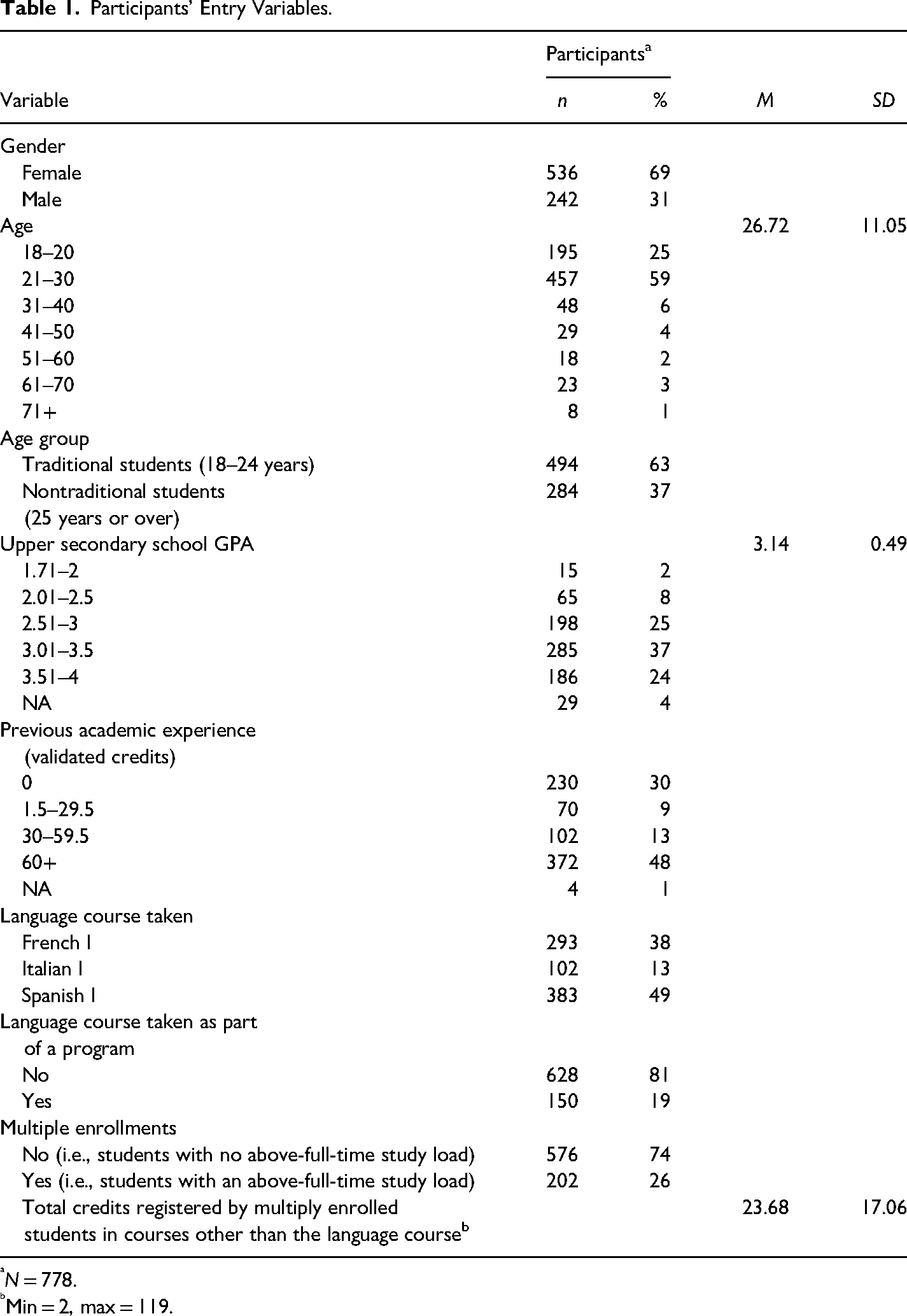
The study also excluded participants with prior knowledge that markedly exceeded the courses’ eligibility criteria, namely (1) students who had studied at secondary school or university—and had therefore lived for an extended period—in a country where the target language is spoken (n = 94) and (2) students who had previously studied the target language at the French I, Italian I, or Spanish I level (n = 128). An additional four participants were removed due to the unavailability of prior study information in the admissions management system. The elimination of these 226 students from the dataset resulted in a final sample of 778 participants for analysis. The entry variables of these 778 participants are presented in Table 1.
Participants’ Entry Variables.
N = 778.
Min = 2, max = 119.
The large majority of the 778 participants had previously enrolled in a university course prior to the language course. For only 205 participants (26%), the language course was their very first university enrollment. Since enrollment in a course does not guarantee that the student is active or attends classes, previous academic experience in this study is measured by the number of credits validated in courses completed before the language course. In other words, this measure reflects previous “successful” university experience. As shown in Table 1, 230 participants (30%) had not validated any credits prior to enrolling in the language course: 205 of them had not previously enrolled at the university, while the remaining 25 had not validated any credits in the courses for which they had enrolled. Nineteen percent of the participants (n = 150) were taking the language course as part of a program, including Teacher Education Programs for Secondary School and Bachelor's Programs in Languages, Modern Languages, Languages and Translation, Latin American Studies, Global Management, Human Geography, or History.
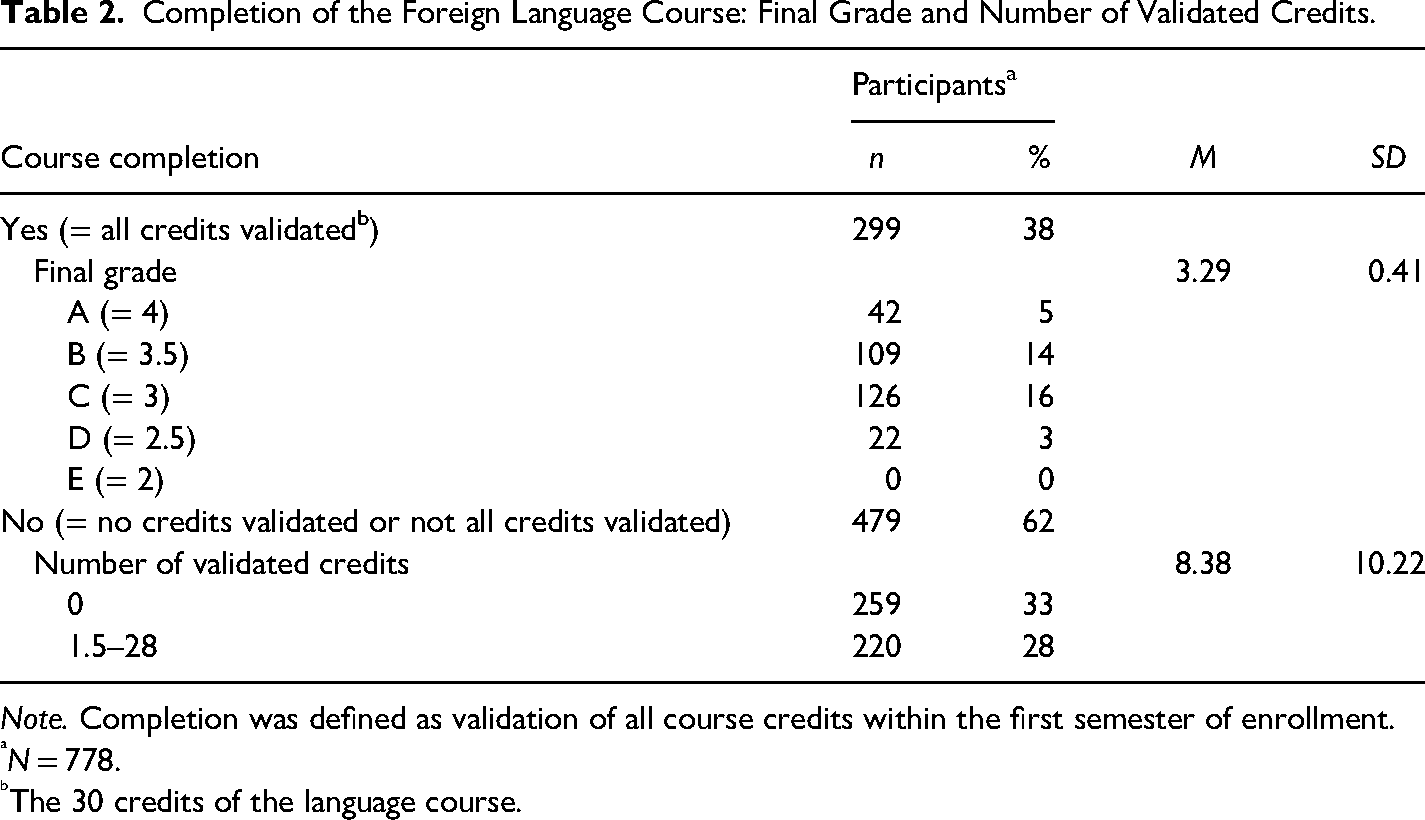
Participants’ academic results at the end of the language course are presented in Table 2, which also indicates whether they completed the course by the end of their first semester of enrollment, the study's dependent variable.
Completion of the Foreign Language Course: Final Grade and Number of Validated Credits.
Note. Completion was defined as validation of all course credits within the first semester of enrollment.
N = 778.
The 30 credits of the language course.
Data Analysis
Logistic regression was used to analyze the impact of entry variables on course completion. This statistical method is suitable for predicting an outcome (such as course completion) from a set of variables and for assessing the extent to which these variables affect (positively or negatively) the odds of the outcome (Tabachnick & Fidell, 2013). The dependent variable was binary, coded as 1 if the language course was completed by the end of the first semester of enrollment, and 0 otherwise. The independent variables were coded as follows:
Gender: 0 = male, 1 = female Age (at course start): 0 = traditional students (18–24 years), 1 = nontraditional students (25 years or over) Upper secondary school GPA: numeric value on a 0–4 scale Successful completion of previous academic studies: 1 = at least 30 validated credits earned in previous university courses, 0 = no or fewer than 30 validated credits Multiple enrollments: 1 = yes (students enrolled in at least one additional course in another discipline alongside the language course), 0 = no.
Age was categorized into “traditional” and “nontraditional” groups, with the cut-off between 24 and 25 years following previous research definitions (Bean & Metzner, 1985; MacDonald, 2018).
As Swedish upper secondary schools do not calculate students’ GPA, upper secondary GPAs were computed from final certificates for this study and converted to a four-point GPA scale (4 = A, 3.5 = B, 3 = C, 2.5 = D, 2 = E, 0 = F) to enable participant comparisons.
For previous academic experience, the semester was considered an appropriate unit of analysis, as students can identify shortcomings in their study and time management and make necessary adjustments during their first semester of university studies (Bargmann & Kauffeld, 2023; van der Meer et al., 2010).
Prior to analysis, logistic regression assumptions were verified, including sample size adequacy, multicollinearity diagnostics, and outlier examination, to ensure that all conditions required for applying the statistical method were met.
Results
This section presents the findings of the study in relation to the four research questions.
Research Question 1
Table 1 shows that multiple enrollments were common (202 of 778 participants, or 26% of the total). Multi-enrolled students were registered in a full-time course (30 credits) plus, on average, an additional 23.68 credits in other courses (SD = 17.06).
Research Question 2
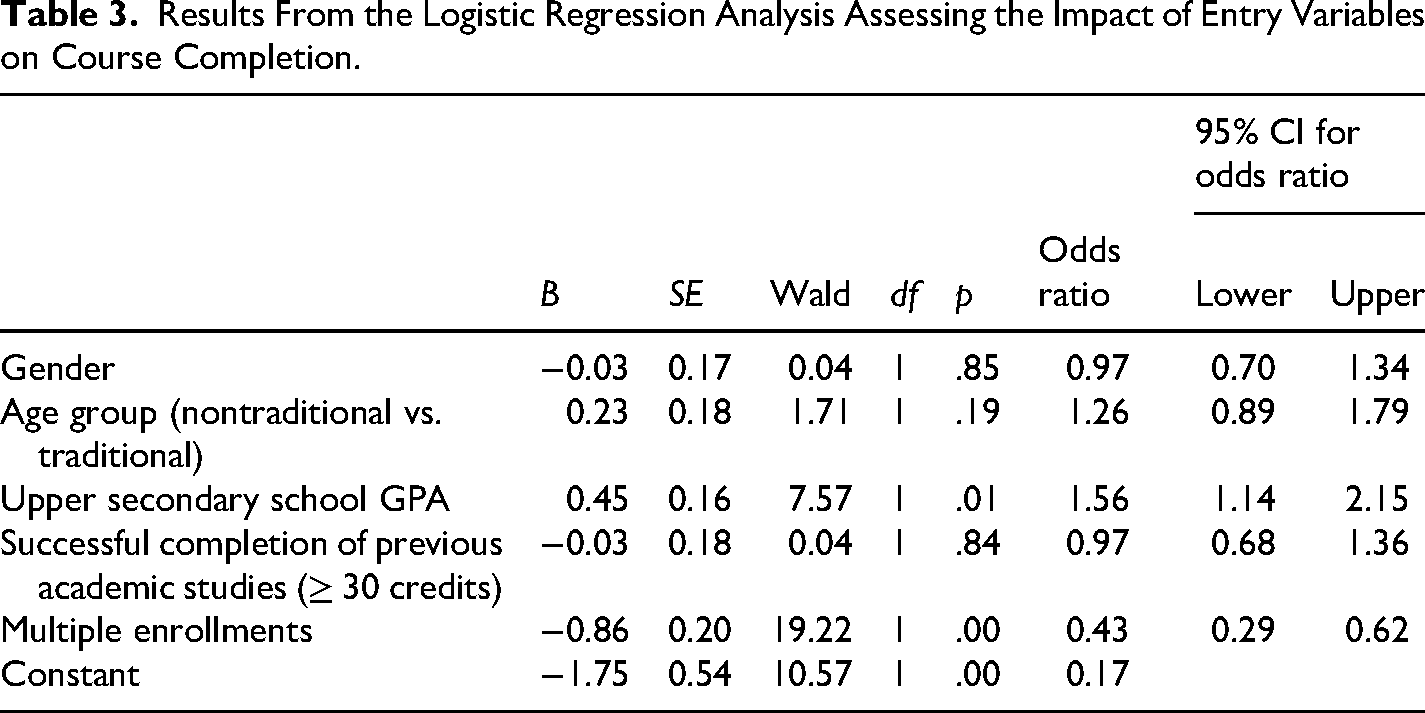
Logistic regression was performed to assess the impact of five predictors (gender, age, upper secondary school GPA, successful completion of previous academic studies, and multiple enrollments) on the odds of students completing the language course by the end of their first semester of enrollment. The full model containing all predictors was statistically significant, χ2(5, n = 745) = 31.37, p < .001, indicating that the model was able to distinguish between students who completed their language course within one semester and those who did not. Overall, the model correctly classified 60% of cases. As shown in Table 3, multiple enrollments made a unique statistically significant contribution to the model. The odds ratio for multiple enrollments was 0.43, meaning that students enrolled in one or more additional courses alongside the foreign language course had 57% lower odds of completing the language course within one semester.
Results From the Logistic Regression Analysis Assessing the Impact of Entry Variables on Course Completion.
Research Question 3
The only other predictor to make a unique statistically significant contribution to the model was upper secondary school GPA, which had an odds ratio of 1.56. This indicates that for every additional point on the GPA scale, the odds of completing the language course increased by a factor of 1.56, controlling for other variables in the model.
Neither gender, age group, nor successful completion of previous academic studies made a statistically significant contribution to the model. For both gender and successful completion of previous academic studies, the odds ratio (0.97) was close to 1, indicating no meaningful difference in course completion rates between male and female students or between beginner students and those with prior academic experience. Age group (nontraditional vs. traditional students) had a positive association with completion (odds ratio = 1.26), but this effect was not statistically significant.
Research Question 4
The final research question addressed how students’ capacity to manage study loads above full-time, induced by multiple enrollments, varied. Of the 202 participants with multiple enrollments, 48 (24% of the multiply enrolled students, representing 6% of the total sample of 778) earned more than 30 credits during the semester in which they were enrolled in the foreign language course (M = 40.89, SD = 8.17, min = 30.5, max = 62.5). Among these 48 students, 30 successfully completed the language course within one semester while also earning credits in one or more additional subjects.
Discussion
This study found that multiple enrollments were common (26% of the participants) and reduced the odds of completing the foreign language course within one semester by 57%. These findings are consistent with those of an exploratory study conducted on a beginner-level French course (Engel, 2021), in which 27% of students were enrolled in at least one additional course alongside the French course, and multiple enrollments similarly lowered the odds of course completion by 57%. Although these two studies involved students with different levels of language proficiency, the consistent results suggest a robust negative impact of multiple enrollments on course completion. To my knowledge, this issue remains an underexplored area of research, limiting opportunities to compare these findings with those of previous studies.
The negative impact of multiple enrollments on course completion observed in this study and in the exploratory study mentioned above may stem from the competing demands of multiple courses, which reduce the amount of study time students can devote to each enrolled course. Multiple enrollments thus represent a risk factor for course completion, similar to the challenges posed by extensive extracurricular commitments (Tinto, 1993) or work obligations (Logan et al., 2016).
Among the other predictors included in the regression model, only upper secondary GPA was found to have a statistically significant effect on course completion. A one-point increase on the four-point GPA scale used in this study (i.e., moving from E to C, D to B, or C to A) increased the odds of completing the language course by 56%, controlling for all other factors in the model. This finding aligns with previous research demonstrating a positive correlation between upper secondary school GPA and academic achievement (Richardson et al., 2012; Robbins et al., 2004; van Rooij et al., 2018). The other entry variables showed no statistically significant impact on course completion. This is consistent with previous research reporting a small, if any, effect of gender (Richardson et al., 2012; St. John et al., 2001) and a limited effect of age (Richardson et al., 2012) on academic outcomes. Previous findings regarding the predictive value of prior academic experience for student success have been mixed, with some earlier studies showing no or negligible impact (Bonin, 2020; Hall et al., 2012).
While multiple enrollments increased the risk of non-completion at the group level, students’ ability to handle the intensive workload associated with multiple enrollments varied. A small group of participants (6%) completed more than the standard full-time study load of 30 credits per semester, averaging 40.89 credits. Behavioral approaches to student engagement have assessed engagement using measures such as time spent studying, class attendance, and indicators of academic performance (Astin, 1999; Bowden et al., 2021). The number of validated credits used in this study to describe students’ activity and performance could similarly serve as a measure of student engagement. The subset of participants who managed to complete more than the typical number of credits could thus be considered to have devoted substantial time and energy to their academic pursuits and may be described as “highly involved” students (Astin, 1999).
Implications for Theory
As a significant risk factor for non-completion, multiple enrollments should be incorporated into models of student persistence. They represent an entry characteristic not accounted for in the models discussed in the literature review, such as those of Braxton and Hirschy (2005), Tinto (1993), and Schmitz et al. (2010). The present study demonstrates the strong negative effect of multiple enrollments—particularly when they lead to a study load exceeding full-time status—on students’ likelihood of completing a course. Accordingly, this variable should be recognized as an important determinant of persistence. Incorporating it is essential to ensuring the cross-contextual validity of retention models.
In Sweden, higher education is publicly funded, and consequently, Swedish students are exempt from tuition fees. 4 This funding system represents a significant point of divergence from that of other countries, particularly the United States. Public funding reduces the financial barriers to student success that tuition fees can create, but it also introduces other challenges, such as the prevalence of multiple enrollments enabled by tuition-free education. It is therefore essential that models of student retention—many of which were originally developed in the North American context—be adapted to account for the specificities of other higher education systems if they are to remain valid across contexts.
Although the present study's design does not allow for the precise identification of the mechanisms underlying the negative relationship between multiple enrollments and course completion, several hypotheses can be advanced. Heavy workloads may negatively affect factors related to motivation and students’ drive to persist. In a qualitative interview-based study, Mikkonen and Ruohoniemi (2011) reported that participants experienced fluctuations in motivation due to heavy workloads in veterinary studies, citing fatigue and excessively high course expectations that could lead to a loss of interest in their studies. High workloads can also be a source of stress, resulting in a range of negative consequences, such as a lack of free time, feelings of overload due to the volume of required learning, and fear of failing courses (Liu et al., 2015). Study overload resulting from multiple enrollments might therefore be associated with a decline in well-being or an increased sense of burnout, which could, in turn, reduce students’ motivation to persist and complete their courses.
Further hypotheses can be developed through the lens of self-regulated learning theory. One possibility is that students may underestimate the amount of work involved in parallel studies, leading to unrealistic goal-setting (because the workload exceeds their capabilities) or inadequate planning. This would reflect issues in the forethought phase identified by Zimmerman (2002). Disruptions to self-regulatory processes may also occur during the performance phase, as high workloads and stress could affect students’ ability to maintain attention and reduce their use of effective learning strategies.
These hypotheses warrant further exploration in future studies to better identify the pathways through which heavy study loads contribute to course non-completion, for example, through qualitative research based on student interviews.
Implications for Policy and Practice
University staff invest time and energy in offering and administering courses, efforts that yield no or limited educational outcomes when students do not complete their studies. This leads to unreciprocated expenditures for universities and represents a poor use of public resources. The present study has shown that multiple enrollments pose a significant risk of non-completion. Therefore, it may be worth considering measures to reduce multiple enrollments as a strategy for containing university budgets. Multiple enrollments differ from the other entry characteristics examined in this study, as they are modifiable and arise from students’ own enrollment decisions, rather than from fixed demographic factors (e.g., gender and age) or dispositional factors (e.g., secondary school achievement and academic experience). Institutions could therefore adopt a straightforward measure by informing students with multiple enrollments of the heightened risk of non-completion and encouraging course withdrawal unless they have good reasons and sufficient motivation to pursue parallel studies.
An alternative strategy would be to support multiply enrolled students in validating a higher number of credits, for example by providing academic support, assisting them in developing study techniques, and encouraging reflection on their approaches to learning (Haarala-Muhonen et al., 2017). Such support may help students become more effective learners and improve their chances of course completion.
Limitations
The study presented in this article has several limitations. First, its focus on foreign language students may limit the generalizability of its findings across disciplines. The impact of multiple enrollments on course completion may vary depending on the student population considered. It can be hypothesized that the strength of this impact is inversely proportional to students’ motivation to complete a course. For example, the negative effect of multiple enrollments may be limited for courses that students consider highly “strategic” for their future careers. Therefore, it would be valuable to replicate this study with other student populations and in different university contexts to gain a broader understanding of the impact of multiple enrollments on student completion.
Another limitation relates to the type of investigation conducted in this study (a register survey). Student workload was measured using the number of attempted credits extracted from a student management system. However, purely quantitative indicators such as time spent studying, number of attempted credits, or number of earned credits cannot fully capture the demands placed on students. Therefore, alternative approaches to analyzing student workload have been proposed, including perceived study load (Kyndt et al., 2014) and measures that integrate the effort invested by students (D’Eon & Yasinian, 2022).
Additionally, reliance on administrative data restricts the scope of predictors examined. To elucidate the mechanisms underlying student persistence, other important factors influencing course completion should be considered, such as those presented in Tinto's (2017) “Through the Eye of Students” model (e.g., students’ self-efficacy, sense of belonging, and perceptions of the curriculum). Therefore, the register-based study presented in this article should be complemented with other types of investigations, such as interview- or questionnaire-based studies, to enrich our understanding of persistence among multiply enrolled students.
Conclusion
This study found that multiple enrollments resulting in a higher-than-normal study load significantly impede course completion. This phenomenon has been overlooked in previous research, making the present study an important contribution to the field of college student retention. Although the Swedish context differs from that of other countries—such as the United States, particularly in terms of higher education financing—the mechanisms identified in this study have cross-cultural relevance. Excessive workloads and the challenge of managing multiple demands (whether parallel courses, family responsibilities, or employment alongside studies) increase the risk of non-completion, regardless of national context. Moreover, incorporating multiple enrollments into models of student retention is essential to ensure their validity across higher education systems and to extend their applicability beyond the North American settings in which many of these models were originally developed.
While this study focused on Romance language students, the issue of multiple enrollments and their impact on persistence is relevant across the wider higher education sector. Future research should investigate the role of multiple enrollments and heavy workloads in student persistence across other academic disciplines.
Footnotes
Declaration of Conflicting Interests
The author(s) declared no potential conflicts of interest with respect to the research, authorship, and/or publication of this article.
Funding
The author(s) received no financial support for the research, authorship, and/or publication of this article.
