




Abstract
Texting has been identified as a tool that has the potential to enhance informational exchanges between academic advisors and students. We use focus group and survey data from a recent texting intervention to assess student and advisor receptivity to texting as a new mode of communication. The data reveal that most students immediately saw the benefits of this new tool. In contrast, advisors initially were very skeptical of its value. They raised concerns about having a voice in the content of the messages and the time commitment that would be needed to respond to students’ texts. Over time, this feedback led to modifications in the texting protocol and, in turn, advisors came to view texting as an important mechanism for improving communication with students. Our study ends with a discussion of texting best practices within the context of academic advising.
Social and academic integration is an essential factor in college student persistence (Tinto, 1993, 2017). Research has demonstrated that academic advisors have the potential to promote such integration as they provide crucial assistance to students who are navigating the complex world of college life (Bai & Pan, 2010; Bettinger & Baker, 2014; Castleman & Page, 2014; Ideas42, 2016; Kot, 2014). Advisors communicate vital information to students about a multitude of issues, including major requirements, course enrollment, scholarships, financial aid, school clubs, and counseling resources.
Delivering necessary, sometimes time-sensitive information to students can be challenging, especially for nonfaculty, professional academic advisors working in large, public institutions (Walker et al., 2017). Historically, academic advising caseloads at public, 4-year institutions average slightly <300 undergraduate students for every one full-time advisor (Robbins, 2013). As a consequence, many students likely do not have regular contact with their advisors. To provide timely information to students, advisors increasingly utilize a multitude of communication platforms such as webpages, weekly newsletters, and targeted emails.
Simultaneously, students at large public institutions often face a choice-ridden, educational world they must navigate while balancing other aspects of life, including employment and family demands. Time demands unrelated to school are likely to make it difficult to meet regularly with an academic advisor. Competing demands may also reduce the likelihood a student will proactively seek out information on websites or read emails in a timely fashion.
Texting has been identified as a useful communication tool that has the potential to break down the informational barriers students and advisors face. Students may be more receptive to reading text communications as it is relatively easy to engage with a cell phone text. It is also a mode of communication most students regularly use with friends and family. 1 If a texting platform is used for such communications, it may also create communications economies of scale for advisors.
Student and staff receptivity to utilizing texting as a mode of communication may be critical to the success of texting initiatives. Yet, the research done to date is typically silent on this issue. In this paper, we use focus group and survey data from a recent texting intervention that we administered in one college at a public university to drill into the question of receptivity. We found most students enthusiastically engaged with academic text communications, whereas a very small minority did not. In contrast, academic advisors were initially reticent to add the technology to their communications portfolio. Both students’ and advisors’ enthusiasm for the text communications grew over the course of the semester, however. Based on our findings, we draw out the implications of utilizing texting technologies for advising best practices.
Literature Review
Although texting is not a new idea when it comes to communication between advisors and students (Pawelek & Cantu, 2014), the literature is limited with regard to the actual incorporation and implementation of this into the daily routine of an advisor’s professional practice. Recent research on academic advising has instead focused on the student’s overall academic experience, including persistence and engagement with the college or university (Castleman & Page, 2014; Damgaard & Nielsen, 2018). Some scholars have focused on the personal and socio-demographic factors that impact persistence (Allen et al., 2008; Corbett et al., 2008; Davidson et al., 2009; Hagedorn et al., 2001; Hoffman & Lowitzki, 2005), whereas others have focused on the relationship a student has with the university (Crockett, 1978; Tinto, 1975, 2015, 2017). Tinto (1993, 2017) argued that building a sense of community with the college or university increased a student’s sense of belonging, ultimately increasing their likelihood of persistence. Moreover, as universities have shifted academic advising responsibilities away from faculty to advising professionals, the advisor/student relationship is often the most consistent connection that a student has with the university (Mu & Fosnacht, 2019).
Research has also considered the impact of academic advising on social isolation and reducing information complexity, both being barriers to student persistence (Tinto, 1975, 2017). Deil-Amen and Rosenbaum (2003) found that first-generation students or those from low-income households benefit from structured academic advising. These students often have less access to information about college life prior to entering the academy. Bloom and Sommo (2005) found that students from disadvantaged backgrounds who were enrolled in a program that promoted academic integration, student persistence, and achievement, in the long run, had higher course passage rates than those in the control group. Academic advisors reduced informational complexity, and in many cases, were the first point of integration with the university’s culture, facilitating and encouraging a student’s sense of belonging on campus (Strayhorn, 2015).
A recent study on the relationship between academic advising services and seniors at 156 schools found that students perceived a positive relationship between academic advising and their self-identified gains and grades, though the researchers found no correlation between the institutional advising climate and grades (Mu & Fosnacht, 2019). Another study took a different approach, examining academic advising and student needs and expectations (Young-Jones et al., 2013). Young-Jones et al. (2013), found six factors that significantly related student success to academic advising. Among these factors were advisor accountability, advisor empowerment, student responsibility, student self-efficacy, student study skills, and student perceived support. These factors offer opportunities for colleges and universities to take actions that promote student success. However, they also present challenges for advisors if providing student support involves mastering and utilizing new communication tools.
Recent studies like those above shed new light on the challenges academic advisors face when it comes to communicating with students and providing their advisees with the conceptual, informational, and relational core competencies as it relates to the advising professional (NACADA, 2021). The challenges impeding advisors’ ability to carry out these competencies include time constraints, limited resources, incomplete training, and duties assigned outside the purview of academic advising (Higgins, 2017; Walker et al., 2017). This raises the question of how advisors might effectively and efficiently communicate information to students that supports their engagement and on-time graduation.
It is often said anecdotally that (a) students do not read the onslaught of emails they receive, (b) flyers posted throughout campus are not seen, and (c) students do not make the time for nonmandatory advising appointments. Moreover, during a first (typically mandatory) advising appointment, advisors must communicate vital information while also building a rapport with their advisee. In one study, Walker et al., (2017) found students reporting that they often are not sure where to begin in the advising process. Or, when they did access advising services, many felt they did not receive all of the information about opportunities for engaging with their academic career. In comparison, in this same study, students who had an effective advising session stated it was because “information was clearly and consistently transmitted and communication was framed to support timely graduation” (p. 46).
Some colleges and universities are utilizing text messaging services to connect students with academic advisors for a variety of reasons, from promoting persistence and retention to reducing summer melt (Arnold et al., 2020; Castleman et al., 2015; Castleman & Long, 2013; Castleman & Page, 2014; Page et al., 2020). A few studies have investigated student experiences with text messaging but very little research has focused on the advisors’ experiences. Arnold et al., (2020) studied the experience of students transitioning from high school to college who were enrolled in a two-way texting program with academic advisors. Through focus groups and text message queries about their experiences, they found students enjoyed virtual advising through text messaging. Overall, students reported text messages kept them on track for success in college. However, there were some challenges and mixed experiences reported as well. Some students did not understand it was a two-way text messaging program and others did not receive the advisors’ texts due to incorrect information (Arnold et al., 2020).
The contribution of our study to current research is two-fold. First, we provide insights about the advisor experience with text messaging, a domain that has been absent from the literature to date. Second, we assess the experience of students at all undergraduate academic levels over time. Prior studies have often narrowly targeted specific groups (e.g., entering freshmen, students at especially high risk for nonpersistence). Information about both help us draw out the implications for how best to incorporate text messaging in academic advising best practices with the goal of improving advisor–student communication.
Methods
The Setting
The data for this study were gathered from one college at a large, public, research-intensive university with 19 colleges. There are ∼4000 undergraduate majors in the college where subject matter emphasizes the social sciences. The college is a “discovery” rather than a “destination” college for entering freshmen as most students do not declare a major in the college at the beginning of their academic career. Rather, they typically “discover” the majors during their freshman year, and some may not even declare a major until their sophomore year. In addition, ∼40% of the majors are transfer students who started their college education at either a two-year school or another in-state, four-year school. Approximately 59% of the college’s majors are female and 63% are White non-Hispanic. These figures are similar to national statistics, where 57% of college students are female and ∼55% of undergraduates at public four-year institutions are White non-Hispanic (Snyder et al., 2019).
Most of the college’s communications with students are conducted via email from the college’s centralized academic advising center. The academic advising center has 14 full-time academic advisors who help students navigate the college’s 11 unique majors. The student-to-advisor ratio is ∼285:1, which is in keeping with the national average at public, four-year institutions (Robbins, 2013). Email messaging from advisors to undergraduate majors is typically focused on registration and mandatory advising appointment reminders, application deadlines for scholarships and graduation, and selected upcoming special events (e.g., college-sponsored public lectures). More recently, messages have also been distributed via a weekly student digest, on major-specific webpages, and on the college’s website. Freshmen and sophomore declared majors have a mandatory academic advising appointment they are required to attend during the fall semester before they can register for spring semester classes. There is no mandatory spring semester advising appointments, nor are there any advising requirements for juniors and seniors.
The Intervention
During the 2019–2020 academic year, the academic success and completion enhancement randomized field experiment (RFE) was implemented in the college. The text messaging intervention used insights from behavioral economics to develop a text messaging plan designed to (a) reduce informational complexity associated with the university, (b) build a sense of community within the college, and (c) nudge students to embrace optimal choices.
The intervention made use of a FERPA-compliant texting platform that is specifically designed for use in higher education. The platform allowed for two-way texting between students and academic advisors and secure integration of student data. 2 It also had a blended messaging feature that enabled both automated responses for frequently asked questions and personalized responses from advisors when automation was not 98% confident that an automated response was appropriate. This feature was appealing as it reduced advisor time spent crafting individual responses. Those student replies that required a personal response were addressed by advisors within at least two business days of receipt and students were informed that there might be a one- or two-day time lag in advisors’ responses. Advisors were asked to dedicate two hours per week (i.e., the equivalent of two advising appointments) to answer text questions to meet this requirement. If, from time to time, two hours was not enough, help from the advising center’s administrative coordinator was provided.
The rollout of the texting communication plan was in three stages. In fall 2019, a small pilot program was undertaken with approximately 300 randomly selected students majoring in the college. The goals of this pilot were to (a) assess if the intervention was reaching its targeted audience, (b) ascertain if the monitoring procedures (e.g., data collection, data management) were working properly, (c) train the advisors in the use of the software, and (d) gauge the level of advisor staff support needed going forward as the program was expanded. Academic advisors were also trained on how to use the texting software during this first phase and guidelines for best practices were reviewed.
The second stage of the program rollout involved an RFE with ∼2000 students who had completed <100 credit hours and who were randomly assigned to the treatment group (where they received text messages) or the control group. Students in both the treatment and control groups continued to receive standard college communications (e.g., emails, course webpage postings).
Quantitative data on student engagement with the texting platform and opt-out rates were collected during the spring semester through the texting program’s platform. These data were linked to students’ administrative records and quantitative analyses revealed that students in the treatment group were significantly more likely to persist to the end of the semester than were their otherwise similar counterparts in the control group (Tippetts et al., 2020). A cost analysis was done in conjunction with the intervention that revealed text messaging to be a moderately cost-effective strategy for improving persistence in the college (Zick et al., 2020). That analysis identified advisor time spent engaging with students via text as a key variable cost.
Finally, in the third stage, after the RFE ended, we began texting all majors in the college regardless of their career stage. Thus, since May 2020, the college has been texting ∼4000 undergraduate majors. Students must actively opt out of receiving the text messages with only about 3.5% of majors doing so. 3
The Approach
Throughout the three stages of the project, qualitative data were gathered with the explicit goal of improving the use of texting as a communications modality between academic advisors and undergraduate students. These efforts focused on two types of qualitative data collection, focus groups and open-ended survey questions asked of both academic advisors and students. Taken together, they provide rich, contextual information about students’ and advisors’ relative receptivity to using texting as a communications tool.
Students participated in three different focus groups, two were held in February 2020 and one in November 2020. All students in the spring semester 2020 treatment group were invited to sign up for one of the two focus groups held in February. In contrast, only those students who had never engaged with advisors via text message, but who had not opted out of the program, were invited to attend the November focus group. All students were notified of the opportunity to participate in three focus groups by their advisor via text message and email. In turn, students notified the focus group facilitator of their interest in participating. A total of 71 students showed interest in participating in the two focus groups that were held in February and the first 24 students to contact the facilitator were invited to attend, 12 students for each focus group. Although all contacted students confirmed attendance, only six actually attended the first focus group and 10 attended the second. A similar process was used for the focus group in November. A total of 12 students expressed interest in participating and ultimately, six students did participate. The February focus groups were held on campus. Due to the COVID-19 pandemic, the November focus group was held via Zoom.
The focus groups were scheduled for one hour and they were held at different times of the day to capture students who may have had class conflicts or work obligations. The student focus groups lasted roughly 45 min. Lunch or a snack was provided for the students who participated in the in-person focus groups. There were two facilitators in each focus group, one primary facilitator and a secondary facilitator who took notes and participated in the conversation by asking follow-up questions. Students were made aware of the topic of the focus group when invited to attend; however, to ensure their understanding, the primary facilitator gave a thorough introduction to the texting program and the primary goals of the focus group. Following focus group theory, students were asked a series of 8–10 open-ended questions to facilitate the discussion (Krueger & Casey, 2014). The two February 2020 focus groups were recorded and transcribed. The November focus group utilized Zoom's transcription service.
Students who participated in the focus groups were thanked with a $20 campus bookstore or Amazon gift card. Three students were also part-time employees of the university and in those cases, the funds were added to their regular paycheck.
At the end of the spring semester, students in the treatment group were also asked via text to provide feedback on the usefulness of text communications from their academic advisor. Students were told that they would be entered into a drawing for one of two $20 gift cards to the campus store if they responded. A total of 396 out of the 1400 students in the treatment arm of the study responded to this text requesting feedback.
Data from the advisors were gathered at three different points in time. The lead advisors for each of the 11 majors were invited to attend a focus group on the initial use of text messaging late in the fall 2019 semester during the pilot testing phase. Nine advisors were able to attend. The advisor focus group was scheduled based on when most advisors would be able to participate and lunch was provided. Similar to the student focus groups, there were two facilitators, and the advisors were given a thorough introduction to the purpose of the text messaging program and the purpose of the focus group. Advisors were asked questions based on their receptivity and concerns surrounding text messaging as a new form of communicating with students. The advisor focus group was transcribed for analysis. Data were also gathered from the advisors through two anonymous surveys. One survey was administered at the end of the spring 2020 semester and the other was administered in spring 2021. A total of seven advisors responded to the first survey and 10 advisors responded to the second. Both surveys were intended to generate feedback on how advisors were using the texting program as well as what they liked and did not like about this new communication modality.
In the analyses that follow we utilize data from the sources described above and summarized in Figure 1, to gain insights about students’ and advisors’ receptivity to the use of text messaging as a new mode of communication. Qualitative analyses of the focus group recordings for both students and advisors were done using Atlas.ti 9. The advisor survey was administered and analyzed using Qualtrics and Atlas.ti 9. An open-coding structure was used for the focus group and survey analyses (Blair, 2015; Corbin & Strauss, 1990). Coding was done based on similar concepts and comments to establish patterns and themes as the conversation progressed in each focus group (Corbin & Strauss, 1990). Advisor surveys were analyzed question by question to establish themes and the differing perspectives of the advisors based on the questions prompt. Next, subcodes were added to gain a more complete understanding of students and advisor perceptions of the text messaging intervention based on the data collection timeline. The university’s institutional review board deemed the research conducted for this study to not meet the definition of human subjects’ research.
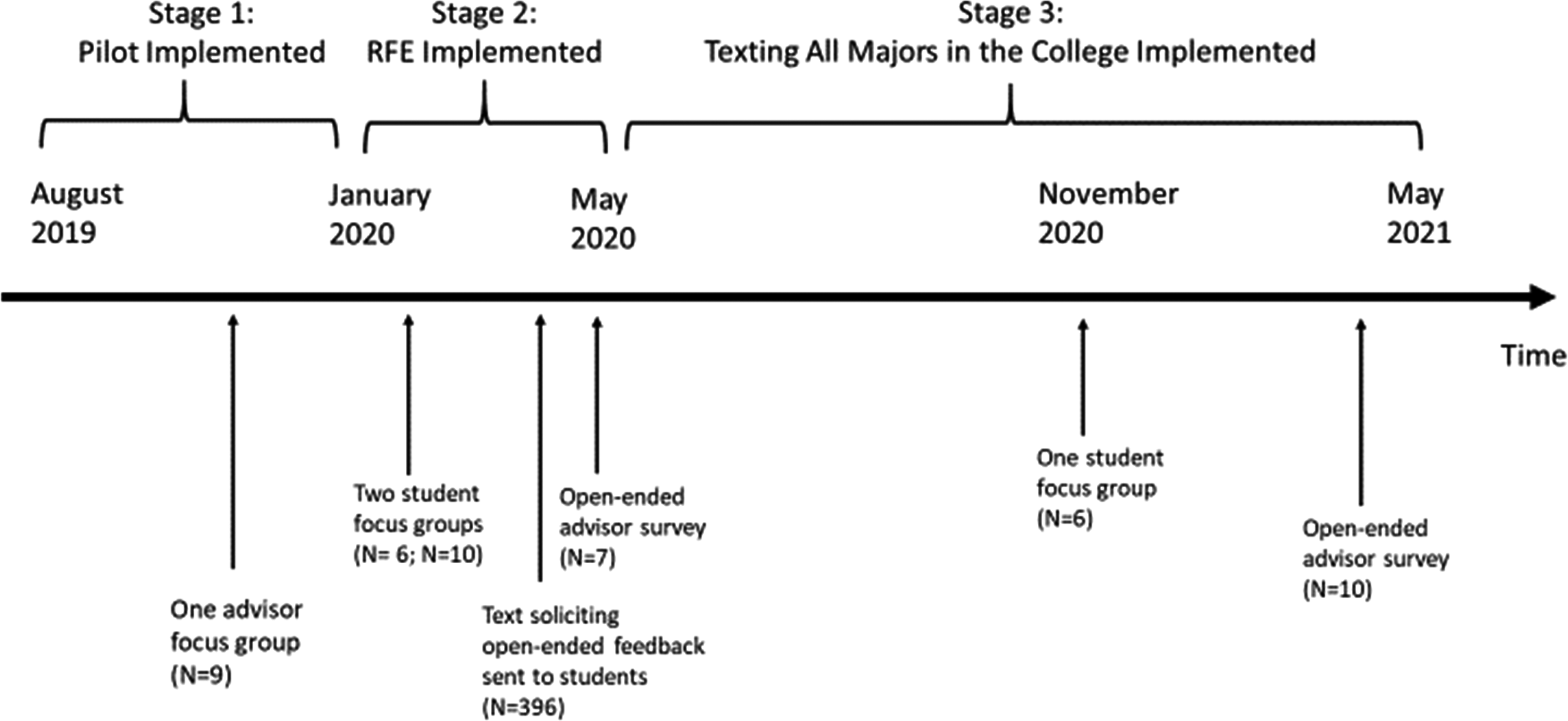
Data collection timeline.
Results
Student Receptivity
Overall, students were eager to participate in the focus group conversations and elaborate on their answers to the questions that were asked. All students in each of the three focus groups participated in the discussion. At least one student from each of the 11 majors was able to attend one of the three focus groups. A variety of themes emerged from the conversations. They covered topics like overall satisfaction with the texting platform, whether the students took action because of a text, how students felt about the academic advising center before and after the text messaging platform, and the type of text messages students liked most. We will use these themes to guide the results of the student focus groups in the following paragraphs.
All three focus groups began with a question regarding how the students typically received information from the university and the college prior to the implementation of the text messaging program. The majority of students indicated that email was the most common, with a few saying they receive information from the major-specific forum housed in the university’s learning management system. Students were then asked about their preferred method of communication. Most students preferred email, but some preferred social media platforms such as Twitter or Instagram. At this point, a handful of students expressed how much they enjoyed text messaging as an additional form of communication, with two students mentioning they preferred it over email or other communication modalities the university and college used.
For students in the February focus group, the conversation next moved to the texting platform. Students were asked to describe their experience with the texting platform. The majority of students expressed that texting was convenient, with one student saying “… I’m pretty sure the majority of us are on our phones and so it’ll just pop right then and there so you see it …. I like the convenience that it just pops up and you see right then and there.” In total, the convenience of texting an advisor was mentioned 12 times over the three focus groups—more than any other intervention attribute. Other students echoed this sentiment, noting that it was easier to see information on a phone than needing to log into email to get important notices or reminders. Another student noted they enjoyed that texting was less formal than sending an email, with some students noting that it was like “texting a friend,” and was thus a more personal connection to the advisor.
In one of the February focus groups, a student described that they had used the texting platform to ask their advisor a question. A few other participants in the group had not realized that was an option but agreed that they would use the texting platform to ask simple questions. Although the introductory text message at the beginning of the semester had noted that a student could text their advisor, the majority of participants in all three focus groups had assumed that the texts were automated. In the focus group the following November, participants were again surprised to learn that they could contact their lead advisor with simple questions via text. One student from this focus group noted “… for me it would be much easier because I always think, well, I only have one small question. I’ll try and figure it out. And then I just keep putting it off … having the ability to just shoot that text will be really nice.” Recall that students in the November focus group had received text messages but had not used text messaging to engage with an advisor. When attendees in this latter focus group were asked why they had not engaged with the platform by responding to a text or asking their advisor a question, most of the students again said it was because they did not know they could ask their advisor a question through the text program. A couple of participants stated that they keep their email for school-related communications and use text messaging for personal communications. They did like the information provided in the texts, however, said it would be unlikely that they would use the texting program to interact with an advisor.
Next, students were asked about infographics that were included with the majority of texts. Examples of such infographics included, (a) how to access the student’s degree audit report online, (b) how to apply for scholarships online, (c) how to participate in a virtual course registration day event, (d) links to wellness resources at the university (including the food pantry and the counseling center), and (e) the application process for the college's student ambassador program. Students overwhelmingly liked the infographics, with the most common comment being that they are easy to understand and added to their satisfaction with the texting program. A few students in the November focus group mentioned that they only read the infographic and not the body of the text, whereas others said they ignored the infographic and only read the text. Those who said they mostly ignored the infographics, did clarify by saying that when the text seemed relevant to them, they were more inclined to look at the infographic than if it was a text they did not believe pertained to them.
The facilitators then prompted students to discuss the specific infographic that introduced students to their academic advisor. The infographic provided a picture of their lead advisor, how to reach them, and a list of other advisors on their team who could help when the lead advisor was unavailable. At this point, one student in a February focus group noted that they did not like that the text came from an advisor because it was clearly automated. This student believed it was “fake” because the advisor was not the one directly sending the texts. Another student noted that they also agreed that this introductory message seemed fake, but overall enjoyed the text program for the value of the information. Other students echoed this sentiment but agreed that being aware of the ability to text the advisor and that the advisor would respond changed their opinion about the “fake” nature of the texts. At the same time, some students countered this idea when asked how they felt about the academic advising center after receiving texts from their advisor, saying “it definitely feels more personable,” another saying, “It’s just more accessible,” and last a student said, “it creates more supportiveness.” Quite a few students also noted that they felt closer to their advisor after the texting program was implemented than they did before. As a follow-up question, students were asked if it would be acceptable for an advisor to indicate in their text response that they would be answering the question via email, due to the length of the answer. Most students were fine with this option as long as the advisor told them they would answer via email, as this would prompt the student to check their email for advisor’s response.
The conversation then shifted to the frequency of texts being sent to students. The college policy is to send one text per week, unless there is time-sensitive information that needs to be shared or if a major-specific text needs to be sent to a subset of the student population. Students in all three focus groups indicated that the once-a-week frequency was good, but it would be okay to send more than one text per week if there was important information to communicate (e.g., upcoming special events, highlighting a new course that would be offered the following semester). A couple of students who had one major in the college and a second major in a different college indicated that they would like to receive texts from the other college, effectively doubling the number of texts they would receive. These students echoed feedback about the informational nature of the texts. Overall, students enjoyed receiving the text messages because they perceived them to be relevant to their academic careers and because the messages provided important reminders about academic deadlines each semester.
Next, students were asked if a text message had prompted them to take an action they would not have otherwise taken. Quite a few students said they had not yet taken any actions but planned to in the future. For example, in response to a text message that encouraged students to apply for scholarships, several students indicated that they had started the scholarship application but had not yet submitted it. After the initial RFE and the February focus groups, the scope of messages was expanded to also include a text highlighting courses for the following semester. Students in the November focus groups indicated that the major-specific course highlight was one of their favorite texts, with a few students saying that they signed up for a course because of the text highlight. These students also noted that they would like to see courses in other majors in the college. For example, a political science major was interested in learning about the course highlights in sociology. At the end of the spring 2020 semester, a text was sent to gauge students’ satisfaction with the texting program after being enrolled for at least one semester. When prompted to provide a “thumbs up” or “thumbs down” if they liked or disliked it, respectively, 391 out of 1400 students in the treatment arm responded with a “thumbs up” emoticon, with only four responding with a “thumbs down,” and one with an “OK.” After the initial response, students were asked to provide more feedback. Students echoed the feedback from the focus groups, praising the convenience of texting, their advisor’s responsiveness, the shorter response times, the range of information provided, and reminders about important events. One student stated that “[u]sually the advising program is somewhat intimidating, only because it is a longer process of signing up, scheduling and going in for an appointment with a stranger. This texting program makes it feel entirely more personal and accessible.” Another student noted “[i]t made me feel good that someone was checking in on me, [e]nsuring that I was okay.”
It should also be noted that because the intervention occurred during spring 2020 when the COVID pandemic unfolded, and the university moved to have all classes online, students may have found the advisors’ text messages to have been especially helpful. Indeed, one student wrote, “This semester has been especially difficult because of the pandemic and even though I’m usually a step ahead of things, I’ve found myself falling behind and struggling. Getting texts from [Advisor] was helpful because I felt less alone and I felt like I had a direct line of contact to somebody who could help me at the university …. Receiving updates and engaging texts to make sure I had what I needed gave me a sense of connection with the advising department that I’ve never had before.”
Although the vast majority of the feedback was positive, there were five negative comments. One student said they never used the texting option, another student said, “I felt like it felt very fake, not like I was talking to a real person as well as the fact that a lot of the time the texts were seemingly unnecessary and more of an annoyance than helpful.” Yet another student noted that the program had inadvertently not been using their preferred name, which was upsetting.
Advisor Receptivity
The college had nine lead academic advisors for its 11 majors, with two lead advisors covering multiple majors. Initially, the advisors were generally reluctant to incorporate another form of student communication and expressed their reluctance through the training sessions and staff meetings that were held prior to and during the fall semester pilot. To better understand the advisors’ reluctance, a focus group was scheduled. Advisors were hesitant but willing to participate in the focus group. To ensure the anonymity of the advisors, the facilitators of this focus group were graduate students in the college who had prior focus group training. The focus group recording was transcribed, and advisors’ comments were anonymized before the transcript was shared with the texting program team. This focus group was held in the fall of 2019, so there would be time to address advisor concerns, before expanding the program in the spring semester of 2020. The topics covered in the focus group ranged from concerns about texting students to advisors “losing their voice” given partially automated messages, potential miscommunications, and the possible spamming of students.
After advisors were given an overview of the goals for implementing a texting program within the college, the conversation began by assessing the platform itself. For example, is the platform easy to navigate and understand. The advisors agreed that it was fairly user-friendly. However, many advisors expressed concern that texting would add another task to their already busy schedules. They also raised an issue about the texting platform’s notification system, noting that the system did not give real-time notifications and thus made the process of checking to see if they had received a new text a bit cumbersome. Additionally, they expressed concern that students would expect responses at all hours of the day, including nights and weekends. The advisors voiced the need to provide clear guidelines to students about when they would be answering texts, how the platform would be used by advisors, and what type of questions were appropriate to answer via text.
Next, the advisors were asked about their time commitment to the texting platform. Advisors agreed that at the time of the focus group (i.e., November 2019, when only 300 students were receiving text messages), the time commitment was small and manageable. Knowing that the program would soon be expanded to include more students, they did express concern over handling their entire student load via text. This led to a discussion of the variety of questions students were asking. For instance, students were texting advisors to ensure the advisor had received an email they had sent. As an example of an interaction that generated longer responses from advisors, some students had texted saying that a message that had been sent did not apply to them because they had recently met with an advisor. The advisors expressed apprehension about having the texts come from them, rather than the advising center itself. One advisor noted that a student had requested help on a weekend and then received an automated text before the advisor could reply. The advisor worried that receiving an automated text before they were able to respond to a specific question or comment seemed insensitive and jeopardized the relationship between advisor and student. Another advisor expressed concern about auto-responses. Although the advisor recognized the benefit of the auto-response in certain situations, they would like to use their own voice to respond to certain texts coming from students. Again, they were troubled by the fact that these messages were coming from advisors, but that advisors were unable to insert their voice into the auto-responses or the messages themselves.
The above thread naturally led to the advisors’ expression of concern over the impersonal nature of texting. As one advisor said, “… yes this [is] supposed to be a personal connection, but once [the students] pick up that it’s [automated]… it causes issues in our relationship from advisor to student.” Yet, another advisor said, “I just don’t think you can fake personal connection.” Most advisors agreed that once students realize there is not a personal connection via text, the result would be a complete loss of the relationship, which is ultimately worse for the student.
Many advisors believed that it would be better for the text platform to be a reminder system from the college, taking their personal names off the communication completely. They reasoned that if students knew that it was simply a reminder system, it would eliminate many of the issues they were experiencing, such as telling students they would answer their questions over email or missing a text from a student who missed their advising appointment. They also expressed concern that a few of the text messages sent at the beginning of the semester, had open-ended questions. Advisors did not like open-ended prompts. They believed that it opened the door for random questions and added to advisors’ time commitments.
When asked how the college could help support advisors and address their concerns, advisors agreed that having texts targeting specific groups would be better than sending the same text to all student populations. Advisors also expressed that they would like the language to be more reflective of the collaborative advising model used in the college (e.g., using language like, “make an appointment with one of our advisors,” instead of “make an appointment with me.”). Finally, advisors also conveyed that they would like more text messages that targeted what they believed were the most important things to communicate to students (e.g., center walk-in hours, deadlines, events that help students get involved with their major department).
More generally, the concerns raised by the advisors centered around a lack of ownership and control over the text messaging plan. In response to these concerns, the administrative team implemented changes to address the advisor’s concerns in spring 2020. We updated the introduction text message to set clear expectations for when advisors would respond to text messages. For example, the infographic that was included with the first text contained a note that their lead advisor would reply to text messages during a one-hour block of time twice per week. Another change was to include advisor-initiated major-specific text messages each term. We also clarified that some texts would be automated, but students could use texting to contact their advisor and the advisor would respond directly. Lastly, language was adjusted to be more inclusive of the advisors who were available to help students, from including pictures of the advising team in the introduction infographic, to advising students to make an appointment with someone on the advising team, rather than only directing them to the lead advisor.
At the end of the spring 2020 semester, advisors were surveyed so the administrative team could obtain anonymous feedback on the changes that had been made to the texting program. (Due to the advent of the coronavirus pandemic mid-semester, we were unable to conduct another focus group.) Advisors were asked a series of questions similar to those asked in the focus group. There was a noticeable change in the survey feedback compared to the feedback given the preceding fall in the advisor focus group. Although many advisors expressed concern and hesitation in the fall, at the end of the spring semester, most advisors saw how the program benefited their students.
In their survey responses, advisors noted the texting platform allowed them to answer quick questions that otherwise might have required a student appointment. The program also allowed them to respond quickly to students and they acknowledged the students liked the program and the quick responses they received when asking simple questions. At the same time, advisors reiterated some of the concerns brought up in the focus group, including concerns about students receiving automated messages before they can reply to a student’s text message or email. Some advisors continued to be concerned that the messages were coming from individual advisors rather than the advising center. Advisors also expressed the desire to have more ownership of the texting program, with one advisor noting that they would like to be able to send texts that were more targeted to their student population.
The second survey was sent to advisors one year after the first survey. This survey asked open-ended questions regarding advisors’ perceptions of using text messaging to communicate with students. Although the two spring semester surveys were similar, this latter survey focused on how texting had helped or hindered student–advisor relationships and the advisors’ ability to do their jobs. Overall, advisors again showed support for the text communications, noting that students seemed to like texting and that it allowed them to answer quick questions that may not have come up in an appointment or an email.
When asked how texting helped or hindered their communication with students, one advisor said “[s]tudents seem to really appreciate the less formal type of communication. I also find that it’s a good resource for letting students know about important updates or changes through text.” All of the advisors believed that texting helped, particularly with simple questions and reminders. A few advisors noted that students enjoyed texting and were used to receiving information through text, making texting helpful overall. The only hinderance advisors noted was that some students ask complex questions via text, meaning the advisor has to redirect them to email or an appointment. Advisors noted that students may not realize texting cannot take the place of a regular appointment for resolving complex issues.
Advisors were also asked whether texting had improved or hindered their relationship with students. Again, the majority of advisors agreed that it has helped their relationships. A couple of advisors noted that it was neutral, but for those students who used the platform, it seemed to enhance the relationship. Advisors were also asked about the time spent on texts per week. Advisors reported utilizing different strategies for time management. Some advisors kept the texting platform open all day, checking on and off throughout the day. Others designated anywhere from a half hour to one hour a day to respond to texts; however, all respondents checked the texting platform at least once per day.
When asked how texting has positively impacted their advising practices, one advisor said, “[i]t's allowed me to be relevant to the student, and service them in a way that they are very familiar with. Students have also expressed that they like the idea of being able to text their advisor to get quicker responses.” Other advisors had used texting to reach out to advisees if they are late for an appointment. Another noted that texting had allowed them to be more accessible to students and students appreciated the reminders sent through text.
Advisors were also asked how texting had negatively impacted their advising practices. A few advisors said that it had not negatively impacted them, whereas others noted that it added another form of communication to their already-busy schedules. Another said it was hard to gauge which texts would generate the most responses, making time management challenging, and that sending one text per week was too much. There was also mixed feedback on the auto-responses to some texts. Some advisors thought it was helpful and cut down on their need to send a personal response, whereas others did not think the auto-response was helpful. Some advisors viewed the informal nature of the text messaging led to students replying with informal language. Relatedly, some advisors noted a lack of established best practices for students when texting advisors (e.g., students periodically sending messages outside of regular office hours).
Finally, advisors were asked how the text messaging program could be improved. Advisors expressed the need for more strategic messaging, including major-specific messaging and more targeted messaging, such as texting students based on their academic level (freshman, sophomore, junior, and senior). The need for a better notification system within the platform was also a common suggestion. Advisors worried that they were missing some messages because the system does not notify advisors when they receive a new text. A few advisors noted behind-the-scenes administrative issues that impacted advisor and student engagement (e.g., data transfer issues and wrong numbers).
Discussion and Conclusions
In summary, students quickly saw the benefits of text communications while it took time for advisors to see texting as enhancing their communications with students. Student opt-out rates were extremely low and many students reported liking the pertinence of the text messages and the ease of using this form of communication with their advisors. Although academic advisors were initially skeptical about the value of adding texting to their student communications tool box, the positive feedback from students coupled with adjustments that were made in response to advisors’ feedback, eventually led advisors to see the value of the program. Thus, we believe that group texts may be helpful in communicating information to students, especially in those circumstances where advisors have large caseloads.
Before turning to a discussion of the implications of our findings for advising practices and promoting student success, it is important to provide some contextualization. Specifically, in some instances, students or advisors may not have felt comfortable expressing contrary opinions in a focus group setting. In addition, while this study utilized multiple methods to ensure that we had gathered a variety of opinions, we were unable to conduct a focus group with the small number of students who chose to opt-out of the text messaging platform. Speaking with students who chose not to participate in the program could provide the college with more insight into how to make the text messaging program more accessible to all students. In addition, the growth of social media technologies may affect students’ assessment of the value of text message communications in the future. As such, this is a topic that clearly warrants more research. Finally, this study was conducted in a large, public university setting where all formal student advising is done by professional academic advisors. Consequently, our findings may have limited generalizability to smaller schools or institutions where faculty members also work in an advising capacity.
It is also important to acknowledge that our study may have been impacted by the fact that some of the data were gathered after the COVID-19 pandemic began. The pandemic presented unusual communication challenges for both advisors and students, including conducting and attending virtual advising appointments and relaying the frequent changes to the summer and fall schedules as the university grasp the severity of the situation. The text messaging platform provided advisors with a tool to convey important, time-sensitive information to students using students’ preferred communications mode of delivery. It also gave students direct access to an advisor when walking into the on-campus open office hours was no longer an option. As a consequence, texting enhanced the advising center’s ability to respond effectively to major academic disruption and this may have been a factor in both students’ and advisors’ assessment of the technology. Students may not have been as enthusiastic about utilizing texting under normal circumstances.
Student and advisor feedbacks were the impetus for important changes in our texting program over time. Specifically, we learned that clear and consistent communication with advisors on the goals and timing of the texts were important. We also learned that it was important to communicate to students about when they should expect answers from advisors. In addition, the college created more targeted messages with the assistance of advisor input (e.g., major specific events and opportunities, important departmental deadlines). Finally, we updated the introductory message to include information that the texting program was a two-way messaging program, with some automation. Going forward, we believe it is important to continue to gather student and advisor feedbacks periodically. Such feedback will allow for continued improvement in the texting service as academic advisors’ workloads and students’ academic needs shift over time.
Although students readily embraced receiving advisor text messages, advisors were initially reluctant to use a texting platform because of their belief it would damage the relational core competence of their advising practice. However, with time, advisors found texting their students provided an innovative entryway to meet students where they were at in their academic career. Essentially, texting did not damage the relational component of academic advising. Rather, it enhanced the advisors’ ability to connect with their students on the conceptual, informational, and relational levels and helped advisees to navigate their higher education experiences.
Our qualitative findings have several implications for advising best practices as they relate to group texts. These recommendations are targeted at increasing the advisors’ receptivity to and sense of ownership of this new communications tool. First, when implementing a texting program, it is important to assess how it impacts the advisors’ allocation of time. In the first stage of our roll-out, advisors’ schedules were adjusted to give them the time needed to respond to students’ messages. Advisors were also encouraged to let students know when their questions required an appointment or if their questions were better answered via email. Ongoing tracking of advisor time is also important because their time commitments likely change as more students begin to use the program to get timely answers to “quick” questions. In turn, as student utilization of texting increases, this could have consequences for the time advisors spend on email, phone, and in-person appointments as well.
Second, advisors are typically most knowledgeable of the types of reminders and nudges that students need. Thus, soliciting input from advisors on messaging priorities can increase the effectiveness of text communications. In addition, keeping them abreast of when specific messages are sent is helpful. We sent reminders to advisors through the center’s calendar program so that they knew in advance when specific automated messages were to be sent. This encouraged advisors to reply to any outstanding student texts before the next automated advisor text was sent and it helped them to plan for the time needed to respond to the next set of incoming messages from students.
Finally, and most importantly, providing regular time for training and periodically gathering feedback from advisors enhanced the effectiveness of our texting protocol. Thus, administrators should be mindful of scheduling time with advisors for ongoing assessment, discussion of concerns, and training as acting on the feedback from these activities helps to maximize the potential benefits of texting as a communication tool.
Footnotes
Declaration of Conflicting Interests
The authors declared no potential conflicts of interest with respect to the research, authorship, and/or publication of this article.
Funding
The authors received no financial support for the research, authorship, and/or publication of this article.
