




Abstract
This study uses an asset-based lens to explore the support college students give to others in their social network. Retention literature often categorizes students as passive receivers of social support. Qualitative data comes from a 3-year longitudinal study of college students who graduated from the same urban school district, drawing from a larger mixed-methods research project (MCAP). Data from this study demonstrates that many college students are actively supporting peers, siblings and parents in the form of tangible (monetary) help, informational assistance and emotional support. Recognizing students as important contributors in their communities is important for educators seeking to understand the experience of college students and the assets they bring with them when they enter campus.
To complete a bachelor’s degree affords one access to higher incomes, more employment stability, occupational prestige, and better health outcomes (Abel & Deitz, 2014). Across the United States, there has been an increase in the number of students enrolling in postsecondary education (National Center for Education Statistics [NCES], 2019). Yet, completing a college credential remains an insurmountable task for many students from groups that have been historically excluded from higher education. Nationally, only 40% of Pell grant-recipients complete a bachelor’s degree within 6 years (Goldrick-Rab et al., 2016). These statistics point to an ongoing need to better understand what the postsecondary experience for students from groups historically excluded from the higher education system.
Within the abundant research on college retention, student departure has been largely conceptualized using a deficit lens. In an attempt to unpack what leads to dropout, researchers have interpreted college access and success as a “problem” (Braxton & Mundy, 2001), focusing on what students lack. The push for widening participation from students of all backgrounds in higher education calls for a re-examination of how we understand the assets that students from diverse backgrounds bring. Asset-based approaches are becoming more widely recognized as a tool for challenging the default attitude of understanding a social phenomenon as a problem to be solved, instead focusing on existing strengths to be built upon. In education, rather than starting from the vantage point of what a student might lack, an asset-based approach recognizes the strengths and experiences students bring with them to the classroom and the wider campus (Krutkowski, 2017; McKay & Devlin, 2016). This study unpacks the experience of college students as they navigate the postsecondary system in the 3 years after graduating from an urban school district. The aim of this study is to understand the ways traditional-age college students act as a significant source of support to those in their social network as opposed to mere passive receivers of support, as is often portrayed in the literature.
Literature Review
In the research on postsecondary persistence, college students are often categorized as the beneficiaries of social capital and social support. Research on college persistence gaps among students that have been historically excluded from higher education often takes a deficit approach when conceptualizing social support and social capital, emphasizing that students from certain backgrounds have less access to valuable capital (McKay & Devlin, 2016; Morrow, 1999). Largely missing from this literature is the way that students offer support to the people in their network. If access to higher education is to a vital pathway to college-aspiring students of all backgrounds, a more nuanced picture of how students are contributors to others on and off campus is needed. Instead of focusing on the support lacking from a student’s network, this study takes an asset-based approach to unpack the social support that college-aged young adults have to give.
Deficit Thinking in College Persistence
In the research on college persistence, theories around why students drop-out focus on what they lack that keeps them from connecting with the higher education environment (Tierney & Hagedorn, 2002). More specifically, the gaps in education outcomes between student groups have focused on student access to adequate academic skills and access to finances to pay for college (Tierney & Hagedorn, 2002; Perna, 2004; Roderick et al., 2009). Even arguments surrounding the importance of social support in college have been framed using a deficit lens, pointing out how certain students (namely, first generation, low income, and/or minority students) lack information or other forms of social capital from parents and schools (Perna & Titus, 2005; Roderick et al., 2009). The deficit discourse in the literature focuses on students as lacking and, thus, not belonging within the norms of the university environment. Farmer-Hinton (2017) highlights the deeply embedded deficit narratives surrounding Black students as not fitting the archetypal images of college students as White and affluent. Such narratives powerfully underlie structurally unequal access to educational opportunities. Similarly, McKay and Devlin (2016) challenge the deficit discourse surrounding low-income students, finding this group of students to be hard working, high achieving, and determined to succeed.
Students as Receivers of Support
One aspect of the deficit approach to understanding student departure has been focused on the lack of social support of which certain students have access. The role of social support has been central to the literature on college retention since early theoretical models emphasized the value of support to help students integrate into the social structure of the college (Tinto, 1987). Research following this approach has concentrated on on-campus social networks and what faculty and support staff can do to aid in student persistence, particularly for students who have historically been excluded from higher education (Cholewa & Ramaswami, 2015; Drake, 2011; Pascarella & Terenzini, 2005; Pike & Kuh, 2005). Tinto’s (2017) most recent theoretical model continues to emphasize the importance of on-campus social support, but compartmentalizes social ties beyond the campus as outside the core experience of students as they persist.
Support From Home Networks
Underlying this focus in retention theory on students as passive receivers of support from on-campus social ties is the idea that students do (and should) separate from their home communities when they enter the campus social structure. A small branch of qualitative studies explores the complexities surrounding maintaining connected to home social networks for students from communities with close kinship ties. These studies highlight family and home community support as an essential asset for college students, including those from Chicano (K. P. González, 2002), Latina (Rosas & Hamrick, 2002), African American (Guiffrida, 2005), Native American (Jackson et al., 2003), and White Appalachian (Bryan & Simmons, 2009) backgrounds. Qualitative research allows for nuance, and several of these studies also note that there are simultaneously challenges for students as they maintain close ties to home communities, including the emotional strain of extenuating familial circumstances (Guiffrida, 2005), or the cultural mismatch of time expectations between home communities and college norms (Jackson et al., 2003). The same student might feel simutanously both pride and academic motivation in representing their networks from home, and emotional strain due to financial stress that college enrollment places on their family (Guiffrida, 2005).
Scarce research within the existing retention literature focuses on the connection to social ties when students continue to live at home and attend a local university or community college (Karp et al., 2010; Sandoval-Lucero et al., 2014; Tinto & Goodsell-Love, 1995). Remaining in home social networks as a college student is the reality for the majority of students today, with more than three out of four students attending college within 50 miles of home (Goldrick-Rab et al., 2016; NCES, 2011). More qualitative research is needed that recognizes these complex dynamics as students maintain membership in home and college social networks, whether a student goes off to college or stays physically enmeshed in pre-college social networks.
Students as Providers of Support
Related to the support students receive is the support they give to others. While qualitative studies of home social networks seek to recognize the value of the home community for student support, this research omits the ways many of these students offer support to others in their networks. The national narrative is that young adults today are dependent on others in their networks, particularly in the form of financial and emotional dependence on parents (Fingerman et al., 2012; Schiffrin et al., 2014). Behind this narrative is a cultural preference towards independence for college-aged young adults, which is reflected in the expectations of the college social system (Stephens et al., 2012). Yet, many students, including those from communities with more collectivist social norms, often bring with them social values of interdependence, including emphasizing the needs of others and their own role as a part of community (Stephens et al., 2012). The support students give to others in their social network may be rooted in a more communally-oriented set of expectations, largely invisible in current retention theory.
Asset-Based Approaches
Research on the support college-aged young adults give as active members of their community builds on an asset-based approach to understanding experiences surrounding college (Krutkowski, 2017; McKay & Devlin, 2016). Social capital theory has been widely used in studies of higher education outcomes as a conceptual tool for understanding how social ties can provide value to students (Perna & Titus, 2005). This literature over-relies on the definition of social capital put forward by Coleman (1988), who understood students as one-way beneficiaries of the social support from the vertical social connection of parents (Dika & Singh, 2002). Those who are critical of social capital theory note its potential to contribute to deficit thinking, as yet another resource that individuals and families from certain communities (particularly those from minority communities or those outside the United States) lack (Morrow, 1999).
Existing asset-based approaches to highlighting the valuable resources of certain students do not explicitly extend this asset-based understanding to the individual college-aged adult as a contributor to their own network. Yet, embedded in the asset-based lens is the implicit understanding of individuals as having agency and value within their communities in ways that institutions like those in higher education might not always see (N. González et al., 2005; Kiyama, 2010; Yosso, 2005). Just as the knowledge of certain communities has not be valued by the dominant education discourse, so too the contributions support by students has been largely invisible in the literature on college experiences.
Forms of Social Support
While there are currently no longitudinal studies focused on how helping others impacts the experience of college students, this topic has been explored in more depth within research on older adults. As with studies of college-aged adults, research in this field has focused more on how older adults act as passive receivers of support (Krause & Shaw, 2000). Yet, many such older adults also help others in their social network. In their study of emotional support provided by older adults, Krause and Shaw (2000) found that helping others boosted the self-esteem of participants, though this benefit tapered off for low SES individuals when they were overextending their own resources in helping others. Types of assistance are defined by Krause (1995) as: tangible help, informational assistance and emotional support. I extend the utilization of these categories of support to traditional-age postsecondary students in this study. This article seeks to highlight the important role many college students have in their own social networks, in order to contribute to our collective understanding of how postsecondary life unfolds for students who graduated from urban high schools.
Study Objective
While social support has been a central topic within the extensive research on retention, this literature has failed to recognize the important role that many college students play as providers of support. This article seeks to contribute to that gap by unpacking how college students describe their own role in supporting peers, siblings and parents. Using an asset-based approach, this study highlights the role that recent graduates from the same urban high school district play within their social networks as they navigate the postsecondary system. A key strength of this study design is that it relies on 3 years of longitudinal data, which allows for a rich analysis of student experience over time. Furthermore, with some exceptions (Jackson et al., 2003), most studies on retention are limited to participants on one campus or program (e.g., K. P. González, 2002; Guiffrida, 2005; ). This approach often is not set up to capture the majority of students who graduate from a different institution than where they first enrolled (NCES, 2003). By utilizing qualitative data from a larger research project, this study follows a group of recent high school alumni from the same urban school district in the 3 years following graduation. As a result, a broad range of experience was captured as participants navigated the expansive and often complex postsecondary system.
Methodological Approach
Milwaukee College Access Project
Data from this study comes from a large mixed-methods research project called the Milwaukee College Access Project (MCAP). This project was organized around The Degree Project (TDP), the first randomized control trial of a promise scholarship in the United States (Harris et al., 2018). Qualitative data collection included topics far pertaining to college access and success far beyond financial aid. Since social support was a central topic of interest throughout the interviews, the support students gave to others organically emerged through the data collection process. The research question for this study focused on the student experience of providing support to others while attempting to persist in college. Thus, while other data was collected for the MCAP, only postsecondary qualitative data was utilized in this study.
Data Collection
To compile the sampling frame, students in all high schools in the Milwaukee Public School (MPS) district completed a Senior Exit Survey at the time of graduation, where they were asked if they’d be willing to participate in a larger study of college access and success. Interview participants for this second phase of data collection were drawn from those who consented to participate in the project and stated that they were going to enroll in college for the following semester. A pool of 399 graduating seniors completed the exit survey and consented to be interviewed. A stratified random sample design was implemented (Maxwell, 2012), aimed around capturing participants from a range of various high school and individual characteristics as related to testing the theory of change behind TDP. Participants were randomly selected within eight stratified categories. This sampling frame led to an interview cohort that included participants from different types of schools, academic backgrounds, and student-statuses, indicating that selection bias was minimized.
This cohort of students graduated from high school in 2015, and semi-structured longitudinal interviews were conducted in the summers of 2016, 2017, and 2018. Interviews were at an average length of 90 minutes. Interviews were transcribed verbatim and imported into NVivo data analysis software. For the purpose of this study of current college students, only participants who enrolled in college at some point in the 3 years of interviews are included (n = 31). Of the 31 total participants, 27 were interviewed all three consecutive years (while the remaining five dropped out of the study either after the 1st or 2nd year). A total of 87 separate interviews were included in the coding and analysis of this study.
Interview Participants
The racial/ethnic makeup of interviewees closely paralleled the breakdown of enrollees in Milwaukee Public Schools (Wisconsin Information System for Education, n.d.). Of the 31 participants, 21 identified as African-American/Black, three identified as Latinx, two identified as Asian, four identified as White, one identified as Middle Eastern, and one identified as multiracial. At the time of the first interview, eight were enrolled at a 2-year college, 19 enrolled at a 4-year college, two enrolled at a for-profit institution, and three were not enrolled (enrolling the subsequent year). Most qualitative studies of college student experiences only look at students at one institution; by following a group of recent graduates from the same urban school district over 3 years, we are able to see patterns of students who transfer, enroll late, and stop-out for reasons such as work and other disruptions in sequential enrollment. This inclusion is not trivial, but is highly reflective of students in the American higher education system. In a national sample, 59% of 4-year degree recipients graduated from a different institution than where they first began their degree (NCES, 2003). Qualitative studies that only investigate a group of students at the same university at one point in time miss substantial swaths of students coming in and out of the postsecondary system, for reasons such dropping out, transferring, and taking a break. Thus, the design of this study allows us to capture student experiences as they move between institutions, which is particularly important for students who may not have access to the financial stability that makes it easier to avoid stop-out, drop-out, or transfer-out choices.
Data Analysis
The longitudinal design of the MCAP project allowed for a rich and unique approach to explore how student support unfolded over the 3 years of data. This longitudinal approach allowed for an intensively iterative data collection process. Initial broad themes were identified while data collection was taking place (Patton, 2002). Because interviews with the same participants would be occurring multiple times, there was room for diving deep into emerging themes in subsequent interviews. The theme of college students as providers of support was identified in the 1st year of data collection, when students spoke about their own role providing monetary and other support to others when asked about the support they received. These ideas were then were drawn out further through the development of new interview questions in the protocol of the subsequent 2 years. The full interview protocol included an extensive list of questions on a broad range of subjects, many of which were focused on social support and social capital through different stages in the persistence process (for example, questions about parental support through the major selection process). An abbreviated list of questions focused on the support students provided to others is provided in the Appendix. This list demonstrates how the focus on students as a source of support developed over the 3 years of interviews.
Longitudinal Analysis
Following data collection, analysis included first the generation of temporal narratives by creating a profile of a single participant experience over time (Saldaña, 2003; Thomson & Holland, 2003). Next, cross-sectional analyses across the interviews led to the identification of core themes outlined in this paper. This stage of analysis followed Lincoln and Guba (1986) inductive approach. Beginning with the data itself, units that related to the same content were grouped together in “provisional categories” (Lincoln & Guba, 1986, p. 346). These units were then compared to each other using the constant comparative method to search for whether units were similar enough to be placed in the same category, or whether a new category needed to be created. Categories were reviewed for consistency. The following findings emerged from this data analysis process.
Findings
The literature on student retention often portrays students as one-way receivers of support, namely from parents, faculty, and campus advisors (see Figure 1). Yet, the student participants in this study were also important providers of support in various ways not often captured in studies of this population (see Figure 2).
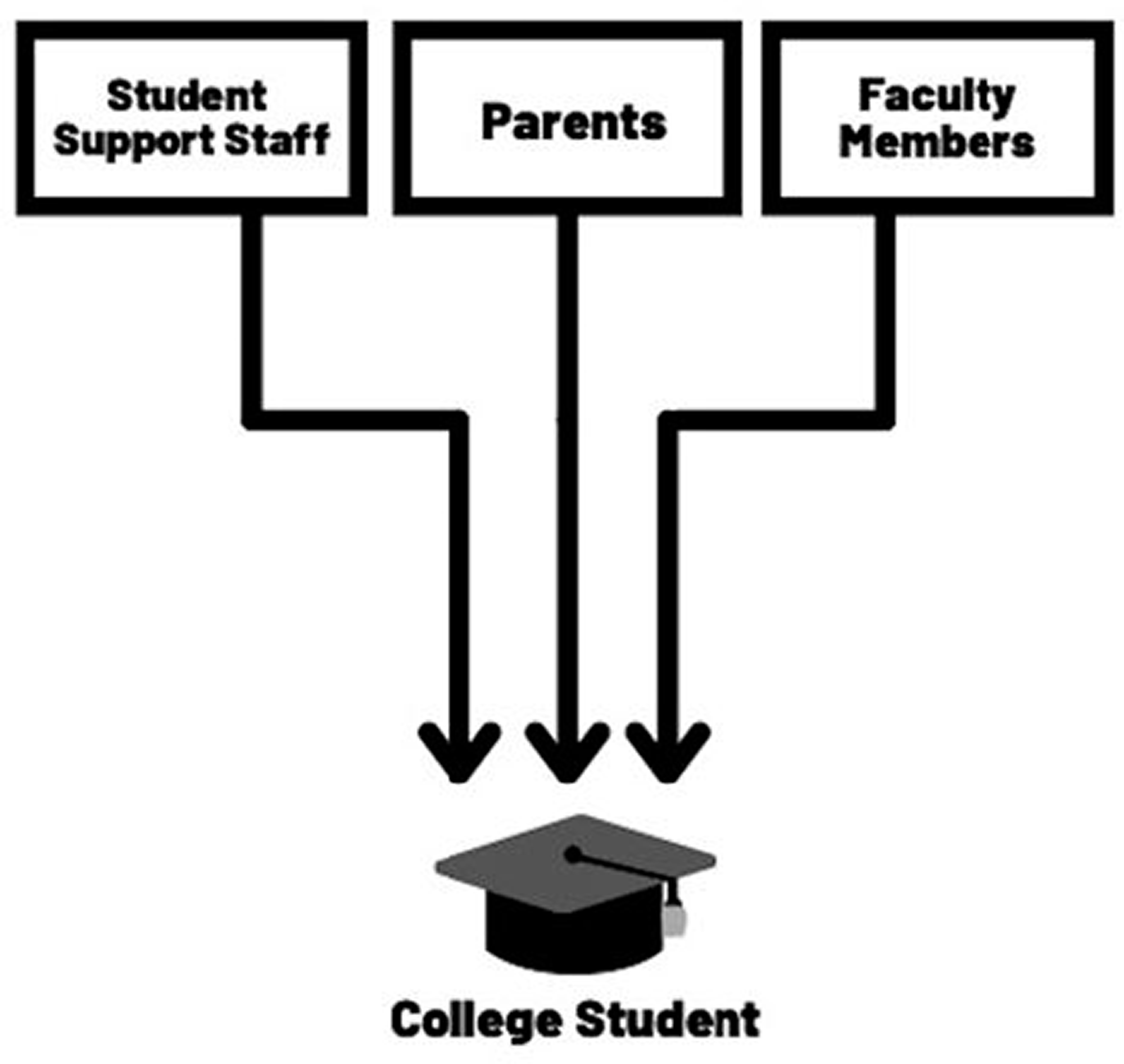
Traditional Retention Literature’s Understanding of College Students as Passive Receivers of Support.
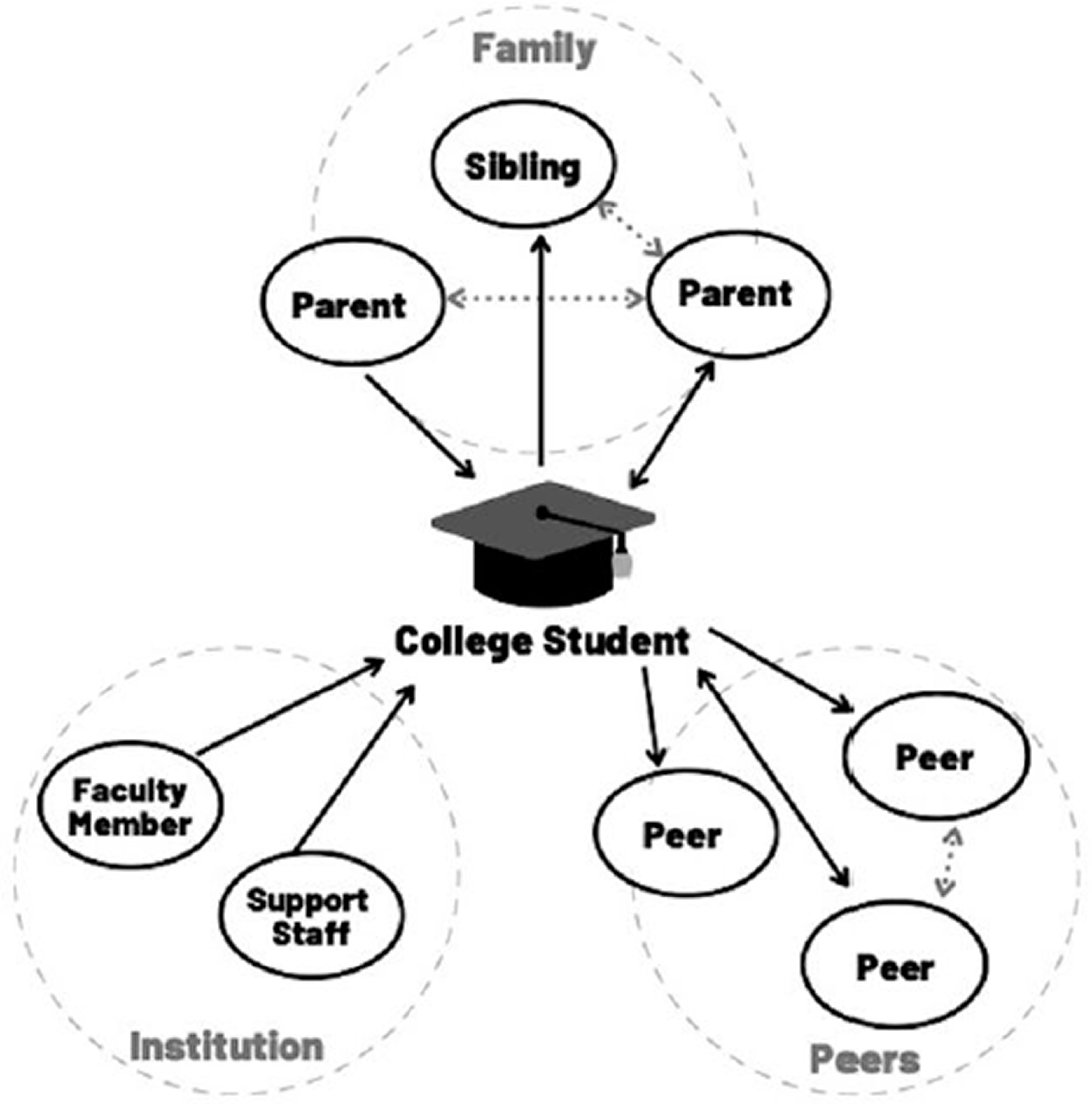
College Students’ Networks of Support, Include Support Students Give to Others.
The primary question guiding this study was: (1) Using an asset-based lens, how do college students who graduated from urban high schools offer support to others in their social network in the form of tangible help and emotional/informational support? Themes are categorized by the types of support as put forth by Krause (1995) in research on older adults: tangible help (referring in this study to financial support), informational assistance and emotional support.
Tangible Help
Underlying dominant retention theory is the assumption that college students are receivers of support, particularly in terms of financial support from parents (Fingerman et al., 2012; Schiffrin et al., 2014). This conjecture held true for many of the participants of this study. Some reported significant help, such as a parent who took out a large parent-plus loan or helped pay for partial rent costs. Others shared that parents gave them small amounts, such as the occasional offer of “ten or twenty dollars to help me.” Yet, while these students did rely on others, they also played an important role as financial providers to those in their social network. The vast majority of participants reported giving financial support to friends and/or family at some point during the 3 years of interviews. Out of the thirty-one students, twenty-two gave examples of how they monetarily offered support to those in their social network, including to parents as well as siblings and friends.
Contributing to Household Costs
Reflecting national trends (NCES, 2011), most of our study participants did not move a great distance in order to enroll in college (only three participants left the state, and two of those moved along with other family members). The majority of students in this study enrolled in college in the same city where they completed high school. As a cost-saving strategy, most of these students continued to live at home (or moved back home) at some point in the 3 years of the study. Almost all of these students contributed to the bills, groceries, or other household financial needs. The following quotes provide insight from students living at home and contributing to household expenses: – “Sometimes, yeah. I help my parents out. I do owe like sixteen hundred every semester [to the college]. So I'll get that done, and then the rest of the time I'll help my parents out with groceries ‘cause there are six of us, and I know they can't afford it.” – “A lot of times [my parents] need help with like their, just like their everyday bills. (…) So I help them with that.” – “Since I have the job and I live at home I don't really have anything to spend money on, so I help my dad out with the bills.”
While helping to support parents and the network of their immediate family of origin was the main way that our participants provided financial support, it was not always as a regular contributor. Several students were asked to step in and provide occasional financial help to parents for particular reasons, such as after a father got cancer or became disabled, or when a mother went back to college. A common theme was that students were often asked to step in to provide a loan to a mother or father that they would later pay back. Anthony was one such student, who lived at home with his mother all 3 years of the study as he attended the local university. He also worked full-time as a manager first in fast food and later at a grocery store. Anthony described the nature of how he his mom relied on him to help with the communal household bills when needed, but would keep a record so that she could pay him back: I would say only my mom asks for money sometimes. I mean, maybe she's running late on the phone and internet bill, she'll ask me for, like, a couple hundred dollars but she keeps track of it so the next time that I have to pay my insurance or my phone bill, she'll take it out of what she owes me or whatever. So then I won't have to pay it. She's done it a couple times but she doesn't owe me anything right now and I don't owe her anything right now. Every now and then when they need it. When they really need it. My mom don't ask me that much anymore. Sometimes I have to ask her because I know she needs it. She gets on to ask me, so like, little stuff like that, like her phone bill. She doesn't like to let her phone be off on her mother's birthday, which is my grandmother that passed. You know, her siblings are going to try to call her. So I would do just ask– why wouldn't you just say, can you pay my phone bill? But I just paid it for her.
Supporting Friends
The role of financial provider often extended to the horizontal social ties of siblings and friends. Participants commonly reported that they occasionally paid for a friend’s phone bills, funded car costs including gasoline, or covered the costs of food or social events. Several students had a friend who they regularly helped support in small ways, such as student-athlete Daniel, who shared, My [friend] didn't have the support system that I had. He had nothing like that really. There's been times where, because I've seen him working so hard to, like, get away from all that. There's been times where I have been his support system and helped him out. My past girlfriend, I've done a lot of stuff to help make her successful. So I have taken on that support role for others. (…) Like there's been times where my friend hasn't had, like, food. I've helped him with that. A couple times his phone was off, like, I paid his phone bill for him. Just little stuff like that. Just once they get down and need a little help.
Just as some participants offered assistance to friends who were struggling, other students had siblings who needed their financial support. Christopher was a student at in-state college away from home, the oldest of a large family. One of his younger sisters recently had a baby, and looked to him to help with family expenses such as covering the costs of diapers. As he explained: [My sister] wants to go to college in cosmetology and business. So, I was like, ‘keep doing what you’re doing.’ And I help her out, financially, because I can't watch any kids while I'm up here. But I help her out financially whenever I'm able to.
Reciprocated Support
While some participants supported friends and siblings in behaviors portrayed as one-directional, most students offered financial resources in ways that were reciprocated. Nicole, who was enrolled at the local community college, explained how she contributed money to close friends: Really, they've asked for help for things. Groceries, a cable bill every now and then. Just the support of friends, just asking if maybe they don't have money to get to work or gas money for something or, you know, just something small. Gas money, maybe food, you know. Things of that nature. (…) They'll always say ‘I'll pay you back’ and I'm kind of like, ‘No, don't worry about it. I might need your help eventually.’
Challenges to Supporting Others
There are positive aspects to sharing resources mutually with those in one’s network. However, a few participants did note ways that sharing their monetary resources had negative effects in ways that might have impacted college persistence. For example, Daniel had taken out student loans from his 1st year at an out-of-state school where he enrolled to play sports. He mentioned that helping to support his friends made it challenging to pay off those loans, which he was required to pay on during semesters when he wasn’t enrolled in the local community college. Another student, Ashley, reflected on how helping others impacted her own ability to buy books for class: “Sometimes, I think only once, it happened where I couldn't buy my books because I helped [friends] out. And I was short on [the money needed for] my books then, so I had to wait a week extra to get my books.”
Other students, mostly those who perceived their families as particularly financially vulnerable, supported parents and sibling to such a degree that they experienced frustration from associated social pressure. Jasmine was one such participant, an academically motivated student enrolled at a local private college with an impressive assembly of scholarships. Her mother helped to support her when she had a baby following her 2nd year of college via occasional childcare, but was unable to help her financially. This lack of financial safety net was especially frustrating to Jasmine as she navigated her own deep-seated ambition, academic talent, and dedication to school with what she described as “devastation” for having to take a year off after having her son. Within this context she experienced particular frustration with the strain of having her mother request money: [My mother] will ask for some. It won't be a large amount of money. (…) But if I have anything or a school check or something [she’ll ask me for] probably like 50 bucks. (…) But still it bothers me because she can't help me because she's not stable. (…) You're supposed to be my mom. Do you know what I'm saying? You should be at that point where you're able to help me. And so it makes me angry at her. It makes me very angry at her that you can't even help me. If I'm going to a situation with my rent, I can't pay my bills, I can't even call you like I'm supposed to be able to.
Jasmine was one of several participants to express conflicting emotions surrounding financial requests from family members. In his 2nd year interview Christopher was in the middle of a full-time internship with a company that paid well, which allowed him the type of financial freedom that his family had not experienced before. As he described, I would never think that helping my family or my friends out is a bad thing and of course, if I have the money I'll do it because I have the money. Even working at [this company] I found out I became middle class. It was pretty funny. I was like, ‘Oh snap. I'm middle class.’ They ask me for money quite a lot. Sometimes where it gets like overbearing. And I do get annoyed of a lot of it. (…) I get annoyed because I like to help but it's like, at the same time I get annoyed because I know they’re doing stupid stuff with their money. But at the same time it is like, I'm willing to help as long as I got it. And because I live very minimalistic here [laughs] I don't usually need a lot of things. So I'm more willing, but I'm 100% willing especially because my little sister, because she has a kid and then like my little brother also, like they need things. And my mom is getting back to work and so things are looking up, but I still get annoyed.
Emotional and Informational Support
To understand the roles that many college students play as providers of support to those in their social network, one must look beyond tangible help in the form of monetary support. Many of the participants in this study were emotional pillars to others in their social network as they navigated the challenge of persisting in college.
Formal Support Roles
Some participants stepped into on-campus roles of emotional support, both formal and informal. Sheena took a year off after high school, working full-time at a national retail chain. When she went back to college, she quickly stepped into a resident advisor (RA) role in her dorm. Both in this formal role, and informally in her interactions with other 1st year students, other students relied on her heavily for emotional support: Being older than people in my class, they come to me for things. (…) Within my friend group, there they always come to me with their problems. Like always, always, always, always. But because what they are getting, like, their stage of life that they're walking into, I already did. And I mean a year doesn't seem like a lot, but it kind of is. Because they're just now graduating, they're just now on their feet. And like I go to school with people who have never even had a job before, so.
In their 2nd and 3rd years, several student participants were involved in helping provide support to incoming students in both emotional and informational ways, after having navigated the college transition themselves recently. Several students served as orientation leaders or went out of their way to offer informal advice to incoming students. Kayla, for instance, was not in a formal leadership role on campus, but described herself as “helping a lot of first years” with specific advice about navigating the college system. Susan stepped into a similar role in the social system of her college, in her case as an orientation leader: Seeing new freshmen coming, it's like, “Oh my gosh, I was just in their shoes, and just seeing how they're going to be homesick and everything,” you know. And I would just talk to them, like “This is just temporary, you'll be fine. I was like that too.” I don't know, it's kind of funny and cute at the same time, 'cause that used to be me, you know. And now that the friends that I made- the freshman that I made friends with, now they're all comfortable now, and they're saying like that same things to the next freshmen, so it's kind of like a ripple effect, I feel like. Like, if you just kind of, the people just kind of adapt to the culture there. 'Cause now that I'm becoming a junior, I just kind of look back and I'm just like “Eh, college is not that bad.” I mean, if you live on campus, you might be homesick for a while, but it's only temporary. And if you need someone, there's always someone there for you, since it's such a small college.
Supporting Family
In addition to the roles they stepped in within the on-campus social network, students also provided informational and emotional support to family members. For some, this support came in the form of helping younger siblings navigate the college application process, or giving advice about keeping up grades and study habits. Informational support for Martin came in the form of helping his older sister with academics as she pursued a health-science based degree at the same time that he was in college: I mean like she'll ask me for help and because she has to do [the college’s] general requirements, so she'll ask me for help with that. And I'm just like I don't know, it's real easy to me, like the stuff I was doing in high school. Like she was taking the really basic level stats class, which was easier than my AP stats class.
Many students provided emotional support to parents, as they navigated challenges including illness or rehab. Others provided care support for those in their networks in the form of babysitting, either for friends, younger siblings, or nieces and nephews. For example, Vanessa mentions regularly providing care for her niece, watching her while her sister was at work or getting her on the bus for school. Sheena was another student who helped regularly with childcare, in her case for her best friend who had a child after their 1st year of college. Even though she believed she wasn’t supposed to provide extended periods of childcare in the dormitory, she shared that she continued to babysit regularly to help support her friend. Like other students who supported friends financially, Sheena perceived that her friend had greater need than she did because of the demands of being a parent, and therefore played an important role in providing support through semi-regular childcare.
A reoccurring theme for participants was maintaining a close connection with extended family members, especially grandparents. One such student, Trevor, maintained his living situation with his grandmother while he was enrolled at the community college. As he explained, “because after my grandfather passed, she didn't want to stay in the home by herself. So, I was the one who volunteered to stay with her and help her out when she needed.” Jerome helped his grandmother out financially with household bills, but more so was there as a presence in the house so she didn’t have to live alone.
Kayla was another student whose grandparent depended on her as a source of emotional support. As she explained: So during the summer I've opted to – like I see my parents when I go over there whenever I want to just to hang out with them and talk to them or if I have questions. And so, I've decided throughout my college career I'd be staying with my grandma because all of her children are adults and they've all moved out and she's just in a huge house by herself taking care of her mother. (…) And so with me there she feels like better, 'cause she has to go to work. She feels better about going to work so in case something happens with my great grandma, I'm there. (…) And I'm like always there so basically I just help her out with whatever she needs me to do.
Even the few students in this study who didn’t work while in school and were not expected to provide financial support to family or friends, still maintained their role in the social network as important sources of emotional support. For example, Sid was from a family of recent immigrants were singularly focused on higher education as the path for him and his older brother, who both attended the local community college. The one interaction that he reported with his academic advisor occurred after Sid was told he missed so many classes that he would have to retake a course, as he explained, “'cause I had to take care of my grandpa at home.” For Sid, and other participants, it was an expectation in the social system of his family that he would extend care to grandparents and others who needed it. Thus, even as a full-time student, Sid continued to play an important role in maintaining social ties as demonstrated by providing care to those in his family.
Discussion
Persisting in college takes substantial resources in terms of money and time. Those resources were strained for nearly all of our student participants, many of whom worked full-time hours in addition to academic demands on their time. Yet, the college students in this study remained mainstays within their social networks, providing support in ways that have been largely invisible within the extensive literature on college persistence and social support.
When embarking on the topic of how college students support others, the underlying question is how the support of others has an impact on student persistence. This question is especially relevant for college students who may be strained with time and financial resources, and therefore experience hardship from extending those resources further in ways that lead to drop-out. This study was exploratory in nature, offering detailed insight into how students support others, but not data focused on the direct impact providing support would have on ultimate persistence goals. More research is needed that analyzes how supporting others impacts educational outcomes.
Certainly, a reoccurring theme was the pressure that providing financial, emotional, and informational support put on certain students. However, the challenges of providing support were not the only, or even the main, finding based on the interview data. In early conceptualizations of this article I focused in on the support provided by students as another of the many challenges that students from less advantaged backgrounds have to overcome. However, once I began data analysis, it became clear that supporting others was a substantial aspect of these students lives, in ways that were neither all good nor all bad.
College students like those in this study were important to their social network, resulting in their contributions to others. By taking an asset-based stance, the intention of this article is to recognize how students are contributors. These contributions underscore resourcefulness, such as when Christopher chose to live modestly and take on-campus employment in part to send money home to help his younger sister and her new baby. Helping others also contributed to their own identity for these students as providers to others in their network. For example, Sheena developed a sense of herself as a leader through her on-campus role as a provider of emotional support. Daniel is another example, in how he categorized himself as someone who was fortunate and proud to support his struggling friend with small expenses.
Mutual Support
Many participants gave to their social connections in ways that reflected mutual support. Social capital has been widely used as a conceptual tool in the literature on educational outcomes. Yet this research has most often followed Coleman’s (1988) definition and focused on how students collect social capital in the form of information and academic expectations received from horizontal social ties of parents or on-campus institutional support persons (Pascarella & Terenzini, 2005; Perna & Titus, 2005; Pike & Kuh, 2005). By using an asset-based lens to investigate how students give to others, this study demonstrates that a different approach to social capital may be more apt in the lives of this group of students, who recently graduated from urban high schools. Yosso (2005) defines social capital as “networks of people and community resources” or “social contacts that can provide both instrumental and emotional support to navigate through society’s institutions” (p. 79). Yosso’s definition, which places value on social connections as a source of not only informational but also emotional support, also includes an element of mutual benefit. He highlights the tradition within Communities of Color of ‘lifting as we climb,’ or passing resources obtained back to others.
This definition offers a more pertinent lens for how some students function in their social networks, not merely as passive receivers of support, but as active providers engaged in relationships that they perceive as mutual. Economists put forward a theory called informal social insurance, which occurs when individuals in a low-resource community contribute to supporting others with the expectation that others in the network will support them in the future if needs arise (Bloch et al., 2008). The students in this study follow the basic principles of that theory when they support others in their network with the expectation that mutual support will be available should they need it in the future. Nicole and James each provided examples of this, when they financially supported friends in need and expected that they would be able to reach out to those friends in the future. In this way, supporting others may help to build a supportive social environment for the student where they have others that will be available during times of challenge.
In other narratives, participants were providing support to siblings or peers out of their own sense that they had access to more support or resources then the other person, and therefore felt a sense of responsibility to ‘pass it forward’ and help lift up others. Thus, investing in the social network here was broader, since they didn’t expect direct mutual support from those they were assisting, but knew that they would receive resources from another source. In either case, the students understood themselves as a significant part of a larger social network where they had a responsibility to others despite (or because of) their role as a college student.
Implications and Conclusion
An asset-based lens calls for researchers not to only focus on student needs, but also the immense strengths that students demonstrate in their ability to provide support (Krutkowski, 2017). Our traditional way of looking at college retention often fortifies the idea that the problems that students face must always be the focus, rather than seeking to understand student strengths and the whole self that they bring when they arrive on campus. By only focusing on “the problem” of college retention, researchers and practitioners working to help students are missing a more robust understanding of students from diverse backgrounds, including their role as contributors. Student support of others reflects their own commitment to community and central role in maintaining memberships both on and beyond the college campus.
More research is needed that explores the experience of students from diverse backgrounds as they navigate their postsecondary journey. In particular, a quantitative dive into the support students give, both financially and otherwise, could help to analyze how such roles impact college persistence. Such studies should be careful, however, to recognize that maintaining membership with home networks and supporting others is an important part of the lives of many students, rather than just listing another challenge for some students to overcome. Understanding students as contributors must include recognition of their value in their community, and not just push the misconception that college students need only be receivers of support.
The college students that arrive on our campuses bring with them strengths as individuals. Rather than setting aside their outside commitments and important roles as community members, researchers and practitioners must seek to understand how these students support others in ways that reflect their own commitments to communities. The need to provide support to others may be a difference based on familial backgrounds for some students. Such difference is all too often associated with deficit and disadvantage, conceptualizations of students that must be re-addressed if policymakers and educators intend to build a postsecondary system that supports the persistence of all students.
Appendix

Footnotes
Declaration of Conflicting Interests
The author declared no potential conflicts of interest with respect to the research, authorship, and/or publication of this article.
Funding
The authors disclosed receipt of the following financial support for the research, authorship, and/or publication of this article: This work is part of the Milwaukee College Access Project, supported by funding from the U.S. Department of Education, Institute for Education Sciences and led by principal investigator, Douglas Harris.
