




Abstract
Objective:
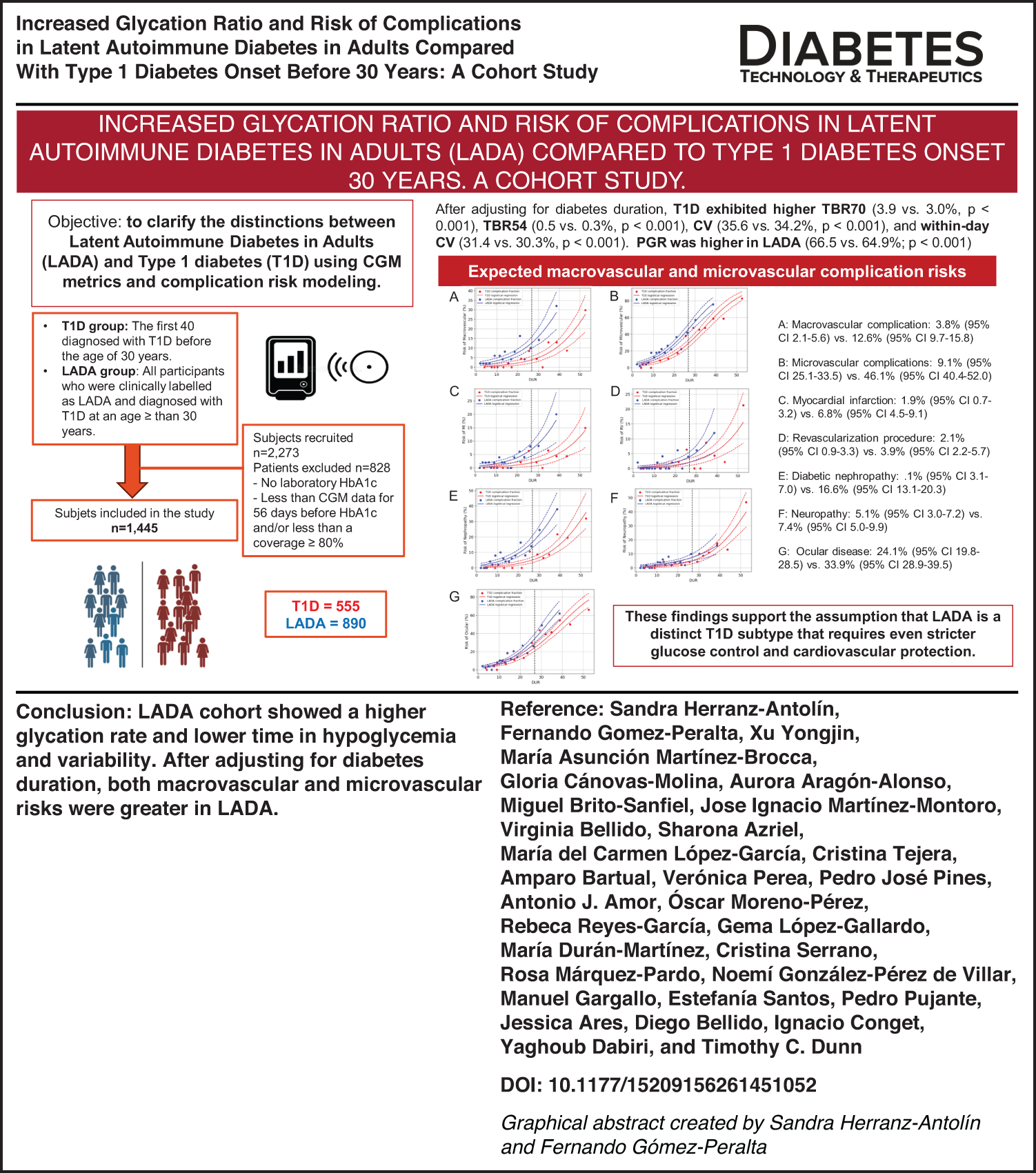
To clarify the distinctions between Latent Autoimmune Diabetes in Adults (LADA) and Type 1 diabetes (T1D) diagnosed < 30 years using continuous glucose monitoring (CGM) metrics, glycation rate, and risk of complications.
Design and Methods:
Multicenter, cross-sectional, observational study including subjects with T1D onset < 30 years (T1D cohort) and those classified as LADA diagnosed ≥ 30 years (LADA cohort) with ≥ 80% CGM coverage 56 days prior to glycated hemoglobin (HbA1c). Logistic regression was used to model the risk of complications.
Results:
T1D (n = 555) and LADA (n = 890) showed different ages (43 vs. 58 years; P < 0.001), age at diagnosis (16 vs. 43 years; P < 0.001), diabetes duration (26.8 vs. 15.1 years; P < 0.001), HbA1c (7.2 vs. 7.3%; P = 0.017), microvascular complications (35 vs. 23%; P < 0.001), and daily total and basal insulin [0.63 vs. 0.59 U/(kg·d); P = 0.006 and 0.35 vs. 0.32 U/(kg·d); P = 0.002]. After adjusting for diabetes duration, T1D exhibited higher time below range (TBR70: 3.9 vs. 3.0%; P < 0.001; TBR54: 0.5 vs. 0.3%; P < 0.001) and variability [coefficient of variation (CV): 35.6 vs. 34.2%; P < 0.001; within-day CV: 31.4 vs. 30.3%; P < 0.001]. Personal glycation ratio was higher in LADA after adjusting for diabetes duration and body mass index (66.5 vs. 64.9%; P < 0.001). Estimated risks of macrovascular and microvascular complications were higher in LADA than in T1D [12.6% (95% CI 9.7–15) vs. 3.8% (95% CI 2.1–5.6) and 46.1% (95% CI 40.4–52.0) vs. 29.1% (95% CI 25.1–33.5)] after adjusted for diabetes duration.
Conclusions:
LADA cohort showed a higher glycation rate and lower time in hypoglycemia and variability. Microvascular complications were more common in T1D, but after adjusting for diabetes duration, macrovascular and microvascular risks were greater in LADA.
Keywords
Get full access to this article
View all access options for this article.
References
Supplementary Material
Please find the following supplemental material available below.
For Open Access articles published under a Creative Commons License, all supplemental material carries the same license as the article it is associated with.
For non-Open Access articles published, all supplemental material carries a non-exclusive license, and permission requests for re-use of supplemental material or any part of supplemental material shall be sent directly to the copyright owner as specified in the copyright notice associated with the article.
