



Abstract
Forensic psychology has historically focused on assessing and managing deficits that contribute to offending. Recently, there has been a push across fields towards focusing on strengths in both assessment and treatment, which may have therapeutic benefits for clients (e.g. emotional well-being, positive identity, therapeutic alliance). As this has yet to be tested, we conducted a pre-registered experiment to examine the effects of strength- and risk-focused interviews on a number of therapeutic process variables. A sample of individuals on probation were randomly assigned to have a strength-focused (n = 51) or risk-focused interview (n = 50). Immediately after and 1 month later, participants completed measures of affect, alliance, engagement, motivation to change and identity. Contrary to our pre-registered hypotheses, participants who had a strength-focused interview did not report more positive affect (p = .46, η2 [95% CI] = .027 [.000, .077]), a stronger alliance with the interviewer (p = .92, η2 [95% CI] = .005 [.000, .051]), more engagement (p = .58, η2 [95% CI] = .020 [.000, .071]), or greater readiness to change (p = .19, η2 [95% CI] = .061 [.000, .092]) than those having a risk-focused interview immediately or 1 month later. However, participants who had a strength-focused interview perceived themselves as less likely to reoffend in the future (p = .02, η2 [95% CI] = .051 [.000, .154]), which remained significant 1 month later when we controlled for interviewer adherence to condition (p = .04, η2 [95% CI] = .052 [.000, .17]). We offer minimal initial support for the unique benefits of strength-focused (vs. risk-focused) interviews. Future research should use larger samples with adequate power to detect small effects and examine if strength-focused interviews are beneficial for culturally and linguistically diverse groups.
Keywords
People involved in the legal system receive clinical interviews by mental health professionals as part of psychological and forensic assessments that help make many high-stakes decisions (Day, 2019). Clinical interviews for correctional and forensic mental health purposes help to inform what sentence someone receives, if they are incarcerated and at what security level, what their mental health and treatment needs are, what treatment programs they should receive, what their risk to society is, when they are released, and more. Given the important consequences for the individual's life and safety of communities, there is a need for more empirical literature to allow for a greater understanding of clinical forensic interviewing (Logan, 2018).
The primary goal of a clinical interview is to gather information about the client's history and current functioning. There are various techniques and styles, which vary in their structure (i.e. structured, semi-structured, unstructured; Sommers-Flanagan, 2016). Content can also vary. Most interviews focus on the client's risk factors (that increase risk for violence and offending), such as their offence history, physical and mental health symptoms, substance use, childhood behavioural problems and childhood trauma or abuse (Day, 2019; Viljoen et al., 2018). This focus on risk factors reflects a deficit-based approach that has historically been predominant in the field of forensic psychology (Wanamaker et al., 2018). An interview could also gather information about strengths (that decrease in risk for violence and offending), such as social support, educational success, stable employment and community engagement (de Ruiter & Nicholls, 2011). It is reasonable to assume that the way that a clinical interview is conducted has significant implications for the amount, nature and quality of information gathered.
The deficit-based approach has resulted in criticism from researchers and clinicians across fields (such as mental health, healthcare, forensics) who advocate for a greater focus on strengths (de Ruiter & Nicholls, 2011). Assessments that focus on strengths may be more balanced and yield more complete information. For example, violence risk assessments involve predicting the likelihood that someone will engage in violent or criminal behaviour in the future. Ignoring peoples’ strengths in these assessments may also lead to an over-prediction of risk, which can lead to numerous harmful outcomes (e.g. placement in higher security custodial settings, lower likelihood of parole and unmet mental health needs).
Over the past two decades, researchers have developed violence risk assessment tools that include protective factors (e.g. Borum et al., 2005; de Vogel et al., 2007, 2012) whose incremental predictive validity over traditional deficit-focused tools remains unclear given mixed results (Wanamaker et al., 2018). Meta-analyses have indicated that predictive validity remains similar regardless of whether risk judgments are based on a consideration of risk factors and strengths, or risk factors alone (e.g. O'Shea & Dickens, 2016). However, there is reason to be optimistic; another meta-analysis showed that the Structured Assessment of Protective Factors for violence risk (SAPROF) had incremental validity over traditional deficit-focused tools, such as the Historical Clinical Risk Management-20 (HCR-20) and Static-99 (Burghart et al., 2023).
Assessing strengths may also have a therapeutic benefit for the evaluee (Orlinsky, 2001). In this study, we assessed the effects of strength-focused clinical interviewing on several variables clinically relevant in a forensic context, in particular affective state, alliance with the interviewer, engagement with the interview, motivation to change and prosocial identity. These factors are important for treatment and risk management; when clients experience more positive emotions, have a strong alliance with service providers, actively participate in treatments, are motivated to change and view themselves morally and prosocially, they may be more responsive to interventions and less likely to reoffend (e.g. Kennealy et al., 2012; Maldonado & Murphy, 2018).
Potential impacts of assessing strengths on the therapeutic process
Affect
Talking about one's strengths may lead to immediate increases in positive affect and pride than talking about one's problems. Although this has not been tested with justice samples, studies have found these results in other samples. For instance, Seligman et al. (2005) found that community participants who completed an assessment of character strengths showed increased happiness at a one-week follow-up. Positive affect may have implications for forensic treatments as short-term increases in positive affect can increase optimism, broaden thinking, improve problem-solving and set the stage for therapeutic change (Fredrickson, 2001).
Alliance
Strength-focused interviewing may enhance the bond between interviewers and evaluees by making evaluees feel understood, respected and seen as capable (de Ruiter & Nicholls, 2011; de Vries Robbé & Willis, 2017). These positive experiences may reduce stigmatisation, which is especially important for clients who are Indigenous, Black and People of Colour as they are often stigmatised, pathologised and stereotyped in western, white and/or colonised nations as a result of racism and discrimination. As such, strengths-focused practice has been identified as one essential element of culturally sensitive forensic mental health care (De Pau et al., 2023).
In a forensic service consisting of community, low secure and medium secure settings, clients who had participated in a strengths-based intervention program shared that having their strengths recognised by providers made them feel valued, which helped them to successfully transition into the community (Quinn et al., 2023).
In the present study we consider therapeutic alliance (in particular, therapeutic bond and stigma) as the literature has documented its associations with positive treatment outcomes. When clients feel an alliance with their care provider, they show greater treatment completion (DeSorcy et al., 2016) and declines in offending (Papalia et al., 2022).
Engagement
Strengths-based practice may also align with clients’ interests and goals, increasing engagement with services. Some research has examined effects of strengths-focused interventions on engagement for people who have offended. A randomised control trial by Mann et al. (2004) found that clients who received a positively-oriented intervention were more willing to disclose lapses, had more motivation to stop offending and completed more of their homework than clients who had received a risk-oriented intervention. Thus, it appears that focusing on strengths may have implications for improving engagement, including an increased willingness to disclose information and ability to identify strategies to stop offending in the future.
Motivation to change
Asking people about their strengths could increase their motivation to change (de Ruiter & Nicholls, 2011; de Vries Robbé & Willis, 2017). Motivation to change has been shown to be a key element of treatment efficacy and enduring behavioural change (Lundahl & Burke, 2009). In motivational interviewing, interviewers often ask clients to talk about past changes to increase their self-efficacy (Miller & Rollnick, 2013). Even brief motivational interviewing-based programs (i.e. one to four sessions) can increase motivation in people who are incarcerated or in secure forensic settings (Anstiss et al., 2011; Moulden et al., 2024). Outside of motivational interviewing, the randomised control trial by Mann et al. (2004) discussed in the previous section found that a positively-oriented intervention increased clients’ motivation to stop offending (as rated by their therapists) compared to a risk-oriented intervention. Given the importance of motivation for forensic treatment outcomes, we examined motivation to change (using the stages of change model), readiness to stop offending and participants’ self-reported likelihood of offending in the future.
Self-image
Finally, attention to strengths might influence self-image. To successfully stop or reduce offending behaviours, it can help to ‘develop a coherent, prosocial identity’ to replace their previous criminal identity (Maruna, 2001). According to Maruna (2001), those who are no longer criminally involved reinterpret their past criminal behaviour to align with their current prosocial identity. An aspect of identity that is more malleable is moral self-image, defined as a ‘person's perception of their own morality’ (Jordan et al., 2015, p. 1), which includes whether they see themselves as moral and how important morality is to them. As moral self-image has been shown to be influenced by behaviour and other social cues (e.g. an individual views themselves more moral after engaging in an ethical act; Jordan et al., 2015), one's moral self-image may increase after discussing times when they have engaged in more prosocial behaviour. To capture self-image that may be influenced by strength-focused interviewing, we consider moral identity (i.e. whether they view themselves as moral and how important morality is to them) and criminal identity (i.e. whether they view themselves as a criminal and how important criminality is to them).
Present study
The hypothesis that assessing strengths (vs. risks) might lead to improved outcomes has yet to be directly tested. In the present study, we investigated whether assessing strengths can enhance therapeutic process variables. People on probation were randomly assigned to a strength-focused interview in which they discussed strengths associated with reduced offending or a risk-focused interview in which they discussed risk factors associated with heightened offending. We then assessed affect, alliance with interviewers, engagement, motivation to change and identity immediately after the interview and at a 1-month follow-up. We hypothesised that following the interview, participants having a strength-focused interview would report more positive affect, a stronger alliance with the interviewer, more engagement with the interview, greater readiness to change and a more moral self-image than those having a risk-focused interview. We also anticipated that improvements would remain at a 1-month follow-up. We pre-registered our hypotheses, study design and analytic strategy on the Open Science Framework (https://osf.io/4u7we).
Method
Sample
We sampled 101 adults on probation (84 men, 16 women and 1 person who identified as non-binary; Mage = 40.09, SD = 11.42, range = 19–67) located in a metropolitan district in Western Canada. Fifty-one participants were randomly assigned to a strength-focused interview, and 50 were randomly assigned to a risk-focused interview. Overall, 61.4% of participants (n = 62) self-identified as white, 17.8% (n = 18) were Indigenous (i.e. First Nations, Métis, Inuit), 7.9% (n = 8) were Asian (i.e. East Asian, South Asian, Southeast Asian) and 4% (n = 4) were Latinx. Most participants (96%, n = 97) had a history of prior arrests and incarceration (93.1%, n = 94). The median number of prior arrests and prior incarcerations were 15.00 and 6.50, respectively. Based on participants’ responses to an abbreviated version of the Self-Report of Offending (Huizinga, 1991), the most common previously committed offences were physical fights (89.1%, n = 91), shoplifting (83.2%, n = 84), possession of stolen goods (83.2%, n = 84), selling marijuana (72.3%, n = 73) and driving under the influence (72.3%, n = 73). See Table 1 for participant characteristics for each condition. Groups did not differ significantly in their age, gender (female vs. male), race/ethnicity (Indigenous, Black, or Person of Colour vs. White), number of prior arrests and Self-Report of Offending Total score at baseline (see Table 1). Data collection was completed in accordance with local IRB standards.
Participant characteristics in strength and risk conditions.
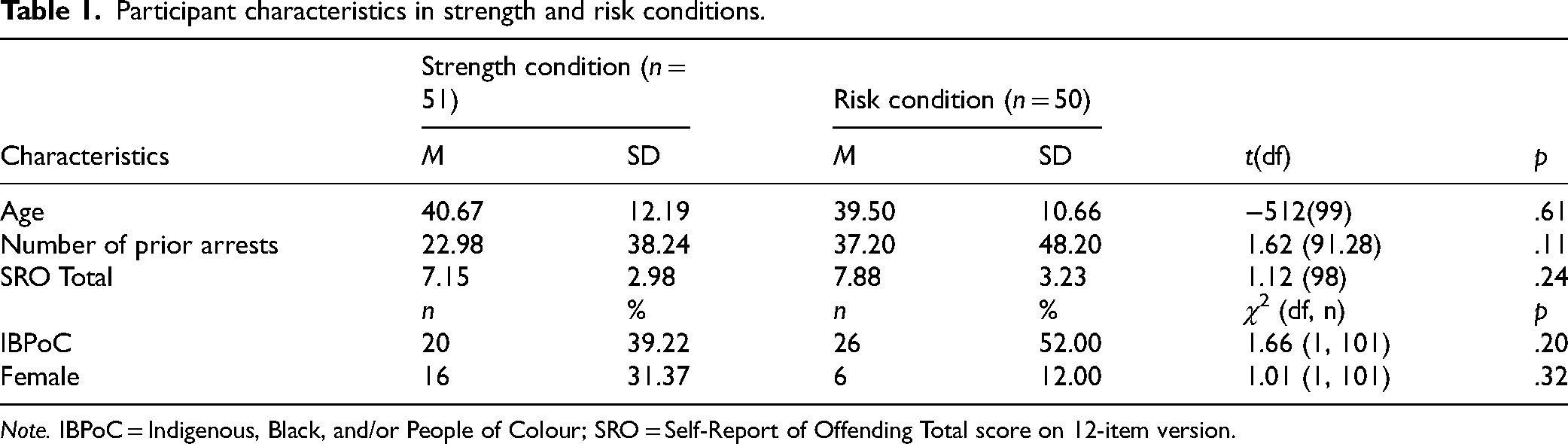
Note. IBPoC = Indigenous, Black, and/or People of Colour; SRO = Self-Report of Offending Total score on 12-item version.
Sample size rationale
An a priori power analysis using G*Power 3 (Faul et al., 2007) indicated that a sample of 100–128 participants would provide 95% (n = 100) to 98% (n = 128) power to detect a medium effect size (f2 = .15) with a one-way MANOVA with two groups and three dependent variables (as we were primarily interested in multivariate between subject differences) using a directional (one-tailed) test with alpha = .05. This sample size range of 100–128 participants also provided adequate power (80–88%) to detect a medium effect size (f2 = .25) for one-way ANOVA with two groups and a directional (one-tailed) test with alpha = .05.
Interview procedures
We put up posters at 12 probation offices in a metropolitan area of a Western Canadian city. Probation officers also notified their clients about the study. In total, 333 people phoned to indicate interest. Of these, 43 were not eligible (e.g. no longer on probation), 159 could not be reached, 16 withdrew interest, seven did not attend scheduled appointments, two were no longer able to participate (e.g. in the hospital) and one did not consent to the audio-recorded interview. Four participants were excluded because they could not complete the interview (e.g. drunk or high; n = 2), left part way through (n = 1) or behaved inappropriately (n = 1). This left a final sample of 101 respondents.
Participants were randomly assigned to conditions using Excel (RANDBETWEEN and CHOOSE functions). Interviewers included six graduate students in psychology, many of whom had training and experience conducting clinical interviews in practice, and two students who had recently completed their undergraduate degree in Psychology. Most interviewers were female (n = 7), and slightly over half identified as white (n = 5). All interviewers completed a 10-h training on the study protocol that included interviewing techniques (e.g. open-ended questions, probes) and completed simulated interviews with mock study participants. Each interviewer was assigned an equal number of strength and risk-focused interviews. Interviewers were not told in advance whether they would be completing a strength- or risk-focused interview for a given case. Interviewers were blind to the research questions and study hypotheses.
After participants completed an initial set of questionnaires (i.e. demographic characteristics, offense history and pre-interview affect), interviewers conducted an audio-recorded strength- or risk-focused interview with the participant. Participants then completed measures of affect (post-interview), engagement, alliance, motivation to change and identity. Given that momentary affect can be dynamic, affect was measured before and immediately after the interview. All other variables were measured only after the interview. To reduce the possibility that demand characteristics might influence responses (e.g. questions about alliance), interviewers left the room while participants were completing the questionnaires and participants sealed the questionnaires in an envelope after finishing. Once the interview was done, the interviewer completed a measure of alliance and recorded any concerns regarding adherence to the interview protocol. On average, risk-focused interviews were approximately four minutes longer than strength-focused interviews (M = 32.88 min, SD = 10.23 vs. M = 28.93 min, SD = 9.39), t(97) = 2.00, p = .048. Despite the significant difference, post-hoc analyses indicated that all of our results remained the same after controlling for interview length.
Strength- and risk-focused interviews
Interviews began with a period of rapport building. Then, participants received either a strength- or risk-focused interview developed specifically for this study. In the strength-focused interview, participants were asked to identify a time in which they had stopped offending or in which their offending slowed down, not including periods of incarceration. After identifying a period of reduced offending, interviewers asked participants a general question about the ‘strengths’ that allowed them to not offend during that time (i.e. ‘So, in general, during that period of time, what strengths or positive things in your life helped you to stop offending?’), followed by more specific questions about strengths related to relationships, school or work, leisure time, attitudes, personality characteristics and lower use of substances (i.e. domains in central eight model of offending: Bonta & Andrews, 2017). As one example of a follow-up question, participants were asked, ‘Did any strengths or positive changes related to relationships (such relationships with family, romantic partners, or friends) play a role in stopping offending?’ To prime participants to think further about their strengths, participants also completed a 37-item questionnaire developed by the research team on strengths that led to their identified period of reduced offending.
In the risk-focused interview, participants were asked to identify the time in which they were offending the most and the ‘difficulties’ that led to this period of heightened offending (i.e. ‘So, in general, during that period of time, what difficulties or risk factors played a role in your offending?’). Participants were asked the same set of interview questions as participants in the strength condition and completed the same 37-item questionnaire, but the wording was revised to focus on difficulties rather than strengths (e.g. ‘Did any problems or difficulties related to relationships, such relationships with family, romantic partners, or friends, play a role in your offending?’). Following interviews, the study manager reviewed the recordings and rated adherence to condition (see Supplemental Material 1). Conditions did not significantly differ in their average adherence ratings, t(98) = 1.08, p = .28.
1-Month follow-up
Approximately 1 month following the interview (M = 38.67 days, SD = 15.00, Mdn = 33.00), participants completed a follow-up questionnaire on motivation to change and identity. Alliance, engagement and affect were not assessed because no interview was conducted at the follow-up, and effects were not expected after such a delay. To reduce attrition, participant and collateral contact information were collected, and participants were reminded about their follow-up 2 weeks before the appointment. The completion rate for the 1-month follow-up was 70.3% (n = 71). Participants who did and did not complete the 1-month follow-up did not differ significantly in age, t(99) = 0.10, p = .92, gender, χ2(1, 100) = 2.52, p = .11, number of prior offenses, t(97) = 0.98, p = .33, or interview condition, χ2(1, 100) = 0.88, p = .35. White participants were significantly more likely to complete follow-ups than participants who were Indigenous, Black and/or People of Colour, χ2(1, 101) = 7.68, p = .01.
Study measures
Participants completed measures of demographics, offence history, affect, alliance, engagement, motivation to change and identity. In this section, we briefly describe each measure. In general, we used coefficient alpha (using interpretation guidelines reported in Cicchetti, 1994). A few of our measures only had a small number of items (i.e. two to four), which attenuates coefficient alpha. In these cases, we also reported the mean inter-item correlation (MIC) as a measure of internal consistency as per Clark and Watson (1995), Briggs and Cheek (1986) and Piedmont (2014), with values between .15 and .50 considered acceptable. Given the large number of measures, refer to Supplemental Materials 2 for a full description each.
Participants reported their demographic characteristics and offence history as well as completed an abbreviated version of the Self-Report of Offending (Huizinga, 1991). This version included 12 most commonly endorsed offences (e.g. purposely destroying or damaging property). In the current study, the internal consistency of the abbreviated version fell in the ‘good’ range (α = .82).
To measure momentary affect after the interview, participants filled out the Positive and Negative Affect Schedule – State Version (PANAS; Watson & Clark, 1994), which includes two 10-item subscales: Positive Affect (e.g., proud, determined) and Negative Affect (e.g. distressed, ashamed), as well as the Authentic Pride Scale – State Version (Tracy & Robins, 2007). Internal consistency fell in the ‘excellent’ range for measures of affect (α = .94, .90 and .96 for Positive Affect, Negative Affect and Authentic Pride total scores, respectively, post-interview).
To measure alliance, participants and interviewers completed the Bond scale from the Working Alliance Inventory (WAI; Horvath & Greenberg, 1989, 2011). Internal consistency fell in the ‘fair’ range (α = .79 and .72 for the participant-rated version and interviewer-rated versions, respectively; Cicchetti, 1994). Participants also completed the Perceived Stigma Scale (PSS) of the Inmate Perceptions and Expectations of Stigma Measure (Moore et al., 2013). As in previous research (Moore et al., 2013), internal consistency fell in the ‘good’ range (α = .81; Cicchetti, 1994).
To measure engagement, participants were asked about strategies they could adopt to help avoid offending (with the interviewer recording the number of different strategies that participants provided), as well as completed the Self-Disclosure Index (SDI; Miller et al., 1983) and Marlowe–Crowne Social Desirability Scale (MC-SDS; Crowne & Marlowe, 1960). The index had ‘excellent’ internal consistency (α = .92; Cicchetti, 1994) and the MC-SDS had ‘good’ internal consistency (α = .84; Cicchetti, 1994).
Participants also completed various measures of motivation to change. The University of Rhode Island Change Assessment Scale – Short Form (URICA-S; Mander et al., 2017) was divided into four subscales: Precontemplation (α = .69, MIC = .36), Contemplation (α = .68, MIC = .36), Action (α = .82; MIC = .53) and Maintenance (α = .63, MIC = .29).Participants also completed the Readiness Ruler (Miller & Rollnick, 2013), which included two questions about general offending and the same two questions about violent offending (i.e. ‘How important is it to you right now to stop committing crimes/violent crimes?’ and ‘How confident are you that you could stop committing crimes/violent crimes if you decided to?’; α = .68, MIC = 0.37). Finally, participants completed the Perceived Risk Scale (PRS) that we developed, which includes six questions (i.e. ‘On a scale from zero to ten, with zero being the lowest and ten being the highest, how likely is it that you will commit a crime during the… next month, year, or ever again?’). Internal consistency was found to be ‘good’ (α = .88; Cicchetti, 1994).
Finally, to measure identity, we administered the Social Identity as a Criminal Scale – In-Group Affect (e.g. ‘I often regret that I am a criminal’ – reverse scored; α = .69; MIC = .36) and Centrality Subscales (Walters, 2003; α = .58; MIC = .23), the Self-Importance of Moral Identity Scale – Internalisation Subscale (referred to as Moral Identity; Aquino & Reed, 2002; α = .88; Cicchetti, 1994) and the Moral Self-Image Scale (Jordan et al., 2015; α = .93; Cicchetti, 1994).
Data analytic plan
All outcomes were normally distributed (i.e. skewness and kurtosis between −2 and 2; George & Mallery, 2010), except for Moral Identity Internalisation assessed at baseline in the strength-focused interview condition and the Readiness Ruler and PRS assessed at follow-up in the strength-focused interview condition. Missing data was relatively rare and was handled through prorating (see Supplemental Material 3 for a more thorough description).
To examine within-person changes in affect from pre- to post-interview for all normally distributed variables, we conducted a mixed MANOVA, with condition (strength- vs. risk-focus) as the between-groups independent variable, time (pre- vs. post-interview) as the within-group independent variable, and Positive and Negative Affect Scale-Positive Affect Total, Positive and Negative Affect Scale -Negative Affect Total and Authentic Pride Total scores as dependent variables. Between-subject differences in affect, alliance with interviewers, engagement with the interview, motivation and identity (assessed once post-interview) were tested using MANOVAs for each group of normally dependent variables (see Table 3).
Although MANOVAs are generally robust to moderate violations of normality given a large enough sample size (i.e. at least 10 participants in each group; Tabachnick et al., 2013), we ran multivariate analyses on the non-normally distributed variables using permutational MANOVAS (i.e. PERMANOVAs; a non-parametric equivalent to the MANOVA) using the vegan package in R and ran univariate analyses on these variables using Mann–Whitney U tests. These non-parametric alternatives do not rely on assumptions of normality, making them well-suited for these variables.
We then ran one set of MANCOVAs with adherence and length as covariates to determine if the results remained the same after controlling for adherence to interview protocol and length of interviews (see Supplemental Materials 4). Given that our pre-registered hypotheses were directional, we report one-tailed significance tests unless otherwise specified. To measure effect sizes, we used partial eta squared (η2) interpreted as small (.01), medium (0.6) and large (.14) (Cohen, 2013). We also included 95% confidence intervals on effect sizes using the MBESS package in R (Fleishman, 1980; Kelley, 2007; Steiger, 2004).
Results
Changes in affect
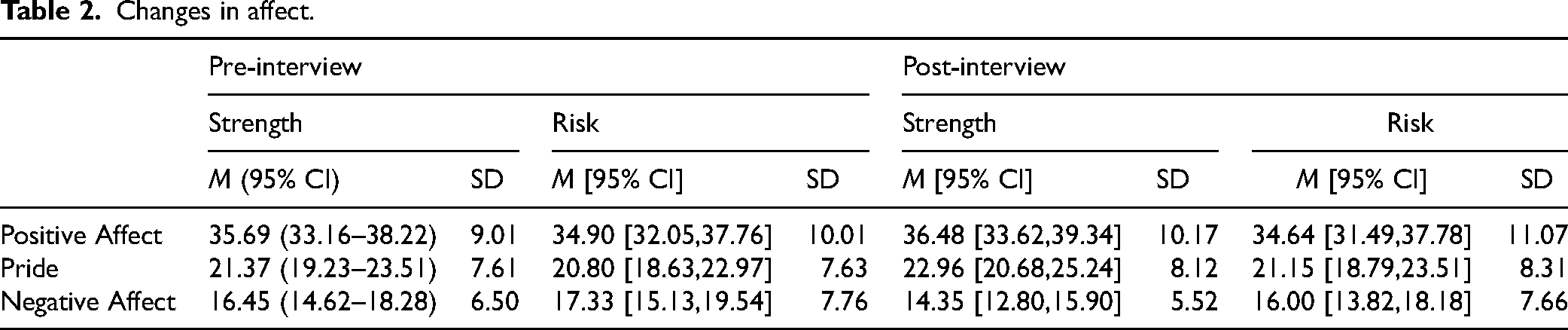
Participants’ positive affect did not significantly increase from pre- to post-interview, F(1, 99) = .16, p = .34, η2 [95% CI]=.002 [.000, .050]. There was also no significant effect of condition on positive affect, F(1, 99) = .48, p = .25, η2 [95% CI] = .005 [.000, .064], nor a significant condition by time (pre- vs. post-interview) interaction, F(1, 99) = .68, p = .21, η2 [95% CI]=.007 [.000, .071]. However, participants showed a significant increase in pride from pre- to post-interview, F(1, 99) = 5.16, p = .01, η2 [95% CI] = .050 [.000, .151]. Yet, the effect of condition on pride, F(1, 99) = .62, p = .22, η2 [95% CI] = .006 [.000, .069], as well as the interaction between condition and time, F(1, 99) = 2.11, p = .08, η2 [95% CI] = .021 [.000, .103], did not reach significance. Finally, negative affect decreased from pre- to post-interview, F(1, 99) = 8.21, p = .003, η2 [95% CI] = .077 [.007, .189], with no significant effect of condition, F(1, 99) = 1.06, p = .15, η2 [95% CI] = .011 [.000, .081], nor significant interaction, F(1, 99) = .40, p = .26, η2 [95% CI ] = .004 [.000, .135]. Thus, we did not detect support for our pre-registered predictions. Positive affect did not show meaningful change. Moreover, while feelings of pride and negative affect improved from before to after the interview, changes were similar for the strength- and risk-focused interviews. Using Cohen's (2013) guidelines, all effect sizes were in the small range, with the exception of decreases in negative affect, which had a medium effect size. See Table 2 for descriptive statistics across conditions and time.
Changes in affect.
Between-group differences at post-interview
As shown in Table 3, the MANCOVA examining the effects of the interview condition on post-interview affect after controlling for pre-interview affect showed no significant effects contrary to our pre-registered predictions. In addition, the omnibus tests from the MANOVAs/PERMANOVA examining effects of condition on the alliance, engagement, motivation to change and identity variables were not statistically significant. At the univariate level, only one difference consistent with our pre-registered hypotheses emerged; participants having a strength-focused interview reported significantly lower PRS scores (p = .02) with a small to medium effect size (η2 [95% CI] = .051 [.000, .154]). All other differences had small effect sizes (η2 < .06).When we reran the original analyses after adding adherence as a covariate, the results were the same. Therefore, once again, we observed little support for our pre-registered hypotheses, such that participants in the strength-focused (vs. risk-focused) interview condition did not report greater alliance, engagement, motivation to change and moral identity.
Post-interview: strengths vs. risk condition.
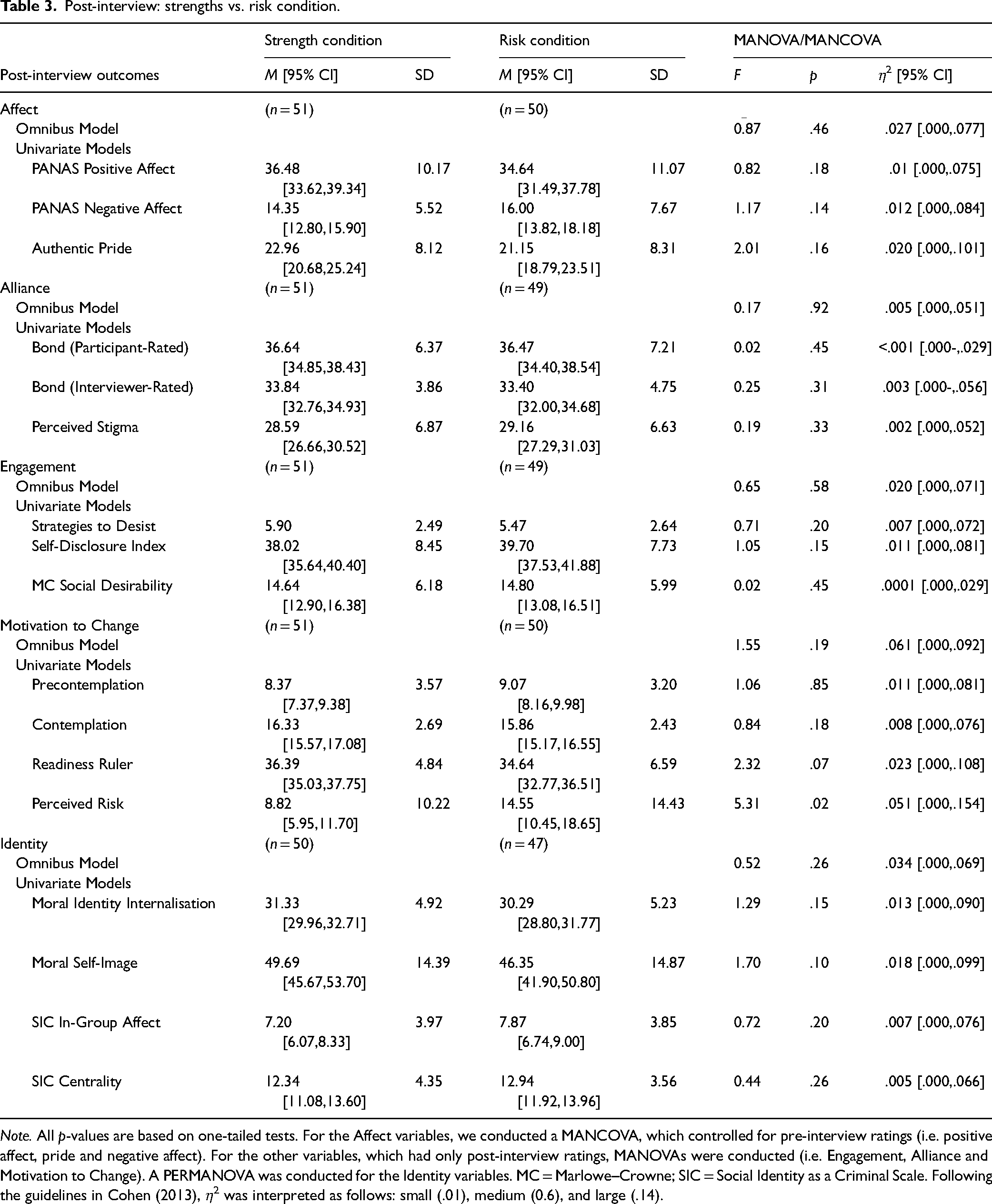
Note. All p-values are based on one-tailed tests. For the Affect variables, we conducted a MANCOVA, which controlled for pre-interview ratings (i.e. positive affect, pride and negative affect). For the other variables, which had only post-interview ratings, MANOVAs were conducted (i.e. Engagement, Alliance and Motivation to Change). A PERMANOVA was conducted for the Identity variables. MC = Marlowe–Crowne; SIC = Social Identity as a Criminal Scale. Following the guidelines in Cohen (2013), η2 was interpreted as follows: small (.01), medium (0.6), and large (.14).
Between-group differences at 1-month follow-up
As shown in Table 4, the omnibus MANOVA tests revealed no differences between strength-focused and risk-focused interview conditions in terms of motivation to change (p = .86) and identity (p = .82) at the 1-month follow-up. Univariate analyses also showed no significant differences between conditions. The PERMANOVA also showed no significant effect on the motivational state variables (p = .09). The Mann–Whitney U tests also showed no significant effects on the individual variables. When we ran our analyses with adherence as a covariate, participants having a risk-focused interview scored significantly higher on the PRS than participants having a strengths-focused interview (p = .04, η2 [95% CI] = .052 [.000, .17]). Nonetheless, this effect was only marginal when adherence was not controlled for (p = .09, η2 [95%CI] = .045 [.000, .169]). Differences on the PRS were small to moderate in their effect size, and all other effect sizes were small (η2 < .06). As such, we observed little support for our pre-registered hypotheses at the 1-month follow-up assessment.
1-Month follow-up: strengths vs. risk condition.
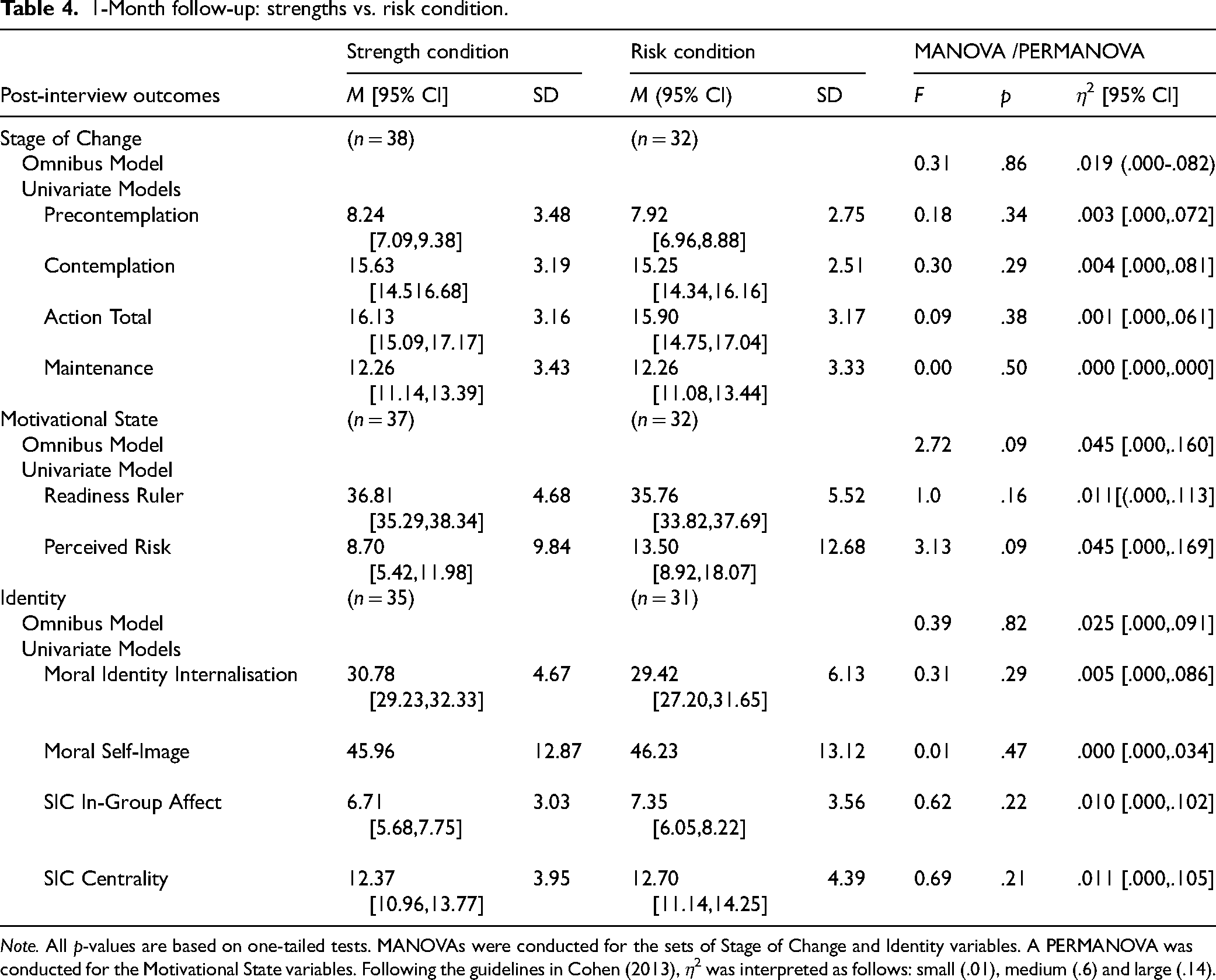
Note. All p-values are based on one-tailed tests. MANOVAs were conducted for the sets of Stage of Change and Identity variables. A PERMANOVA was conducted for the Motivational State variables. Following the guidelines in Cohen (2013), η2 was interpreted as follows: small (.01), medium (.6) and large (.14).
Power analysis
We conducted post-hoc power analyses to determine if we were adequately powered to detect small effects. Our final sample size of 101 participants indeed provided adequate power. In particular, we had 88% power to detect small effect sizes (f2 = .10) in changes in affect (repeated measures, within-between interactions with 2 groups, 2 measurements, and a 0.75 correlation between repeated measures, one-tailed) and 91% power to detect small effect sizes (f2 = .15) in between-group differences (MANOVA: global effects with 2 groups and 5 response variables, one-tailed). After 1-month follow-up, given our 30% attrition rate, we were slightly underpowered to detect small effects (power of 77%).
Discussion
Clinicians and researchers argue that forensic assessment and treatment should include attention to strengths or protective factors, rather than focusing exclusively on risk factors for violence and offending. Indeed, some researchers have speculated that discussing strengths could improve the accuracy of assessments, reduce bias and support the therapeutic process (Borum et al., 2005; de Vogel et al., 2007, 2012). We conducted a pre-registered experiment to examine the effects of strength- and risk-focused interviews on a number of therapeutic process variables in persons on probation. Overall, we found limited support for our hypotheses. Participants completing the strength-focused and risk-focused interview reported similar levels of positive affect, alliance with their interviewer, engagement and moral self-image. However, as predicted, participants completing a strength-focused interview perceived themselves as less likely to reoffend in the future, which remained significant 1 month later when we controlled for adherence to condition. In addition, participants completing both interview types reported less negative affect and greater pride following the interview than before the interview.
In support of one hypothesis, participants completing a strength-focused interview viewed themselves as less likely to offend in the future than participants completing a risk-focused interview. This effect was significant 1 month later, but only when adherence to interview protocol was controlled for. Participants may have been reminded of times when they have successfully reduced their offending, thereby increasing their confidence in their ability to change, which is in line with previous research (Holdsworth et al., 2017). In motivational interviewing, clinicians often ask people about periods of success to bolster confidence and perceived mastery.
We did not observe support for our predictions that people interviewed about strengths (vs. risks) would report more positive affect, show greater alliance with their interviewer (such as a stronger bond), engage more in interviews (i.e. an increased willingness to disclose information), or view themselves as more moral and less criminally entrenched. The observed results do not appear to be attributable to poor adherence to the study conditions, weak manipulation, or inadequate power. Interviewers showed high adherence to the protocols, and results remained insignificant when adherence was controlled for (with the exception of Perceived Risk at 1 month follow-up when we controlled for adherence ratings). Further, participants spent a relatively long time (30 min on average) speaking exclusively about their strengths or weaknesses, which we anticipated would provide a strong effect. Finally, a sensitivity analysis confirmed that we had adequate power to detect small effects. An exception to this was our power to detect small effects at 1-month follow-up (77%) given that our attrition rate was 30%. Although it is possible that some significant differences may have emerged with a slightly larger sample size at the 1-month follow-up assessment, we speculate that this is not likely given the lack of differences found immediately following the interview.
As such, we interpret our results to mean that it is possible for interviewers to engage and connect with evaluees regardless of whether they conduct interviews that focus on the evaluees’ risk or protective factors. In support of this explanation, participants completing both strength- and risk-focused interviews reported lower negative affect and greater pride after the interview as opposed to before. Further, participants in both conditions reported a high level of connection to their interviewers. For instance, the mean item-level score on the Bond Scale was approximately 5.20, which indicates that participants ‘often’ felt a good alliance with interviewers. The lack of difference runs counter to those who theorise that focusing on strengths would promote more positive communication between clients and clinicians, treatment motivation and therapeutic alliance (Alder, 2017; de Vries Robbé et al., 2012). That being said, consistent with our findings, prior research has shown that when people disclose personal information about themselves, even when that information is negative or unflattering, they feel an increased sense of closeness with listeners (Sprecher et al., 2013). Disclosing negative and positive events can yield similar benefits, such as decreases in distress and depression (Frattaroli, 2006).
Limitations and strengths
Important limitations pertain to the findings’ ecological validity and generalisability to real-world settings. As this is one of the first studies to compare the impact of strength and risk-focused interviews with people on probation, we chose an experimental design wherein interviews were conducted by student interviewers rather than practicing clinicians. Further, participants talked only about either their strength or risk factors to isolate the effects of assessing strengths; this design deviates from real-world practice where strength and risk factors are often considered in combination. For priming to occur, we also asked participants to first think about a time when their offending either stopped/reduced (strength condition) or increased (risk condition), which does not occur prior to a real-world clinical interview. Thus, our findings cannot yet be generalised. For instance, the finding that negative affect decreased, and that pride increased after both strength- and risk-focused interviews may not occur in the real world. In clinical settings, assessment results are often used to make significant decisions that can affect evaluees’ liberty, and as such, it may be more challenging to develop a strong alliance with evaluees, even with a strength-based focus.
A strength of the current study is that we rated and controlled for adherence to the interview protocol and length of interviews. Although it was not possible to examine interrater reliability for the ratings because they were made by a single person with a high familiarity with the study, that person was relatively consistent in their ratings. As such, to provide another means by which to examine adherence to the interview protocol, we also examined interview length alone (as deviations from the protocol could reasonably be expected to result in interviews that are notably shorter or longer). Although strength-focused interviews (on average, 32 min) were significantly longer than risk-focused interviews (on average, 28 min), post-hoc analyses indicated our results remained the same after controlling for interview length.
Future research
In future research, the first step will be to try to replicate these findings in a larger sample to determine if there are small differences between strength-focused and risk-focused interviews that we were unable to detect. It will also be important for future studies to include a control condition (i.e. where the interviewee is asked about topics unrelated to strengths or risks) to determine whether any benefits are in fact caused by speaking about risks and/or strengths per se, or rather simply having a discussion with an interviewer. In addition, although groups in our study were equivalent on relevant variables, such as number of prior arrests and Self-Report of Offending total scores, we did not consider the client's self-perceived criminogenic risks and strengths. Future research may wish to consider this variable, either as a control or predictor. For instance, if clients have difficulty believing they truly possess strengths, it may be difficult to identify periods of success, hindering the outcomes of a focus on their strengths (Nikolova et al., 2016). Future research could also examine whether assessing strengths might carry other benefits that we did not assess, such as the amount and quality of information gathered.
Finally, another important direction is to examine the utility of strength-focused interviews with racialised groups, particularly Indigenous and Black Peoples, who are vastly overrepresented in legal systems within western, white and/or colonised nations due to social inequities, systemic racism, interpersonal biases and stereotypes (Mauer, 2011; Roberts & Reid, 2017). For instance, Indigenous Peoples have long called for strength-based approaches to resist ‘deficit discourse’ (Askew et al., 2020; Shepherd & Willis-Esqueda, 2018). Thus, future research could test whether strength-based approaches might create more culturally safe assessment experiences and reduce biases and stereotypes.
Implications
To our knowledge, this is the first study to compare the effects of strength-focused and risk-focused clinical interviewing on a number of variables clinically relevant for assessment and treatment with justice involved persons, in particular affective state, alliance with the interviewer, engagement with the interview, motivation to change and prosocial identity. Although we did not find that assessing strengths led to consistent improvements across variables, we did find that those interviewed about their strengths reported a higher motivational state than those interviewed about risks. This is important because motivational state may have clinical implications for recidivism, with one longitudinal study showing that intentions to stop offending predicted lower subsequent self-reported offending (Bottoms & Shapland, 2011). Furthermore, we found that people interviewed with either a strength- or risk-focus reported lower negative affect and greater pride after their interview. As professionals are often required to consider clients’ risks, such as in their evaluations to predict the likelihood of future violence and offending, this finding will be of interest as it suggests that it may be possible to engage and connect with clients even when risks must be discussed.
While this experimental study did not find consistent differences between strength- and risk-focused interviewing, it would be premature to downplay the importance of strengths-focused approaches in practice. Advocates have long emphasised the value of strengths-based practices for avoiding pathologisation and fostering resilience (Bryant et al., 2021). As the first study on this topic to our knowledge, we chose an experimental design; interviews with persons on probation were completed by student clinicians in an artificial setting. Outcomes may vary drastically with real-world clinical forensic interviews, which highly impact individuals’ lives and liberties. Nonetheless, our findings contribute to the growing body of literature on strengths in forensic practice, but further research is needed with larger and more diverse samples, across various settings and age groups (youth vs. adults), at different phases of the legal system (e.g. sentencing vs. parole hearings) and with designs that better reflect real-world conditions.
Supplemental Material
sj-docx-1-fmh-10.1177_14999013251339202 - Supplemental material for Can asking people on probation about their strengths improve affect, alliance, engagement, motivation and prosocial identity?
Supplemental material, sj-docx-1-fmh-10.1177_14999013251339202 for Can asking people on probation about their strengths improve affect, alliance, engagement, motivation and prosocial identity? by McKenzie S. Braley, Samuel Matthew, Catherine S. Shaffer, Lara B. Aknin and Jodi L. Viljoen in International Journal of Forensic Mental Health
Supplemental Material
sj-docx-2-fmh-10.1177_14999013251339202 - Supplemental material for Can asking people on probation about their strengths improve affect, alliance, engagement, motivation and prosocial identity?
Supplemental material, sj-docx-2-fmh-10.1177_14999013251339202 for Can asking people on probation about their strengths improve affect, alliance, engagement, motivation and prosocial identity? by McKenzie S. Braley, Samuel Matthew, Catherine S. Shaffer, Lara B. Aknin and Jodi L. Viljoen in International Journal of Forensic Mental Health
Supplemental Material
sj-docx-3-fmh-10.1177_14999013251339202 - Supplemental material for Can asking people on probation about their strengths improve affect, alliance, engagement, motivation and prosocial identity?
Supplemental material, sj-docx-3-fmh-10.1177_14999013251339202 for Can asking people on probation about their strengths improve affect, alliance, engagement, motivation and prosocial identity? by McKenzie S. Braley, Samuel Matthew, Catherine S. Shaffer, Lara B. Aknin and Jodi L. Viljoen in International Journal of Forensic Mental Health
Supplemental Material
sj-docx-4-fmh-10.1177_14999013251339202 - Supplemental material for Can asking people on probation about their strengths improve affect, alliance, engagement, motivation and prosocial identity?
Supplemental material, sj-docx-4-fmh-10.1177_14999013251339202 for Can asking people on probation about their strengths improve affect, alliance, engagement, motivation and prosocial identity? by McKenzie S. Braley, Samuel Matthew, Catherine S. Shaffer, Lara B. Aknin and Jodi L. Viljoen in International Journal of Forensic Mental Health
Footnotes
Acknowledgements
The authors dedicate this article to the last author, Jodi L. Viljoen, who sadly passed away before publication. They thank Adam Blanchard for providing support and feedback on the drafts of this article.

Funding
The authors disclosed receipt of the following financial support for the research, authorship, and/or publication of this article: This research was funded by a SSHRC Insight Development Grant (2017-00872) awarded to Dr. Viljoen.
Declaration of conflicting interests
The authors declared no potential conflicts of interest with respect to the research, authorship and/or publication of this article.
Data availability statement
Supplemental material
Supplemental material for this article is available online.
Author biographies
References
Supplementary Material
Please find the following supplemental material available below.
For Open Access articles published under a Creative Commons License, all supplemental material carries the same license as the article it is associated with.
For non-Open Access articles published, all supplemental material carries a non-exclusive license, and permission requests for re-use of supplemental material or any part of supplemental material shall be sent directly to the copyright owner as specified in the copyright notice associated with the article.
