




Abstract
Combined exercise rehabilitation for chronic obstructive pulmonary disease (COPD) and chronic heart failure (CHF) is potentially attractive. Uncertainty remains as to the baseline profiling assessments and outcome measures that should be collected within a programme. Current evidence surrounding outcome measures in cardiac and pulmonary rehabilitation were presented by experts at a stakeholder consensus event and all stakeholders (n = 18) were asked to (1) rank in order of importance a list of categories, (2) prioritise outcome measures and (3) prioritise baseline patient evaluation measures that should be assessed in a combined COPD and CHF rehabilitation programme. The tasks were completed anonymously and related to clinical rehabilitation programmes and associated research. Health-related quality of life, exercise capacity and symptom evaluation were voted as the most important categories to assess for clinical purposes (median rank: 1, 2 and 3 accordingly) and research purposes (median rank; 1, 3 and 4.5 accordingly) within combined exercise rehabilitation. All stakeholders agreed that profiling symptoms at baseline were ‘moderately’, ‘very’ or ‘extremely’ important to assess for clinical and research purposes in combined rehabilitation. Profiling of frailty was ranked of the same importance for clinical purposes in combined rehabilitation. Stakeholders identified a suite of multidisciplinary measures that may be important to assess in a combined COPD and CHF exercise rehabilitation programme.
Keywords
Introduction
Chronic obstructive pulmonary disease (COPD) and chronic heart failure (CHF) are long-term conditions, characterised by exertional dyspnoea and fatigue. 1,2 Exercise training is recommended in the management of both diseases. 2,3 Pulmonary rehabilitation (PR) is a structured exercise programme, typically delivered over 6–12 weeks, in which adults with respiratory conditions participate in supervised exercise training. 4 Programmes are interdisciplinary, often including educational components that are designed to optimise physical and social performance as well as autonomy. 4 The primary objective of PR is to improve an individual’s exercise capacity to subsequently reduce their symptom burden, most commonly dyspnoea. 5 Cardiac rehabilitation (CR) is similar in structure to PR, however, prevention of secondary cardiac events is the main objective. 6 A recent Cochrane Review examined exercise-based CR specifically within CHF. 7 While there is scientific literature surrounding exercise rehabilitation for CHF, often access is limited. This is in part reflected by the recent national audit report which stated only 5.5% of patients starting CR had CHF. 8
Cardiovascular disease is a leading cause of morbidity and mortality in COPD (particularly in those with mild–moderate disease), 9 suggesting some patients with COPD may benefit from components of CR, aiming to reduce cardiovascular risk. Conversely, patients with CHF are likely to benefit from an improved exercise capacity and the subsequent reduction in dyspnoea, the primary objectives of PR. The systemic effects from COPD and CHF are similar, such as skeletal muscle dysfunction. 10 Individuals with CHF have reduced functional capacity compared to the traditional CR population and their level of function is similar to adults with COPD. 11 This further supports merging CHF and COPD into one combined exercise rehabilitation programme. Previous research invited adults with CHF to PR alongside adults with COPD, and it was found to be feasible and effective. 11 To the best of our knowledge, the research by Evans et al. 11 was the first to investigate combined exercise rehabilitation for COPD and CHF; a measure of exercise capacity was used as the primary outcome and no assessment of cardiovascular risk was undertaken.
There have been suggestions as to the choice of outcome measures that should be embedded within CR 12 and PR. 5 The core outcome measures in effectiveness trials initiative 13 suggests a standard template of outcomes for use in either CR or PR is not established. In 2017, a study was registered to report on a core set of outcomes within PR, but findings are not yet available. 14 Similar efforts are needed within CR.
In a 2016 consensus event, expert stakeholders from cardiac and respiratory medicine discussed the practical considerations and key components of a combined exercise rehabilitation programme for adults with COPD and/or CHF. 15 The stakeholders (n = 74 including service providers, commissioners, managers and researchers) concluded that rehabilitation for COPD and CHF could be symptom as opposed to disease-based. Specifically within the United Kingdom, the long-term plan created by the National Health Service (NHS) acknowledges the opportunity of merging CR and PR, but state an evidence base for joint rehabilitation is required, prior to promulgation across the NHS. 16
An exploration of experts’ and stakeholders’ opinion concerning outcome measures in a combined exercise rehabilitation programme appears to be the clear progression regards developing a combined rehabilitation programme. The Delphi technique is often used to gain consensus on a topic 17 and is important for achieving consensus on issues where none previously existed. 18 However, it can be time-consuming and laborious. 19 The technique consists of various ‘rounds’ and it has previously been stated the first stage is ‘characterized by exploration of the subject under discussion, wherein each individual contributes additional information he feels is pertinent to the issue’. 20
The objective of this stakeholder event was to discuss and prioritise baseline and outcome measures that should be collected within combined COPD and CHF exercise rehabilitation. A patient and public involvement (PPI) event was used to secure the opinion of current service users.
Methods
Stakeholder consensus event
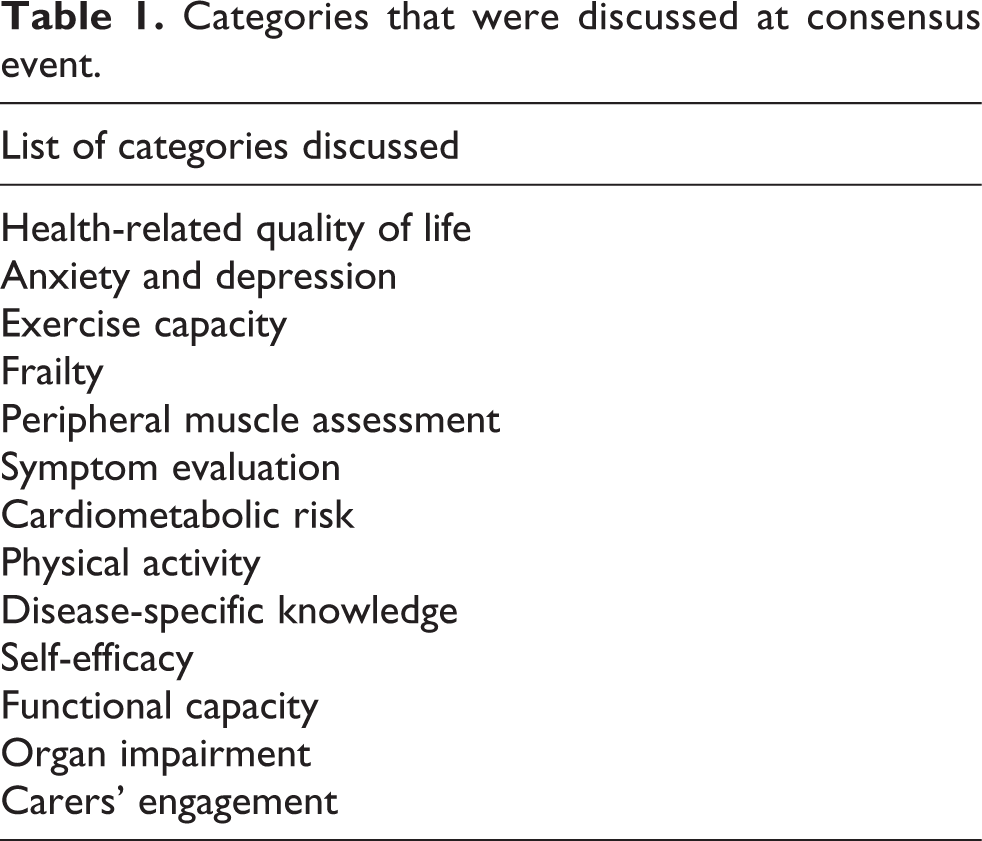
Invitations were sent to all experts and stakeholders prior to the event which was held at the National Institute for Health Research (NIHR) Leicester Biomedical Research Centre, Glenfield Hospital on 22 November 2017. The experts and stakeholders were invited based on their previous experiences in research and clinical practice in cardiac and respiratory disease. Prior to selection, we identified the importance of representation of a range of healthcare professionals, clinical leads from diverse geographical locations and a representation of a variety of service delivery models. Event organisers (AVJ, RAE and SJS) scoped the literature (systematic reviews, Cochrane reviews and respective national audits) to create a list of categories for discussion. This was circulated to all stakeholders prior to the event and comments/suggestions were welcomed. The final list is listed in Table 1.
Categories that were discussed at consensus event.
Experts presented on key categories before all attendees were led through four different tasks (Figure 1). An example question from each task is shown in Online Supplemental Material 1. All stakeholders were asked to rank the categories in the order of overall importance, with 1 referring to the ‘most important’ for both clinical (task 1) and research purposes (task 2). Stakeholders were then asked ‘Do you think a measure assessing (category) should be used for clinical purposes?’and ‘Do you think a measure assessing (category) should be used for research purposes?’ These were binary questions with yes or no answers (task 3). All stakeholders were then asked to rate the importance of each category as (a) a patient baseline/profiling measure and (b) an outcome measure for both clinical and research purposes using a 1–7 Likert-type scale (‘not at all important’, ‘low importance’, ‘slightly important’, ‘neutral’, ‘moderately important’, ‘very important’ and ‘extremely important’) (task 4). Answers were provided through a combination of paper responses and electronic voting. Descriptive statistics were used to report consensus. Following analysis of results, general discussion then occurred surrounding the top categories.

A flow chart showing the tasks completed by stakeholders at the consensus meeting.
PPI event
The objective of the PPI event was to understand the outcome measures deemed most important by current service users and was held at the National Centre for Sport and Exercise Medicine, Loughborough University on 7 February 2018. Patients currently enrolled on the combined exercise rehabilitation programme at University Hospital Leicester NHS Trust were approached. Volunteers were provided with the same list of categories from the stakeholder event (functional status was written as ‘activities of daily living’) and were asked which items they thought were the most important to measure using an image-based 1–7 Likert-type scale. 21 Participants were asked if a ‘generic/non-disease specific’ or ‘disease specific’ set of measures should be assessed within combined rehabilitation. This was stated as measures that assess your health/well-being in general or assess aspects of your health/well-being that may be impacted by your disease. Volunteers were informed of the stakeholder consensus event but not the results.
Results
Stakeholder demographics
Twenty interdisciplinary stakeholders from across England were invited to attend the 1-day meeting. Five stakeholders were unable to attend the event, of which three remotely completed data collection. Despite efforts to ensure data completeness, the number of responses received for task 4 is shown in Online Supplemental Material 2, Table A.
In total, consensus was gathered from 18 experts and stakeholders across the United Kingdom (listed as authors). The professions of stakeholders are as follows: clinician (n = 6), nurse (n = 3), physical activity specialist (n = 1), physiotherapist (n = 7) and clinical scientist (n = 1).
Over half of the stakeholders (55%, n = 10) currently work within clinical CR and/or PR programmes and 94% (n = 17) are currently involved in research within CR and/or PR. The majority of the stakeholders were involved in the previous consensus meeting 15 (72%, n = 13) and less than a quarter of the stakeholders had developed an outcome measure in the past (22%, n = 4).
Overall ranking of categories that could be assessed for clinical purposes in combined rehabilitation programmes
Figure 2(a) shows the ranking of the median data from 18 stakeholders, which revealed that the five most important categories that should be assessed for clinical purposes were health-related quality of life, exercise capacity, symptom evaluation, anxiety and depression and self-efficacy. Organ impairment was ranked the least important category to assess in clinical rehabilitation programmes (median rank of 12).

(a) The median ranking of each category for clinical rehabilitation purposes. A rank of 1 illustrates the most important. (b) The median ranking of each category for research rehabilitation purposes. A rank of 1 illustrates the most important.
Overall ranking of categories that could be assessed for research purposes within combined rehabilitation programmes
Figure 2(b) shows the categories considered the most important by the stakeholders for research purposes. These include health-related quality of life, exercise capacity, symptom evaluation, frailty and joint fifth were cardiometabolic risk and anxiety and depression.
Health-related quality of life was ranked the most important for clinical and research purposes (median rank 2), while organ impairment was ranked the least important (median rank of 12). The largest difference between importance of categories for clinical and research purposes was found in disease-specific knowledge and cardiometabolic risk (median rank differed by 3). Results show disease-specific knowledge was ranked of higher importance for clinical purposes, while cardiometabolic risk was deemed more important for research purposes surrounding combined rehabilitation. Frailty and peripheral muscle assessment had a median rank difference of 2 (frailty clinical median rank of 7, research median rank of 5; peripheral muscle assessment clinical median rank 11, research median rank of 9).
Categories that could be assessed for clinical and/or research purposes in combined rehabilitation programmes
Thirty-nine percent (n = 7) of stakeholders voted to assess organ impairment in research rehabilitation settings alone (data not shown).
Baseline patient evaluation measures for clinical purposes in combined rehabilitation programmes
A measure of health-related quality of life was deemed ‘moderately’, ‘very’ or ‘extremely’ important by 72% (n = 13) of the stakeholders.
Nine stakeholders voted a measure of peripheral muscle assessment was ‘not at all’, ‘low’, ‘slightly’ important or they were neutral in their decision. Six stakeholders voted similarly for measures of self-efficacy.
Outcome measures for clinical purposes in combined rehabilitation programmes
Ninety-four percent (n = 17) of stakeholders voted health-related quality of life and exercise capacity as ‘moderately’, ‘very’ or ‘extremely’ important to assess as outcome measures in clinical rehabilitation settings. The majority of stakeholders also agreed that physical activity, functional capacity and symptom evaluation were ‘moderately’, ‘very’ or ‘extremely’ important outcome markers (89%, 88% and 94%, respectively). There was a range of opinion with regard to the assessment of some items; over a third of stakeholders (n = 6) voted a measure of organ impairment was ‘not at all’ or of ‘low’ importance, while 41% (n = 7) voted ‘moderately’ or ‘very important’. Additionally, half of the stakeholders (50%, n = 9) voted peripheral muscle assessment was ‘moderately’, ‘very’ or ‘extremely’ important, while over a quarter (28%, n = 5) suggested it was ‘not at all’ or of ‘low’ importance to assess as an outcome measure in clinical rehabilitation settings.
Baseline patient evaluation measures for research purposes in combined rehabilitation programmes
Measures of organ impairment, anxiety and depression and health-related quality of life were also deemed important (82% (n = 14), 83% (n = 15) and 69% (n = 11) voted ‘moderately’, ‘very’ or ‘extremely’ important, accordingly). A quarter (n = 4) of stakeholders voted disease-specific knowledge was ‘slightly’, ‘low’ or ‘not at all’ important in this setting.
Outcome measures for research purposes in combined rehabilitation programmes
Health-related quality of life and anxiety and depression also scored highly, with 89% (n = 16) and 82% (n = 14) of the stakeholders voting the same importance. Forty-seven per cent (n = 8) of stakeholders deemed an outcome measure of organ impairment in research as ‘slightly’, ‘low’ or ‘not at all’ important’.
PPI event
Results were collected from six of the eight attendees; two adults were unable to complete the task despite support. Two participants voted a measure of health-related quality of life, two voted a measure of exercise capacity and two equally voted a measure of physical activity and activities of daily living as the most important. Eighty-three per cent (n = 5) of participants agreed that a generic set of measures or measures relating to both the heart and the lungs should be assessed in all patients on a combined COPD and CHF exercise rehabilitation programme.
General discussion and practicalities of assessing domains
Once the results had been analysed, a general discussion was encouraged between stakeholders, which included the practicality and possible methods to assess each item. A summary of the items prioritised for both clinical and research purposes surrounding combined rehabilitation is summarised in Table 2, alongside specific comments and possible measurement tools. The stakeholders note this is not an exhaustive list of measurement tools, and it was beyond the scope of the meeting to describe the validity of measures. This report provides recommendations for assessment and acknowledges further work is needed regards the validity of these tools within a specific cardio-respiratory population. Scientific statements, 22 programme guidelines 23 and standards 24,25 have been produced by various professional bodies and the stakeholders acknowledged that adhering to these may influence outcome measures collected.
Top five categories to assess within clinical and research exercise rehabilitation programmes for adults with COPD and/or CHF as voted by stakeholders.a

COPD: chronic obstructive pulmonary disease; CHF: chronic heart failure.
a Additional comments or proposed methods of assessment are also provided.
Stakeholders agreed that where possible, questionnaires should be generic and not disease specific, as many patients are likely to attend the programme with co-morbid conditions. Existing questionnaires should not be altered to make them generic. Instead, questionnaires need to be validated in other populations. While an assessment of cardiometabolic risk did not rank within the top five most important items within clinical settings, stakeholders suggested measures of blood pressure, lipid profile, glycated haemoglobin (HbA1c) and components of the metabolic syndrome could be assessed as they are clinically relevant and applicable to the setting. Use of a cardiovascular disease risk calculator (such as QRISK2-2017 53 ) was also discussed; however, this is not recommended in adults with existing cardiac disease.
Discussion
Summary of main findings
To the best of our knowledge, this is the first stakeholder event seeking to identify and prioritise the outcome measures and baseline patient evaluation measures that could be used within combined COPD and CHF rehabilitation, for both clinical and research purposes. Health-related quality of life was ranked by stakeholders as the most important category to assess for clinical and research purposes within rehabilitation, with measures of exercise capacity and symptom evaluation also rated highly. This is supported by the views of service users in that they also stated health-related quality of life and exercise capacity were important outcome measures. A previous Delphi panel including 26 experts from 13 countries which aimed to develop a consensus-based core outcome measures within multimorbidity research also found health-related quality of life to be the highest scored outcome. 54
We saw discordance in the ranking of assessing cardiometabolic risk in that it was ranked highly for research purposes but lower for clinical purposes. There is inconclusive evidence surrounding the effect of traditional rehabilitation on cardiometabolic variables, some studies have found improvements in haemodynamic and lipid profile 55 –57 whereas others have not. 58,59 Many review articles have suggested this is an area of future research. 60 –62
Skeletal muscle dysfunction is well recognised in COPD and CHF 10 and is a frequently reported measure in PR studies, although less commonly in CHF rehabilitation studies. Interestingly, the measurement of peripheral muscle strength was ranked of low importance for both clinical and research purposes within rehabilitation. However, there is suggestion from the American Thoracic Society and European Respiratory Society that measures of limb muscle function are important within COPD. 63 While stakeholders were not asked to reason their decisions, there was agreement surrounding the importance of a functional assessment of strength, such as the sit-to-stand test, as opposed to specific assessment of muscle strength or mass.
All stakeholders voted that profiling frailty and symptoms were ‘moderately’, ‘very’, or ‘extremely’ important for clinical purposes within combined rehabilitation. Research surrounding frailty and PR has increased over recent years, yet it remains a novel outcome. Frailty affects one in four patients with COPD that are referred for PR and has been found to be an independent predictor of programme non-completion. 64 Within the CHF population, a systematic review found the prevalence of frailty ranged from 18% to 54% and those that were frail were more likely to experience higher rates of morbidity and mortality. 65 Unfortunately, assessment of frailty within CR is not frequently reported. 66
Our preliminary findings support the need for suitable symptom-based outcome measures to be applied across the cardio-respiratory spectrum, particularly within the COPD and CHF population. Many of the categories deemed important by stakeholders (e.g. exercise capacity, frailty and cardiometabolic risk) are arguably easy to assess, irrespective of the disease. For example, an exercise test can be used to examine exercise tolerance or a blood sample can be analysed to quantify cardiometabolic risk. These are universal assessments that can be used to assess features of many diseases. Challenges arise with respect to certain outcomes, such as assessing health-related quality of life. Many generic tools exist, such as Short-Form 36. 67 These may not acknowledge the symptoms often experienced by cardio-respiratory patients, but this is an area of future research. Most widely used tools are disease specific, designed and validated for use in either COPD or CHF populations. An example of this is the chronic heart questionnaire 41 and chronic respiratory questionnaire 42 used in CHF and COPD populations accordingly, despite only one question differing between the two questionnaires. There is an opportunity to explore the value of tools that can be useful in both cardiac and respiratory disease, or indeed the multi-morbid patient. An example of this is the multidimensional dyspnoea profile, which was validated in an asthma, COPD, pneumonia and CHF cohort. 39
Strengths and limitations of the study
We acknowledge that the stakeholders and PPI representatives only included UK participants, therefore, a risk of sampling bias may be present; extending this process to collaborate with international centres is an important future work. The degree of international generalisability is compromised. We also recognise that the PPI representatives may be influenced by their participation in a combined rehabilitation programme, as opposed to being exposed to CR or PR only. Furthermore, this stakeholder event does not meet all the requirements of common consensus methodology (e.g. Delphi, Nominal Group Technique). Despite this, the stakeholder event was characterised by most of the features, including anonymity, statistical group response and the use of experts. 68 This strengthens our findings by reducing domination of individual participants, providing a statistical summary of the group’s view and the inclusion of experts from various academic, clinical and research backgrounds.
Implications for future research and clinical practice
Combined rehabilitation for adults with COPD and/or CHF is a potentially attractive delivery model. Research has shown it is feasible and effective to rehabilitate adults with CHF alongside adults with COPD, 11 and it may have economical and clinical benefits. 15 However, merging two rehabilitation programmes together raises questions and concerns regards the assessments and outcome measures that should be included. This consensus event has created a priority list of measures for a combined exercise rehabilitation programme that is likely to guide the delivery of future clinical practice and research within this novel area.
Supplemental material
supplementarymaterial - Outcome measures in a combined exercise rehabilitation programme for adults with COPD and chronic heart failure: A preliminary stakeholder consensus event
supplementarymaterial for Outcome measures in a combined exercise rehabilitation programme for adults with COPD and chronic heart failure: A preliminary stakeholder consensus event by Amy V Jones, Rachael A Evans, William D-C Man, Charlotte E Bolton, Samantha Breen, Patrick J Doherty, Nikki Gardiner, Linzy Houchen-Wolloff, John R Hurst, Kate Jolly, Matthew Maddocks, Jennifer K Quint, Olivia Revitt, Lauren B Sherar, Rod S Taylor, Amye Watt, Jennifer Wingham, Janelle Yorke and Sally J Singh in Chronic Respiratory Disease
Footnotes
Authors’ note
All authors participated in the stakeholder consensus event and assisted with proof reading of the article. The views expressed are those of the authors and not necessarily those of the NHS, the NIHR or the Department of Health and Social Care.
Declaration of conflicting interests
The author(s) declared no potential conflicts of interest with respect to the research, authorship, and/or publication of this article.
Funding
The author(s) disclosed receipt of the following financial support for the research, authorship, and/or publication of this article: RAE is an NIHR fellow. MM is supported by an NIHR Career Development Fellowship (CDF-2017-009) and by the NIHR Collaboration for Leadership in Applied Health Research and Care (CLAHRC) South London. CEB is supported by the NIHR Nottingham BRC, Respiratory Theme. WDCM was partly supported by CLAHRC Northwest London at the time of the consensus meeting. SJS is supported by CLAHRC East Midlands.

Supplemental material
Supplemental material for this article is available online.
References
Supplementary Material
Please find the following supplemental material available below.
For Open Access articles published under a Creative Commons License, all supplemental material carries the same license as the article it is associated with.
For non-Open Access articles published, all supplemental material carries a non-exclusive license, and permission requests for re-use of supplemental material or any part of supplemental material shall be sent directly to the copyright owner as specified in the copyright notice associated with the article.
