




Abstract
Exposure to secondhand smoke (SHS) has been linked to disease, disability, and premature death. While several countries have enacted smoke-free legislations, exposure to SHS may still occur in unregulated private environments, such as in the family car. We performed a systematic review of peer-reviewed literature in PubMed and Web of Science up to May 2013. Articles were selected if they provided a quantitative measure of SHS exposure (biological or atmospheric markers); the study was conducted inside a car; and the assessed exposure was attributable to cigarette combustion. From 202 articles identified, 12 met the inclusion criteria. Among all studies that assessed smoking in cars with at least one window partially open, the particulate matter 2.5 μm or less in diameter (PM2.5) concentrations ranged from 47 μg/m3 to 12,150 μg/m3. For studies with all windows closed, PM2.5 ranged from 203.6 μg/m3 to 13,150 μg/m3. SHS concentration in a car was mediated by air-conditioning status, extent of airflow, and driving speed. Smoking in cars leads to extremely high exposure to SHS and increased concentration of atmospheric markers of exposure—even in the presence of air-conditioning or increased airflow from open windows. This clearly shows that the only way to protect nonsmokers, especially children, from SHS within cars is by eliminating tobacco smoking.
Introduction
Exposure to secondhand smoke (SHS) has been linked to disease, disability, and premature death. 1 SHS is estimated globally to cause in excess of 400,000 deaths annually from ischemic heart disease and asthma. 1,2 In response to the evidence supporting the need to reduce population exposure to SHS, a number of countries have proceeded to adopt smoke-free policies within public places. These actions have had a measurable impact on population health, as recently emphasized by an Institute of Medicine report, which concluded that there is evidence linking smoke-free policies in public areas with decreases in the incidence of acute myocardial infarctions and pulmonary illness. 3,4
While extensive efforts have been made to regulate SHS exposure in public places, populations that are protected by such smoke-free legislations may still be exposed to SHS in unregulated private environments, such as in the family car. In the United States, an estimated 88 million persons are still exposed to SHS in such private environments. 1,5 With commuting lengths increasing (time activity studies show that Americans spend, on average, more than 60 minutes daily in enclosed vehicles), and as 44% of US adult smokers report smoking in a car when nonsmokers are present, it is vital to document the level of exposure and attributable health risks of exposure to SHS within cars. 6,7
No systematic review of the magnitude of effect of SHS exposure within a car on biomarkers of exposure has been performed. Hence, the aim of this study was to review the impact of SHS exposure within a car on atmospheric and biological markers of exposure and provide a detailed analysis of the mediating role of potential covariates and driving conditions.
Methods
Search strategy
Two electronic databases, namely, PubMed and Institute for Science Information Thompson Reuters Web of Science, were searched for research published up to May 2013. The following Medical Subject Headings terms and search phrases relating to SHS exposure in cars were combined and applied: (“secondhand smoke exposure” OR “environmental tobacco smoke” OR “passive smoking”) AND (“cars” OR “automobiles” OR “vehicles”). The search was limited to articles written in English and a publication date restriction of after 1995 was imposed, as tobacco industry documents have indicated that relative research performed before the 1990s was orchestrated to indicate a null effect as noted by other researchers. 8
Inclusion/exclusion criteria
For inclusion in our analysis, studies were subject to the following criteria: (a) the study provided a quantitative measure of SHS exposure, whether via a biological assay or an environmental marker; (b) the study was conducted within a car—not a simulated chamber; and (c) the exposure measured was due to combustion of cigarettes. Studies reporting only qualitative or self-reported measures of SHS exposure, those conducted in chambers other than cars, and those reporting or discussing social perceptions or legislative actions regarding SHS exposure in cars were excluded.
Data extraction
Two authors (SAR and CIV) independently reviewed published data in accord with the inclusion criteria. First, articles were screened by title for their relevance, and then those of interest were screened by their abstract and full text was obtained. The reference list of each relevant article was also assessed for additional articles of interest. Within individual studies, data were extracted on the following potential correlates of SHS exposure: car volume, window status (open or close), type and number of cigarettes smoked, air-conditioner (AC) use, location and duration of smoking in car, traffic density, car speed, and measured particulate matter (PM) and biological markers.
Data analyses
Because of the heterogeneity in study design and outcome measures, it was not feasible to perform a meta-analysis. Hence, we summarized and presented results using a narrative synthesis.
Results
Description of studies
Using our search phrases, 127 results on PubMed and 75 results on Web of Science were generated. After carefully reviewing the titles and abstracts, 119 of 127 PubMed articles were excluded because they did not meet the inclusion criteria. Similarly, 71 of 75 Web of Science articles were excluded because they either overlapped with the identified PubMed articles or they did not meet the inclusion criteria. In total, 12 studies were included in our final systematic review (see Figure 1). 6,8 – 17 Seven of these were conducted in the United States, one in England, one in South Korea, one in Canada, one in Greece, and one in New Zealand. A detailed description of the included studies, their covariates, and main results are presented in Table 1.

Search strategy for articles meeting inclusion criteria on PubMed and Web of Science.
Summary of major findings of 12 experimental studies assessing impact of SHS exposure in a car on atmospheric and biological markers of exposure.
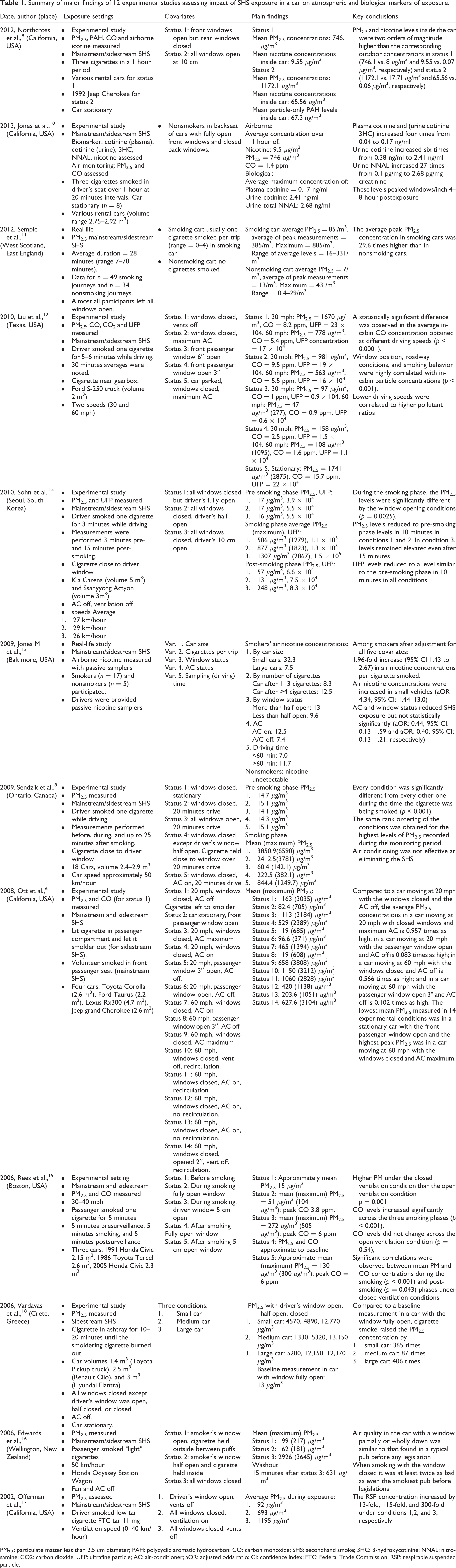
PM2.5: particulate matter less than 2.5 μm diameter; PAH: polycyclic aromatic hydrocarbon; CO: carbon monoxide; SHS: secondhand smoke; 3HC: 3-hydroxycotinine; NNAL: nitrosamine; CO2: carbon dioxide; UFP: ultrafine particle; AC: air-conditioner; aOR: adjusted odds ratio; CI: confidence index; FTC: Federal Trade Commission; RSP: respirable suspended particle.
Markers of SHS exposure in a car
Atmospheric markers
PM 2.5 μm or less in diameter (PM2.5) was the most common marker of SHS exposure (n = 11 of 12 studies), followed by carbon monoxide (CO; n = 5 of 12 studies), ultrafine particles (n =2 of 12 studies), and airborne nicotine (n = 2 of 12 studies). 9,10 The range of PM2.5 concentrations found in all studies with at least one window partially open was 47–12,150 μg/m3. For studies with all windows closed, PM2.5 concentrations ranged from 203.6 μg/m3 to 13,150 μg/m3. Jones et al., reported mean airborne nicotine concentrations of 32.3 μg/m3 in small cars and 7.5 μg/m3 in large cars. 10 In their study, cars with windows more than half open had a mean airborne nicotine concentration of 13 μg/m3, while cars with windows less than half open had a mean airborne nicotine concentration of 9.6 μg/m3 (in nonsmoking cars, no airborne nicotine was detected). Northcross et al., reported that the airborne nicotine concentration in a car with the front windows open and the back windows closed was 9.55 μg/m3, whereas if all windows were closed, the concentration of airborne nicotine increased to 65.56 μg/m3. 9
Biological markers
Only one study assessed the effect of intra-vehicular exposure to SHS on biological markers of exposure. 10 The levels of plasma and urinary cotinine, 3-hydroxycotinine (3HC), and nitrosamine (NNAL) were measured among nonsmokers who were exposed to SHS while sitting in the backseat of a car where a driver smoked three cigarettes over an hour with the front windows open and the back windows closed (Table 1). The findings showed that plasma cotinine levels increased 4-fold (from 0.04 ng/ml to 0.17 ng/ml), urinary cotinine increased over 6-fold (from 0.38 ng/ml to 2.41 ng/ml), while urine NNAL increased 27-fold (from 0.10 pg/mg to 2.68 pg/mg creatinine) after 1 h of SHS exposure in a car. Peak levels of the biomarkers in urine and plasma were reached 4–8 h postexposure. The study also found a significant correlation between the levels of PM2.5 (mean after 1 h = 746/m3) and plasma cotinine levels (ρ = 0.94; p = 0.005).
Correlates of SHS exposure in a car
Car speed
Two studies examined the effect of driving speed on SHS exposure under varying conditions of airflow and ventilation 6,12 Liu et al., 12 assessing sidestream and mainstream smoke, reported that when the front passenger window was open 6′′ and one cigarette was smoked in the driver’s seat for 5 min, PM2.5 concentrations were 97 μg/m3 at 30 mph and 34 μg/m3 at 60 mph. Ott et al. 6 identified that with windows closed and AC on, mean PM2.5 concentrations attributable to sidestream smoke at 20 mph was measured at 529 μg/m3 and at 60 mph was 465 μg/m3. With one passenger window 3′′ open, the mean PM2.5 concentrations remained stable at 119 μg/m3 at 20 mph and 60 mph.
Window and ventilation status
Nine studies assessed the effects of window status on SHS exposure levels in cars as shown in Table 1. One study reported that at 30 mph, mean PM2.5 concentrations were 490 μg/m3 when the windows were closed and AC was off, 303 μg/m3 when windows were closed and AC was on maximum, and 97 μg/m3 when the front passenger window was open and air-conditioning was off. 12 Similar findings, albeit at much higher concentrations (despite higher car volume), were reported by Sohn et al. who identified that in cars with the driver’s window fully open, half open, or approximately 3′′ open, the corresponding PM2.5 concentrations were 506 μg/m3, 877 μg/m3, and 1307 μg/m3, respectively. 14 Consistent results were reported in an earlier study, which showed that in cars traveling at 20 mph completely opening a passenger window reduces the PM2.5 concentrations from to 97 μg/m3, respectively, as compared to 1163 μg/m3 with the window open 3′′. 6 Similarly, at car speeds of 60 mph, opening a passenger window by 3′′ reduced PM2.5 concentrations from 1150 μg/m3 to 119 μg/m3. 6
One study (Sendzik et al.), which compared the effect of opening all windows to opening only the driver’s window, found that mean PM2.5 levels due to one cigarette smoked in the driver’s seat during a 20 minute drive were 2412.5 μg/m3 (maximum = 3781 μg/m3) with all windows closed, 222.5 μg/m3(maximum = 382.1 μg/m3) with the driver’s window half open, and 60.4 μg/m3 (maximum = 142.1 μg/m3) with all windows fully open. 8 Opening more windows decreased the PM2.5 measured, although, even with all windows open, the PM2.5 concentration was still greater than the baseline (mean PM2.5 measured in the stationary car before smoking was approximately 15 μg/m3). Nearly identical concentrations were reported by Rees et al., using a smoker in the driver’s seat with all windows closed or all opened. 15
The effect of holding a cigarette outside of the car between puffs was explored by Edwards et al. 16 Surprisingly, slightly lower PM2.5 concentrations were found in cars with windows only half open and holding the cigarette inside the car than in cars with the windows fully open and holding the cigarette outside between puffs. This difference was, however, relatively small between these two conditions (162 vs. 119 μg/m3). The mean PM2.5 when all windows were closed was, however, over 18 times higher than either scenario (mean PM2.5 = 2926 μg/m3).
As reported by Offerman et al., 17 PM2.5 concentrations may be reduced significantly by turning ventilation on in a car with closed windows but will be reduced much more by opening windows. Moreover, Vardavas et al., assessing sidestream smoke only, identified that PM2.5 concentrations in a stationary vehicle can be lowered by opening the driver’s window half way and lowered further by opening a window completely. 18
Discussion
The results of this systematic review indicate that smoking in cars increases the concentration of atmospheric (PM2.5, CO, and airborne nicotine) and biological (NNAL, 3HC, plasma and urine cotinine) markers of SHS. These levels are mediated by exposure settings (air conditioning status, number of windows open, inches each window is open, driving speed, and type of SHS (i.e. mainstream or sidestream cigarette smoke). Most studies measured PM2.5 levels after a cigarette was smoked in the driver’s seat, and all such analyses found PM2.5 concentrations to be much higher than in bars before the adoption of smoke-free legislation. For reasons of comparison, average SHS concentrations in hospitality venues before the adoption of smoke-free legislations in Norway (262 μg/m3), 19 Scotland (246 μg/m3), 20 and Greece (340 μg/m3) 21 indicate levels that are 10 times less than those measured within a car with smoking occuring. Furthermore, assuming the observed PM2.5 levels inside vehicles where smoking was occurring were analogous to daily levels, the average level in all of these vehicles exceeded both the average 24-hour (35 µg/m3) and annual (15 µg/m3) US Environmental Protection Agency standards. 22 Accordingly, occupants of smoking-permitted vehicles are at heightened risk for SHS exposure and related health problems.
Research has previously identified that the family car is potentially the most significant source of exposure to SHS and causes the largest increase in cotinine concentrations in comparison with other areas, such as the home, workplace or café/bars, even in areas where smoking in public places is still allowed. 23 Subsequently, in countries where smoking in public places is not allowed, the relative contribution of SHS exposure within the car, toward a population’s cumulative exposure to SHS, would be even greater. In addition to exposing nonsmoking passengers present at the time of the smoking to SHS, cigarette smoke can cling to car upholstery, thereby potentially exposing passengers to thirdhand smoke even when the smoker has stopped puffing. Recent research has also shown that smoking in cars may also have negative economic consequences to the car owner as it reduces the resale value or asking price of such cars. 24
Article 8 of the WHO Framework Convention on Tobacco Control calls for the adoption of smoke-free environments for the protection of public health. 25 In public health practice, there is a long history of enacting policies that affect individual behavior in cars to protect the public’s health and safety. Seat belt requirements and legislation against drunk driving and cell phone use and texting are just a few examples. As of January 2011, multiple jurisdictions throughout the world, including five US states (Arkansas, California, Louisiana, Maine, and Utah), had enacted legislation prohibiting smoking inside cars. 26 However, most of these current regulations prohibit smoking in cars only when occupied by persons younger than a specified age, leaving adults unprotected. As SHS exposure impacts both adults and children, the extent of exposure noted within our systematic review may justify the legislation of SHS exposure within cars, regardless of the passengers’ age, comorbidities, or gender. Indeed, support for smoke-free policies in private cars has been shown to be overwhelmingly high in the United States, especially in the presence of children passengers. 27
To date, limited research has indicated the health effects of SHS exposure within a car. A longitudinal study in Australia indicated that, by age 14, children exposed to SHS in cars were more likely to have current wheeze, persistent wheeze, and decreased lung function in comparison with children either exposed to SHS at home and/or those who are unexposed. 28 Similarly, Kabir et al., within the context of a cross-sectional study in Ireland, associated SHS in the car with the occurrence of wheeze among children of the same age. 29
To the best of our knowledge, this is the first systematic review aimed at providing a synthesis of SHS exposure levels in cars. Strict inclusion and exclusion criteria were applied, while two separate online databases were assessed by two researchers. However, we cannot exclude the possibility of publication bias as a potential source of error in systematic reviews. Moreover, as we restricted our review to articles published in English, there is a possibility that reports in other languages may have been missed. Finally, because of the presence of several potential confounding factors that were present in many of the studies as we have noted and described (e.g. differences in car volume, window status, and traffic density), we were unable to perform homogenization, as well as merged analyses and interpretation of the data. Despite the above limitations, this systematic review provides a collective overview of the research performed to date.
Conclusions
Smoking in cars can potentially expose passengers to very elevated concentrations of SHS, with increased ventilation and open window status found to reduce but not eliminate elevated SHS concentrations. SHS concentrations measured within vehicles with a smoker surpass those concentrations previously measured within the hospitality industry (bars, pubs, and café) before the adoption of smoke-free legislations. The existing evidence clearly indicates that the regulation of cigarette smoking within cars may be justified and recommended as a means of reducing SHS exposure. Further research into the fraction of disease risk attributable to SHS exposure in a car is warranted.
Footnotes
Authors’ Note
ITA initiated the reported research while affiliated with the Center for Global Tobacco Control at Harvard University. He is currently affiliated with the Centers for Disease Control and Prevention’s Office on smoking and health. The research in this report was completed and submitted outside of the official duties of his current position and does not reflect the official policies or positions of the Centers for Disease Control and Prevention. Authors SR and CIV performed data extraction and systematic review, while all three authors performed data interpretation and manuscript preparation. All authors read, edited, and approved the final manuscript.Part of this systematic review was presented at the Annual Conference of the American College of Chest Physicians in Chicago, November 2013.
Conflict of interest
The authors declared no conflicts of interest.
Funding
This research received no specific grant from any funding agency in the public, commercial, or not-for-profit sectors.