




Abstract
Background
The evaluation of user satisfaction with an automated insulin delivery (AID) system is crucial. The aim was to assess the change in user satisfaction after upgrading from a previous to a next generation sensor integrated in the same AID system.
Methods
A prospective intervention study was conducted. Type 1 diabetes subjects simultaneously upgraded from Guardian-Sensor®4 to Simplera-SyncTM, integrated in the MiniMedTM-780G system. User satisfaction was evaluated at baseline and after 3 months of use of Simplera-SyncTM by the Glucose Monitoring Experience Questionnaire (GME-Q), a validated questionnaire designed to evaluate the experience with a glucose monitoring system. Glucose control and use of the system were also compared.
Results
Ninety-one subjects were included (age: 38 ± 15 years-old, 59% female). GME-Q global score increased from 3.84 ± 0.49 to 4.40 ± 0.46. All subscales, effectiveness, convenience, and intrusiveness also improved. Sensor use increased from 93% [91, 95] to 98% [96, 99] and time in automode from 94% [92, 97] to 100% [97, 100], with 50% of the subjects achieving 100% of time in automode. A reduction in time in moderate hypoglycaemia and the number of hypoglycaemia episodes was observed.
Conclusion
Upgrading to a new sensor, as part of an AID system, can improve user satisfaction and allow for increased sensor use and time in automation.
Keywords
Introduction
Automated insulin delivery (AID) systems are considered the standard of care in the management of type 1 diabetes. International Guidelines recommend that they should be offered to all people with type 1 diabetes. 1 New AID systems are being included in the market, and real-world data show that they are being widely used by people of all ages, from children to elderly.
Alongside the broader use of AID systems and the variety of systems available, the importance of patient-reported outcomes is being increasingly acknowledged. Real-world studies, systematic reviews, and meta-analyses highlight the importance of assessing the effect of automated insulin delivery use on patient-reported outcomes.2–4
Individual satisfaction with an AID might depend on multiple factors, and the different components of the AID system could exert a separate influence. Recently, the new sensor Symplera SyncTM was launched to be integrated in the Medtronic MiniMedTM 780G AID system, replacing the previous generation sensor, the Guardian Sensor® 4. Both sensors are calibration-free and share a 7-days sensor life, but Simplera SyncTM is a disposable all-in-one sensor, with a simple two-step insertion process, while Guardian Sensor® 4 has a reusable transmitter that requires charging and a more complex insertion process. The chemistry stack of Simplera SyncTM is the same as that of Guardian Sensor 4®, with equivalent accuracy. The use of new Simplera SyncTM has recently shown to be safe and to improved glycaemic control in 222 subjects. 5
The present study aimed to assess the changes in user satisfaction and glycaemic control after upgrading from the previous generation to the next generation of sensors in the same AID system.
Material and methods
Study design
A prospective single-center intervention study was performed. Subjects with type 1 diabetes, 15 years old or older, simultaneously upgraded from Medtronic MiniMedTM 780G with Guardian Sensor® 4 to the Medtronic MiniMedTM 780G with Simplera SyncTM.
The Medtronic MiniMed™ 780G system software was updated remotely, without the need for a pump replacement. The software package was downloaded through the MiniMedTM Mobile App. This process typically took between 45 and 90 min. During this time, users could continue to use the insulin pump, continuous glucose monitoring (CGM) system, and the smartphone without interruption.
The subject selection was made based on their technology skills, prioritizing people able to easily update the MiniMedTM Mobile App remotely, after receiving brief instructions, without needing further support.
Variables
Satisfaction with the CGM system was evaluated at baseline and after 3 months of use. The Glucose Monitoring Experience Questionnaire (GME-Q) is a validated questionnaire designed to specifically assess satisfaction with a glucose monitoring system. 6 A linguistically validated version of the GME-Q 7 was completed by all the participants before the upgrade and after 3 months of use of the new sensor. The GME-Q includes 23 items with a five-point Likert scale, from “strongly disagree” to “strongly agree.” Total satisfaction and three subscales, convenience, intrusiveness, and effectiveness were computed. For this calculation, the sum of scores were divided by the number of items completed. Negatively worded items were reversed before the calculation. The total satisfaction score and each subscale score range from 1 to 5, with higher scores meaning a higher satisfaction level, except for the intrusiveness domain, where higher scores reflect a lower satisfaction level. A final open-ended question was included, asking about the differences between the two sensors.
Additionally, glucose metrics and use of the system were assessed at baseline and after 3 months of use of the new sensor. Time in Range (TIR) (70–180 mg/dl), time <70 mg/dl and <54 mg/dl, and time >180 mg/dl and >250 mg/dl in the 14-days download at each time point were recorded, according to the International Consensus on Time in Range. 8 Furthermore, Time in Tight range (TITR) (70–140 mg/dl) was assessed. Sensor use, time in automode, coefficient of variation of sensor glucose, insulin dose, GMI (glucose management indicator), active insulin time, and glucose target were also collected. The number of exits, from automode to manual mode, and the reason for each exit, were also registered.
Ethics
The study protocol followed the Declaration of Helsinki principles and was approved by the Badajoz University Hospital Ethics Committee (Registration number: 021_21). All the participants were informed of the protocol and signed the corresponding consent form.
Statistical analysis
Data analysis was performed using the SPSS statistics software v20. A descriptive analysis of continuous variables was performed by calculating their mean and standard deviation. Categorical variables were expressed as percentages. A Kolmogorov-Smirnov test has been performed to detect variables with non-normal distributions. The median and interquartile range were calculated for those variables. A paired Student’s t-test was used for the analysis of differences. Comparisons between proportions were analysed by a chi-square test and the McNemar test. A p-value <0.05 was considered statistically significant.
Results
Main characteristics of the subjects included in the study.

n = 91. Data are expressed as mean ± standard deviation unless otherwise indicated.
User satisfaction with the continuous glucose monitoring system
Change in glucose monitoring experience questionnaire (GME-Q) scores 3 months after upgrading from Guardian Sensor® 4 to Simplera SyncTM as part of the Medtronic MiniMedTM 780G system.
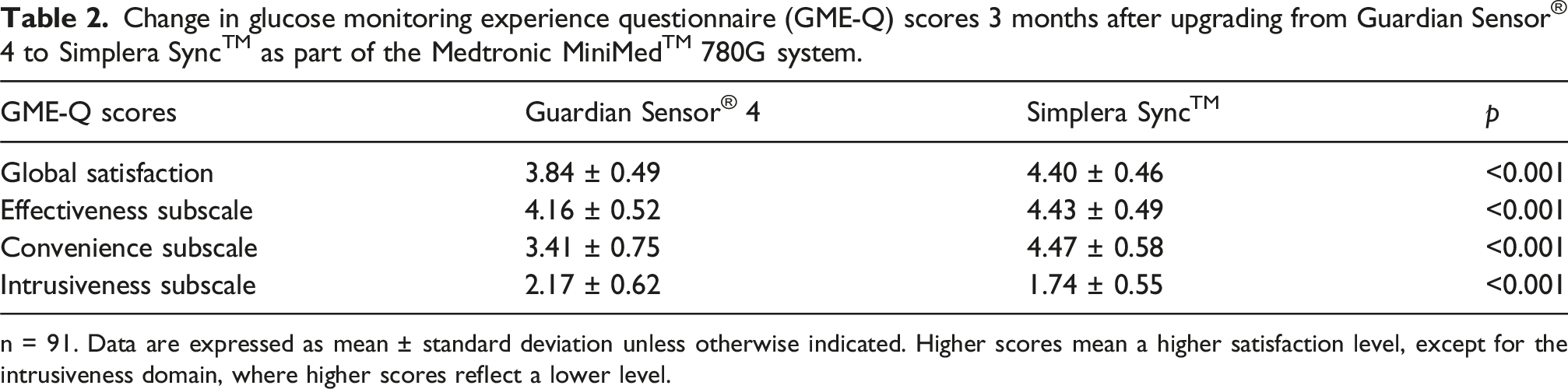
n = 91. Data are expressed as mean ± standard deviation unless otherwise indicated. Higher scores mean a higher satisfaction level, except for the intrusiveness domain, where higher scores reflect a lower level.
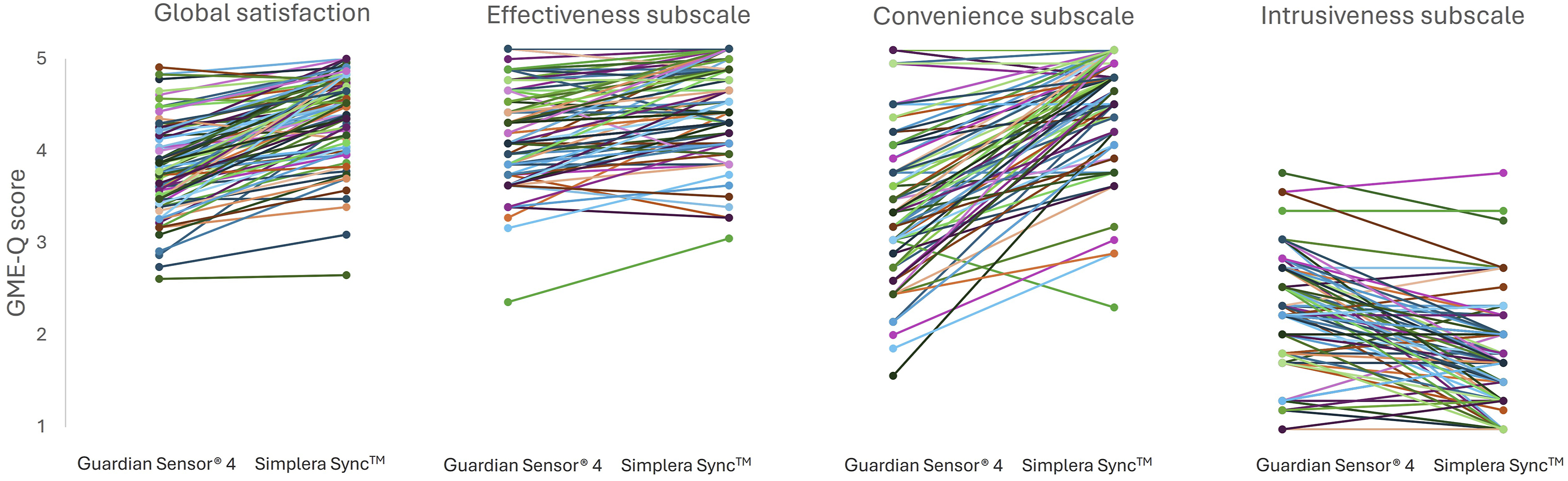
Changes in GME-Q score from baseline, with Guardian Sensor® 4, to the 3-months visit, with Simplera SyncTM, representing each individual’s score (GME-Q global score, GME-Q effectiveness subscale, GME-Q convenience subscale, GME-Q intrusiveness subscale).
When each of the 23 questions were analysed individually, all the scores were significantly more positive for Simplera SyncTM than for Guardian Sensor® 4 (all p < 0.05). The higher difference between scores was found in question 2 (“it takes a lot of time”) with a difference of 1.8 ± 1.4, followed by question 4 (“it is discreet”) with a difference of 1.5 ± 1.4 (both p < 0.001).
The percentage of participants reporting a high global satisfaction (score ≥4) increased from 36% (n = 33) with Guardian Sensor® 4 to 82% (n = 75) with Simplera SyncTM (p = 0.001).
The number of responses each participant gave to the final open-ended question was variable, ranging from 0 to 4. A total of 148 responses were obtained from all the participants. These responses were aggregated by topic to get a general overview of the subject’s feedback and general satisfaction with the new system. Greater ease of use and increased comfort with the new sensor were reported in 93 (63%) of the answers. The smaller size and the discretion were reported in 27 (18%) of the answers. 10 percent of the answers reported early sensor loss or worse functioning.
Glucose control and use of the system
Sensor use increased from 93% [91, 95] with Guardian Sensor® 4 to 98% [96, 99] with Simplera SyncTM (p < 0.001). Also, the proportion of subjects achieving a sensor use of ≥97% increased from 10% (n = 9) to 75% (n = 65) (p < 0.001).
Similarly, time in automode increased from 94% [92, 97] to 100% [97, 100], and the number of participants achieving a time in automode ≥97% was 79% (n = 69) with Simplera SyncTM compared to 25% (n = 22) with Guardian Sensor® 4, reaching 100% of time in automode 52% (n = 45) of the participants with Simplera SyncTM compared to 3% (n = 3) with Guardian Sensor® 4 (all p < 0.001).
With Guardian Sensor® 4, 100 exits to manual mode were recorded in the whole cohort, compared to 73 exits with Simplera SyncTM (p = 0.015). The number of exits due to automode being disabled by the user decreased from 41 to 16 in the whole cohort, and the number of exits due to lack of sensor data decreased from 7 to 1 (both p < 0.006).
Change in glucose control and use of the system.

n = 91. Data are expressed as media [interquartile range].
Conversely, time <70 mg/dl was significantly lower at the 3-months visit, compared to baseline (1%1,3 with Guardian Sensor® 4 compared to 1% [0, 2] with Simplera SyncTM, p = 0.004). Similarly, the number of hypoglycaemia episodes was slightly lower with the new sensor (0.4 [0.1, 0.7] episodes per day with Guardian Sensor® 4 compared to 0.3 [0.1, 0.6] episodes per day with Simplera SyncTM, p = 0.014). No differences were found in time in hyperglycaemia >180 mg/dl or >250 mg/dl, GMI, coefficient of variation of glucose, mean sensor glucose, time <54 mg/dl, or insulin dose (total daily dose, percentage of bolus insulin, and percentage of basal insulin).
The glucose target was set at 100 mg/dl in 84% (n = 73) of the users of both sensors, and the active insulin time was 2 h in 79% (n = 69) of the Guardian Sensor® 4 users compared to 77% (n = 67) of the Simplera SyncTM users. Only four individuals had modified the active insulin time in the AID system, and only three subjects had reduced the glucose target from 120 mg/dl to 110 mg/dl.
No addition or change in medications that could affect glucose control was performed during the study period. Twenty-one percent (n = 19) of the participants had adjusted at least one of their insulin-to-carbohydrate ratios.
Discussion
AID systems are considered the best option for type 1 diabetes management, and their use is widely increasing. Evaluation of use satisfaction with an AID system is crucial.9–12 The three components of the AID system, the pump, the sensor, and the algorithm, influence separately and differently the user satisfaction with the AID system. 13 Therefore, it is relevant to evaluate whether there are meaningful differences when new sensors are introduced to a given AID system.
Our study evaluates the changes in user satisfaction after switching from a previous CGM system to a next generation one, as part of the same AID system, using a validated and linguistically adapted questionnaire. Additionally, differences in glucose metrics and use of the system were evaluated. A clearly higher user satisfaction with the new monitoring system was found, either in terms of global satisfaction, effectiveness, convenience, and intrusiveness. The new sensor was considered more discreet, comfortable, and easier to use.
In our population, the better usability of the new Simplera SyncTM, compared to Guardian Sensor® 4, likely allows for a higher duration of use and higher time in automode. The new sensor use was higher than the previous one, allowing for an increased time in automode and a lower number of exits to manual mode. Sensor use was increased, probably due to several factors. First, the all-in-one design of Symplera SyncTM is easy to carry and avoids the need for transmitter charging. Probably reducing the time without monitoring between sensors. In addition, the users were aware of the possibility of activating a new sensor while still using the previous one, thus reducing the warm-up time to a few minutes, instead of 2 h. Although this practice was not encouraged or evaluated, it is a plausible explanation for the almost 4% increase in sensor use we saw and the threefold increase in the percentage of users achieving ≥97% of sensor use in our cohort. Furthermore, the impressive increase in the percentage of participants reaching 100% of time in automode (15 times higher) gives hope to the dream of full-time automation in type 1 diabetes management.
Seghal et al. 14 had previously shown an increased device satisfaction and trust and a reduced diabetes burden in 15 subjects, 4 weeks after upgrading from Guardian Sensor® 3, a calibration-requiring sensor, to the calibration-free Guardian Sensor® 4.
Also, a previous study 15 evaluated the upgrade from Guardian Sensor® 4 to Simplera SyncTM, as part of the 780G system, in 75 participants, finding an increased time in automode and sensor wear, from 79.2% to 85.8%, and from 80.7% to 88.4%, respectively. This increase was larger than what we saw in our population, but noticeably, the baseline time in automation and sensor use was already higher at baseline, with Guardian Sensor® 4, in our cohort, namely 93% and 94%, respectively.
Additionally, an increased TITR (70–140 mg/dl), from 38.1% to 40.5%, was found in the Michaels et al. analysis. However, contrary to our study, a simultaneous change in infusion set, from a 3-days to a 7-days infusion set, had been performed, and the percentage of users with optimal settings has increased from 47% to 65%, precluding attributing the benefit in tight glucose control to the sensor upgrade exclusively.
When Dexcom G7 sensor became available to be connected to the t:slim X2 insulin pump with Control-IQ technology, no changes in glucose metrics were found, compared to the previous Dexcom G6 sensor, in a retrospective evaluation conducted in 463 participants who transitioned from the Dexcom G6 to the Dexcom G7 sensor, although patient-reported outcomes were not assessed. 16
Finally, in our study, glycaemic control remained unchanged, with a slight reduction in time in moderate hypoglycaemia. The incremental improvement in time in hypoglycaemia and the reduction in hypoglycaemia episodes were not expected, due to the similarity of the two sensors’ chemistry. Rather, the higher time in automode and sensor wear might have contributed to an increased hypoglycaemia protection. With our study design, it is not possible to determine if that difference was due to the change in the therapy, allowing for a more successful use of the AID system, or due to a difference in the accuracy between both sensors.
The main strength of the study is that it represents the first prospective evaluation of the benefit in user satisfaction after switching from Guardian Sensor® 4 to Simplera SyncTM, as part of the Medtronic MiniMedTM 780G system, an extensively used AID system. The use of a validated patient-reported questionnaire and the relatively high number of participants, including adolescents and adults, also contributes to the applicability of our results. Also, the stability of the settings of the glucose target and the duration of active insulin, which are the main factors determining the performance of the AID system, makes our results regarding glucose control more valuable. Our data show that for AID users who are already optimally controlled and competent in using of the system, further improvement is achievable by enhancing the usability of the individual components of the AID system.
As a limitation of the study, it has to be mentioned that some variables, which could have affected glucose control, were not recorded, such as the type of insulin in the AID system. Also, 21% (n = 19) of the participants had adjusted at least one of their insulin-to-carbohydrate ratios, and these changes could have affected glucose control in those subjects. The duration of each individual sensor, to assess the frequency of early sensor loss, was not collected either. Finally, no HbA1c data were available to exclude the possibility of a discrepancy in glucose readings between the two sensors.
In conclusion, the first user experience evaluation with the new sensor Simplera SyncTM, as a part of an AID system, shows higher satisfaction than with Guardian Sensor® 4, integrated into the Medtronic MiniMedTM 780G AID system. This satisfaction was evaluated by the validated and linguistically adapted questionnaire GME-Q, which includes global satisfaction, effectiveness, convenience, and intrusiveness.
Footnotes

Ethical considerations
Approval was obtained from the Badajoz University Hospital Ethics Committee. The procedures used in this study adhere to the tenets of the Declaration of Helsinki.
Author contributions
All the authors contributed to the design and implementation of the research, the analysis of the results, and the writing of the manuscript.
Funding
The authors received no financial support for the research, authorship, and/or publication of this article.
Declaration of conflicting interests
The authors declared the following potential conflicts of interest with respect to the research, authorship, and/or publication of this article: The authors declare the following conflict of interest: PIBV has received speaking/consulting honoraria from Abbott, Novo Nordisk, Medtronic, Roche, Novalab, Ypsopmed, and Lilly; EGP has received speaking/consulting honoraria for Medtronic, Abbott, Novo Nordisk, Alexion, Sandoz, and Sanofi; FJAD has received speaking/consulting honoraria for Medtronic, Abbott, Novo Nordisk, Alexion, Sandoz, Sanofi, and Pfizer.
Prior presentation
Parts of this study have been accepted for oral presentation at the 61st annual meeting of the European Association for the Study of Diabetes (EASD).