




Abstract
Purpose
This study examines whether Angiopoietin Like 8 (ANGPTL8) is linked to cardiometabolic risk factors (CMRFs) in Saudi women with type 2 diabetes (T2DM).
Methods
Case-control investigation compared 150 women aged 30–60 with T2DM to 140 healthy women of the same age and gender.
Results
ANGPTL8 levels differed significantly between T2DM and non-diabetics. Fasting blood glucose (FBG), insulin resistance (IR), triglycerides (TG), high-sensitivity C-reactive protein (hs-CRP), body mass index (BMI), and atherogenic index (AIP) of plasma all correlated positively with ANGPTL8 concentrations. Insulin levels correlated negatively with ANGPTL8. Multiple linear regression models showed that elevated ANGPTL8 independently predicted higher FBG, hs-CRP, IR, TG, and AIP in T2DM patients.
Conclusion
The study found a significant association between ANGPTL8 levels and IR, hs-CRP, TG, AIP, and BMI in women with T2DM. These components are classified as CMRFs and have the potential to contribute to the development of cardiovascular disease (CVD).
Introduction
Diabetes is a metabolic disorder associated with a deficit in insulin production or activity, resulting in persistently elevated blood glucose levels. Diabetes mellitus type 2 (T2DM) is often diagnosed in people over 35. 1 Compared to other Middle Eastern countries, Saudi Arabia ranks second highest and seventh globally in terms of diabetes prevalence and incidence. 2 This increase has been attributed to several factors, including changes in diet with the substitution of animal products and refined foods, 3 and socioeconomic factors, such as an increase in affluence, which reveals a rise in the genetic or ethnic predisposition for diabetes. Mostly diabetes mellitus is linked with a higher risk of cardiovascular complications 4 and doubles the risk of cardiovascular disease (CVD), particularly among individuals with an antiquity of diabetes as opposed to those newly diagnosed with the condition. High BMI also alters hemodynamics and cardiac structure, making it one of the independent risk factors for CVD in T2DM. 5 Independent risk factors for CVD include high cholesterol levels, low-density lipoprotein (LDL-C), and triglycerides (TG) in T2DM. 5
ANGPTL8 is a protein (previously known as betatrophin) that is synthesized in adipose tissues and the liver and discharged into the bloodstream to stimulate cell growth. Results of human research link ANGPTL8 to T2DM and obesity. 6 A study reported ANGPTL8 (1710.5 pg/mL) levels in the plasma of T2DM patients which was significantly higher than in non-diabetic people. 6 As a result, ANGPTL8 has been promised as a new biomarker for predicting disease onset and pathogenesis and a possible circulatory biomarker for predicting CVD. 7 Also, only in T2DM patients elevated ANGPTL8 levels were reported to have a connection with insulin resistance. It was reported that when insulin resistance exceeds a particular threshold, ANGPTL8 levels may rise as a compensatory mechanism. However, the possibility of ANGPTL8 levels due to other unknown origins cannot be ruled out, 9 because patients with dyslipidemia, T2DM, hypertension, obesity, and non-alcoholic fatty liver disease have elevated circulating ANGPTL8 levels (798.6 pg/mL). 8 As a result, several studies have focused on the relationship between ANGPTL8 and T2DM to better understand its involvement in glucose and lipid metabolism. Research on ANGPTL8 is limited and the findings are inconclusive, with some studies showing an increase while others show a reduction or no change. This study examined the association between ANGPTL8, glucose, insulin, and lipid profile, which are cardiometabolic risk factors in Saudi women with T2DM in Madinah.
Materials and methods
In 2021 and 2022, 150 women with type 2 diabetes (T2DM) between 30 and 50 were compared to 140 healthy women (control) of the same age range and gender in a pilot case-control research. Overnight fasting glucose, HbA1c, insulin levels, high-sensitivity C-reactive protein (hs-CRP), and lipid profile tests were evaluated at Madinah Hospital laboratories. The methodology utilized in the assay was founded on the principles of chemiluminescence immunoassay technology, as per the guidelines provided by the manufacturer. However, ANGPTL8 (RR 0.18-3.7 ng/mL) levels were analyzed by centrifuging the remaining 1.5 mL of blood sample (1000× g, 5 min) and storing the serum at 20°C for Enzyme-Linked Immunosorbent Assay (ELISA) analysis. Homeostasis Model Estimation of Insulin Resistance (HOMA-IR) index = (fasting insulin Uµ/mL) x (fasting glucose mg/dl)/405 was used to determine the degree of Insulin Resistance (IR). The AIP (atherogenic index of plasma) (log10 TG/HDL-C) was assessed as an atherogenic dyslipidemia indicator. AIP classifies three categories: low risk (0.1), medium risk (0.1-0.24), and high risk (>0.24) for CVD. 9 The individual’s weight and height were recorded twice using a digital scale (Beurer GmbH Type PS 07, China) to calculate their body mass index (BMI).
Statistical analysis
All of the statistical analyses were carried out using GraphPad Prism 7. (GraphPad Software, CA, USA). Quantitative information was described using mean values and standard deviations. The differences between the two groups were assessed using the student's t-test. The multivariate linear regression analysis was used to investigate variables associated with the presence of high ANGPTL8 levels in T2DM patients, and for other variables, the 95% confidence intervals of the unstandardized coefficients were calculated (B). At the p ≤ .05 threshold of significance, every differentiation was different.
Results
Clinical and laboratory characteristics for study groups.

Values are Mean ± standard deviation; p-value obtained from Independent Student t-test. *p < .05, **p < .001.
Multiple linear regression showing association between ANGPTL8 and CMRFs.
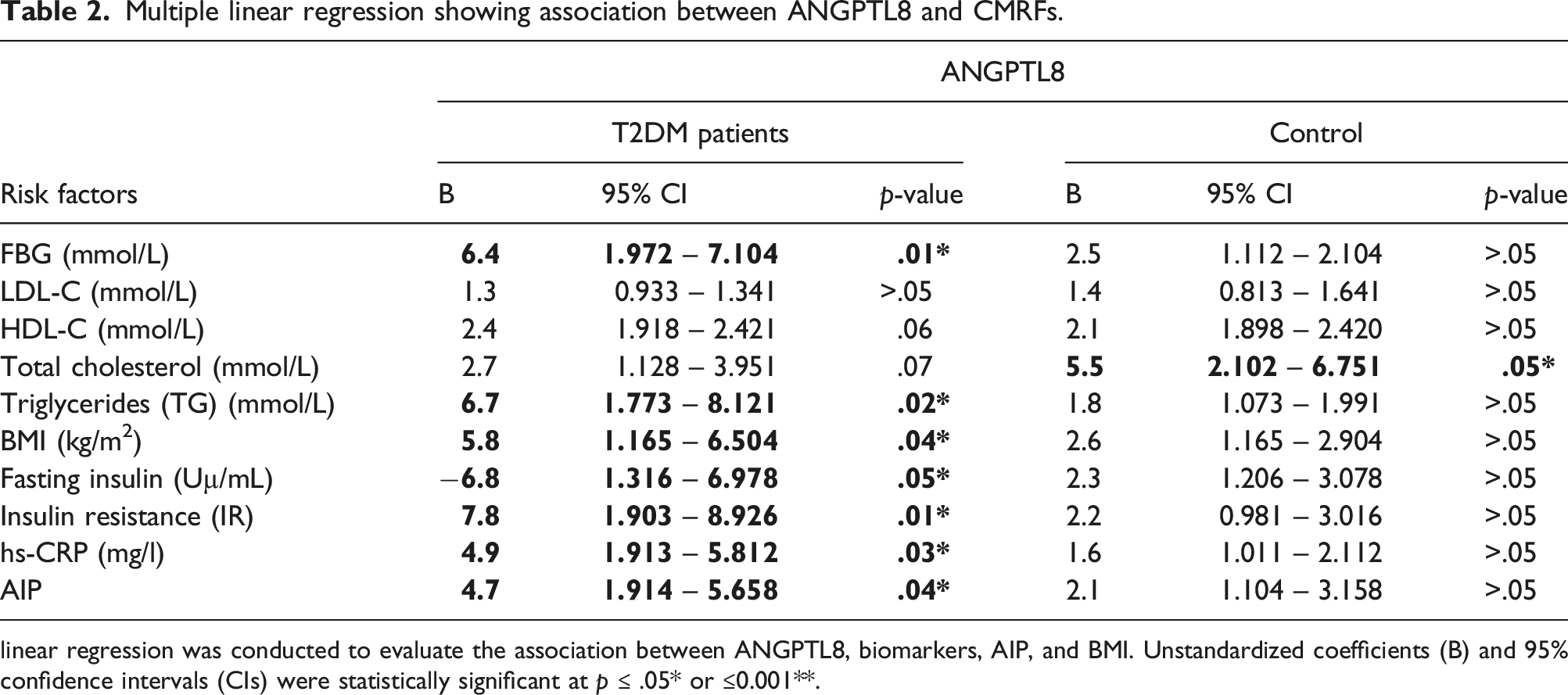
linear regression was conducted to evaluate the association between ANGPTL8, biomarkers, AIP, and BMI. Unstandardized coefficients (B) and 95% confidence intervals (CIs) were statistically significant at p ≤ .05* or ≤0.001**.
Discussion and conclusions
Diabetes mellitus has become a prominent global health concern. Detecting biomarkers that indicate the future progression of diabetes, its severity, and the severity of its consequences may have significant implications for delaying or preventing the development of diabetes and its complications. Researchers at the Harvard Stem Cell Institute (HSCI) 10 have recently found a novel hormone called ANGPTL8, also known as lipasin or betatrophin, which mostly circulates in the liver and adipose tissues and substantially promotes pancreatic-cell proliferation. 10 It has also been hypothesized that this hormone is an independent predictor of T2DM.10,11 Several contradictory investigations have proven the role of ANGPTL8 in glucose metabolism and diabetic consequences. However, there are also interesting findings demonstrating that ANGPTL8 enhances insulin sensitivity by directly activating insulin-mediated AKT phosphorylation.12,13 Thus, the precise role of ANGPTL8 in T2DM remains unknown. According to a meta-analysis, there may be a variation in the correlation between ANGPTL8 levels and T2DM based on ethnicity. 14 ELISA kits that employ antibodies targeting either the N-terminus or C-terminus of betatrophin are capable of detecting solely the full-length form or both the full-length and cleaved form, correspondingly. The functional form of ANGPTL8 and the regulation of proteolytic cleavage remain uncertain. It is important to acknowledge that the utilization of distinct ELISA kits may yield divergent outcomes. The lack of uniformity observed in various studies may be attributed to limited sample sizes featuring diverse clinical characteristics or potential selection bias. Additional research is warranted to establish conclusive findings, as prior investigations have employed non-optimal techniques for assessing insulin resistance and have been limited in sample size. 14 Future studies should employ more accurate methodologies and expand the study cohort. In this research, for the first time, an increased ANGPTL8 level is related to an increase in CMRFs in women with T2DM. Compared to the control group, the levels of ANGPTL8 in the diabetes patients were substantially higher, and positive associations were shown between ANGPTL8 and fasting blood glucose and insulin resistance. Also, pancreatic β-cell growth and metabolic control are both hypothesized to be enhanced by ANGPTL8. In humans, the relationships between ANGPTL8 levels and diabetes, obesity, and lipid profile are still controversial. In brief, there is a constant argument about whether insulin is directly or indirectly involved in the expression of ANGPTL8 levels because of variations in blood glucose levels. Moreover, research is needed to determine the precise role of ANGPTL8 in T2DM and insulin resistance. Another noteworthy takeaway from this research is the links between ANGPTL8 levels, lipid profiles, and obesity (as measured by BMI) in women with T2DM. Patients with T2DM revealed a favorable association between blood ANGPTL8, TG levels, and BMI but not with total cholesterol, HDL-C, or LDL-C. Our result indicated that ANGPTL8 levels are higher in people with T2DM who are overweight or obese compared to people who do not have diabetes. Alternatively, elevated TG levels may result from overexpression of ANGPTL8. This suggests that elevated ANGPTL8 levels in the blood are associated with the hypertriglyceridemia characteristic of obesity. Nevertheless, additional investigation is required to comprehensively comprehend the physiological significance of ANGPTL8 in the circulation of lipids and obesity. The relationship between blood ANGPTL8 levels, BMI values, and lipid profiles in diabetic patients has been a topic of debate due to inconsistent results reported in various studies. Many possible reasons, such as the different study populations and ethnicities may clarify these inconsistent results. Also, the differences in adipose tissue distribution between Europeans and Asians may impact ANGPTL8 concentrations. Alternatively, the effects of hypoglycemic drugs taken by T2DM patients may have different or unclear effects on serum ANGPTL8 levels. ANGPTL8 and AIP levels were considerably greater in T2DM patients, which was another unexpected conclusion of the research. Patients diagnosed with T2DM are more likely to develop CVD, and AIP is a clinically relevant biomarker for diagnosing such risk. It is possible to utilize the AIP as a primary measure for assessing cardiovascular risk. The index is a stronger predictor of atherosclerosis and CVD than the traditional atherogenic lipid profile. The current study found that the women with T2DM had higher hs-CRP values than non-diabetics; hs-CRP correlated positively with ANGPTL8 levels. A correlation was found in a prior study between ANGPTL8 and hs-CRP, indicating a potential association between the inflammatory process and elevated ANGPTL8 levels in humans, which may exacerbate dyslipidemia. The strong correlation observed between ANGPTL8 and hs-CRP suggests that ANGPTL8 has the potential to serve as a prognostic indicator for Metabolic Syndrome (MetS) and possibly CVD when used in conjunction with hs-CRP. Some biomarkers, such as hs-CRP, serve as early warning systems for the onset of hypertension and T2DM. Many epidemiological findings have proved that higher levels of hs-CRP correlate with increased risks of CVD and metabolic syndrome. This research aimed to assess selected CMRFs among women with T2DM and high ANGPTL8 levels and evaluate their associations with developing CVD. Based on multiple linear regression analyses, the effects of increasing ANGPTL8 levels on BMI, TG, hs-CRP, FBG, and IR were significant, suggesting that women with T2DM had multiple CMRFs that correlated positively with high levels of ANGPTL8. Therefore, T2DM was associated with several CVD complications that could be serious. We did not find published studies in Saudi Arabia that determined the associations between ANGPTL8 levels and CMRFs among women with T2DM.
Conclusion
Our study is the first to evaluate the CMRFs in women with T2DM, which might serve as a foundation for future research. Moreover, our findings have substantiated the association between ANGPTL8 and fasting blood glucose, BMI, and lipid profile. The findings also revealed a correlation between ANGPTL8 and indicators of insulin resistance and markers of inflammation such as hs-CRP. The results indicate that measuring the levels of ANGPTL8 in the bloodstream might serve as a useful indicator for complications related to T2DM, such as CVD. Regularly monitoring these levels could potentially decrease the occurrence of these difficulties.
Footnotes
Acknowledgements
The Authors extend their appreciation to Princess Nourah bint Abdulrahman University Researchers Supporting Project number (PNURSP2024R155), Princess Nourah bint Abdulrahman University, Riyadh, Saudi Arabia. The authors would also thank Miss Johayna Aboalkayer (Taibah University, Medical Applied Science Collage’s technician), the lab technician who supported and helped us in the current study.
Author contributions
WM (The 1st author): Laboratory work, Data entry, statistical analysis, writing part of the introduction, methodology, the result, and discussion sections. DN (Co-author): Manuscript writing (Introduction, Discussion). All authors read and approved the final manuscript.
Declaration of conflicting interests
The author(s) declared no potential conflicts of interest with respect to the research, authorship, and/or publication of this article.
Funding
The author(s) disclosed receipt of the following financial support for the research, authorship, and/or publication of this article: The author declares that this research received a specific grant from Princess Nourah Bint Abdulrahman University Researchers Supporting Project number (PNURSP2024R155), Princess Nourah bint Abdulrahman University, Riyadh, Saudi Arabia.
Ethical statement
Institutional review board statement
The study was conducted in accordance with the Declaration of Helsinki, and approved by Ethical approval to conduct the study was obtained from the Ethical Committee at the College of Applied Medical Sciences, Taibah University, Madinah and Institutional Review Board, General Directorate of Health Affairs in Madinah (IRB 022-22).

Data availability statement
The dataset generated for this study is available on request to the corresponding author.