




Abstract

Mikhailidis et al. have commented on our article ‘Metabolic syndrome: different definitions and gender-specific associations with cardiovascular risk factors’1 and provided evidence2–5 to support the view that associations between the metabolic syndrome (MetS) and cardiovascular (CV) risk factors vary according to the MetS definition employed.
In our article 1 , we have used the National Cholesterol Education Program/Adult Treatment Panel III (NCEP/ATP III) definition modified by the American Heart Association/National Heart, Lung and Blood Institute (AHA/NHLBI) criteria to define the MetS, which includes the waist circumference (Men ⩾ 90 cm; Women ⩾ 80 cm). As suggested by Mikhailidis et al., we reanalysed the data using the Joint Interim Societies MetS definition with Chinese waist circumference (Men ⩾ 85 cm; Women ⩾ 80 cm) 6 . The results showed that the prevalence of the MetS changed from 27.9% to 30.4% in men. However, although the associations between MetS and CV risk factors altered slightly, the direction of the associations was no different between these two MetS definitions (see Table 1).
Associations between CV risk factors and prevalence of MetS defined NCEP/ATP III modified by the AHA/NHLBI criteria and the Joint Interim Societies criteria, respectively, in men (N = 8156).
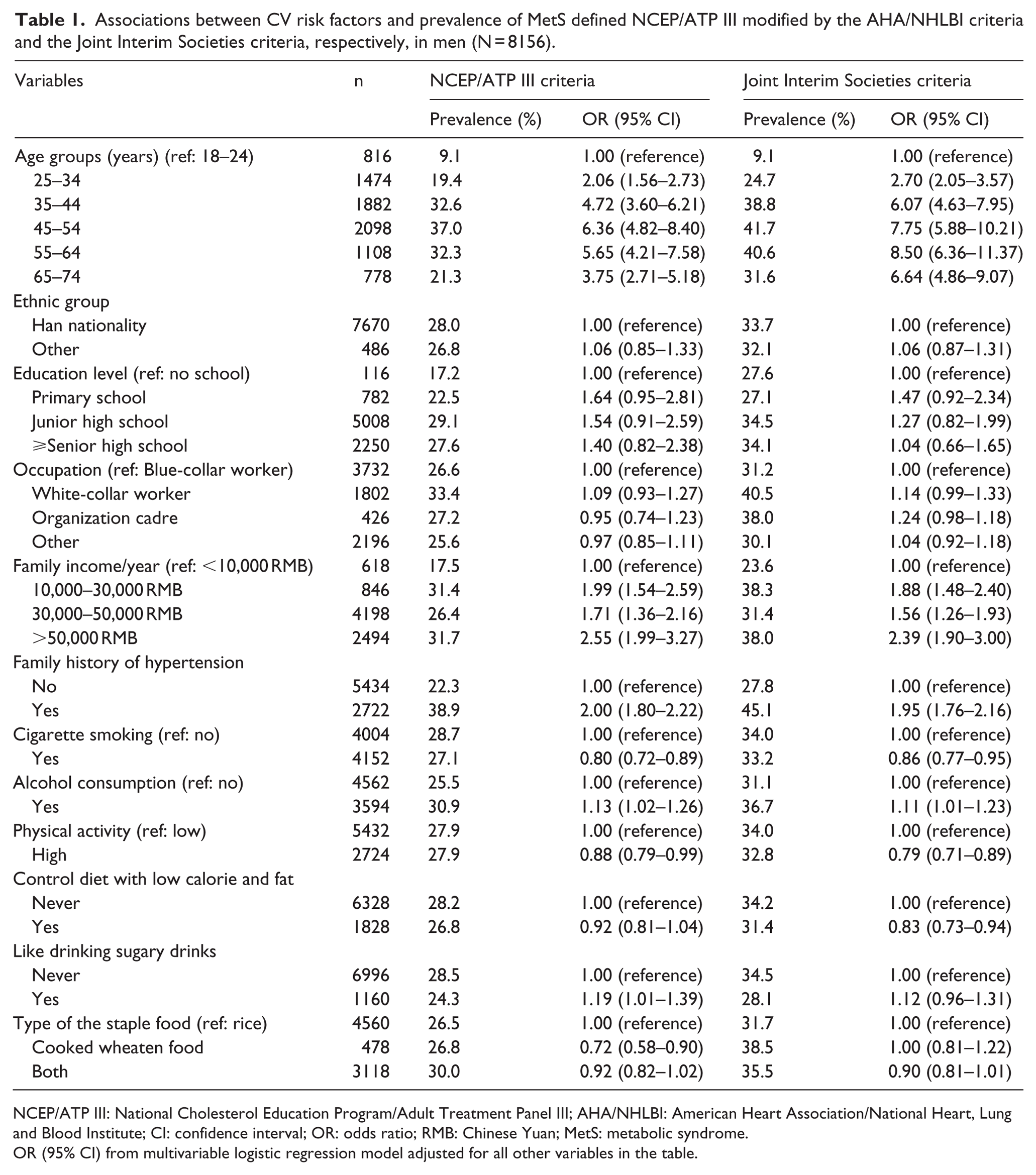
NCEP/ATP III: National Cholesterol Education Program/Adult Treatment Panel III; AHA/NHLBI: American Heart Association/National Heart, Lung and Blood Institute; CI: confidence interval; OR: odds ratio; RMB: Chinese Yuan; MetS: metabolic syndrome.
OR (95% CI) from multivariable logistic regression model adjusted for all other variables in the table.
Unfortunately, we did not measure serum uric acid (SUA) in our study, but we are grateful for this suggestion which we will consider in future studies.