




Abstract
Fas apoptotic inhibitory molecule 2 (FAIM2) is an obesity-related gene, but the mechanisms by which FAIM2 is involved in obesity are not understood. Epigenetic alterations are important factors in the development of obesity. The purpose of this study was to investigate the potential associations of FAIM2 promoter methylation with obesity and components of dyslipidaemia in Chinese children. We studied FAIM2 promoter methylation in 59 obese and 39 lean children using the Sequenom MassARRAY platform. The methylation levels at 8 CpG sites in the FAIM2 promoter were significantly different between the obese and lean subjects, especially the methylation level at CpG site 500 (p = 0.01). The methylation levels at several of the examined CpG sites were significantly associated with dyslipidaemia and its components after adjusting for age, gender and body mass index (BMI). The methylation levels at two CpG sites (sites -362 and -360 and site -164) were highly significantly associated with high level of triglycerides (p = 0.00002 and 0.0009, respectively). This study provides the first evidence that the methylation levels of the FAIM2 promoter are significantly associated with obesity and are independently associated with dyslipidaemia and its components in Chinese children.
Introduction
In recent years, overweight and obesity have become more widespread in most areas of the world, including China. 1 The rising incidence of obesity is a major threat to public health. Overweight children exhibit a higher risk for severe adult obesity, 2 and childhood obesity strongly predisposes to several adult diseases, such as hypertension, type 2 diabetes and cardiovascular disease.
Fas apoptotic inhibitory molecule 2 (FAIM2) is a nervous system-specific inhibitor of Fas/CD95-mediated apoptosis that directly binds to the Fas receptor to protect cells against apoptosis. 3 Genome-wide association (GWA) studies in Caucasians identified that the single nucleotide polymorphism (SNP) rs7138803 near FAIM2 was associated with body mass index (BMI) and obesity. 4 The SNP rs7138803 was also reported to be associated with obesity in Chinese population. 5 Recently, some studies demonstrated that nutritional state affects the expression of FAIM2. 6 However, the mechanism by which FAIM2 is involved in obesity has yet to be elucidated. (Supplementary Figure 1).
Obesity most likely results from the complex interaction between genetic and environmental factors. Epigenetic alterations, especially DNA methylation, have been suggested to be associated with the development of obesity.7–9 We hypothesized that changes in the DNA methylation of the FAIM2 promoter play a role in obesity. The aim of this study was to investigate the methylation of FAIM2 in obese and lean subjects.
Materials and methods
Subjects and ethics
The cohort included 59 obese (BMI > 30 kg/m2 and fat mass percentage (FMP) > 40) and 39 lean (BMI < 18 kg/m2 and FMP < 15) subjects selected from a cross-sectional survey of Beijing children aged 8–18 years in 2013.
We obtained written informed consent from all participants (or their parents/guardians). This study was approved by the ethics committees of the Capital Institute of Pediatrics.
Measurement of anthropometric parameters and biochemical analyses
The anthropometric measurements included weight, height and FMP. All instruments were validated according to the standard methods of the manufacturers. Weight and FMP were measured using a body composition analyser (InBody 720; Biospace Co., Ltd, Seoul, Korea). BMI was calculated as weight in kilograms divided by the square of height in metres. Blood pressure was measured via auscultation using a standard clinical sphygmomanometer.
The levels of triglycerides (TG), high-density lipoprotein cholesterol (HDL-C), low-density lipoprotein cholesterol (LDL-C), total cholesterol (TC) and fasting plasma glucose (FPG) were analysed using an automatic biochemical analyser (Olympus Chemistry Analyser AU640; Olympus Optical Co., Ltd, Tokyo, Japan) using commercial kits (Olympus Optical Co., Ltd).
We classified the lipid profiles as abnormal based on the Chinese criteria as follows: TG ⩿ 1.7 mmol/L, HDL-C ⩾ 1.04 mmol/L, LDL-C ⩿ 3.37 mmol/L and TC ⩿ 5.18 mmol/L. A diagnosis of dyslipidaemia was made if any of these four criteria was met. A high FPG level was defined as FPG ⩿ 5.6 mmol/L.
DNA methylation analysis
Genomic DNA was extracted from peripheral blood leukocytes using a QIAamp® DNA Blood Mini Kit according to the manufacturer’s protocol (QIAGEN Inc., Valencia, CA, USA).
The Sequenom MassARRAY platform (BioMiao Biological Technology, Beijing, China) was used to quantitatively analyse the methylation of FAIM2 [NC_000012.12 (49866896 … 49903977)]. The target DNA regions were amplified via polymerase chain reaction (PCR) using bisulphite-modified DNA. Specific primers are listed in Supplementary Table 1. The PCR primers were designed using EpiDesigner software (http://www.epidesigner.com). The methylation ratios were calculated using Epityper software version 1.0 (Sequenom, San Diego, CA, USA).
Statistical analysis
The continuous variables are presented as the mean ± standard deviation (SD), and the differences between the groups were assessed using analysis of variance (ANOVA). The categorical variables are presented as the percentages, and differences between the groups were assessed using the Chi-square test. A general linear model was used to investigate the difference in the methylation levels between the obese and lean subjects after adjusting for age and gender. Logistic regression was performed to evaluate the associations between abnormal lipid traits (high TG, low HDL-C, high LDL-C or high TC) or dyslipidaemia and the methylation levels after adjusting for age, gender and BMI; p < 0.05 was used to indicate statistically significant differences. Data were analysed using SPSS version 13.0 (SPSS, Inc., Chicago, IL, USA).
Results
The characteristics of the study participants are summarized in Supplementary Table 2. In addition to BMI and FMP, the obese subjects exhibited higher levels of systolic blood pressure (SBP), diastolic blood pressure (DBP), TG and LDL-C and lower level of HDL-C in comparison with the lean subjects.
We investigated the methylation level of the FAIM2 promoter in the cohort (Table 1). The methylation levels at 8 CpG sites (sites -1061 and -1059, site -975, site -859, site -500, site -371, sites -353 and -349, site -183 and site -115) were significantly different between the obese and lean subjects, especially the methylation level at CpG site -500 (p = 0.01), after adjusting for age and gender.
The methylation levels of the FAIM2 promoter in obese and lean subjects.
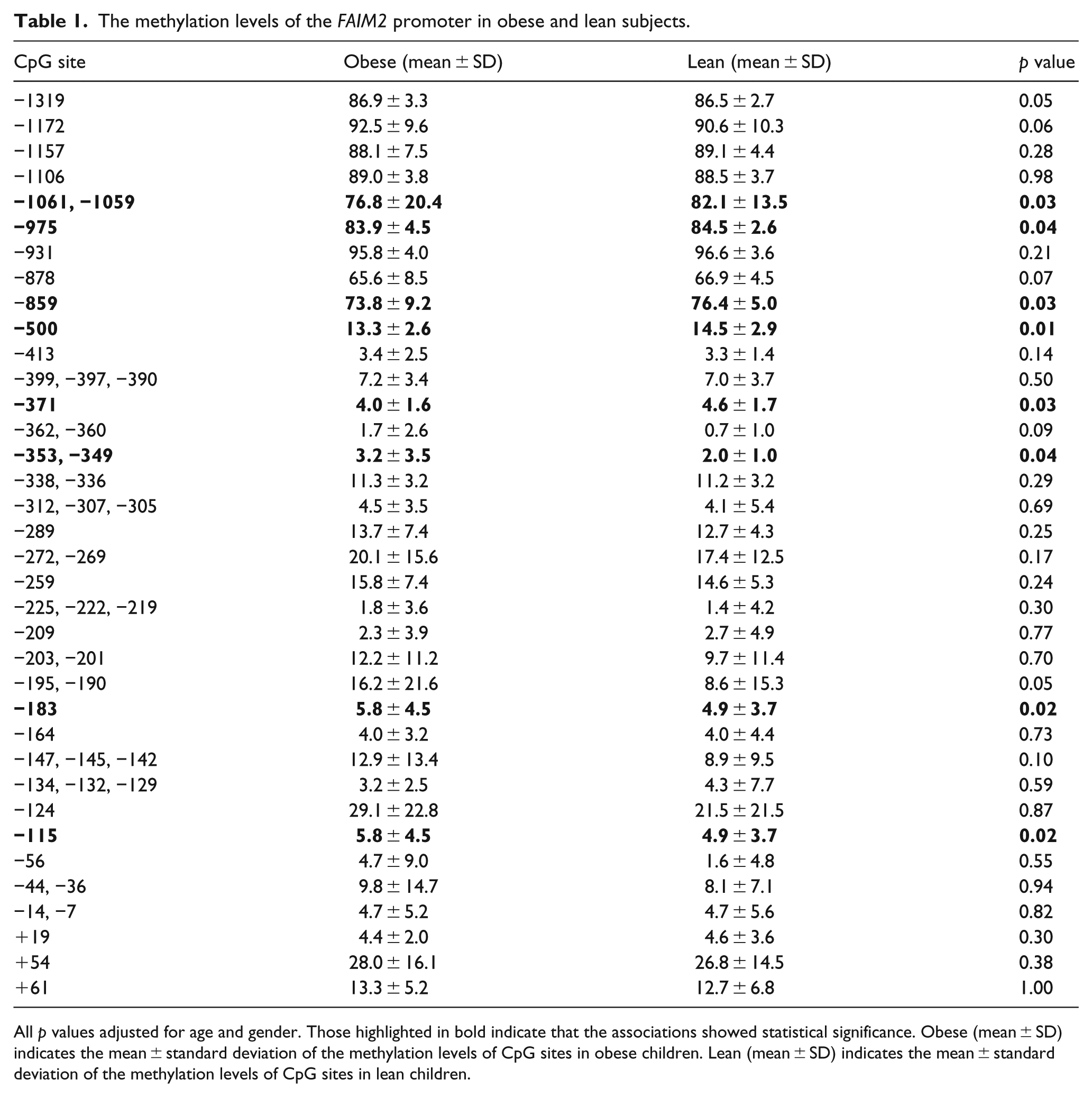
All p values adjusted for age and gender. Those highlighted in bold indicate that the associations showed statistical significance. Obese (mean ± SD) indicates the mean ± standard deviation of the methylation levels of CpG sites in obese children. Lean (mean ± SD) indicates the mean ± standard deviation of the methylation levels of CpG sites in lean children.
Supplementary Table 3 shows the associations between the methylation variations at the examined CpG sites and dyslipidaemia and its four components. The methylation levels at several of the examined CpG sites were significantly associated with high TG, low HDL-C, high LDL-C and high TC levels and dyslipidaemia after adjusting for age, gender and BMI. The methylation levels at two CpG sites (sites -362 and -360 and site -164) were highly significantly associated with high TG level (p = 0.00002 and 0.0009, respectively). The methylation level at CpG site -975 was significantly associated with high TG, high LDL-C and high TC levels. We also investigated the association between the methylation levels of the FAIM2 promoter and plasma glucose. Among the examined CpG sites, only CpG site -56 was significantly associated with high FPG level (p = 0.01).
Discussion
FAIM2 is a 35.1 kDa membrane protein that is highly expressed in the hippocampus and that regulates Fas ligand-mediated apoptosis in neurons. 3 Reich et al. 10 provided evidence that FAIM2 acts as a neuroprotective molecule after transient brain ischaemia. The function of FAIM2 in the hypothalamus is unclear.
The SNP rs7138803 near FAIM2 was found to be associated with BMI and obesity based on GWA studies in Caucasians. 4 Subsequently, replicated study showed that rs7138803 was significantly associated with obesity in the Chinese population. 5 Although FAIM2 was regulated by nutritional state, 6 the molecular mechanism by which FAIM2 affects obesity has yet to be clarified.
Because of the emerging evidence that the development of obesity is epigenetically regulated,7–9 we hypothesized that changes in the DNA methylation of the FAIM2 promoter are involved in obesity and examined the associations of the methylation of the FAIM2 promoter with obesity, dyslipidaemia and four components of dyslipidaemia in Chinese children. Our study indicated that the methylation levels at several of the examined CpG sites were significantly associated with high TG, low HDL-C, high LDL-C and high TC levels and dyslipidaemia (Supplementary Table 3). The methylation levels of the FAIM2 promoter were significantly different between the obese and lean subjects (Table 1, Supplementary Figure 2).
There are a few limitations to this study. First, because of the lack of gene expression data from leukocytes or tissues, this study may not provide direct evidence that the expression of FAIM2 influences obesity. Second, there was no statistically significant difference between the methylation levels of the FAIM2 promoter and FMP. This result could be attributable to the small sample size in our study. Studies with greater sample sizes are needed to examine the association of the methylation levels of this gene with FMP to confirm this result. In addition, the FMP measurement used in this study cannot distinguish between visceral and subcutaneous adipose tissues. It has been reported that individuals with excess visceral adipose carry higher risk of developing diabetes and cardiovascular events than those with excess subcutaneous adipose. In future studies, measurement of visceral adipose tissue may provide a more complete understanding of the association between the methylation levels of FAIM2 and obesity. Third, we would collect the data concerning birth weight and environmental factors, including physical activity, to examine the potential influence of these factors on the associations between the methylation levels of FAIM2 and obesity in further studies. Fourth, the specific tissue to identify epigenetic variations related to obesity should be hypothalamus or adipocytes, but we investigated the methylation levels in peripheral blood leukocytes because of practical difficulties in obtaining tissues from participants. Multiple studies have investigated DNA methylation in peripheral blood leukocytes.8,9
In this study, we explored for the first time that the methylation levels of the FAIM2 promoter were significantly associated with obesity and were independently associated with dyslipidaemia and its components. The function of FAIM2 in the hypothalamus remains to be fully investigated.
Footnotes
Acknowledgements
The authors thank the children and their parents for their participation in this study. We also thank Ping Yang, Guimin Huang, Zhongjian Su, Xinying Shan, Fangfang Chen and Wenpeng Wang for their help with blood sample collection.
Author contributions
Lijun Wu and Xiaoyuan Zhao contributed equally to this work.
Declaration of conflicting interests
The authors declare that there is no conflict of interest.
Funding
This work was supported by the National Natural Science Foundation of China (grant no. 81200624), the National Basic Research Program of China (973 Program, grant no. 2013CB530605) and the Beijing Training Project for the Leading Talents in S&T (grant no. 2011LJ07).