



Abstract
This study explores the relationship between political trust and citizen participation in grassroots movements during crises, focusing on the 2023 Turkey earthquakes. The disaster highlighted governmental actions and the critical role of grassroots organisations in disaster response. Using data from a representative survey of 1204 participants conducted 2 months post earthquake, the study examines how political trust and ideological orientation influence grassroots engagement. Findings reveal that lower political trust correlates with higher participation in grassroots activities, as citizens seek alternatives when institutional responses fall short. Interestingly, right-leaning individuals also showed significant involvement, suggesting shifts in ideological motivations during crises driven by solidarity and community values. The study highlights the role of grassroots movements in fostering resilience and provides insights for improving disaster management by addressing trust deficits and empowering civic action.
Keywords
Introduction
On 6 February 2023, two earthquakes, registered at 7.7 and 7.8 on the Richter scale, struck the border region between Turkey and Syria, an area home to over 16 million residents. Numerous structures, including educational and medical facilities, have crumbled, causing several individuals to face harsh winter elements without proper shelter. According to official reports, the number of casualties in these cities has been declared to exceed 50,000, and the United Nations Development Programme states that the physical damage resulting from the earthquake amounts to 34.2 billion US dollars (Paykoç, 2023). Two issues marked the earthquake’s initial aftermath: first, the massive criticisms, which were mainly directed at the ineffective response of state institutions combined with their inefficiency in rescue services, and second, civil society organisations coordinated swift countrywide response to counter this inefficiency through crowdsourcing to rescue earthquake victims (Bellini and Sauter, 2025; Çevik and Aksoy, 2023; Rea et al., 2024; Woo et al., 2024).
The aftermath of natural disasters often reveals the strengths and weaknesses of existing political structures and community networks. Case studies, such as the responses to Hurricane Katrina and the 2010 earthquake in Haiti, illustrate how grassroots movements can emerge without effective governmental responses (Pyles et al., 2018). In these instances, local organisations and community members mobilised to provide essential services, highlighting the importance of citizen agency and local knowledge in recovery. These events again underlined the importance of citizen engagement, mainly through grassroots movements, for community engagement in disaster preparedness and recovery. Grassroots movements empower individuals and communities to take collective action in response to perceived inadequacies in governmental disaster response efforts. These movements can mobilise local resources, facilitate knowledge sharing and advocate for policy changes that reflect the needs and priorities of affected communities. The success of grassroots initiatives often hinges on political trust within a community, as trust fosters collaboration and encourages citizens to work alongside governmental agencies.
While the relationship between political trust and citizen participation in grassroots movements has been extensively studied in political science and social movements literature (Anheier and Kendall, 2002; Cluverius and Banda, 2018; Newton, 2001; Piper et al., 2024; Yun, 2023) existing research has predominantly focused on ordinary times or non-crisis contexts. During and after natural disasters, the interplay between political trust and citizen participation emerges as a critical factor influencing the effectiveness of disaster response and recovery efforts. Empirical research has shown that political trust is strongly associated with people’s willingness to comply with laws and rules enacted by the government in response to crises (Marien and Hooghe, 2011), particularly among those who do not believe the rules are in their best interests (Rudolph and Evans, 2005). Hence, high levels of political trust can enhance communication between government agencies and citizens, fostering an environment where individuals are more likely to heed warnings, comply with evacuation orders and engage in recovery initiatives during times of crisis. Conversely, a lack of political trust can lead to scepticism of official communications and dangerous behaviours during disasters (Kreutzer, 2022; Reinhardt, 2015). Thus, an interesting area of study remains uninvestigated regarding this relationship in the context of natural disasters, where the dynamics of trust shape political behaviour due to the high stakes and urgency of such events. This study addresses this issue by examining how political trust shapes participation in grassroots movements following the 2023 earthquakes in Turkey, a context that offers a unique opportunity to explore these dynamics under extraordinary conditions.
However, this crisis situation is not the only factor that makes the Turkish case interesting. Although the sheer magnitude of the disaster laid bare significant institutional failings and grassroots organisations highlighted the dynamic role that civil society can play when formal structures prove wanting, the analysis will be misleading without considering the Turkish political context. Turkey occupies a singular political space commonly described as ‘electoral authoritarian’, where nominally competitive elections exist, but institutions are systematically skewed in favour of incumbents. Such contexts complicate standard assumptions about how trust operates, considering issues including partisanship and polarisation. Hence, this paper explores how trust in political institutions shaped engagement in grassroots rescue and relief efforts, offering insights into the broader interplay between trust, civic participation and political behaviour. After reviewing the relevant literature and situating grassroots movements in the context of political trust research, the article tests whether the post-disaster setting catalyses new forms of civic engagement or entrenches existing patterns of trust.
Accordingly, what follows contributes to the existing literature by advancing state-of-the-art by situating this inquiry within a disaster context, which deepens our understanding of how political trust influences grassroots participation during and after natural disasters in an illiberal context. Understanding this relationship is crucial, as it sheds light on how communities can self-organise and respond effectively when institutional responses fall short, providing valuable insights for policymakers and practitioners seeking to improve disaster resilience during fluctuating trust. The study employs a method grounded in established political trust and participation theories to achieve this goal. As discussed, Turkey serves as an ideal case for analysis due to the scale of the disaster, the visibility of grassroots mobilisation and the intense scrutiny of government actions. The analysis is based on a novel dataset from a country-representative survey conducted 2 months after the earthquake. By examining this case, the paper aims to elucidate how trust in political institutions shapes citizen engagement in collective action during crises, with implications for disaster management and democratic governance. The paper is organised as follows: The first section reviews the theoretical foundations of grassroots movements and the role of political trust in citizen participation. The second section outlines the study’s hypotheses, data-collection procedures and analytical methods. The final section discusses the findings concerning existing research, concluding with practical and theoretical implications.
Political Trust and Grassroots Organisations
Political trust is a fundamental concept in political science that mainly refers to citizens’ confidence in their government and its institutions (Norris, 2022, pp. 3–26). It encompasses various dimensions, including trust in political leaders, institutions and the political system, hence making it essential for the functioning of democracy, as it influences citizens’ willingness to engage in political processes, comply with laws and support government initiatives. So, political trust, as a critical feature for democratic governance and social cooperation, has been extensively explored. For example, Citrin and Stoker (2018) highlight the relationship between trust, democratic engagement and policy preferences, providing foundational insights into trust’s role in sustaining political systems. Additional research extends this by arguing that political trust underpins frameworks for enforcing social rights, emphasising governmental goodwill, fiduciary responsibility and competence (Vitale, 2018). Likewise, Zmerli and van der Meer (2017) comprehensively examine trust’s causes, consequences and regional variations, emphasising its importance in representative democracies.
Accompanying these works, the literature on political trust also highlights the multifaceted nature of the concept, focusing on various factors, including government performance, social capital and individual experiences. In that vein, one dominant line of research conceptualises political trust as a barometer of governance effectiveness and a stabilising force within political systems (Li and Shang, 2023) in which high levels of political trust are associated with greater public acceptance of restrictive measures during crises – such as pandemics, climate change and terrorism – particularly among individuals with lower anxiety levels (Casiraghi et al., 2024). Moreover, it is also shown that political trust moderates policy priorities, helping sustain focus on crucial concerns even amid adverse events (Ahonen et al., 2025).
However, its influence is not universal. For instance, trust has negligible effects on redistribution preferences, challenging assumptions about its role in shaping policy preferences (Devine, 2024). Yet, the interplay between trust and distrust in political institutions is equally complex, mainly due to the reason that both operate individually and collectively and involve institutional relationships (Devine, 2024). While political trust modestly correlates with voter turnout and policy compliance, its relationship with informal participation remains weak (Devine, 2024). In addition, it can serve a palliative role by shielding individuals’ subjective well-being from the adverse effects of poor governance performance (Hadarics, 2025).
The inconsistent findings presented in these works highlight that political trust remains a critical yet nuanced element in understanding citizens’ interactions with political systems and their responses to policy challenges. In that sense, focusing on participation in grassroots organisations provides an alternative lens to interrogate political trust’s lived experiences. Grassroots activism, which often operates outside traditional institutional frameworks, provides a rich site for examining how trust is negotiated, built and contested among citizens (Cluverius and Banda, 2018). Such participation may reveal whether trust in political systems is reinforced through localised action or if it diverges, potentially shaping a more critical or conditional form of trust. Addressing these questions through grassroots contexts enriches the political trust literature and situates trust within the dynamic interplay of formal and informal political engagement, offering a more holistic understanding of its role in democratic life.
Grassroots organisations, characterised by their community-driven focus and diverse roles across sectors, are essential in fostering political trust and addressing local and global challenges. Early works on the subject highlighted that these organisations often emerge as local political entities aiming to address issues beyond their immediate environments by relying on the active participation of members (Gundelach, 1979). Their role extends across various domains, including emergency preparedness, promoting volunteerism and resource-sharing among local governments (Andrew et al., 2015). Accordingly, it can be argued that grassroots organisations are instrumental in shaping political trust by bridging the gap between citizens and the state, fostering civic engagement and providing alternative governance structures. These organisations often fill voids left by state failures, where they counter corruption and low civic participation, thereby earning citizens’ trust (Marinova, 2015). Their ability to deliver socioeconomic and political development resonates with public concerns, reinforcing their legitimacy (Husted and Just, 2022). Moreover, these organisations empower communities to demand accountability and practice self-rule, promoting civic-mindedness and addressing governance challenges, thus enhancing democratic governance and trust and proximity to local institutions fosters trust that extends to national governance, enhancing stability and democratic legitimacy (Achbari et al., 2018).
One dominant line in the literature focuses on the political determinants of participation in grassroots organisations and prioritises the ideological motivations behind grassroots activism, which can catalyse mobilisation, shaping the agenda and strategies of movements. This literature frequently refers to the ideological position of individuals and links left-wing ideology to grassroots movements. For example, arguing that political ideology significantly influences the propensity for individuals to engage in grassroots activism, Hindsley et al. (2023) demonstrate that individuals’ ideological orientations can predict their likelihood of participating in political activities, including grassroots movements. Further research also indicates that left-wing movements mobilise people far more than their right-wing counterparts in Western Europe, stating that left-leaning grassroots movements are concentrated during periods of right-wing governments, while the right-leaning ones tend to mobilise more when the left is in power (Koopmans and Duyvendak, 1995). Furthermore, the ideological motivations behind grassroots participation can also influence the strategies employed by activists. Research on populist radical right parties reveals how members’ grievances towards political elites and outgroups are rooted in ideological beliefs that shape their activism (Ammassari, 2023). This example illustrates how ideology informs the goals of grassroots movements and dictates the engagement methods, whether through confrontational tactics or collaborative approaches. The ideological orientation of activists can thus significantly impact the effectiveness and sustainability of grassroots initiatives. These findings suggest that those with leftist ideologies may be more inclined to engage in activism that challenges existing power structures, while individuals with conservative ideologies might prioritise different forms of participation that align with their values.
These examples demonstrate that political trust and grassroots organisations intersect meaningfully, collectively shaping public engagement with political systems. Together, they foster environments conducive to transparency, accountability and collective action, highlighting their complementary roles in enhancing democratic stability and addressing societal challenges. However, trust in political institutions takes on additional complexity during disaster times. Studies, such as Han et al. (2017), which examined the Wenchuan earthquake in China, reveal that trust in government is positively associated with perceived risk and disaster preparedness. Similarly, You et al. (2020) found that natural disasters can enhance citizens’ trust in the government, primarily through exposure to official media. Similarly, Pyles et al. (2018) emphasise the importance of community participation in disaster recovery processes, noting that trust in local institutions can lead to more effective and sustainable recovery outcomes. These works highlight the reciprocal relationship between political trust and grassroots participation, where trust fosters engagement, and active participation can, in turn, enhance trust in political institutions.
Given global crises’ increasing frequency and complexity, further research is essential to deepen our understanding of political trust during such turbulent times. Specific areas warranting attention include the mechanisms through which political trust influences public compliance with restrictive measures, the role of psychological and situational factors in shaping trust dynamics and the strategies governments can employ to rebuild trust after governance failures. In that sense, as a significant event that strained governmental capacity and spurred grassroots mobilisation, the 2023 earthquakes in Turkey present a unique opportunity to test the existing political trust and participation theories mentioned earlier. Such an analysis can illuminate whether and how grassroots actions relate to trust in political institutions, offering empirical insights that challenge and refine the established literature. This case contributes to bridging existing gaps and demonstrates the transformative potential of localised participation in reshaping political trust narratives by situating political trust within the context of grassroots responses to the crisis.
Putting Turkey in Perspective
However, the context of crises caused by multiple earthquakes does not constitute the full analytical background of our case. As mentioned in the introduction, the significance of political trust in shaping citizen participation acquires a further layer of complexity in contexts of democratic backsliding – situations where elected leaders subvert institutional checks, restrict media freedoms, capture judicial organs and undermine competitive elections. Such contexts complicate standard assumptions about how trust operates, considering issues including partisanship and polarisation. In such contexts, the interplay between trust and backsliding becomes circular. Leaders label critical voices as illegitimate or extremist, undermining state bodies’ perceived impartiality like election commissions or courts (Druckman, 2023). As citizens observe each institutional rupture – a ‘necessary measure’ in the eyes of partisans, a ‘democratic breach’ in opponents’ eyes – trust frays for broad swaths of the population. Once-latent anxieties about corruption or bias become entrenched beliefs about the system’s inherent corruption (Simonson et al., 2024). Under these circumstances, the scope for organised grassroots action can shrink unless triggered by a severe crisis that galvanises broad-based solidarity. Turkey’s political trajectory in the past decade demonstrates precisely this interplay: a once-competitive environment slid towards electoral authoritarianism, with the ruling of the Justice and Development Party (AKP), neutralising checks and silencing critics (Esen and Gumuscu, 2016). Meanwhile, partisan loyalties to President Erdoğan persist among substantial population segments, while opposition supporters distrust government agencies deeply. This polarisation sets the stage for an unpredictable response when an event like the 2023 earthquake upends everyday life and demands a large-scale, coherent response. Providing empirical evidence on this ground, studies of Hungary, Poland and elsewhere confirm that this polarised environment fosters selective trust, with citizens apt to trust only institutions controlled by their favoured faction (Gidengil et al., 2022; Thürmer and McCrea, 2024). The cynicism that emerges at the national level can hamper civic engagement in official channels, pushing some activists into informal or grassroots spheres. However, heightened repression or co-optation of civil society can stifle such grassroots spaces (Peters and Pierre, 2022).
Another central theme for academic inquiry is whether trust in such contexts transcends party lines. Some observers stress the agency of political elites who exploit existing partisan divides or historical grievances to erode democracy from within (Bessen, 2024). Others highlight the bottom-up dynamic, arguing that mass polarisation, shifts in public opinion and deepening affective hostility between rival partisan camps furnish incumbents with the cover they need to undercut institutional independence (Blais et al., 2010). Certain scholars posit that when trust extends beyond one’s in-group, it fortifies the system by cultivating a presumption of fair play among partisan rivals (Braley et al., 2023). Under these conditions, even vigorous policy disagreements do not devolve into existential battles that justify institutional sabotage. In polarised environments, trust becomes parochial – people trust only their favoured politicians and see institutions run by the other side as irredeemably corrupt. The result is a zero-sum logic that paves the way for illiberal tactics, as each camp tries to protect itself by undermining institutional checks. Empirical studies in multiple countries confirm that low cross-partisan trust correlates with increased tolerance for executive overreach, the repression of dissent and other anti-democratic steps (Simonson et al., 2024). Eroding trust ushers in a vicious cycle: partisan mistrust magnifies leaders’ capacity to dispense with oversight bodies, fueling further distrust in the rule of law. Hence, it would be appropriate to argue that backsliding emerges as a multifaceted process weaving together elite strategy, structural conditions and citizen reactions. These discussions seem to be highly relevant to the Turkish case. For one thing, the country is highly polarised along party lines: pro-government citizens expressed confidence in Erdoğan’s leadership and official institutions, while opposition voters deeply distrusted state bodies they perceived as partisan (Çakır, 2020; Kocapınar and Kalaycıoğlu, 2024; Laebens and Öztürk, 2020).
Against this backdrop, the Turkish case underscores the need for new research on how democratic backsliding intersects with political trust in times of crisis and how these developments shape participation in grassroots organisations. As exemplified earlier, the evolving scholarship on backsliding often treats trust as either an overarching condition that incumbents manipulate or as a casualty of elite transgressions, but the nuanced relationship between trust, authoritarian consolidation and civic mobilisation remains under-explored. Turkey’s post-earthquake context is uniquely positioned to address this gap. It combines an electoral authoritarian regime with the aftermath of a vast natural disaster that required immense relief efforts, allows civil society to demonstrate its capabilities and reframes public debates about state competence. This environment permits the examination of key questions: does eroding trust in an authoritarian-leaning government lead citizens to rely more on grassroots organisations, or do fear and repression smother activism? Are newly emergent civic networks capable of sustaining their momentum and advocating for broader political reforms, or do they remain confined to apolitical relief work? Do long-standing patterns of partisanship override the impetus for cross-cutting solidarity in the face of shared tragedy?
Disaster Management and Grassroots Organisations in Turkey
As briefly mentioned in the introduction, two major earthquakes hit Turkey on 6 February 2023, with a magnitude of 7.7 in Pazarcık, Kahramanmaraş province, and 7.6 in Elbistan. The first earthquake marked the second-largest recorded earthquake in the history of Turkey. The earthquakes caused fatalities in ten provinces of Turkey, expanding to Syria. The government declared a level 4 alert for the earthquake-affected region, incorporating international aid due to the extent of the tremors and devastation.
To better understand the context of the 2023 earthquakes, it is vital to consider the historical evolution of disaster management in Turkey, particularly after the 1999 Marmara earthquake. The 17 August 1999 earthquake was pivotal in Turkey’s political history. In its aftermath, the public’s trust in the government sharply declined due to its failure to respond to the crisis effectively. The earthquake’s mismanagement was one of the critical factors that contributed to the rise of the AKP, which came to power in 2002 on a platform promising better disaster management and governance (Yörük, 2023). The 1999 Marmara earthquake exposed the fragility of state-citizen trust during times of crisis and highlighted the role of grassroots efforts and civil society in disaster response. Civil society organisations and local volunteers took on significant roles in relief efforts, fostering trust at the community level, even as trust in central government institutions eroded. This decline in institutional trust set the stage for the AKP’s emphasis on effective disaster management, though over time, as subsequent crises like the 2023 earthquakes revealed, these promises were not fully realised (Arıcan, 2023; Çakı, 2020).
Trust in governance in Turkey has experienced notable fluctuations over the past few decades, shaped by a combination of political, economic and social factors. As discussed earlier, trust in key institutions, such as the parliament and government, is vital for maintaining political stability and social cohesion. A review of trust trends in Turkey reveals a complex pattern. According to the World Values Survey (WVS) data, public confidence in parliament was highest from 1989 to 1993, after which it steadily declined. Trust in the government, however, rose during 2005–2009, only to diminish again in the following years, as reflected in WVS data. These shifts in trust levels reflect the changing political environment, and the 1999 earthquake’s aftermath played a crucial role in shaping these trends.
Approximately 1 year after the devastating earthquakes of 2023, a survey sought to gauge public confidence in the government’s preparedness for future natural disasters. The findings revealed a stark lack of confidence in the government’s ability to address future risks. A significant 61% of respondents expressed doubts about the government’s capacity to take the necessary preventive measures, with 40% stating they were entirely unconvinced of the government’s preparedness (Clancy et al., 2024). To address the vulnerabilities exposed by the 1999 earthquake, the government established the Disaster and Emergency Management Presidency (AFAD) in 2009. However, despite its mandate to reduce disaster risks, the collapse of thousands of buildings in February 2023 highlighted its ineffectiveness. The inadequate appointment of high-level officials based on merit and the lack of proper oversight mechanisms were among the reasons for the mismanagement of the national crisis (DDA, 2023).
During the AKP era, the construction and real estate sectors were viewed as pivotal engines of economic growth. The AKP government facilitated the privatisation of public land and actively promoted public and private property development through economic incentives and political support, substantially contributing to the country’s GDP (Demiralp et al., 2016). However, the focus on economic growth through construction came at a significant cost. Rather than implementing strict regulations to mitigate disaster risks, the AKP government’s prioritisation of rapid urbanisation and zoning amnesties resulted in dangerous building practices, contributing to the scale of devastation seen in 2023. On the other hand, most public buildings that were not built for profit were subject to construction inspection. The fact that these buildings remain standing shows that the losses are preventable (Tol, 2023). There is a lack of transparency regarding where the earthquake taxes, amounting to 685 billion lira when calculated based on inflation and exchange rates between 2003 and 2022, have been spent (Özden, 2023). The rejection of the earthquake proposals submitted to the Turkish Grand National Assembly is another sign of negligence in the 2023 February
The response to the 2023 earthquake further highlighted the erosion of trust in state institutions, as the centralised decision-making structure delayed the involvement of local governments and civil society. The previous authority granted to the Turkish Armed Forces to intervene in disasters had been revoked, and thus, they were not mobilised until after 48 crucial hours had passed. While the government claimed that the crisis was under control, it was revealed that the Turkish Red Crescent, an organisation closely aligned with the state, profits by selling tents to grassroots organisations like AHBAP, which stepped in to address immediate needs by purchasing 2050 tents (Arıcan, 2023).
The communication infrastructure, perhaps the most critical channel for organising the emergency response, collapsed after the 2023 earthquakes. Social media became crucial for coordinating rescue efforts without a timely and effective government response. Survivors trapped under rubble used platforms like Twitter to report their locations, enabling search and rescue teams to reach them more quickly (Ilgın and Karagül, 2023). Internet and telephone lines were cut, and communication could not be provided. During critical hours when government bodies were not functioning, the public used Twitter to report the wreckage and call for rescue. The government decided to disrupt the sharing of addresses of those under the rubble, the coordination of cooperation, and applied band narrowing, which lasted for 9.5 hours (Butler and Coşkun, 2023). In the 1999 and 2023 earthquakes, grassroots efforts and civil society emerged as crucial players in disaster response, often compensating for the failures of such state systems. While the 1999 earthquake eroded trust in central institutions, the 2023 earthquake further exposed structural dysfunctions in disaster management, compounded by poor governance and communication failures.
Besides provoking an unprecedented humanitarian crisis, the February 2023 earthquakes in Turkey ignited immediate responses from various grassroots organisations, including secular and religious ones. These grassroots organisations played vital roles in mobilising relief, engaging broad segments of Turkish society and gaining varying levels of public trust.
Prominent among secular grassroots responses was the AHBAP Association, founded by the musician Haluk Levent. Initially emerging from social media-driven civilian initiatives, AHBAP rapidly organised logistical networks, raising considerable public donations totalling nearly 3 billion TL by the end of February 2023. AHBAP distinguished itself through transparency, promptly sharing detailed expenditure accounts and independent audit reports. It effectively delivered tents, temporary container homes, food and medical supplies, filling critical gaps left by state institutions (Berkem, 2023). Another significant secular actor was AKUT (Search and Rescue Association), a specialised volunteer-driven organisation which deployed over 1100 trained volunteers to disaster-stricken areas, successfully rescuing over 200 people trapped under debris (AKUT, 2023).
Parallel to secular initiatives, religious grassroots organisations, notably the Humanitarian Relief Foundation (İHH) and Türkiye Diyanet Foundation (TDV), also mobilised swiftly (IHH, 2023; Sandıkçı and Eksik, 2023). İHH, leveraging existing infrastructure from previous international relief efforts, dispatched around 1400 search-and-rescue personnel and coordinated extensive distributions of hot meals, hygiene supplies and shelter materials. Diyanet, as the official religious authority, mobilised its expansive institutional network, opening mosques and Quran schools as emergency shelters for approximately 78,500 displaced survivors. Through TDV, it coordinated over 51,000 volunteers nationwide, delivered over 79,000 tents and provided millions of meals. The TDV also contributed significantly to emotional and spiritual support, an aspect less visible within secular aid efforts.
Despite sharing overarching humanitarian objectives, notable differences emerged between secular and religious grassroots approaches (Berkem, 2023). As exemplified by AHBAP and AKUT, secular organisations were typically decentralised and volunteer-based, relying heavily on public crowdfunding campaigns amplified through social media and celebrity endorsements. They often filled critical logistical gaps and exhibited agility and transparency in operations. Conversely, religious organisations such as İHH and Diyanet benefitted from structured institutional networks and pre-existing community relations, enabling rapid, widespread deployment of aid resources. Their fundraising methods prominently featured religiously motivated donations (zakat and sadaqah), alongside mosque-based community mobilisation.
Public response to these organisations revealed deep sociopolitical dynamics within the Turkish society. Social media platforms became central arenas for expressing preferences and mobilising donations (Macura et al., 2023). Secular organisations like AHBAP experienced a surge in popularity, particularly among segments of society critical of governmental effectiveness. Conversely, religious organisations maintained robust support among conservative and religiously motivated donors. Tensions occasionally surfaced online, reflecting ideological divides, as some users perceived grassroots prominence as undermining state authority (Tupper and Karacaoğlu, 2025). Nevertheless, widespread calls for unity emerged, emphasising collective humanitarian solidarity.
Traditional media coverage mirrored these societal cleavages. Opposition and independent media frequently highlighted the successes of secular grassroots initiatives while scrutinising the state-led response. Pro-government outlets emphasised governmental and religiously affiliated relief activities, sometimes portraying independent grassroots popularity skeptically as politically motivated (The Guardian, 2023). As mentioned earlier, the controversies involving the Turkish Red Crescent (Kızılay) – which faced severe public criticism following revelations of selling tents to NGOs like AHBAP rather than directly distributing aid – further shifted public trust towards independent and grassroots organisations. Donation patterns provided additional insights into public perceptions. Although the significant public financial support for secular grassroots, particularly AHBAP, demonstrated a pronounced trust and perceived efficiency in non-state actors, whereas state-managed fundraising initiatives primarily secured large institutional pledges (Ataman and Özçelebi, 2024), religious grassroots fundraising, at the same time, attracted both individual and institutional donations, emphasising community trust and moral obligations.
These incidents also showed that the earthquake relief effort underscored the strengths and limitations of grassroots organisations. Secular groups demonstrated flexibility, efficiency and transparency but occasionally encountered political scepticism and logistical constraints. Religious organisations offered unmatched scale, infrastructure and emotional support yet faced scrutiny from secular segments concerning priorities and resource allocation. Ultimately, the diverse response landscape highlighted secular and religious grassroots groups’ complementary roles during national crises.
Based on the literature review presented, this study sets three hypotheses for testing. First, in the context of crises, we argue that higher levels of participation in grassroots organisations are associated with lower levels of trust in political institutions. The above-presented literature highlights a nuanced relationship between political trust and participation, with fluctuating trust often pushing individuals to seek alternatives. The 2023 earthquakes in Turkey exemplify this dynamic. The earthquakes created serious doubts about the government’s capacity to manage disasters, reflecting a significant erosion of trust. In this context, grassroots organisations like AHBAP were pivotal in delivering essential resources and coordinating rescue efforts when government systems faltered. This shift from reliance on formal institutions to grassroots alternatives aligns with the literature’s ambiguity, which acknowledges a weak link between political trust and informal participation (Devine, 2024) but leaves room for exploration in crisis contexts. The Turkish case provides an ideal setting to test this hypothesis because it combines widespread trust erosion with active grassroots responses during a severe crisis. By studying this case, we can better understand how political trust influences shifts in civic engagement, particularly towards grassroots organisations. Following the twin earthquakes in Turkey, widespread criticisms of institutional shortcomings underscored frustrations with the state’s lack of preparedness. Meanwhile, grassroots and civic organisations quickly mobilised: volunteer groups transported aid, set up shelters and coordinated rescue operations via social media. Public opinion surveys revealed a spike in the public’s positive perceptions of NGOs – especially among those who previously had limited awareness of civil society’s potential (Ataman and Özçelebi, 2024). However, pro-government outlets contested these portrayals, depicting the state as ‘doing its best’ under unprecedented conditions and, at times, accusing certain NGOs of undermining national unity or seeking political advantage from the crisis (Çevik and Aksoy, 2023). As a result, the quake zone became a contested space for legitimation, with both governmental authorities and civic actors vying to demonstrate competence, compassion and reliability.
Second, we hypothesise that participation in grassroots organisations decreases as ideological positions lean towards the right. As discussed earlier, the importance of ideology in fostering involvement in grassroots movements is well-documented, and people with left-leaning views are more likely to engage in grassroots movements because they prioritise decentralisation and structural change. In contrast, right-leaning people frequently prioritise stability and formal institutional participation, making them less inclined to join in informal, grassroots activities. Again, the 2023 earthquakes provide an excellent background to investigate this link in the context of crises. The importance of grassroots groups during the 2023 earthquakes and their involvement in delivering emergency aid exemplifies socialist ideas of community action and decentralisation. Conservative beliefs, which may be more closely aligned with state institutions, may regard grassroots activities as secondary or superfluous, particularly when their political representatives hold power. This ideological discrepancy highlights the literature’s ambiguity, as the particular conditions under which right-leaning individuals engage in grassroots activity remain unexplored.
Third, we hypothesise that different party voters will exhibit distinct participation patterns in grassroots organisations, addressing the abovementioned polarisation and partisanship discussions on the Turkish political landscape. Empirical and theoretical studies show that grassroots movements are reactive mechanisms and spaces where citizens negotiate their political identities. These identities are particularly significant in polarised political environments, where partisan loyalties often shape government competence and crisis response perceptions. The hypothesis bridges a critical gap in our understanding of political behaviour under extreme conditions by investigating if and how different party voters engage in grassroots organisations. In this way, it would be possible to test the assumptions on whether severe crises catalyse new forms of civic engagement or reinforce pre-existing partisan divides.
Data, Methods and Results
This study uses a quantitative research design to test the above-set hypotheses. Accordingly, the relationship between participation in the grassroots movement and trust in political institutions was examined using the Turkey Trust Research Project survey data, which consisted of 1204 participants. The survey fieldwork was carried out during April and May 2023 and involved face-to-face interviews in 12NUTS-1 statistical areas, 30 provinces and 98 districts; respondents were selected using a multi-stage, stratified, clustered random sampling procedure without replacement. The total response rate was approximately 22%.
The dependent variable of this study aims to measure whether the respondent has participated in the grassroots movements after the February 6 Earthquake. Accordingly, the variable for grassroots participation was created from the responses to the question with the following wording: ‘Did you support the voluntary aid activities outside the official institutions of the state for the Southeastern Anatolian Earthquake that occurred on February 6, 2023?’ The response is coded as ‘1’ for participation and ‘0’ otherwise. This question was followed by another one that gauges the type of support in terms of participation, so when the respondents answered yes, this indicates that they actually participated rather than providing mere/broad support for grassroots organisations.
To test the first hypothesis, we develop a ‘political trust index’ from the trust battery available in the questionnaire. This battery includes a series of questions which tap into the level of trust in a series of governmental institutions, including ‘Kızılay’, the state-funded equivalent of the Red Cross in Turkey, ‘AFAD’ (The Disaster and Emergency Management Presidency), ‘Presidency of Religious Affairs’, ‘Ministry of Health’, ‘Turkish Statistical Institute’, ‘High Election Board’ and ‘Turkish Radio and Television Corporation’. To measure the latent trait underlying respondents’ ordinal survey answers reliably and to account explicitly for the ordinal nature of the items, Item Response Theory (IRT) with a Graded Response Model was chosen instead of traditional exploratory factor analysis. While factor analysis treats response data as continuous and assumes equal intervals between response categories, IRT models ordinal response categories directly, offering improved accuracy in estimating item parameters and individual scores. Thus, IRT provides a more precise and theoretically consistent measurement of latent constructs, especially when dealing with Likert-type or ordinal survey items (De Ayala, 2009). The details of the IRT analysis are provided in the Supplemental Appendix. The ideological position independent variable was analysed using the responses to the question, ‘In politics, people sometimes talk about Right and Left. Where would you place yourself on a scale from 0 to 10, with 0 being the farthest left and 10 being the farthest right?’ The scale ranges from 0 to 10, where ‘0’ represents the farthest left and ‘10’ represents the farthest right.
In addition to these variables, the following model controls the hypothesised relationship with other variables available in the questionnaire, including political knowledge, internal and external political efficacy, political participation and democratic satisfaction. First, political knowledge, which encompasses an individual’s understanding of political processes, institutions and current events, is a predictor of political trust, which has significant implications for political engagement, including participation. The literature highlights the effects of knowledge on trust levels and political engagement and the implications of knowledge disparities across different demographic groups (Christensen, 2018; Michalski et al., 2023). Similarly, internal and external political efficacy levels are shown to be factors that shape political trust in diverse ways (Boulianne, 2019; Geurkink et al., 2020; Wasike, 2023). Likewise, studies on the link between democratic satisfaction and trust levels underscore the multifaceted relationship between democratic satisfaction and political trust, influenced by individual perceptions, societal conditions and institutional performance (Dawson and Krakoff, 2023; Mauk, 2021; Weber et al., 2017). The descriptive statistics of these variables are provided in the Supplemental Appendix.
To test our hypotheses, we set three separate logistic regression models. The results are presented in Table 1
Logistic regression models on grassroots participation.
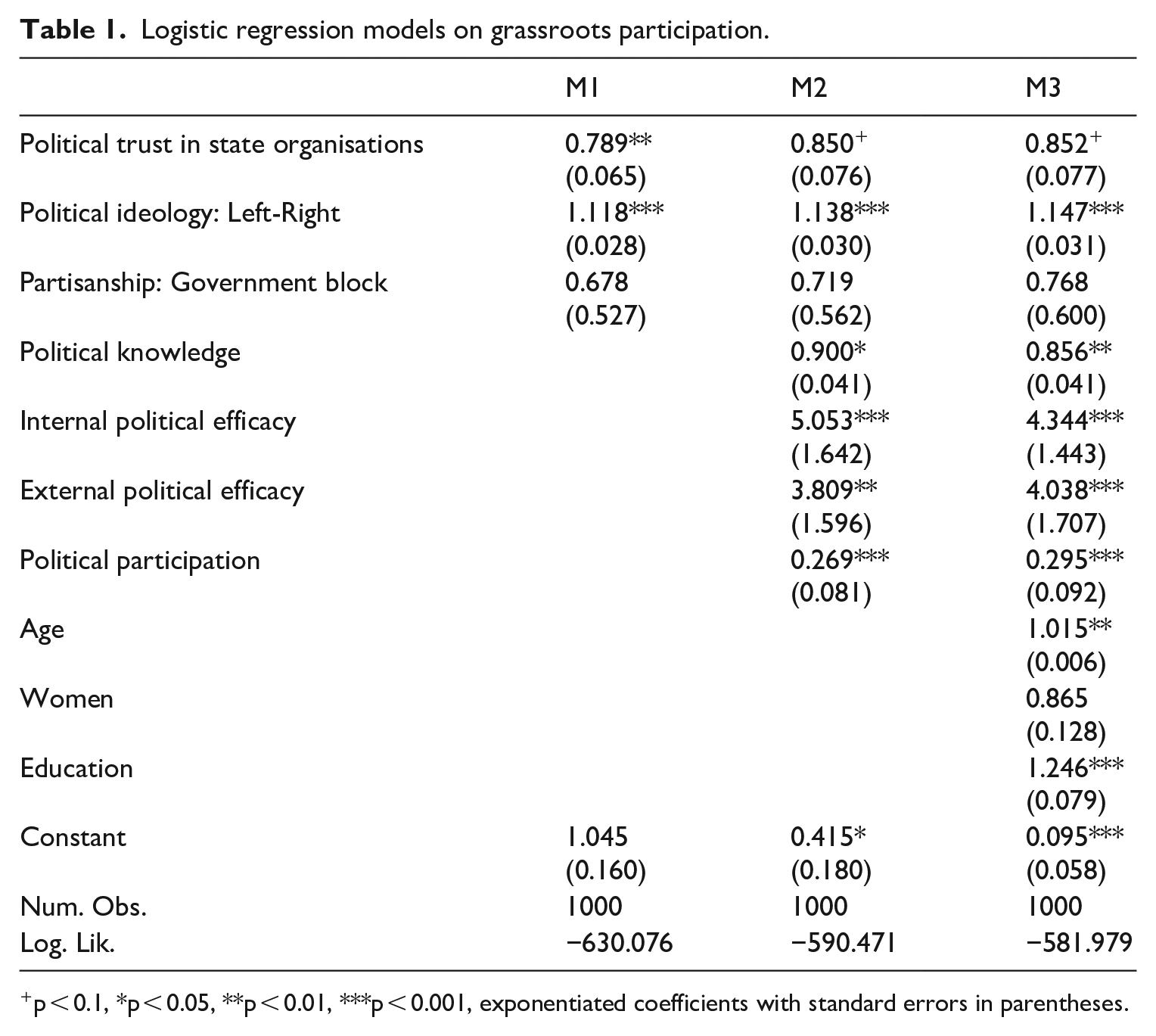
p < 0.1, *p < 0.05, **p < 0.01, ***p < 0.001, exponentiated coefficients with standard errors in parentheses.
In a series of logistic regression models designed to understand the determinants of grassroots participation, the findings reveal a complex interplay between political attitudes and demographic factors. Importantly, the regression coefficients have been exponentiated, so they are directly interpretable as odds ratios, which indicate the multiplicative change in the odds of participation for a one-unit increase in the predictor.
In the initial model (M1), political trust exhibits a significant negative relationship with grassroots participation. With an odds ratio of 0.78, each one-unit increase in political trust is associated with a 22% reduction in the odds of participating. This suggests that individuals who place greater trust in established political institutions may feel less compelled to engage in alternative, grassroots forms of political involvement, potentially viewing the formal channels as sufficient for addressing political and social issues. Conversely, ideological orientation shows a robust positive effect in the base model. An odds ratio of 1.11 indicates that each one-unit shift towards a more right-wing stance increases the odds of participation by 11%. This finding challenges traditional assumptions that grassroots movements are primarily the domain of left-leaning individuals. Instead, it implies that, within the study context, right-leaning respondents are also actively engaged, perhaps mobilising in response to specific political grievances or to counter perceived institutional shortcomings. Interestingly, partisanship is not a significant predictor in this model, showing that the influence of partisanship on grassroots engagement is either indirect or contextually overshadowed by stronger predictors such as political trust and ideology.
While the Base Model provides meaningful insights, its explanatory power is limited. The Political Controls Model M2 introduces additional political variables, offering a more comprehensive picture of grassroots participation. The inclusion of political knowledge, internal and external efficacy and prior political participation significantly enhances the model’s explanatory capacity, where the statistical significance of political trust and ideology variables is sustained. Political knowledge, which was reverse-coded as high values resemble low political knowledge, is negatively associated with grassroots participation. By contrast, internal efficacy emerges as one of the strongest predictors of participation. Individuals with a high sense of internal efficacy – believing they have the capacity to influence political processes – are significantly more likely to engage in grassroots activities. This underscores the critical role of personal empowerment in fostering civic engagement. Similarly, external efficacy, which reflects the belief that the political system is responsive to citizens’ actions, also strongly predicts participation. Together, these findings highlight the dual importance of personal agency and perceived systemic responsiveness in motivating grassroots involvement. Political participation, which was reverse-coded as high values, resembles low political participation, another variable introduced in this model, and has a significant positive effect on grassroots engagement. This result indicates behavioural continuity, where individuals with a history of political engagement are more likely to participate in grassroots activities. Such individuals may have developed a habit of active involvement or possess the necessary skills and networks to engage effectively.
The Full Model incorporates socio-demographic variables – age, gender and education – alongside the political variables from the previous model. The addition of these variables further refines the explanation of grassroots participation. Age has a small but significant positive effect, indicating that older individuals are slightly more likely to participate in grassroots organisations. This finding may reflect greater stability, time availability or accumulated civic experience among older individuals. Education, in contrast, has a more pronounced effect, with higher levels of educational attainment significantly increasing the likelihood of participation. This finding aligns with established research showing that education equips individuals with civic skills, awareness and confidence, enhancing their political engagement capacity. Notably, gender does not significantly affect this model, suggesting that grassroots participation in this context is relatively inclusive across genders, unlike other forms of political engagement where gender disparities often persist.
Discussion
The results of this analysis offer several important insights into the dynamics of grassroots participation. First and foremost, findings show that as trust in political institutions decreases, the chances of participation in grassroots movements increase, which parallels our hypotheses, and the research underlines the importance of political institutions in natural disasters since trust in government can significantly influence individuals’ willingness to engage in relief activities and their perceptions of the effectiveness of these efforts. When citizens trust their government, they are more likely to cooperate with governmental agencies and participate in organised relief efforts. For the Turkish case, similar findings to our work indicate that political trust is conducive to cooperation and vital in emergencies, as it can enhance community resilience and mobilisation (Cifuentes-Faura, 2024). To recall, the literature shows that individuals with higher levels of trust in the government perceive lower consequences of potential earthquakes and tend to make less preparation (Han et al., 2017). In addition, individuals who perceive that the government and local authorities have more knowledge about the hazard or are more responsible for protection from the hazard have a higher level of trust in the government’s ability and willingness to mitigate the hazard (Murphy et al., 2018). Scepticism observed within the Turkish public regarding donation collection has been linked to various economic and social factors, including poverty, income inequality, educational quality and perceptions of corruption. A robust culture of trust, community cooperation and mutual responsibility is essential for effectively addressing crises. Trust facilitates the mobilisation of collective action and fosters a sense of mutual commitment and obligation (Saleh, 2023).
Second, the positive association between right-wing ideological orientation and participation highlights the need to consider cultural and contextual factors when analysing political behaviour. This finding challenges stereotypes about ideological affiliations and grassroots activism, emphasising the diversity of motivations behind civic engagement. As previously explained, as individuals are expected to position themselves ideologically further to the left, their participation in grassroots movements will increase. However, the findings displayed the opposite for the Turkish case: as individuals position themselves ideologically further to the right, they increase the chances of participation in grassroots movements. Although this finding could be attributed to various factors, including nationalistic sentiments, community solidarity and a desire to address perceived inadequacies in government response, we argue that the recent earthquake in Turkey has prompted a reevaluation of these ideological dynamics. The aftermath of a natural disaster often brings communities together, transcending ideological divides. In Turkey, the earthquake might have created a cross-cutting sense of urgency and collective identity among citizens, prompting individuals from various ideological backgrounds to engage in relief efforts. Another possible explanation could be the function of Islam during the relief period. Islam’s emphasis on solidarity and mutual aid may have increased citizens’ participation in relief efforts following the earthquake. The call for help to earthquake victims by President Erdoğan, as the leader of the right-wing ideology, can also be considered a factor that may lead to increased participation in grassroots movements by those who identify themselves with the right-wing ideological position. Moreover, right-leaning individuals may view their participation as demonstrating national pride and responsibility, aligning their actions with a broader narrative of resilience and recovery. Research indicates that community identity can significantly influence participation in disaster relief efforts. For instance, individuals may feel compelled to contribute to relief initiatives to reinforce their connection to their community and demonstrate their commitment to collective well-being. This phenomenon can be particularly pronounced in contexts where national identity is closely tied to community resilience, as seen in Turkey following the earthquake (Katılmış, 2020).
Third, despite Turkey’s deeply polarised electoral landscape, our findings provide little statistical support for the expectation that grassroots engagement after the February 2023 earthquakes cleaved neatly along party lines. To recall, our hypothesis posited that voters aligned with the governing presidential bloc would be less inclined to channel resources through non‑state actors, whereas opposition supporters – skeptical of official institutions – would gravitate towards autonomous relief networks. In all three logistic models, however, the government‑bloc voter indicator fails to reach conventional significance; once controls for political efficacy, prior participation and socio‑demographics are introduced, even this tentative difference evaporates. Although several interpretations are plausible, we think that the crisis may have produced a trans‑partisan solidarity effect that temporarily muted habitual partisan filters. Volunteers often cooperated across ideological boundaries in the immediate aftermath, driven more by proximity and humanitarian urgency than party identity. Our models’ absence of a partisan divide suggests that the first weeks after the earthquakes catalysed an unusual cross‑ideological solidarity, where neighbours pulled neighbours from the rubble, shared phone batteries and pooled fuel irrespective of their partisanship. Two complementary mechanisms help explain this pattern.
First, we know that most survivors were physically present in collapsed blocks, tent encampments or makeshift distribution hubs in the quake zone. Recruitment into ad‑hoc volunteer teams flowed through street‑level familiarity – kinship ties, long-standing favours or simply recognising a face from the local market. Such ‘strong proximity cues’ (Gordon and Taft, 2011) override partisan heuristics because the costs of misidentifying an ally are high: every minute saved in debris clearance can rescue a life. Second, the massive infrastructural collapse generated a moral imperative which reframed participation as a civic duty transcending political loyalties. Social‑media hashtags circulated across partisan echo chambers and were retweeted by influencers from all parties, signalling a shared script of collective survival. This framing helped volunteers reinterpret typical partisan symbols – for example, mosque courtyards by Diyanet or AHBAP logistics centres adorned with pop‑icons – as complementary nodes in the same relief network. The statistical trace of that frame appears in the ideology coefficient: right‑leaning citizens, usually comfortable with state‑centred channels, still joined autonomous aid chains because doing so was coded as patriotic rather than oppositional. Theoretical work on the subject ratifies this: ‘bridging social capital’ argues that disasters sometimes generate short‑lived civic fusion that suspends entrenched cleavages (Pyles et al., 2018). Our evidence qualifies that claim: the fusion here was not an abstract embrace of pluralism but a practical convergence around immediate life‑or‑death tasks. Partisan mistrust resurfaced once heavy debris was cleared and relief governance shifted to compensation and accountability. Indeed Bellini and Sauter (2025) portrait of how the Turkish state ‘nationalised’ the humanitarian arena after the 2023 earthquakes. The autocratic aid‑allocation funnel shows a top‑down logic in which AFAD and the Turkish Red Crescent co‑opt loyal national NGOs, contain secular grassroots organisations through administrative hurdles and channel assistance towards regime‑friendly constituencies. Our survey captures the demand‑side echo of that funnel: citizens who perceive these partisan allocations register sharply lower trust in state bodies and are more likely to throw their effort or money behind grassroots initiatives that operate outside the official pipeline. These findings also demonstrate that the trust–participation nexus is contingent on how states manage the symbolic economy of disaster relief, moving the debate beyond a binary of ‘state versus civil society’ towards a layered account in which autocrats can simultaneously activate and appropriate grassroots energies.
Before concluding, discussing the findings related to political efficacy would be worthwhile since the strong influence of internal and external efficacy suggests that fostering a sense of personal agency and belief in systemic responsiveness could be key strategies for increasing grassroots involvement. The existing research on political efficacy suggests that individuals with a high level of interest in politics and a high sense of internal efficacy have high participation rates in various areas such as voting, other forms of conventional political participation, non-conventional political participation and civic participation (Barrett & Brunton-Smith, 2021). The findings of this study emphasise the significant role of both internal and external efficacy in shaping grassroots involvement. Internal efficacy, which reflects an individual’s belief in their ability to influence political processes, and external efficacy, which pertains to the belief that the political system is responsive to citizens’ actions, form a powerful driver of civic engagement. In addition, the interaction between political efficacy and satisfaction with government performance further influences an individual’s willingness to engage in grassroots (Zhan & You, 2024), highlighting the importance of both personal agency and trust in the responsiveness of political institutions. Finally, age is often seen as a key factor in shaping political participation, with younger individuals typically being more disengaged from formal political processes but increasingly involved in alternative forms of activism, such as grassroots movements. Flanagan and Levine (2010) highlight that while some young people actively engage in political and social causes, many remain disconnected from civic life due to cynicism, disillusionment or a sense of powerlessness. This disengagement is also reflected in Gordon and Taft’s (2011) study, which suggests that many youth feel detached from societal issues, contributing to their reduced participation in political processes. In contrast, older individuals are generally more likely to engage in grassroots organisations, as indicated by the positive effect of age in our findings.
Conclusion
This study set out to explain why, in the aftermath of the February 2023 earthquakes, so many citizens opted to work through grassroots organisations instead of relying solely on state structures. Drawing on a country‑representative survey conducted 2 months after the disaster, the analysis tested three propositions centred on political trust, ideological self‑placement and partisan attachment. The findings demonstrate that trust deficits constitute a crucial predictor of grassroots engagement. Respondents who rated key state bodies unreliable were markedly more inclined to volunteer time or donate resources to autonomous networks. That pattern persisted even after controls for political knowledge, efficacy, prior participation and socio‑demographics, indicating that perceptions of institutional failure rather than individual capacity or civic habit chiefly motivated bottom‑up action in Turkey’s electoral‑authoritarian setting, where corruption scandals and delayed relief eroded legitimacy, grassroots organisations became functional substitutes for a faltering state.
The second proposition concerned ideology. Conventional scholarship often links left‑leaning identities to protest‑style mobilisation, yet the data show that right‑oriented respondents were significantly more active after the quakes. This counter‑intuitive relationship is best understood in light of the moral framing that emerged during the first relief phase: volunteering was cast as a duty and an affirmation of communal resilience, themes that resonate strongly with nationalist and religious worldviews. Simultaneously, secular groups such as AHBAP and AKUT gained credibility by displaying transparency and logistical efficiency, making them attractive to citizens of diverse ideological stripes. Ideology, therefore, conditioned participation, but in a direction opposite to that expected – an outcome that invites scholars to reconsider how natural disasters reorder symbolic associations between left, right and the repertoire of contention.
The third hypothesis, which predicted a partisan cleavage in relief activism, received no support. Once trust and efficacy were entered into the models, the formal distinction between government‑bloc and opposition voters lost predictive power. The absence of a partisan effect suggests that the humanitarian emergency temporarily displaced routine party cues, enabling cross‑ideological cooperation that Turkey’s polarised politics rarely permits. Yet the durability of this solidarity remains an open question; how these informal alliances fare once attention turns from rescue to compensation and accountability will be decisive for the country’s broader democratic trajectory.
However, several limitations must be noted. The study focuses on a single case – the 2023 earthquake in Turkey – which may limit the generalisability of the findings to other contexts or types of disasters. In addition, while the data provided insights into the relationship between political trust and grassroots participation, it did not account for the quality or long-term sustainability of the grassroots movements themselves. Future research should explore the longitudinal effects of disaster-driven grassroots movements, examining whether they lead to sustained political or social change. Investigating the role of social media across different types of disasters and varying political environments would also provide a deeper understanding of how technology shapes modern civic engagement. Finally, exploring the intersection of political ideology and grassroots activism in more diverse political contexts would yield valuable insights into the conditions that foster or hinder collective action during crises.
Several research agendas follow from these findings. Longitudinal surveys could test whether the observed civic fusion survives the transition from emergency response to the more contentious politics of rebuilding. Fine‑grained organisational data would clarify whether regime‑friendly charities, autonomous secular NGOs and neighbourhood committees attract different social bases and cultivate distinct political repertoires. Incorporating refugee and migrant populations, largely omitted from the present sample yet disproportionately affected by discriminatory aid allocation, would reveal whether the trust–participation nexus functions differently when formal citizenship rights are lacking. Finally, comparative work across other electoral autocracies exposed to large‑scale shocks could determine whether Turkey’s pattern of trust withdrawal and cross‑ideological volunteering is idiosyncratic or indicative of a broader authoritarian governance dilemma.
The evidence indicates that political trust is not a passive sentiment but an active resource that citizens withdraw, redeploy and rebuild in the crucible of crisis. When state performance falters under extraordinary strain, grassroots mobilisation becomes both a barometer of institutional legitimacy and a potential incubator of new civic repertoires. Understanding that dynamic is essential for disaster management in Turkey and assessing the resilience of democratic norms in an era of escalating environmental and political shocks.
Supplemental Material
sj-docx-1-psw-10.1177_14789299251357768 – Supplemental material for From the Ground Up: Investigating the Relationship between Political Trust and Citizen Participation in the Wake of the Turkey Earthquake
Supplemental material, sj-docx-1-psw-10.1177_14789299251357768 for From the Ground Up: Investigating the Relationship between Political Trust and Citizen Participation in the Wake of the Turkey Earthquake by Didem Mina Kara and Emre Toros in Political Studies Review
Footnotes
Declaration of conflicting interests
The author(s) declared no potential conflicts of interest with respect to the research, authorship, and/or publication of this article.
Funding
The author(s) disclosed receipt of the following financial support for the research, authorship, and/or publication of this article: This study is partially funded by TUBITAK 1001 Scientific Research scheme with the project number 122K368.

Additional Supplementary Information may be found with the online version of this article.
1.Variables and operationalisations
2.Descriptives of sample and model variables
3.The IRT analysis
4.Survey information
Author biographies
References
Supplementary Material
Please find the following supplemental material available below.
For Open Access articles published under a Creative Commons License, all supplemental material carries the same license as the article it is associated with.
For non-Open Access articles published, all supplemental material carries a non-exclusive license, and permission requests for re-use of supplemental material or any part of supplemental material shall be sent directly to the copyright owner as specified in the copyright notice associated with the article.
