



Abstract
According to the cleavage literature, there is a cultural conflict in Europe where libertarian-cosmopolitan positions oppose traditionalist-communitarian ones. Empirically, however, it remains unclear how individuals position themselves across issues of environmentalism, gender, sexual diversity, immigration and the European Union and how these positions are linked. This article explores what multidimensional attitudinal configurations exist in Europe, how they are rooted in social structure and linked to party identification. Using data from 21 countries in the European Values Study 2017, I first conduct latent profile analysis on individual attitudinal data, followed by regression analysis to assess the resulting profiles’ socio-structural and political underpinnings. Although ambivalent and multidimensional attitudes dominate, results show a divide of sexual diversity attitudes. The attitudinal groups are stratified along occupation, education and the political spectrum. The findings contribute to a more nuanced understanding of cultural attitudes in Europe and cast doubt on the assumption of a polarized cultural conflict.
Introduction
Recent public and scholarly debates highlight the polarization of European societies along cultural attitudes rather than economic issues, which are often seen as less significant. However, empirical evidence on the linkage between different cultural attitudes and the attitudinal groups they form is scarce. Following the cleavage literature, we face an embedded cultural conflict in Europe today dividing societies into two opposing camps: libertarian-cosmopolitan positions and traditionalist-communitarian positions (Bornschier, 2010; Teney et al., 2014). Accordingly, the present attitudinal divides are the product of a two-fold transformation of the political and attitudinal space since the 1960s and 1970s. First, at that time, New Social Movements of the left pushed for cultural liberalism in society by defending environmentalism, sexual diversity, egalitarian gender roles and gender equality. This created an attitudinal divide between traditionalists and libertarians. In the 1990s, right-wing populist parties reshaped the attitudinal space in Europe embedding immigration and European integration issues into the existing cultural conflict leading to the cosmopolitan-communitarian divide (Bornschier, 2010; Kriesi, 2010; Kriesi et al., 2008, 2012). This time, so-called winners of globalization, well-educated citizens with high occupational status who embrace open borders as they benefit from it, are opposed to so-called losers of globalization. Losers of globalization are lower educated citizens with lower occupational status who see immigrants as a threat to their identity and economic position (Teney et al., 2014). The divides, which structure both attitudes and social strata, also influence voting behaviour. Studies show that the higher to upper middle social strata holding libertarian-cosmopolitan attitudes are more likely to vote for GAL (green-alternative-libertarian) parties whereas the lower social strata holding traditionalist-communitarian attitudes are more likely to vote for TAN (traditional-authoritarian-nationalist) parties (Dolezal, 2010; Hooghe and Marks, 2009; Oesch, 2012; Oesch and Rennwald, 2018).
According to the understanding of a single cultural divide in which all kinds of cultural issue attitudes are embedded, linking libertarian to cosmopolitan and traditionalist to communitarian views in a unidimensional way, individuals’ attitudinal positions are predictable across issues (De Wilde et al., 2020). In this perspective, gender egalitarians should have pro-immigrant views, embrace environmentalism, support European integration and accept sexual diversity. Traditionalist-communitarians, by contrast, should have exactly the opposite attitudinal positions on all these issues. Other literature strands though empirically diagnose a spread of ambivalent, multidimensional attitudinal positions combining mixed attitudinal positions towards different issues. For instance, individuals may hold egalitarian views on gender equality while maintaining traditional views on gender roles or may be tolerant of sexual diversity while opposing immigration (Grunow et al., 2018; Knight and Brinton, 2017; Lancaster, 2020; Spierings, 2021; Spierings et al., 2017). Although already Kitschelt assumes conflicts to be multidimensional (Kitschelt and McGann, 2005: 80), scholars have yet to explore how these multidimensional attitudinal groups integrate and transform the bipolar cultural divide.
Understanding the implications of an embedded cultural divide rooted in the social structure and predicting vote choice is crucial, as they could lead to a polarized society. Therefore, it is important to conduct a fine-grained analysis of cultural attitudinal groups in Europe and to highlight multidimensional conflicts beyond the bipolar divide. This article aims to explore whether cultural attitudes form an aligned divide or multidimensional attitudinal groups, using data from the European Values Study 2017. Applying Latent Profile Analysis (LPA), I identify attitudinal profiles in Europe across attitudes towards immigration, the EU, environmental protection and climate change, gender roles and gender equality, and sexual diversity. Next, I regress the classified attitudinal profiles on social structural characteristics and party identification to assess whether the attitudinal divides coincide with social and political divides. By linking all three key features of a cleavage (cf. Bartolini and Mair, 1990; Deegan-Krause, 2007), this study contributes to a better understanding of structured conflicts in Europe and advances cleavage literature more generally.
The Cultural Divide in Europe
Embedding of Libertarian-Cosmopolitan and Traditionalist-Communitarian Positions
The cleavage literature distinguishes between two types of conflict, economic and cultural. In the first half of the twentieth century, it was the traditional class conflict (or distributional conflict) that predominated ideological conflicts in Europe. Political attitudes towards social inequality, authoritarianism, state intervention and market liberalism lie at the heart of this conflict (Bornschier, 2010; Kriesi et al., 2006). The religious cleavage centred on the role of religious norms in society has built the cultural axis of contention in Europe at that time (Bornschier, 2010; Inglehart and Baker, 2000; Pless et al., 2020).
In the meantime, two major developments transformed the political space in Europe according to cleavage scholars. First, the economic conflict has lost in salience and the cultural conflict has taken the leading role in dividing attitudes and predicting vote choice (Ford and Jennings, 2020; Kriesi et al., 2006). Second, in parallel to this development the nature of the cultural conflict has changed in two rounds of transformation. The first round of transformation took place in the 1970s when New Social Movements linked to the political left were pushing for universalistic values. New lifestyles, sexual diversity and identity, alternative family models, feminist rights and abortion, peace, anti-authoritarianism, nuclear powers and environmental protection belong to the most politicized issues of that time. A value conflict between culturally libertarian and culturally traditionalist or authoritarian ideals and conceptions of justice established and is labelled cultural simply because it rallies non-economic issue attitudes (Azmanova, 2011; Bornschier, 2010; Deegan-Krause, 2007; Dolezal, 2010).
The second round of transformation hit in the 1990s and was driven by radical right parties. Bornschier (2010) argues that because the new right countermovement was ideologically diffuse, it needed political leadership to break through. The countermovement involved two elements: first, the opposition to the cultural liberalism issues, and second, the promotion of new issues, especially immigration. Next to immigration, European integration constitutes the core issue of this ‘new’ cultural cleavage. Supporters of immigration and European integration are oftentimes associated with winners of globalization whereas so-called losers of globalization tend to perceive immigrants as a threat and to be Eurosceptic as they seek to defend their conception of community. Communitarian positions are thus opposed to cosmopolitan positions in this divide (Bornschier, 2010; Kriesi, 2010; Kriesi et al., 2006; Teney et al., 2014).
Although the two rounds of conflict feature different political issue attitudes, cleavage scholars advocate that they are embedded in a unidimensional conflict mainly because of three key factors (Bornschier, 2010; Dolezal, 2010; Kriesi et al., 2006). First, libertarian as well as cosmopolitan values are both considered to be driven by education. Individuals with higher education are more likely to hold libertarian as well as cosmopolitan attitudes than individuals with lower education. Häusermann and Kriesi (2015) explain: ‘Education has a‚ liberalizing‘ effect; that is, it induces a general shift of political value orientations toward cultural liberalism, cosmopolitanism, and universalism’ (Häusermann and Kriesi, 2015: 205). By contrast, the lower educated are prone to ‘cultural backlash’ as they feel more insecure about their labour market position, their cultural identity and gender role (Abou-Chadi and Finnigan, 2019; Inglehart and Norris, 2017; Lancaster, 2021; Pfau-Effinger, 2005). Hence, traditionalist and communitarian views are more likely among lower educated people as cultural and economic threats have increased over the past decades. This explanation resonates well with the literature on gender ideologies that makes similar assumptions about egalitarian and traditionalist gender attitudes. Accordingly, particular segments of the highly educated upper and middle class drive egalitarian attitudes, whereas the lower educated are more likely to hold (moderate) traditionalist attitudes (Bolzendahl and Myers, 2004; Knight and Brinton, 2017; Scarborough et al., 2019). Similar socio-structural divides have also been identified for attitudes towards environmental protection (Otto and Gugushvili, 2020).
Second, these divides induced by education are reinforced with increasing dynamics of globalization and so-called modernization. Scholars argue that macro level processes such as globalization, educational expansion, digitalization and so-called modernization have been advantageous for those individuals who were well equipped by high levels of educational attainment, i.e. the ‘winners’ of globalization. However, they have been highly consequential for the lower educated who were faced with increasing international economic competition, economic insecurity, unstable family arrangements and challenges to the cultural and national identity, i.e. the ‘losers’ of globalization (De Wilde et al., 2019; Inglehart and Norris, 2003; Kriesi et al., 2012; Teney et al., 2014; Teney and Rupieper, 2023). Ultimately, the socially structured groups holding aligned cultural attitudes shape social identities (Bornschier et al., 2021).
Third, cosmopolitans and libertarians are both more likely to vote for GAL (green-alternative-libertarian) parties whereas communitarians and traditionalists are more likely to vote for TAN (traditional-authoritarian-nationalist) parties (Hooghe and Marks, 2009). This has been widely demonstrated for Western European countries (Bornschier et al., 2021; Dolezal, 2010; Off, 2023) and recently also for Central and Eastern European countries as concerns immigration attitudes (Lancaster, 2021).
The cleavage literature focuses on the polar edges of both, the libertarian-traditionalist and the cosmopolitan-communitarian divide, pushing for the assumption of a unidimensional bipolar divide with two oppositional attitude camps (Teney et al., 2014; Zürn and de Wilde, 2016). The closer attitudes align and the stronger the cultural divide, the more polarized European societies are in ideological terms (Borbáth et al., 2023). In such an embedded divide, individual attitudes towards one cultural issue can predict the position towards any other cultural issue attitude. Consequently, I expect issue attitudes towards gender, sexual diversity, the environment, immigration and the EU to form a libertarian-cosmopolitan group and a traditionalist-communitarian group (1). This empirical expectation is visualized in Figure 1, which summarizes the theoretical linkages between the cultural issue attitudes.
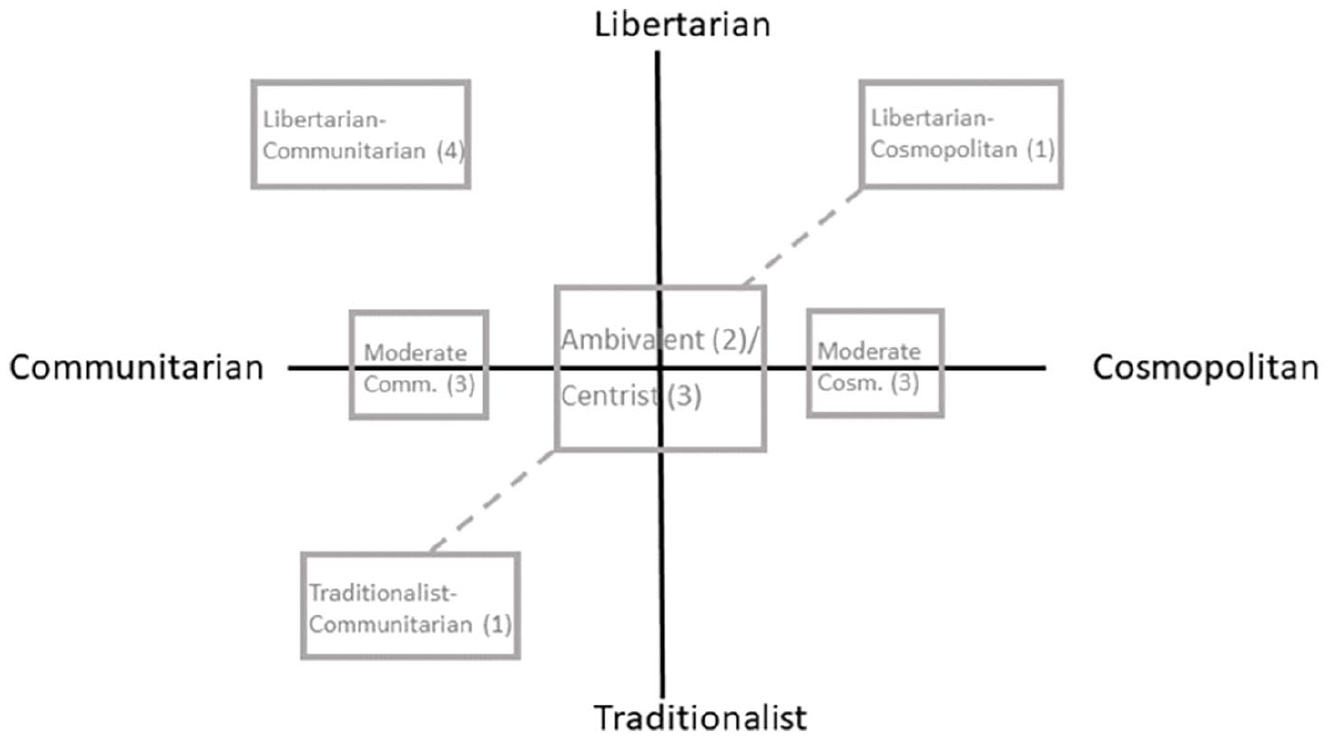
Synthesis of Theoretical Linkages and Hypotheses Between Cultural Issue Attitudes.
Multidimensional Attitudes Challenging the Alignment of Cultural Issue Attitudes
The embedded cultural divide, however, is only one possible attitudinal configuration. Yet, attitudinal conflicts might be more complex than the predominant bipolar divide in the cleavage literature suggests. Already Kitschelt acknowledged that attitudinal conflicts ‘are likely to be multidimensional’ (Kitschelt and McGann, 2005: 80). That means the cultural conflict has multiple facets and issues and people’s attitudes might differ depending on the issue at stake. Three forms of multidimensionality are possible: (a) multidimensionality within attitude dimensions (e.g. between multiple gender issues), (b) multidimensionality between attitude dimensions (e.g. between gender and immigration issues) and (c) ambivalent or centrist attitudes (i.e. positions in the middle of the attitudinal spectrum). Ambivalent attitudes shall describe middle positions related to issue attitudes of the libertarian-traditionalist divide and centrist attitudes shall describe middle positions related to issue attitudes of the cosmopolitan-communitarian divide. As such, they are conceptually different from multidimensionality types a and b, but also represent a divergence from the bipolar divide in the cleavage literature, which is why they are discussed as part of the same typology. Ambivalent or centrist positions can have multiple reasons. The most likely reasons in the European context are lack of political interest or centrist party cues (Rodon, 2015). Oftentimes the former is the case for less salient issues and weakly aligned attitudes, whereas the latter signals centrist normative ideas or moderate attitudinal positions (Baldassarri and Goldberg, 2014; Kriesi, 2010; Rodon, 2015). Both result in a lack of political conflict and attitudinal polarization, because individuals’ positions are easily connectable to others or because they are volatile or vary across issues.
Multidimensional Attitudes Linked to the Libertarian-Traditionalist Divide
As concerns attitudes towards gender, sexual diversity and the environment, all cultural issue attitudes related to the libertarian-traditionalist divide, previous studies indeed show that they are multidimensional. According to the literature on gender ideologies, the unidimensional distinction between egalitarian and traditionalist gender attitudes no longer adequately describes contemporary gender ideologies. On the one hand, the traditionalist pole vanishes over time, whereas on the other hand, new multidimensional forms of gender ideologies emerge such as gender essentialism or egalitarian familism (Begall et al., 2023; Grunow et al., 2018; Knight and Brinton, 2017). These positions combine rather traditionalist positions viewing family and childcare alone being fulfilling for women with egalitarian attitudes concerning women’s right to a job and their contribution to the household income. Essentially, they are a consequence of the uneven value change related to the egalitarian shift in the public sphere and the stalled gender revolution in the private sphere (England, 2010; Sullivan et al., 2018). Politically, individuals holding ambivalent, multidimensional gender ideologies are associated with centre-right or no party identification (Diabaté et al., 2023).
Previous studies on environmentalism point to its multidimensional association with other issue attitudes. In some contexts, environmentalism is aligned with gender attitudes, while in others, it is part of the economic divide given that environmental protection is oftentimes associated with a lot of costs and perceived as contradicting economic prosperity (Gugushvili, 2021; Kitschelt and McGann, 2005; Kriesi et al., 2006, 2008, 2012). The dual dimensionality of environmentalism can lead to ambivalent attitudes or, in other cases, form a completely separate attitudinal dimension. Most recently, Kenny and Langsæther (2022) have shown that these attitudes constitute a proper dimension next to the cultural dimension with different social predictors. Hence, I expect to find a group of ambivalent, multidimensional gender and environmentalism attitudes (2).
Multidimensional Attitudes Linked to the Cosmopolitan-Communitarian Divide
Arguably, the multidimensional aspect also applies to immigration and EU attitudes and therefore to the cosmopolitan-communitarian divide. Scholars emphasize that the European integration issue has two dimensions, a cultural and an economic one (Azmanova, 2011; Van Klingeren et al., 2013). Consequently, individuals’ positions towards the issue might differ depending on the dimension at stake. For example, individuals may have divergent opinions towards European integration, enlargement and certain policies (De Vries, 2018; Toshkov and Krouwel, 2022). Oftentimes, attitudes towards the EU lie in-between the two dimensions, which makes them less likely to be strongly aligned with other cultural attitudes (De Wilde et al., 2020; Toshkov and Krouwel, 2022).
Similarly, immigration attitudes are attributed a cultural and an economic dimension (Stephan and Stephan, 1996), although scholars find that cultural threat mechanisms can explain anti-immigrant attitudes better than economic threat mechanisms. Furthermore, attitudes are related to security and crime threats and differ by groups of immigrants (Hellwig and Sinno, 2017; Hendriks et al., 2022; Schlueter and Scheepers, 2010). All these features show that attitudes towards immigrants are no homogeneous phenomenon, but are likely to be multidimensional.
Attitudes in the middle of the cosmopolitan-communitarian divide have so far received scant attention in the literature. Cleavage scholars tend to interpret attitudinal heterogeneity or centrism as structural weakness and declining ideological grounds (Kriesi, 2010). Generally, though, centrist and moderate positions are widespread across Europe (Rodon, 2015). New empirical evidence reveals large groups of moderate cosmopolitan and moderate communitarian attitudes with shares of 45.7% and 28.6% in Europe, which tend to crowd out strong cosmopolitanism and communitarianism (Dilger, 2023). Subsequently, I expect to find groups of centrism and moderate cosmopolitanism and communitarianism (3).
Multidimensional Attitudes Across Attitudinal Divides
In the last years, studies have found empirical evidence for multidimensional attitudes across attitudinal divides. An attitudinal phenomenon called ‘homonationalists’ (Spierings, 2021) or ‘sexually modern nativists’ (Spierings et al., 2017) has received broad attention in the literature. Essentially, scholars find that individuals holding anti-immigrant views, the core constituency of the radical right, have libertarian attitudes towards sexual diversity and gender equality (De Koster et al., 2014; Lancaster, 2020; Spierings, 2021; Spierings et al., 2017). Arguably, these people fear the return of traditional values due to incoming migrants and see themselves as defenders of liberal values like sexual diversity or gender equality. As a result, attitudes towards gender and sexual diversity from the first transformation of politics might cut across immigration attitudes of the second transformation linking libertarian to communitarian attitudes. Moreover, a recent article studying the linkage between immigration, EU and gender attitudes finds different groups of multidimensional attitudes across Europe (Schäfer et al., 2024). In Western Europe, centrist attitudes predominate and are linked to a wide spectrum of different gender attitudes from egalitarianism to traditionalism. In Central and Eastern Europe, the authors find predominantly ambivalent gender attitudes which are in turn linked to cosmopolitan, centrist and communitarian attitudes towards immigration (while attitudes towards the EU are hardly divided) (ibid.).
I therefore expect to find ambivalent-centrist and multidimensional groups across attitudinal divides such as libertarian-communitarianism that combine cultural issue attitudes in new ways (4).
To sum up, previous studies find different forms of multidimensional attitudes linked to different cultural issue attitudes between both the libertarian-traditionalist and the cosmopolitan-communitarian divide and to different combinations across the two divides. They challenge the structure of the bipolar cultural divide put forward by the cleavage literature and cast doubt on the level of polarization this divide entails. Figure 1 visualizes the empirical expectations derived from the literature.
Data and Methods
The empirical analysis is based on the European Values Study (EVS) from 2017. The EVS is a large-scale standardized survey of the adult population conducted across European countries. The questionnaire particularly targets a variety of individual values and beliefs. The present analysis includes all European member states as of 2017 in order to guarantee the comparability of the EU items. The subsequent sample comprises 21 countries 1 with a total amount of 34,926 (N) respondents.
Measures
The empirical analysis covers attitude items of six different dimensions: immigration, the EU, the environment, gender roles and sexual diversity. For each dimension, I have selected two items. Gender attitudes are included as two separate factors. 2 The measures are listed in Table 1.
Key Attitudinal Variables.
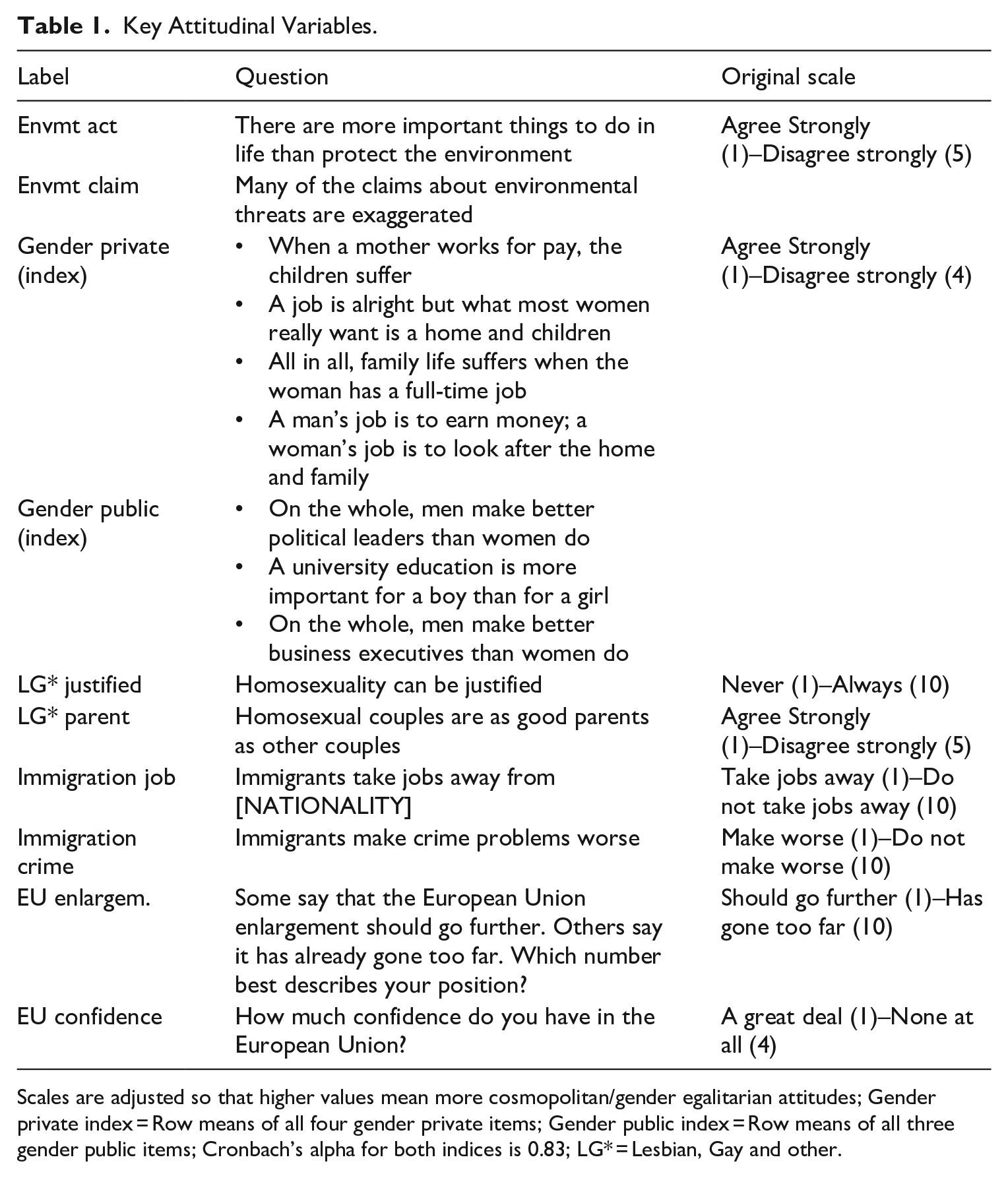
Scales are adjusted so that higher values mean more cosmopolitan/gender egalitarian attitudes; Gender private index = Row means of all four gender private items; Gender public index = Row means of all three gender public items; Cronbach’s alpha for both indices is 0.83; LG* = Lesbian, Gay and other.
Before conducting the analysis, all item scales were harmonized from zero to one and their direction was adjusted so that higher values mean more libertarian/ cosmopolitan positions. Moreover, I have included measures of respondents’ occupational class using the Oesch class scheme (Oesch, 2012), employment status, educational level, gender, religiosity and party appeal to assess the socio-structural and political underpinning of the attitudinal groups. Descriptive statistics of all measures are provided in section B in the Supplementary Material.
The final analytic sample consists of 34,915 observations, excluding 11 respondents for whom information on all attitude items were missing.
Analytic Strategy
To analyse the ideological configurations in Europe, I apply Latent Profile Analysis (LPA). LPA is a latent class mixture model that clusters individuals based on their survey response behaviour on individual attitudes. Its purpose is to ‘uncover latent profiles or groups of individuals who share a meaningful and interpretable pattern of responses on the measures of interest’ (Ferguson et al., 2020: 459). Survey items serve as indicators to calculate the latent profiles. The indicators are continuous variables of individual attitudes and the outcome variable is a categorical variable of attitudinal groups with as many values as there are latent profiles. In LPA, the profiles are constructed based on individual response probabilities, which has two main advantages. First, in contrast to non-probabilistic cluster analysis, the probabilistic model accounts for misclassification and second, in contrast to factor analysis, LPA is not a variable-based but a person-centred approach. Hence, the profiles are determined by response patterns of individuals and not by relationships between variables. The data driven approach is sensitive to multidimensional attitude patterns and can detect both, unidimensional and multidimensional attitudinal groups (Ferguson et al., 2020). In LPA, multiple models with different numbers of profiles are estimated and compared in terms of model fit, parsimony and interpretability of profiles. The LPA models are estimated in Mplus, Version 8.8, using the full information maximum likelihood (FIML) criterion to deal with missing data. 3 The multi-stage modelling process and the subsequent model choice for the present analysis are detailed in section C in the Supplementary Material. Its outcome is a 6-profile model with homogeneous but distinct profiles, which are parsimonious (see section D in the Supplementary Material), account for the most common attitudinal profiles across European countries (see section E in the Supplementary Material) and are robust across attitude items and under alternative model specifications (see section F in the Supplementary Material).
Next, the latent profile posterior probabilities of the final LPA are used to estimate the profile memberships for different socio-structural characteristics and party identification. To do so, I follow the manual three-step approach, also called BCH approach (Bolck et al., 2004). This approach is currently the state of the art, because it accounts for uncertainty related to the classification process at all stages of the analysis (Asparouhov and Muthen, 2014; Ferguson et al., 2020). In the first step, I follow the LPA modelling process described above to find the best model. In the second step, I replicate this LPA model increasing the start values to 1000 in order to avoid local maxima when confirming the initial estimation of the model. In the third step, I perform a multinomial logistic regression on socio-structural characteristics and party identification using the profile membership as dependent variable and the posterior probabilities of profile membership from the obtained model outcome of the second step as weights.
Results
Configurations of Attitudinal Groups in Europe
The LPA identified the following six attitudinal profiles in Europe as shown in Figure 2 4 : A large Libertarian-Moderate Cosmopolitan profile with a share of 25%, a cross-cutting Moderate Libertarian-Moderate Communitarian profile with 15.7% of respondents, two profiles located in the attitudinal centre, namely a Moderate Libertarian-Centrist profile of 12.7% and a large Ambivalent-Centrist profile of 21.4%, another cross-cutting Ambivalent-Moderate Cosmopolitan profile comprising 10.4% of respondents, and finally a Traditionalist-Moderate Communitarian profile representing 14.8% of respondents’ attitudes. Remarkably, attitudes towards sexual diversity show the largest attitudinal variation between profiles. In general, environmental and gender issue attitudes seem to have a slight libertarian-egalitarian drift, whereas particularly EU issue attitudes have an overall tendency towards moderate and centrist positions.
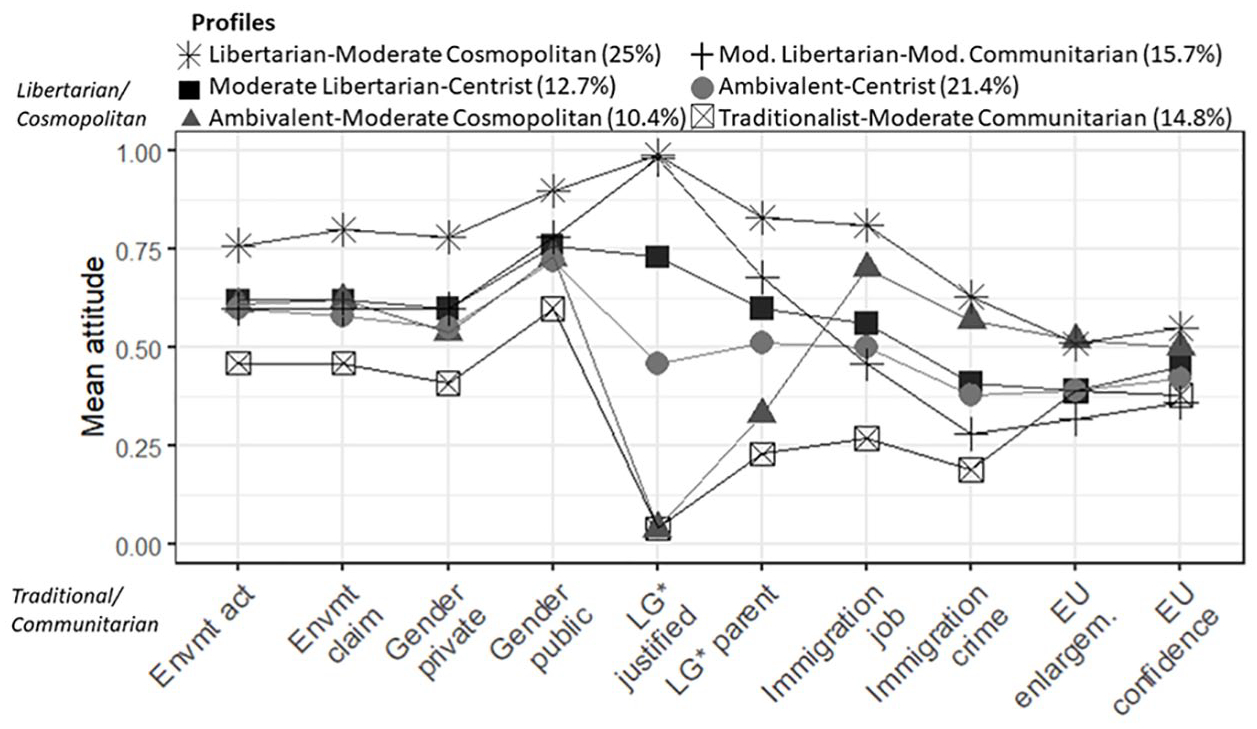
Latent Profiles of Cultural Attitudes in Europe.
Libertarian-Moderate Cosmopolitan Profile
Respondents in the large Libertarian-Moderate Cosmopolitan profile agree on taking action to protect the environment and think that environmental claims are not exaggerated. Moreover, they approve egalitarian gender roles in the private sphere and even more so gender equality in the public sphere. Respondents in this profile clearly have no doubt that homosexuality is justifiable and they agree on the statement that homosexual couples can be as good parents as heterosexual couples. Taking these attitudinal positions together that are formally linked to the value change of the 1970s, respondents can be labelled as libertarian. As concerns attitudes towards issues of the new cultural divide, respondents in the profile agree that immigrants do not take away jobs from nationals and they tend to agree that immigrants do not make crime problems worse. They believe that EU enlargement until now is just fine and they neither feel confident nor unconfident about the EU as a whole. Together, attitudes towards immigration and the EU in this profile represent a position that can be labelled as moderate cosmopolitan relative to the other attitudinal profiles.
Moderate Libertarian-Moderate Communitarian Profile
In the Moderate Libertarian-Moderate Communitarian profile, respondents tend to agree on taking action to protect the environment and think that environmental claims are not exaggerated. They approve egalitarian gender roles in the private sphere and even more so gender equality in the public sphere, but not as much as respondents from the Libertarian-Moderate Cosmopolitan profile. Moreover, respondents think that homosexuality is justifiable and they agree on the statement that homosexual couples can be as good parents as heterosexual couples. While respondents generally have a libertarian view in this profile, compared to the Libertarian-Moderate Cosmopolitan profile, it is less pronounced and can thus be described as moderate libertarian. Concerning immigration and EU issues, respondents’ attitudes in this profile lay at the communitarian part of the attitudinal scales. Respondents tend to agree that immigrants take away jobs from nationals and that immigrants make crime problems worse. Relative to other profiles, they are rather sceptical of European enlargement and of being confident about the EU as a whole. Hence, moderate libertarian positions are coupled with moderate communitarian positions in this profile creating a cross-cutting profile.
Moderate Libertarian-Centrist Profile
Respondents in the Moderate Libertarian-Centrist profile hold similar attitudes towards the environment and gender like respondents from the previous Moderate Libertarian-Moderate Communitarian profile. Although their acceptance of sexual diversity is slightly less pronounced in this profile, respondents still tend to agree that homosexuality is justifiable and that homosexual couples can be as good parents as heterosexual couples. Hence, their stance towards issue attitudes related to the libertarian-traditionalist divide can overall be classified as moderate libertarian. As concerns attitudes towards immigration and the EU, respondents hold rather centrist positions located in the middle of the attitudinal scales. They neither agree nor disagree about immigrants taking away jobs from nationals, they tend to agree that immigrants make crime problems worse, that EU enlargement has gone too far and are not really confident about the EU as a whole.
Ambivalent-Centrist Profile
In the Ambivalent-Centrist profile, respondents’ attitudes towards the environment and gender are similar to respondents’ attitudes in the moderate libertarian profiles. Respondents’ attitudes towards sexual diversity are located at the middle of the attitudinal spectrum. Apparently, respondents neither agree nor disagree on whether homosexuality is justified and whether homosexual couples can be as good parents as heterosexual couples. To account for this ambivalence about sexual diversity and the ambivalence related to attitudes towards gender and the environment, this profile is labelled Ambivalent-Centrist. Respondents’ attitudes towards immigration and the EU in this profile are considered centrist and in line with the previous Moderate Libertarian-Centrist profile.
Ambivalent-Moderate Cosmopolitan Profile
Respondents in the Ambivalent-Moderate Cosmopolitan profile hold similar attitudes towards the environment and gender as the previous moderate libertarian and ambivalent profiles. Yet, they differ with respect to their attitudes towards sexual diversity. Respondents do not agree that homosexuality is justified and they do not think that homosexual couples can be as good parents as heterosexual couples, which can be classified as moderate traditional. To account for the divergence, I labelled their overall views on all three issue attitudes ambivalent. As concerns attitudes towards immigration, respondents hold pro-immigration attitudes relative to the other profiles. EU attitudes in this profile are somewhat cosmopolitan relative to the other profiles, but respondents stand in the middle of the attitudinal scale. Hence, I labelled this profile Ambivalent-Moderate Cosmopolitan.
Traditionalist-Moderate Communitarian Profile
Compared to the other profiles, respondents’ attitudes in this profile can be classified as relatively Traditionalist-(Moderate) Communitarian. Yet, respondents differ in their views towards the single issue attitudes. They are slightly against environmental protection and believe that environmental claims might be a little exaggerated. They do not support egalitarian gender roles in the private sphere, but are weak supporters of gender equality in the public sphere. Clearly, they oppose the statement that homosexuality is justified and reject the statement that homosexual couples are as good parents as are heterosexual couples. Taking these attitudes together, respondents hold traditionalist attitudes towards issues of the 1970s—especially relative to the other profiles. Moreover, respondents think that immigrants take away jobs from nationals and that immigrants make crime problems worse. They also tend to agree that EU enlargement has gone too far and are not really confident about the EU as a whole. Hence, these views can be labelled as moderate communitarian.
To sum up, the latent profile analysis shows that respondents’ positions towards cultural issue attitudes form different attitudinal configurations of which only about 40% form a cultural divide between libertarian-(moderate) cosmopolitan and traditionalist-(moderate) communitarian positions. Instead, attitudinal configurations are multidimensional and cross-cutting as it is the case for anti-sexual diversity and pro-immigration attitudes. In addition, a large share of respondents has ambivalent-centrist attitudes. Moreover, the empirical findings reveal a polarization of sexual diversity attitudes in Europe.
Socio-Structural and Party Political Underpinning of Attitudinal Groups
In this section, the latent profiles are linked to their socio-structural underpinning. Following the logic of cultural divides, the most opposite profiles (Libertarian-Moderate Cosmopolitan and Traditionalist-Moderate Communitarian) should be most structured, while ambivalent, multidimensional profiles should show less socio-structural differences.
Figure 3 shows the chances of profile membership for the different socio-structural characteristics in reference to the Libertarian-Moderate Cosmopolitan profile. Technical (semi-)professionals, as well as production and service workers are more likely than socio-cultural professionals to belong to any profile other than the reference, Libertarian-Moderate Cosmopolitanism. In addition, small business owners are more likely than socio-cultural professionals to hold Traditionalist-Moderate Communitarian and Moderate Libertarian-Moderate Communitarian attitudes. Lower educated people have almost 10 times the chance to hold Traditionalist-Moderate Communitarian attitudes than higher educated people. Generally, lower and medium educated people are more likely than higher educated people to belong to any profile other than Libertarian-Moderate Cosmopolitanism. Men are particularly more likely to hold Traditionalist-Moderate Communitarian and Ambivalent-Moderate Cosmopolitan attitudes than women, but are generally more likely than women to belong to any profile other than Libertarian-Moderate Cosmopolitanism. Finally, attitudinal groups seem particularly stratified along party appeal in Europe. Right-wing people are about 18 times more likely to hold Traditionalist-Moderate Communitarian attitudes and more than 10 times more likely to hold Moderate Libertarian-Moderate Communitarian attitudes than left-wing people. Yet, they are generally more likely than left-wing people to belong to any profile other than Libertarian-Moderate Cosmopolitanism. People without party appeal and with centrist party appeal are more likely than left-wing people to belong to any profile other than Libertarian-Moderate Cosmopolitanism. However, the chances for Traditionalist-Moderate Communitarian attitudes stand out for people without party appeal.
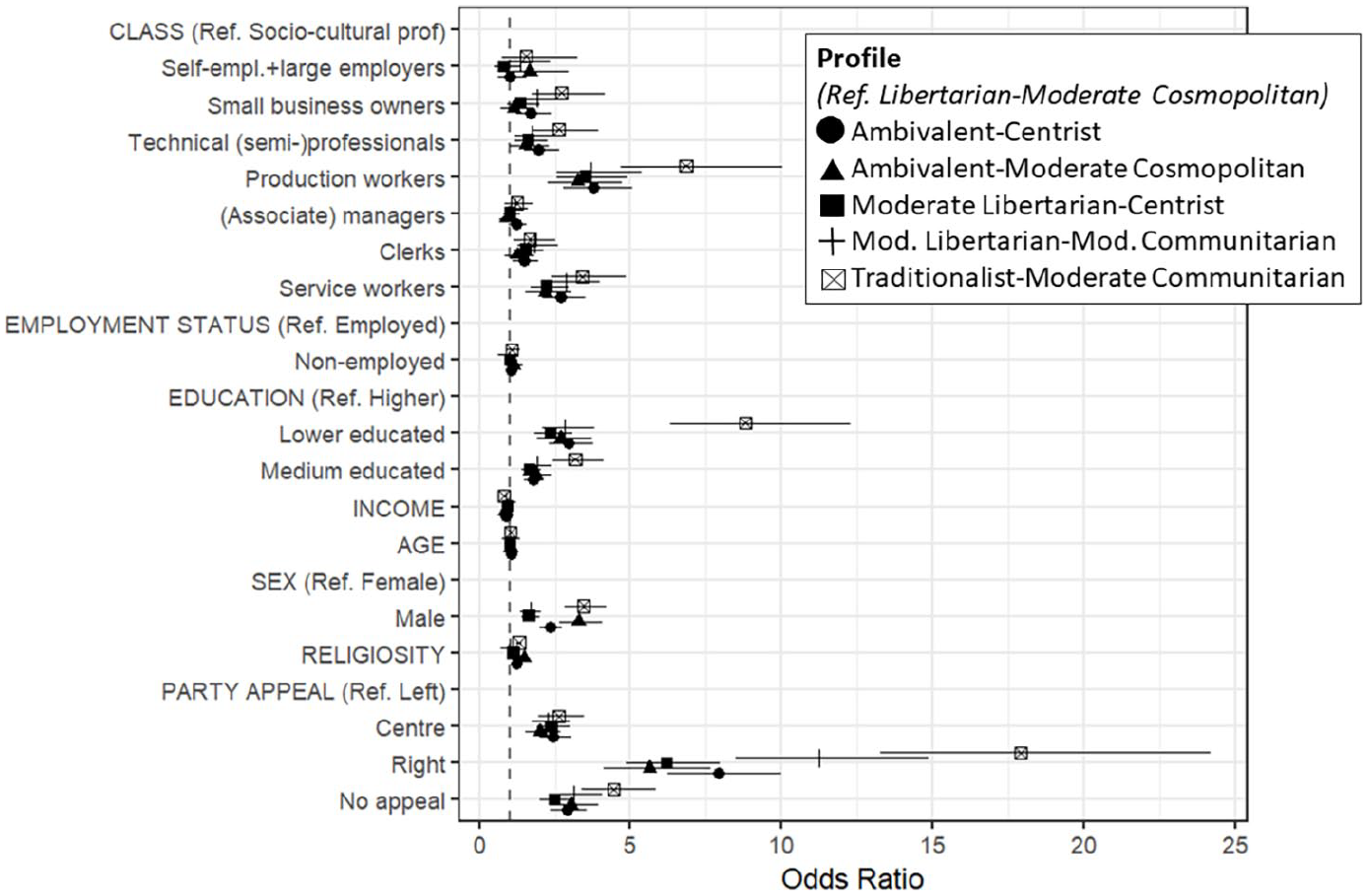
Multinomial Logistic Regression of Profile Membership on Socio-Structural Characteristics and Party Appeal.
In sum, the results point to a socio-structural divide between the Traditionalist-Moderate Communitarian profile composed of production and service workers, lower educated, men and individuals with right-wing party appeal on the one hand, and the Libertarian-Moderate Cosmopolitan profile dominated by socio-cultural professionals, higher educated, women and individuals with left-wing party appeal on the other hand. Ambivalent, multidimensional attitudinal profiles are less socially structured. The findings are in line with recent work on opposing cleavage identities and socio-structural group conflicts (Bornschier et al., 2021; Zollinger, 2024).
Discussion and Conclusion
This article set out to test the cleavage literature’s assumption of a single attitudinal conflict in Europe dividing individuals’ opinion on cultural issues including the environment, gender roles, sexual diversity, immigration and the EU. Taking up the cleavage literature’s claim of an embedded divide, we would observe a cultural divide in society between libertarian-cosmopolitan and traditionalist-communitarian attitudes (Bornschier, 2010). Recently, though, ambivalent and multidimensional attitudes have come to the forefront of cultural conflicts in Europe today and the related shifts in the attitudinal space are yet to be determined. To research the structure of the attitudinal space in Europe today, first a LPA has been performed on a set of different cultural issue attitudes and second, the socio-structural underpinning of the attitudinal groups has been assessed by means of a multinomial logistic regression. In light of this debate, the empirical findings of this article reveal that the attitudinal space in Europe is most likely a mixture of a single issue divide over sexual diversity issues on the one hand, and large ambivalent and multidimensional attitudinal groups on the other hand.
Starting with the issue attitudes of the first transformation of politics towards the environment, gender roles and sexual diversity, the empirical results of the LPA are largely in line with previous empirical findings. First, there seems to be a libertarian consensus on these issue attitudes with 53.4% of respondents holding libertarian or moderate libertarian attitudes, most visibly egalitarian gender attitudes related to the public sphere (cf. Grunow et al., 2018; Knight and Brinton, 2017). Second, many attitudes cluster in the middle of the attitudinal spectrum revealing a large group holding ambivalent attitudes (31.8% in total) (cf. Scarborough et al., 2019, 2021). Third, the traditionalist pole has been vanished except for attitudes towards sexual diversity, which are partly very disapproving. Taken together, these findings largely confirm expectations on ambivalent gender and environment attitudes.
Concerning the expected embedded divide, the LPA results show an issue-specific polarization related to the acceptance of homosexual rights instead of a full-blown cultural divide across multiple issue attitudes. On the sexual diversity dimension, attitudes seem polarized between strong libertarian and traditionalist positions with ambivalent positions in-between. On the one hand, this finding could be driven by particular countries if, for example, Scandinavian countries scored very libertarian on this issue and Poland or Hungary very traditionalist. However, the single country LPAs in section E of the Supplementary Material instead show that the attitudinal divide over sexual diversity issues is prevalent all over Europe except for Spain, Slovakia and Italy. On the other hand, it could hide other salient conflicts such as an immigration divide. Running the LPA without sexual diversity items though reveals that a more pronounced divide over gender attitudes replaces the polarized divide over sexual diversity attitudes while the rest of the attitudinal structure remains rather stable. Yet, the LPA outcome has only four instead of six profiles given the reduced number of attitude items (see Figure I1 in the Supplementary Material). 5 Arguably, increased issue salience could also be a reason for the polarization of sexual diversity (and gender) attitudes (cf. Off, 2023).
Somewhat more puzzling though is the limited cosmopolitan-communitarian divide over immigration and EU issue attitudes, the two issue attitudes related to the second transformation of politics. However, when taking a closer look at the LPA outcome (Figure 2), attitudes towards immigration are indeed divided between cosmopolitan and communitarian positions—only not as polarized as are attitudes towards sexual diversity. This finding supports the embedding expectation. Concerning multidimensionality expectations, the results reveal two kinds of cross-cutting groups: for one, tolerance towards sexual diversity coupled with anti-immigration stances and for two, intolerance towards sexual diversity combined with pro-immigration stances. The former phenomenon is widely known in the literature and described as ‘sexually modern nativists’ (Lancaster, 2020; Spierings et al., 2017) or ‘homonationalists’ (Spierings, 2021) who claim to defend liberal values (tolerance towards sexual diversity) against rising traditionalism brought about by immigrants (anti-immigration stance). By contrast, the latter phenomenon that can be described as ‘sexually traditionalist cosmopolitans’ has not been studied yet. Separate country LPAs show that this attitudinal pattern exists in many European countries although to different degrees (see section E in the Supplementary Material). Future studies though need to further investigate this attitudinal group.
Concerning the absence of a divide over EU attitudes, two explanations are most likely. On the one hand, the items measuring EU support may be outdated and do not cover the full attitudinal spectrum. Following current research, EU support has multiple facets yielding complex attitudinal configurations (De Vries, 2018; Lubbers and Scheepers, 2010). On the other hand, EU attitudes may have lost in contentious power relative to other cultural issue attitudes as recently demonstrated in a LPA study by Schäfer and colleagues (Schäfer et al., 2024). Various scholars show that attitudes towards sexual diversity, gender and immigration are on the height of cultural conflicts in Europe today (Abou-Chadi and Finnigan, 2019; Lancaster, 2020, 2021; Off, 2023; Spierings, 2021; Spierings et al., 2017) although generally, opinion polarization has rather decreased in Europe in the last years (Dochow-Sondershaus et al., 2024; Dochow-Sondershaus and Teney, 2024; Munzert and Bauer, 2013; Traber et al., 2023). Moderate to centrist attitudinal positions seem all the more relevant supporting the third expectation. The findings of the socio-structural analysis are in line with latest findings on limited opinion polarization between educational and occupational groups in Europe. In the present analysis, it seems that only Traditionalist-Moderate Communitarians and Libertarian-Moderate Cosmopolitans divide the social strata by educational level, occupation and gender hinting at a partial social-structural underpinning of the attitudinal conflict. The attitudinal conflict though bears larger potential for political conflicts among voters as the attitudinal groups are highly stratified along the left-right continuum. These are important findings revealing mainly structural conflicts between members of traditionalist-moderate communitarian and libertarian-moderate cosmopolitan groups, but more volatile conflicts between proponents of ambivalent, multidimensional attitudes pointing to a newly shift in the attitudinal space in Europe.
Limitations
The analysis and the subsequent empirical findings presented in this article are subject to a few limitations. First, the EVS only provides a limited amount of items related to cultural attitudes covering particular aspects of the ongoing societal conflicts. To demonstrate that the LPA results are not sensitive to the selection of items, I conducted robustness checks using the different attitudinal variables available for the environment, gender and immigration (see section F in the Supplementary Material). Second, the variety and heterogeneity of countries make it difficult to adequately measure attitudinal constructs in Europe. Conventional tests of measurement invariance such as multi-group analyses have not been applicable due to computational complexity. Instead, I address this limitation by calculating separate LPA models for each European country of the data set (see section E in the Supplementary Material). Third, the present empirical findings are solely a snapshot of cultural attitudinal configurations in Europe, but due to the limited availability of consistent items over time, the analysis is restricted to the EVS wave of 2017.
Conclusion
This study demonstrates that the cultural conflict in Europe is ambivalent and multidimensional. Linking different cultural issue attitudes by means of latent profile analysis reveals multiple attitudinal groups that partly confirm an aligned and embedded cultural conflict, but largely show ambivalent and multidimensional groups combining attitudinal positions in various ways. Groups of relative libertarian-(moderate) cosmopolitanism and traditionalist-(moderate) communitarianism, which are in line with an embedded cultural conflict according to the cleavage literature, represent almost 40% of cultural attitudes in Europe. Yet, more than 60% involve ambivalent or centrist positions of multidimensional attitudinal groups. Two multidimensional attitudinal profiles particularly stand out, because they cut across cultural divides thereby linking positions from opposite ends of the attitudinal spectrum: the Moderate Libertarian-Moderate Communitarian profile and the Ambivalent-Moderate Cosmopolitan profile. Attitudinal profiles are further rooted in the social structure partially dividing occupational and educational groups, but largely groups along the left-right political spectrum in Europe.
All in all, this study contributes to a deeper understanding of structured conflicts in Europe today. Precisely, the empirical findings have three empirical and political implications. First, the attitudinal space in Europe is dominated by multidimensional cultural attitudes exceeding a unidimensional attitudinal conflict. Second, strong polarization is absent from the attitudinal space in Europe except for attitudes towards sexual diversity. Third, politically, the empirical findings signal all-clear for the polarization diagnosis in Europe for the moment, but also bear strong potential for political mobilization in the future.
Supplemental Material
sj-docx-1-psw-10.1177_14789299241311760 – Supplemental material for Groups of Individual Attitudes Towards Cultural Issues in Europe: A Unidimensional Conflict?
Supplemental material, sj-docx-1-psw-10.1177_14789299241311760 for Groups of Individual Attitudes Towards Cultural Issues in Europe: A Unidimensional Conflict? by Ines Schäfer in Political Studies Review
Footnotes
Acknowledgements
I sincerely thank Daniela Grunow and Yassine Khoudja for their valuable feedback on earlier drafts of this article as well as two anonymous reviewers.
Data availability
The European Values Study is archived at GESIS online and available for the scientific community.
Declaration of conflicting interests
The author(s) declared no potential conflicts of interest with respect to the research, authorship and/or publication of this article.
Funding
The author(s) disclosed receipt of the following financial support for the research, authorship and/or publication of this article: This research was supported by the Bundesministerium für Bildung und Forschung (BMBF) under the funding line ‘Zusammenhalt in Europa’ (project number 01UG2114) and conducted as part of the research group FOR 5173: Reconfiguration and Internalization of Social Structure, which is funded by the Deutsche Forschungsgemeinschaft (DFG, German Research Foundation—project number 439346934).

Supplemental material
Additional supplementary information may be found with the online version of this article.
A. Factor Analysis Gender Items Table A1: ML-confirmatory factor analysis of gender items with correlated factors Table A2: ML-exploratory factor analysis of gender items with oblique rotation B. Descriptive Statistics Table B1: Descriptive Statistics Figure B2: Distributions of attitude items C. Latent profile modelling process and model choice Figure C1: BIC plot of LPA models with 1-8 profiles Table C2: Latent profile model fit statistics Table C3: Distribution of Posterior Probabilities of Membership by Latent Profile D. Alternative LPA models Figure D1: Latent profiles of cultural attitudes in Europe, 7-profile solution Figure D2: Latent profiles of cultural attitudes in Europe, 5-profile solution E. Single country LPAs Figure E1: Latent profiles of political attitudes in the single Western European countries, individual profile solutions per country Figure E2: Latent profiles of political attitudes in the single Central and Eastern European countries, individual profile solutions per country F. Robustness checks of the LPA G. Mean attitudes LPA Table G1: Mean attitude values per profile across all European countries H. Regression coefficients socio-structural analysis Table H1: Multinomial logistic regression of profile membership on socio-structural characteristics and party identification I. LPA model without sexual diversity items Figure I1: Latent profiles of cultural attitudes in Europe excluding LG* items, 4-profile solution
Notes
Author Biography
References
Supplementary Material
Please find the following supplemental material available below.
For Open Access articles published under a Creative Commons License, all supplemental material carries the same license as the article it is associated with.
For non-Open Access articles published, all supplemental material carries a non-exclusive license, and permission requests for re-use of supplemental material or any part of supplemental material shall be sent directly to the copyright owner as specified in the copyright notice associated with the article.
