



Abstract
This Special Issue explores the causes, patterns and consequences of presidential activism, defined as the presidents’ use of their formal powers and their attempts to influence politics through informal channels. Examining ‘going public’ strategies, the influence exerted by presidents through informal and formal coordination mechanisms, links to political parties and foreign policy leadership, it argues that presidential activism shapes intra-executive relations, enabling presidents to wield influence beyond their constitutional powers. Presidential activism is facilitated by the presidents’ popularity and role as head of state, particularly in less stable political contexts. These findings underline the need to investigate further various channels of presidential activism and how the citizens and media react to it, both during normal times and crises.
Introduction
Contemporary democracy is marked by the rise of directly elected presidents and there is an increasing research focus on the concentration of power in single executive leaders (e.g. Elgie, 2018; Poguntke and Webb, 2005; Samuels and Shugart, 2010). What Ganghof (2021) labels ‘executive personalism’ can entail significant risks, however, particularly in less stable countries where political movements often revolve around individual leaders. Fragile democracies have collapsed as presidents have usurped powers (Levitsky and Ziblatt, 2018; Meng, 2020), and even in ‘Western’ countries, heads of state have challenged existing constitutional rules (Grimaldi, 2023b). Presidents have almost without exception benefitted from their popularity. By enjoying higher approval rates than ‘party politicians’ (Kujanen, 2024), presidents have sought to question the legitimacy of legislatures and courts (Protsyk, 2006).
These dynamics are particularly evident in semi-presidential regimes where a popularly elected president shares executive powers with a prime minister accountable to the legislature (Elgie, 1999). Semi-presidentialism is the most common regime type in Europe, with 23 European countries having semi-presidential constitutions. The regime type is found also outside of Europe, although in smaller numbers: eight in Africa, three in Asia and one in Latin America (Anckar, 2022). Research on semi-presidentialism has made great strides forward ever since the concept was originally coined by Duverger (1980). Shugart and Carey (1992) introduced the distinction between two categories of semi-presidentialism – president-parliamentary and premier-presidential regimes. Under president-parliamentarism the government is accountable to both the president and the parliament, whereas under premier-presidentialism the government is accountable only to the parliament. President-parliamentary constitutions usually also provide overall stronger presidential prerogatives. Generally, the literature is highly critical of president-parliamentarism while indicating more positive performance records regarding premier-presidentialism (Elgie, 2011, 2019; Sedelius and Linde, 2018; Shugart and Carey, 1992).
This research has primarily focused on regime stability and how key variables such as presidential powers and divided government affect democratic performance (Åberg and Sedelius, 2020). It has confirmed that semi-presidentialism has built-in potential for intra-executive conflict, as both the president and the prime minister (indirectly) can claim authority from a popular mandate – and conflict between the president and cabinet does indeed occur frequently, particularly under cohabitation where the two executives represent opposite political camps (Elgie, 2018; Sedelius and Mashtaler, 2013; Yan, 2021). Yet, the strong focus on intra-executive conflict has resulted in scholars paying much less attention to presidential behaviour and activism. In fact, we argue that the emphasis on conflict has resulted in a rather one-dimensional view of how semi-presidential systems operate. However, recently, scholars have begun to explore more systematically how presidents utilize their formal and informal powers. Comparative empirical publications have examined legislative vetoes (Köker, 2017), informal institutions and intra-executive coordination mechanisms (Raunio and Sedelius, 2020), constitutional conventions and inter-institutional relations (Brunclík et al., 2023; Brunclík and Kubát, 2019), and the differences between directly and indirectly elected presidents (Grimaldi, 2023b). Also, some in-depth case studies have provided informative accounts of presidential behaviour (e.g. Beuman, 2016; Feijo, 2021; Hloušek, 2013).
This Special Issue focuses on the (a) causes, (b) patterns and (c) consequences of presidential activism, defined as ‘the presidents’ use of their formal powers and their attempts to influence politics through informal channels’ (Raunio and Sedelius, 2020: 35). It addresses several aspects of presidential activism and semi-presidentialism that have so far been largely neglected by scholars, such as ‘going public’ strategies, the influence exerted by presidents through informal and formal coordination mechanisms, links to political parties and foreign policy leadership. Its findings benefit not only students of presidents and country specialists, but also scholars working more broadly on constitutional design, executives and political leadership. The next section contains the overall theoretical framework of our collection of articles. After that, we explain how the individual articles increase our understanding of presidential activism. The final section maps out avenues for future research.
Theoretical Framework
A Presidency-Centred Institutional Approach
Regarding patterns of behaviour and between-country comparisons, our analytical framework leans towards presidency-centred as opposed to president-centred explanations. The former refers to studies that emphasize constitutional powers and the political context, while the latter stresses the role of individual presidents and their personalities (Gilmour, 2002; Hager and Sullivan, 1994; Köker, 2017: 23–54). Incumbents’ behaviour is shaped by existing rules and norms, inheriting accepted modes of operation from their predecessors. Our argument therefore underlines the weight of both formal and informal institutions that are expected to shape presidential activism. Following North (1990), there is broad consensus that formal rules are written down and created by state institutions, typically legislatures, executives or courts, and enforced through official channels. We define informal institutions in turn as ‘socially shared rules, usually unwritten, that are created, communicated, and enforced outside of officially sanctioned channels’ (Helmke and Levitsky, 2004: 727; Lauth, 2015). Informal institutions can prove functional and have beneficial effects on decision-making or they can be dysfunctional in that they undermine problem-solving and destabilize cooperation and formal institutions (see Grimaldi, 2023a).
We expect that key institutional factors identified in the literature related to the functioning of semi-presidentialism – such as formal presidential powers, party dynamics, government composition and cohabitation – are crucial also in shaping the patterns and consequences of presidential activism. As Anckar and Sedelius (2024) argue, however, it is important to emphasize that presidential activism is not the same as presidential powers. For example, a president with extensive veto powers may not need to use them if her party controls the legislature. In contrast, during periods of cohabitation – when the president and prime minister represent opposing political camps – presidential activism, including the use of vetoes, is likely to increase as the president’s de facto executive power is reduced. This phenomenon has been observed in various country contexts (e.g. Lazardeux, 2015; Pukelis and Jastramskis, 2021).
Constitutionally Limited But Widely Popular Presidencies
Presidents in semi-presidential regimes are generally constitutionally weaker than their counterparts in presidential systems. However, there are significant similarities between the two regime types in terms of the president’s role as head of state. Presidents are often expected to be above party politics and represent all parts of society as opposed to the prime minister who is a party politician leading the cabinet and accountable to parliament. As heads of state, presidents not only have constitutional prerogatives but also have certain duties such as annual high-profile speeches or state visits. Even when presidents are clearly subordinate to the prime ministers, they are very much public figures that typically enjoy higher popularity ratings than prime ministers and other politicians (Duvold and Sedelius, 2023; Kujanen, 2024). The president can strategically leverage this prestigious position to advance policy preferences, shaping both the extent and nature of presidential activism. Presidential activism tends to be higher when the country is experiencing political turbulence, with low level of societal consensus or weak governments (Tavits, 2009). In particular, the relative approval of presidents vis-à-vis other political institutions should matter. As argued by Ponder (2018: 31) about US presidents, ‘presidents do not derive leverage only when they are popular, but when a government as a whole is beleaguered, and they stand well above the fracas’.
Categories of Presidential Activism
Figure 1 depicts the various channels of activism available to presidents. The matrix contains four cells divided into formal public activism, formal non-public activism, informal public activism and informal non-public activism. We readily acknowledge that these categories are to some extent overlapping. For example, during state visits presidents are carrying out their constitutional duties, but they can also utilize those occasions for high-profile statements or social media posts. Another example is contacts with ministries or politicians that can be related to constitutional prerogatives but at the same time give the president the opportunity to engage in behind-the-scenes bargaining.
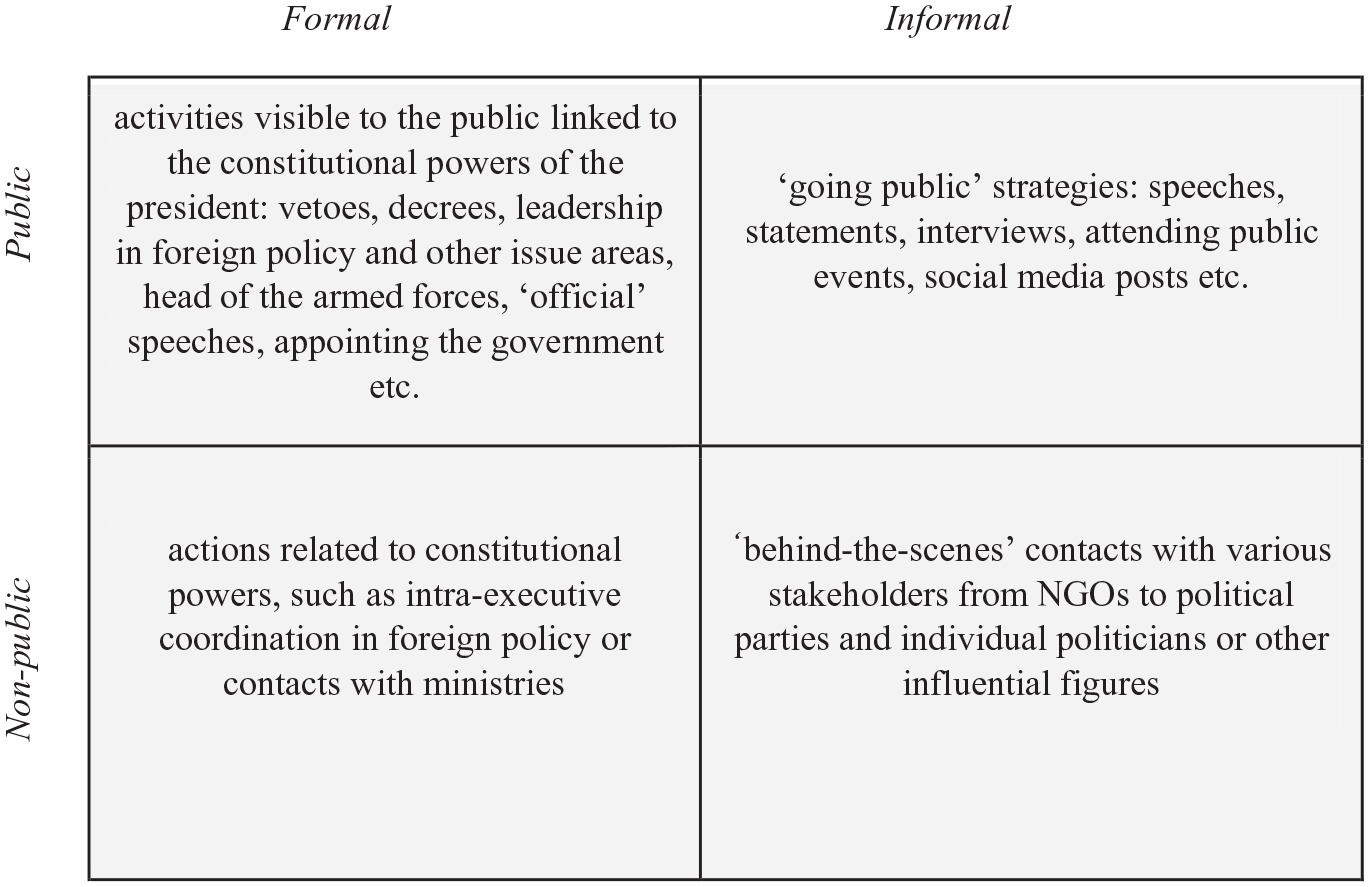
Four Categories of Presidential Activism.
Among the most visible forms of informal presidential activism, ‘going public’ strategies stand out. In his analysis of American presidents, Kernell (2007: 1–2) defines going-public as ‘a strategy whereby a president promotes himself and his policies in Washington by appealing directly to the American public for support’. Kernell (2007: 3–4) also emphasizes that going-public is directly at odds with bargaining with Congress and other political actors and institutions. Through public speeches and writings, the president ‘seeks the aid of a third party – the public – to force other politicians to accept his preferences’. Presidents can use public addresses to strengthen their bargaining position and do so by illustrating the potential electoral costs to opponents (Cox and Kernell, 1991). But, of course, through going-public the president can also undermine her or his own legitimacy – and reduce her weight in intra-executive decision-making. There are good reasons for politicians motivated by re-election or policy influence to go public with their opinion differences, especially when they need to either claim credit or avoid blame for particular policies (Lazardeux, 2015). Constitutionally weak presidents thus seek to compensate their limited constitutional powers with more public channels of influence or obtrusive behaviour. These considerations are particularly relevant in younger democracies, where surveys often reveal high levels of public trust in the presidents but outright distrust in the prime minister and political parties (Kujanen, 2024). Available evidence indeed suggest that presidents often emerge victorious from intra-executive conflicts, with going public tactics benefitting the presidents (Protsyk, 2006; Raunio and Sedelius, 2020).
Much of presidential activism occurs non-public, however. This includes presidents’ contacts and coordination with ministries and public agencies, interest groups and other stakeholders, and not least political parties. As heads of state and guardians of national interest, presidents can either stay above party politics or use their status for maintaining active ties to all parties. In some countries, it can be more legitimate for the president to become publicly involved in parliamentary politics or election campaigns, rallying support for ‘their’ parties, while elsewhere they are expected not to interfere in domestic party-political battles. Despite our emphasis on presidency-centred explanations, the presidents’ background is also relevant here, as some have considerable experience from key political institutions, while non-partisan presidents often lack ties to parties and top-level politicians. The president can utilize party networks especially when she and the prime minister represent the same party or at least are not from opposing ideological blocs. Under such situations, the president can wield strong influence over the government, both through her power of selecting and/or deselecting the prime minister or through intra-party decision-making processes (e.g. Passarelli, 2015; Pukelis and Jastramskis, 2021; Samuels and Shugart, 2010).
Moving the Debate Forward: Articles in the Special Issue
The Special Issue is guided by three broad research questions: What are the drivers of presidential activism? Is presidential activism explained more by the individuals holding the office or the institutional prerogatives and political culture of the country? What are the consequences of presidential activism? Some articles focus on a single category of presidential activism (Figure 1), while others explore all four types, demonstrating how they are interconnected. Likewise, some articles primarily investigate the drivers and patterns of presidential activism, while others focus on its outcomes and consequences.
The articles examine semi-presidential countries in different parts of the world, including in the so-called hybrid regimes or electoral democracies. Importantly, the articles also introduce new empirical approaches that can be utilized in future research on semi-presidentialism. They illuminate two sides of the presidency. On the one side, and in line with the ‘intra-executive conflict’ paradigm, presidential activism impacts directly on relations between the two executives and the broader policymaking capacity. On the other side, the articles bring to light a largely neglected aspect of presidents: as heads of state, they operate above party politics as guardians of national interest, a position which they can also use strategically and benefit from in intra-executive battles. The articles lend support to the argument about presidency-centred explanations, yet also highlight differences between individual presidents.
Three articles explore various forms and patterns of public activism, particularly of the informal kind. Examining the tone and content of formal speeches and informal messages of Finnish and French presidents from 2000 to 2020, Kujanen et al. (2023) show that the presidents in both countries by and large employ a ‘statespersonlike’ style in their behaviour. Presidential speeches primarily express a positive tone, and they contain few references to other state institutions and economy and other governmental domains. Instead, presidents typically seek to portray themselves as guardians of national interest, with foreign policy and national unity emphasized in the speeches. Shifting to social media as a key informal ‘going public’ platform, Fruhstorfer et al. (2024) analyse Twitter activity by presidents across 15 European semi-presidential democracies between 2010 and 2020. As expected, during periods of turbulence and social conflict, public engagement with presidential tweets rises significantly, indicating that citizens tend to look to the president for guidance. However, contrary to expectations, the authors find that presidents do not increase their Twitter activity during these turbulent times. In addition, they show that presidential power is negatively associated with Twitter activity, suggesting that more powerful presidents rely less on social media compared to their weaker counterparts. Interestingly, partisan conflict had little effect on presidential social media activity, further supporting the ‘statespersonlike’ thesis. Jastramskis and Pukelis (2023) compare parliamentary Latvia, with its indirectly elected president, to semi-presidential Lithuania, examining cases where the president publicly comments on the performance of the cabinet and individual ministers. Their findings confirm that on average presidents under the semi-presidential system in Lithuania are significantly more publicly active than their counterparts in Latvia and that presidential attention on the government correlated highly with overall media attention. In addition, presidents were more likely to go public during their first year in office, especially on foreign and defence policy issues.
Focusing both on drivers and patterns of presidential activism, two articles examine a still under-researched yet highly salient factor – presidents’ (public and non-public) links with political parties. Previous research has mainly explored presidents’ influence in government formation, whereas Gherghina et al. (2023) analyse how Romanian presidents utilize informal avenues to maintain an influence in the life of their (former) political parties. Their approach has four empirical dimensions – electing successors, prime ministerial appointments, inclusion in coalition agreements and parties’ electoral performance – and shows how both Traian Băsescu and Klaus Iohannis intervened in all four dimensions despite their different backgrounds (partisan vs non-partisan). The presidents influenced both party leadership selections and government formation processes and actively campaigned in favour of ‘their’ parties in elections. Băsescu nonetheless acted more confrontationally than Iohannis, resulting in two impeachments. Koskimaa and Passarelli (2024) instead focus in their article on the determinants of party presidentialization, that is how political parties become more leader-centred. They combine a regime type approach with arguments about parties’ ‘genetic’ heritage to study the centralization of power within parties. Using the Political Party Database Project’s (PPDB) global dataset, they compare 96 parties across 25 semi-presidential and presidential countries. Their findings show that the ‘presidentiality’ of the political regime encourages leader- and president-centric party organizations, which in turn facilitates presidential activism.
The final two articles address drivers and consequences of presidential activism, covering both institutional and formal conditions, along with informal and context-dependent factors. Turning to a highly under-researched context, Moestrup and Sedelius (2023) seek to explain variation in presidential activism in sub-Saharan Africa, comparing two francophone countries, the Democratic Republic of Congo (DRC) and Niger, with two lusophone countries, Cabo Verde and São Tomé e Príncipe. They show how formal prerogatives such as chairing cabinet meetings and agenda setting powers combine to increase both the intensity and outcome of presidential activism among the francophone presidents as compared to their lusophone counterparts. Their findings from the DRC and Niger also highlight how presidential activism, particularly in terms of intra-executive conflict and policymaking capacity, can be more damaging to regime stability in contexts of weak institutionalization and fragile democracy. Finally, Amorim Neto and Anselmo (2024) focus on presidents’ foreign and defence policy activism in Portugal from 1982 to 2021. Their key findings indicate that a president’s second term, the absence of a strictly unified executive and a majority cabinet are each necessary, but together sufficient, for presidential interventions to occur. In addition, while formal powers are necessary, they are not sufficient alone for ensuring presidential success. The authors conclude that presidential activism has had limited policy consequences, though it has produced certain institutional and short-term electoral effects. Overall, decision-making in foreign and defence policy has proceeded relatively smoothly, coordinated and without significant intra-executive conflict.
Agenda for Future Research
Our Special Issue has introduced new avenues for examining presidential activism. Yet, we acknowledge that this collection of articles should be viewed primarily as an attempt to systematize research on presidential activism. Therefore, we encourage scholars to dig deeper into how presidents try to shape politics. There are three lines of inquiry that we see as particularly relevant.
First, uncovering presidential activism is important, but even more relevant is how the media and citizens react to it. Presidents as (normally) popular heads of state enjoy almost automatic media coverage, and future studies could analyse the contents of that coverage: are presidents treated differently than party politicians? Various data such as surveys could be utilized to examine citizens’ view of presidential activism. For example, to what extent are citizens willing to tolerate presidential interventions in policy areas falling in the jurisdiction of the government?
Second, even if presidents are not always in reality ‘above party politics’, they are often seen as guardians of national interests and unity, and hence their activism during crises could be investigated. For example, in France, the president oversaw the managing of the COVID pandemic, while in Finland, the president tried to become involved, but the government retained firm control of decision-making (Navarro and Raunio, 2024). In Taiwan, on the contrary, Yan (2023) observed that during the COVID pandemic, the president focused primary on foreign affairs and defence, while the government took the lead in handling epidemic prevention measures and addressing internal affairs. Similarly, the full-scale invasion of Ukraine since 2022 has unearthed an interesting division of labour under semi-presidentialism: President Volodymyr Zelenskyi has been in charge of the war effort, but the prime minister and the government have largely been responsible for domestic policies (Sedelius et al., 2024). Considering that even constitutionally weak presidents normally have at least some functions in foreign affairs, scholars could examine whether the altered security environment in Europe has affected presidential activism also in other semi-presidential countries.
Third, the role of the president during crises brings into focus the broader, ongoing debate about how best to conceptualize the president in relation to the prime minister within the executive. The dominant approach has focused on measuring the constitutional powers of the presidents (e.g. Doyle and Elgie, 2016), and on the distinction between president-parliamentarism and premier-presidentialism (Shugart and Carey, 1992). In their article, Kujanen et al. (2023) leaned on the ‘statesperson’ concept, while Sedelius et al. (2024) introduce three models for determining shifting relations between the president and prime minister – figurehead-leader, arbiter-management and leader-implementer. While no single measurement or concept is perfect, it is clear that further critical examination of ways to capture the variation within the dual executive of semi-presidential regimes is necessary.
Footnotes
Declaration of conflicting interests
The author(s) declared no potential conflicts of interest with respect to the research, authorship and/or publication of this article.
Funding
The author(s) disclosed receipt of the following financial support for the research, authorship and/or publication of this article: This research has been supported by the Research Council of Finland (project number 333013).
